fuel FORD F650 2015 13.G Repair Manual
[x] Cancel search | Manufacturer: FORD, Model Year: 2015, Model line: F650, Model: FORD F650 2015 13.GPages: 384, PDF Size: 4.95 MB
Page 242 of 384
Body
•Wash your vehicle thoroughly to remove dirt, grease, oil, tar or mud
from exterior surfaces, rear-wheel housing and the underside of the
front fenders.
•Periodically wash vehicles stored in exposed locations.
•Touch-up raw or primed metal to prevent rust.
•Cover chrome and stainless steel parts with a thick coat of auto wax
to prevent discoloration. Re-wax as necessary when you wash your
vehicle.
•Lubricate all hood and door hinges and latches with light grade oil.
•Cover interior trim to prevent fading.
•Keep all rubber parts free from oil and solvents.
Engine
•Change the engine oil and filter before storage. Used engine oil
contains contaminates that may cause engine damage.
•Start the engine every 15 days. Run at fast idle until it reaches
normal operating temperature.
•With your foot on the brake, shift through all the gears while the
engine is running.
Fuel System
Fill the fuel tank(s) with high-quality fuel until the first automatic
shutoff of the fuel pump nozzle.
Cooling System
•Protect against freezing temperatures.
•When removing vehicle from storage, check coolant fluid level.
Confirm there are no cooling system leaks, and fluid is at the
recommended level.
Battery
Note:If battery cables are disconnected, it is necessary to reset memory
features.
•Check and recharge as necessary. Keep connections clean.
•If storing your vehicle for more than 30 days without recharging the
battery, it may be advisable to disconnect the battery cables to make
sure battery charge does not lose its charge.
Brakes
•Make sure to release the brakes and parking brake fully.
Vehicle Care241
2015 F-650/750(f67)
Owners Guide gf(ownloose), 1st Printing, December 2013
Canadian_French(fr_can)
Page 243 of 384
Tires
•Maintain recommended air pressure.
Miscellaneous
•Make sure to cover all linkages, cables, levers and pins under your
vehicle with grease to prevent rust.
•Move vehicles at least 25 feet (8 meters) every 15 days to lubricate
working parts and prevent corrosion.
Removing Your Vehicle from Storage
When your vehicle is ready to come out of storage, do the following:
•Wash your vehicle to remove any dirt or grease film build-up on
window surfaces.
•Check windshield wipers for any deterioration.
•Check under the hood for any foreign material that may have
collected during storage (mice or squirrel nests).
•Check the exhaust for any foreign material that may have collected
during storage.
•Check tire pressures and set tire inflation per the Tire Label.
•Check brake pedal operation. Drive your vehicle 15 feet (4.5 meters)
back and forth to remove rust build-up.
•Check fluid levels (including engine coolant, engine oil and fuel) to
make sure there are no leaks and fluids are at recommended levels.
•If you remove the battery, clean the battery cable ends and inspect.
Contact an authorized dealer if you have any concerns or issues.
242Vehicle Care
2015 F-650/750(f67)
Owners Guide gf(ownloose), 1st Printing, December 2013
Canadian_French(fr_can)
Page 247 of 384
Checking Tire Pressure
Always check inflation pressure when tires are cold. Never bleed air from
hot tires to relieve normal pressure build-up. Normal increase in pressure
due to service conditions is 10–15 psi (69–103 kPa), which is allowable
in truck tires.
Tires should be properly inflated to manufacturers’ recommended
pressure for the size and service load in which the vehicle is being used.
See the specific tire manufacturer with which your vehicle is equipped
with for the latest information concerning service load and inflation
pressure.
It is particularly important to keep moisture from the inside of tires, and
proper selection of air compressor equipment, proper air line routing,
and the use of shop air dryers is strongly recommended to avoid
moisture in the high pressure air used for tire inflation.
Under-inflation
Do not allow tires to become under-inflated; increased flexing due to
under-inflation causes heat build-up within the tire components. This
leads to reduced strength, breakdown of the rubber compounds, and
possible separation of the tire components (such as ply and tread
separation and reduced retreadability).
Under-inflation is the primary cause of premature tire concerns including
sudden loss of air. In addition, low inflation causes an increase in rolling
resistance. This results in reduced fuel mileage, a loss in tread mileage,
and uneven wear due to increased tread movement. To determine proper
inflation, see the tire manufacturer load and inflation guide, which you
can find on the tire manufacturer website or at your local truck tire
dealer.
Tire Inspection
Check the tires for abnormal wear patterns and proper inflation
pressures. Repair or replace cut or broken tire casings.
Inspect tires for the following conditions. If any are present, remove and
repair, retread, or scrap the tire as the condition dictates.
•Any blister, bump or raised portion anywhere on the surface of the
tire tread or sidewall (other than a bump made by a repair). These
indicate the start of internal separation.
•Any cut that reaches to the belt or ply cords, or any cut that is large
enough to grow in size and depth.
•Any nail or puncturing object.
•If a tread groove is holding a stone or object that is starting to drill
into the tread base, remove the object.
246Wheels and Tires
2015 F-650/750(f67)
Owners Guide gf(ownloose), 1st Printing, December 2013
Canadian_French(fr_can)
Page 255 of 384
ENGINE SPECIFICATIONS (GASOLINE ENGINE ONLY)
Engine 6.8L V10 engine
Cubic inches 413
Required fuel Minimum 87 octane
Firing order 1-6-5-10-2-7-3-8-4-9
Spark plug gap 0.039–0.043 inch (1.0–1.1 mm)
Ignition system Coil on plug
Compression ratio 9.2:1
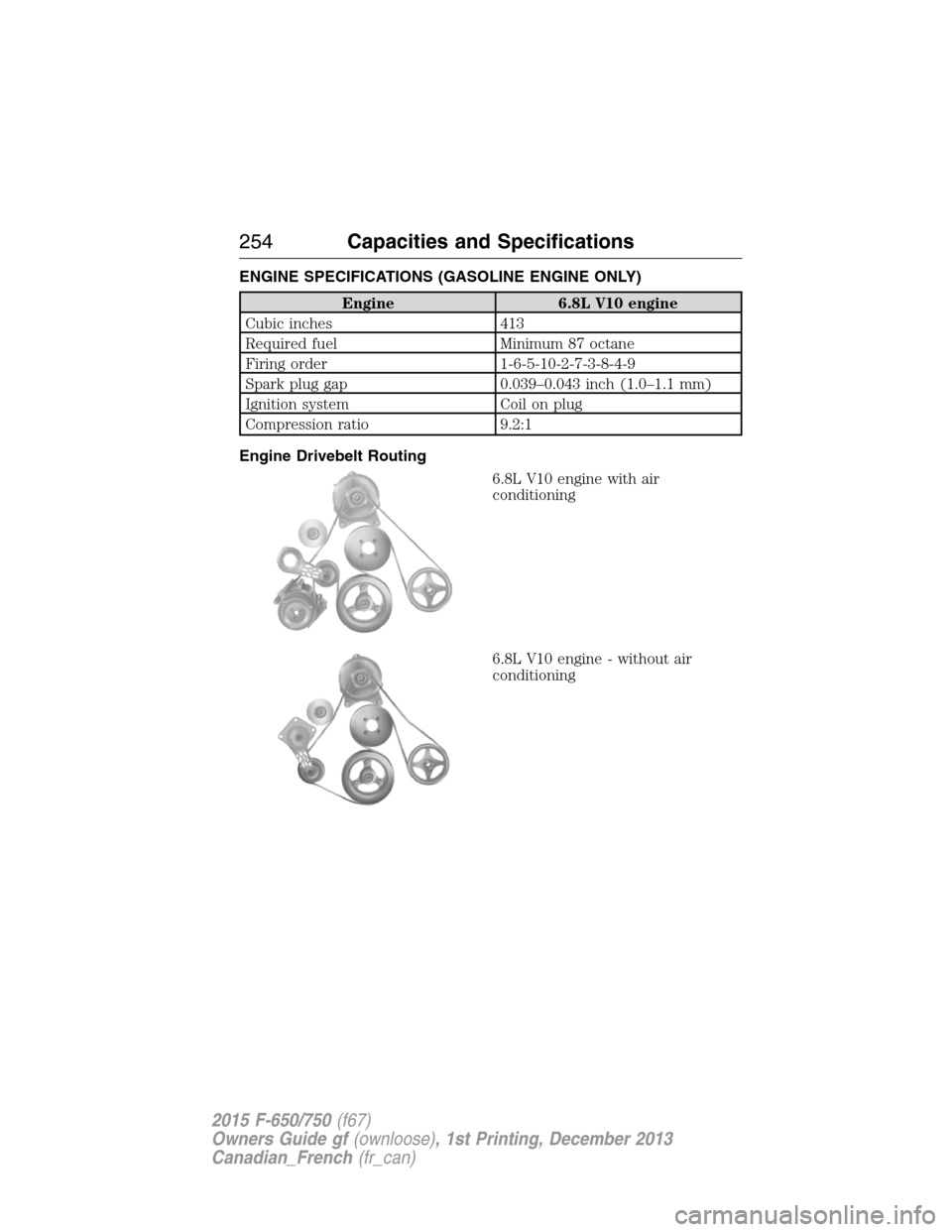
Engine Drivebelt Routing
6.8L V10 engine with air
conditioning
6.8L V10 engine - without air
conditioning
254Capacities and Specifications
2015 F-650/750(f67)
Owners Guide gf(ownloose), 1st Printing, December 2013
Canadian_French(fr_can)
Page 272 of 384
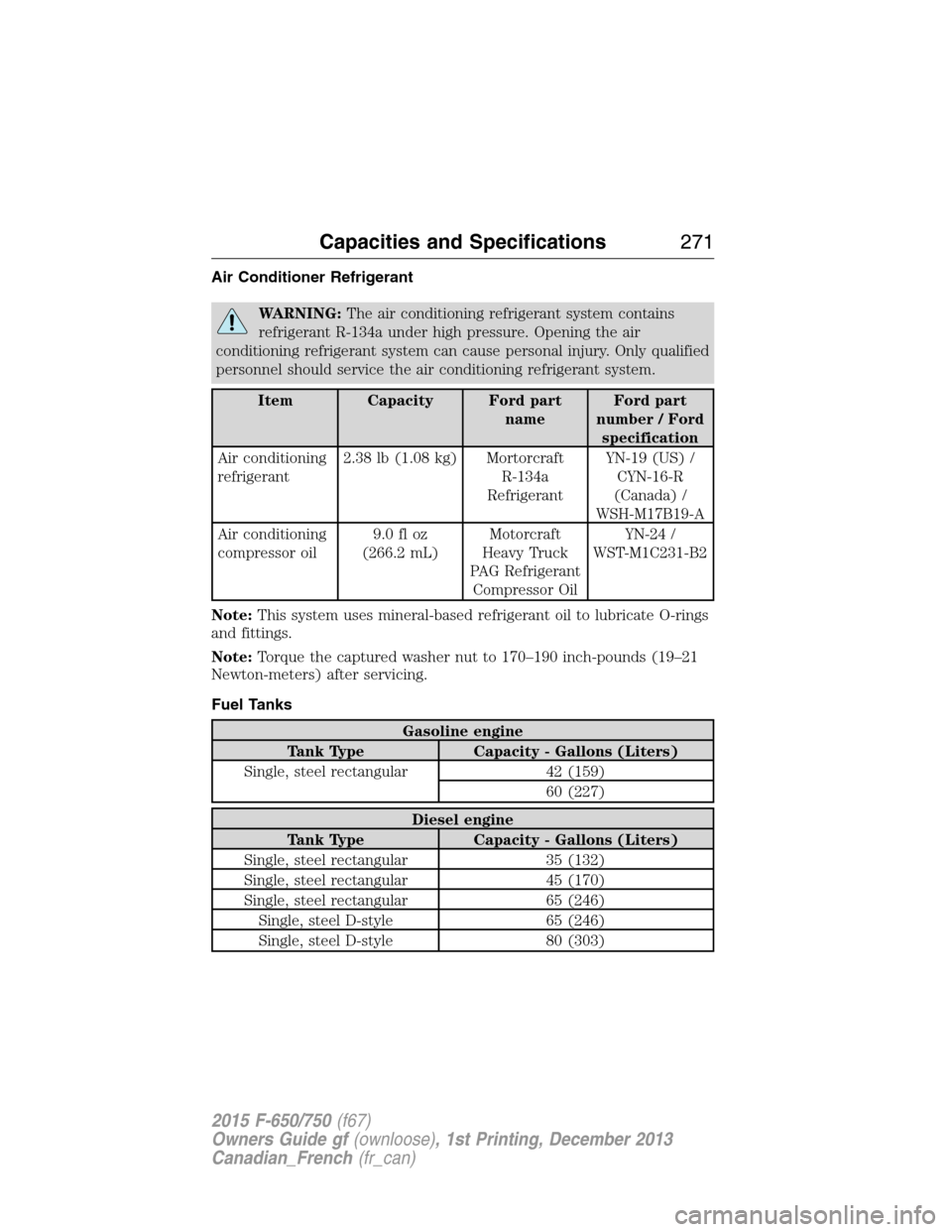
Air Conditioner Refrigerant
WARNING:The air conditioning refrigerant system contains
refrigerant R-134a under high pressure. Opening the air
conditioning refrigerant system can cause personal injury. Only qualified
personnel should service the air conditioning refrigerant system.
Item Capacity Ford part
nameFord part
number / Ford
specification
Air conditioning
refrigerant2.38 lb (1.08 kg) Mortorcraft
R-134a
RefrigerantYN-19 (US) /
CYN-16-R
(Canada) /
WSH-M17B19-A
Air conditioning
compressor oil9.0floz
(266.2 mL)Motorcraft
Heavy Truck
PAG Refrigerant
Compressor OilYN-24 /
WST-M1C231-B2
Note:This system uses mineral-based refrigerant oil to lubricate O-rings
and fittings.
Note:Torque the captured washer nut to 170–190 inch-pounds (19–21
Newton-meters) after servicing.
Fuel Tanks
Gasoline engine
Tank Type Capacity - Gallons (Liters)
Single, steel rectangular 42 (159)
60 (227)
Diesel engine
Tank Type Capacity - Gallons (Liters)
Single, steel rectangular 35 (132)
Single, steel rectangular 45 (170)
Single, steel rectangular 65 (246)
Single, steel D-style 65 (246)
Single, steel D-style 80 (303)
Capacities and Specifications271
2015 F-650/750(f67)
Owners Guide gf(ownloose), 1st Printing, December 2013
Canadian_French(fr_can)
Page 310 of 384
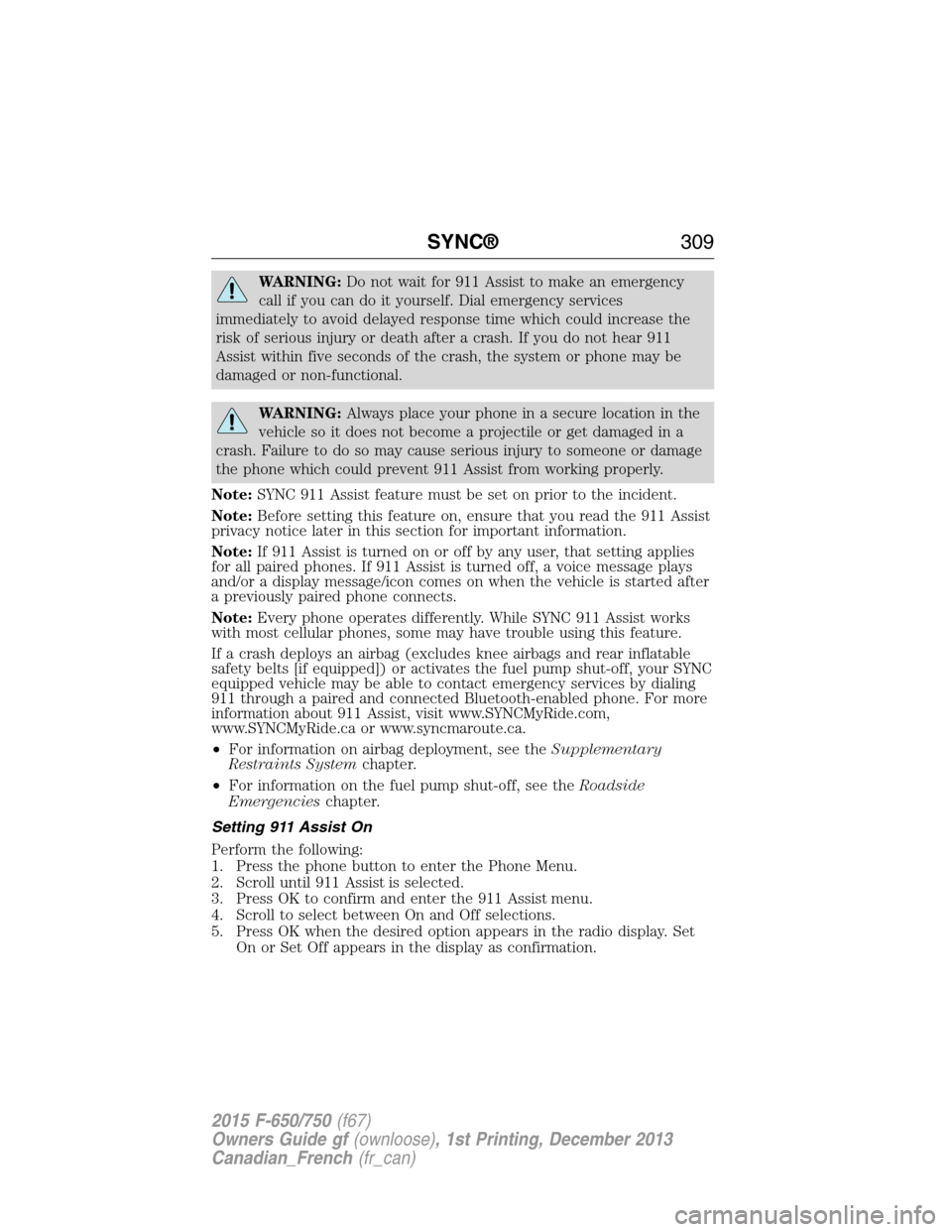
WARNING:Do not wait for 911 Assist to make an emergency
call if you can do it yourself. Dial emergency services
immediately to avoid delayed response time which could increase the
risk of serious injury or death after a crash. If you do not hear 911
Assist within five seconds of the crash, the system or phone may be
damaged or non-functional.
WARNING:Always place your phone in a secure location in the
vehicle so it does not become a projectile or get damaged in a
crash. Failure to do so may cause serious injury to someone or damage
the phone which could prevent 911 Assist from working properly.
Note:SYNC 911 Assist feature must be set on prior to the incident.
Note:Before setting this feature on, ensure that you read the 911 Assist
privacy notice later in this section for important information.
Note:If 911 Assist is turned on or off by any user, that setting applies
for all paired phones. If 911 Assist is turned off, a voice message plays
and/or a display message/icon comes on when the vehicle is started after
a previously paired phone connects.
Note:Every phone operates differently. While SYNC 911 Assist works
with most cellular phones, some may have trouble using this feature.
If a crash deploys an airbag (excludes knee airbags and rear inflatable
safety belts [if equipped]) or activates the fuel pump shut-off, your SYNC
equipped vehicle may be able to contact emergency services by dialing
911 through a paired and connected Bluetooth-enabled phone. For more
information about 911 Assist, visit www.SYNCMyRide.com,
www.SYNCMyRide.ca or www.syncmaroute.ca.
•For information on airbag deployment, see theSupplementary
Restraints Systemchapter.
•For information on the fuel pump shut-off, see theRoadside
Emergencieschapter.
Setting 911 Assist On
Perform the following:
1. Press the phone button to enter the Phone Menu.
2. Scroll until 911 Assist is selected.
3. Press OK to confirm and enter the 911 Assist menu.
4. Scroll to select between On and Off selections.
5. Press OK when the desired option appears in the radio display. Set
On or Set Off appears in the display as confirmation.
SYNC®309
2015 F-650/750(f67)
Owners Guide gf(ownloose), 1st Printing, December 2013
Canadian_French(fr_can)
Page 311 of 384
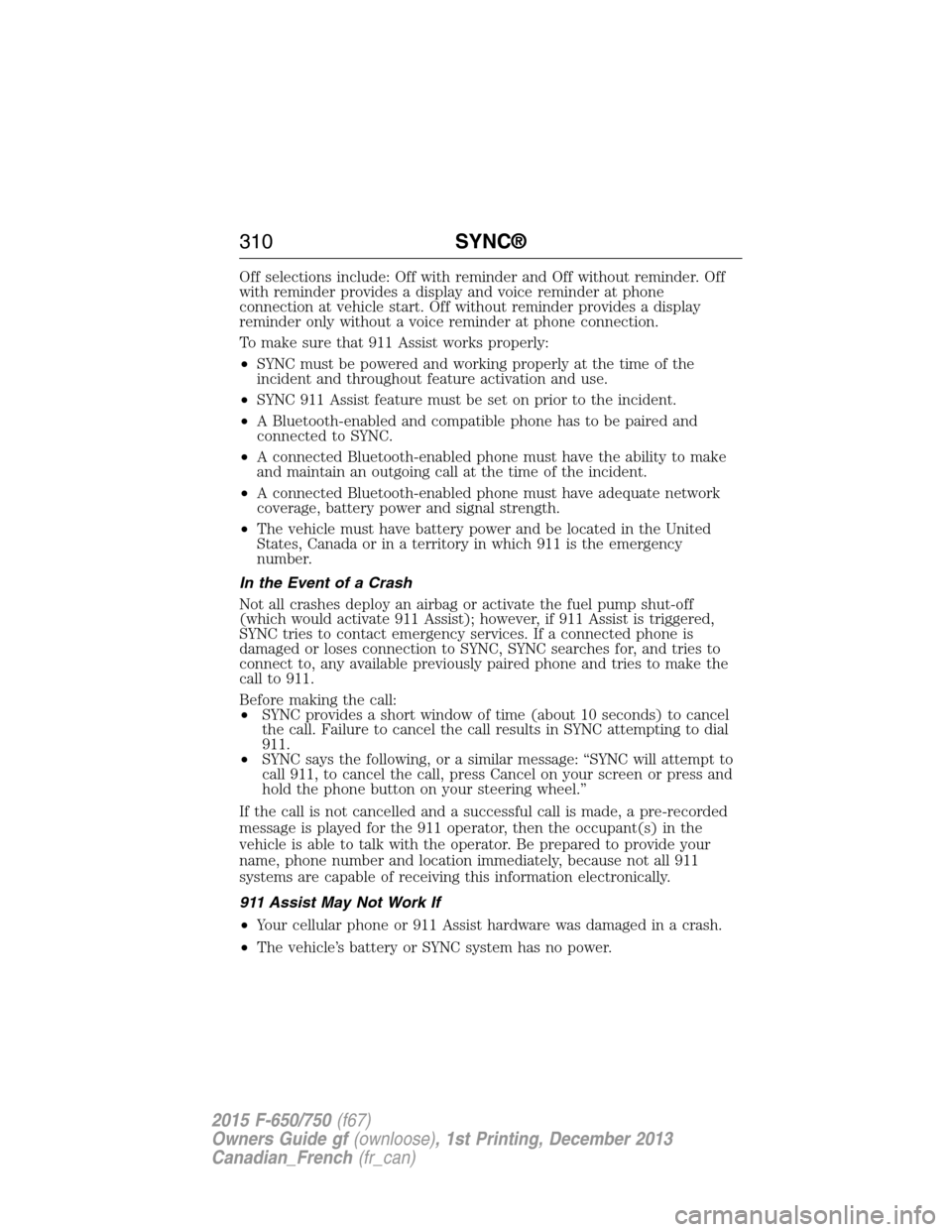
Off selections include: Off with reminder and Off without reminder. Off
with reminder provides a display and voice reminder at phone
connection at vehicle start. Off without reminder provides a display
reminder only without a voice reminder at phone connection.
To make sure that 911 Assist works properly:
•SYNC must be powered and working properly at the time of the
incident and throughout feature activation and use.
•SYNC 911 Assist feature must be set on prior to the incident.
•A Bluetooth-enabled and compatible phone has to be paired and
connected to SYNC.
•A connected Bluetooth-enabled phone must have the ability to make
and maintain an outgoing call at the time of the incident.
•A connected Bluetooth-enabled phone must have adequate network
coverage, battery power and signal strength.
•The vehicle must have battery power and be located in the United
States, Canada or in a territory in which 911 is the emergency
number.
In the Event of a Crash
Not all crashes deploy an airbag or activate the fuel pump shut-off
(which would activate 911 Assist); however, if 911 Assist is triggered,
SYNC tries to contact emergency services. If a connected phone is
damaged or loses connection to SYNC, SYNC searches for, and tries to
connect to, any available previously paired phone and tries to make the
call to 911.
Before making the call:
•SYNC provides a short window of time (about 10 seconds) to cancel
the call. Failure to cancel the call results in SYNC attempting to dial
911.
•SYNC says the following, or a similar message: “SYNC will attempt to
call 911, to cancel the call, press Cancel on your screen or press and
hold the phone button on your steering wheel.”
If the call is not cancelled and a successful call is made, a pre-recorded
message is played for the 911 operator, then the occupant(s) in the
vehicle is able to talk with the operator. Be prepared to provide your
name, phone number and location immediately, because not all 911
systems are capable of receiving this information electronically.
911 Assist May Not Work If
•Your cellular phone or 911 Assist hardware was damaged in a crash.
•The vehicle’s battery or SYNC system has no power.
310SYNC®
2015 F-650/750(f67)
Owners Guide gf(ownloose), 1st Printing, December 2013
Canadian_French(fr_can)
Page 312 of 384
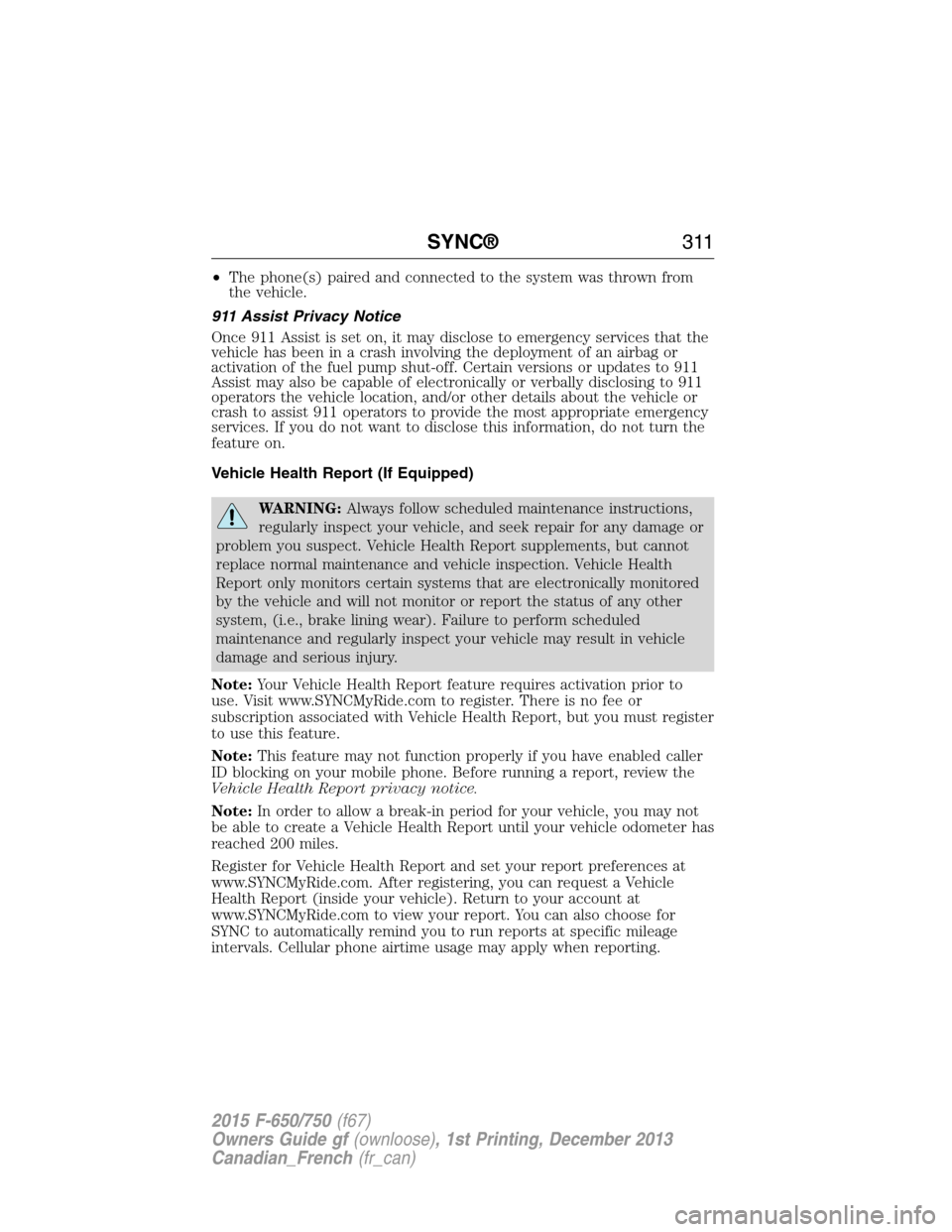
•The phone(s) paired and connected to the system was thrown from
the vehicle.
911 Assist Privacy Notice
Once 911 Assist is set on, it may disclose to emergency services that the
vehicle has been in a crash involving the deployment of an airbag or
activation of the fuel pump shut-off. Certain versions or updates to 911
Assist may also be capable of electronically or verbally disclosing to 911
operators the vehicle location, and/or other details about the vehicle or
crash to assist 911 operators to provide the most appropriate emergency
services. If you do not want to disclose this information, do not turn the
feature on.
Vehicle Health Report (If Equipped)
WARNING:Always follow scheduled maintenance instructions,
regularly inspect your vehicle, and seek repair for any damage or
problem you suspect. Vehicle Health Report supplements, but cannot
replace normal maintenance and vehicle inspection. Vehicle Health
Report only monitors certain systems that are electronically monitored
by the vehicle and will not monitor or report the status of any other
system, (i.e., brake lining wear). Failure to perform scheduled
maintenance and regularly inspect your vehicle may result in vehicle
damage and serious injury.
Note:Your Vehicle Health Report feature requires activation prior to
use. Visit www.SYNCMyRide.com to register. There is no fee or
subscription associated with Vehicle Health Report, but you must register
to use this feature.
Note:This feature may not function properly if you have enabled caller
ID blocking on your mobile phone. Before running a report, review the
Vehicle Health Report privacy notice.
Note:In order to allow a break-in period for your vehicle, you may not
be able to create a Vehicle Health Report until your vehicle odometer has
reached 200 miles.
Register for Vehicle Health Report and set your report preferences at
www.SYNCMyRide.com. After registering, you can request a Vehicle
Health Report (inside your vehicle). Return to your account at
www.SYNCMyRide.com to view your report. You can also choose for
SYNC to automatically remind you to run reports at specific mileage
intervals. Cellular phone airtime usage may apply when reporting.
SYNC®311
2015 F-650/750(f67)
Owners Guide gf(ownloose), 1st Printing, December 2013
Canadian_French(fr_can)
Page 344 of 384
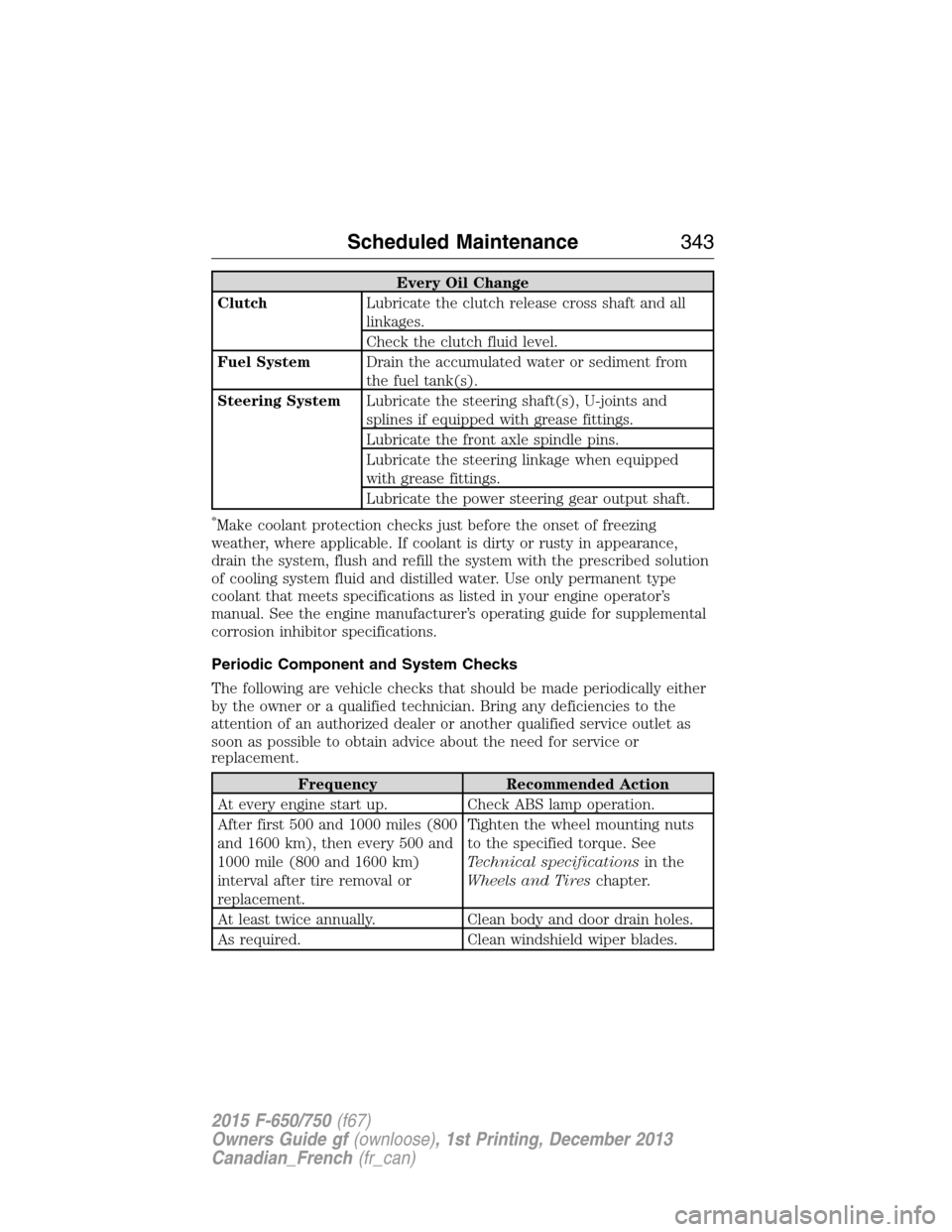
Every Oil Change
ClutchLubricate the clutch release cross shaft and all
linkages.
Check the clutch fluid level.
Fuel SystemDrain the accumulated water or sediment from
the fuel tank(s).
Steering SystemLubricate the steering shaft(s), U-joints and
splines if equipped with grease fittings.
Lubricate the front axle spindle pins.
Lubricate the steering linkage when equipped
with grease fittings.
Lubricate the power steering gear output shaft.
*Make coolant protection checks just before the onset of freezing
weather, where applicable. If coolant is dirty or rusty in appearance,
drain the system, flush and refill the system with the prescribed solution
of cooling system fluid and distilled water. Use only permanent type
coolant that meets specifications as listed in your engine operator’s
manual. See the engine manufacturer’s operating guide for supplemental
corrosion inhibitor specifications.
Periodic Component and System Checks
The following are vehicle checks that should be made periodically either
by the owner or a qualified technician. Bring any deficiencies to the
attention of an authorized dealer or another qualified service outlet as
soon as possible to obtain advice about the need for service or
replacement.
Frequency Recommended Action
At every engine start up. Check ABS lamp operation.
After first 500 and 1000 miles (800
and 1600 km), then every 500 and
1000 mile (800 and 1600 km)
interval after tire removal or
replacement.Tighten the wheel mounting nuts
to the specified torque. See
Technical specificationsin the
Wheels and Tireschapter.
At least twice annually. Clean body and door drain holes.
As required. Clean windshield wiper blades.
Scheduled Maintenance343
2015 F-650/750(f67)
Owners Guide gf(ownloose), 1st Printing, December 2013
Canadian_French(fr_can)
Page 345 of 384
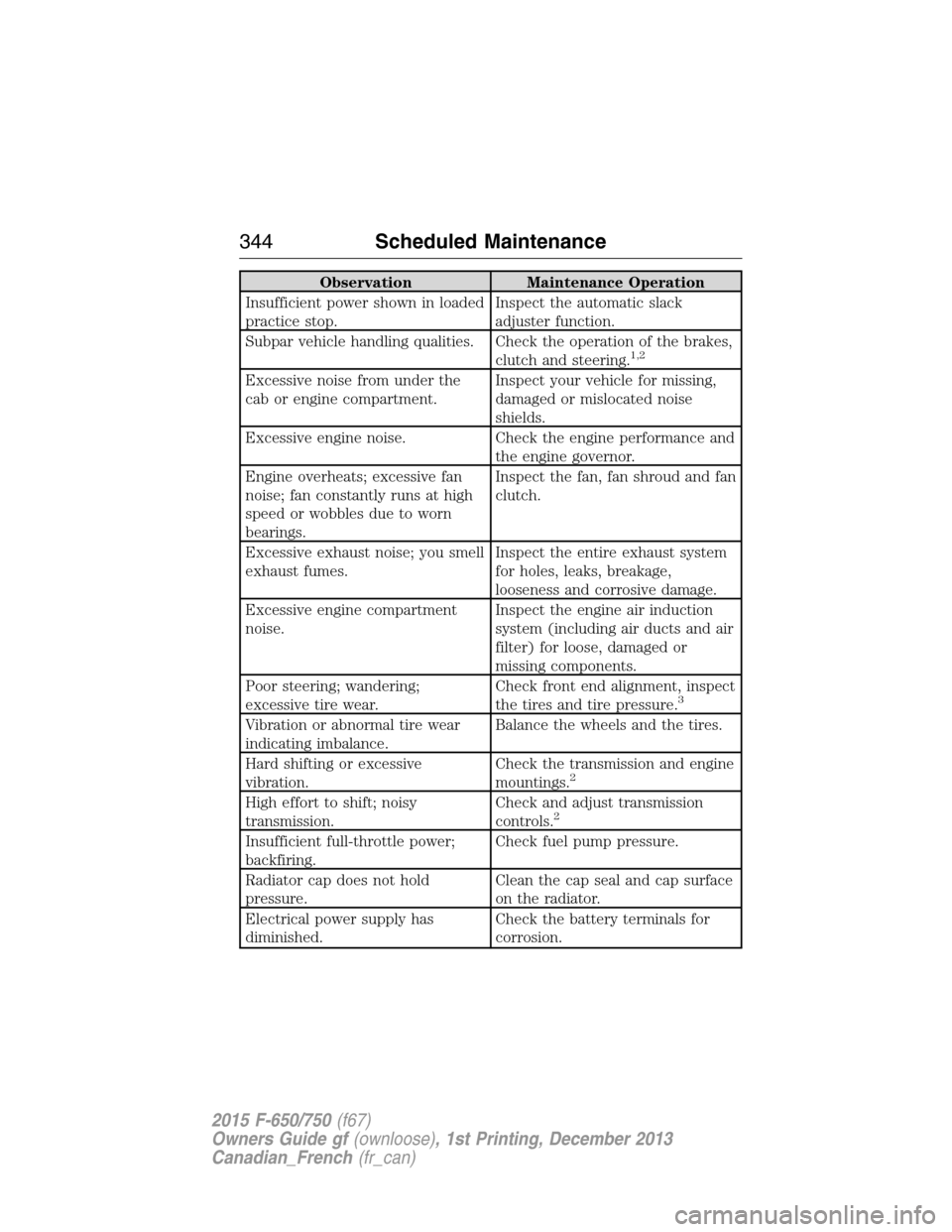
Observation Maintenance Operation
Insufficient power shown in loaded
practice stop.Inspect the automatic slack
adjuster function.
Subpar vehicle handling qualities. Check the operation of the brakes,
clutch and steering.
1,2
Excessive noise from under the
cab or engine compartment.Inspect your vehicle for missing,
damaged or mislocated noise
shields.
Excessive engine noise. Check the engine performance and
the engine governor.
Engine overheats; excessive fan
noise; fan constantly runs at high
speed or wobbles due to worn
bearings.Inspect the fan, fan shroud and fan
clutch.
Excessive exhaust noise; you smell
exhaust fumes.Inspect the entire exhaust system
for holes, leaks, breakage,
looseness and corrosive damage.
Excessive engine compartment
noise.Inspect the engine air induction
system (including air ducts and air
filter) for loose, damaged or
missing components.
Poor steering; wandering;
excessive tire wear.Check front end alignment, inspect
the tires and tire pressure.
3
Vibration or abnormal tire wear
indicating imbalance.Balance the wheels and the tires.
Hard shifting or excessive
vibration.Check the transmission and engine
mountings.
2
High effort to shift; noisy
transmission.Check and adjust transmission
controls.2
Insufficient full-throttle power;
backfiring.Check fuel pump pressure.
Radiator cap does not hold
pressure.Clean the cap seal and cap surface
on the radiator.
Electrical power supply has
diminished.Check the battery terminals for
corrosion.
344Scheduled Maintenance
2015 F-650/750(f67)
Owners Guide gf(ownloose), 1st Printing, December 2013
Canadian_French(fr_can)