fuel FORD F650 2015 13.G Workshop Manual
[x] Cancel search | Manufacturer: FORD, Model Year: 2015, Model line: F650, Model: FORD F650 2015 13.GPages: 384, PDF Size: 4.95 MB
Page 192 of 384
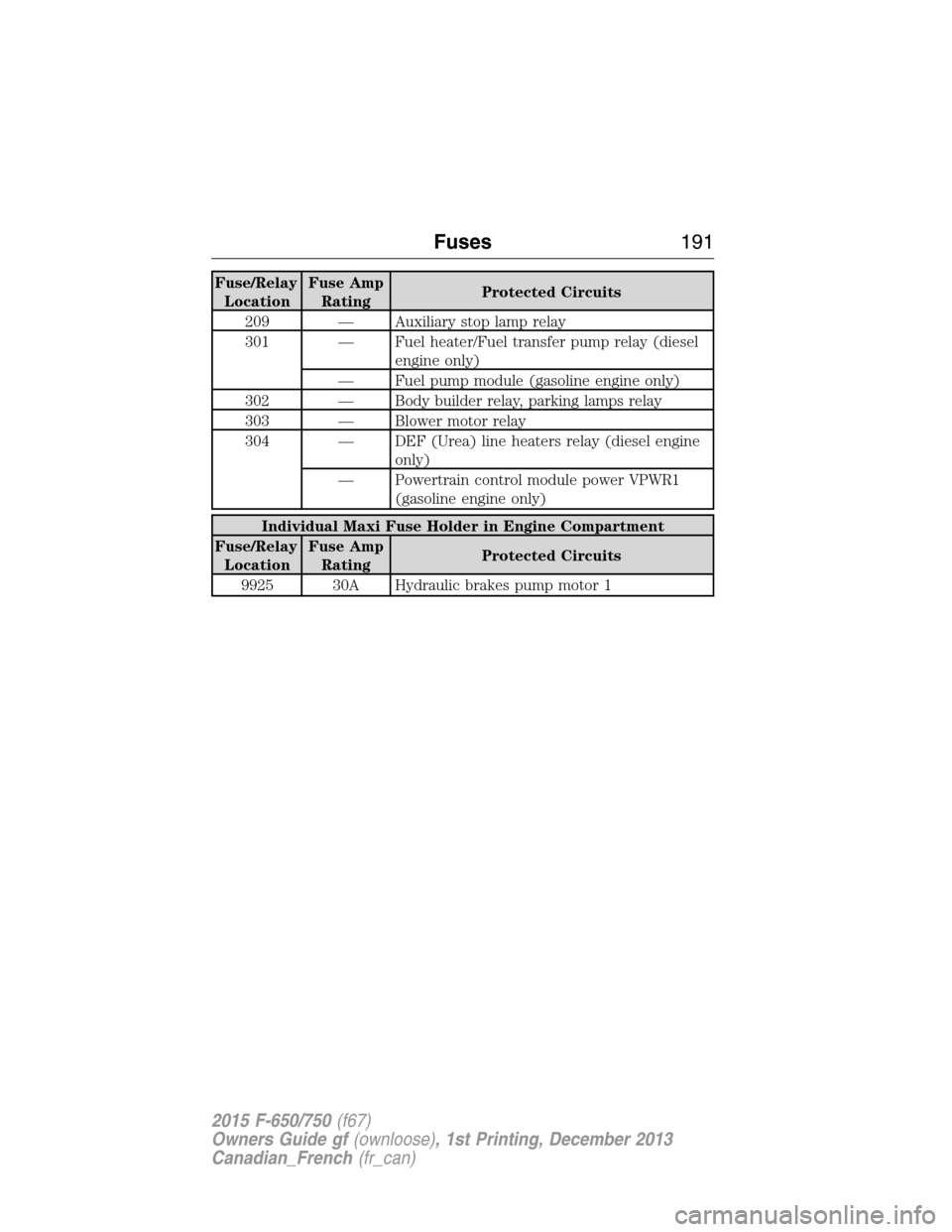
Fuse/Relay
LocationFuse Amp
RatingProtected Circuits
209 — Auxiliary stop lamp relay
301 — Fuel heater/Fuel transfer pump relay (diesel
engine only)
— Fuel pump module (gasoline engine only)
302 — Body builder relay, parking lamps relay
303 — Blower motor relay
304 — DEF (Urea) line heaters relay (diesel engine
only)
— Powertrain control module power VPWR1
(gasoline engine only)
Individual Maxi Fuse Holder in Engine Compartment
Fuse/Relay
LocationFuse Amp
RatingProtected Circuits
9925 30A Hydraulic brakes pump motor 1
Fuses191
2015 F-650/750(f67)
Owners Guide gf(ownloose), 1st Printing, December 2013
Canadian_French(fr_can)
Page 194 of 384
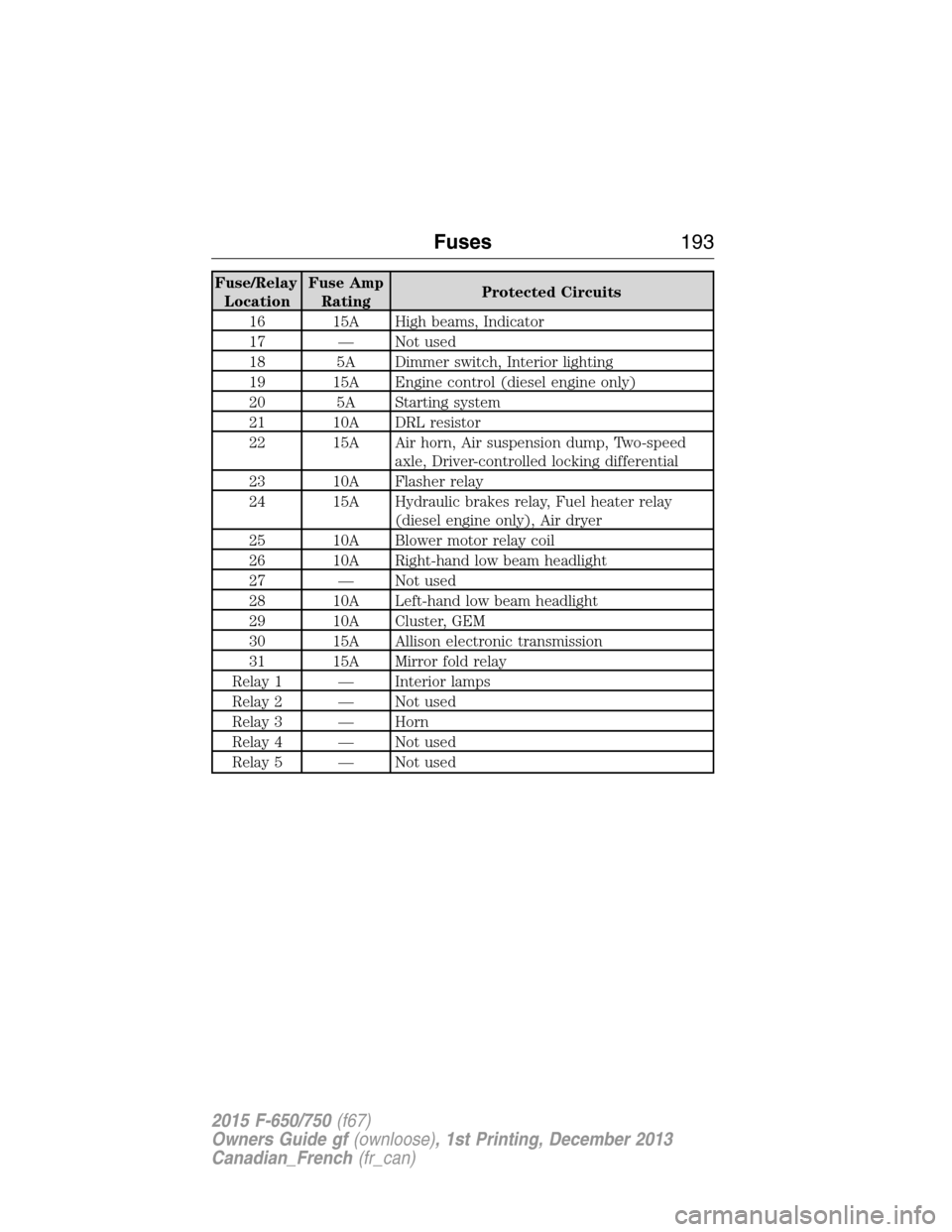
Fuse/Relay
LocationFuse Amp
RatingProtected Circuits
16 15A High beams, Indicator
17 — Not used
18 5A Dimmer switch, Interior lighting
19 15A Engine control (diesel engine only)
20 5A Starting system
21 10A DRL resistor
22 15A Air horn, Air suspension dump, Two-speed
axle, Driver-controlled locking differential
23 10A Flasher relay
24 15A Hydraulic brakes relay, Fuel heater relay
(diesel engine only), Air dryer
25 10A Blower motor relay coil
26 10A Right-hand low beam headlight
27 — Not used
28 10A Left-hand low beam headlight
29 10A Cluster, GEM
30 15A Allison electronic transmission
31 15A Mirror fold relay
Relay 1 — Interior lamps
Relay 2 — Not used
Relay 3 — Horn
Relay 4 — Not used
Relay 5 — Not used
Fuses193
2015 F-650/750(f67)
Owners Guide gf(ownloose), 1st Printing, December 2013
Canadian_French(fr_can)
Page 199 of 384
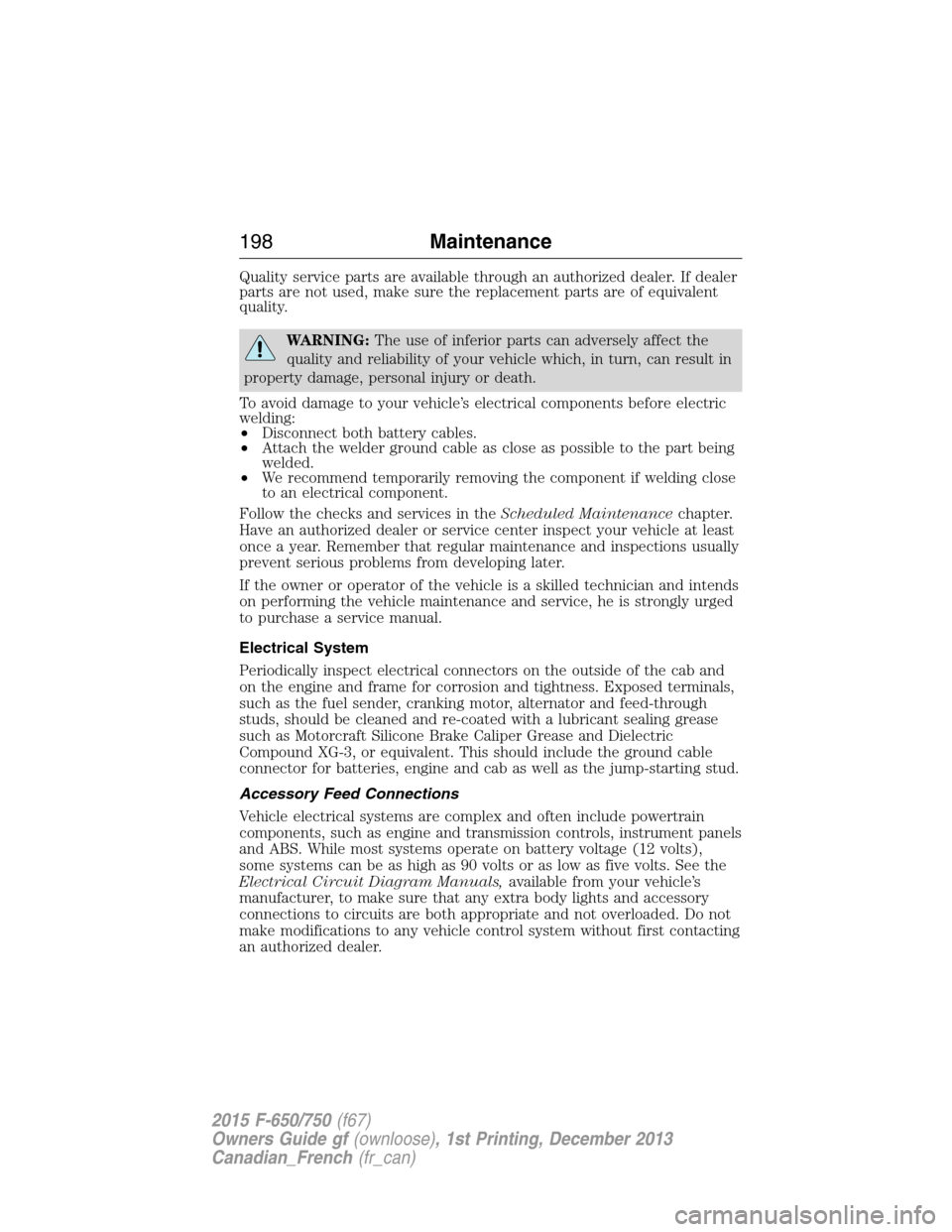
Quality service parts are available through an authorized dealer. If dealer
parts are not used, make sure the replacement parts are of equivalent
quality.
WARNING:The use of inferior parts can adversely affect the
quality and reliability of your vehicle which, in turn, can result in
property damage, personal injury or death.
To avoid damage to your vehicle’s electrical components before electric
welding:
•Disconnect both battery cables.
•Attach the welder ground cable as close as possible to the part being
welded.
•We recommend temporarily removing the component if welding close
to an electrical component.
Follow the checks and services in theScheduled Maintenancechapter.
Have an authorized dealer or service center inspect your vehicle at least
once a year. Remember that regular maintenance and inspections usually
prevent serious problems from developing later.
If the owner or operator of the vehicle is a skilled technician and intends
on performing the vehicle maintenance and service, he is strongly urged
to purchase a service manual.
Electrical System
Periodically inspect electrical connectors on the outside of the cab and
on the engine and frame for corrosion and tightness. Exposed terminals,
such as the fuel sender, cranking motor, alternator and feed-through
studs, should be cleaned and re-coated with a lubricant sealing grease
such as Motorcraft Silicone Brake Caliper Grease and Dielectric
Compound XG-3, or equivalent. This should include the ground cable
connector for batteries, engine and cab as well as the jump-starting stud.
Accessory Feed Connections
Vehicle electrical systems are complex and often include powertrain
components, such as engine and transmission controls, instrument panels
and ABS. While most systems operate on battery voltage (12 volts),
some systems can be as high as 90 volts or as low as five volts. See the
Electrical Circuit Diagram Manuals,available from your vehicle’s
manufacturer, to make sure that any extra body lights and accessory
connections to circuits are both appropriate and not overloaded. Do not
make modifications to any vehicle control system without first contacting
an authorized dealer.
198Maintenance
2015 F-650/750(f67)
Owners Guide gf(ownloose), 1st Printing, December 2013
Canadian_French(fr_can)
Page 206 of 384
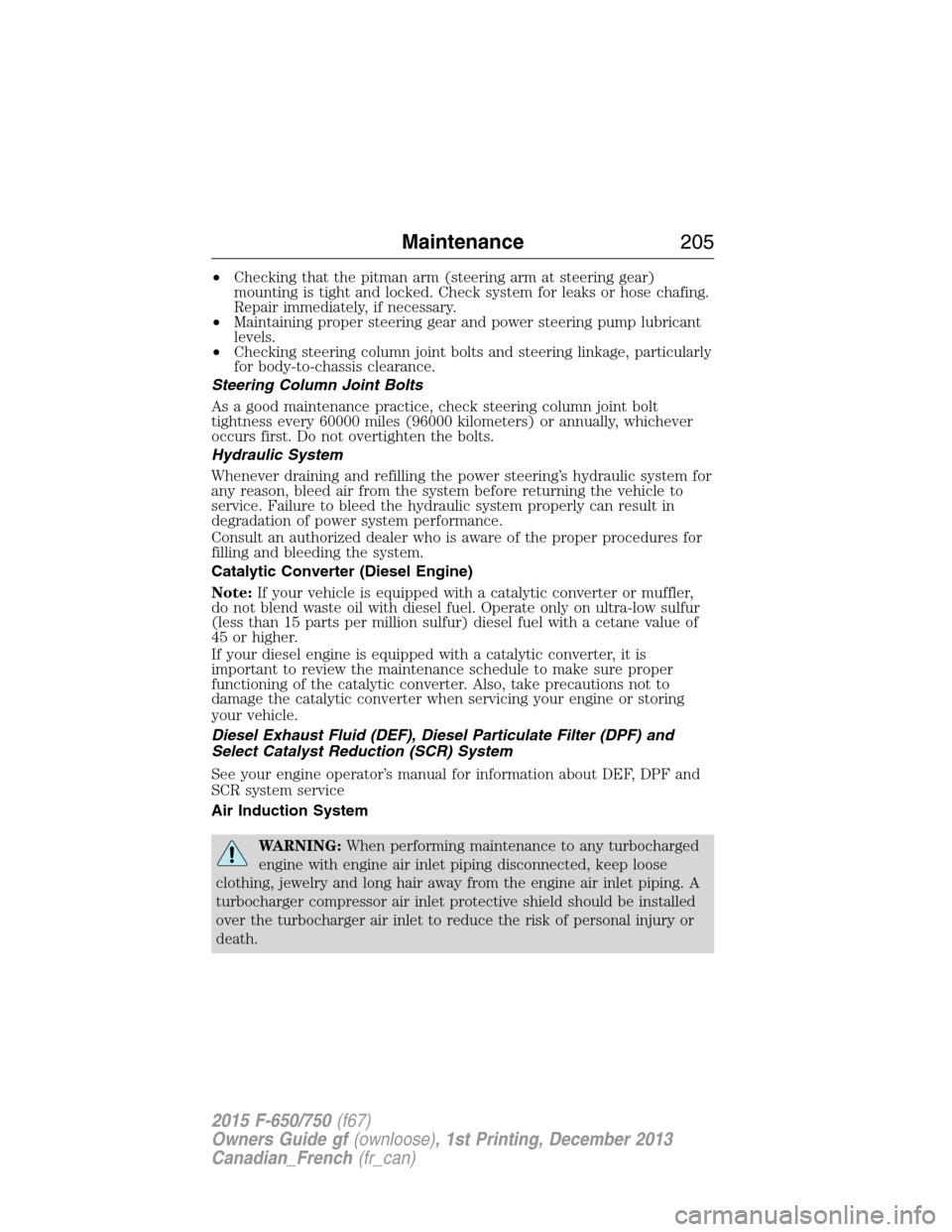
•Checking that the pitman arm (steering arm at steering gear)
mounting is tight and locked. Check system for leaks or hose chafing.
Repair immediately, if necessary.
•Maintaining proper steering gear and power steering pump lubricant
levels.
•Checking steering column joint bolts and steering linkage, particularly
for body-to-chassis clearance.
Steering Column Joint Bolts
As a good maintenance practice, check steering column joint bolt
tightness every 60000 miles (96000 kilometers) or annually, whichever
occurs first. Do not overtighten the bolts.
Hydraulic System
Whenever draining and refilling the power steering’s hydraulic system for
any reason, bleed air from the system before returning the vehicle to
service. Failure to bleed the hydraulic system properly can result in
degradation of power system performance.
Consult an authorized dealer who is aware of the proper procedures for
filling and bleeding the system.
Catalytic Converter (Diesel Engine)
Note:If your vehicle is equipped with a catalytic converter or muffler,
do not blend waste oil with diesel fuel. Operate only on ultra-low sulfur
(less than 15 parts per million sulfur) diesel fuel with a cetane value of
45 or higher.
If your diesel engine is equipped with a catalytic converter, it is
important to review the maintenance schedule to make sure proper
functioning of the catalytic converter. Also, take precautions not to
damage the catalytic converter when servicing your engine or storing
your vehicle.
Diesel Exhaust Fluid (DEF), Diesel Particulate Filter (DPF) and
Select Catalyst Reduction (SCR) System
See your engine operator’s manual for information about DEF, DPF and
SCR system service
Air Induction System
WARNING:When performing maintenance to any turbocharged
engine with engine air inlet piping disconnected, keep loose
clothing, jewelry and long hair away from the engine air inlet piping. A
turbocharger compressor air inlet protective shield should be installed
over the turbocharger air inlet to reduce the risk of personal injury or
death.
Maintenance205
2015 F-650/750(f67)
Owners Guide gf(ownloose), 1st Printing, December 2013
Canadian_French(fr_can)
Page 212 of 384
Adding Engine Oil
Note:Do not remove the engine oil dipstick or the filler cap when the
engine is running.
Note:Do not add engine oil further than the MAX mark. Oil levels above
the MAX mark may cause engine damage.
Only use oils certified for gasoline engines by the
American Petroleum Institute (API). Oil with this
trademark symbol conforms to the current engine and
emission system protection standards and fuel
economy requirements of the International Lubricants
Specification Advisory Council (ILSAC), comprised of
U.S. and Japanese automobile manufacturers.
1. Check the engine oil level.
2. If the engine oil level is not within the normal range, add engine oil
that meets Ford specifications. SeeCapacities and Specifications
for more information. Remove the engine oil filler cap and use a
funnel to pour the engine oil into the opening.
3. Recheck the engine oil level. Make sure the oil level is not above the
normal operating range on the engine oil dipstick.
4. Put the dipstick back in completely.
5. Fully install the oil filler cap by turning it clockwise until it clicks or
stops turning.
ENGINE COOLANT CHECK
Diesel Engine
See your engine operator’s manual for information on checking and
adding engine coolant.
Fan Clutches
WARNING:Stay clear of the fan and fan area while the engine is
running or possible personal injury may occur.
Your vehicle’s cooling system is equipped with a viscous fan clutch
which:
•Helps control cooling, increases performance, improves fuel economy
and reduces noise.
•Bimetallic spring sensors control. Do not tamper with these sensors
as this may change their calibration or keep the fan clutch from
operating at all.
Maintenance211
2015 F-650/750(f67)
Owners Guide gf(ownloose), 1st Printing, December 2013
Canadian_French(fr_can)
Page 225 of 384
FUEL FILTER
Gasoline Engine
Your vehicle is equipped with a lifetime fuel filter that is part of the fuel
tank. You do need to perform regular maintenance or replace it.
Diesel Engine
WARNING:Do not drain water separator while engine is
running. Fuel may ignite if separator is drained while engine is
running or vehicle is moving.
The fuel filter water separator removes any contaminated particles and
water from the fuel before the fuel enters the engine.
See your engine operator’s manual for information on draining and
replacing the fuel filter.
WASHER FLUID CHECK
WARNING:If you operate your vehicle in temperatures below
40°F (5°C), use washer fluid with antifreeze protection. Failure
to use washer fluid with antifreeze protection in cold weather could
result in impaired windshield vision and increase the risk of injury or
accident.
Add fluid to fill the reservoir if the level is low. Only use a washer fluid
that meets Ford specifications. SeeTechnical specificationsin the
Capacities and Specificationschapter.
State or local regulations on volatile organic compounds may restrict the
use of methanol, a common windshield washer antifreeze additive. Only
use washer fluids containing non-methanol antifreeze agents if they
provide cold weather protection without damaging your vehicle’s paint
finish, wiper blades or washer system.
CHANGING THE VEHICLE BATTERY
WARNING:This vehicle may be equipped with more than one
battery, removal of cable from only one battery does not
disconnect the vehicle electrical system. Be sure to disconnect cables
from all batteries when disconnecting power. Failure to do so may
cause serious personal injury or property damage.
224Maintenance
2015 F-650/750(f67)
Owners Guide gf(ownloose), 1st Printing, December 2013
Canadian_French(fr_can)
Page 227 of 384
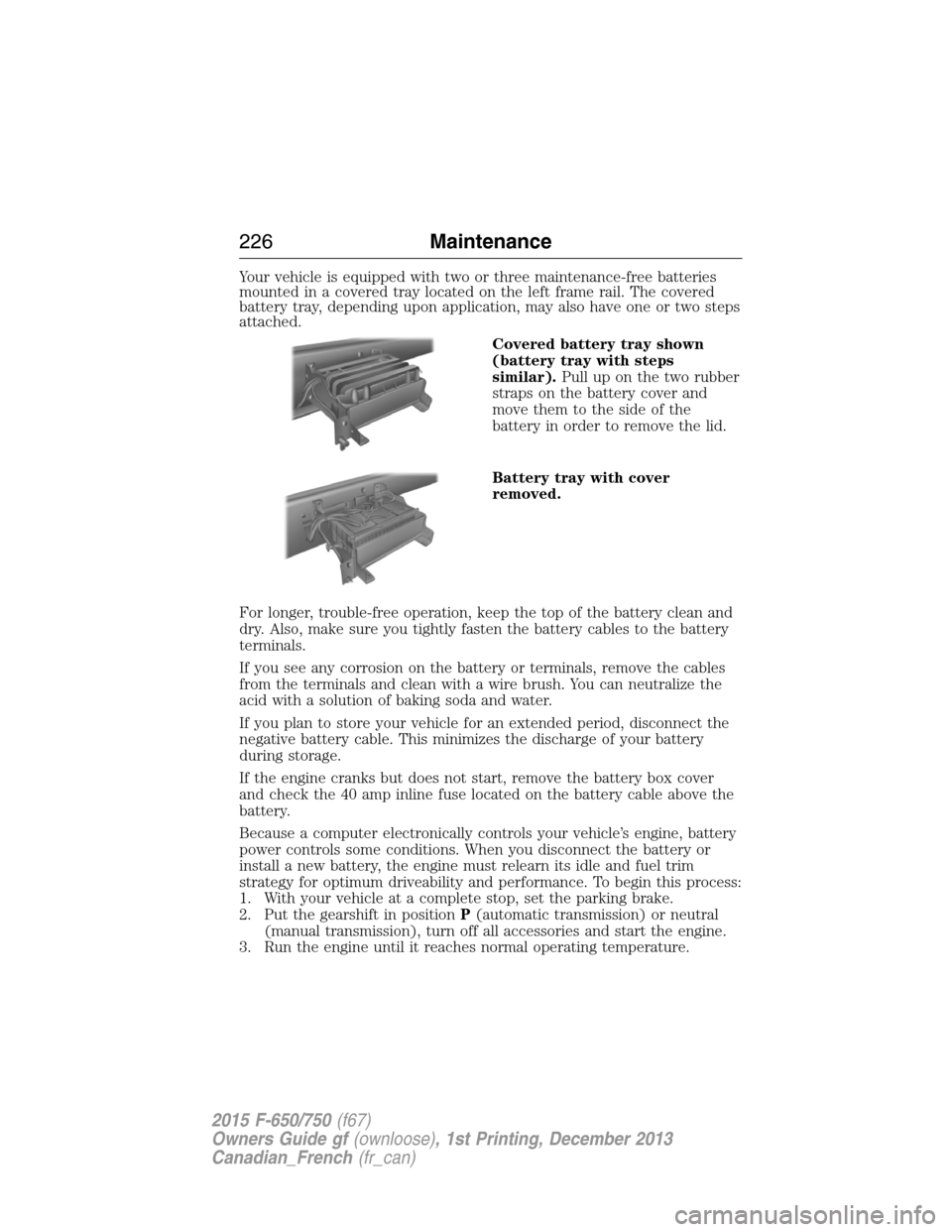
Your vehicle is equipped with two or three maintenance-free batteries
mounted in a covered tray located on the left frame rail. The covered
battery tray, depending upon application, may also have one or two steps
attached.
Covered battery tray shown
(battery tray with steps
similar).Pull up on the two rubber
straps on the battery cover and
move them to the side of the
battery in order to remove the lid.
Battery tray with cover
removed.
For longer, trouble-free operation, keep the top of the battery clean and
dry. Also, make sure you tightly fasten the battery cables to the battery
terminals.
If you see any corrosion on the battery or terminals, remove the cables
from the terminals and clean with a wire brush. You can neutralize the
acid with a solution of baking soda and water.
If you plan to store your vehicle for an extended period, disconnect the
negative battery cable. This minimizes the discharge of your battery
during storage.
If the engine cranks but does not start, remove the battery box cover
and check the 40 amp inline fuse located on the battery cable above the
battery.
Because a computer electronically controls your vehicle’s engine, battery
power controls some conditions. When you disconnect the battery or
install a new battery, the engine must relearn its idle and fuel trim
strategy for optimum driveability and performance. To begin this process:
1. With your vehicle at a complete stop, set the parking brake.
2. Put the gearshift in positionP(automatic transmission) or neutral
(manual transmission), turn off all accessories and start the engine.
3. Run the engine until it reaches normal operating temperature.
226Maintenance
2015 F-650/750(f67)
Owners Guide gf(ownloose), 1st Printing, December 2013
Canadian_French(fr_can)
Page 236 of 384
•Always use a clean sponge or car wash mitt with plenty of water for
best results.
•Dry your vehicle with a chamois or soft, terry cloth towel in order to
eliminate water spotting.
•It is especially important to wash your vehicle regularly during the
winter months, as dirt and road salt are difficult to remove and cause
damage to the vehicle.
•Immediately remove items such as gasoline, diesel fuel, bird droppings
and insect deposits because they can cause damage to your vehicle’s
paintwork and trim over time. Use Motorcraft Bug and Tar Remover
(ZC-42), which is available from an authorized dealer.
•Remove any exterior accessories, such as antennas, before entering a
car wash.
•Suntan lotions and insect repellents can damage any painted surface;
if these substances come in contact with your vehicle, wash off as
soon as possible.
•If your vehicle is equipped with running boards, use Motorcraft Detail
Wash (ZC-3-A), and, as required, Motorcraft Bug and Tar Remover
(ZC-42), both as per the directions on the products’ labels. To
manually dry, use a clean, dry, lint-free towel. Do not use rubber,
plastic and vinyl protectant products on the running board surface, as
the area may become slippery.
Exterior Chrome
•Wash your vehicle first, using cool or lukewarm water and a neutral
pH shampoo, such as Motorcraft Detail Wash (ZC-3-A).
•Use Motorcraft Custom Bright Metal Cleaner (ZC-15), available from
an authorized dealer. Apply the product as you would a wax to clean
bumpers and other chrome parts; allow the cleaner to dry for a few
minutes, and then wipe off the haze with a clean, dry rag.
•Never use abrasive materials, such as steel wool or plastic pads, as
they can scratch the chrome surface.
Underbody
Flush the complete underside of your vehicle frequently. Keep body and
door drain holes free from packed dirt.
Rear suspension components may require regular cleaning with a power
washer or a thorough rinse with a strong stream of water if you operate
your vehicle in dusty or muddy environments. Rear leaf springs or other
Vehicle Care235
2015 F-650/750(f67)
Owners Guide gf(ownloose), 1st Printing, December 2013
Canadian_French(fr_can)
Page 238 of 384
CLEANING THE ENGINE
Note:To prevent damage to the engine control module, never
spray-wash it directly. Never spray any connector.
Engines are more efficient when they are clean because grease and dirt
build-up keep the engine warmer than normal.
When washing:
•Take care when using a power washer to clean the engine. The
high-pressure fluid could penetrate the sealed parts and cause
damage.
•Do not spray a hot engine with cold water to avoid cracking the
engine block or other engine components.
•Spray Motorcraft Engine Shampoo and Degreaser on all parts that
require cleaning and pressure rinse clean. In Canada, use Motorcraft
Engine Shampoo.
•Never wash or rinse the engine while it is hot or running; water in
the running engine may cause internal damage.
CLEANING THE WINDOWS AND WIPER BLADES
Clean the windows and wiper blades regularly. If the wipers do not wipe
properly, substances on your vehicle’s glass or the wiper blades may
cause squeaking or chatter noise from the blades, and streaking and
smearing of the windshield. To clean these items follow these tips:
•Clean the windows with a non-abrasive cleaner, such as Motorcraft
Ultra-Clear Spray Glass Cleaner.
•The wiper blades can be cleaned with isopropyl-rubbing alcohol or
Motorcraft Premium Windshield Washer Concentrate in the United
States, or Premium Quality Windshield Washer Fluid in Canada. Be
sure to replace wiper blades when they appear worn or do not
function properly.
•Do not use abrasives, as they may cause scratches.
•Do not use fuel, kerosene, or paint thinner to clean any parts.
If you cannot remove those streaks after cleaning with the glass cleaner
or if the wipers chatter and move in a jerky motion, clean the outer
surface of the windshield and the wiper blades using a sponge or soft
cloth with a neutral detergent or mild-abrasive cleaning solution. After
cleaning, rinse the windshield and wiper blades with clean water. The
windshield is clean if beads do not form when you rinse the windshield
with water.
Vehicle Care237
2015 F-650/750(f67)
Owners Guide gf(ownloose), 1st Printing, December 2013
Canadian_French(fr_can)
Page 241 of 384
A clearcoat paint finish coats aluminum wheels and wheel covers. In
order to maintain their condition:
•Clean weekly with Motorcraft Wheel and Tire Cleaner. Use a sponge to
remove heavy deposits of dirt and brake dust accumulation. Rinse
thoroughly with a strong stream of water when you have completed
the cleaning process.
•To remove tar and grease, use Motorcraft Bug and Tar Remover.
•Never apply any cleaning chemical to hot or warm wheel rims or
covers.
•Some automatic car washes may cause damage to the finish on your
wheel rims or covers.
•Industrial-strength (heavy-duty) cleaners, or cleaning chemicals, in
combination with brush agitation to remove brake dust and dirt, could
wear away the clearcoat finish over time.
•Do not use hydrofluoric acid-based or high caustic-based wheel
cleaners, steel wool, fuels or strong household detergent.
•If you intend on parking your vehicle for an extended period after
cleaning the wheels with a wheel cleaner, drive your vehicle for a few
minutes before doing so. This reduces the risk of increased corrosion
of the brake discs.
VEHICLE STORAGE
If you plan to store your vehicle for an extended period (30 days or
more), read the following maintenance recommendations to make sure
your vehicle stays in good operating condition.
All motor vehicles and their components were engineered and tested for
reliable, regular driving. Long-term storage under various conditions may
lead to component degradation or failure unless you take specific
precautions to preserve the components.
General
•Store all vehicles in a dry, ventilated place.
•Protect from sunlight, if possible.
•If vehicles are stored outside, they require regular maintenance to
protect against rust and damage.
240Vehicle Care
2015 F-650/750(f67)
Owners Guide gf(ownloose), 1st Printing, December 2013
Canadian_French(fr_can)