coolant temperature FORD FESTIVA 1991 User Guide
[x] Cancel search | Manufacturer: FORD, Model Year: 1991, Model line: FESTIVA, Model: FORD FESTIVA 1991Pages: 454, PDF Size: 9.53 MB
Page 171 of 454
CLEARING CODES
Clearing Codes Procedure
Disconnect negative battery cable. Press brake pedal for 5-10 seconds. Turn off VOM or Super Star II tester. Reconnect battery.
ECA LOCATION
ECA is located on center console behind kick panel on Capri, and under instrument panel on driver side of Festiva.
QUICK TESTS
KEY ON, ENGINE OFF (KOEO) SELF-TEST
KOEO
1. This is a test of electronic engine control system, conducted with power (voltage) applied and engine not running. Activate self-test, and
record all codes displayed.
2. Erase codes, and repeat self-test. Diagnose only codes occurring during repeat self-test. See TROUBLE CODE DEFINITION
table. If
no codes are present, proceed to KEY ON, ENGINE RUNNING (KOER) SELF
-TEST .
KEY ON, ENGINE RUNNING (KOER) SELF-TEST
KOER
1. Deactivate self-test. Start and run engine at 2000 RPM for 2 minutes to warm up EGO sensor. Turn off engine and wait 10 seconds.
2. Restart engine, and activate self-test. Record all service codes displayed. See TROUBLE CODE DEFINITION
table. If no codes are
present, proceed to SWITCH MONITOR TEST
.
SWITCH MONITOR TEST
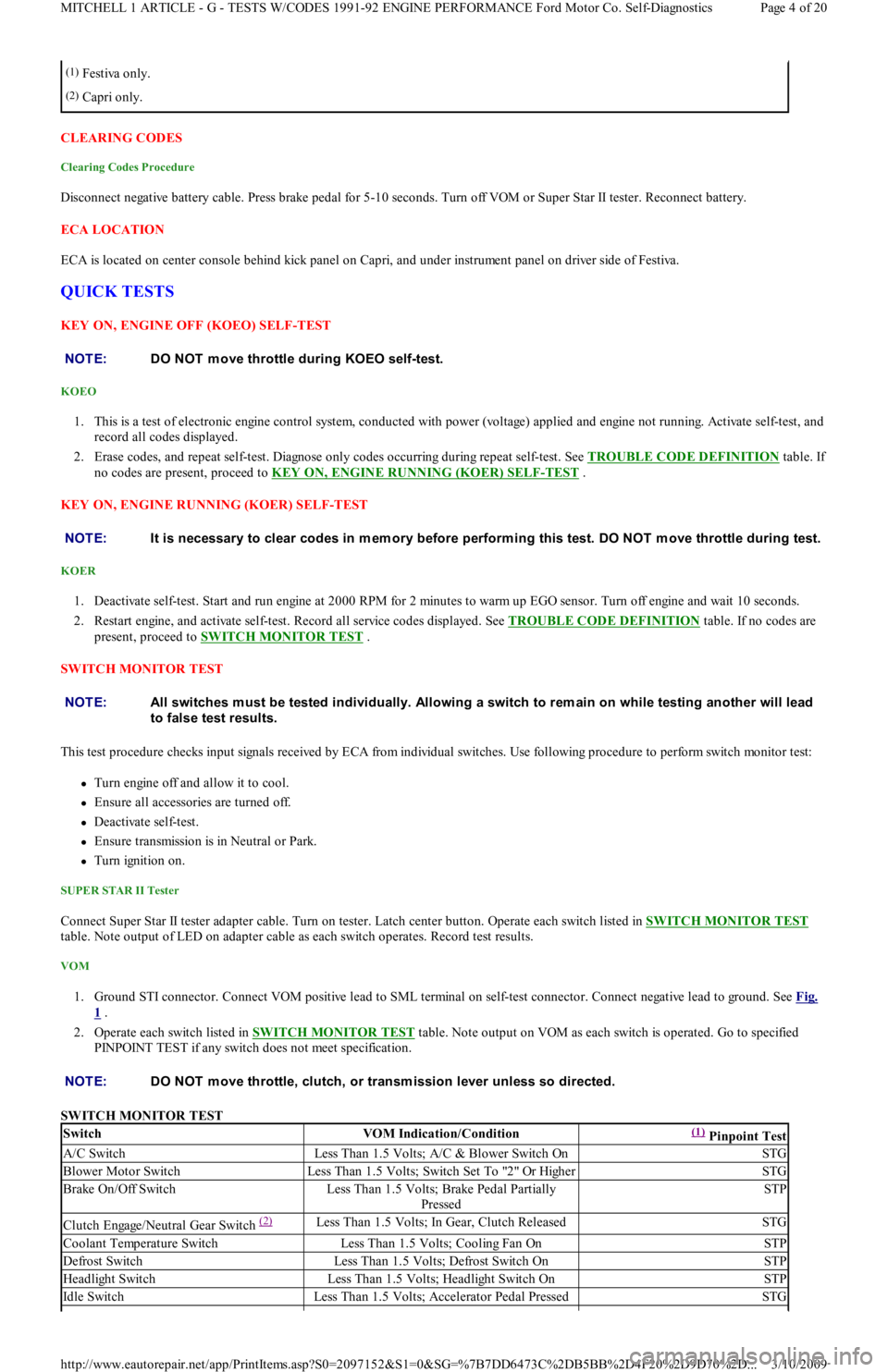
This test procedure checks input signals received by ECA from individual switches. Use following procedure to perform switch monitor test:
Turn engine off and allow it to cool.
Ensure all accessories are turned off.
Deactivate self-test.
Ensure transmission is in Neutral or Park.
Turn ignition on.
SUPER STAR II Tester
Connect Super Star II tester adapter cable. Turn on tester. Latch center button. Operate each switch listed in SWITCH MONITOR TEST
table. Note output of LED on adapter cable as each switch operates. Record test results.
VOM
1. Ground STI connector. Connect VOM positive lead to SML terminal on self-test connector. Connect negative lead to ground. See Fig.
1 .
2. Operate each switch listed in SWITCH MONITOR TEST
table. Note output on VOM as each switch is operated. Go to specified
PINPOINT TEST if any switch does not meet specification.
SWITCH MONITOR TEST
(1)Festiva only.
(2)Capri only.
NOTE:DO NOT m ove throttle during KOEO self-test.
NOTE:It is necessary to clear codes in m em ory before perform ing this test. DO NOT m ove throttle during test.
NOTE:All switches m ust be tested individually. Allowing a switch to rem ain on while testing another will lead
to false test results.
NOTE:DO NOT m ove throttle, clutch, or transm ission lever unless so directed.
SwitchVOM Indication/Condition(1) Pinpoint Test
A/C SwitchLess Than 1.5 Volts; A/C & Blower Switch OnSTG
Blower Motor SwitchLess Than 1.5 Volts; Switch Set To "2" Or HigherSTG
Brake On/Off SwitchLess Than 1.5 Volts; Brake Pedal Partially
PressedSTP
Clutch Engage/Neutral Gear Switch (2) Less Than 1.5 Volts; In Gear, Clutch ReleasedSTG
Coolant Temperature SwitchLess Than 1.5 Volts; Cooling Fan OnSTP
Defrost SwitchLess Than 1.5 Volts; Defrost Switch OnSTP
Headlight SwitchLess Than 1.5 Volts; Headlight Switch OnSTP
Id l e Swit chLess Than 1.5 Volts; Accelerator Pedal PressedSTG
Page 4 of 20 MITCHELL 1 ARTICLE - G - TESTS W/CODES 1991-92 ENGINE PERFORMANCE Ford Motor Co. Self-Diagnostics
3/10/2009 http://www.eautorepair.net/app/PrintItems.asp?S0=2097152&S1=0&SG=%7B7DD6473C%2DB5BB%2D4F20%2D9D70%2D
...
Page 177 of 454
connector while moving vane in VAF meter. Voltage should be as specified in VAF METER VOLTAGE table. If voltage is okay,
repair VAF wire to ECA. If voltage is not okay, go to next step.
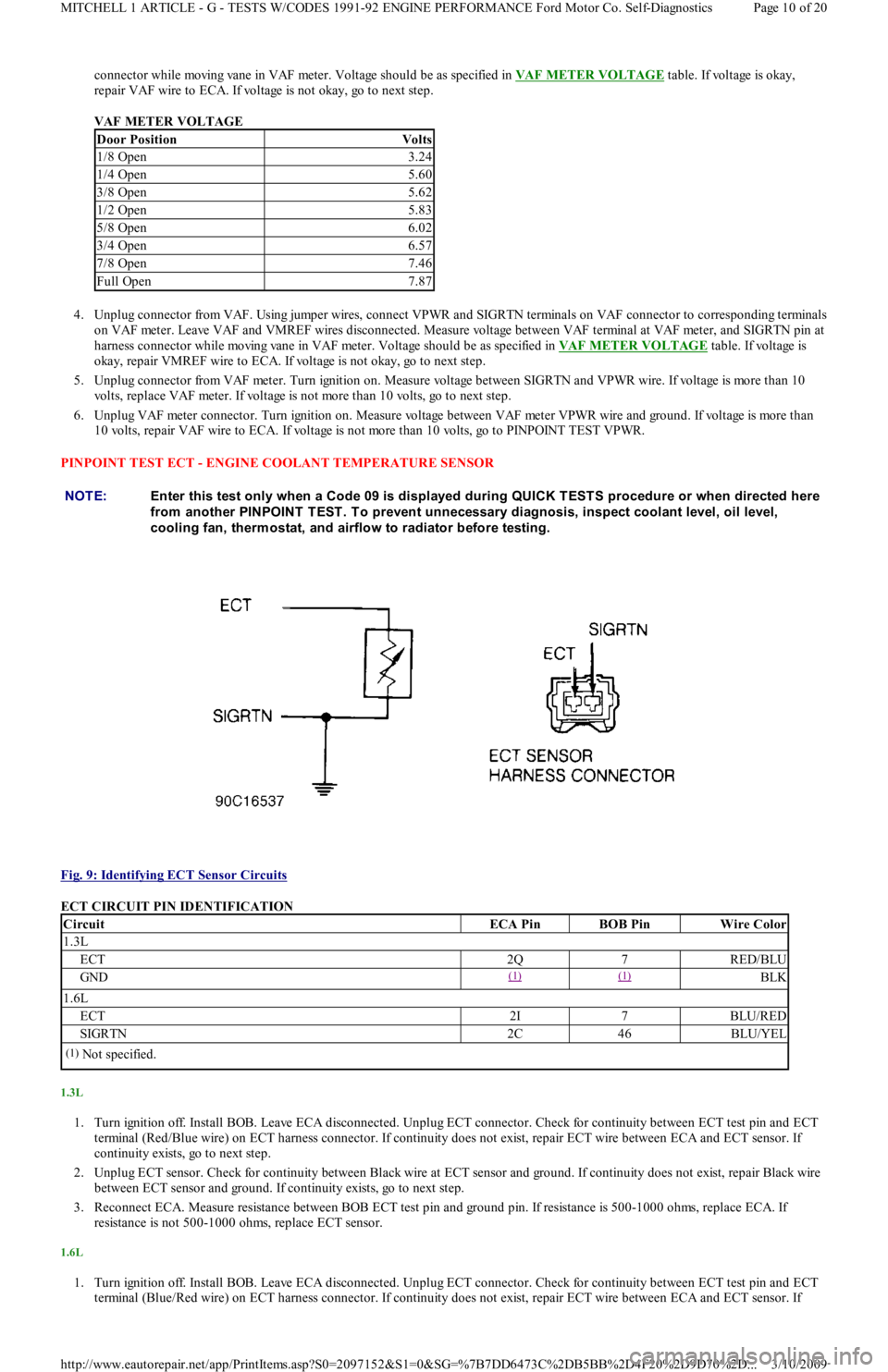
VAF METER VOLTAGE
4. Unplug connector from VAF. Using jumper wires, connect VPWR and SIGRTN terminals on VAF connector to corresponding terminals
on VAF meter. Leave VAF and VMREF wires disconnected. Measure voltage between VAF terminal at VAF meter, and SIGRTN pin at
harness connector while moving vane in VAF meter. Voltage should be as specified in VAF METER VOLTAGE
table. If voltage is
okay, repair VMREF wire to ECA. If voltage is not okay, go to next step.
5. Unplug connector from VAF meter. Turn ignition on. Measure voltage between SIGRTN and VPWR wire. If voltage is more than 10
volts, replace VAF meter. If voltage is not more than 10 volts, go to next step.
6. Unplug VAF meter connector. Turn ignition on. Measure voltage between VAF meter VPWR wire and ground. If voltage is more than
10 volts, repair VAF wire to ECA. If voltage is not more than 10 volts, go to PINPOINT TEST VPWR.
PINPOINT TEST ECT - ENGINE COOLANT TEMPERATURE SENSOR
Fig. 9: Identifying ECT Sensor Circuits
ECT CIRCUIT PIN IDENTIFICATION
1.3L
1. Turn ignition off. Install BOB. Leave ECA disconnected. Unplug ECT connector. Check for continuity between ECT test pin and ECT
terminal (Red/Blue wire) on ECT harness connector. If continuity does not exist, repair ECT wire between ECA and ECT sensor. If
continuity exists, go to next step.
2. Unplug ECT sensor. Check for continuity between Black wire at ECT sensor and ground. If continuity does not exist, repair Black wire
between ECT sensor and ground. If continuity exists, go to next step.
3. Reconnect ECA. Measure resistance between BOB ECT test pin and ground pin. If resistance is 500-1000 ohms, replace ECA. If
resistance is not 500-1000 ohms, replace ECT sensor.
1.6L
1. Turn ignition off. Install BOB. Leave ECA disconnected. Unplug ECT connector. Check for continuity between ECT test pin and ECT
terminal (Blue/Red wire) on ECT harness connector. If continuity does not exist, repair ECT wire between ECA and ECT sensor. If
Door PositionVolts
1/8 Open3.24
1/4 Open5.60
3/8 Open5.62
1/2 Open5.83
5/8 Open6.02
3/4 Open6.57
7/8 Open7.46
Full Open7.87
NOTE:Enter this test only when a Code 09 is displayed during QUICK T EST S procedure or when directed here
from another PINPOINT T EST . T o prevent unnecessary diagnosis, inspect coolant level, oil level,
cooling fan, therm ostat, and airflow to radiator before testing.
CircuitECA PinBOB PinWire Color
1.3L
ECT2Q7RED/BLU
GND(1) (1) BLK
1.6L
ECT2I7BLU/RED
SIGRTN2C46BLU/YEL
(1)Not specified.
Page 10 of 20 MITCHELL 1 ARTICLE - G - TESTS W/CODES 1991-92 ENGINE PERFORMANCE Ford Motor Co. Self-Diagnostics
3/10/2009 http://www.eautorepair.net/app/PrintItems.asp?S0=2097152&S1=0&SG=%7B7DD6473C%2DB5BB%2D4F20%2D9D70%2D
...
Page 189 of 454
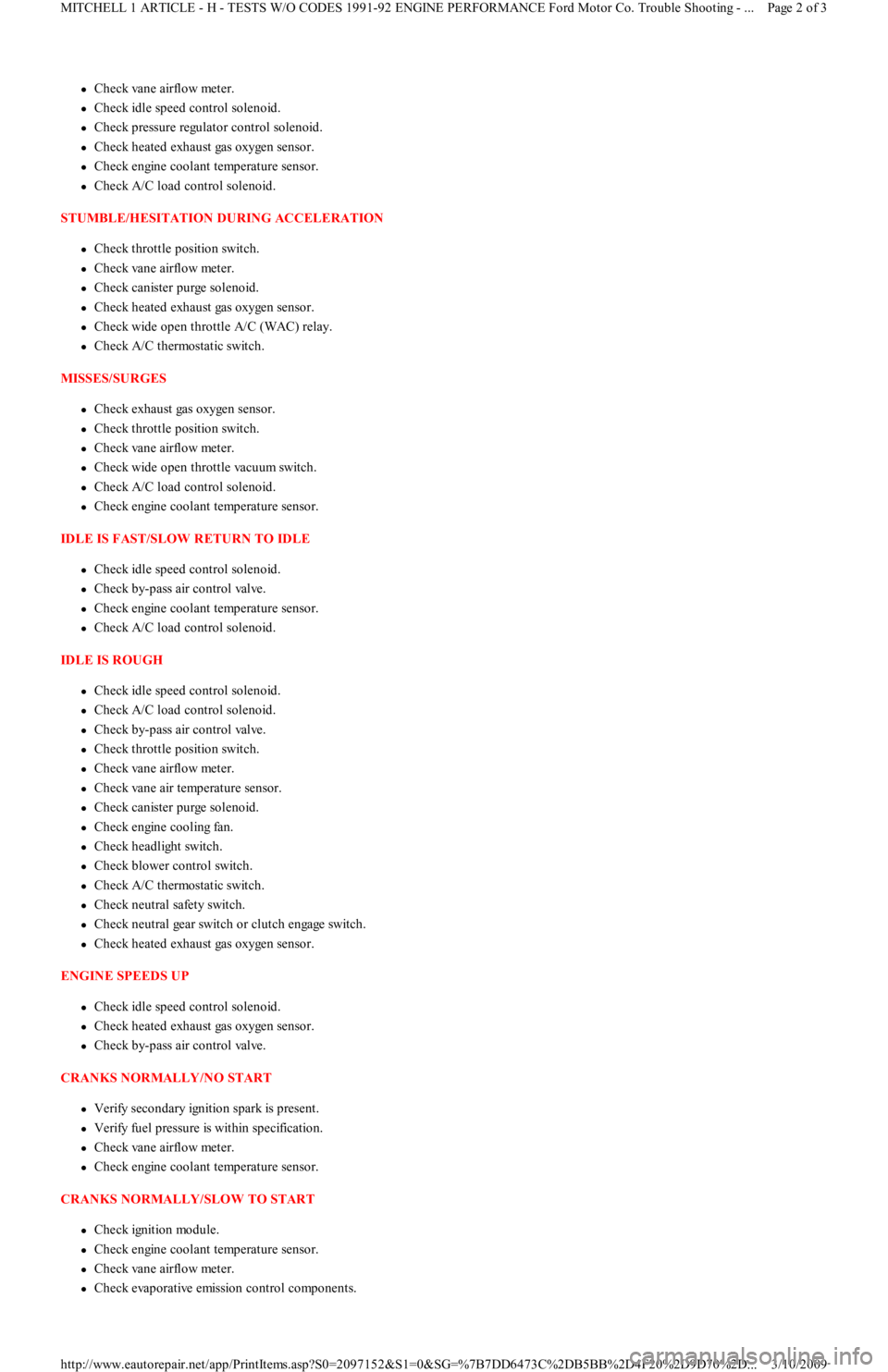
Check vane airflow meter.
Check idle speed control solenoid.
Check pressure regulator control solenoid.
Check heated exhaust gas oxygen sensor.
Check engine coolant temperature sensor.
Check A/C load control solenoid.
STUMBLE/HESITATION DURING ACCELERATION
Check throttle position switch.
Check vane airflow meter.
Check canister purge solenoid.
Check heated exhaust gas oxygen sensor.
Check wide open throttle A/C (WAC) relay.
Check A/C thermostatic switch.
MISSES/SURGES
Check exhaust gas oxygen sensor.
Check throttle position switch.
Check vane airflow meter.
Check wide open throttle vacuum switch.
Check A/C load control solenoid.
Check engine coolant temperature sensor.
IDLE IS FAST/SLOW RETURN TO IDLE
Check idle speed control solenoid.
Check by-pass air control valve.
Check engine coolant temperature sensor.
Check A/C load control solenoid.
IDLE IS ROUGH
Check idle speed control solenoid.
Check A/C load control solenoid.
Check by-pass air control valve.
Check throttle position switch.
Check vane airflow meter.
Check vane air temperature sensor.
Check canister purge solenoid.
Check engine cooling fan.
Check headlight switch.
Check blower control switch.
Check A/C thermostatic switch.
Check neutral safety switch.
Check neutral gear switch or clutch engage switch.
Check heated exhaust gas oxygen sensor.
ENGINE SPEEDS UP
Check idle speed control solenoid.
Check heated exhaust gas oxygen sensor.
Check by-pass air control valve.
CRANKS NORMALLY/NO START
Verify secondary ignition spark is present.
Verify fuel pressure is within specification.
Check vane airflow meter.
Check engine coolant temperature sensor.
CRANKS NORMALLY/SLOW TO START
Check ignition module.
Check engine coolant temperature sensor.
Check vane airflow meter.
Check evaporative emission control components.
Page 2 of 3 MITCHELL 1 ARTICLE - H - TESTS W/O CODES 1991-92 ENGINE PERFORMANCE Ford Motor Co. Trouble Shooting -
...
3/10/2009 http://www.eautorepair.net/app/PrintItems.asp?S0=2097152&S1=0&SG=%7B7DD6473C%2DB5BB%2D4F20%2D9D70%2D
...
Page 192 of 454
CLUTCH ENGAGE SWITCH (CES)
This switch is located on the manual transaxle and informs the ECA of transmission operating conditions. The ECA uses this data fo r id l e
speed control and canister purge valve operation.
CRANKSHAFT POSITION SENSOR (CPS) (FESTIVA)
This sensor is located in the distributor and sends engine RPM and crankshaft position data to the ECA. The ECA uses this data in calculating
fuel metering, ignition timing, idle speed control and canister purge valve operation.
CYLINDER IDENTIFICATION SENSOR (CID) (CAPRI)
This sensor is located in the distributor and provides crankshaft position data to the ECA. The ECA uses this data in calculating fuel metering
and ignition timing.
ELECTRICAL LOAD SWITCHES
Blower control, cooling fan, rear window defroster, air conditioning and headlight switches all send signals to the ECA. The ECA uses these
signals for idle speed control.
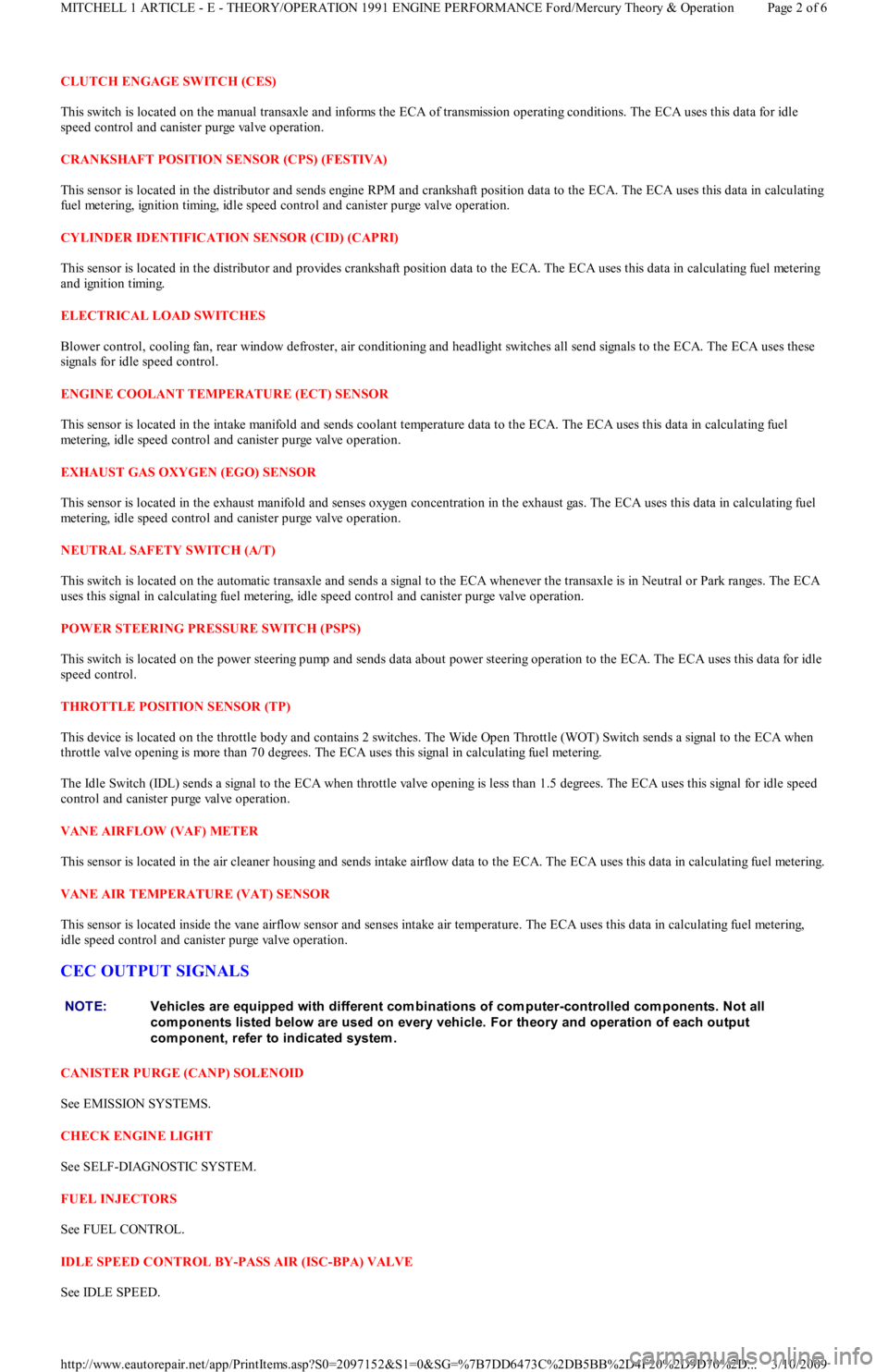
ENGINE COOLANT TEMPERATURE (ECT) SENSOR
This sensor is located in the intake manifold and sends coolant temperature data to the ECA. The ECA uses this data in calculating fuel
metering, idle speed control and canister purge valve operation.
EXHAUST GAS OXYGEN (EGO) SENSOR
This sensor is located in the exhaust manifold and senses oxygen concentration in the exhaust gas. The ECA uses this data in calculating fuel
metering, idle speed control and canister purge valve operation.
NEUTRAL SAFETY SWITCH (A/T)
This switch is located on the automatic transaxle and sends a signal to the ECA whenever the transaxle is in Neutral or Park ranges. The ECA
uses this signal in calculating fuel metering, idle speed control and canister purge valve operation.
POWER STEERING PRESSURE SWITCH (PSPS)
This switch is located on the power steering pump and sends data about power steering operation to the ECA. The ECA uses this data for idle
speed control.
THROTTLE POSITION SENSOR (TP)
This device is located on the throttle body and contains 2 switches. The Wide Open Throttle (WOT) Switch sends a signal to the ECA when
throttle valve opening is more than 70 degrees. The ECA uses this signal in calculating fuel metering.
The Idle Switch (IDL) sends a signal to the ECA when throttle valve opening is less than 1.5 degrees. The ECA uses this signal for idle speed
control and canister purge valve operation.
VANE AIRFLOW (VAF) METER
This sensor is located in the air cleaner housing and sends intake airflow data to the ECA. The ECA uses this data in calculating fuel metering.
VANE AIR TEMPERATURE (VAT) SENSOR
This sensor is located inside the vane airflow sensor and senses intake air temperature. The ECA uses this data in calculating fu el met erin g,
idle speed control and canister purge valve operation.
CEC OUTPUT SIGNALS
CANISTER PURGE (CANP) SOLENOID
See EMISSION SYSTEMS.
CHECK ENGINE LIGHT
See SELF-DIAGNOSTIC SYSTEM.
FUEL INJECTORS
See FUEL CONTROL.
IDLE SPEED CONTROL BY-PASS AIR (ISC-BPA) VALVE
See IDLE SPEED. NOTE:Vehicles are equipped with different com binations of com puter-controlled com ponents. Not all
com ponents listed below are used on every vehicle. For theory and operation of each output
com ponent, refer to indicated system .
Page 2 of 6 MITCHELL 1 ARTICLE - E - THEORY/OPERATION 1991 ENGINE PERFORMANCE Ford/Mercury Theory & Operation
3/10/2009 http://www.eautorepair.net/app/PrintItems.asp?S0=2097152&S1=0&SG=%7B7DD6473C%2DB5BB%2D4F20%2D9D70%2D
...
Page 202 of 454
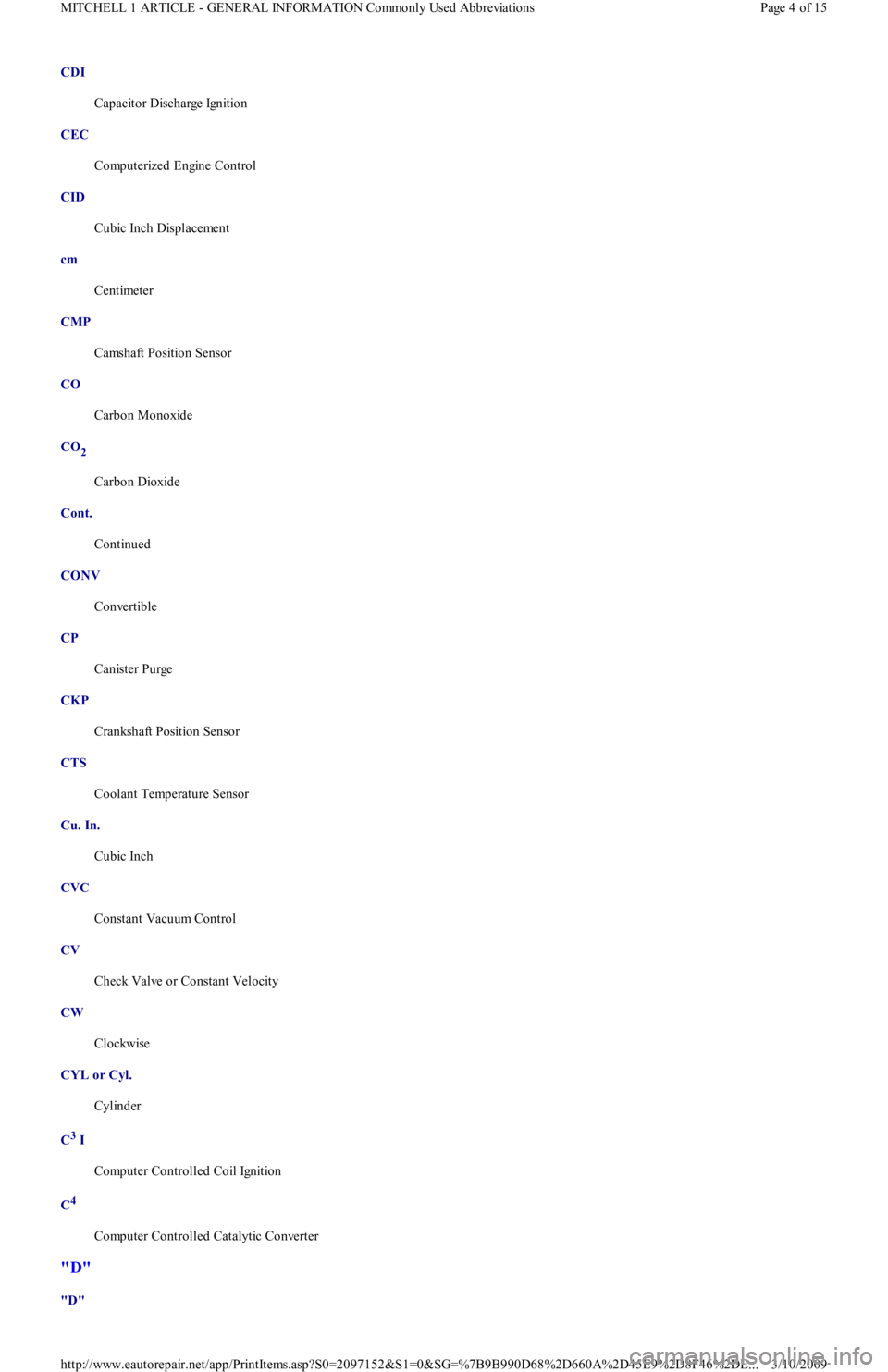
CDI
Capacitor Discharge Ignition
CEC
Computerized Engine Control
CID
Cubic Inch Displacement
cm
Centimeter
CMP
Camshaft Position Sensor
CO
Carbon Monoxide
CO
2
Carbon Dioxide
Cont.
Continued
CONV
Convertible
CP
Canister Purge
CKP
Crankshaft Position Sensor
CTS
Coolant Temperature Sensor
Cu. In.
Cubic Inch
CVC
Constant Vacuum Control
CV
Check Valve or Constant Velocity
CW
Clockwise
CYL or Cyl.
Cylinder
C
3 I
Computer Controlled Coil Ignition
C
4
Computer Controlled Catalytic Converter
"D"
"D"
Page 4 of 15 MITCHELL 1 ARTICLE - GENERAL INFORMATION Commonly Used Abbreviations
3/10/2009 http://www.eautorepair.net/app/PrintItems.asp?S0=2097152&S1=0&SG=%7B9B990D68%2D660A%2D45E9%2D8F46%2DE
...
Page 204 of 454
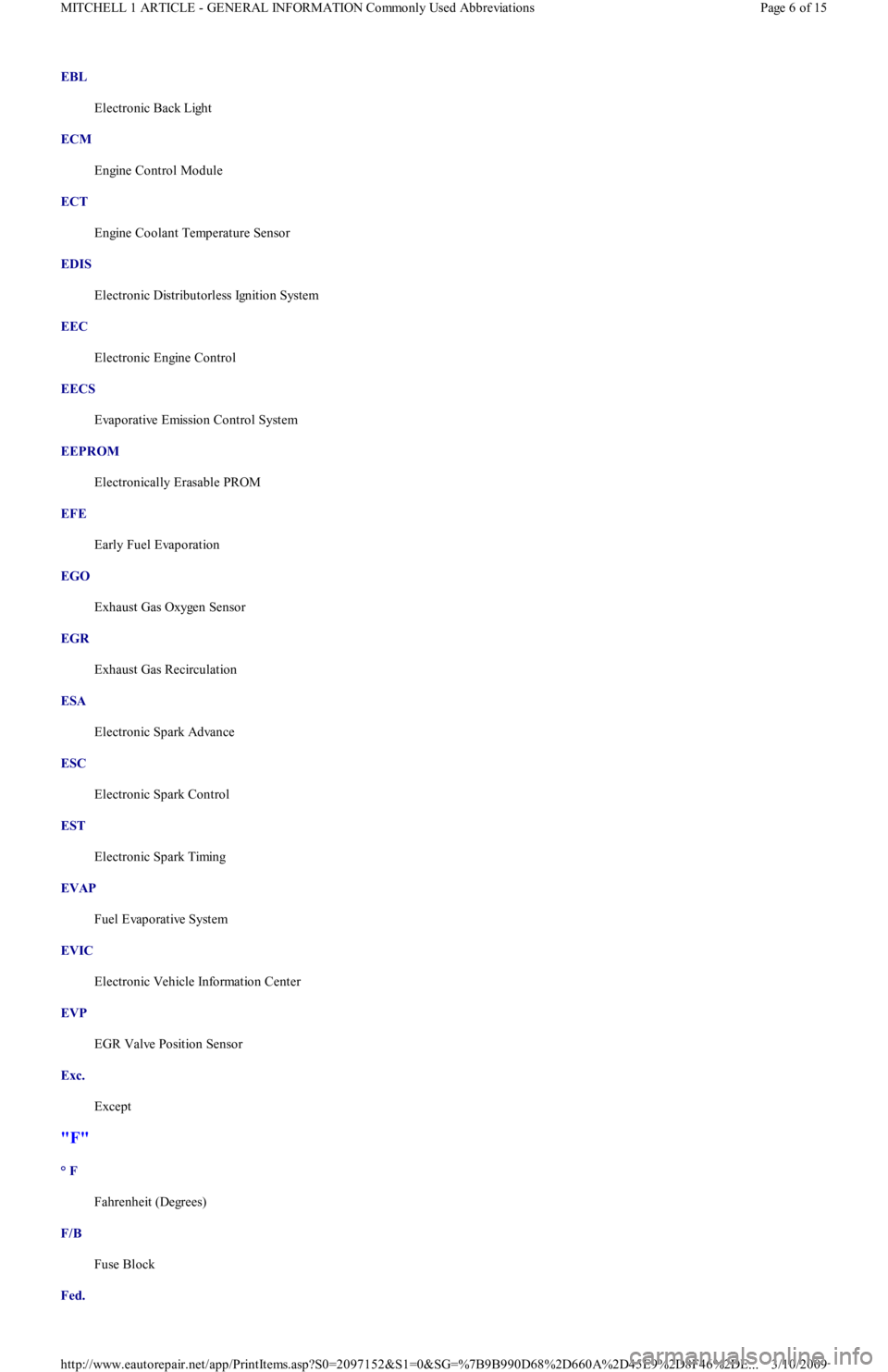
EBL
Electronic Back Light
ECM
Engine Control Module
ECT
Engine Coolant Temperature Sensor
EDIS
Electronic Distributorless Ignition System
EEC
Electronic Engine Control
EECS
Evaporative Emission Control System
EEPROM
Electronically Erasable PROM
EFE
Early Fuel Evaporation
EGO
Exhaust Gas Oxygen Sensor
EGR
Exhaust Gas Recirculation
ESA
Electronic Spark Advance
ESC
Electronic Spark Control
EST
Electronic Spark Timing
EVAP
Fuel Evaporative System
EVIC
Electronic Vehicle Information Center
EVP
EGR Valve Position Sensor
Exc.
Except
"F"
° F
Fahrenheit (Degrees)
F/B
Fuse Block
Fed.
Page 6 of 15 MITCHELL 1 ARTICLE - GENERAL INFORMATION Commonly Used Abbreviations
3/10/2009 http://www.eautorepair.net/app/PrintItems.asp?S0=2097152&S1=0&SG=%7B9B990D68%2D660A%2D45E9%2D8F46%2DE
...
Page 220 of 454
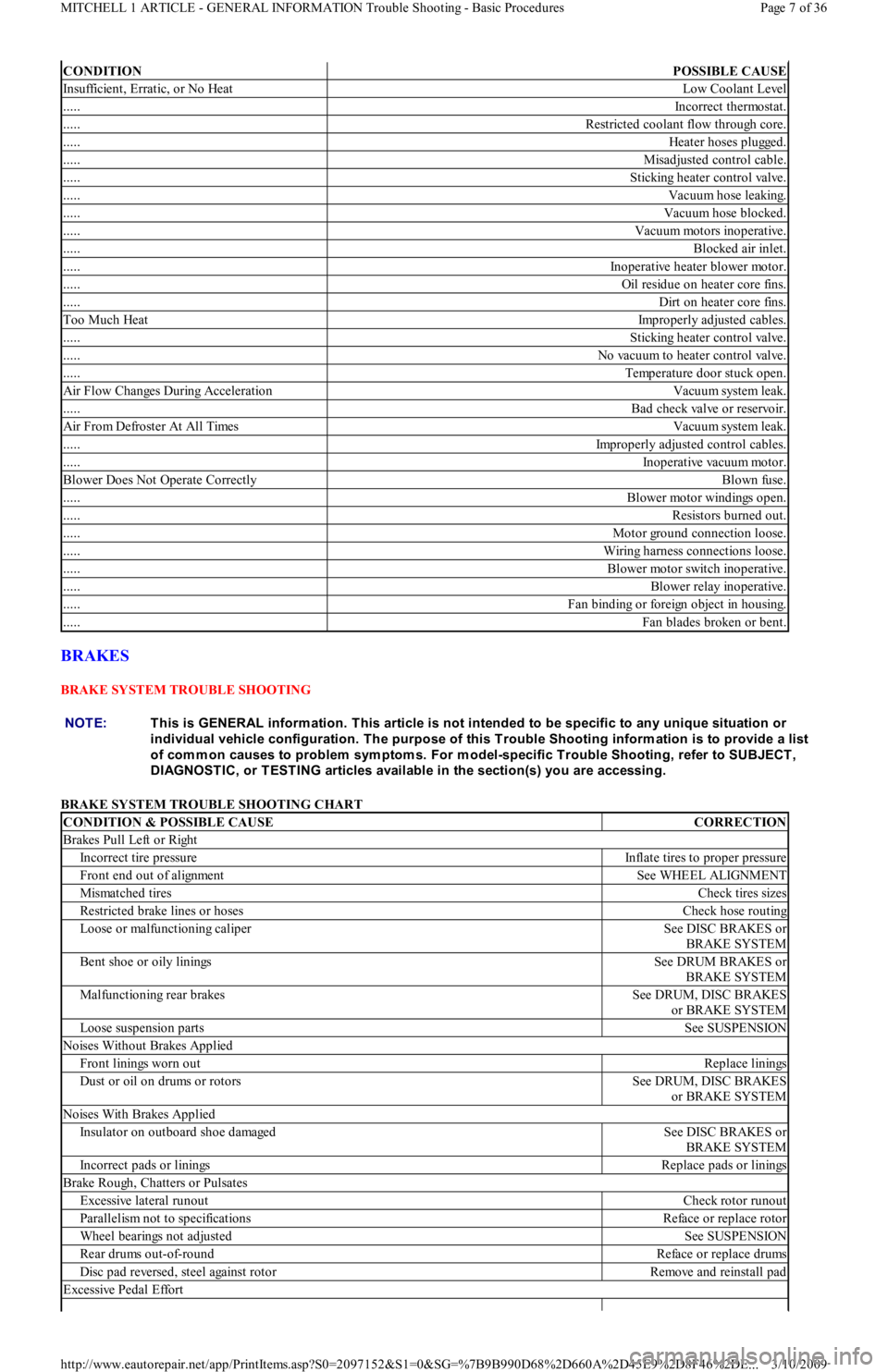
BRAKES
BRAKE SYSTEM TROUBLE SHOOTING
BRAKE SYSTEM TROUBLE SHOOTING CHART
CONDITIONPOSSIBLE CAUSE
Insufficient, Erratic, or No HeatLow Coolant Level
.....Incorrect thermostat.
.....Restricted coolant flow through core.
.....Heater hoses plugged.
.....Misadjusted control cable.
.....Sticking heater control valve.
.....Vacuum hose leaking.
.....Vacuum hose blocked.
.....Vacuum motors inoperative.
.....Blocked air inlet.
.....Inoperative heater blower motor.
.....Oil residue on heater core fins.
.....Dirt on heater core fins.
Too Much HeatImproperly adjusted cables.
.....Sticking heater control valve.
.....No vacuum to heater control valve.
.....Temperature door stuck open.
Air Flow Changes During AccelerationVacuum system leak.
.....Bad check valve or reservoir.
Air From Defroster At All TimesVacuum system leak.
.....Improperly adjusted control cables.
.....Inoperative vacuum motor.
Blower Does Not Operate CorrectlyBlown fuse.
.....Blower motor windings open.
.....Resistors burned out.
.....Motor ground connection loose.
.....Wiring harness connections loose.
.....Blower motor switch inoperative.
.....Blower relay inoperative.
.....Fan binding or foreign object in housing.
.....Fan blades broken or bent.
NOTE:This is GENERAL inform ation. This article is not intended to be specific to any unique situation or
individual vehicle configuration. T he purpose of this T rouble Shooting inform ation is to provide a list
of com m on causes to problem sym ptom s. For m odel-specific T rouble Shooting, refer to SUBJECT ,
DIAGNOST IC, or T EST ING articles available in the section(s) you are accessing.
CONDITION & POSSIBLE CAUSECORRECTION
Brakes Pull Left or Right
Incorrect tire pressureInflate tires to proper pressure
Front end out of alignmentSee WHEEL ALIGNMENT
Mismatched tiresCheck tires sizes
Restricted brake lines or hosesCheck hose routing
Loose or malfunctioning caliperSee DISC BRAKES or
BRAKE SYSTEM
Bent shoe or oily liningsSee DRUM BRAKES or
BRAKE SYSTEM
Malfunctioning rear brakesSee DRUM, DISC BRAKES
or BRAKE SYSTEM
Loose suspension partsSee SUSPENSION
Noises Without Brakes Applied
Front linings worn outReplace linings
Dust or oil on drums or rotorsSee DRUM, DISC BRAKES
or BRAKE SYSTEM
Noises With Brakes Applied
Insulator on outboard shoe damagedSee DISC BRAKES or
BRAKE SYSTEM
Incorrect pads or liningsReplace pads or linings
Brake Rough, Chatters or Pulsates
Excessive lateral runoutCheck rotor runout
Parallelism not to specificationsReface or replace rotor
Wheel bearings not adjustedSee SUSPENSION
Rear drums out-of-roundReface or replace drums
Disc pad reversed, steel against rotorRemove and reinstall pad
Excessive Pedal Effort
Page 7 of 36 MITCHELL 1 ARTICLE - GENERAL INFORMATION Trouble Shooting - Basic Procedures
3/10/2009 http://www.eautorepair.net/app/PrintItems.asp?S0=2097152&S1=0&SG=%7B9B990D68%2D660A%2D45E9%2D8F46%2DE
...
Page 230 of 454
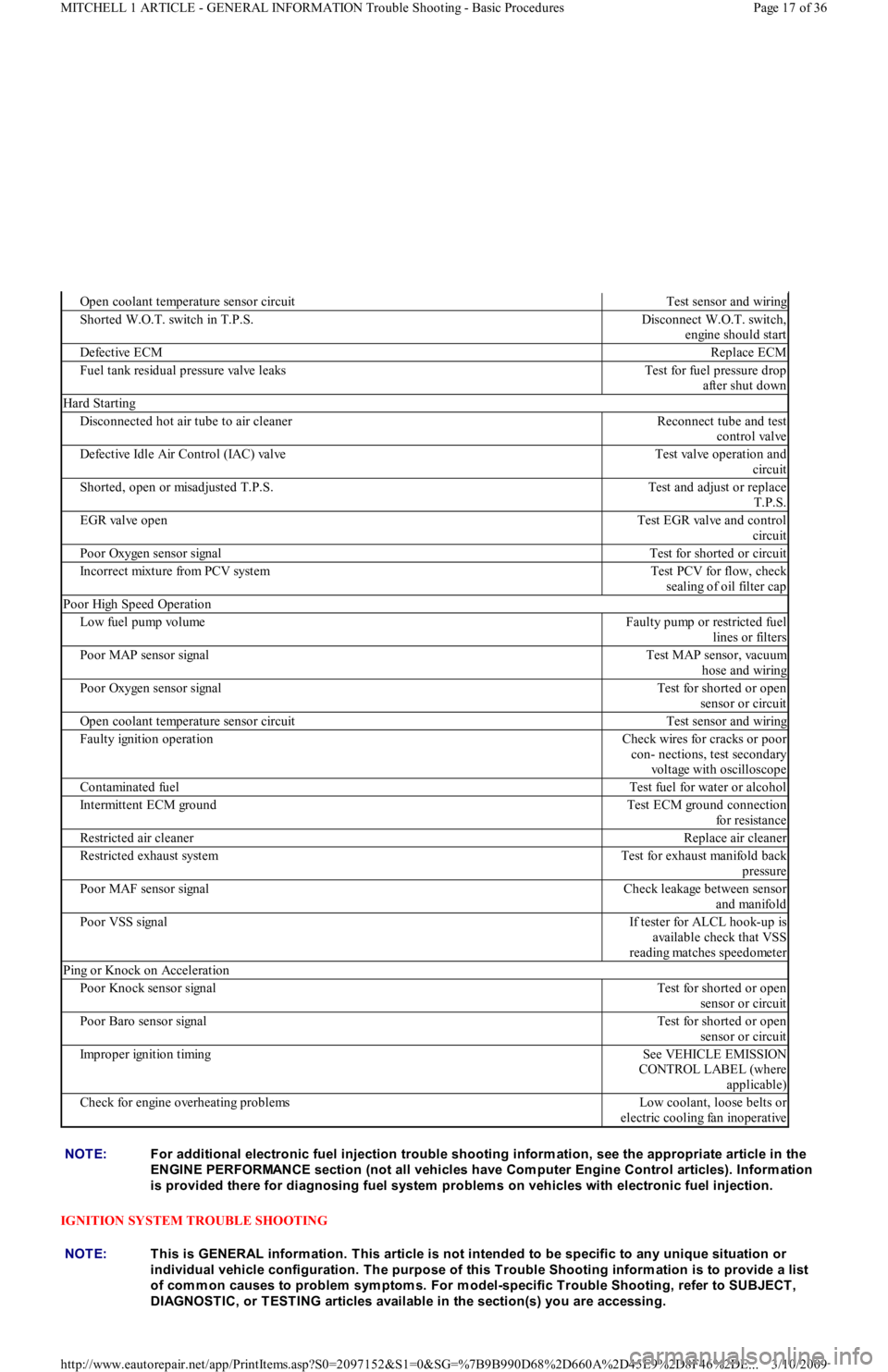
IGNITION SYSTEM TROUBLE SHOOTING
Open coolant temperature sensor circuitTest sensor and wiring
Shorted W.O.T. switch in T.P.S.Disconnect W.O.T. switch,
engine should start
Defective ECMReplace ECM
Fuel tank residual pressure valve leaksTest for fuel pressure drop
after shut down
Hard Starting
Disconnected hot air tube to air cleanerReconnect tube and test
control valve
Defective Idle Air Control (IAC) valveTest valve operation and
circuit
Shorted, open or misadjusted T.P.S.Test and adjust or replace
T.P.S.
EGR valve openTest EGR valve and control
circuit
Poor Oxygen sensor signalTest for shorted or circuit
Incorrect mixture from PCV systemTest PCV for flow, check
sealing of oil filter cap
Poor High Speed Operation
Low fuel pump volumeFaulty pump or restricted fuel
lines or filters
Poor MAP sensor signalTest MAP sensor, vacuum
hose and wiring
Poor Oxygen sensor signalTest for shorted or open
sensor or circuit
Open coolant temperature sensor circuitTest sensor and wiring
Faulty ignition operationCheck wires for cracks or poor
con- nections, test secondary
voltage with oscilloscope
Contaminated fuelTest fuel for water or alcohol
Intermittent ECM groundTest ECM ground connection
for resistance
Restricted air cleanerReplace air cleaner
Restricted exhaust systemTest for exhaust manifold back
pressure
Poor MAF sensor signalCheck leakage between sensor
and manifold
Poor VSS signalIf tester for ALCL hook-up is
available check that VSS
reading matches speedometer
Ping or Knock on Acceleration
Poor Knock sensor signalTest for shorted or open
sensor or circuit
Poor Baro sensor signalTest for shorted or open
sensor or circuit
Improper ignition timingSee VEHICLE EMISSION
CONTROL LABEL (where
applicable)
Check for engine overheating problemsLow coolant, loose belts or
electric cooling fan inoperative
NOTE:For additional electronic fuel injection trouble shooting inform ation, see the appropriate article in the
ENGINE PERFORMANCE section (not all vehicles have Com puter Engine Control articles). Inform ation
is provided there for diagnosing fuel system problem s on vehicles with electronic fuel injection.
NOTE:This is GENERAL inform ation. This article is not intended to be specific to any unique situation or
individual vehicle configuration. T he purpose of this T rouble Shooting inform ation is to provide a list
of com m on causes to problem sym ptom s. For m odel-specific T rouble Shooting, refer to SUBJECT ,
DIAGNOST IC, or T EST ING articles available in the section(s) you are accessing.
Page 17 of 36 MITCHELL 1 ARTICLE - GENERAL INFORMATION Trouble Shooting - Basic Procedures
3/10/2009 http://www.eautorepair.net/app/PrintItems.asp?S0=2097152&S1=0&SG=%7B9B990D68%2D660A%2D45E9%2D8F46%2DE
...
Page 268 of 454

Fig. 14: Typical Negative Backpressure EGR Valve
Courtesy of GENERAL MOTORS CORP.
Digital EGR Valve
The digital EGR valve operates independently of engine manifold vacuum. This valve controls EGR flow through 3 orifices. These 3 orifices
are opened and closed by electric solenoids. The solenoids are, in turn, controlled by the Electronic Control Module (ECM). When a
solenoid is energized, the armature with attached shaft and swivel pintle is lifted, opening the orifice. See Fig. 15
.
The ECM uses inputs from the Coolant Temperature Sensor (CTS), Throttle Position Sensor (TPS) and Mass Airflow (MAF) sensors to
control the EGR orifices to make 7 different combinations for precise EGR flow control. At idle, the EGR valve allows a very small amount of
exhaust gas to enter the intake manifold. This EGR valve normally operates above idle speed during warm engine operation.
Verify EGR valve is present and not modified or purposely damaged. Ensure thermal vacuum switches, pressure transducers, speed switches,
etc., (if applicable) are not by-passed or modified. Ensure vacuum hose(s) to EGR valve is not plugged. Ensure electrical connector to EGR
valve is not disconnected.
Page 8 of 12 MITCHELL 1 ARTICLE - EMISSION CONTROL VISUAL INSPECTION PROCEDURES 1983-93 GENERAL INFORMATI
...
3/10/2009 http://www.eautorepair.net/app/PrintItems.asp?S0=2097152&S1=0&SG=%7B9B990D68%2D660A%2D45E9%2D8F46%2DE
...
Page 345 of 454
Back To Article
HEAT ER SYST EM
1990-92 HEAT ER SYST EMS Ford Motor Co.
DESCRIPTION
The heater system consists of control panel, blower case, heater case, air control doors and ducts. The control panel incorporates 3 control
levers and a 3-speed fan switch. The control panel is located in the center of the instrument panel. All air control doors are cable operated
from the control panel.
The blower case is mounted on the bulkhead, behind the instrument panel on passenger's side of vehicle. The blower case houses a blower
motor, blower motor resistor and the fresh/recirculation air door. The heater case contains mode select door, temperature air mix door and
heater core.
OPERATION
Three control levers, temperature mix, fresh/recirculation and mode select, mechanically operate their associated cables and doors. The
temperature control lever adjusts the mix of fresh or recirculated air with heated air. In full heat position, all airflow goes through the heater
core.
In full cool position, the mix air door closes, allowing airflow to by-pass the heater core. The mode select lever, directs airflow to selected
vents. The fresh/recirculation control lever allows selection of fresh (outside) air or recirculated compartment air.
AJUSTMENT
FRESH/RECIRCULATION CONTROL CABLE
Remove the glove box. Remove fresh/recirculation cable retaining clip. Move control lever to RECIRCULATION position, while holding the
lever door in RECIRCULATION position. Ensure control lever does not move. Install fresh/recirculation cable retaining clip.
MODE SELECT CABLE
Remove mode select cable retaining clip. Move mode select lever to VENT position. Hold mode select lever downward against its stop.
Ensure that mode select lever does not move. Install mode select cable retaining clip.
TEMPERATURE CONTROL CABLE
Set temperature control lever to maximum cold position. Remove temperature cable retaining clip. Hold temperature control lever upward and
against its stop. Ensure that temperature lever does not move. Install temperature cable retaining clip.
TROUBLE SHOOTING
BLOWER MOTOR INOPERATIVE
Check blown motor fuse. Check for defective blower motor and/or blower motor resistor. Check blower motor switch. Check for open in
ground wire. Check for loose electrical connectors or poor connections. See WIRING DIAGRAMS
in this article.
BLOWER DOES NOT CHANGE SPEED
Check for defective blower motor. Check blower motor wiring harness. Check blower motor resistor. Check for blower motor fan switch. See
WIRING DIAGRAMS
in this article.
BLOWER RUNS CONSTANTLY
Check for defective blower motor resistor. Check for short in blower switch or wiring. See WIRING DIAGRAMS
in this article.
HEATER TEMPERATURE INSUFFICIENT
Check for proper coolant level. Check water pump for noise, leaks or wear. Check heater hoses for leaks or restrictions. Check heater core for
leaks, plugs or restrictions. Check inlet and outlet heater hoses for hot water flow. Check thermostat condition and operation. Check air mix
door position and adjust cable if necessary.
IMPROPER WARM AIR DISTRIBUTION
Check air mix door position. Adjust cable as necessary. Check function control door position. Adjust cable as necessary. Check for restriction
in ventilation air duct assembly. Repair as necessary.
TESTING BLOWER MOTOR & RESISTOR
1. Ensure 15-amp blower motor fuse is okay. Using voltmeter, check for battery voltage at blower motor Blue/Yellow terminal. If battery
voltage is present, go to next step. If battery voltage is not present, repair open in Blue/Yellow wire between blower motor and fuse box.
2. Disconnect blower motor connector. Using a jumper wire, apply battery voltage to Blue/Yellow terminal and ground the Blue/Red
terminal. If blower motor does not run, replace blower motor. If blower motor runs, go to next step.
3. Reconnect blower motor connector. Turn ignition on. Turn blower motor off. Disconnect the blower motor resistor connector. Using a
voltmeter, measure voltage at Blue/Red terminal of resistor connector. If battery voltage is not present, repair open in Blue/Red wire
between resistor and blower motor. If voltage is present, go to next step.
4. Using a jumper wire, ground Blue/Black, Blue/Yellow and Blue/White terminals of the blower fan switch one at a time. If the motor
runs at 3 different speeds, go to next step. If not, repair open in wire that failed to operate blower motor.
Page 1 of 4 MITCHELL 1 ARTICLE - HEATER SYSTEM 1990-92 HEATER SYSTEMS Ford Motor Co.
3/10/2009 http://www.eautorepair.net/app/PrintItems.asp?S0=2097152&S1=0&SG=%7B9B990D68%2D660A%2D45E9%2D8F46%2DE
...