Body FORD FESTIVA 1991 Owner's Manual
[x] Cancel search | Manufacturer: FORD, Model Year: 1991, Model line: FESTIVA, Model: FORD FESTIVA 1991Pages: 454, PDF Size: 9.53 MB
Page 149 of 454
VANE AIRFLOW (VAF) METER
Removal
1. Disconnect negative battery cable. On Capri, disconnect primary and secondary wires from coil. On Festiva, disconnect VAF wire
harness connector. Remove air duct.
2. On Capri, remove retaining bolt and ground wire from air cleaner cover. Remove air cleaner cover bolts and air cleaner cover. From
inside of air cleaner cover, remove VAF meter retaining nuts. On Festiva, remove attaching bolt and 4 nuts. Remove vane airflow met er.
Installation
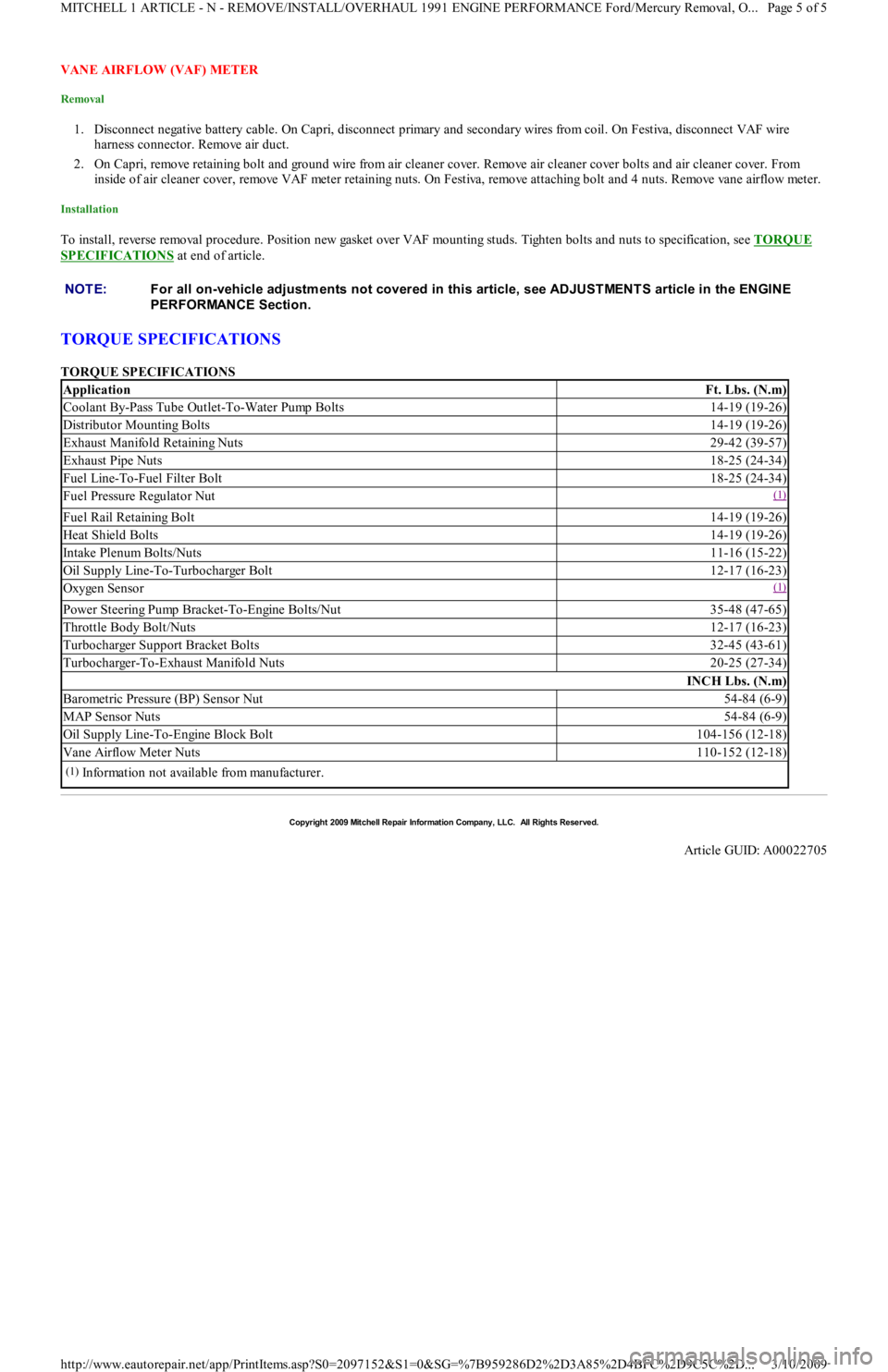
To install, reverse removal procedure. Position new gasket over VAF mounting studs. Tighten bolts and nuts to specification, see TORQUE
SPECIFICATIONS at end of article.
TORQUE SPECIFICATIONS
TORQUE SPECIFICATIONS NOTE:For all on-vehicle adjustm ents not covered in this article, see ADJUST MENT S article in the ENGINE
PERFORMANCE Section.
ApplicationFt. Lbs. (N.m)
Coolant By-Pass Tube Outlet-To-Water Pump Bolts14-19 (19-26)
Distributor Mounting Bolts14-19 (19-26)
Exhaust Manifold Retaining Nuts29-42 (39-57)
Exhaust Pipe Nuts18-25 (24-34)
Fuel Line-To-Fuel Filter Bolt18-25 (24-34)
Fuel Pressure Regulator Nut(1)
Fuel Rail Retaining Bolt14-19 (19-26)
Heat Shield Bolts14-19 (19-26)
Intake Plenum Bolts/Nuts11-16 (15-22)
Oil Supply Line-To-Turbocharger Bolt12-17 (16-23)
Oxygen Sensor(1)
Power Steering Pump Bracket-To-Engine Bolts/Nut35-48 (47-65)
Throttle Body Bolt/Nuts12-17 (16-23)
Turbocharger Support Bracket Bolts32-45 (43-61)
Turbocharger-To-Exhaust Manifold Nuts20-25 (27-34)
INCH Lbs. (N.m)
Barometric Pressure (BP) Sensor Nut54-84 (6-9)
MAP Sensor Nuts54-84 (6-9)
Oil Supply Line-To-Engine Block Bolt104-156 (12-18)
Vane Airflow Meter Nuts110-152 (12-18)
(1)Information not available from manufacturer.
Copyr ight 2009 Mitchell Repair Information Company, LLC. All Rights Reserved.
Article GUID: A00022705
Page 5 of 5 MITCHELL 1 ARTICLE - N - REMOVE/INSTALL/OVERHAUL 1991 ENGINE PERFORMANCE Ford/Mercury Removal, O
...
3/10/2009 http://www.eautorepair.net/app/PrintItems.asp?S0=2097152&S1=0&SG=%7B959286D2%2D3A85%2D4BFC%2D9C5C%2D
...
Page 162 of 454
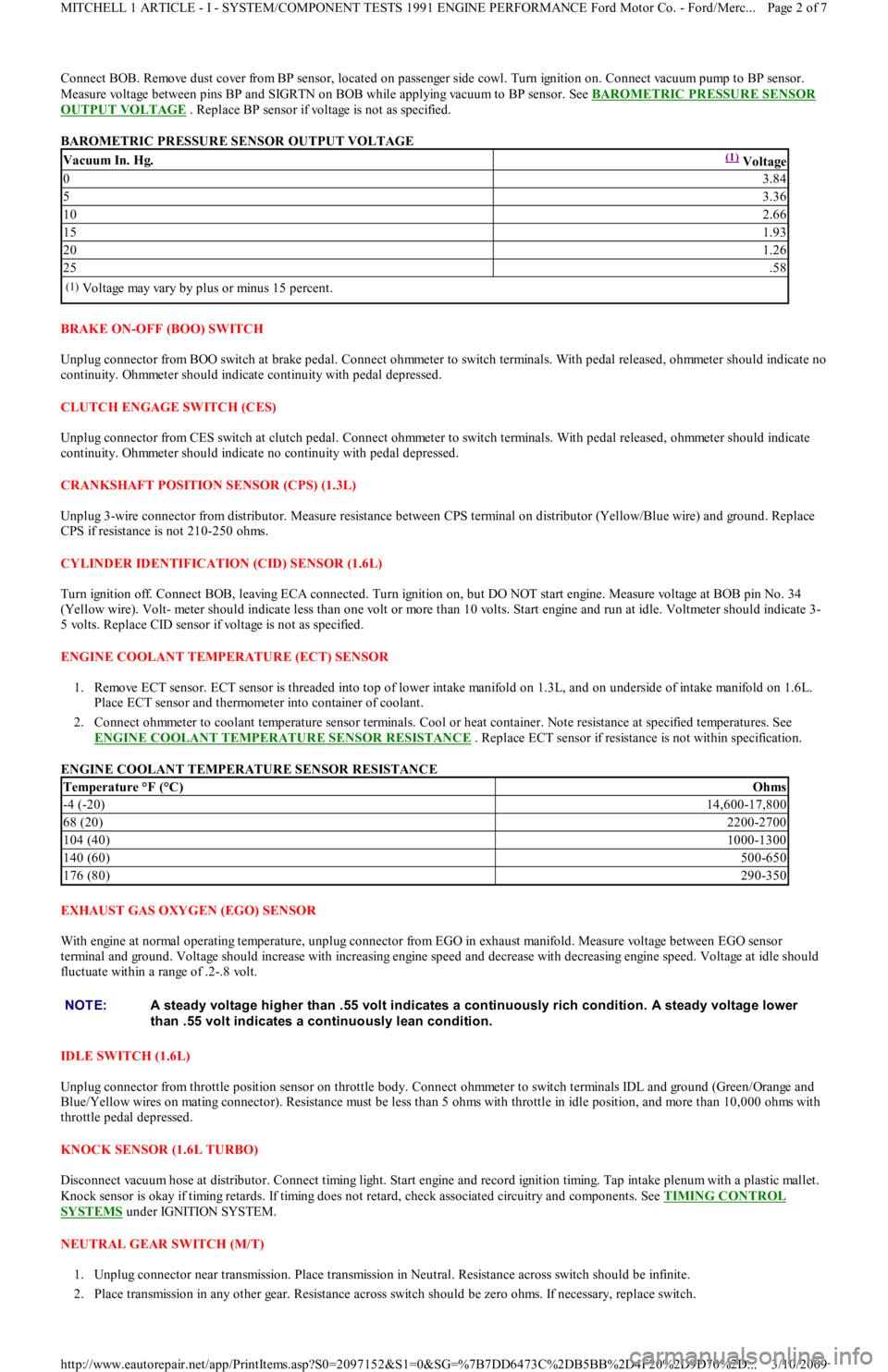
Connect BOB. Remove dust cover from BP sensor, located on passenger side cowl. Turn ignition on. Connect vacuum pump to BP sensor.
Measure voltage between pins BP and SIGRTN on BOB while applying vacuum to BP sensor. See BAROMETRIC PRESSURE SENSOR
OUTPUT VOLTAGE . Replace BP sensor if voltage is not as specified.
BAROMETRIC PRESSURE SENSOR OUTPUT VOLTAGE
BRAKE ON-OFF (BOO) SWITCH
Unplug connector from BOO switch at brake pedal. Connect ohmmeter to switch terminals. With pedal released, ohmmeter should indicate no
continuity. Ohmmeter should indicate continuity with pedal depressed.
CLUTCH ENGAGE SWITCH (CES)
Unplug connector from CES switch at clutch pedal. Connect ohmmeter to switch terminals. With pedal released, ohmmeter should indicate
continuity. Ohmmeter should indicate no continuity with pedal depressed.
CRANKSHAFT POSITION SENSOR (CPS) (1.3L)
Unplug 3-wire connector from distributor. Measure resistance between CPS terminal on distributor (Yellow/Blue wire) and ground. Replace
CPS if resistance is not 210-250 ohms.
CYLINDER IDENTIFICATION (CID) SENSOR (1.6L)
Turn ignition off. Connect BOB, leaving ECA connected. Turn ignition on, but DO NOT start engine. Measure voltage at BOB pin No. 34
(Yellow wire). Volt- meter should indicate less than one volt or more than 10 volts. Start engine and run at idle. Voltmeter should indicate 3-
5 volts. Replace CID sensor if voltage is not as specified.
ENGINE COOLANT TEMPERATURE (ECT) SENSOR
1. Remove ECT sensor. ECT sensor is threaded into top of lower intake manifold on 1.3L, and on underside of intake manifold on 1.6L.
Place ECT sensor and thermometer into container of coolant.
2. Connect ohmmeter to coolant temperature sensor terminals. Cool or heat container. Note resistance at specified temperatures. See
ENGINE COOLANT TEMPERATURE SENSOR RESISTANCE
. Replace ECT sensor if resistance is not within specification.
ENGINE COOLANT TEMPERATURE SENSOR RESISTANCE
EXHAUST GAS OXYGEN (EGO) SENSOR
With engine at normal operating temperature, unplug connector from EGO in exhaust manifold. Measure voltage between EGO sensor
terminal and ground. Voltage should increase with increasing engine speed and decrease with decreasing engine speed. Voltage at idle should
fluctuate within a range of .2-.8 volt.
IDLE SW ITCH (1.6L)
Unplug connector from throttle position sensor on throttle body. Connect ohmmeter to switch terminals IDL and ground (Green/Orange and
Blue/Yellow wires on mating connector). Resistance must be less than 5 ohms with throttle in idle position, and more than 10,000 ohms with
throttle pedal depressed.
KNOCK SENSOR (1.6L TURBO)
Disconnect vacuum hose at distributor. Connect timing light. Start engine and record ignition timing. Tap intake plenum with a plastic mallet.
Knock sensor is okay if timing retards. If timing does not retard, check associated circuitry and components. See TIMING CONTROL
SYSTEMS under IGNITION SYSTEM.
NEUTRAL GEAR SWITCH (M/T)
1. Unplug connector near transmission. Place transmission in Neutral. Resistance across switch should be infinite.
2. Place transmission in any other gear. Resistance across switch should be zero ohms. If necessary, replace switch.
Vacuum In. Hg.(1) Voltage
03.84
53.36
102.66
151.93
201.26
25.58
(1)Voltage may vary by plus or minus 15 percent.
Temperature °F (°C)Ohms
-4 (-20)14,600-17,800
68 (20)2200-2700
104 (40)1000-1300
140 (60)500-650
176 (80)290-350
NOTE:A steady voltage higher than .55 volt indicates a continuously rich condition. A steady voltage lower
than .55 volt indicates a continuously lean condition.
Page 2 of 7 MITCHELL 1 ARTICLE - I - SYSTEM/COMPONENT TESTS 1991 ENGINE PERFORMANCE Ford Motor Co. - Ford/Merc
...
3/10/2009 http://www.eautorepair.net/app/PrintItems.asp?S0=2097152&S1=0&SG=%7B7DD6473C%2DB5BB%2D4F20%2D9D70%2D
...
Page 163 of 454
POWER STEERING PRESSURE SWITCH
1. Start engine and run it at idle. Remove connector from switch. Connect ohmmeter to switch terminals. Turn steering wheel from side to
side while observing ohmmeter.
2. Replace power steering switch if continuity does not exist with front wheels turned, or if continuity exists with wheels straight ahead.
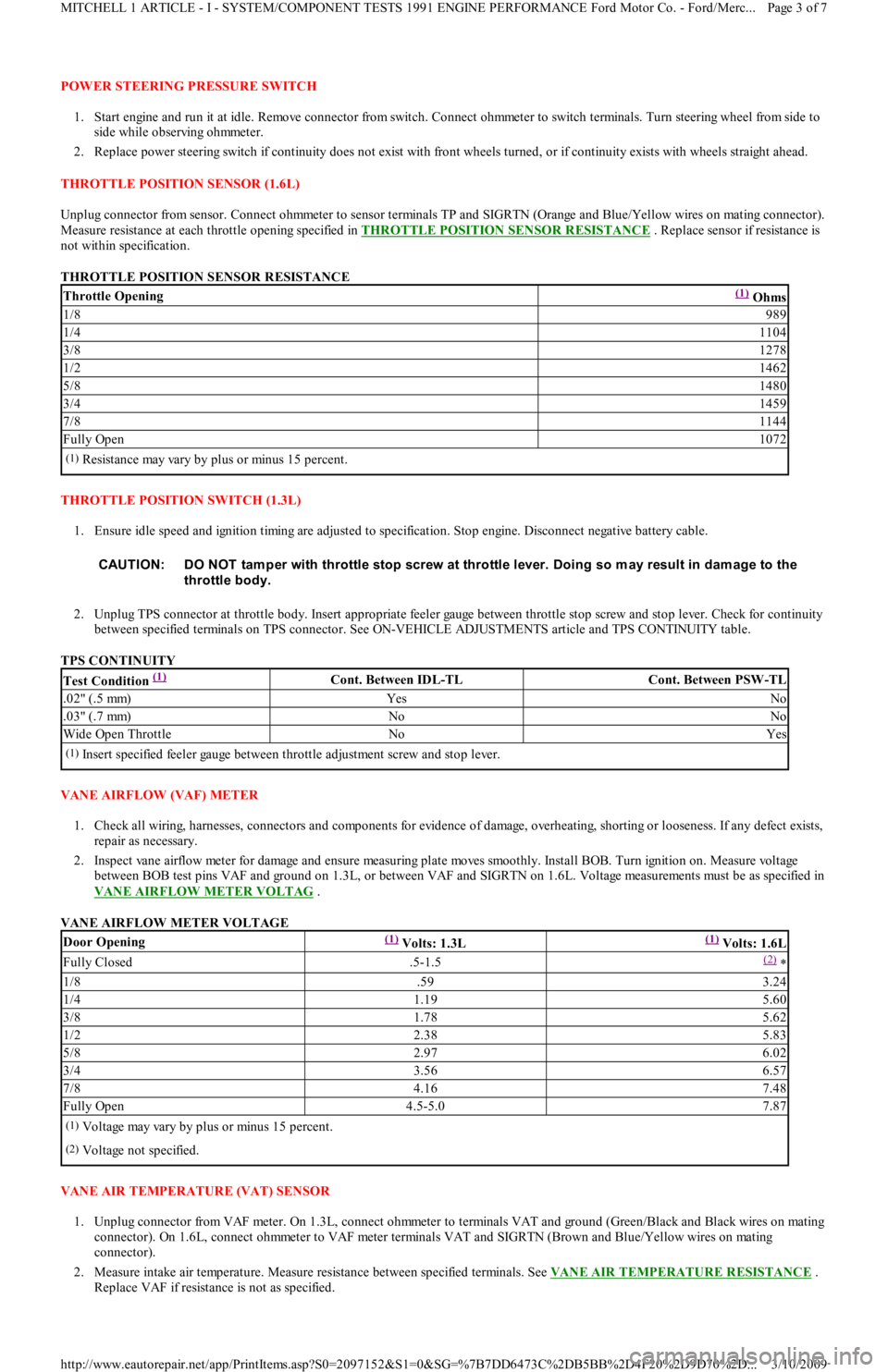
THROTTLE POSITION SENSOR (1.6L)
Unplug connector from sensor. Connect ohmmeter to sensor terminals TP and SIGRTN (Orange and Blue/Yellow wires on mating connector).
Measure resistance at each throttle opening specified in THROTTLE POSITION SENSOR RESISTANCE
. Replace sensor if resistance is
not within specification.
THROTTLE POSITION SENSOR RESISTANCE
THROTTLE POSITION SWITCH (1.3L)
1. Ensure idle speed and ignition timing are adjusted to specification. Stop engine. Disconnect negative battery cable.
2. Unplug TPS connector at throttle body. Insert appropriate feeler gauge between throttle stop screw and stop lever. Check for continuity
between specified terminals on TPS connector. See ON-VEHICLE ADJUSTMENTS article and TPS CONTINUITY table.
TPS CONTINUITY
VANE AIRFLOW (VAF) METER
1. Check all wiring, harnesses, connectors and components for evidence of damage, overheating, shorting or looseness. If any defect exists,
repair as necessary.
2. Inspect vane airflow meter for damage and ensure measuring plate moves smoothly. Install BOB. Turn ignition on. Measure voltage
between BOB test pins VAF and ground on 1.3L, or between VAF and SIGRTN on 1.6L. Voltage measurements must be as specified in
VANE AIRFLOW METER VOLTAG
.
VANE AIRFLOW METER VOLTAGE
VANE AIR TEMPERATURE (VAT) SENSOR
1. Unplug connector from VAF meter. On 1.3L, connect ohmmeter to terminals VAT and ground (Green/Black and Black wires on mating
connector). On 1.6L, connect ohmmeter to VAF meter terminals VAT and SIGRTN (Brown and Blue/Yellow wires on mating
connector).
2. Measure intake air temperature. Measure resistance between specified terminals. See VANE AIR TEMPERATURE RESISTANCE
.
Replace VAF if resistance is not as specified.
Throttle Opening(1) Ohms
1/8989
1/41104
3/81278
1/21462
5/81480
3/41459
7/81144
Fully Open1072
(1)Resistance may vary by plus or minus 15 percent.
CAUT ION: DO NOT tam per with throttle stop screw at throttle lever. Doing so m ay result in dam age to the
throttle body.
Test Condition (1) Cont. Between IDL-TLCont. Between PSW-TL
.02" (.5 mm)YesNo
.03" (.7 mm)NoNo
Wide Open ThrottleNoYes
(1)Insert specified feeler gauge between throttle adjustment screw and stop lever.
Door Opening(1) Volts: 1.3L(1) Volts: 1.6L
Fully Closed.5-1.5(2) *
1/8.593.24
1/41.195.60
3/81.785.62
1/22.385.83
5/82.976.02
3/43.566.57
7/84.167.48
Fully Open4.5-5.07.87
(1)Voltage may vary by plus or minus 15 percent.
(2)Voltage not specified.
Page 3 of 7 MITCHELL 1 ARTICLE - I - SYSTEM/COMPONENT TESTS 1991 ENGINE PERFORMANCE Ford Motor Co. - Ford/Merc
...
3/10/2009 http://www.eautorepair.net/app/PrintItems.asp?S0=2097152&S1=0&SG=%7B7DD6473C%2DB5BB%2D4F20%2D9D70%2D
...
Page 176 of 454
specified, go to next step.
2. Unplug VSS connector at instrument cluster. Measure resistance between VSS and GND terminals on instrument cluster. Rotate
speedometer cable. If resistance drops to less than 5 ohms 4 times for each revolution of speedometer cable, repair VSS signal wire to
4EAT. If resistance does not drop as specified, replace speedometer assembly.
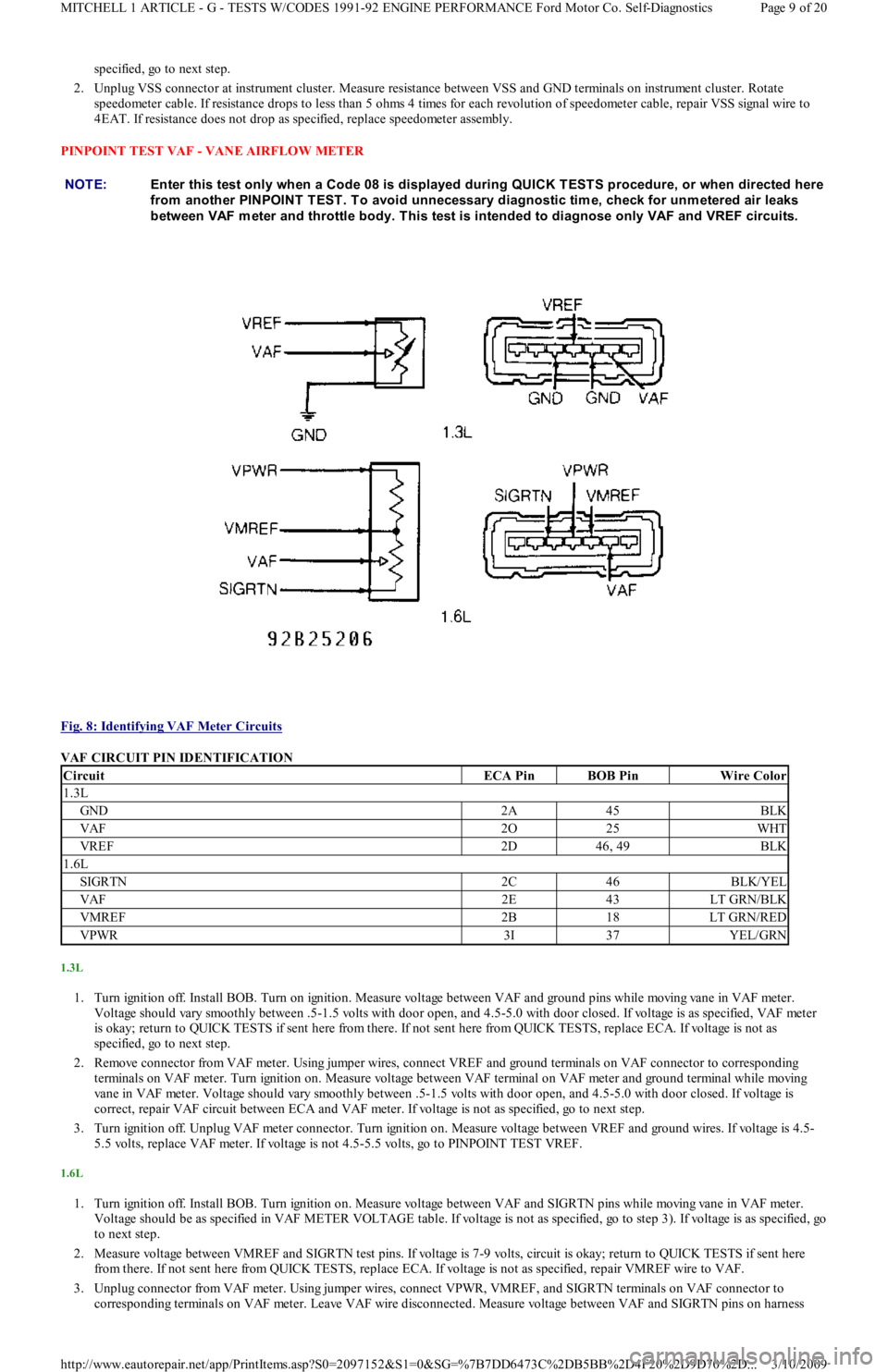
PINPOINT TEST VAF - VANE AIRFLOW METER
Fig. 8: Identifying VAF Meter Circuits
VAF CIRCUIT PIN IDENTIFICATION
1.3L
1. Turn ignition off. Install BOB. Turn on ignition. Measure voltage between VAF and ground pins while moving vane in VAF meter.
Voltage should vary smoothly between .5-1.5 volts with door open, and 4.5-5.0 with door closed. If voltage is as specified, VAF met er
is okay; return to QUICK TESTS if sent here from there. If not sent here from QUICK TESTS, replace ECA. If voltage is not as
specified, go to next step.
2. Remove connector from VAF meter. Using jumper wires, connect VREF and ground terminals on VAF connector to corresponding
terminals on VAF meter. Turn ignition on. Measure voltage between VAF terminal on VAF meter and ground terminal while moving
vane in VAF meter. Voltage should vary smoothly between .5-1.5 volts with door open, and 4.5-5.0 with door closed. If voltage is
correct, repair VAF circuit between ECA and VAF meter. If voltage is not as specified, go to next step.
3. Turn ignition off. Unplug VAF meter connector. Turn ignition on. Measure voltage between VREF and ground wires. If voltage is 4.5-
5.5 volts, replace VAF meter. If voltage is not 4.5-5.5 volts, go to PINPOINT TEST VREF.
1.6L
1. Turn ignition off. Install BOB. Turn ignition on. Measure voltage between VAF and SIGRTN pins while moving vane in VAF meter.
Voltage should be as specified in VAF METER VOLTAGE table. If voltage is not as specified, go to step 3). If voltage is as specified, go
to next step.
2. Measure voltage between VMREF and SIGRTN test pins. If voltage is 7-9 volts, circuit is okay; return to QUICK TESTS if sent here
from there. If not sent here from QUICK TESTS, replace ECA. If voltage is not as specified, repair VMREF wire to VAF.
3. Unplug connector from VAF meter. Using jumper wires, connect VPWR, VMREF, and SIGRTN terminals on VAF connector to
corresponding terminals on VAF meter. Leave VAF wire disconnected. Measure voltage between VAF and SIGRTN pins on harness NOTE:Enter this test only when a Code 08 is displayed during QUICK TESTS procedure, or when directed here
from another PINPOINT T EST . T o avoid unnecessary diagnostic tim e, check for unm etered air leaks
between VAF m eter and throttle body. T his test is intended to diagnose only VAF and VREF circuits.
CircuitECA PinBOB PinWire Color
1.3L
GND2A45BLK
VAF2O25WHT
VREF2D46, 49BLK
1.6L
SIGRTN2C46BLK/YEL
VAF2E43LT GRN/BLK
VMREF2B18LT GRN/RED
VPWR3I37YEL/GRN
Page 9 of 20 MITCHELL 1 ARTICLE - G - TESTS W/CODES 1991-92 ENGINE PERFORMANCE Ford Motor Co. Self-Diagnostics
3/10/2009 http://www.eautorepair.net/app/PrintItems.asp?S0=2097152&S1=0&SG=%7B7DD6473C%2DB5BB%2D4F20%2D9D70%2D
...
Page 179 of 454
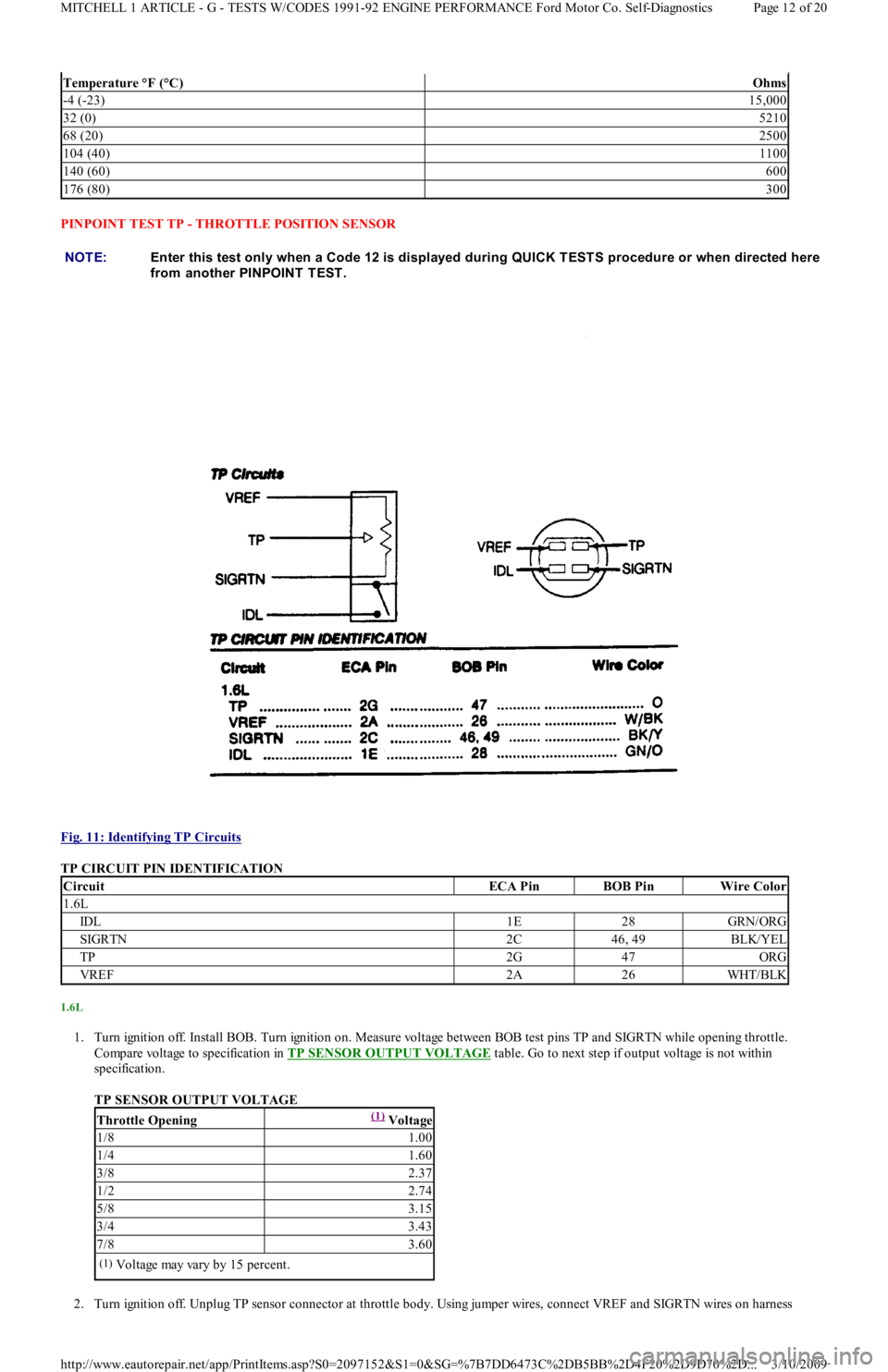
PINPOINT TEST TP - THROTTLE POSITION SENSOR
Fig. 11: Identifying TP Circuits
TP CIRCUIT PIN IDENTIFICATION
1.6L
1. Turn ignition off. Install BOB. Turn ignition on. Measure voltage between BOB test pins TP and SIGRTN while opening throttle.
Compare voltage to specification in TP SENSOR OUTPUT VOLTAGE
table. Go to next step if output voltage is not within
specification.
TP SENSOR OUTPUT VOLTAGE
2. Turn ignition off. Unplug TP sensor connector at throttle body. Using jumper wires, connect VREF and SIGRTN wires on harness
Temperature °F (°C)Ohms
-4 (-23)15,000
32 (0)5210
68 (20)2500
104 (40)1100
140 (60)600
176 (80)300
NOTE:Enter this test only when a Code 12 is displayed during QUICK T EST S procedure or when directed here
from another PINPOINT TEST.
CircuitECA PinBOB PinWire Color
1.6L
IDL1E28GRN/ORG
SIGRTN2C46, 49BLK/YEL
TP2G47ORG
VREF2A26WHT/BLK
Throttle Opening(1) Voltage
1/81.00
1/41.60
3/82.37
1/22.74
5/83.15
3/43.43
7/83.60
(1)Voltage may vary by 15 percent.
Page 12 of 20 MITCHELL 1 ARTICLE - G - TESTS W/CODES 1991-92 ENGINE PERFORMANCE Ford Motor Co. Self-Diagnostics
3/10/2009 http://www.eautorepair.net/app/PrintItems.asp?S0=2097152&S1=0&SG=%7B7DD6473C%2DB5BB%2D4F20%2D9D70%2D
...
Page 182 of 454
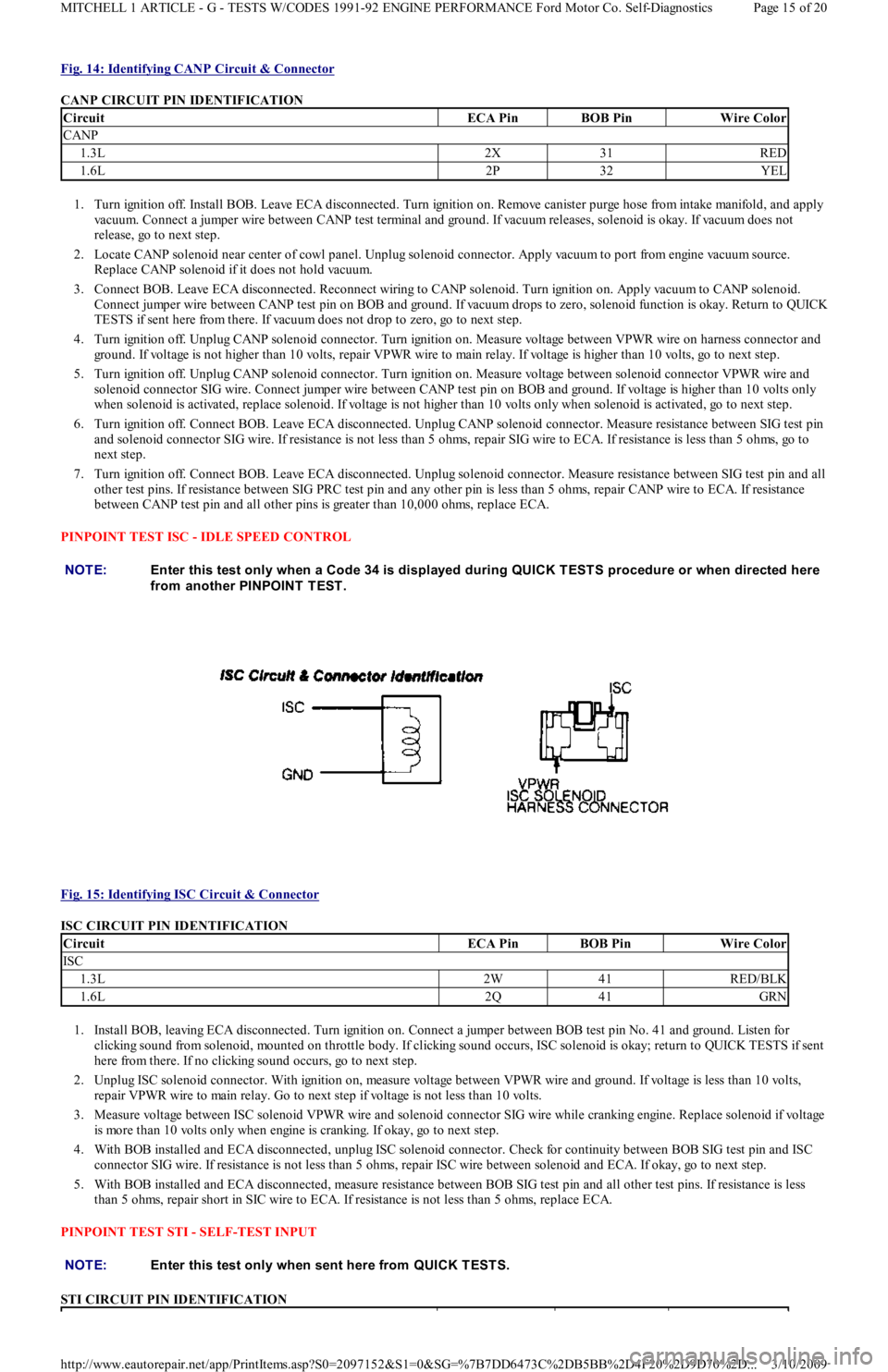
Fig. 14: Identifying CANP Circuit & Connector
CANP CIRCUIT PIN IDENTIFICATION
1. Turn ignition off. Install BOB. Leave ECA disconnected. Turn ignition on. Remove canister purge hose from intake manifold, and apply
vacuum. Connect a jumper wire between CANP test terminal and ground. If vacuum releases, solenoid is okay. If vacuum does not
release, go to next step.
2. Locate CANP solenoid near center of cowl panel. Unplug solenoid connector. Apply vacuum to port from engine vacuum source.
Replace CANP solenoid if it does not hold vacuum.
3. Connect BOB. Leave ECA disconnected. Reconnect wiring to CANP solenoid. Turn ignition on. Apply vacuum to CANP solenoid.
Connect jumper wire between CANP test pin on BOB and ground. If vacuum drops to zero, solenoid function is okay. Return to QUIC
K
TESTS if sent here from there. If vacuum does not drop to zero, go to next step.
4. Turn ignition off. Unplug CANP solenoid connector. Turn ignition on. Measure voltage between VPWR wire on harness connector and
gr o u n d . If vo l t a ge is n o t h igh e r t h a n 1 0 vo l t s, r e p a ir VP WR wir e t o ma in r e l a y. If vo l t a ge is h igh e r t h a n 1 0 vo l t s, go t o n e xt step.
5. Turn ignition off. Unplug CANP solenoid connector. Turn ignition on. Measure voltage between solenoid connector VPWR wire and
solenoid connector SIG wire. Connect jumper wire between CANP test pin on BOB and ground. If voltage is higher than 10 volts only
when solenoid is activated, replace solenoid. If voltage is not higher than 10 volts only when solenoid is activated, go to next step.
6. Turn ignition off. Connect BOB. Leave ECA disconnected. Unplug CANP solenoid connector. Measure resistance between SIG test pin
and solenoid connector SIG wire. If resistance is not less than 5 ohms, repair SIG wire to ECA. If resistance is less than 5 ohms, go to
next step.
7. Turn ignition off. Connect BOB. Leave ECA disconnected. Unplug solenoid connector. Measure resistance between SIG test pin and all
other test pins. If resistance between SIG PRC test pin and any other pin is less than 5 ohms, repair CANP wire to ECA. If resistance
between CANP test pin and all other pins is greater than 10,000 ohms, replace ECA.
PINPOINT TEST ISC - IDLE SPEED CONTROL
Fig. 15: Identifying ISC Circuit & Connector
ISC CIRCUIT PIN IDENTIFICATION
1. Install BOB, leaving ECA disconnected. Turn ignition on. Connect a jumper between BOB test pin No. 41 and ground. Listen for
clicking sound from solenoid, mounted on throttle body. If clicking sound occurs, ISC solenoid is okay; return to QUICK TESTS if sen t
here from there. If no clicking sound occurs, go to next step.
2. Unplug ISC solenoid connector. With ignition on, measure voltage between VPWR wire and ground. If voltage is less than 10 volts,
repair VPWR wire to main relay. Go to next step if voltage is not less than 10 volts.
3. Measure voltage between ISC solenoid VPWR wire and solenoid connector SIG wire while cranking engine. Replace solenoid if voltage
is more than 10 volts only when engine is cranking. If okay, go to next step.
4. With BOB installed and ECA disconnected, unplug ISC solenoid connector. Check for continuity between BOB SIG test pin and ISC
connector SIG wire. If resistance is not less than 5 ohms, repair ISC wire between solenoid and ECA. If okay, go to next step.
5. With BOB installed and ECA disconnected, measure resistance between BOB SIG test pin and all other test pins. If resistance is less
than 5 ohms, repair short in SIC wire to ECA. If resistance is not less than 5 ohms, replace ECA.
PINPOINT TEST STI - SELF-TEST INPUT
STI CIRCUIT PIN IDENTIFICATION
CircuitECA PinBOB PinWire Color
CANP
1.3L2X31RED
1.6L2P32YEL
NOTE:Enter this test only when a Code 34 is displayed during QUICK T EST S procedure or when directed here
from another PINPOINT TEST.
CircuitECA PinBOB PinWire Color
ISC
1.3L2W41RED/BLK
1.6L2Q41GRN
NOTE:Enter this test only when sent here from QUICK TESTS.
Page 15 of 20 MITCHELL 1 ARTICLE - G - TESTS W/CODES 1991-92 ENGINE PERFORMANCE Ford Motor Co. Self-Diagnostics
3/10/2009 http://www.eautorepair.net/app/PrintItems.asp?S0=2097152&S1=0&SG=%7B7DD6473C%2DB5BB%2D4F20%2D9D70%2D
...
Page 192 of 454
CLUTCH ENGAGE SWITCH (CES)
This switch is located on the manual transaxle and informs the ECA of transmission operating conditions. The ECA uses this data fo r id l e
speed control and canister purge valve operation.
CRANKSHAFT POSITION SENSOR (CPS) (FESTIVA)
This sensor is located in the distributor and sends engine RPM and crankshaft position data to the ECA. The ECA uses this data in calculating
fuel metering, ignition timing, idle speed control and canister purge valve operation.
CYLINDER IDENTIFICATION SENSOR (CID) (CAPRI)
This sensor is located in the distributor and provides crankshaft position data to the ECA. The ECA uses this data in calculating fuel metering
and ignition timing.
ELECTRICAL LOAD SWITCHES
Blower control, cooling fan, rear window defroster, air conditioning and headlight switches all send signals to the ECA. The ECA uses these
signals for idle speed control.
ENGINE COOLANT TEMPERATURE (ECT) SENSOR
This sensor is located in the intake manifold and sends coolant temperature data to the ECA. The ECA uses this data in calculating fuel
metering, idle speed control and canister purge valve operation.
EXHAUST GAS OXYGEN (EGO) SENSOR
This sensor is located in the exhaust manifold and senses oxygen concentration in the exhaust gas. The ECA uses this data in calculating fuel
metering, idle speed control and canister purge valve operation.
NEUTRAL SAFETY SWITCH (A/T)
This switch is located on the automatic transaxle and sends a signal to the ECA whenever the transaxle is in Neutral or Park ranges. The ECA
uses this signal in calculating fuel metering, idle speed control and canister purge valve operation.
POWER STEERING PRESSURE SWITCH (PSPS)
This switch is located on the power steering pump and sends data about power steering operation to the ECA. The ECA uses this data for idle
speed control.
THROTTLE POSITION SENSOR (TP)
This device is located on the throttle body and contains 2 switches. The Wide Open Throttle (WOT) Switch sends a signal to the ECA when
throttle valve opening is more than 70 degrees. The ECA uses this signal in calculating fuel metering.
The Idle Switch (IDL) sends a signal to the ECA when throttle valve opening is less than 1.5 degrees. The ECA uses this signal for idle speed
control and canister purge valve operation.
VANE AIRFLOW (VAF) METER
This sensor is located in the air cleaner housing and sends intake airflow data to the ECA. The ECA uses this data in calculating fuel metering.
VANE AIR TEMPERATURE (VAT) SENSOR
This sensor is located inside the vane airflow sensor and senses intake air temperature. The ECA uses this data in calculating fu el met erin g,
idle speed control and canister purge valve operation.
CEC OUTPUT SIGNALS
CANISTER PURGE (CANP) SOLENOID
See EMISSION SYSTEMS.
CHECK ENGINE LIGHT
See SELF-DIAGNOSTIC SYSTEM.
FUEL INJECTORS
See FUEL CONTROL.
IDLE SPEED CONTROL BY-PASS AIR (ISC-BPA) VALVE
See IDLE SPEED. NOTE:Vehicles are equipped with different com binations of com puter-controlled com ponents. Not all
com ponents listed below are used on every vehicle. For theory and operation of each output
com ponent, refer to indicated system .
Page 2 of 6 MITCHELL 1 ARTICLE - E - THEORY/OPERATION 1991 ENGINE PERFORMANCE Ford/Mercury Theory & Operation
3/10/2009 http://www.eautorepair.net/app/PrintItems.asp?S0=2097152&S1=0&SG=%7B7DD6473C%2DB5BB%2D4F20%2D9D70%2D
...
Page 200 of 454
ASCS
Air Suction Control Solenoid
ASD
Auto Shutdown
ASDM
Air Bag System Diagnostic Module
ASV
Air Suction Valve
A/T
Automatic Transmission/Transaxle
ATC
Automatic Temperature Control
ATDC
After Top Dead Center
ATF
Automatic Transmission Fluid
ATS
Air Temperature Sensor
Aux.
Auxiliary
Avg.
Average
AXOD
Automatic Transaxle Overdrive (Ford Models Only)
"B"
BAC
By-Pass Air Control
BAP
Barometric Absolute Pressure Sensor
BARO
Barometric
Batt.
Battery
Bbl.
Barrel (Example: 4-Bbl.)
BCM
Body Control Module
BHP
Brake Horsepower
BMAP
Page 2 of 15 MITCHELL 1 ARTICLE - GENERAL INFORMATION Commonly Used Abbreviations
3/10/2009 http://www.eautorepair.net/app/PrintItems.asp?S0=2097152&S1=0&SG=%7B9B990D68%2D660A%2D45E9%2D8F46%2DE
...
Page 212 of 454
Throttle Actuator Module
TAD
Thermactor Air Diverter
TBC
Body Control Module
TBI
Throttle Body Injection
TCC
Torque Converter Clutch
TDC
Top Dead Center
Temp.
Temperature
TFI
Thick Film Ignition
THERMAC
Thermostatic Air Cleaner
TPM
Tire Pressure Monitor
TPMS
Tire Pressure Monitor System
TPS
Throttle Position Sensor/Switch
TS
Temperature Sensor
TV
Thermovalve
TWC
Three-Way Catalyst
"V"
V
Valve
Vac.
Vacuum
VAF
Vane Airflow
VAPS
Variable Assist Power Steering
VCC
Viscous Converter Clutch
Page 14 of 15 MITCHELL 1 ARTICLE - GENERAL INFORMATION Commonly Used Abbreviations
3/10/2009 http://www.eautorepair.net/app/PrintItems.asp?S0=2097152&S1=0&SG=%7B9B990D68%2D660A%2D45E9%2D8F46%2DE
...
Page 219 of 454
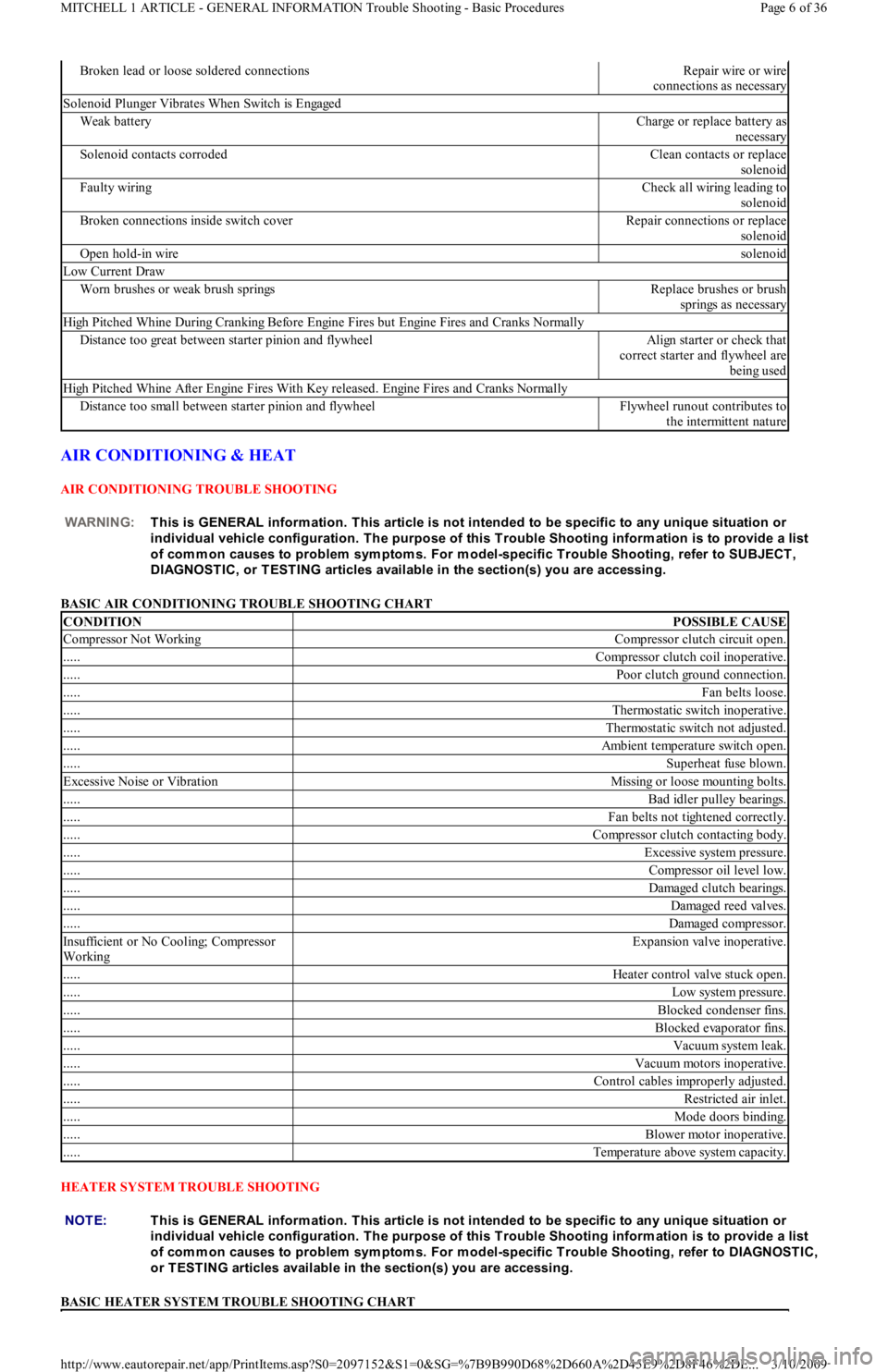
AIR CONDITIONING & HEAT
AIR CONDITIONING TROUBLE SHOOTING
BASIC AIR CONDITIONING TROUBLE SHOOTING CHART
HEATER SYSTEM TROUBLE SHOOTING
BASIC HEATER SYSTEM TROUBLE SHOOTING CHART
Broken lead or loose soldered connectionsRepair wire or wire
connections as necessary
Solenoid Plunger Vibrates When Switch is Engaged
Weak batteryCharge or replace battery as
necessary
Solenoid contacts corrodedClean contacts or replace
solenoid
Faulty wiringCheck all wiring leading to
solenoid
Broken connections inside switch coverRepair connections or replace
solenoid
Open hold-in wiresolenoid
Low Current Draw
Worn brushes or weak brush springsReplace brushes or brush
springs as necessary
High Pitched Whine During Cranking Before Engine Fires but Engine Fires and Cranks Normally
Distance too great between starter pinion and flywheelAlign starter or check that
correct starter and flywheel are
being used
High Pitched Whine After Engine Fires With Key released. Engine Fires and Cranks Normally
Distance too small between starter pinion and flywheelFlywheel runout contributes to
the intermittent nature
WARNING:This is GENERAL inform ation. This article is not intended to be specific to any unique situation or
individual vehicle configuration. T he purpose of this T rouble Shooting inform ation is to provide a list
of com m on causes to problem sym ptom s. For m odel-specific T rouble Shooting, refer to SUBJECT ,
DIAGNOST IC, or T EST ING articles available in the section(s) you are accessing.
CONDITIONPOSSIBLE CAUSE
Compressor Not WorkingCompressor clutch circuit open.
.....Compressor clutch coil inoperative.
.....Poor clutch ground connection.
.....Fan belts loose.
.....Thermostatic switch inoperative.
.....Thermostatic switch not adjusted.
.....Ambient temperature switch open.
.....Superheat fuse blown.
Excessive Noise or VibrationMissing or loose mounting bolts.
.....Bad idler pulley bearings.
.....Fan belts not tightened correctly.
.....Compressor clutch contacting body.
.....Excessive system pressure.
.....Compressor oil level low.
.....Damaged clutch bearings.
.....Damaged reed valves.
.....Damaged compressor.
In su fficien t o r No Co o l in g; Co mp resso r
WorkingExpansion valve inoperative.
.....Heater control valve stuck open.
.....Low system pressure.
.....Blocked condenser fins.
.....Blocked evaporator fins.
.....Vacuum system leak.
.....Vacuum motors inoperative.
.....Control cables improperly adjusted.
.....Restricted air inlet.
.....Mode doors binding.
.....Blower motor inoperative.
.....Temperature above system capacity.
NOTE:This is GENERAL inform ation. This article is not intended to be specific to any unique situation or
individual vehicle configuration. T he purpose of this T rouble Shooting inform ation is to provide a list
of com m on causes to problem sym ptom s. For m odel-specific T rouble Shooting, refer to DIAGNOST IC,
or T EST ING articles available in the section(s) you are accessing.
Page 6 of 36 MITCHELL 1 ARTICLE - GENERAL INFORMATION Trouble Shooting - Basic Procedures
3/10/2009 http://www.eautorepair.net/app/PrintItems.asp?S0=2097152&S1=0&SG=%7B9B990D68%2D660A%2D45E9%2D8F46%2DE
...