ECO mode FORD FIESTA 1989 Service Workshop Manual
[x] Cancel search | Manufacturer: FORD, Model Year: 1989, Model line: FIESTA, Model: FORD FIESTA 1989Pages: 296, PDF Size: 10.65 MB
Page 190 of 296
Right-hand side
4Chock the rear wheels then jack up the
front of the car and support it on axle stands
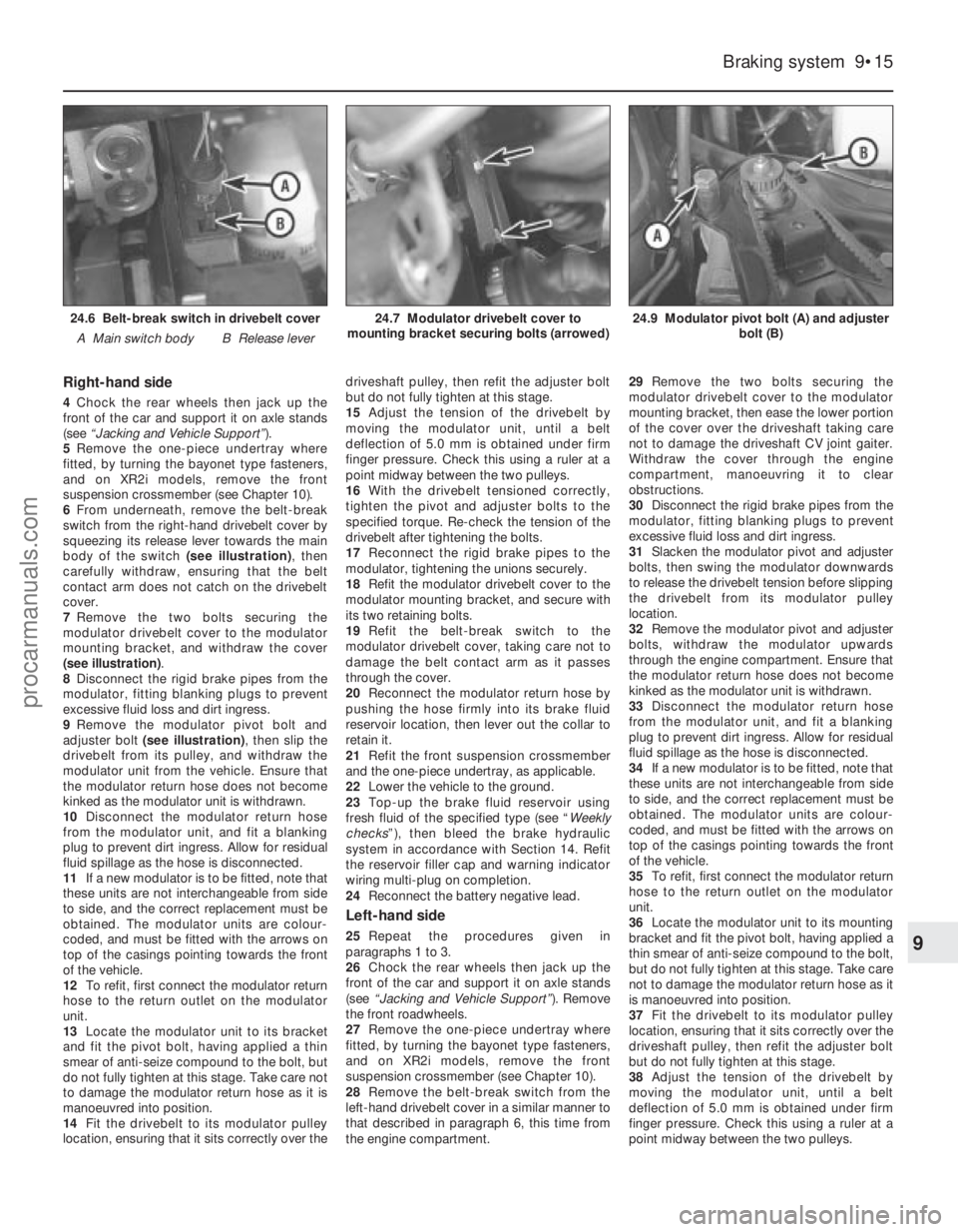
(see “Jacking and Vehicle Support” ).
5 Remove the one-piece undertray where
fitted, by turning the bayonet type fasteners,
and on XR2i models, remove the front
suspension crossmember (see Chapter 10).
6 From underneath, remove the belt-break
switch from the right-hand drivebelt cover by
squeezing its release lever towards the main
body of the switch (see illustration), then
carefully withdraw, ensuring that the belt
contact arm does not catch on the drivebelt
cover.
7 Remove the two bolts securing the
modulator drivebelt cover to the modulator
mounting bracket, and withdraw the cover
(see illustration) .
8 Disconnect the rigid brake pipes from the
modulator, fitting blanking plugs to prevent
excessive fluid loss and dirt ingress.
9 Remove the modulator pivot bolt and
adjuster bolt (see illustration) , then slip the
drivebelt from its pulley, and withdraw the
modulator unit from the vehicle. Ensure that
the modulator return hose does not become
kinked as the modulator unit is withdrawn.
10 Disconnect the modulator return hose
from the modulator unit, and fit a blanking
plug to prevent dirt ingress. Allow for residual
fluid spillage as the hose is disconnected.
11 If a new modulator is to be fitted, note that
these units are not interchangeable from side
to side, and the correct replacement must be
obtained. The modulator units are colour-
coded, and must be fitted with the arrows on
top of the casings pointing towards the front
of the vehicle.
12 To refit, first connect the modulator return
hose to the return outlet on the modulator
unit.
13 Locate the modulator unit to its bracket
and fit the pivot bolt, having applied a thin
smear of anti-seize compound to the bolt, but
do not fully tighten at this stage. Take care not
to damage the modulator return hose as it is
manoeuvred into position.
14 Fit the drivebelt to its modulator pulley
location, ensuring that it sits correctly over the driveshaft pulley, then refit the adjuster bolt
but do not fully tighten at this stage.
15
Adjust the tension of the drivebelt by
moving the modulator unit, until a belt
deflection of 5.0 mm is obtained under firm
finger pressure. Check this using a ruler at a
point midway between the two pulleys.
16 With the drivebelt tensioned correctly,
tighten the pivot and adjuster bolts to the
specified torque. Re-check the tension of the
drivebelt after tightening the bolts.
17 Reconnect the rigid brake pipes to the
modulator, tightening the unions securely.
18 Refit the modulator drivebelt cover to the
modulator mounting bracket, and secure with
its two retaining bolts.
19 Refit the belt-break switch to the
modulator drivebelt cover, taking care not to
damage the belt contact arm as it passes
through the cover.
20 Reconnect the modulator return hose by
pushing the hose firmly into its brake fluid
reservoir location, then lever out the collar to
retain it.
21 Refit the front suspension crossmember
and the one-piece undertray, as applicable.
22 Lower the vehicle to the ground.
23 Top-up the brake fluid reservoir using
fresh fluid of the specified type (see “ Weekly
checks ”), then bleed the brake hydraulic
system in accordance with Section 14. Refit
the reservoir filler cap and warning indicator
wiring multi-plug on completion.
24 Reconnect the battery negative lead.
Left-hand side
25Repeat the procedures given in
paragraphs 1 to 3.
26 Chock the rear wheels then jack up the
front of the car and support it on axle stands
(see “Jacking and Vehicle Support” ). Remove
the front roadwheels.
27 Remove the one-piece undertray where
fitted, by turning the bayonet type fasteners,
and on XR2i models, remove the front
suspension crossmember (see Chapter 10).
28 Remove the belt-break switch from the
left-hand drivebelt cover in a similar manner to
that described in paragraph 6, this time from
the engine compartment. 29
Remove the two bolts securing the
modulator drivebelt cover to the modulator
mounting bracket, then ease the lower portion
of the cover over the driveshaft taking care
not to damage the driveshaft CV joint gaiter.
Withdraw the cover through the engine
compartment, manoeuvring it to clear
obstructions.
30 Disconnect the rigid brake pipes from the
modulator, fitting blanking plugs to prevent
excessive fluid loss and dirt ingress.
31 Slacken the modulator pivot and adjuster
bolts, then swing the modulator downwards
to release the drivebelt tension before slipping
the drivebelt from its modulator pulley
location.
32 Remove the modulator pivot and adjuster
bolts, withdraw the modulator upwards
through the engine compartment. Ensure that
the modulator return hose does not become
kinked as the modulator unit is withdrawn.
33 Disconnect the modulator return hose
from the modulator unit, and fit a blanking
plug to prevent dirt ingress. Allow for residual
fluid spillage as the hose is disconnected.
34 If a new modulator is to be fitted, note that
these units are not interchangeable from side
to side, and the correct replacement must be
obtained. The modulator units are colour-
coded, and must be fitted with the arrows on
top of the casings pointing towards the front
of the vehicle.
35 To refit, first connect the modulator return
hose to the return outlet on the modulator
unit.
36 Locate the modulator unit to its mounting
bracket and fit the pivot bolt, having applied a
thin smear of anti-seize compound to the bolt,
but do not fully tighten at this stage. Take care
not to damage the modulator return hose as it
is manoeuvred into position.
37 Fit the drivebelt to its modulator pulley
location, ensuring that it sits correctly over the
driveshaft pulley, then refit the adjuster bolt
but do not fully tighten at this stage.
38 Adjust the tension of the drivebelt by
moving the modulator unit, until a belt
deflection of 5.0 mm is obtained under firm
finger pressure. Check this using a ruler at a
point midway between the two pulleys.
Braking system 9•15
24.9 Modulator pivot bolt (A) and adjuster bolt (B)24.7 Modulator drivebelt cover to
mounting bracket securing bolts (arrowed)24.6 Belt-break switch in drivebelt cover
A Main switch body B Release lever
9
1595Ford Fiesta Remakeprocarmanuals.com
http://vnx.su
Page 191 of 296
39With the drivebelt tensioned correctly,
tighten the pivot and adjuster bolts to the
specified torque. Re-check the tension of the
drivebelt after tightening the bolts.
40 Reconnect the rigid brake pipes to the
modulator, tightening the unions to seal the
system.
41 Refit the modulator drivebelt cover and
secure with its two retaining bolts. Take care
not to damage the driveshaft CV joint gaiter as
the cover is eased into position.
42 Refit the belt-break switch to the
modulator drivebelt cover, taking care not to
damage the belt contact arm as it passes
through the cover.
43 Reconnect the modulator return hose by
pushing the hose firmly into its brake fluid
reservoir location, then lever out the collar to
retain it.
44 Refit the front suspension crossmember
and the one-piece undertray, as applicable.
45 Refit the roadwheels, then remove the
axle stands and lower the vehicle to the
ground. Tighten the wheel nuts to the
specified torque.
46 Top-up the brake fluid reservoir using
fresh fluid of the specified type (see “ Weekly
checks ”), then bleed the brake hydraulic
system in accordance with Section 14. Refit
the reservoir filler cap and the warning
indicator wiring multi-plug on completion.
47 Reconnect the battery negative lead.
Modulator drivebelt
48Disconnect the battery negative (earth)
lead (refer to Chapter 5A, Section 1).
49 Chock the rear wheels then jack up the
front of the car and support it on axle stands
(see “Jacking and Vehicle Support” ). Remove
the relevant front roadwheel.
50 Remove the one-piece undertray where
fitted, by turning its bayonet-type fasteners,
and on XR2i models, remove the front
suspension crossmember (see Chapter 10).
51 Remove the belt-break switch from the
relevant drivebelt cover, then remove the
drivebelt cover, as described in the previous
sub-Section.
52 Slacken the modulator pivot and adjuster
bolts to release drivebelt tension, then slip the
drivebelt from the modulator.
53 Remove the track rod end balljoint from
the steering arm on the spindle carrier (see
Chapter 10).
54 Disconnect the anti-roll bar connecting
link (where applicable) and release the brake
hose from their locations on the suspension
strut.
55 Remove the pinch bolt and nut securing
the lower suspension arm balljoint to the
spindle carrier, and separate the balljoint from
the spindle carrier assembly.
56 To release the driveshaft inner CV joint
from the differential, have an assistant pull the
spindle carrier away from the centre of the
vehicle whilst you insert a lever between the
inner CV joint and the transmission casing,
then firmly strike the lever with the flat of the hand, but be careful not to damage adjacent
components. Make provision for escaping
transmission oil, if possible plugging the
opening to prevent excessive loss. Do not
allow the CV joints to bend more than 20°
from the horizontal or internal damage may
occur. If both driveshafts are to be removed,
immobilise the differential by inserting an old
joint or suitable shaft, before the other
driveshaft is removed.
57
Slide the drivebelt off the driveshaft.
58 Remove the snap-ring from the groove in
the splines of the inner CV joint. This snap-
ring must be renewed every time the
driveshaft is withdrawn from the differential.
59 With the drivebelt removed, closely
examine the condition of the belt over its
entire length. Renew the belt if any cracks are
noticed in the fabric at the roots of the teeth, if
there is any abrasion of the fabric facing
material, or if there are any tears starting from
the edge of the belt.
60 If, since the drivebelts were last renewed,
a vehicle has covered more than 30 000 miles
(48 000 km) or a period of more than two
years has elapsed, the drivebelts should be
renewed as a matter of course.
61 Prior to refitting the drivebelt, thoroughly
clean its CV joint pulley location.
62 Fit the drivebelt over the driveshaft then,
with a new snap-ring fitted to the inner CV
joint splines, lubricate the splines with
transmission oil. Remove the temporary plug
and insert the inner CV joint to its
transmission casing location. Press against
the spindle carrier so that the snap-ring
engages fully to hold the CV joint splines in
the differential.
63 Refitting is now a reversal of the removal
procedure, tensioning the drivebelt as
described in the previous sub-Section. Ensure
that the pinch-bolt securing the lower
suspension arm balljoint to the spindle carrier
locates in the annular groove on the balljoint
spindle. Secure the track rod and balljoint,
using a new split pin. Tighten the suspension
components to their specified torque (see
Chapter 10).
64 Check the level of the transmission oil,
and top-up as required (see Chapter 1).
Modulator belt-break switch
65 Modulator belt-break switches are fitted
to each of the two drivebelt covers, and clip
into position. To remove, gently squeeze the
protruding lever on the switch towards the
main switch body and lift out, ensuring that
the belt contact arm does not catch on the
drivebelt cover.
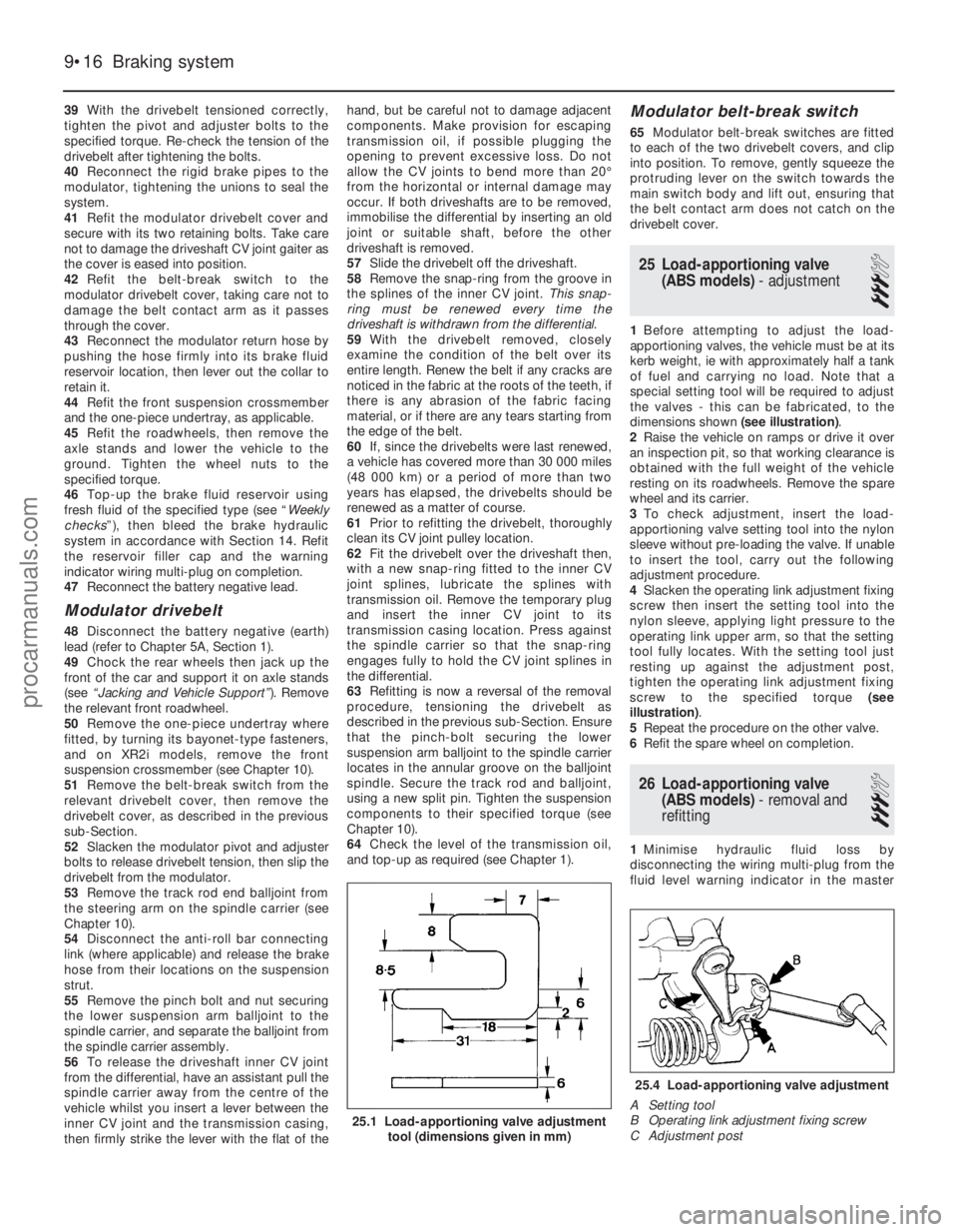
25 Load-apportioning valve (ABS models) - adjustment
3
1Before attempting to adjust the load-
apportioning valves, the vehicle must be at its
kerb weight, ie with approximately half a tank
of fuel and carrying no load. Note that a
special setting tool will be required to adjust
the valves - this can be fabricated, to the
dimensions shown (see illustration).
2 Raise the vehicle on ramps or drive it over
an inspection pit, so that working clearance is
obtained with the full weight of the vehicle
resting on its roadwheels. Remove the spare
wheel and its carrier.
3 To check adjustment, insert the load-
apportioning valve setting tool into the nylon
sleeve without pre-loading the valve. If unable
to insert the tool, carry out the following
adjustment procedure.
4 Slacken the operating link adjustment fixing
screw then insert the setting tool into the
nylon sleeve, applying light pressure to the
operating link upper arm, so that the setting
tool fully locates. With the setting tool just
resting up against the adjustment post,
tighten the operating link adjustment fixing
screw to the specified torque (see
illustration) .
5 Repeat the procedure on the other valve.
6 Refit the spare wheel on completion.
26 Load-apportioning valve
(ABS models) - removal and
refitting
3
1 Minimise hydraulic fluid loss by
disconnecting the wiring multi-plug from the
fluid level warning indicator in the master
9•16 Braking system
25.4 Load-apportioning valve adjustment
A Setting tool
B Operating link adjustment fixing screw
C Adjustment post
25.1 Load-apportioning valve adjustment tool (dimensions given in mm)
1595Ford Fiesta Remakeprocarmanuals.com
http://vnx.su
Page 197 of 296
On all models, the steering is of
conventional rack-and-pinion type,
incorporating a safety system of convoluted
column tube and double universally-jointed
lower steering shaft links. The steering column tube is supported at its
upper end by bracketry, and at its lower end by
a nylon support bush. The steering shaft is
supported within the column tube by two
support bearings, one at either end of the tube. The steering rack assembly is located on
the bulkhead. Steering input is transmitted,
via the steering shaft, to the pinion which
meshes with the teeth on the rack. The pinion transferring the steering input
moves the rack within its housing tube,
withdrawing and extending the track rods
attached to either end of the rack by balljoints.
This movement is transferred, by balljoints in
the track rod ends, to the steering arms on the spindle carriers which direct the roadwheels.
From the 1994 model year onwards, power
steering is available as standard or optional
equipment on certain models.
2 Front spindle carrier -
removal and refitting
3
Removal
Note: A new hub/driveshaft retaining nut will
be required for refitting.
1 Remove the wheel trim from the front
roadwheel on the side concerned, then using
a small pin punch, peen back the locking
portion of the front hub/driveshaft nut. Loosen
off the nut about half-a-turn.
2 Loosen off the front roadwheel retaining
nuts on the side concerned.
3 Chock the rear wheels then jack up the
front of the car and support it on axle stands
(see “Jacking and Vehicle Support” ). Remove
the appropriate roadwheel, and unscrew and
remove the hub/driveshaft retaining nut and
washer.
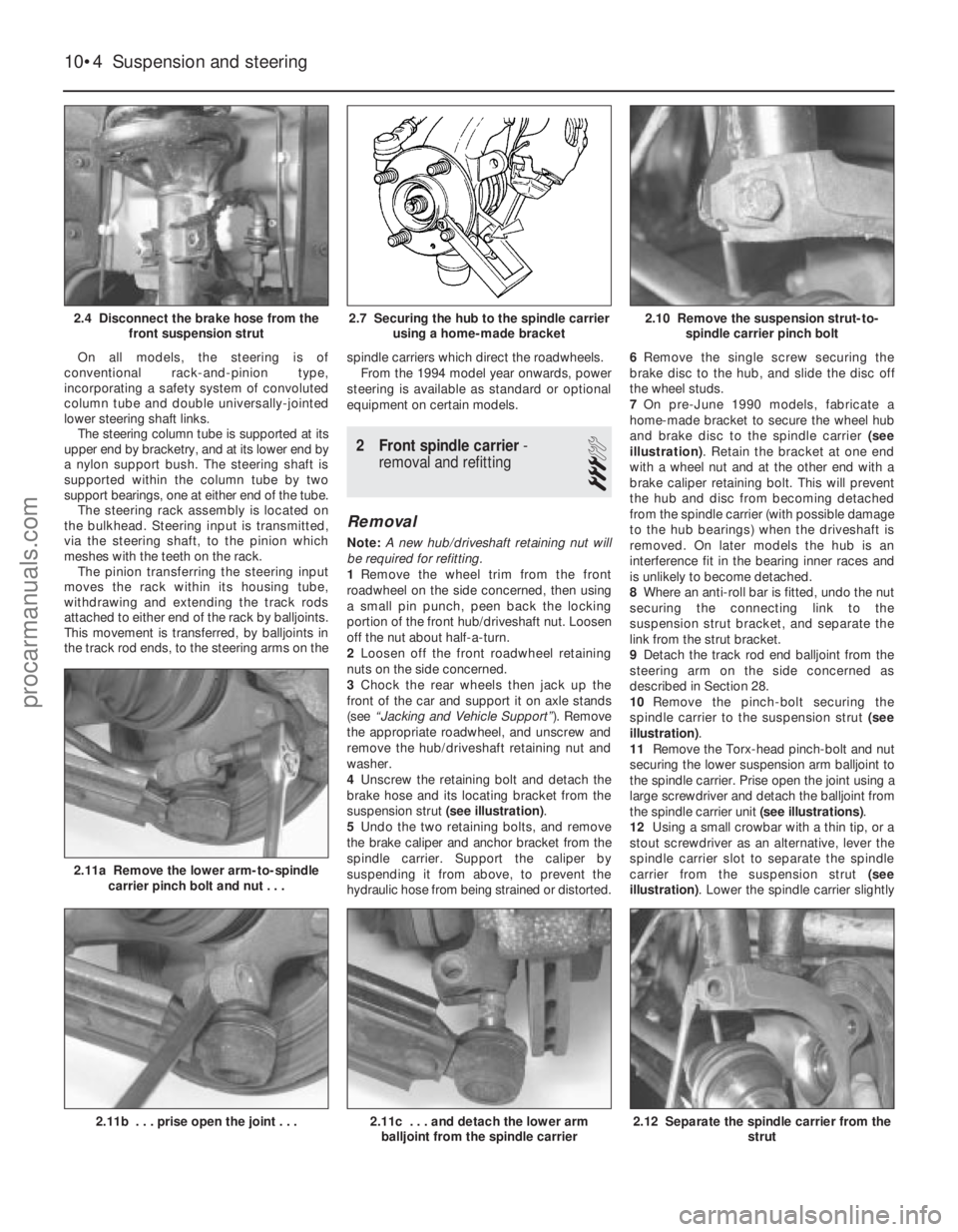
4 Unscrew the retaining bolt and detach the
brake hose and its locating bracket from the
suspension strut (see illustration).
5 Undo the two retaining bolts, and remove
the brake caliper and anchor bracket from the
spindle carrier. Support the caliper by
suspending it from above, to prevent the
hydraulic hose from being strained or distorted. 6
Remove the single screw securing the
brake disc to the hub, and slide the disc off
the wheel studs.
7 On pre-June 1990 models, fabricate a
home-made bracket to secure the wheel hub
and brake disc to the spindle carrier (see
illustration) . Retain the bracket at one end
with a wheel nut and at the other end with a
brake caliper retaining bolt. This will prevent
the hub and disc from becoming detached
from the spindle carrier (with possible damage
to the hub bearings) when the driveshaft is
removed. On later models the hub is an
interference fit in the bearing inner races and
is unlikely to become detached.
8 Where an anti-roll bar is fitted, undo the nut
securing the connecting link to the
suspension strut bracket, and separate the
link from the strut bracket.
9 Detach the track rod end balljoint from the
steering arm on the side concerned as
described in Section 28.
10 Remove the pinch-bolt securing the
spindle carrier to the suspension strut (see
illustration) .
11 Remove the Torx-head pinch-bolt and nut
securing the lower suspension arm balljoint to
the spindle carrier. Prise open the joint using a
large screwdriver and detach the balljoint from
the spindle carrier unit (see illustrations).
12 Using a small crowbar with a thin tip, or a
stout screwdriver as an alternative, lever the
spindle carrier slot to separate the spindle
carrier from the suspension strut (see
illustration) . Lower the spindle carrier slightly
10•4Suspension and steering
2.12 Separate the spindle carrier from the
strut2.11c . . . and detach the lower armballjoint from the spindle carrier2.11b . . . prise open the joint . . .
2.11a Remove the lower arm-to-spindle carrier pinch bolt and nut . . .
2.10 Remove the suspension strut-to- spindle carrier pinch bolt2.7 Securing the hub to the spindle carrier using a home-made bracket2.4 Disconnect the brake hose from the front suspension strut
1595Ford Fiesta Remakeprocarmanuals.com
http://vnx.su
Page 198 of 296
(tapping it down with a soft-faced mallet if
necessary) and carefully pull it off the
driveshaft, having supported the driveshaft to
prevent damage to the CV joints - the
driveshaft must not be bent at an angle
greater than 20° from the horizontal. If the
driveshaft is tight in the hub, lightly tap its
outer end with a soft-faced hammer, or use a
conventional puller and spacer to free it.
Remove the dust sleeve from the inner rim
groove of the spindle carrier.
Refitting
13Fit the dust sleeve to its groove, then
locate the spindle carrier over the driveshaft.
Draw the driveshaft CV joint through the hub
using the old retaining nut and washer.
14 Lever the spindle carrier slot open and
refit the spindle carrier to the suspension
strut. Remove the lever, refit the pinch-bolt
and tighten it to the specified torque.
15 Fit a new hub/driveshaft nut and washer,
and tighten the nut as much possible at this
stage. As the nut is being tightened, rotate the
hub to ensure that the bearings seat correctly.
16 Refit the track rod end balljoint to the
steering arm on the spindle carrier, tighten the
nut to the specified torque and insert a new
split-pin to secure.
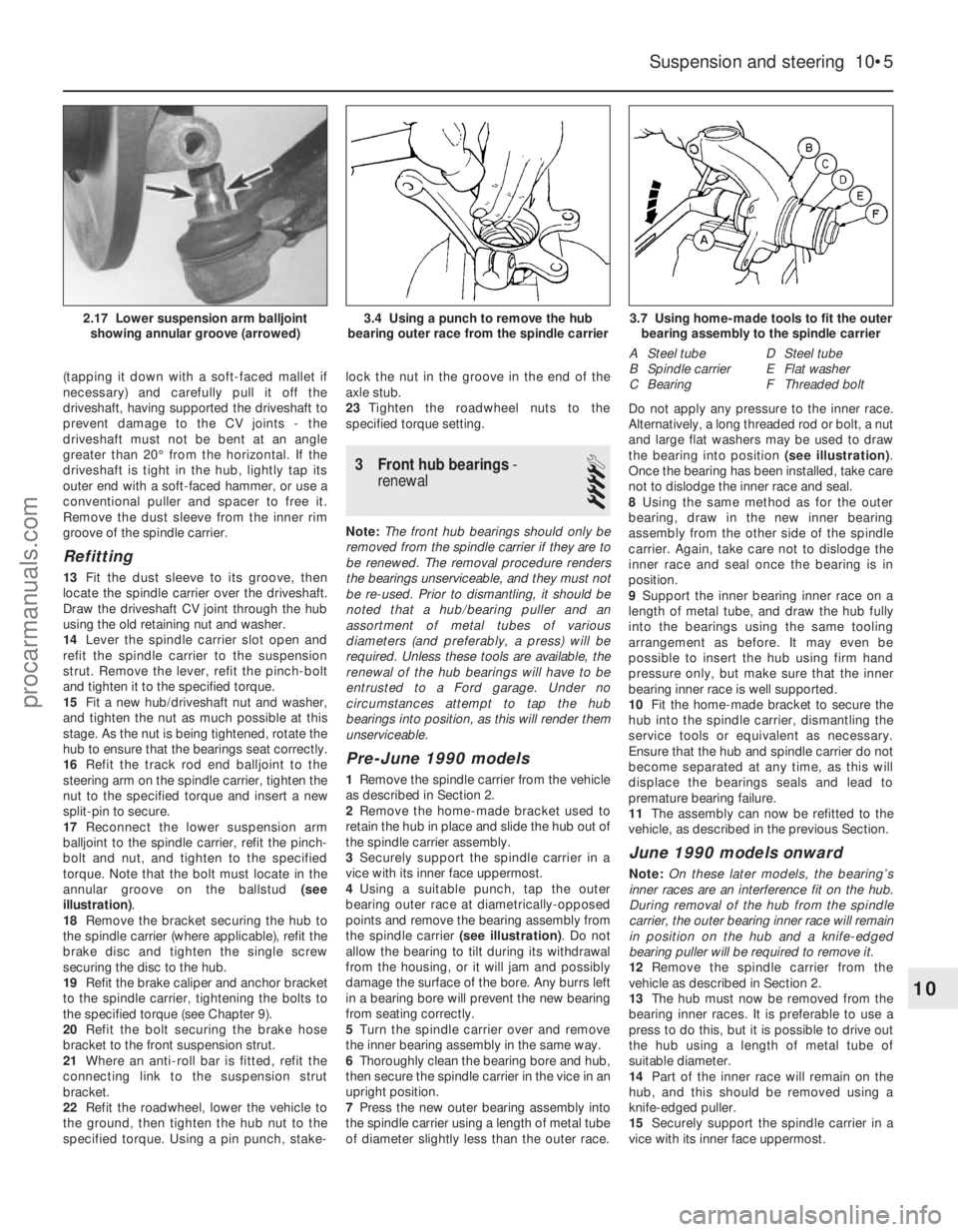
17 Reconnect the lower suspension arm
balljoint to the spindle carrier, refit the pinch-
bolt and nut, and tighten to the specified
torque. Note that the bolt must locate in the
annular groove on the ballstud (see
illustration) .
18 Remove the bracket securing the hub to
the spindle carrier (where applicable), refit the
brake disc and tighten the single screw
securing the disc to the hub.
19 Refit the brake caliper and anchor bracket
to the spindle carrier, tightening the bolts to
the specified torque (see Chapter 9).
20 Refit the bolt securing the brake hose
bracket to the front suspension strut.
21 Where an anti-roll bar is fitted, refit the
connecting link to the suspension strut
bracket.
22 Refit the roadwheel, lower the vehicle to
the ground, then tighten the hub nut to the
specified torque. Using a pin punch, stake- lock the nut in the groove in the end of the
axle stub.
23
Tighten the roadwheel nuts to the
specified torque setting.
3 Front hub bearings -
renewal
4
Note: The front hub bearings should only be
removed from the spindle carrier if they are to
be renewed. The removal procedure renders
the bearings unserviceable, and they must not
be re-used. Prior to dismantling, it should be
noted that a hub/bearing puller and an
assortment of metal tubes of various
diameters (and preferably, a press) will be
required. Unless these tools are available, the
renewal of the hub bearings will have to be
entrusted to a Ford garage. Under no
circumstances attempt to tap the hub
bearings into position, as this will render them
unserviceable.
Pre-June 1990 models
1 Remove the spindle carrier from the vehicle
as described in Section 2.
2 Remove the home-made bracket used to
retain the hub in place and slide the hub out of
the spindle carrier assembly.
3 Securely support the spindle carrier in a
vice with its inner face uppermost.
4 Using a suitable punch, tap the outer
bearing outer race at diametrically-opposed
points and remove the bearing assembly from
the spindle carrier (see illustration). Do not
allow the bearing to tilt during its withdrawal
from the housing, or it will jam and possibly
damage the surface of the bore. Any burrs left
in a bearing bore will prevent the new bearing
from seating correctly.
5 Turn the spindle carrier over and remove
the inner bearing assembly in the same way.
6 Thoroughly clean the bearing bore and hub,
then secure the spindle carrier in the vice in an
upright position.
7 Press the new outer bearing assembly into
the spindle carrier using a length of metal tube
of diameter slightly less than the outer race. Do not apply any pressure to the inner race.
Alternatively, a long threaded rod or bolt, a nut
and large flat washers may be used to draw
the bearing into position
(see illustration).
Once the bearing has been installed, take care
not to dislodge the inner race and seal.
8 Using the same method as for the outer
bearing, draw in the new inner bearing
assembly from the other side of the spindle
carrier. Again, take care not to dislodge the
inner race and seal once the bearing is in
position.
9 Support the inner bearing inner race on a
length of metal tube, and draw the hub fully
into the bearings using the same tooling
arrangement as before. It may even be
possible to insert the hub using firm hand
pressure only, but make sure that the inner
bearing inner race is well supported.
10 Fit the home-made bracket to secure the
hub into the spindle carrier, dismantling the
service tools or equivalent as necessary.
Ensure that the hub and spindle carrier do not
become separated at any time, as this will
displace the bearings seals and lead to
premature bearing failure.
11 The assembly can now be refitted to the
vehicle, as described in the previous Section.
June 1990 models onward
Note: On these later models, the bearing’s
inner races are an interference fit on the hub.
During removal of the hub from the spindle
carrier, the outer bearing inner race will remain
in position on the hub and a knife-edged
bearing puller will be required to remove it.
12 Remove the spindle carrier from the
vehicle as described in Section 2.
13 The hub must now be removed from the
bearing inner races. It is preferable to use a
press to do this, but it is possible to drive out
the hub using a length of metal tube of
suitable diameter.
14 Part of the inner race will remain on the
hub, and this should be removed using a
knife-edged puller.
15 Securely support the spindle carrier in a
vice with its inner face uppermost.
Suspension and steering 10•5
3.7 Using home-made tools to fit the outer bearing assembly to the spindle carrier
A Steel tube
B Spindle carrier
C Bearing D Steel tube
E Flat washer
F Threaded bolt
3.4 Using a punch to remove the hub
bearing outer race from the spindle carrier2.17 Lower suspension arm balljoint showing annular groove (arrowed)
10
1595Ford Fiesta Remakeprocarmanuals.com
http://vnx.su
Page 202 of 296
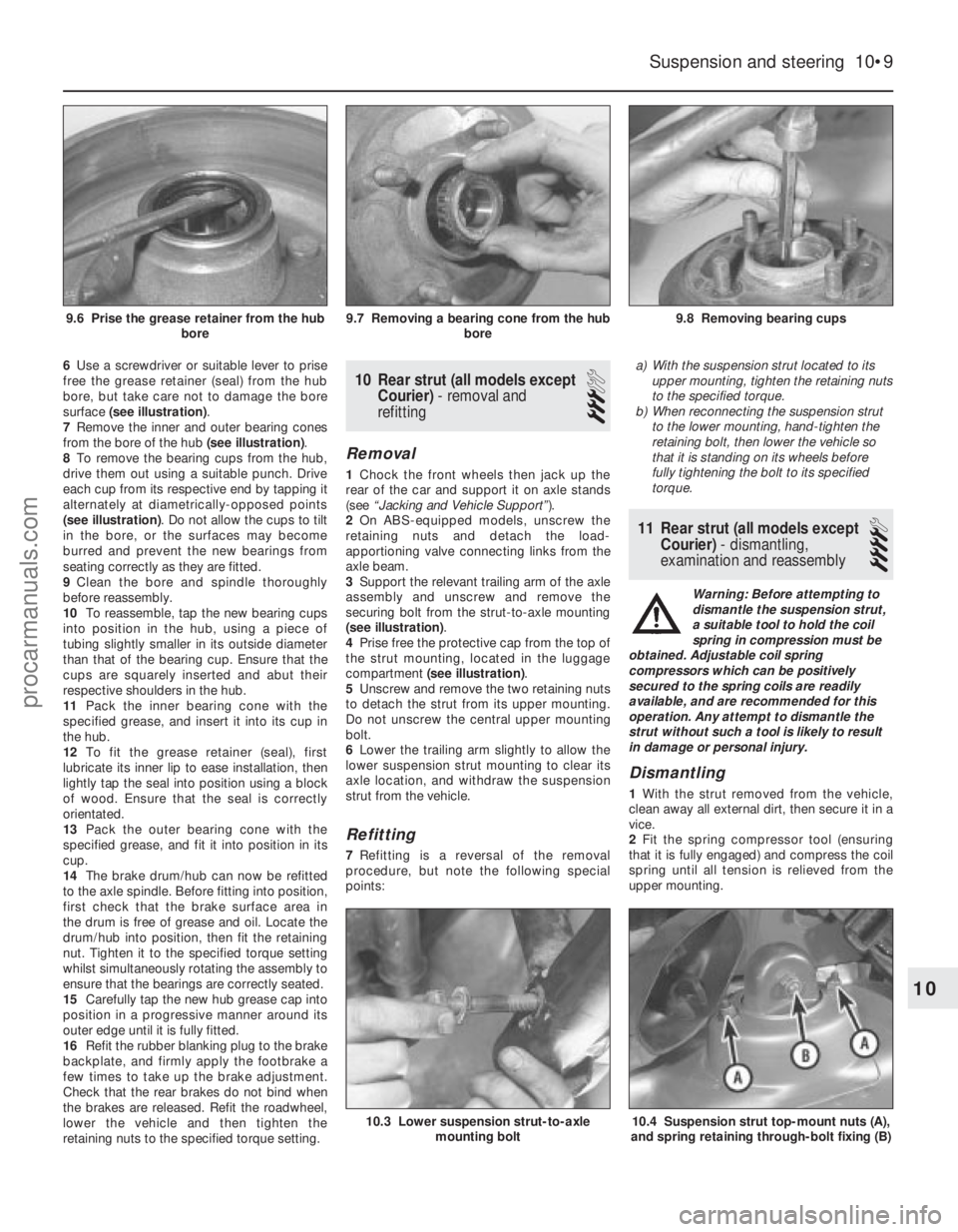
6Use a screwdriver or suitable lever to prise
free the grease retainer (seal) from the hub
bore, but take care not to damage the bore
surface (see illustration) .
7 Remove the inner and outer bearing cones
from the bore of the hub (see illustration).
8 To remove the bearing cups from the hub,
drive them out using a suitable punch. Drive
each cup from its respective end by tapping it
alternately at diametrically-opposed points
(see illustration) . Do not allow the cups to tilt
in the bore, or the surfaces may become
burred and prevent the new bearings from
seating correctly as they are fitted.
9 Clean the bore and spindle thoroughly
before reassembly.
10 To reassemble, tap the new bearing cups
into position in the hub, using a piece of
tubing slightly smaller in its outside diameter
than that of the bearing cup. Ensure that the
cups are squarely inserted and abut their
respective shoulders in the hub.
11 Pack the inner bearing cone with the
specified grease, and insert it into its cup in
the hub.
12 To fit the grease retainer (seal), first
lubricate its inner lip to ease installation, then
lightly tap the seal into position using a block
of wood. Ensure that the seal is correctly
orientated.
13 Pack the outer bearing cone with the
specified grease, and fit it into position in its
cup.
14 The brake drum/hub can now be refitted
to the axle spindle. Before fitting into position,
first check that the brake surface area in
the drum is free of grease and oil. Locate the
drum/hub into position, then fit the retaining
nut. Tighten it to the specified torque setting
whilst simultaneously rotating the assembly to
ensure that the bearings are correctly seated.
15 Carefully tap the new hub grease cap into
position in a progressive manner around its
outer edge until it is fully fitted.
16 Refit the rubber blanking plug to the brake
backplate, and firmly apply the footbrake a
few times to take up the brake adjustment.
Check that the rear brakes do not bind when
the brakes are released. Refit the roadwheel,
lower the vehicle and then tighten the
retaining nuts to the specified torque setting.10 Rear strut (all models except Courier) - removal and
refitting
3
Removal
1 Chock the front wheels then jack up the
rear of the car and support it on axle stands
(see “Jacking and Vehicle Support” ).
2 On ABS-equipped models, unscrew the
retaining nuts and detach the load-
apportioning valve connecting links from the
axle beam.
3 Support the relevant trailing arm of the axle
assembly and unscrew and remove the
securing bolt from the strut-to-axle mounting
(see illustration) .
4 Prise free the protective cap from the top of
the strut mounting, located in the luggage
compartment (see illustration) .
5 Unscrew and remove the two retaining nuts
to detach the strut from its upper mounting.
Do not unscrew the central upper mounting
bolt.
6 Lower the trailing arm slightly to allow the
lower suspension strut mounting to clear its
axle location, and withdraw the suspension
strut from the vehicle.
Refitting
7 Refitting is a reversal of the removal
procedure, but note the following special
points: a)
With the suspension strut located to its
upper mounting, tighten the retaining nuts
to the specified torque.
b) When reconnecting the suspension strut
to the lower mounting, hand-tighten the
retaining bolt, then lower the vehicle so
that it is standing on its wheels before
fully tightening the bolt to its specified
torque.
11 Rear strut (all models except
Courier) - dismantling,
examination and reassembly
4
Warning: Before attempting to
dismantle the suspension strut,
a suitable tool to hold the coil
spring in compression must be
obtained. Adjustable coil spring
compressors which can be positively
secured to the spring coils are readily
available, and are recommended for this
operation. Any attempt to dismantle the
strut without such a tool is likely to result
in damage or personal injury.
Dismantling
1 With the strut removed from the vehicle,
clean away all external dirt, then secure it in a
vice.
2 Fit the spring compressor tool (ensuring
that it is fully engaged) and compress the coil
spring until all tension is relieved from the
upper mounting.
Suspension and steering 10•9
9.8 Removing bearing cups9.7 Removing a bearing cone from the hub bore9.6 Prise the grease retainer from the hubbore
10.4 Suspension strut top-mount nuts (A),
and spring retaining through-bolt fixing (B)10.3 Lower suspension strut-to-axle mounting bolt
10
1595Ford Fiesta Remakeprocarmanuals.com
http://vnx.su
Page 203 of 296
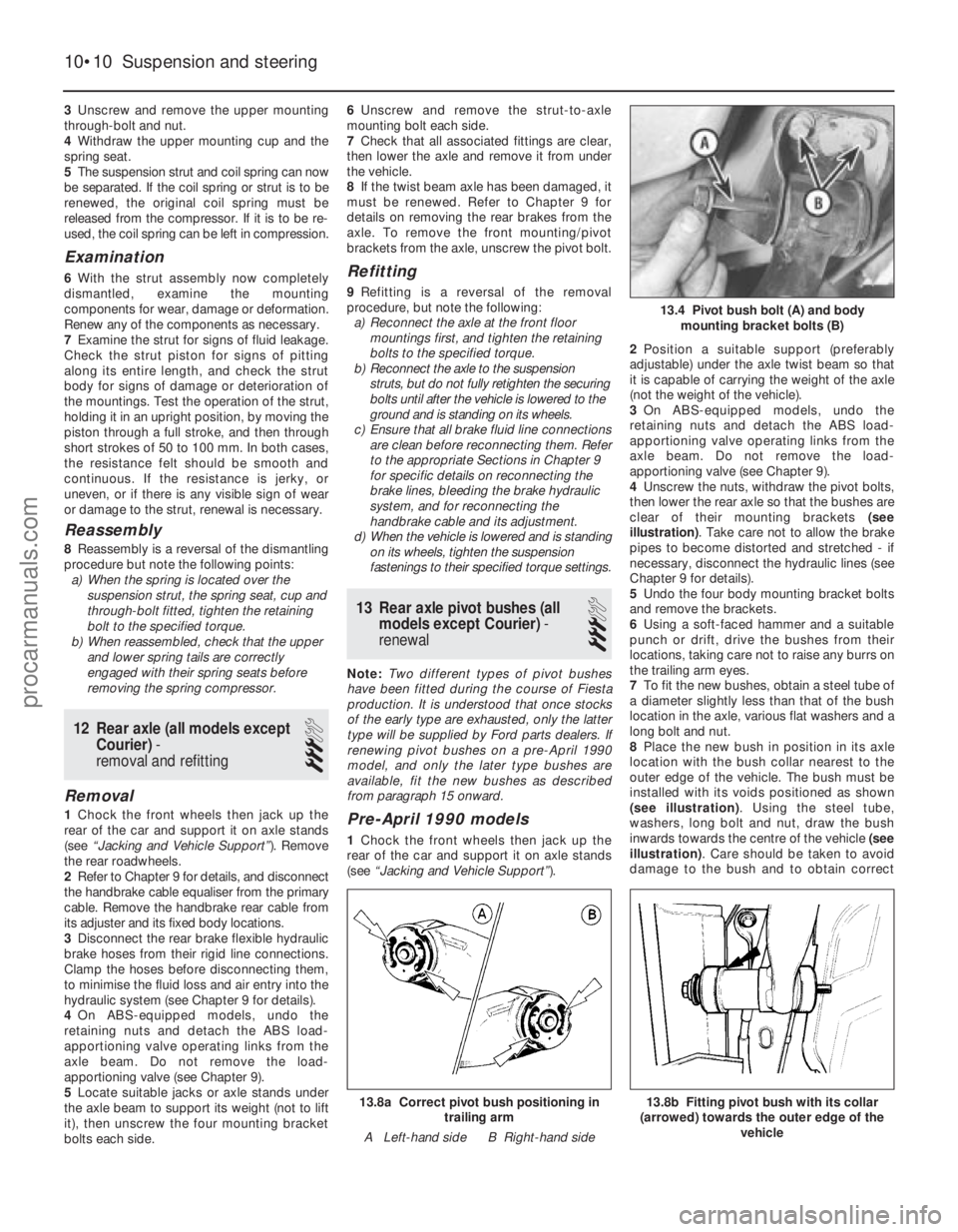
3Unscrew and remove the upper mounting
through-bolt and nut.
4 Withdraw the upper mounting cup and the
spring seat.
5 The suspension strut and coil spring can now
be separated. If the coil spring or strut is to be
renewed, the original coil spring must be
released from the compressor. If it is to be re-
used, the coil spring can be left in compression.
Examination
6 With the strut assembly now completely
dismantled, examine the mounting
components for wear, damage or deformation.
Renew any of the components as necessary.
7 Examine the strut for signs of fluid leakage.
Check the strut piston for signs of pitting
along its entire length, and check the strut
body for signs of damage or deterioration of
the mountings. Test the operation of the strut,
holding it in an upright position, by moving the
piston through a full stroke, and then through
short strokes of 50 to 100 mm. In both cases,
the resistance felt should be smooth and
continuous. If the resistance is jerky, or
uneven, or if there is any visible sign of wear
or damage to the strut, renewal is necessary.
Reassembly
8 Reassembly is a reversal of the dismantling
procedure but note the following points: a) When the spring is located over the
suspension strut, the spring seat, cup and
through-bolt fitted, tighten the retaining
bolt to the specified torque.
b) When reassembled, check that the upper
and lower spring tails are correctly
engaged with their spring seats before
removing the spring compressor.
12 Rear axle (all models except
Courier) -
removal and refitting
3
Removal
1 Chock the front wheels then jack up the
rear of the car and support it on axle stands
(see “Jacking and Vehicle Support” ). Remove
the rear roadwheels.
2 Refer to Chapter 9 for details, and disconnect
the handbrake cable equaliser from the primary
cable. Remove the handbrake rear cable from
its adjuster and its fixed body locations.
3 Disconnect the rear brake flexible hydraulic
brake hoses from their rigid line connections.
Clamp the hoses before disconnecting them,
to minimise the fluid loss and air entry into the
hydraulic system (see Chapter 9 for details).
4 On ABS-equipped models, undo the
retaining nuts and detach the ABS load-
apportioning valve operating links from the
axle beam. Do not remove the load-
apportioning valve (see Chapter 9).
5 Locate suitable jacks or axle stands under
the axle beam to support its weight (not to lift
it), then unscrew the four mounting bracket
bolts each side. 6
Unscrew and remove the strut-to-axle
mounting bolt each side.
7 Check that all associated fittings are clear,
then lower the axle and remove it from under
the vehicle.
8 If the twist beam axle has been damaged, it
must be renewed. Refer to Chapter 9 for
details on removing the rear brakes from the
axle. To remove the front mounting/pivot
brackets from the axle, unscrew the pivot bolt.
Refitting
9 Refitting is a reversal of the removal
procedure, but note the following: a) Reconnect the axle at the front floor mountings first, and tighten the retaining
bolts to the specified torque.
b) Reconnect the axle to the suspension struts, but do not fully retighten the securing
bolts until after the vehicle is lowered to the
ground and is standing on its wheels.
c) Ensure that all brake fluid line connections are clean before reconnecting them. Refer
to the appropriate Sections in Chapter 9
for specific details on reconnecting the
brake lines, bleeding the brake hydraulic
system, and for reconnecting the
handbrake cable and its adjustment.
d) When the vehicle is lowered and is standing
on its wheels, tighten the suspension
fastenings to their specified torque settings.
13 Rear axle pivot bushes (all
models except Courier) -
renewal
3
Note: Two different types of pivot bushes
have been fitted during the course of Fiesta
production. It is understood that once stocks
of the early type are exhausted, only the latter
type will be supplied by Ford parts dealers. If
renewing pivot bushes on a pre-April 1990
model, and only the later type bushes are
available, fit the new bushes as described
from paragraph 15 onward.
Pre-April 1990 models
1 Chock the front wheels then jack up the
rear of the car and support it on axle stands
(see “Jacking and Vehicle Support” ).2
Position a suitable support (preferably
adjustable) under the axle twist beam so that
it is capable of carrying the weight of the axle
(not the weight of the vehicle).
3 On ABS-equipped models, undo the
retaining nuts and detach the ABS load-
apportioning valve operating links from the
axle beam. Do not remove the load-
apportioning valve (see Chapter 9).
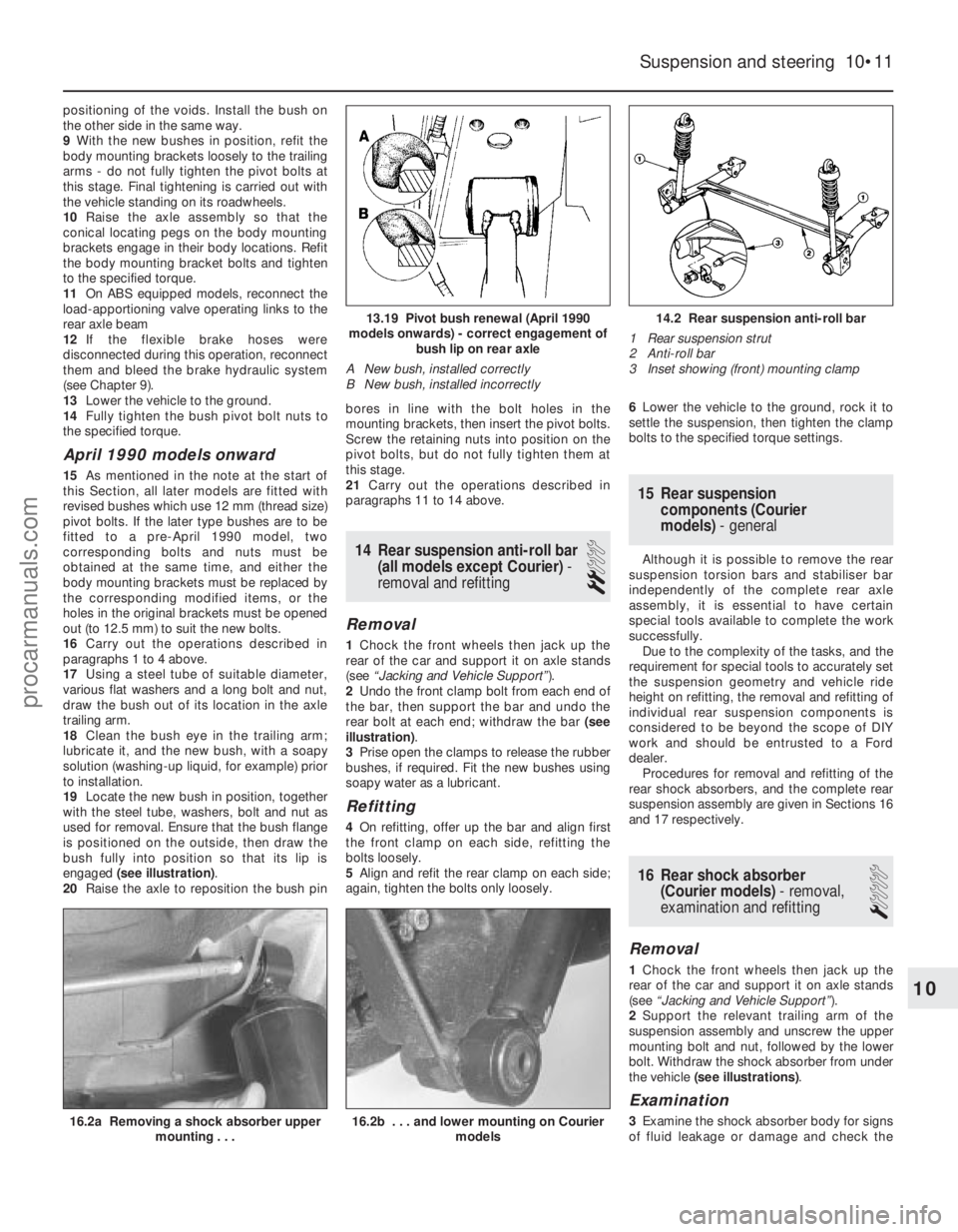
4 Unscrew the nuts, withdraw the pivot bolts,
then lower the rear axle so that the bushes are
clear of their mounting brackets (see
illustration) . Take care not to allow the brake
pipes to become distorted and stretched - if
necessary, disconnect the hydraulic lines (see
Chapter 9 for details).
5 Undo the four body mounting bracket bolts
and remove the brackets.
6 Using a soft-faced hammer and a suitable
punch or drift, drive the bushes from their
locations, taking care not to raise any burrs on
the trailing arm eyes.
7 To fit the new bushes, obtain a steel tube of
a diameter slightly less than that of the bush
location in the axle, various flat washers and a
long bolt and nut.
8 Place the new bush in position in its axle
location with the bush collar nearest to the
outer edge of the vehicle. The bush must be
installed with its voids positioned as shown
(see illustration) . Using the steel tube,
washers, long bolt and nut, draw the bush
inwards towards the centre of the vehicle (see
illustration) . Care should be taken to avoid
damage to the bush and to obtain correct
10•10 Suspension and steering
13.8b Fitting pivot bush with its collar
(arrowed) towards the outer edge of the vehicle13.8a Correct pivot bush positioning intrailing arm
A Left-hand side B Right-hand side
13.4 Pivot bush bolt (A) and body mounting bracket bolts (B)
1595Ford Fiesta Remakeprocarmanuals.com
http://vnx.su
Page 204 of 296
positioning of the voids. Install the bush on
the other side in the same way.
9With the new bushes in position, refit the
body mounting brackets loosely to the trailing
arms - do not fully tighten the pivot bolts at
this stage. Final tightening is carried out with
the vehicle standing on its roadwheels.
10 Raise the axle assembly so that the
conical locating pegs on the body mounting
brackets engage in their body locations. Refit
the body mounting bracket bolts and tighten
to the specified torque.
11 On ABS equipped models, reconnect the
load-apportioning valve operating links to the
rear axle beam
12 If the flexible brake hoses were
disconnected during this operation, reconnect
them and bleed the brake hydraulic system
(see Chapter 9).
13 Lower the vehicle to the ground.
14 Fully tighten the bush pivot bolt nuts to
the specified torque.
April 1990 models onward
15 As mentioned in the note at the start of
this Section, all later models are fitted with
revised bushes which use 12 mm (thread size)
pivot bolts. If the later type bushes are to be
fitted to a pre-April 1990 model, two
corresponding bolts and nuts must be
obtained at the same time, and either the
body mounting brackets must be replaced by
the corresponding modified items, or the
holes in the original brackets must be opened
out (to 12.5 mm) to suit the new bolts.
16 Carry out the operations described in
paragraphs 1 to 4 above.
17 Using a steel tube of suitable diameter,
various flat washers and a long bolt and nut,
draw the bush out of its location in the axle
trailing arm.
18 Clean the bush eye in the trailing arm;
lubricate it, and the new bush, with a soapy
solution (washing-up liquid, for example) prior
to installation.
19 Locate the new bush in position, together
with the steel tube, washers, bolt and nut as
used for removal. Ensure that the bush flange
is positioned on the outside, then draw the
bush fully into position so that its lip is
engaged (see illustration) .
20 Raise the axle to reposition the bush pin bores in line with the bolt holes in the
mounting brackets, then insert the pivot bolts.
Screw the retaining nuts into position on the
pivot bolts, but do not fully tighten them at
this stage.
21
Carry out the operations described in
paragraphs 11 to 14 above.
14 Rear suspension anti-roll bar (all models except Courier) -
removal and refitting
2
Removal
1 Chock the front wheels then jack up the
rear of the car and support it on axle stands
(see “Jacking and Vehicle Support” ).
2 Undo the front clamp bolt from each end of
the bar, then support the bar and undo the
rear bolt at each end; withdraw the bar (see
illustration) .
3 Prise open the clamps to release the rubber
bushes, if required. Fit the new bushes using
soapy water as a lubricant.
Refitting
4 On refitting, offer up the bar and align first
the front clamp on each side, refitting the
bolts loosely.
5 Align and refit the rear clamp on each side;
again, tighten the bolts only loosely. 6
Lower the vehicle to the ground, rock it to
settle the suspension, then tighten the clamp
bolts to the specified torque settings.
15 Rear suspension components (Courier
models) - general
Although it is possible to remove the rear
suspension torsion bars and stabiliser bar
independently of the complete rear axle
assembly, it is essential to have certain
special tools available to complete the work
successfully.
Due to the complexity of the tasks, and the
requirement for special tools to accurately set
the suspension geometry and vehicle ride
height on refitting, the removal and refitting of
individual rear suspension components is
considered to be beyond the scope of DIY
work and should be entrusted to a Ford
dealer. Procedures for removal and refitting of the
rear shock absorbers, and the complete rear
suspension assembly are given in Sections 16
and 17 respectively.
16 Rear shock absorber (Courier models) - removal,
examination and refitting
1
Removal
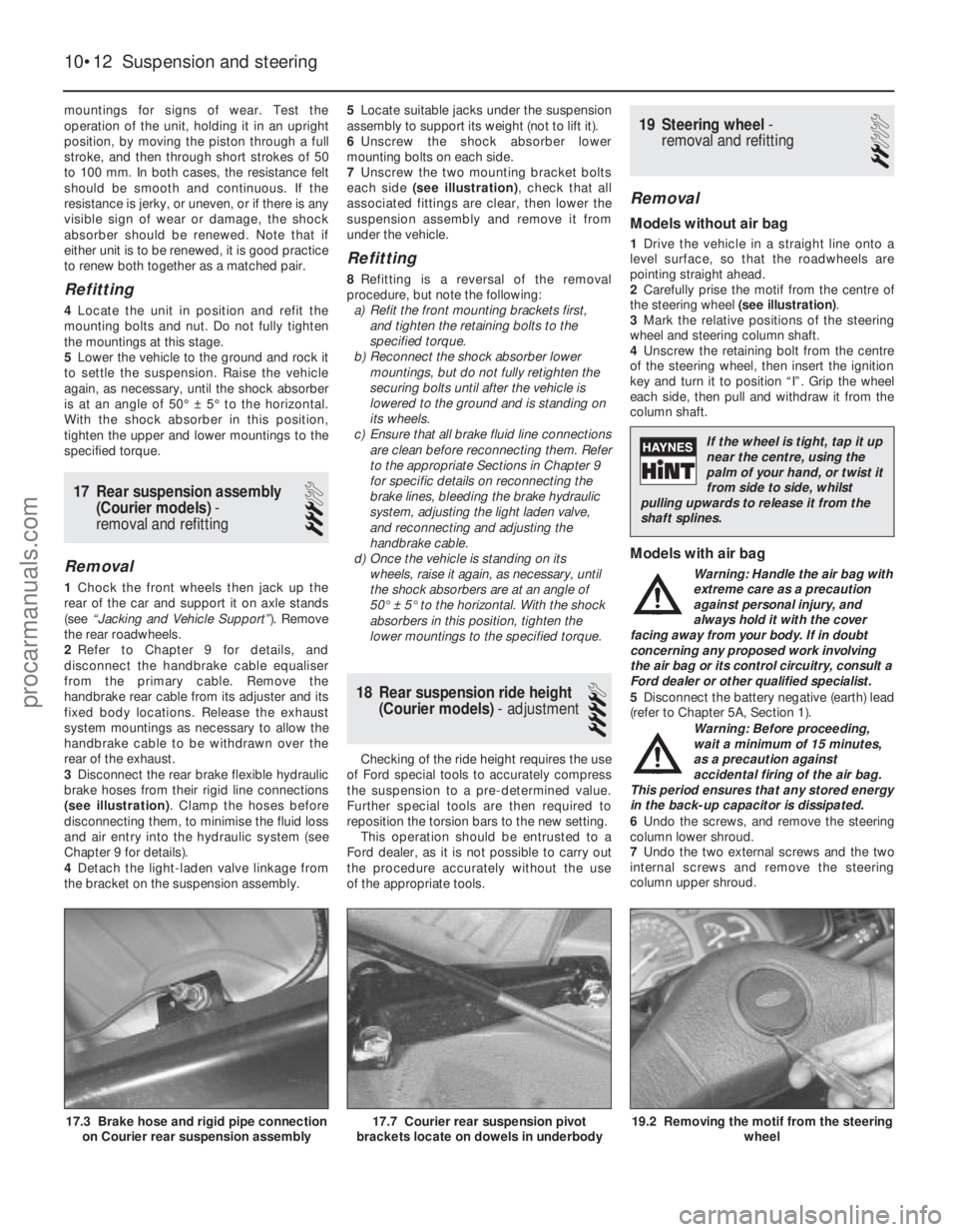
1 Chock the front wheels then jack up the
rear of the car and support it on axle stands
(see “Jacking and Vehicle Support” ).
2 Support the relevant trailing arm of the
suspension assembly and unscrew the upper
mounting bolt and nut, followed by the lower
bolt. Withdraw the shock absorber from under
the vehicle (see illustrations) .
Examination
3Examine the shock absorber body for signs
of fluid leakage or damage and check the
Suspension and steering 10•11
14.2 Rear suspension anti-roll bar
1 Rear suspension strut
2 Anti-roll bar
3 Inset showing (front) mounting clamp13.19 Pivot bush renewal (April 1990
models onwards) - correct engagement of bush lip on rear axle
A New bush, installed correctly
B New bush, installed incorrectly
16.2b . . . and lower mounting on Courier models16.2a Removing a shock absorber uppermounting . . .
10
1595Ford Fiesta Remakeprocarmanuals.com
http://vnx.su
Page 205 of 296
mountings for signs of wear. Test the
operation of the unit, holding it in an upright
position, by moving the piston through a full
stroke, and then through short strokes of 50
to 100 mm. In both cases, the resistance felt
should be smooth and continuous. If the
resistance is jerky, or uneven, or if there is any
visible sign of wear or damage, the shock
absorber should be renewed. Note that if
either unit is to be renewed, it is good practice
to renew both together as a matched pair.
Refitting
4Locate the unit in position and refit the
mounting bolts and nut. Do not fully tighten
the mountings at this stage.
5 Lower the vehicle to the ground and rock it
to settle the suspension. Raise the vehicle
again, as necessary, until the shock absorber
is at an angle of 50° ± 5° to the horizontal.
With the shock absorber in this position,
tighten the upper and lower mountings to the
specified torque.
17 Rear suspension assembly (Courier models) -
removal and refitting
3
Removal
1 Chock the front wheels then jack up the
rear of the car and support it on axle stands
(see “Jacking and Vehicle Support” ). Remove
the rear roadwheels.
2 Refer to Chapter 9 for details, and
disconnect the handbrake cable equaliser
from the primary cable. Remove the
handbrake rear cable from its adjuster and its
fixed body locations. Release the exhaust
system mountings as necessary to allow the
handbrake cable to be withdrawn over the
rear of the exhaust.
3 Disconnect the rear brake flexible hydraulic
brake hoses from their rigid line connections
(see illustration) . Clamp the hoses before
disconnecting them, to minimise the fluid loss
and air entry into the hydraulic system (see
Chapter 9 for details).
4 Detach the light-laden valve linkage from
the bracket on the suspension assembly. 5
Locate suitable jacks under the suspension
assembly to support its weight (not to lift it).
6 Unscrew the shock absorber lower
mounting bolts on each side.
7 Unscrew the two mounting bracket bolts
each side (see illustration) , check that all
associated fittings are clear, then lower the
suspension assembly and remove it from
under the vehicle.
Refitting
8 Refitting is a reversal of the removal
procedure, but note the following: a) Refit the front mounting brackets first,
and tighten the retaining bolts to the
specified torque.
b) Reconnect the shock absorber lower
mountings, but do not fully retighten the
securing bolts until after the vehicle is
lowered to the ground and is standing on
its wheels.
c) Ensure that all brake fluid line connections are clean before reconnecting them. Refer
to the appropriate Sections in Chapter 9
for specific details on reconnecting the
brake lines, bleeding the brake hydraulic
system, adjusting the light laden valve,
and reconnecting and adjusting the
handbrake cable.
d) Once the vehicle is standing on its
wheels, raise it again, as necessary, until
the shock absorbers are at an angle of
50° ± 5° to the horizontal. With the shock
absorbers in this position, tighten the
lower mountings to the specified torque.
18 Rear suspension ride height (Courier models) - adjustment
4
Checking of the ride height requires the use
of Ford special tools to accurately compress
the suspension to a pre-determined value.
Further special tools are then required to
reposition the torsion bars to the new setting.
This operation should be entrusted to a
Ford dealer, as it is not possible to carry out
the procedure accurately without the use
of the appropriate tools.
19 Steering wheel -
removal and refitting
2
Removal
Models without air bag
1 Drive the vehicle in a straight line onto a
level surface, so that the roadwheels are
pointing straight ahead.
2 Carefully prise the motif from the centre of
the steering wheel (see illustration).
3 Mark the relative positions of the steering
wheel and steering column shaft.
4 Unscrew the retaining bolt from the centre
of the steering wheel, then insert the ignition
key and turn it to position “I”. Grip the wheel
each side, then pull and withdraw it from the
column shaft.
Models with air bag
Warning: Handle the air bag with
extreme care as a precaution
against personal injury, and
always hold it with the cover
facing away from your body. If in doubt
concerning any proposed work involving
the air bag or its control circuitry, consult a
Ford dealer or other qualified specialist.
5 Disconnect the battery negative (earth) lead
(refer to Chapter 5A, Section 1).
Warning: Before proceeding,
wait a minimum of 15 minutes,
as a precaution against
accidental firing of the air bag.
This period ensures that any stored energy
in the back-up capacitor is dissipated.
6 Undo the screws, and remove the steering
column lower shroud.
7 Undo the two external screws and the two
internal screws and remove the steering
column upper shroud.
10•12 Suspension and steering
19.2 Removing the motif from the steering wheel17.7 Courier rear suspension pivot
brackets locate on dowels in underbody17.3 Brake hose and rigid pipe connection on Courier rear suspension assembly
1595Ford Fiesta Remake
If the wheel is tight, tap it up
near the centre, using the
palm of your hand, or twist it
from side to side, whilst
pulling upwards to release it from the
shaft splines.
procarmanuals.com
http://vnx.su
Page 206 of 296
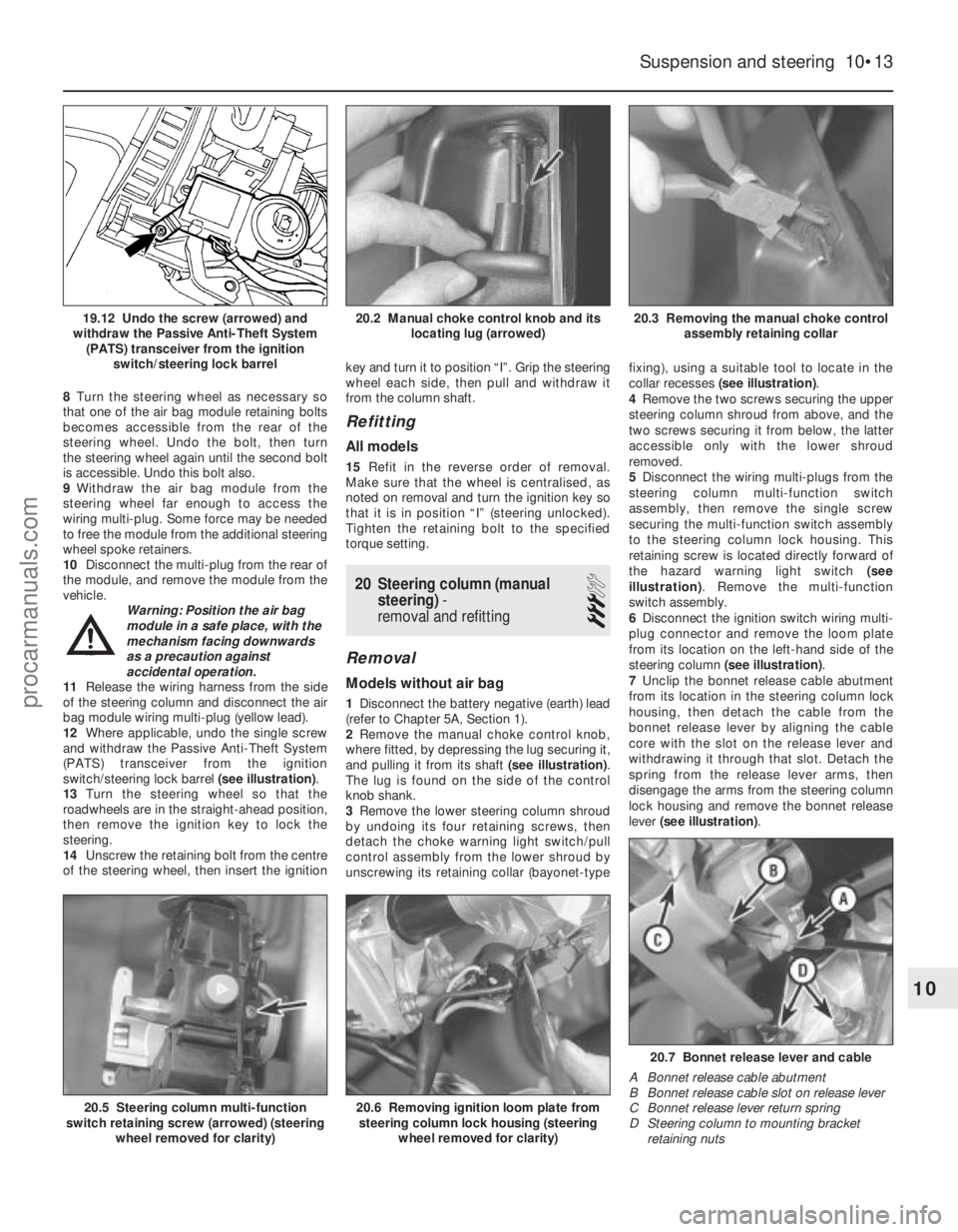
8Turn the steering wheel as necessary so
that one of the air bag module retaining bolts
becomes accessible from the rear of the
steering wheel. Undo the bolt, then turn
the steering wheel again until the second bolt
is accessible. Undo this bolt also.
9 Withdraw the air bag module from the
steering wheel far enough to access the
wiring multi-plug. Some force may be needed
to free the module from the additional steering
wheel spoke retainers.
10 Disconnect the multi-plug from the rear of
the module, and remove the module from the
vehicle. Warning: Position the air bag
module in a safe place, with the
mechanism facing downwards
as a precaution against
accidental operation.
11 Release the wiring harness from the side
of the steering column and disconnect the air
bag module wiring multi-plug (yellow lead).
12 Where applicable, undo the single screw
and withdraw the Passive Anti-Theft System
(PATS) transceiver from the ignition
switch/steering lock barrel (see illustration).
13 Turn the steering wheel so that the
roadwheels are in the straight-ahead position,
then remove the ignition key to lock the
steering.
14 Unscrew the retaining bolt from the centre
of the steering wheel, then insert the ignition key and turn it to position “I”. Grip the steering
wheel each side, then pull and withdraw it
from the column shaft.
Refitting
All models
15
Refit in the reverse order of removal.
Make sure that the wheel is centralised, as
noted on removal and turn the ignition key so
that it is in position “I” (steering unlocked).
Tighten the retaining bolt to the specified
torque setting.
20 Steering column (manual steering) -
removal and refitting
3
Removal
Models without air bag
1 Disconnect the battery negative (earth) lead
(refer to Chapter 5A, Section 1).
2 Remove the manual choke control knob,
where fitted, by depressing the lug securing it,
and pulling it from its shaft (see illustration).
The lug is found on the side of the control
knob shank.
3 Remove the lower steering column shroud
by undoing its four retaining screws, then
detach the choke warning light switch/pull
control assembly from the lower shroud by
unscrewing its retaining collar (bayonet-type fixing), using a suitable tool to locate in the
collar recesses
(see illustration) .
4 Remove the two screws securing the upper
steering column shroud from above, and the
two screws securing it from below, the latter
accessible only with the lower shroud
removed.
5 Disconnect the wiring multi-plugs from the
steering column multi-function switch
assembly, then remove the single screw
securing the multi-function switch assembly
to the steering column lock housing. This
retaining screw is located directly forward of
the hazard warning light switch (see
illustration) . Remove the multi-function
switch assembly.
6 Disconnect the ignition switch wiring multi-
plug connector and remove the loom plate
from its location on the left-hand side of the
steering column (see illustration) .
7 Unclip the bonnet release cable abutment
from its location in the steering column lock
housing, then detach the cable from the
bonnet release lever by aligning the cable
core with the slot on the release lever and
withdrawing it through that slot. Detach the
spring from the release lever arms, then
disengage the arms from the steering column
lock housing and remove the bonnet release
lever (see illustration) .
Suspension and steering 10•13
20.3 Removing the manual choke control
assembly retaining collar20.2 Manual choke control knob and its locating lug (arrowed)19.12 Undo the screw (arrowed) and
withdraw the Passive Anti-Theft System (PATS) transceiver from the ignition switch/steering lock barrel
20.7 Bonnet release lever and cable
A Bonnet release cable abutment
B Bonnet release cable slot on release lever
C Bonnet release lever return spring
D Steering column to mounting bracket retaining nuts
20.6 Removing ignition loom plate fromsteering column lock housing (steering
wheel removed for clarity)20.5 Steering column multi-function
switch retaining screw (arrowed) (steering
wheel removed for clarity)
10
1595Ford Fiesta Remakeprocarmanuals.com
http://vnx.su
Page 207 of 296
8Remove the nuts securing the steering
column mounting bracket.
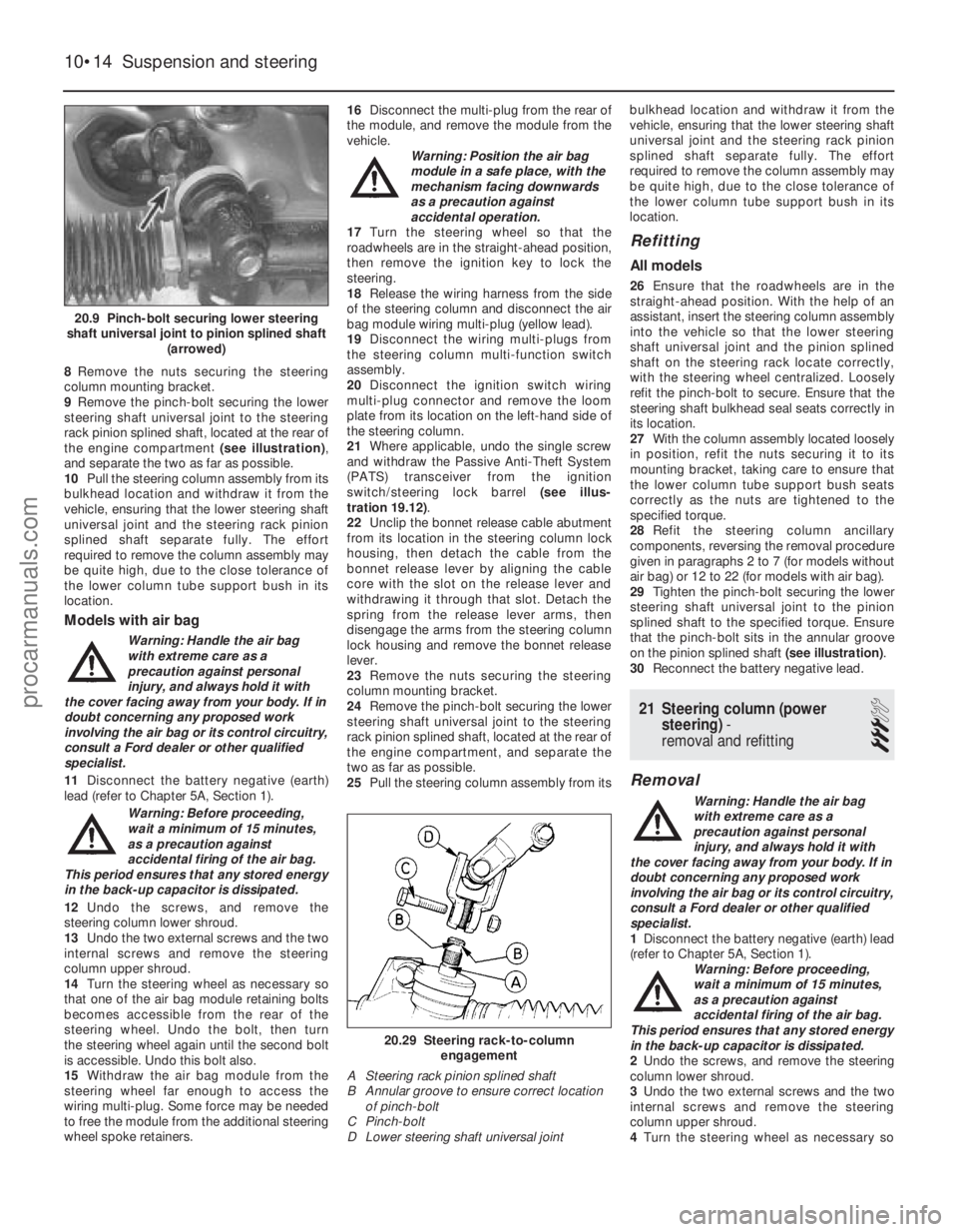
9 Remove the pinch-bolt securing the lower
steering shaft universal joint to the steering
rack pinion splined shaft, located at the rear of
the engine compartment (see illustration),
and separate the two as far as possible.
10 Pull the steering column assembly from its
bulkhead location and withdraw it from the
vehicle, ensuring that the lower steering shaft
universal joint and the steering rack pinion
splined shaft separate fully. The effort
required to remove the column assembly may
be quite high, due to the close tolerance of
the lower column tube support bush in its
location.
Models with air bag
Warning: Handle the air bag
with extreme care as a
precaution against personal
injury, and always hold it with
the cover facing away from your body. If in
doubt concerning any proposed work
involving the air bag or its control circuitry,
consult a Ford dealer or other qualified
specialist.
11 Disconnect the battery negative (earth)
lead (refer to Chapter 5A, Section 1).
Warning: Before proceeding,
wait a minimum of 15 minutes,
as a precaution against
accidental firing of the air bag.
This period ensures that any stored energy
in the back-up capacitor is dissipated.
12 Undo the screws, and remove the
steering column lower shroud.
13 Undo the two external screws and the two
internal screws and remove the steering
column upper shroud.
14 Turn the steering wheel as necessary so
that one of the air bag module retaining bolts
becomes accessible from the rear of the
steering wheel. Undo the bolt, then turn
the steering wheel again until the second bolt
is accessible. Undo this bolt also.
15 Withdraw the air bag module from the
steering wheel far enough to access the
wiring multi-plug. Some force may be needed
to free the module from the additional steering
wheel spoke retainers. 16
Disconnect the multi-plug from the rear of
the module, and remove the module from the
vehicle. Warning: Position the air bag
module in a safe place, with the
mechanism facing downwards
as a precaution against
accidental operation.
17 Turn the steering wheel so that the
roadwheels are in the straight-ahead position,
then remove the ignition key to lock the
steering.
18 Release the wiring harness from the side
of the steering column and disconnect the air
bag module wiring multi-plug (yellow lead).
19 Disconnect the wiring multi-plugs from
the steering column multi-function switch
assembly.
20 Disconnect the ignition switch wiring
multi-plug connector and remove the loom
plate from its location on the left-hand side of
the steering column.
21 Where applicable, undo the single screw
and withdraw the Passive Anti-Theft System
(PATS) transceiver from the ignition
switch/steering lock barrel (see illus-
tration 19.12) .
22 Unclip the bonnet release cable abutment
from its location in the steering column lock
housing, then detach the cable from the
bonnet release lever by aligning the cable
core with the slot on the release lever and
withdrawing it through that slot. Detach the
spring from the release lever arms, then
disengage the arms from the steering column
lock housing and remove the bonnet release
lever.
23 Remove the nuts securing the steering
column mounting bracket.
24 Remove the pinch-bolt securing the lower
steering shaft universal joint to the steering
rack pinion splined shaft, located at the rear of
the engine compartment, and separate the
two as far as possible.
25 Pull the steering column assembly from its bulkhead location and withdraw it from the
vehicle, ensuring that the lower steering shaft
universal joint and the steering rack pinion
splined shaft separate fully. The effort
required to remove the column assembly may
be quite high, due to the close tolerance of
the lower column tube support bush in its
location.
Refitting
All models
26
Ensure that the roadwheels are in the
straight-ahead position. With the help of an
assistant, insert the steering column assembly
into the vehicle so that the lower steering
shaft universal joint and the pinion splined
shaft on the steering rack locate correctly,
with the steering wheel centralized. Loosely
refit the pinch-bolt to secure. Ensure that the
steering shaft bulkhead seal seats correctly in
its location.
27 With the column assembly located loosely
in position, refit the nuts securing it to its
mounting bracket, taking care to ensure that
the lower column tube support bush seats
correctly as the nuts are tightened to the
specified torque.
28 Refit the steering column ancillary
components, reversing the removal procedure
given in paragraphs 2 to 7 (for models without
air bag) or 12 to 22 (for models with air bag).
29 Tighten the pinch-bolt securing the lower
steering shaft universal joint to the pinion
splined shaft to the specified torque. Ensure
that the pinch-bolt sits in the annular groove
on the pinion splined shaft (see illustration).
30 Reconnect the battery negative lead.
21 Steering column (power
steering) -
removal and refitting
3
Removal
Warning: Handle the air bag
with extreme care as a
precaution against personal
injury, and always hold it with
the cover facing away from your body. If in
doubt concerning any proposed work
involving the air bag or its control circuitry,
consult a Ford dealer or other qualified
specialist.
1 Disconnect the battery negative (earth) lead
(refer to Chapter 5A, Section 1). Warning: Before proceeding,
wait a minimum of 15 minutes,
as a precaution against
accidental firing of the air bag.
This period ensures that any stored energy
in the back-up capacitor is dissipated.
2 Undo the screws, and remove the steering
column lower shroud.
3 Undo the two external screws and the two
internal screws and remove the steering
column upper shroud.
4 Turn the steering wheel as necessary so
10•14 Suspension and steering
20.29 Steering rack-to-column
engagement
A Steering rack pinion splined shaft
B Annular groove to ensure correct location of pinch-bolt
C Pinch-bolt
D Lower steering shaft universal joint
20.9 Pinch-bolt securing lower steering
shaft universal joint to pinion splined shaft (arrowed)
1595Ford Fiesta Remakeprocarmanuals.com
http://vnx.su