air bleeding FORD FIESTA 2007 Workshop Manual
[x] Cancel search | Manufacturer: FORD, Model Year: 2007, Model line: FIESTA, Model: FORD FIESTA 2007Pages: 1226, PDF Size: 61.26 MB
Page 179 of 1226
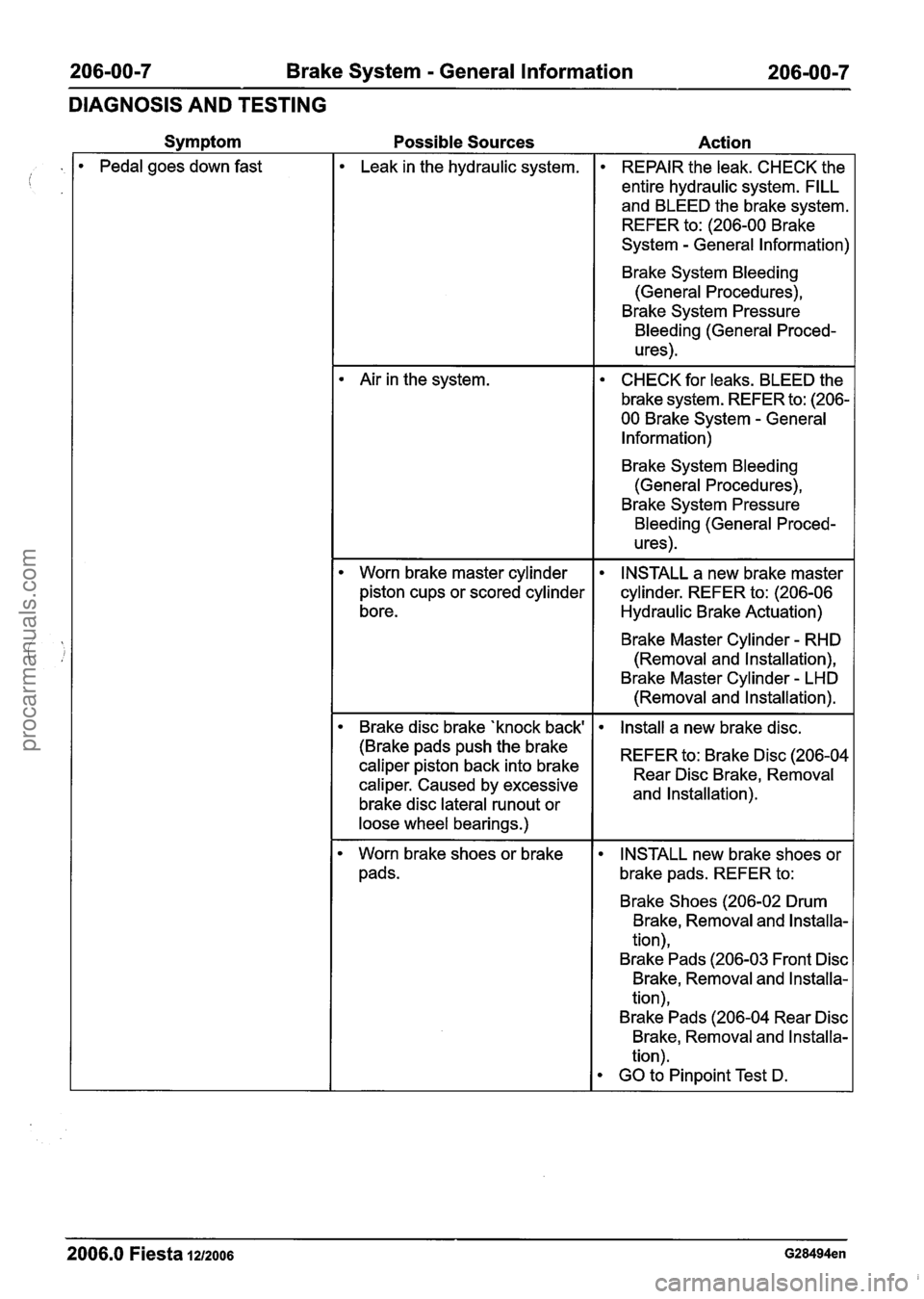
206-00-7 Brake System - General Information 206-00-7
DIAGNOSIS AND TESTING
1 Pedal goes down fast
Possible Sources Action
Leak in the hydraulic system. REPAIR the leak. CHECK the
entire hydraulic system. FILL
and BLEED the brake system.
REFER to: (206-00 Brake
System
- General Information)
Brake System Bleeding
(General Procedures),
Brake System Pressure
Bleeding (General Proced-
ures).
Air in the system.
CHECK for leaks. BLEED the
brake system. REFER to: (206-
00 Brake System
- General
Information)
Brake System Bleeding
(General Procedures),
Brake System Pressure
Bleeding (General Proced-
u res).
Worn brake master cylinder piston cups or scored cylinder
bore. INSTALL
a new brake master
cylinder. REFER to: (206-06
Hydraulic Brake Actuation)
Brake Master Cylinder
- RHD
(Removal and lnstallation),
Brake Master Cylinder
- LHD
(Removal and lnstallation).
I Brake disc brake 'knock back' I Install a new brake disc. I
I loose wheel bearings.) I I
(Brake pads push the brake
caliper piston back into brake
caliper. Caused by excessive
brake disc lateral
runout or
Worn brake shoes or brake
pads. REFER to:
Brake Disc (206-04
Rear Disc Brake, Removal
and Installation). INSTALL new brake shoes or
brake pads. REFER to:
Brake Shoes (206-02 Drum
Brake, Removal and Installa-
tion),
Brake Pads (206-03 Front Disc
Brake, Removal and Installa-
tion),
Brake Pads (206-04 Rear Disc Brake, Removal and Installa-
tion).
GO to Pinpoint Test D.
2006.0 Fiesta 1212006 G28494en
procarmanuals.com
Page 180 of 1226
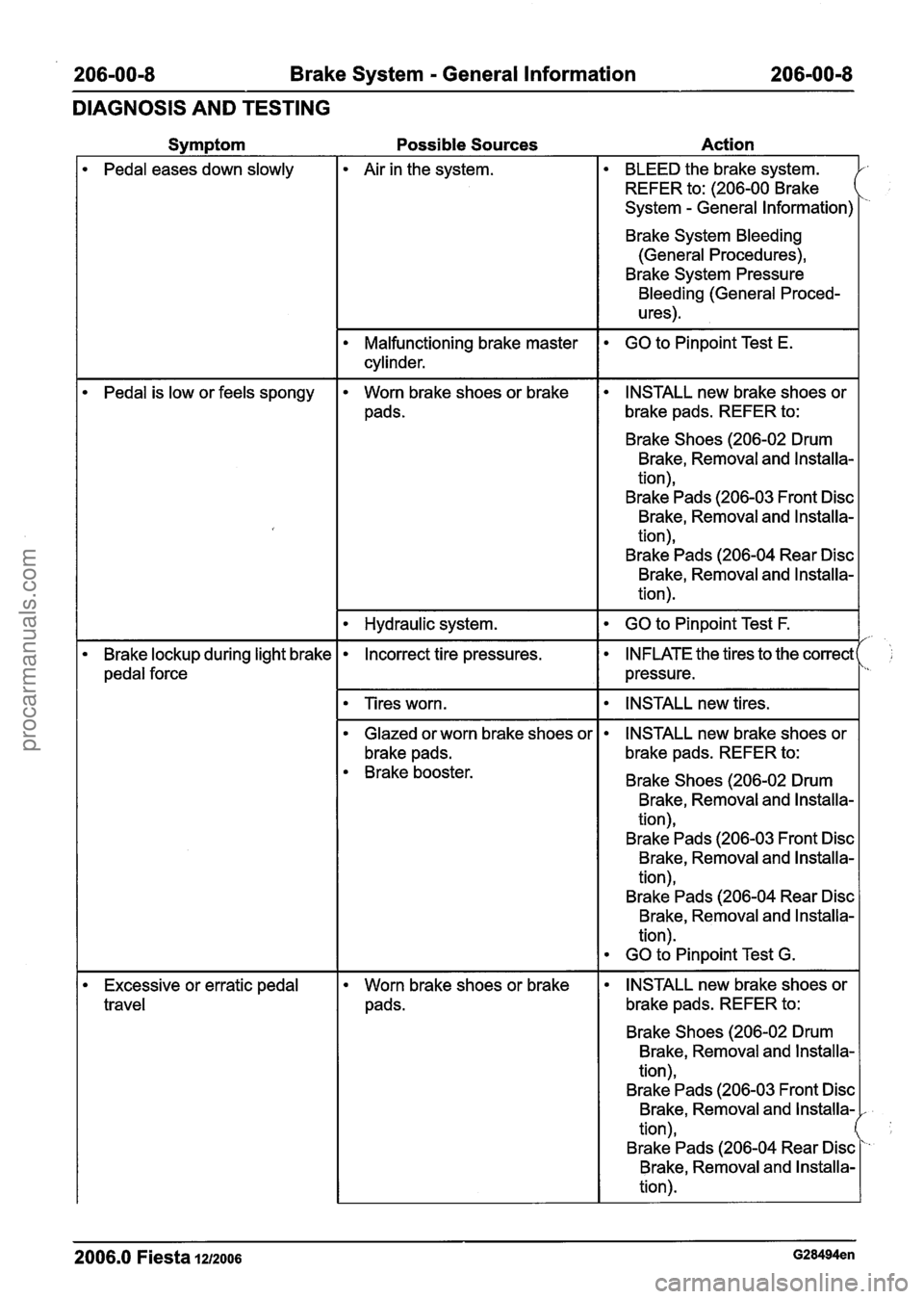
206-00-8 Brake System - General Information 206-00-8
DIAGNOSIS AND TESTING
Svm~tom Possible Sources Action
Pedal eases down slowly Air in the system.
Malfunctioning brake master
cylinder.
BLEED the brake system.
REFER to: (206-00 Brake
System
- General Information)
Brake System Bleeding (General Procedures),
Brake System Pressure Bleeding (General Proced-
ures).
GO to Pinpoint Test E.
Brake, Removal and Installa-
tion),
Brake Pads (206-03 Front Disc
Brake, Removal and Installa-
tion),
Brake Pads (206-04 Rear Disc
Brake, Removal and Installa-
Pedal is low or feels spongy
I tion). I
Brake lockup during light brake I
Worn brake shoes or brake
pads.
pedal force INSTALL new brake shoes or
brake pads. REFER to:
Hydraulic system.
Incorrect tire pressures.
Tires worn.
Glazed or worn brake shoes or
brake pads.
Brake booster.
GO to Pinpoint Test F. I
INFLATE the tires to the correct
pressure.
INSTALL new tires. I
brake pads. REFER to:
Brake Shoes (206-02 Drum
Brake, Removal and Installa-
tion),
Brake Pads (206-03 Front Disc Brake, Removal and Installa-
tion),
Brake Pads (206-04 Rear Disc
Brake, Removal and Installa-
tion).
GO to Pinpoint Test G.
Excessive or erratic pedal
travel Worn brake shoes or brake
pads. INSTALL new brake shoes or
brake pads. REFER to:
Brake Shoes (206-02 Drum Brake, Removal and Installa-
tion),
Brake Pads (206-03 Front Disc Brake, Removal and Installa-
tion),
I
Brake Pads (206-04 Rear Disc
Brake, Removal and Installa-
tion).
2006.0 Fiesta 1212006 G28494en
procarmanuals.com
Page 185 of 1226
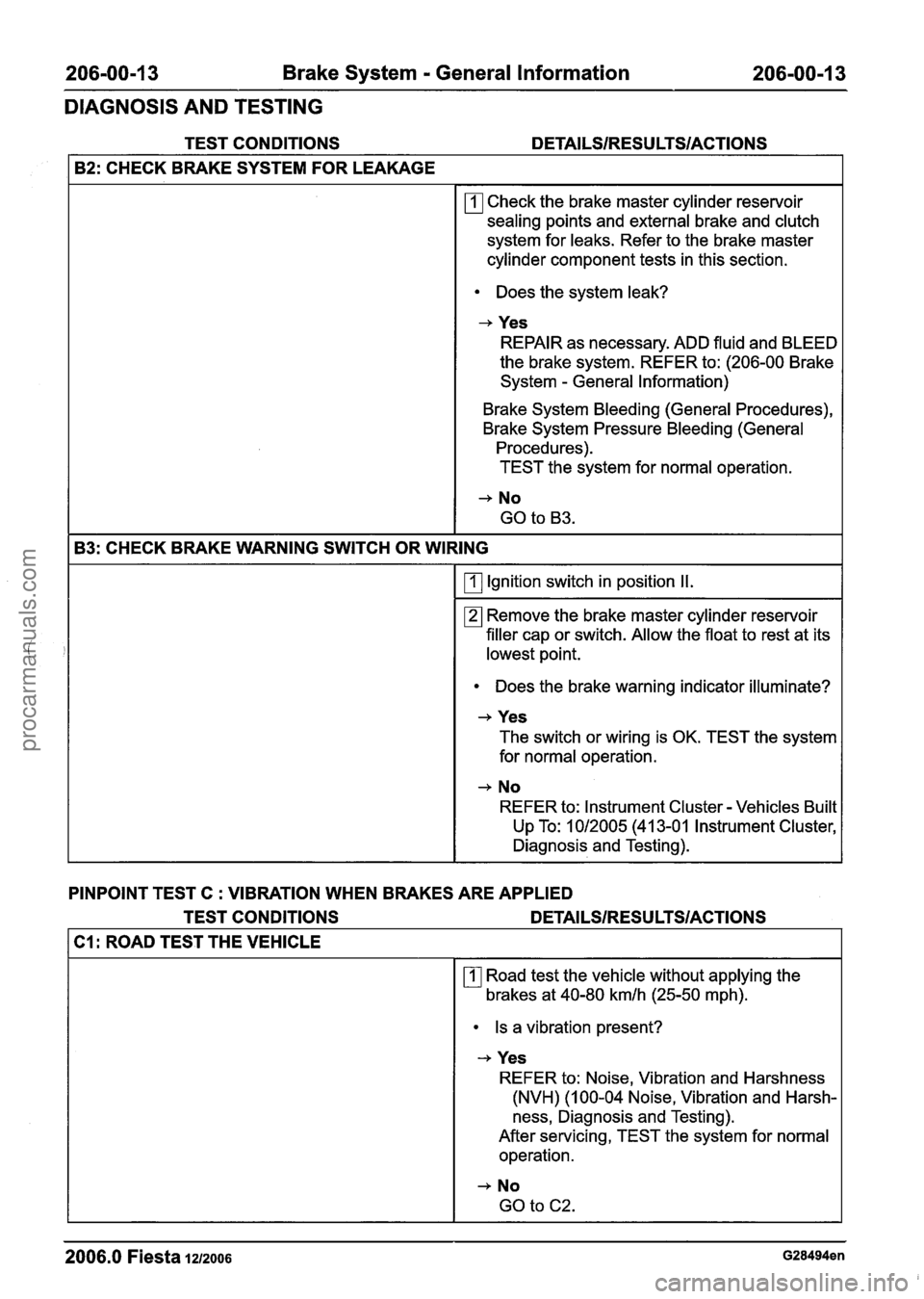
206-00-1 3 Brake System - General Information 206-00-1 3
DIAGNOSIS AND TESTING
TEST CONDITIONS DETAILSIRESU LTSIACTIONS
I B2: CHECK BRAKE SYSTEM FOR LEAKAGE 1
rn Check the brake master cylinder reservoir
sealing points and external brake and clutch
system for leaks. Refer to the brake master
cylinder component tests in this section.
Does the system leak?
-+ Yes
REPAIR as necessary. ADD fluid and BLEED
the brake system. REFER to: (206-00 Brake
System
- General Information)
Brake System Bleeding (General Procedures),
Brake System Pressure Bleeding (General Procedures).
TEST the system for normal operation.
183: CHECK BRAKE WARNING SWITCH OR WIRING I
I rn Ignition switch in position II. I
Remove the brake master cylinder reservoir
filler cap or switch. Allow the float to rest at its
lowest point.
Does the brake warning indicator illuminate?
-+ Yes
The switch or wiring is OK. TEST the system
for normal operation.
-+ No
REFER to: lnstrument Cluster - Vehicles Built I Up To: 1012005 (41 3-01 Instrument Cluster,
I Diagnosis and Testing).
PINPOINT TEST C : VIBRATION WHEN BRAKES ARE APPLIED
TEST CONDITIONS
DETAl LSIRESU LTSIACTIONS
Cl : ROAD TEST THE VEHICLE
Road test the vehicle without applying the
brakes at 40-80 kmlh (25-50 mph).
Is a vibration present?
-+ Yes
REFER to: Noise, Vibration and Harshness
(NVH) (1 00-04 Noise, Vibration and Harsh-
ness, Diagnosis and Testing).
After servicing, TEST the system for normal operation.
-+ No
GO to C2.
2006.0 Fiesta 1212006 G28494en
procarmanuals.com
Page 188 of 1226
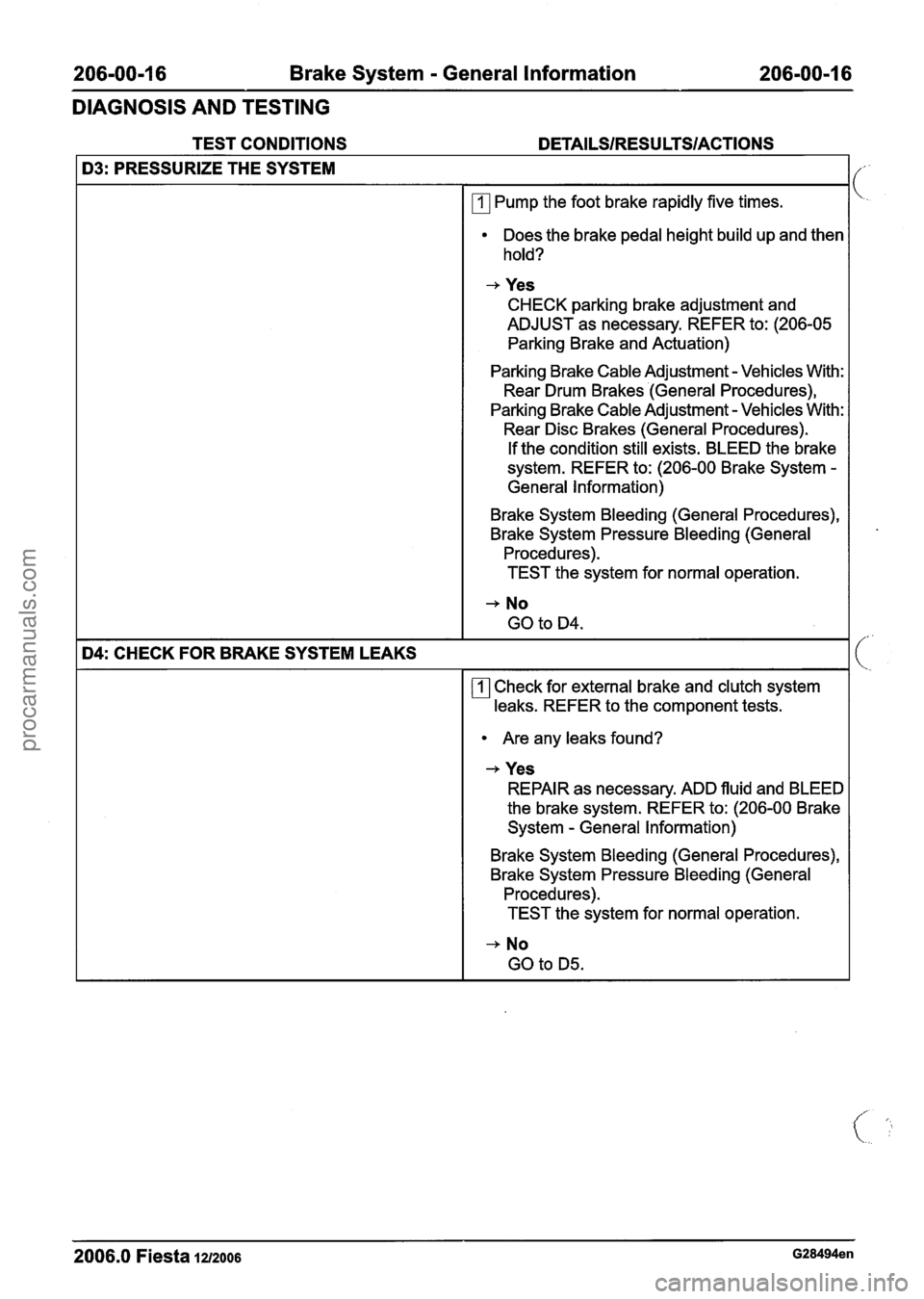
206-00-1 6 Brake System - General Information 206mOO-16
DIAGNOSIS AND TESTING
TEST CONDITIONS
2006.0 Fiesta 12/2006 G28494en
D3: PRESSURIZE THE SYSTEM
D4: CHECK FOR BRAKE SYSTEM LEAKS
Pump the foot brake rapidly five times.
Does the brake pedal height build up and then
hold?
+ Yes
CHECK parking brake adjustment and
ADJUST as necessary. REFER to: (206-05
Parking Brake and Actuation)
Parking Brake Cable Adjustment
- Vehicles With:
Rear Drum Brakes (General Procedures),
Parking Brake Cable Adjustment
- Vehicles With:
Rear Disc Brakes (General Procedures).
If the condition still exists. BLEED the brake
system. REFER to: (206-00 Brake System
-
General Information)
Brake System Bleeding (General Procedures),
Brake System Pressure Bleeding (General
Procedures). TEST the system for normal operation.
+ No
GO to D4.
Check for external brake and clutch system
leaks. REFER to the component tests.
Are any leaks found?
+ Yes
REPAIR as necessary. ADD fluid and BLEED
the brake system. REFER to: (206-00 Brake
System
- General Information)
Brake System Bleeding (General Procedures),
Brake System Pressure Bleeding (General
Procedures). TEST the system for normal operation.
+ No
GO to D5.
procarmanuals.com
Page 190 of 1226
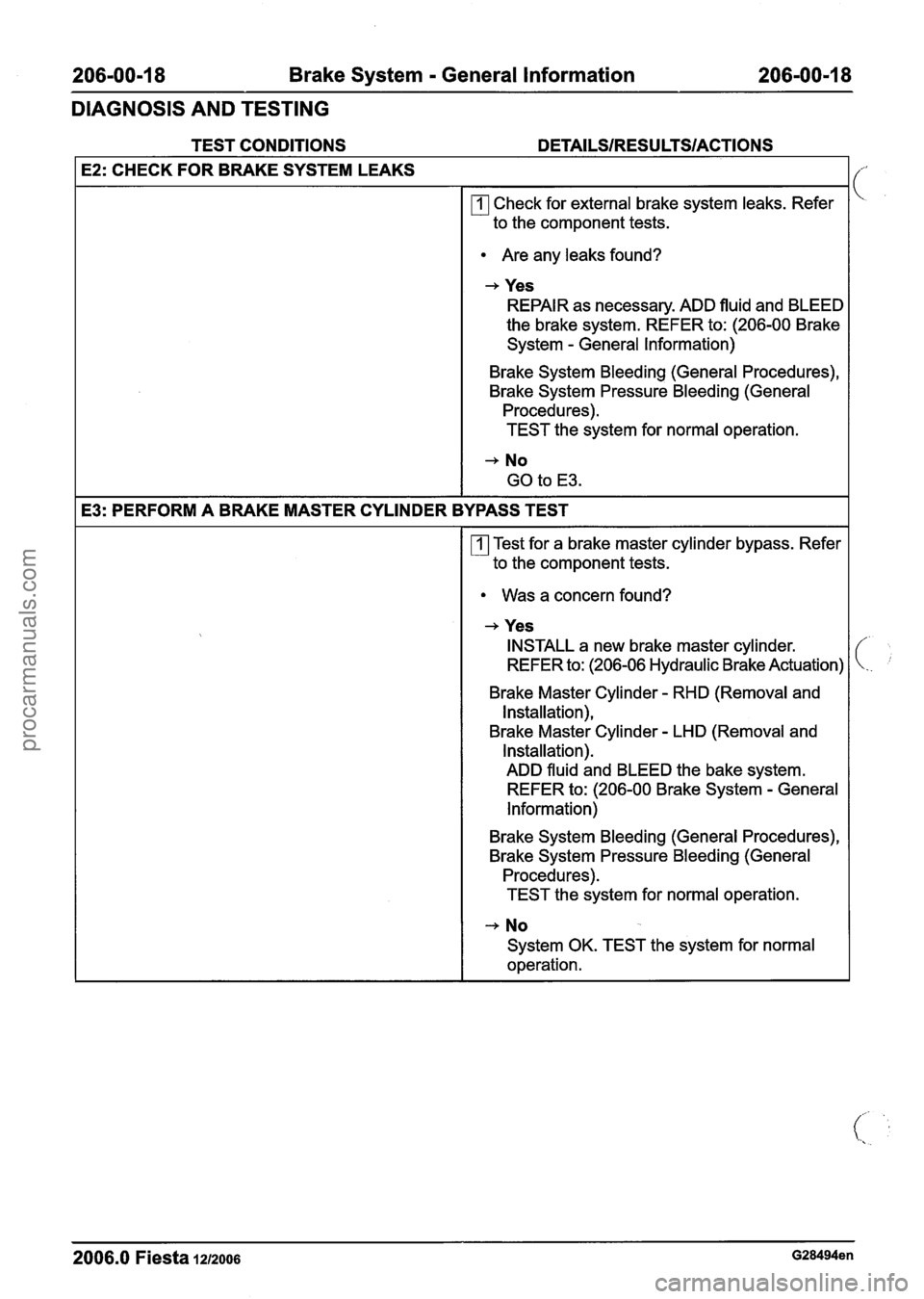
206-00-18 Brake System - General Information 206-00-1 8
DIAGNOSIS AND TESTING
TEST CONDITIONS DETAILSIRESU LTSIACTIONS
E2: CHECK FOR BRAKE SYSTEM LEAKS
Check for external brake system leaks. Refer
to the component tests.
Are any leaks found?
+ Yes
REPAIR as necessary. ADD fluid and BLEED
the brake system. REFER to: (206-00 Brake
System
- General Information)
Brake System Bleeding (General Procedures),
Brake System Pressure Bleeding (General Procedures). TEST the system for normal operation.
+ No
GO to E3.
E3: PERFORM A BRAKE MASTER CYLINDER BYPASS TEST
Test for a brake master cylinder bypass. Refer
to the component tests.
Was a concern found?
+ Yes
INSTALL a new brake master cylinder.
REFER to: (206-06 Hydraulic Brake Actuation)
Brake Master Cylinder
- RHD (Removal and
Installation),
Brake Master Cylinder
- LHD (Removal and
Installation).
ADD fluid and BLEED the bake system.
REFER to: (206-00 Brake System
- General
Information)
Brake System Bleeding (General Procedures),
Brake System Pressure Bleeding (General Procedures). TEST the system for normal operation.
-+ No
System
OK. TEST the system for normal
operation.
2006.0 Fiesta 12/2006 G28494en
procarmanuals.com
Page 192 of 1226
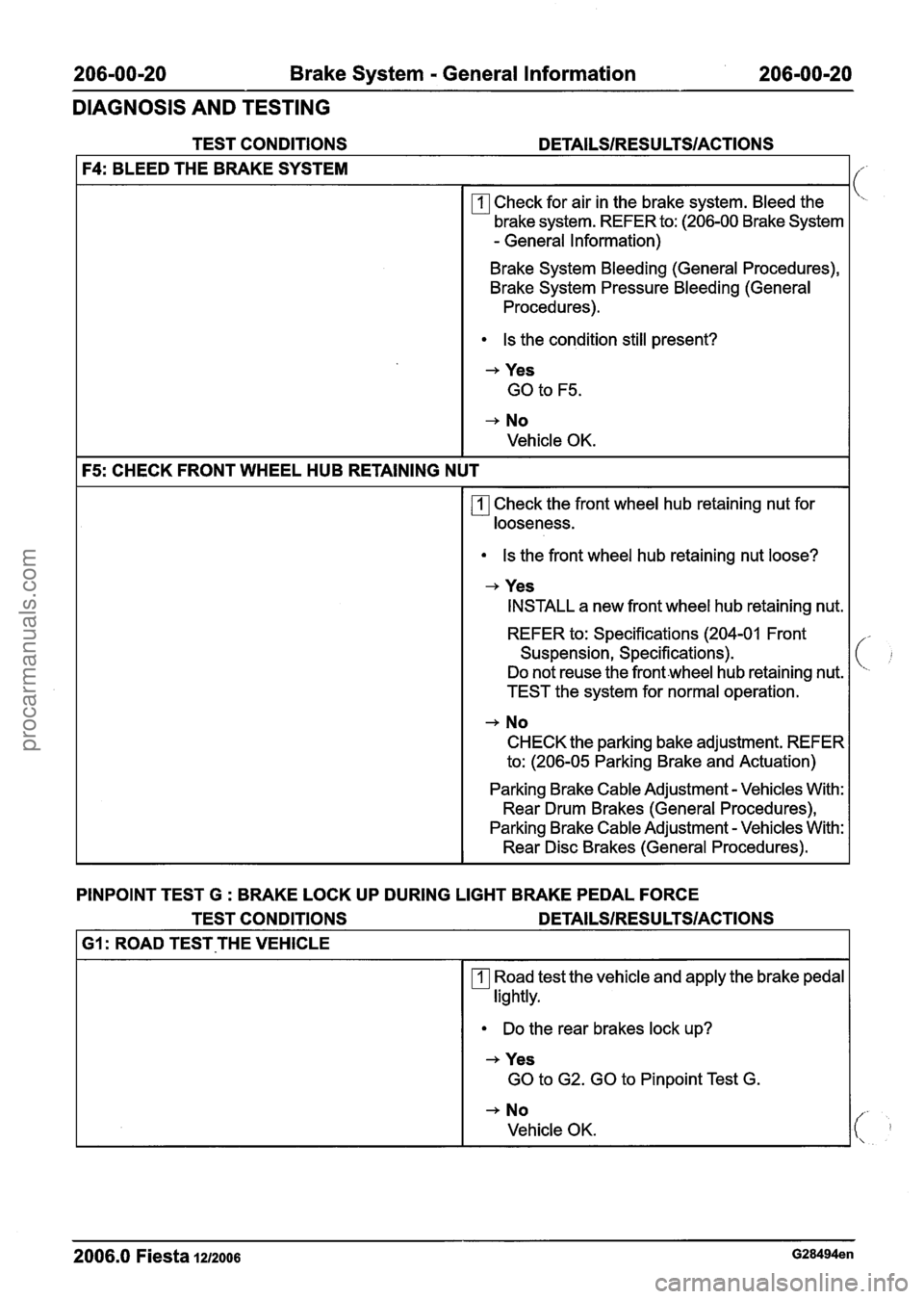
206-00-20 Brake System - General Information 206=00-20
DIAGNOSIS AND TESTING
TEST CONDITIONS
DETAILSIRESULTSIACTIONS
F4: BLEED THE BRAKE SYSTEM
rn Check for air in the brake system. Bleed the
brake system. REFER to: (206-00 Brake System
- General lnformation)
Brake System Bleeding (General Procedures),
Brake System Pressure Bleeding (General Procedures)
.
Is the condition still present?
+ Yes
GO to F5.
+ No
Vehicle OK.
F5: CHECK FRONT WHEEL HUB RETAINING NUT
Check the front wheel hub retaining nut for
looseness.
Is the front wheel hub retaining nut loose?
+ Yes
INSTALL a new front wheel hub retaining nut.
REFER to: Specifications (204-01 Front
Suspension, Specifications).
Do not reuse the
frontwheel hub retaining nut.
TEST the system for normal operation.
+ No
CHECK the parking bake adjustment. REFER
to: (206-05 Parking Brake and Actuation)
Parking Brake Cable Adjustment
- Vehicles With:
Rear Drum Brakes (General Procedures),
Parking Brake Cable Adjustment
- Vehicles With:
Rear Disc Brakes (General Procedures).
PINPOINT TEST G
: BRAKE LOCK UP DURING LIGHT BRAKE PEDAL FORCE
TEST CONDITIONS
DETAILSIRESULTSIACTIONS
I GI : ROAD TEST-THE VEHICLE I
Road test the vehicle and apply the brake pedal
lightly.
Do the rear brakes lock up?
+ Yes
GO to G2. GO to Pinpoint Test G.
+ No
Vehicle OK.
2006.0 Fiesta 12/2006 G28494en
procarmanuals.com
Page 193 of 1226
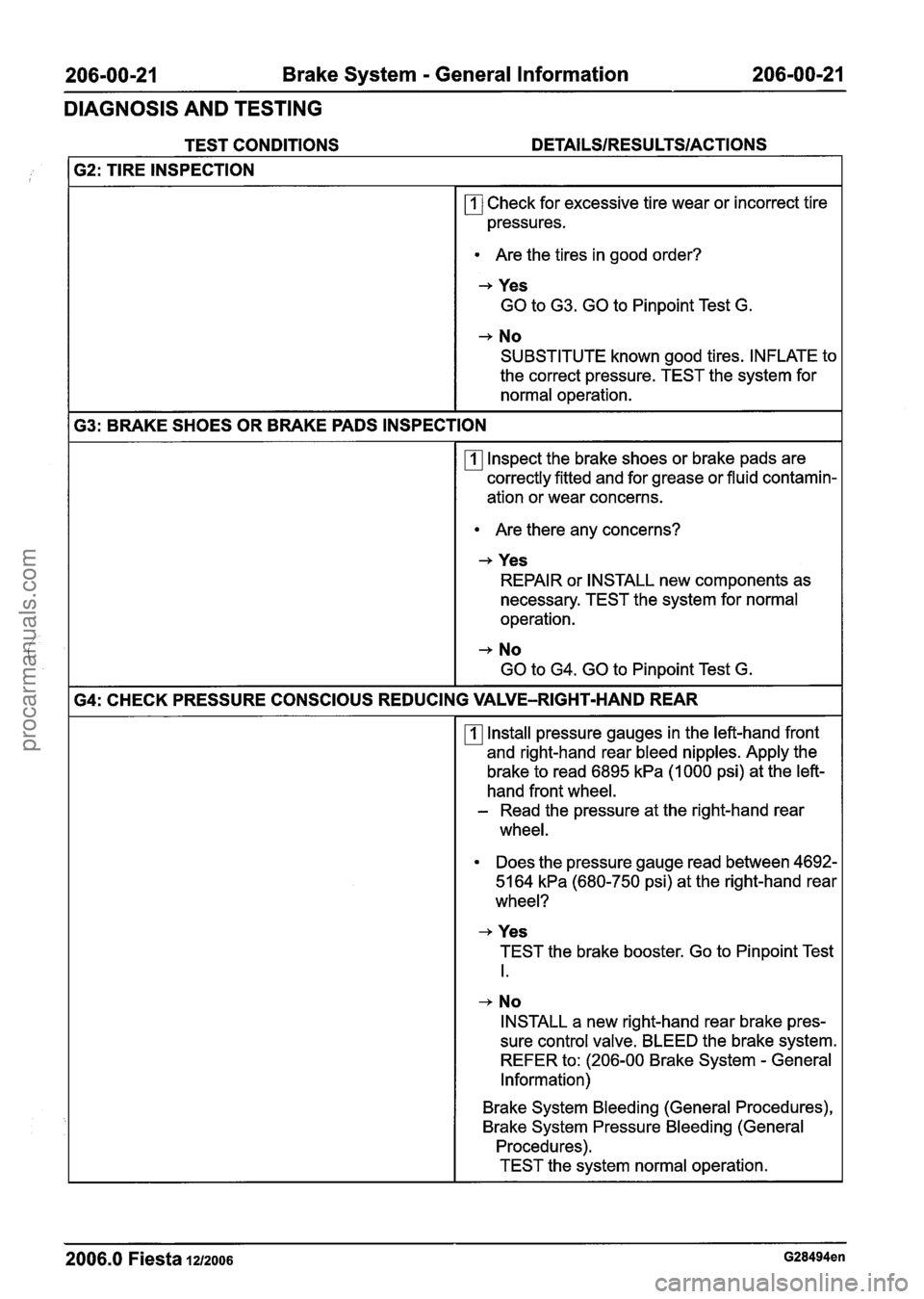
206-00-21 Brake System - General Information 206-00-21
DIAGNOSIS AND TESTING
TEST CONDITIONS DETAILSIRESU LTSIACTIONS
162: TIRE INSPECTION
rn Check for excessive tire wear or incorrect tire
pressures.
Are the tires in good order?
-+ Yes
GO to G3. GO to Pinpoint Test G.
-+ No
SUBSTITUTE known good tires. INFLATE to
the correct pressure. TEST the system for
normal operation.
163: BRAKE SHOES OR BRAKE PADS INSPECTION I
rn Inspect the brake shoes or brake pads are
correctly fitted and for grease or fluid contamin-
ation or wear concerns.
Are there any concerns?
-+ Yes
REPAIR or INSTALL new components as
necessary. TEST the system for normal
operation.
-+ No
GO to G4. GO to Pinpoint Test G.
1 64: CHECK PRESSURE CONSCIOUS REDUCING VALVE-RIGHT-HAND REAR I
rn Install pressure gauges in the left-hand front
and right-hand rear bleed nipples. Apply the brake to read 6895
kPa (1 000 psi) at the left-
hand front wheel.
- Read the pressure at the right-hand rear
wheel.
Does the pressure gauge read between 4692-
5164
kPa (680-750 psi) at the right-hand rear
wheel?
-+ Yes
TEST the brake booster. Go to Pinpoint Test
I.
-+ No
INSTALL a new right-hand rear brake pres-
sure control valve. BLEED the brake system.
REFER to: (206-00 Brake System
- General
Information)
Brake System Bleeding (General Procedures),
Brake System Pressure Bleeding (General
Procedures). TEST the system normal operation.
2006.0 Fiesta 12/2006 G28494en
procarmanuals.com
Page 198 of 1226
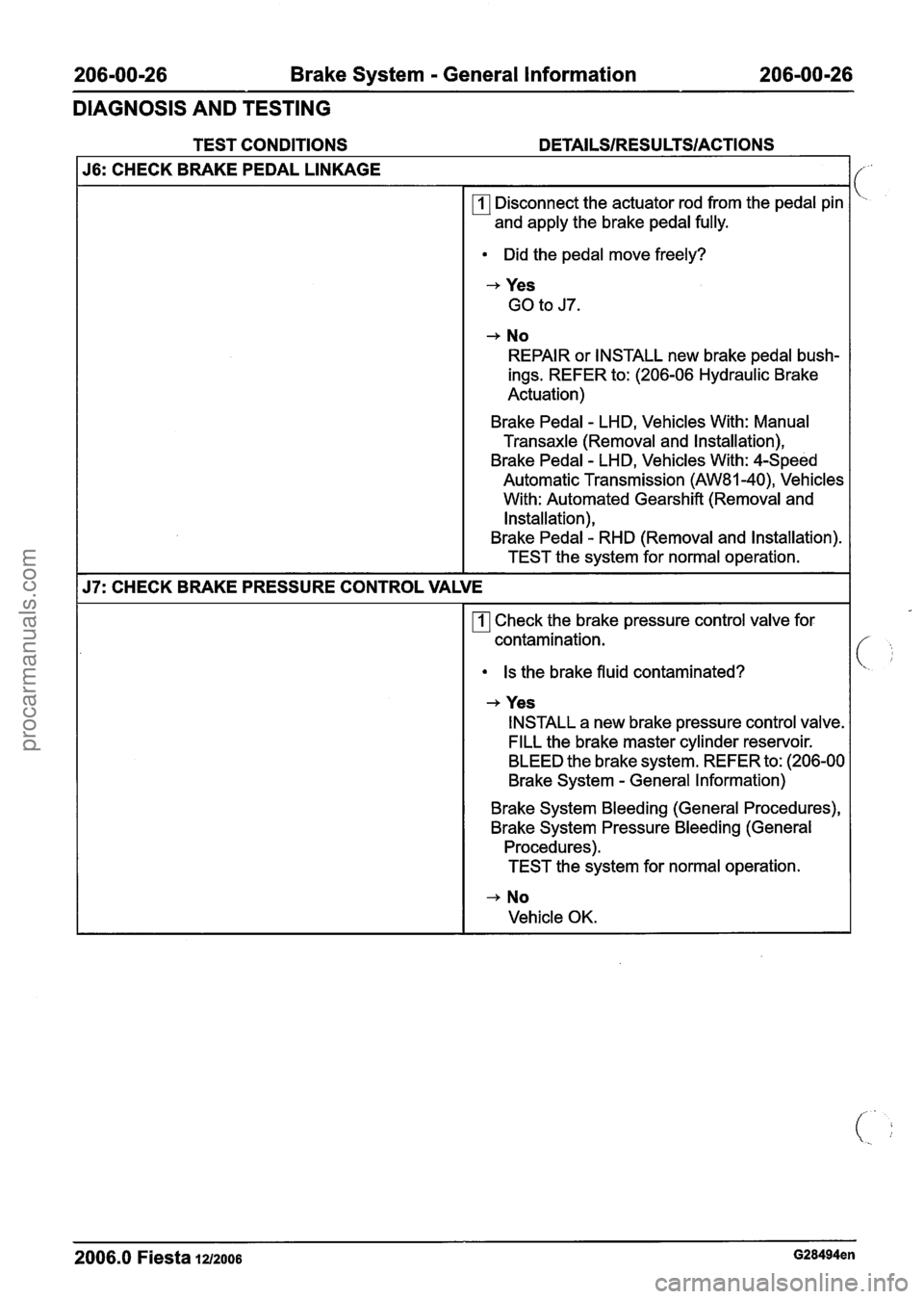
206-00-26 Brake System - General Information 206-00-26
DIAGNOSIS AND TESTING
TEST CONDITIONS DETAILSIRESU LTSIACTIONS
I J6: CHECK BRAKE PEDAL LINKAGE If
rn Disconnect the actuator rod from the pedal pin
and apply the brake pedal fully.
Did the pedal move freely?
-+ Yes
GO to J7.
+ No
REPAIR or INSTALL new brake pedal bush-
ings. REFER to: (206-06 Hydraulic Brake
Actuation)
Brake Pedal
- LHD, Vehicles With: Manual
Transaxle (Removal and Installation),
Brake Pedal
- LHD, Vehicles With: 4-Speed
Automatic Transmission
(AW81-40), Vehicles
With: Automated Gearshift (Removal and
Installation),
Brake Pedal
- RHD (Removal and Installation).
TEST the system for normal operation.
157: CHECK BRAKE PRESSURE CONTROL VALVE I
rn Check the brake pressure control valve for
contamination.
Is the brake fluid contaminated?
+ Yes
INSTALL a new brake pressure control valve.
FILL the brake master cylinder reservoir.
BLEED the brake system. REFER to: (206-00
Brake System
- General Information)
1 Brake System Bleeding (General Procedures),
Brake System Pressure Bleeding (General
Procedures). TEST the system for normal operation.
1 * Ehicle OK.
2006.0 Fiesta 1212006 G28494en
procarmanuals.com
Page 201 of 1226
206-00-29 Brake System - General Information 206-00-29
DIAGNOSIS AND TESTING
and repair the external leak. If the fluid level drops
and no external leak can be found, check for a
brake master cylinder bore end seal leak.
Brake System Check
Brake Pedal Reserve Check
Where a low brake pedal or the feel of a
bottomed-out condition exists, check for brake
pedal reserve.
1. Operate the engine at idle with the transaxle in
NEUTRAL.
2. Apply the brake pedal lightly three or four times.
3. Allow 15 seconds for vacuum to replenish the
brake booster.
N0TE:This increased resistance may feel like
something has bottomed out.
4. Apply the brake pedal until it stops moving
downward or an increased resistance to the
pedal travel occurs.
5. Hold the brake pedal in the applied position and
raise the engine speed to approximately 2000
rpm.
N0TE:The additional movement of the brake pedal
is the result of the increased engine intake manifold
vacuum which exerts more force on the brake
booster during engine rundown. This means that
additional stroke is available in the brake master
cylinder and the brake system is not bottoming out.
6. Release the accelerator pedal and observe that
the brake pedal moves downward as the engine
returns to idle speed.
Brake Booster Functional Test
lnspect all hoses and connections. All unused
vacuum connectors should be capped. Hoses and
their connections should be correctly secured and
in good condition with no holes and no collapsed 2.
With the transaxle in NEUTRAL, stop the engine
and apply the parking brake. Apply the brake
pedal several times to exhaust all vacuum in
the system.
3. With the engine turned off and all vacuum in the
system exhausted, apply the brake pedal and hold it down. Start the engine. If the vacuum
system is operating, the brake pedal will tend
to move downward under constant foot
pressure. If no motion is felt, the vacuum
booster system is not functioning.
4. Remove the vacuum hose from the brake
booster.
Intake manifold vacuum should be
available at the brake booster end of the hose
with the engine at idle speed and the transaxle
in NEUTRAL. Make sure that all unused vacuum
outlets are correctly capped, hose connectors
are correctly secured and vacuum hoses are in
good condition. When it is established that
manifold vacuum is available to the brake
booster, connector the vacuum hose to the
brake booster and repeat Step
3. If no
downward movement of the brake pedal is felt,
install a new brake booster. REFER to: (206-07
Power Brake Actuation)
Brake Booster
- LHD (Removal and lnstallation),
Brake Booster
- RHD (Removal and lnstallation).
5. Operate the engine a minimum of 10 seconds
at fast idle. Stop the engine and let the vehicle
stand for
10 minutes. Then, apply the brake
pedal with approximately 89
N (20 lb) force. The
pedal feel (brake application) should be the
same as that noted with the engine operating.
If the brake pedal feels hard (no power assist),
install a new vacuum check valve and then
repeat the test. If the brake pedal still feels hard,
install a new brake booster. REFER to: (206-07
Power Brake Actuation)
Brake Booster
- LHD (Removal and Installation),
Brake Booster
- RHD e em oval and installation).
If the brake pedal movement feels spongy, bleed
the brake system. REFER to: (206-00 Brake
System
- General Information)
areas. Inspect the check valve on the brake booster Brake System Bleeding (General Procedures),
for damage. Brake
System Pressure Bleeding (General
Procedures).
Brake Booster Operation Check
Brake Master Cylinder
1. Check the hydraulic brake system for leaks or
low fluid. Usually,
the first and strongest indicator of anything
wrong with the braking system is a feeling through
the brake pedal. In diagnosing the condition of the
brake master cylinder, check pedal feel as
2006.0 Fiesta 1212006 G28494en I
i
procarmanuals.com
Page 204 of 1226
206-00-32 Brake System - General Information 206-00-32
GENERAL PROCEDURES
Brake System Bleeding(l2 141 0) /'. ,
All Vehicles Repeat the procedure for the remaining brake
A WARNING:Brake fluid contains polyglycol lines.
ethers and polyglycols. Avoid contact with
General
Equipment
9m ACAUTION:M~~~ sure that the bleed nipple
the eyes. Wash hands thoroughly after
Vehicles with anti-lock brakes handling. If brake fluid contacts the eyes,
flush the eyes for
15 minutes with cold 10. N0TE:This step is only necessary when
running water. Get medical attention
if changing the brake fluid to remove the used
irritation persists.
If taken internally, drink brake
fluid from the hydraulic control unit
water and induce vomiting. Get medical (HCU).
Worldwide
Diagnostic System (WDS)
attention immediately. Failure to follow
Using WDS, bleed the brake system.
these instructions may result in personal'
injury.
CAUTI0N:If brake fluid is spilt on the
paintwork, the affected area must be
immediately washed down with cold water. cap
is installed after bleeding the brake
N0TE:Make sure that the vehicle is standing on a
level surface.
line(s). This will prevent corrosion to the
bleed nipple. Failure to follow this instruction
Bleeding may result in the bleed nipple becoming
seized.
N0TE:The system consists of separate circuits for
each front and diagonally opposite rear wheel.
Each circuit can be bled independently.
ACAUTION:T~~ brake fluid reservoir must
remain full with new, clean brake fluid at all
times during bleeding.
Install the bleed tube to the bleed nipple.
2. Immerse the end of the bleed tube in a bleed
jar containing a small quantity of approved
brake fluid.
3. Position the bleed jar base at least 300 mm
above the bleed nipple to maintain fluid
pressure and prevent air leaking past the
threads of the bleed nipple.
4. Loosen the bleed nipple by one-half turn.
5. Operate the brake pedal fully ipumping brake
fluid and air into the bleed jar) and allow the
brake pedal to return to the rest position.
6. Fill the brake fluid reservoir to the MAX mark.
7. Continue operating the brake pedal until
air-free fluid is being pumped into the bleed
jar.
8. With the brake pedal fully depressed tighten
the bleed nipple.
2006.0 Fiesta IZIZOO~ GI 7458en
procarmanuals.com