cooling FORD FOCUS 2012 3.G User Guide
[x] Cancel search | Manufacturer: FORD, Model Year: 2012, Model line: FOCUS, Model: FORD FOCUS 2012 3.GPages: 406, PDF Size: 2.68 MB
Page 349 of 406
Severe climates
If you drive in extremely cold climates:
•It may be necessary to increase the coolant concentration
above 50%.
•NEVER increase the coolant concentration above 60%.
•A coolant concentration of 60% will provide improved freeze
point protection. Increased engine coolant concentrations
above 60% will decrease the overheat protection
characteristics of the engine coolant and may cause engine
damage.
•If available, refer to the chart on the coolant container to
ensure the coolant concentration in your vehicle will provide
adequate freeze protection at the temperatures in which you
drive in the winter months.
If you drive in extremely hot climates:
•It is still necessary to maintain the coolant concentration
above 40%.
•NEVER decrease the coolant concentration below 40%.
•Decreased engine coolant concentrations below 40% will
decrease the corrosion/freeze protection characteristics of the
engine coolant and may cause engine damage.
•If available, refer to the chart on the coolant container to
ensure the coolant concentration in your vehicle will provide
adequate protection at the temperatures in which you drive.
Vehicles driven year-round in non-extreme climates should use a 50/50
mixture of engine coolant and distilled water for optimum cooling system
and engine protection.
Powertrain limiting and protection
The engine control module (ECU) is equipped with a feature called
powertrain limiting and protection (PTLP). PTLP will help protect the
engine from damage in case the engine is overheating (coolant and/or oil
temperature too hot). PTLP will automatically intervene during normal
engine operation should it determine the engine coolant and/or oil
temperatures are too hot. It does this by gradually reducing the
maximum allowable engine rpm until the engine has cooled sufficiently.
PTLP will automatically reinstate normal engine operation if it
determines the engine temperatures have cooled sufficiently.
Maintenance and Specifications
349
2012 Focus(foc)
Owners Guide, 1st Printing
USA(fus)
Page 367 of 406
•With your foot on the brake, shift through all the gears while the
engine is running.
Fuel system
•Fill the fuel tank with high-quality fuel until the first automatic shutoff
of the fuel pump nozzle.
Note:During extended periods of vehicle storage (30 days or more),
fuel may deteriorate due to oxidation. Add a quality gas stabilizer
product to the vehicle fuel system whenever actual or expected storage
periods exceed 30 days. Follow the instructions on the additive label.
The vehicle should then be operated at idle speed to circulate the
additive throughout the fuel system.
Cooling system
•Protect against freezing temperatures.
•When removing vehicle from storage, check coolant fluid level.
Confirm there are no cooling system leaks, and fluid is at the
recommended level.
Battery
•Check and recharge as necessary. Keep connections clean.
•If storing your vehicle for more than 30 days without recharging the
battery, it may be advisable to disconnect the battery cables to ensure
battery charge is maintained for quick starting.
Note:If battery cables are disconnected, it will be necessary to reset
memory features.
Brakes
•Make sure brakes and parking brake are fully released.
Tires
•Maintain recommended air pressure.
Miscellaneous
•Make sure all linkages, cables, levers and pins under vehicle are
covered with grease to prevent rust.
•Move vehicles at least 25 feet (8 m) every 15 days to lubricate
working parts and prevent corrosion.
Removing vehicle from storage
When your vehicle is ready to come out of storage, do the following:
•Wash your vehicle to remove any dirt or grease film build-up on
window surfaces.
Maintenance and Specifications
367
2012 Focus(foc)
Owners Guide, 1st Printing
USA(fus)
Page 384 of 406
nationwide, 12 month/12,000 mile (20,000 km) parts and labor limited
warranty. Your dealer can give you details.
Value shopping for your vehicle’s maintenance needs
Your dealership recognizes the competitive landscape of maintenance and
light repair automotive services. With factory-trained technicians, and
one-stop service from routine maintenance like oil changes and tire
rotations to repairs like brake service, check out the value your dealers
can offer.
Owner checks and services
Certain basic maintenance checks and inspections should be performed
by the owner or a service technician at the intervals indicated. Service
information and supporting specifications are provided in this owner’s
guide.
Any adverse condition should be brought to the attention of your dealer
or qualified service technician as soon as possible for the proper service
advice. The owner maintenance service checks are generally not covered
by warranties so you may be charged for labor, parts or fluids used.
Engine oil/coolant change intervals
Engine oilAs indicated by the message center (can be up
to one year or 10,000 miles [16,000 km])
Engine coolant,
initial change6 years or 100,000 miles (160,000 km)
(whichever comes first)
Engine coolant,
after initial changeEvery 3 years or 50,000 miles (80,000 km)
Check every month
Engine oil level
Function of all interior and exterior lights
Tires for wear and proper pressure, including spare
Windshield washer fluid level
Check every six months
Battery connections; clean if necessary
Body and door drain holes for obstructions; clean if necessary
Cooling system fluid level and coolant strength
Door weatherstrips for wear; lubricate if necessary
Hinges/latches/outside locks for proper operation; lubricate if necessary
Scheduled Maintenance
384
2012 Focus(foc)
Owners Guide, 1st Printing
USA(fus)
Page 388 of 406
Normal Scheduled Maintenance
At every oil change
interval as indicated
by the message
centerChange engine oil and filter
Rotate tires, inspect tire wear and measure tread
depth
Perform multi-point inspection (recommended)
Inspect automatic transmission fluid level (if
equipped with dipstick); consult dealer for
requirements
Inspect brake pads, shoes, rotors, drums, brake
linings, hoses and parking brake
Inspect cabin air filter (if equipped)
Inspect engine cooling system strength and hoses
Inspect exhaust system and heat shields
Inspect front axle and U-joints; lubricate if
equipped with grease fittings (4WD vehicles)
Inspect half-shaft boots (if equipped)
Inspect steering linkage, ball joints, suspension,
tie-rod ends, driveshaft and U-joints; lubricate if
equipped with grease fittings
Inspect wheels and related components for
abnormal noise, wear, looseness or drag
Reset your Intelligent Oil Life Monitor™ after each engine oil and filter
change; refer to theInstrument Clusterchapter
Do not exceed one year or 10,000 miles (16,000 km) between
service intervals
Scheduled Maintenance
388
2012 Focus(foc)
Owners Guide, 1st Printing
USA(fus)
Page 402 of 406
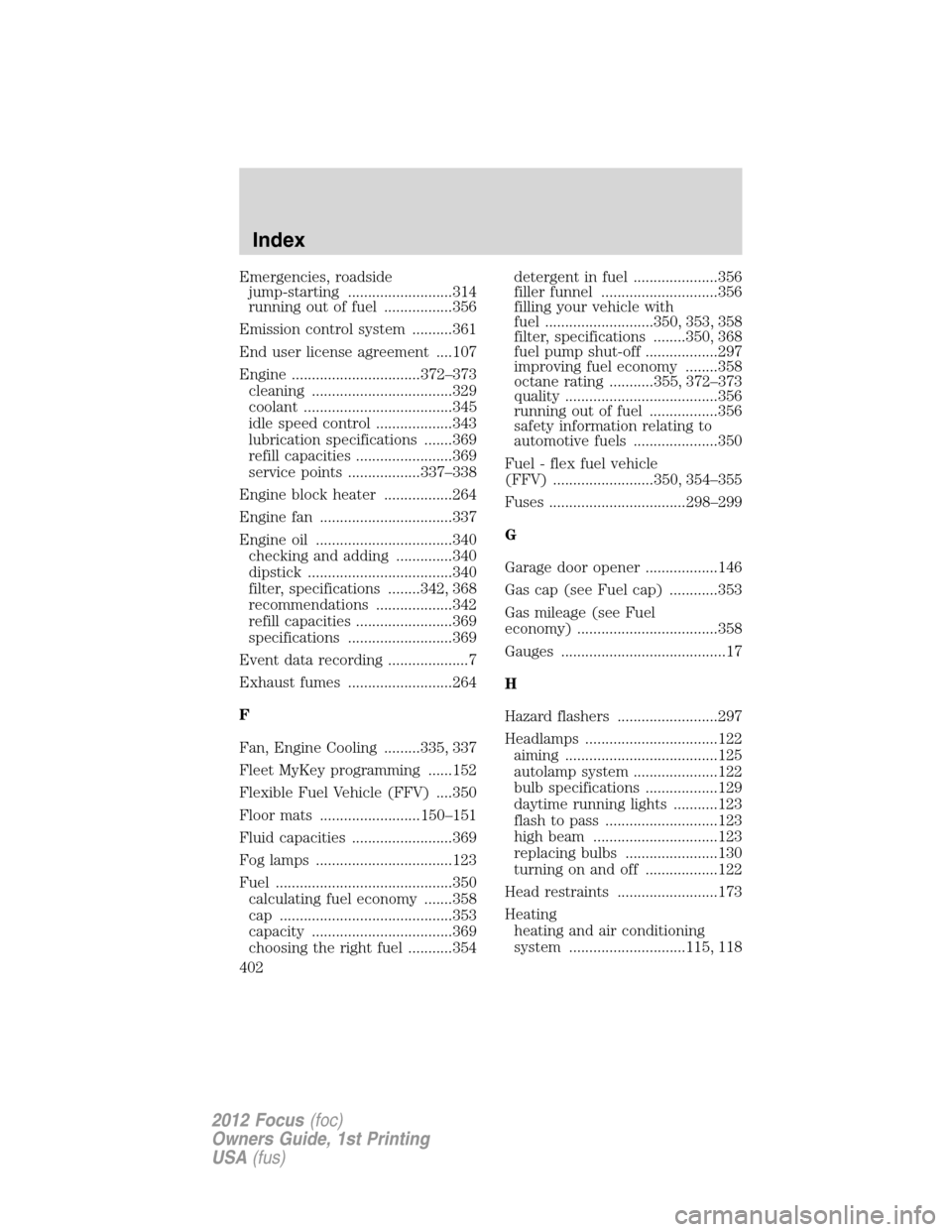
Emergencies, roadside
jump-starting ..........................314
running out of fuel .................356
Emission control system ..........361
End user license agreement ....107
Engine ................................372–373
cleaning ...................................329
coolant .....................................345
idle speed control ...................343
lubrication specifications .......369
refill capacities ........................369
service points ..................337–338
Engine block heater .................264
Engine fan .................................337
Engine oil ..................................340
checking and adding ..............340
dipstick ....................................340
filter, specifications ........342, 368
recommendations ...................342
refill capacities ........................369
specifications ..........................369
Event data recording ....................7
Exhaust fumes ..........................264
F
Fan, Engine Cooling .........335, 337
Fleet MyKey programming ......152
Flexible Fuel Vehicle (FFV) ....350
Floor mats .........................150–151
Fluid capacities .........................369
Fog lamps ..................................123
Fuel ............................................350
calculating fuel economy .......358
cap ...........................................353
capacity ...................................369
choosing the right fuel ...........354detergent in fuel .....................356
filler funnel .............................356
filling your vehicle with
fuel ...........................350, 353, 358
filter, specifications ........350, 368
fuel pump shut-off ..................297
improving fuel economy ........358
octane rating ...........355, 372–373
quality ......................................356
running out of fuel .................356
safety information relating to
automotive fuels .....................350
Fuel - flex fuel vehicle
(FFV) .........................350, 354–355
Fuses ..................................298–299
G
Garage door opener ..................146
Gas cap (see Fuel cap) ............353
Gas mileage (see Fuel
economy) ...................................358
Gauges .........................................17
H
Hazard flashers .........................297
Headlamps .................................122
aiming ......................................125
autolamp system .....................122
bulb specifications ..................129
daytime running lights ...........123
flash to pass ............................123
high beam ...............................123
replacing bulbs .......................130
turning on and off ..................122
Head restraints .........................173
Heating
heating and air conditioning
system .............................115, 118
Index
402
2012 Focus(foc)
Owners Guide, 1st Printing
USA(fus)