lock FORD GRANADA 1985 Service Manual PDF
[x] Cancel search | Manufacturer: FORD, Model Year: 1985, Model line: GRANADA, Model: FORD GRANADA 1985Pages: 255, PDF Size: 14.98 MB
Page 102 of 255
1Check the cost and availability of spare parts
before deciding to dismantle the carburettor. If
the unit has seen much service, fitting a new or
reconditioned carburettor may prove more
satisfactory than any attempt at overhaul.
2Obtain a carburettor repair kit, which will
contain the necessary gaskets, diaphragms
and other renewable items.
3With the carburettor removed from the
vehicle, clean it thoroughly externally and
place it on a clean worksurface.
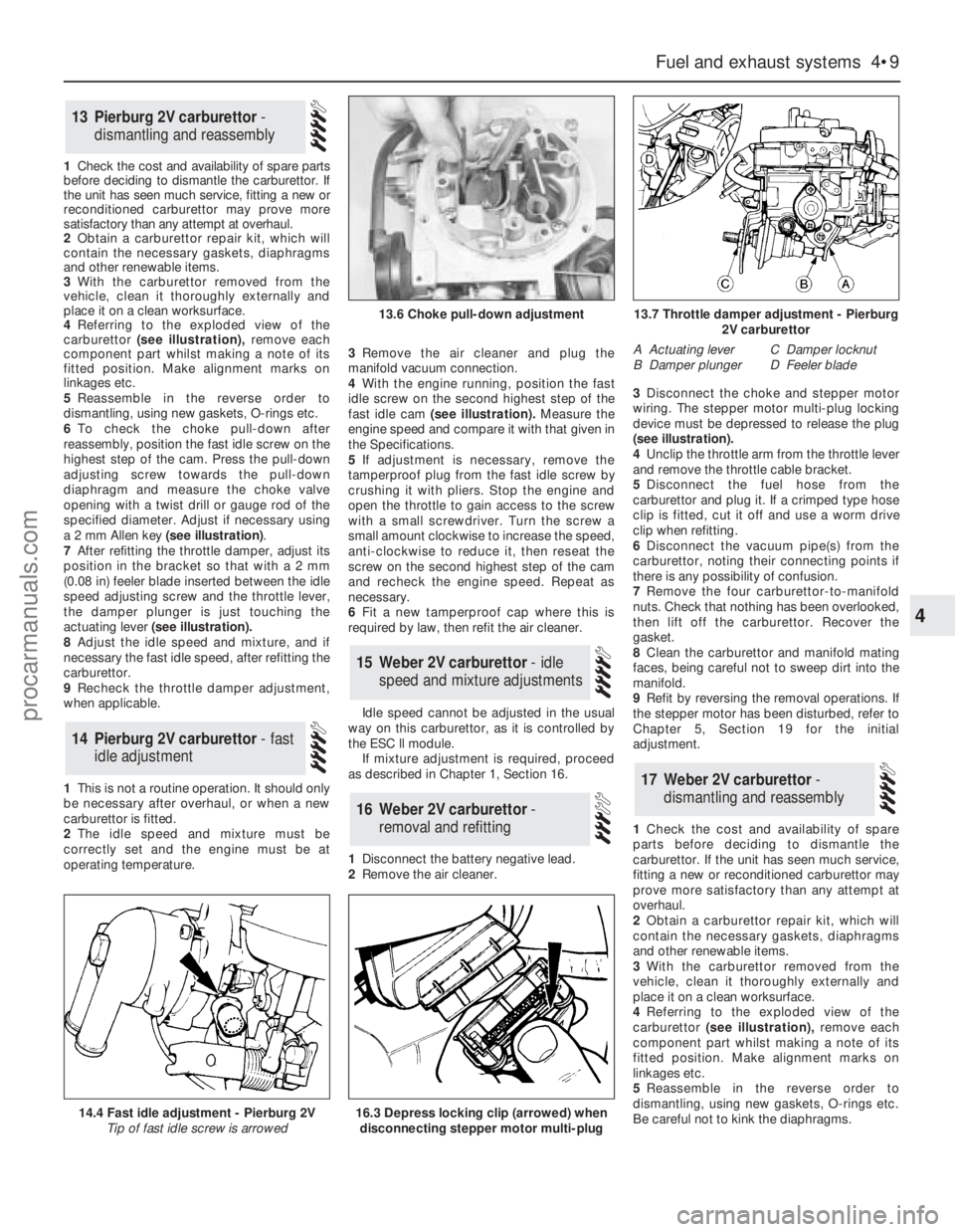
4 Referringto the exploded view of the
carburettor(see illustration),remove each
component part whilst making a note of its
fitted position. Make alignment marks on
linkages etc.
5Reassemble in the reverse order to
dismantling, using new gaskets, O-rings etc.
6To check the choke pull-down after
reassembly, position the fast idle screw on the
highest step of the cam. Press the pull-down
adjusting screw towards the pull-down
diaphragm and measure the choke valve
opening with a twist drill or gauge rod of the
specified diameter. Adjust if necessary using
a 2 mm Allen key (see illustration).
7After refitting the throttle damper, adjust its
position in the bracket so that with a 2 mm
(0.08 in) feeler blade inserted between the idle
speed adjusting screw and the throttle lever,
the damper plunger is just touching the
actuating lever(see illustration).
8Adjust the idle speed and mixture, and if
necessary the fast idle speed, after refitting the
carburettor.
9Recheck the throttle damper adjustment,
when applicable.
1This is not a routine operation. It should only
be necessary after overhaul, or when a new
carburettor is fitted.
2The idle speed and mixture must be
correctly set and the engine must be at
operating temperature.3Remove the air cleaner and plug the
manifold vacuum connection.
4With the engine running, position the fast
idle screw on the second highest step of the
fast idle cam(see illustration).Measure the
engine speed and compare it with that given in
the Specifications.
5If adjustment is necessary, remove the
tamperproof plug from the fast idle screw by
crushing it with pliers. Stop the engine and
open the throttle to gain access to the screw
with a small screwdriver. Turn the screw a
small amount clockwise to increase the speed,
anti-clockwise to reduce it, then reseat the
screw on the second highest step of the cam
and recheck the engine speed. Repeat as
necessary.
6Fit a new tamperproof cap where this is
required by law, then refit the air cleaner.
Idle speed cannot be adjusted in the usual
way on this carburettor, as it is controlled by
the ESC ll module.
If mixture adjustment is required, proceed
as described in Chapter 1, Section 16.
1Disconnect the battery negative lead.
2Remove the air cleaner.3Disconnect the choke and stepper motor
wiring. The stepper motor multi-plug locking
device must be depressed to release the plug
(seeillustration).
4Unclip the throttle arm from the throttle lever
and remove the throttle cable bracket.
5Disconnect the fuel hose from the
carburettor and plug it. If a crimped type hose
clip is fitted, cut it off and use a worm drive
clip when refitting.
6Disconnect the vacuum pipe(s) from the
carburettor, noting their connecting points if
there is any possibility of confusion.
7Remove the four carburettor-to-manifold
nuts. Check that nothing has been overlooked,
then lift off the carburettor. Recover the
gasket.
8Clean the carburettor and manifold mating
faces, being careful not to sweep dirt into the
manifold.
9Refit by reversing the removal operations. If
the stepper motor has been disturbed, refer to
Chapter 5, Section 19 for the initial
adjustment.
1Check the cost and availability of spare
parts before deciding to dismantle the
carburettor. If the unit has seen much service,
fitting a new or reconditioned carburettor may
prove more satisfactory than any attempt at
overhaul.
2Obtain a carburettor repair kit, which will
contain the necessary gaskets, diaphragms
and other renewable items.
3With the carburettor removed from the
vehicle, clean it thoroughly externally and
place it on a clean worksurface.
4 Referringto the exploded view of the
carburettor(see illustration),remove each
component part whilst making a note of its
fitted position. Make alignment marks on
linkages etc.
5Reassemble in the reverse order to
dismantling, using new gaskets, O-rings etc.
Be careful not to kink the diaphragms.
17Weber 2V carburettor -
dismantling and reassembly
16Weber 2V carburettor -
removal and refitting
15Weber 2V carburettor - idle
speed and mixture adjustments
14Pierburg 2V carburettor - fast
idle adjustment
13Pierburg 2V carburettor -
dismantling and reassembly
Fuel and exhaust systems 4•9
4
14.4 Fast idle adjustment - Pierburg 2V
Tip of fast idle screw is arrowed
13.6 Choke pull-down adjustment13.7 Throttle damper adjustment - Pierburg
2V carburettor
A Actuating lever
B Damper plungerC Damper locknut
D Feeler blade
16.3 Depress locking clip (arrowed) when
disconnecting stepper motor multi-plug
procarmanuals.com
Page 107 of 255
16Start the engine and note the engine
speed (rpm). The engine speed should
increase above the normal idle speed, and
should be as given in the Specifications.
17If the engine speed is not as specified,
remove the tamperproof plug from the top of
the throttle kicker housing, and turn the
adjustment screw to give the specified speed.
18On completion of adjustment, fit a new
tamperproof cap.
19Disconnect the tubing from the inlet
manifold, and reconnect the throttle kicker
vacuum hose.
20Refit the plastic shield and the air cleaner.
On 2.4 & 2.9 litre V6 models especially,
residual pressure will remain in the fuel lines
long after the vehicle was last used therefore
the fuel system must be depressurised before
any hose is disconnected; the system is
depressurised via the vent valve on the fuel
rail, noting that it may be necessary to depress
the valve several times before the pressure is
fully released. As an added precaution place a
rag over the valve as it is depressed to catch
any fuel which is forcibly expelled. Before
carrying out any operation on the fuel system
refer to the precautions given in Safety first! at
the beginning of this Manual and follow them
implicitly. Petrol is a highly dangerous and
volatile liquid and the precautions necessary
when handling it cannot be overstressed.
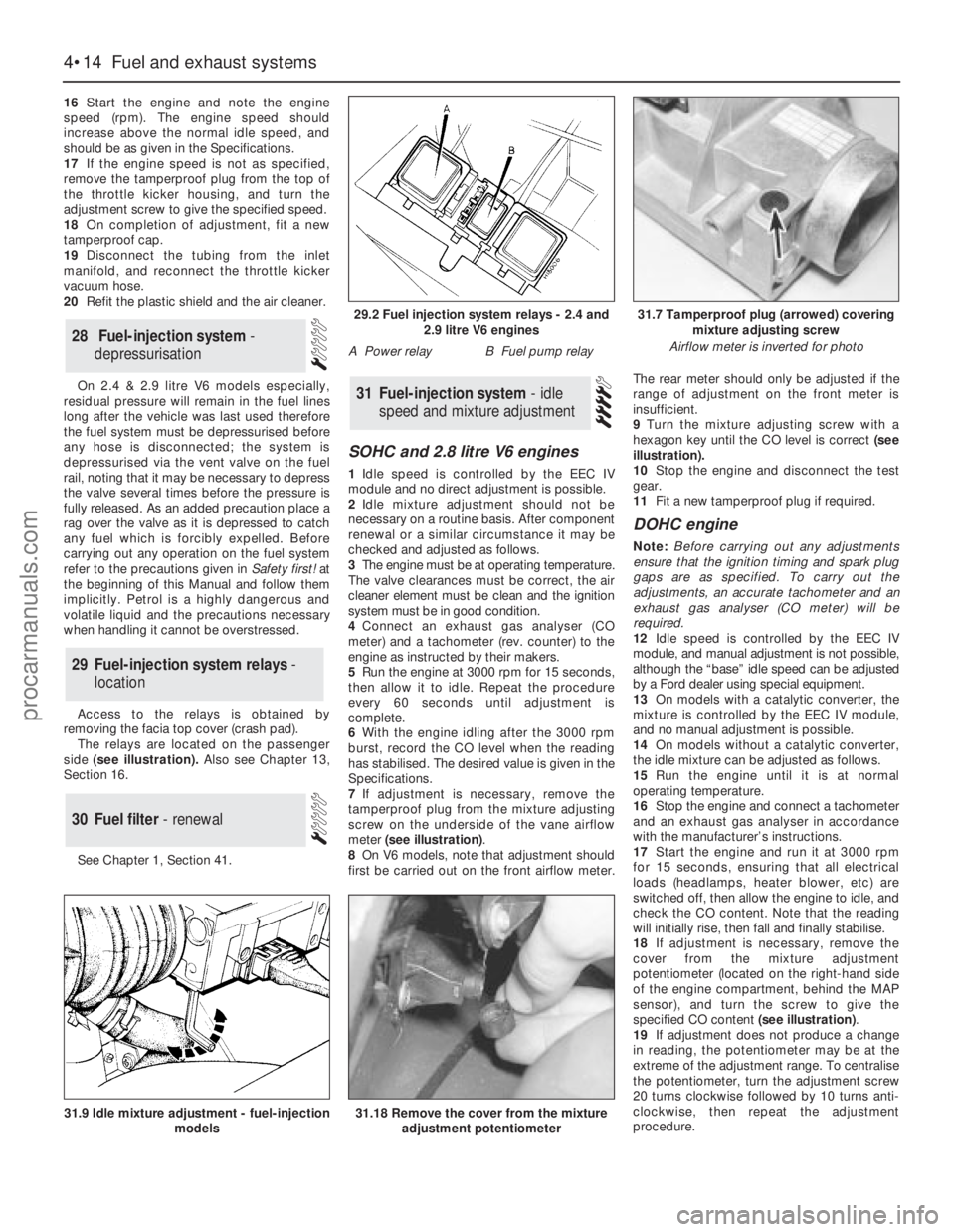
Access to the relays is obtained by
removing the facia top cover (crash pad).
The relays are located on the passenger
side(see illustration). Also see Chapter 13,
Section 16.
See Chapter 1, Section 41.
SOHC and 2.8 litre V6 engines
1Idle speed is controlled by the EEC IV
module and no direct adjustment is possible.
2Idle mixture adjustment should not be
necessary on a routine basis. After component
renewal or a similar circumstance it may be
checked and adjusted as follows.
3The engine must be at operating temperature.
The valve clearances must be correct, the air
cleaner element must be clean and the ignition
system must be in good condition.
4Connect an exhaust gas analyser (CO
meter) and a tachometer (rev. counter) to the
engine as instructed by their makers.
5Run the engine at 3000 rpm for 15 seconds,
then allow it to idle. Repeat the procedure
every 60 seconds until adjustment is
complete.
6With the engine idling after the 3000 rpm
burst, record the CO level when the reading
has stabilised. The desired value is given in the
Specifications.
7If adjustment is necessary, remove the
tamperproof plug from the mixture adjusting
screw on the underside of the vane airflow
meter (see illustration).
8On V6 models, note that adjustment should
first be carried out on the front airflow meter.The rear meter should only be adjusted if the
range of adjustment on the front meter is
insufficient.
9Turn the mixture adjusting screw with a
hexagon key until the CO level is correct (see
illustration).
10Stop the engine and disconnect the test
gear.
11Fit a new tamperproof plug if required.
DOHC engine
Note: Before carrying out any adjustments
ensure that the ignition timing and spark plug
gaps are as specified. To carry out the
adjustments, an accurate tachometer and an
exhaust gas analyser (CO meter) will be
required.
12Idle speed is controlled by the EEC IV
module, and manual adjustment is not possible,
although the “base” idle speed can be adjusted
by a Ford dealer using special equipment.
13On models with a catalytic converter, the
mixture is controlled by the EEC IV module,
and no manual adjustment is possible.
14On models without a catalytic converter,
the idle mixture can be adjusted as follows.
15Run the engine until it is at normal
operating temperature.
16Stop the engine and connect a tachometer
and an exhaust gas analyser in accordance
with the manufacturer’s instructions.
17Start the engine and run it at 3000 rpm
for 15 seconds, ensuring that all electrical
loads (headlamps, heater blower, etc) are
switched off, then allow the engine to idle, and
check the CO content. Note that the reading
will initially rise, then fall and finally stabilise.
18If adjustment is necessary, remove the
cover from the mixture adjustment
potentiometer (located on the right-hand side
of the engine compartment, behind the MAP
sensor), and turn the screw to give the
specified CO content (see illustration).
19If adjustment does not produce a change
in reading, the potentiometer may be at the
extreme of the adjustment range. To centralise
the potentiometer, turn the adjustment screw
20 turns clockwise followed by 10 turns anti-
clockwise, then repeat the adjustment
procedure.
31Fuel-injection system - idle
speed and mixture adjustment
30Fuel filter - renewal
29Fuel-injection system relays -
location
28Fuel-injection system -
depressurisation
4•14Fuel and exhaust systems
31.18 Remove the cover from the mixture
adjustment potentiometer31.9 Idle mixture adjustment - fuel-injection
models
29.2 Fuel injection system relays - 2.4 and
2.9 litre V6 engines
A Power relayB Fuel pump relay
31.7 Tamperproof plug (arrowed) covering
mixture adjusting screw
Airflow meter is inverted for photo
procarmanuals.com
Page 108 of 255
20Checking and adjustment should be
completed within 30 seconds of the meter
readings stabilising. If this has not been
possible, run the engine at 3000 rpm for 15
seconds, then allow the engine to idle. Re-
check the CO content and carry out further
adjustments if necessary.
21On completion of adjustment, stop the
engine and disconnect the tachometer and the
exhaust gas analyser. Refit the cover to the
adjustment screw.
2.4 & 2.9 litre V6 engines
22As with the 2.8 V6, idle speed is
electronically controlled. Basic idle speed
adjustment can only be carried out by a Ford
dealer using special equipment.
23On models not equipped with a catalytic
converter, mixture adjustment can be carried
out as described above.
24On models equipped with a catalytic
converter, the mixture is controlled by the EEC IV
module and no manual adjustment is possible.
SOHC and V6 engines
1Disconnect the battery negative lead.
2Free the throttle position sensor multi-plug
from its clip. On the OHCmodels this is below
the idle speed control valve, on the underside
of the inlet manifold; on V6 engines it is
located below the throttle valve housing.
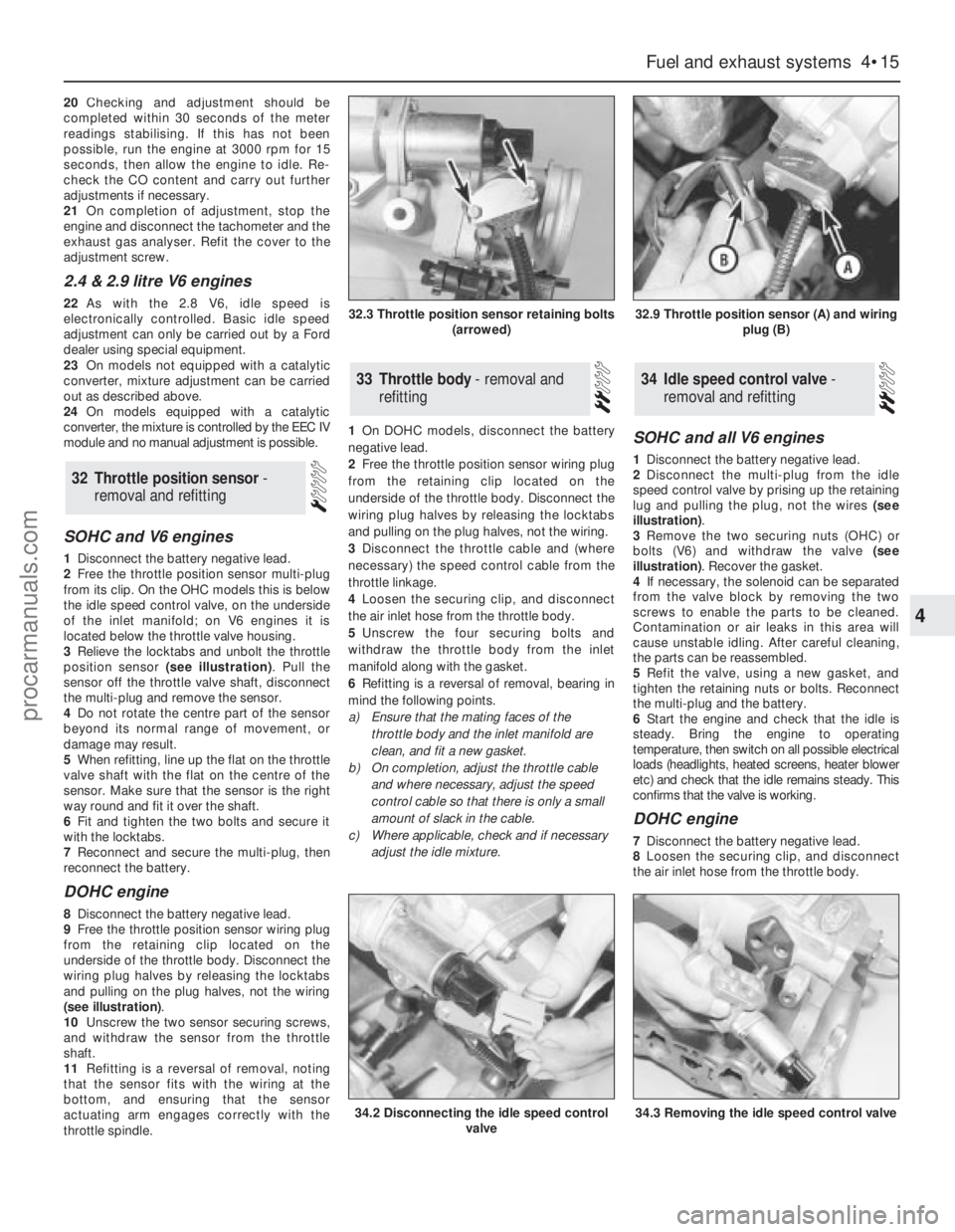
3Relieve the locktabs and unbolt the throttle
position sensor (see illustration). Pull the
sensor off the throttle valve shaft, disconnect
the multi-plug and remove the sensor.
4Do not rotate the centre part of the sensor
beyond its normal range of movement, or
damage may result.
5When refitting, line up the flat on the throttle
valve shaft with the flat on the centre of the
sensor. Make sure that the sensor is the right
way round and fit it over the shaft.
6Fit and tighten the two bolts and secure it
with the locktabs.
7Reconnect and secure the multi-plug, then
reconnect the battery.
DOHC engine
8Disconnect the battery negative lead.
9Free the throttle position sensor wiring plug
from the retaining clip located on the
underside of the throttle body. Disconnect the
wiring plug halves by releasing the locktabs
and pulling on the plug halves, not the wiring
(see illustration).
10Unscrew the two sensor securing screws,
and withdraw the sensor from the throttle
shaft.
11Refitting is a reversal of removal, noting
that the sensor fits with the wiring at the
bottom, and ensuring that the sensor
actuating arm engages correctly with the
throttle spindle.1On DOHC models, disconnect the battery
negative lead.
2Free the throttle position sensor wiring plug
from the retaining clip located on the
underside of the throttle body. Disconnect the
wiring plug halves by releasing the locktabs
and pulling on the plug halves, not the wiring.
3Disconnect the throttle cable and (where
necessary) the speed control cable from the
throttle linkage.
4Loosen the securing clip, and disconnect
the air inlet hose from the throttle body.
5Unscrew the four securing bolts and
withdraw the throttle body from the inlet
manifold along with the gasket.
6Refitting is a reversal of removal, bearing in
mind the following points.
a)Ensure that the mating faces of the
throttle body and the inlet manifold are
clean, and fit a new gasket.
b)On completion, adjust the throttle cable
and where necessary, adjust the speed
control cable so that there is only a small
amount of slack in the cable.
c)Where applicable, check and if necessary
adjust the idle mixture.
SOHC and all V6 engines
1Disconnect the battery negative lead.
2Disconnect the multi-plug from the idle
speed control valve by prising up the retaining
lug and pulling the plug, not the wires (see
illustration).
3Remove the two securing nuts (OHC) or
bolts (V6) and withdraw the valve (see
illustration). Recover the gasket.
4If necessary, the solenoid can be separated
from the valve block by removing the two
screws to enable the parts to be cleaned.
Contamination or air leaks in this area will
cause unstable idling. After careful cleaning,
the parts can be reassembled.
5Refit the valve, using a new gasket, and
tighten the retaining nuts or bolts. Reconnect
the multi-plug and the battery.
6Start the engine and check that the idle is
steady. Bring the engine to operating
temperature, then switch on all possible electrical
loads (headlights, heated screens, heater blower
etc) and check that the idle remains steady. This
confirms that the valve is working.
DOHC engine
7Disconnect the battery negative lead.
8Loosen the securing clip, and disconnect
the air inlet hose from the throttle body.
34Idle speed control valve -
removal and refitting33Throttle body - removal and
refitting
32Throttle position sensor -
removal and refitting
Fuel and exhaust systems 4•15
4
32.3 Throttle position sensor retaining bolts
(arrowed)32.9 Throttle position sensor (A) and wiring
plug (B)
34.2 Disconnecting the idle speed control
valve34.3 Removing the idle speed control valve
procarmanuals.com
Page 109 of 255
9Unscrew the securing nut, and release the
air inlet tube from the bracket on the engine
compartment front panel.
10Disconnect the wiring plug from the idle
speed control valve.
11Release the air cleaner lid securing clips,
then remove the air inlet tube, plenum
chamber, and air cleaner lid as an assembly,
disconnecting the breather hose from the air
inlet tube.
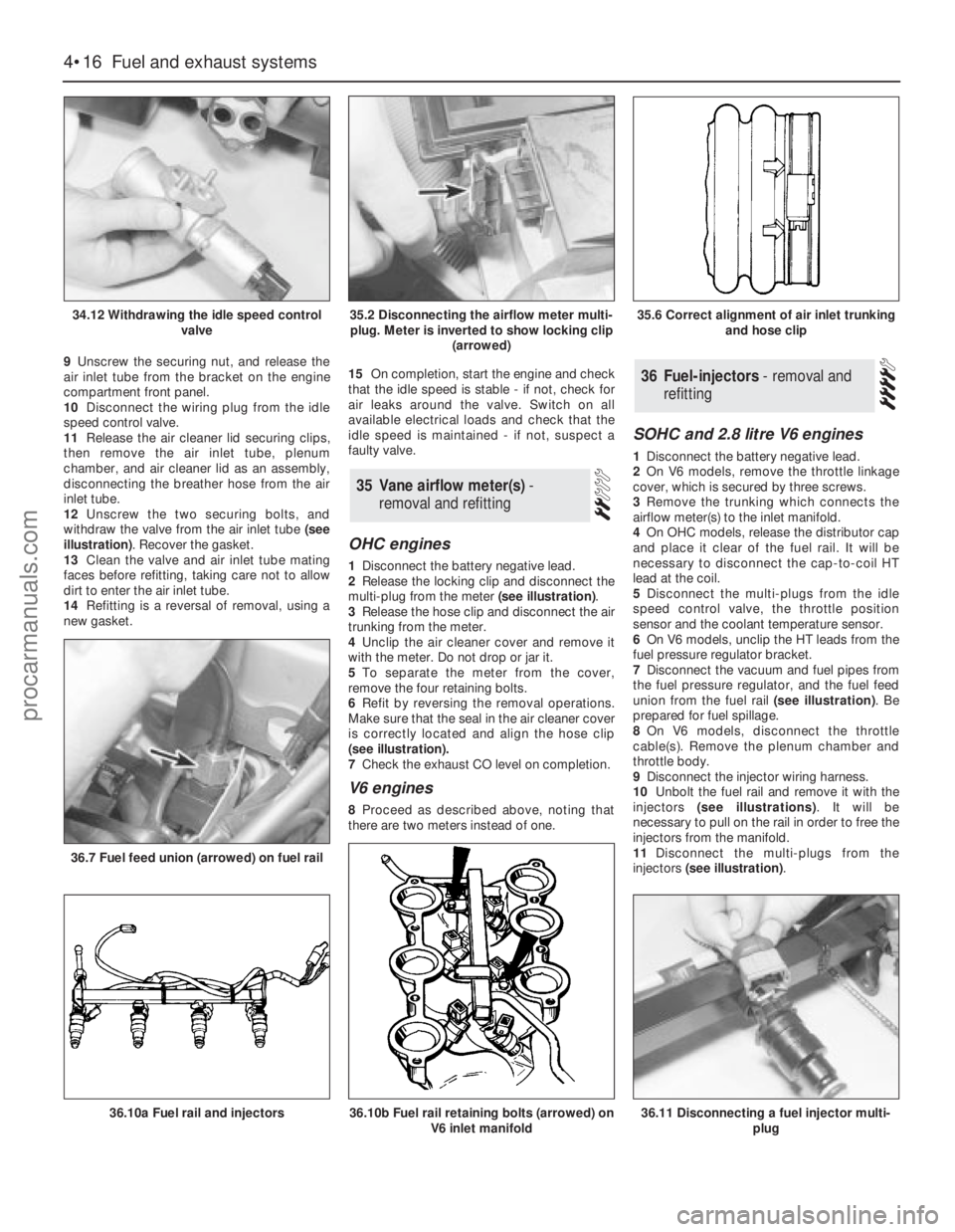
12Unscrew the two securing bolts, and
withdraw the valve from the air inlet tube (see
illustration). Recover the gasket.
13Clean the valve and air inlet tube mating
faces before refitting, taking care not to allow
dirt to enter the air inlet tube.
14Refitting is a reversal of removal, using a
new gasket.15On completion, start the engine and check
that the idle speed is stable - if not, check for
air leaks around the valve. Switch on all
available electrical loads and check that the
idle speed is maintained - if not, suspect a
faulty valve.
OHC engines
1Disconnect the battery negative lead.
2Release the locking clip and disconnect the
multi-plug from the meter (see illustration).
3Release the hose clip and disconnect the air
trunking from the meter.
4Unclip the air cleaner cover and remove it
with the meter. Do not drop or jar it.
5To separate the meter from the cover,
remove the four retaining bolts.
6Refit by reversing the removal operations.
Make sure that the seal in the air cleaner cover
is correctly located and align the hose clip
(seeillustration).
7Check the exhaust CO level on completion.
V6 engines
8Proceed as described above, noting that
there are two meters instead of one.
SOHC and 2.8 litre V6 engines
1Disconnect the battery negative lead.
2On V6 models, remove the throttle linkage
cover, which is secured by three screws.
3Remove the trunking which connects the
airflow meter(s) to the inlet manifold.
4On OHCmodels, release the distributor cap
and place it clear of the fuel rail. It will be
necessary to disconnect the cap-to-coil HT
lead at the coil.
5Disconnect the multi-plugs from the idle
speed control valve, the throttle position
sensor and the coolant temperature sensor.
6On V6 models, unclip the HT leads from the
fuel pressure regulator bracket.
7Disconnect the vacuum and fuel pipes from
the fuel pressure regulator, and the fuel feed
union from the fuel rail (see illustration). Be
prepared for fuel spillage.
8On V6 models, disconnect the throttle
cable(s). Remove the plenum chamber and
throttle body.
9Disconnect the injector wiring harness.
10Unbolt the fuel rail and remove it with the
injectors (see illustrations). It will be
necessary to pull on the rail in order to free the
injectors from the manifold.
11Disconnect the multi-plugs from the
injectors (see illustration).
36Fuel-injectors - removal and
refitting
35Vane airflow meter(s) -
removal and refitting
4•16Fuel and exhaust systems
34.12 Withdrawing the idle speed control
valve
36.7 Fuel feed union (arrowed) on fuel rail
36.10a Fuel rail and injectors36.10b Fuel rail retaining bolts (arrowed) on
V6 inlet manifold36.11 Disconnecting a fuel injector multi-
plug
35.2 Disconnecting the airflow meter multi-
plug. Meter is inverted to show locking clip
(arrowed)35.6 Correct alignment of air inlet trunking
and hose clip
procarmanuals.com
Page 113 of 255
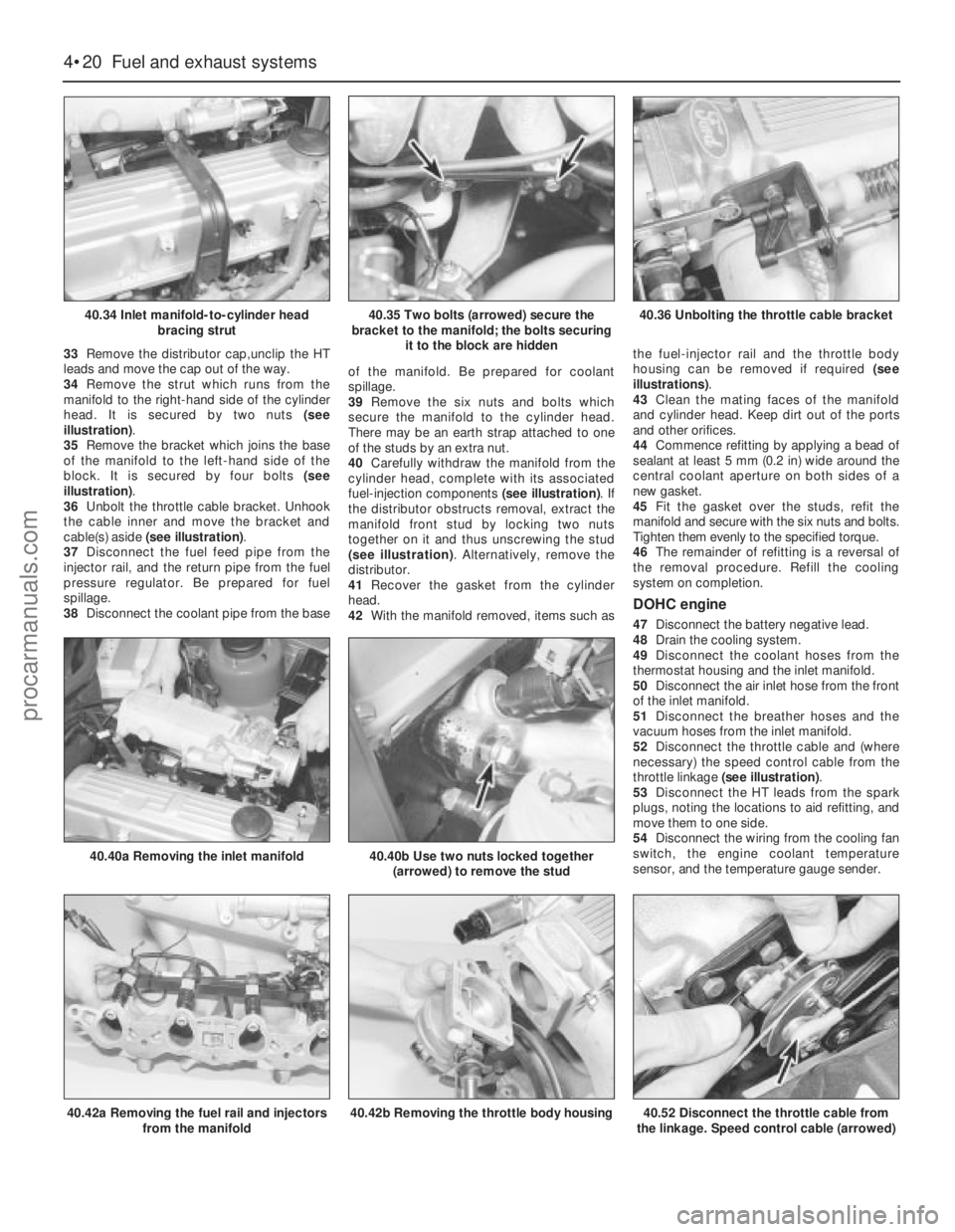
33Remove the distributor cap,unclip the HT
leads and move the cap out of the way.
34Remove the strut which runs from the
manifold to the right-hand side of the cylinder
head. It is secured by two nuts (see
illustration).
35Remove the bracket which joins the base
of the manifold to the left-hand side of the
block. It is secured by four bolts (see
illustration).
36Unbolt the throttle cable bracket. Unhook
the cable inner and move the bracket and
cable(s) aside (see illustration).
37Disconnect the fuel feed pipe from the
injector rail, and the return pipe from the fuel
pressure regulator. Be prepared for fuel
spillage.
38Disconnect the coolant pipe from the baseof the manifold. Be prepared for coolant
spillage.
39Remove the six nuts and bolts which
secure the manifold to the cylinder head.
There may be an earth strap attached to one
of the studs by an extra nut.
40Carefully withdraw the manifold from the
cylinder head, complete with its associated
fuel-injection components (see illustration). If
the distributor obstructs removal, extract the
manifold front stud by locking two nuts
together on it and thus unscrewing the stud
(see illustration). Alternatively, remove the
distributor.
41Recover the gasket from the cylinder
head.
42With the manifold removed, items such asthe fuel-injector rail and the throttle body
housing can be removed if required (see
illustrations).
43Clean the mating faces of the manifold
and cylinder head. Keep dirt out of the ports
and other orifices.
44Commence refitting by applying a bead of
sealant at least 5 mm (0.2 in) wide around the
central coolant aperture on both sides of a
new gasket.
45Fit the gasket over the studs, refit the
manifold and secure with the six nuts and bolts.
Tighten them evenly to the specified torque.
46The remainder of refitting is a reversal of
the removal procedure. Refill the cooling
system on completion.
DOHC engine
47Disconnect the battery negative lead.
48Drain the cooling system.
49Disconnect the coolant hoses from the
thermostat housing and the inlet manifold.
50Disconnect the air inlet hose from the front
of the inlet manifold.
51Disconnect the breather hoses and the
vacuum hoses from the inlet manifold.
52Disconnect the throttle cable and (where
necessary) the speed control cable from the
throttle linkage (see illustration).
53Disconnect the HT leads from the spark
plugs, noting the locations to aid refitting, and
move them to one side.
54Disconnect the wiring from the cooling fan
switch, the engine coolant temperature
sensor, and the temperature gauge sender.
4•20Fuel and exhaust systems
40.34 Inlet manifold-to-cylinder head
bracing strut
40.42a Removing the fuel rail and injectors
from the manifold
40.40a Removing the inlet manifold40.40b Use two nuts locked together
(arrowed) to remove the stud
40.42b Removing the throttle body housing40.52 Disconnect the throttle cable from
the linkage. Speed control cable (arrowed)
40.35 Two bolts (arrowed) secure the
bracket to the manifold; the bolts securing
it to the block are hidden40.36 Unbolting the throttle cable bracket
procarmanuals.com
Page 115 of 255
DOHC carburettor engine
8This procedure is essentially as described
above, noting the following points:
a)Note the plastic bush which is fitted to the
rear manifold stud. This must be removed
before the gasket can be withdrawn.
b)On refitting ensure that the mating
surfaces are clean and dry and fit new
gaskets.
c)Apply a thin coat of anti-seize compound
to the manifold studs to aid future
removal.
d)Tighten the manifold nuts to the specified
torque settings.
DOHC fuel-injection engine
9Disconnect the battery negative lead.
10Disconnect the wiring plug from the idle
speed control valve at the front of the plenum
chamber.
11Loosen the clamp, and detach the air inlet
hose from the air inlet tubing.
12Unscrew the securing nut, and release the
air inlet tube from the bracket on the engine
compartment front panel.
13Release the air cleaner lid securing clips,
then lift away the air inlet tube, plenum
chamber and air cleaner lid as an assembly,
disconnecting the breather hose from the air
inlet tube.
14On models fitted with a catalytic
converter, disconnect the exhaust gas oxygen
sensor wiring plug.
15Unscrew the securing nuts and disconnect
the exhaust downpipe from the manifold.
Recover the gasket. Support the exhaust
downpipe from underneath the vehicle (eg
with an axle stand) to avoid placing
unnecessary strain on the exhaust system.
16Unscrew the six securing nuts, and lift the
manifold from the cylinder head. Recover the
gasket.
17Refitting is a reversal of removal, bearing
in mind the following points.
a)Ensure that all mating faces are clean, and
use a new gasket.
b)Tighten the manifold securing nuts and
the downpipe securing nuts progressively
to the specified torque (where given).
SOHC and 2.8 litre V6 engines
1Periodically inspect the exhaust system for
freedom from corrosion and security of
mountings. Large holes will be obvious; small
holes may be found more easily by letting the
engine idle and partly obstructing the tailpipe
with a wad of cloth.
2Check the condition of the rubber
mountings by applying downward pressure on
the exhaust system and observing the
mountings for splits or cracks. Renew
deteriorated mountings.
3The exhaust systems fitted in production
have fewer sections than those available for
repair. Repair sections may be fitted to
production systems by cutting at the
appropriate point.
4The production exhaust systems are made
of aluminised and stainless steel. Repair
systems are available to the same standard, or
in standard quality (SQ) painted mild steel.
5It is recommended that the whole exhaust
system be removed even if only part requires
renewal, since separation of old joints, cutting
pipes etc is much easier away from the
vehicle. Proceed as follows.
6Disconnect the battery negative lead. Raise
and support the vehicle.
7Unbolt the manifold-to-downpipe flanged
joint(s).
8On V6 models, unbolt the left-hand front
silencer mounting.
9Release any earth straps.
10With the help of an assistant, unhook the
system from its mountings and remove it.
11Renew sections as necessary. Apply
exhaust jointing compound to sliding and
flanged joints, but do not tighten their clamps
yet. Use new sealing rings where necessary
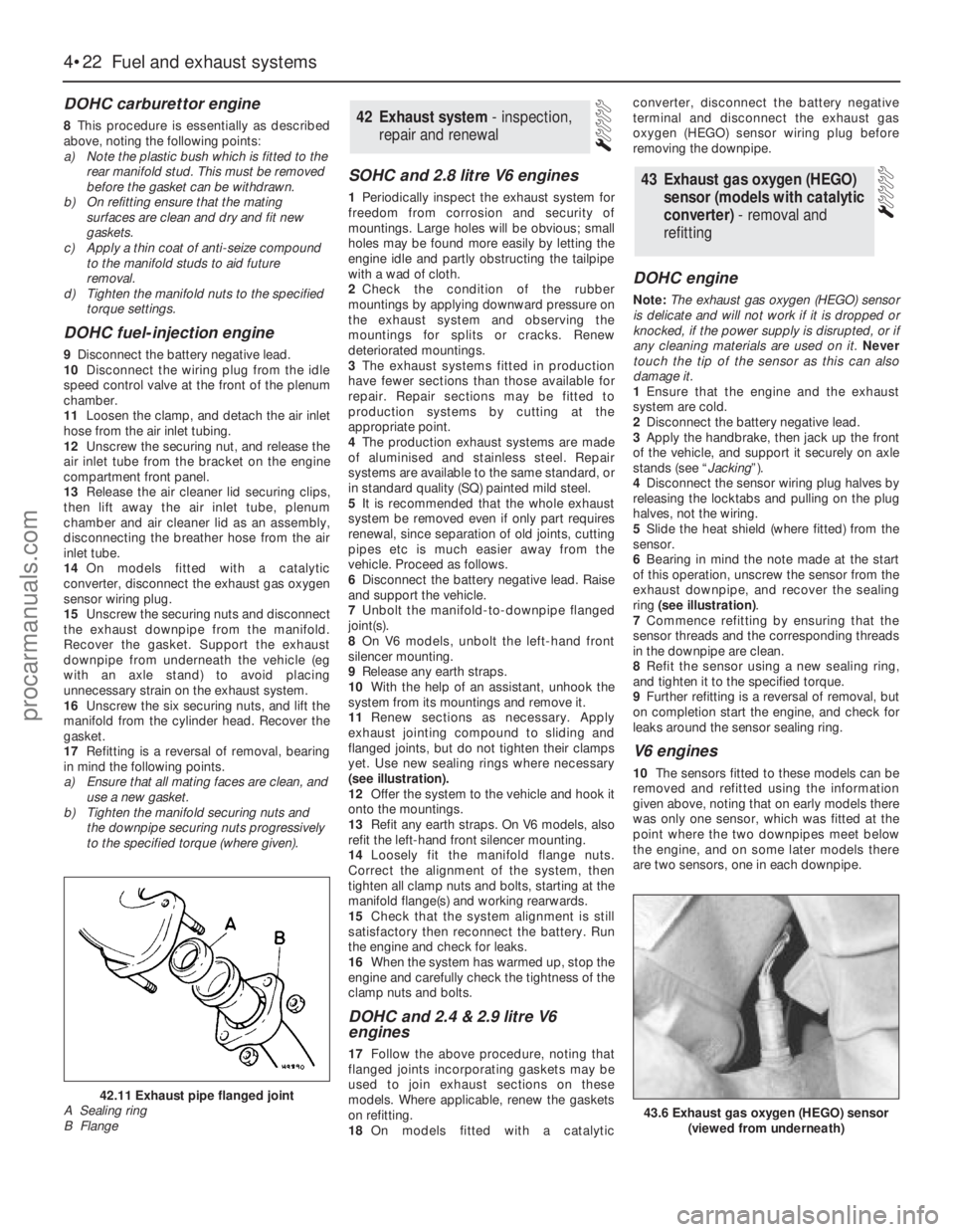
(see illustration).
12Offer the system to the vehicle and hook it
onto the mountings.
13Refit any earth straps. On V6 models, also
refit the left-hand front silencer mounting.
14Loosely fit the manifold flange nuts.
Correct the alignment of the system, then
tighten all clamp nuts and bolts, starting at the
manifold flange(s) and working rearwards.
15Check that the system alignment is still
satisfactory then reconnect the battery. Run
the engine and check for leaks.
16When the system has warmed up, stop the
engine and carefully check the tightness of the
clamp nuts and bolts.
DOHC and 2.4 & 2.9 litre V6
engines
17Follow the above procedure, noting that
flanged joints incorporating gaskets may be
used to join exhaust sections on these
models. Where applicable, renew the gaskets
on refitting.
18On models fitted with a catalyticconverter, disconnect the battery negative
terminal and disconnect the exhaust gas
oxygen (HEGO) sensor wiring plug before
removing the downpipe.
DOHC engine
Note: The exhaust gas oxygen (HEGO) sensor
is delicate and will not work if it is dropped or
knocked, if the power supply is disrupted, or if
any cleaning materials are used on it. Never
touch the tip of the sensor as this can also
damage it.
1Ensure that the engine and the exhaust
system are cold.
2Disconnect the battery negative lead.
3Apply the handbrake, then jack up the front
of the vehicle, and support it securely on axle
stands (see “Jacking”).
4Disconnect the sensor wiring plug halves by
releasing the locktabs and pulling on the plug
halves, not the wiring.
5Slide the heat shield (where fitted) from the
sensor.
6Bearing in mind the note made at the start
of this operation, unscrew the sensor from the
exhaust downpipe, and recover the sealing
ring (see illustration).
7Commence refitting by ensuring that the
sensor threads and the corresponding threads
in the downpipe are clean.
8Refit the sensor using a new sealing ring,
and tighten it to the specified torque.
9Further refitting is a reversal of removal, but
on completion start the engine, and check for
leaks around the sensor sealing ring.
V6 engines
10The sensors fitted to these models can be
removed and refitted using the information
given above, noting that on early models there
was only one sensor, which was fitted at the
point where the two downpipes meet below
the engine, and on some later models there
are two sensors, one in each downpipe.
43Exhaust gas oxygen (HEGO)
sensor (models with catalytic
converter) - removal and
refitting
42Exhaust system - inspection,
repair and renewal
4•22Fuel and exhaust systems
43.6 Exhaust gas oxygen (HEGO) sensor
(viewed from underneath)
42.11 Exhaust pipe flanged joint
A Sealing ring
B Flange
procarmanuals.com
Page 116 of 255
Models up to July 1990
1The carbon canister is situated in the engine
compartment where it is mounted onto the
right-hand valance next to the suspension
strut mounting.
2To remove the canister first disconnect the
battery negative terminal. If necessary, undo
the two coolant expansion tank retaining
screws and position the tank clear of the
canister to improve access.
3Disconnect the vacuum hose from the top
of the canister.
4Slacken and remove the mounting bolt and
withdraw the canister from the engine
compartment.
5Refitting is a reverse of the removal
procedure.
Models from July 1990
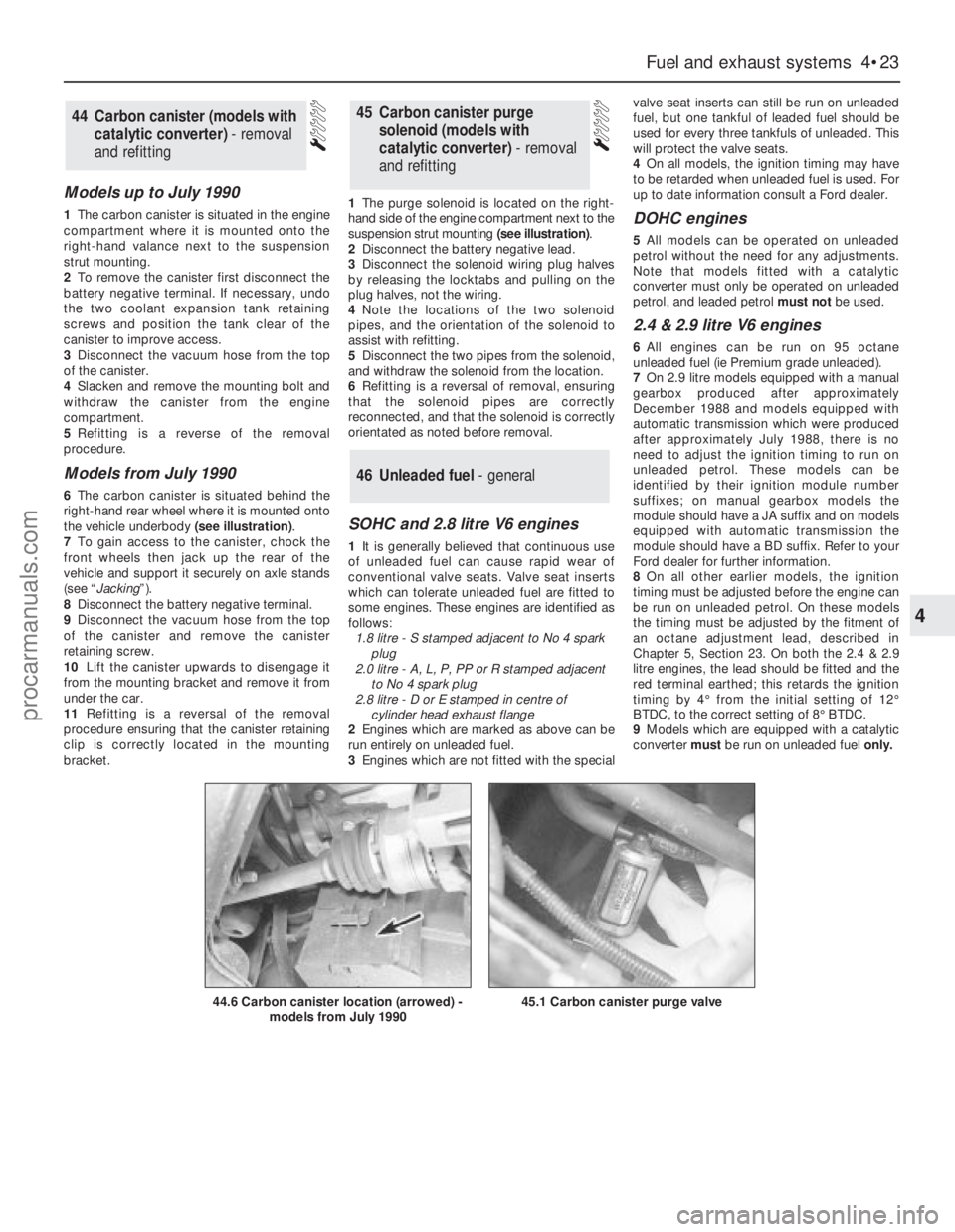
6The carbon canister is situated behind the
right-hand rear wheel where it is mounted onto
the vehicle underbody (see illustration).
7To gain access to the canister, chock the
front wheels then jack up the rear of the
vehicle and support it securely on axle stands
(see “Jacking”).
8Disconnect the battery negative terminal.
9Disconnect the vacuum hose from the top
of the canister and remove the canister
retaining screw.
10Lift the canister upwards to disengage it
from the mounting bracket and remove it from
under the car.
11Refitting is a reversal of the removal
procedure ensuring that the canister retaining
clip is correctly located in the mounting
bracket.1The purge solenoid is located on the right-
hand side of the engine compartment next to the
suspension strut mounting (see illustration).
2Disconnect the battery negative lead.
3Disconnect the solenoid wiring plug halves
by releasing the locktabs and pulling on the
plug halves, not the wiring.
4Note the locations of the two solenoid
pipes, and the orientation of the solenoid to
assist with refitting.
5Disconnect the two pipes from the solenoid,
and withdraw the solenoid from the location.
6Refitting is a reversal of removal, ensuring
that the solenoid pipes are correctly
reconnected, and that the solenoid is correctly
orientated as noted before removal.
SOHC and 2.8 litre V6 engines
1It is generally believed that continuous use
of unleaded fuel can cause rapid wear of
conventional valve seats. Valve seat inserts
which can tolerate unleaded fuel are fitted to
some engines. These engines are identified as
follows:
1.8 litre - S stamped adjacent to No 4 spark
plug
2.0 litre - A, L, P, PP or R stamped adjacent
to No 4 spark plug
2.8 litre - D or E stamped in centre of
cylinder head exhaust flange
2Engines which are marked as above can be
run entirely on unleaded fuel.
3Engines which are not fitted with the specialvalve seat inserts can still be run on unleaded
fuel, but one tankful of leaded fuel should be
used for every three tankfuls of unleaded. This
will protect the valve seats.
4On all models, the ignition timing may have
to be retarded when unleaded fuel is used. For
up to date information consult a Ford dealer.
DOHC engines
5All models can be operated on unleaded
petrol without the need for any adjustments.
Note that models fitted with a catalytic
converter must only be operated on unleaded
petrol, and leaded petrol must notbe used.
2.4 & 2.9 litre V6 engines
6All engines can be run on 95 octane
unleaded fuel (ie Premium grade unleaded).
7On 2.9 litre models equipped with a manual
gearbox produced after approximately
December 1988 and models equipped with
automatic transmission which were produced
after approximately July 1988, there is no
need to adjust the ignition timing to run on
unleaded petrol. These models can be
identified by their ignition module number
suffixes; on manual gearbox models the
module should have a JA suffix and on models
equipped with automatic transmission the
module should have a BD suffix. Refer to your
Ford dealer for further information.
8On all other earlier models, the ignition
timing must be adjusted before the engine can
be run on unleaded petrol. On these models
the timing must be adjusted by the fitment of
an octane adjustment lead, described in
Chapter 5, Section 23. On both the 2.4 & 2.9
litre engines, the lead should be fitted and the
red terminal earthed; this retards the ignition
timing by 4°from the initial setting of 12°
BTDC, to the correct setting of 8°BTDC.
9Models which are equipped with a catalytic
converter must be run on unleaded fuel only.
46Unleaded fuel - general
45Carbon canister purge
solenoid (models with
catalytic converter) - removal
and refitting44Carbon canister (models with
catalytic converter) - removal
and refitting
Fuel and exhaust systems 4•23
4
44.6 Carbon canister location (arrowed) -
models from July 199045.1 Carbon canister purge valve
procarmanuals.com
Page 119 of 255
The ignition system is responsible for
igniting the fuel/air charge in each cylinder at
the correct moment. The components of the
system are the spark plugs, ignition coil,
distributor and connecting leads. Overall
control of the system is one of the functions of
the engine management module. Fuel-
injection models have a subsidiary ignition
module mounted on the distributor.
There are no contact breaker points in the
distributor. A square wave signal is generated
by the distributor electro-magnetically; this
signal is used by the engine management
module as a basis for switching the coil LT
current. Speed-related (centrifugal) advance is
also handled by the module. On carburettor
models, ignition timing is also advanced under
conditions of high inlet manifold vacuum.The engine management models are “black
boxes” which regulate both the fuel and the
ignition systems to obtain the best power,
economy and emission levels. The module
fitted to carburettor models is known as the
ESC II (Electronic Spark Control Mk II) module.
On fuel-injection models the more powerful
EEC IV (Electronic Engine Control Mk IV)
module is used.
Both types of module receive inputs from
sensors monitoring coolant temperature,
distributor rotor position and (on some
models) manifold vacuum. Outputs from the
module control ignition timing, inlet manifold
heating and (except on 1.8 litre models) idle
speed. The EEC IV module also has overall
control of the fuel-injection system, from
which it receives information.
Provision is made for the ignition timing to
be retarded to allow the use of low octane fuel
if necessary. On all except 1.8 litre models
there is also a facility for raising the idle speed.The EEC IV module contains self-test
circuitry which enables a technician with the
appropriate test equipment to diagnose faults
in a very short time. A Limited Operation
Strategy (LOS) means that the car is still
driveable, albeit at reduced power and
efficiency, in the event of a failure in the
module or its sensors.
Due to the complexity and expense of the
test equipment dedicated to the engine
management system, suspected faults should
be investigated by a Ford dealer, or other
competent specialist. This Chapter deals with
component removal and refitting, and with
some simple checks and adjustments.
On DOHC carburettor engines, the basic
operating principles of the ignition system are
as described above. A development of the
ESC II (Electronic Spark Control ll) system is
used to control the operation of the engine.
The ESC II module receives information from a
crankshaft speed/position sensor and an
1General information and
precautions
5•2Engine electrical systems
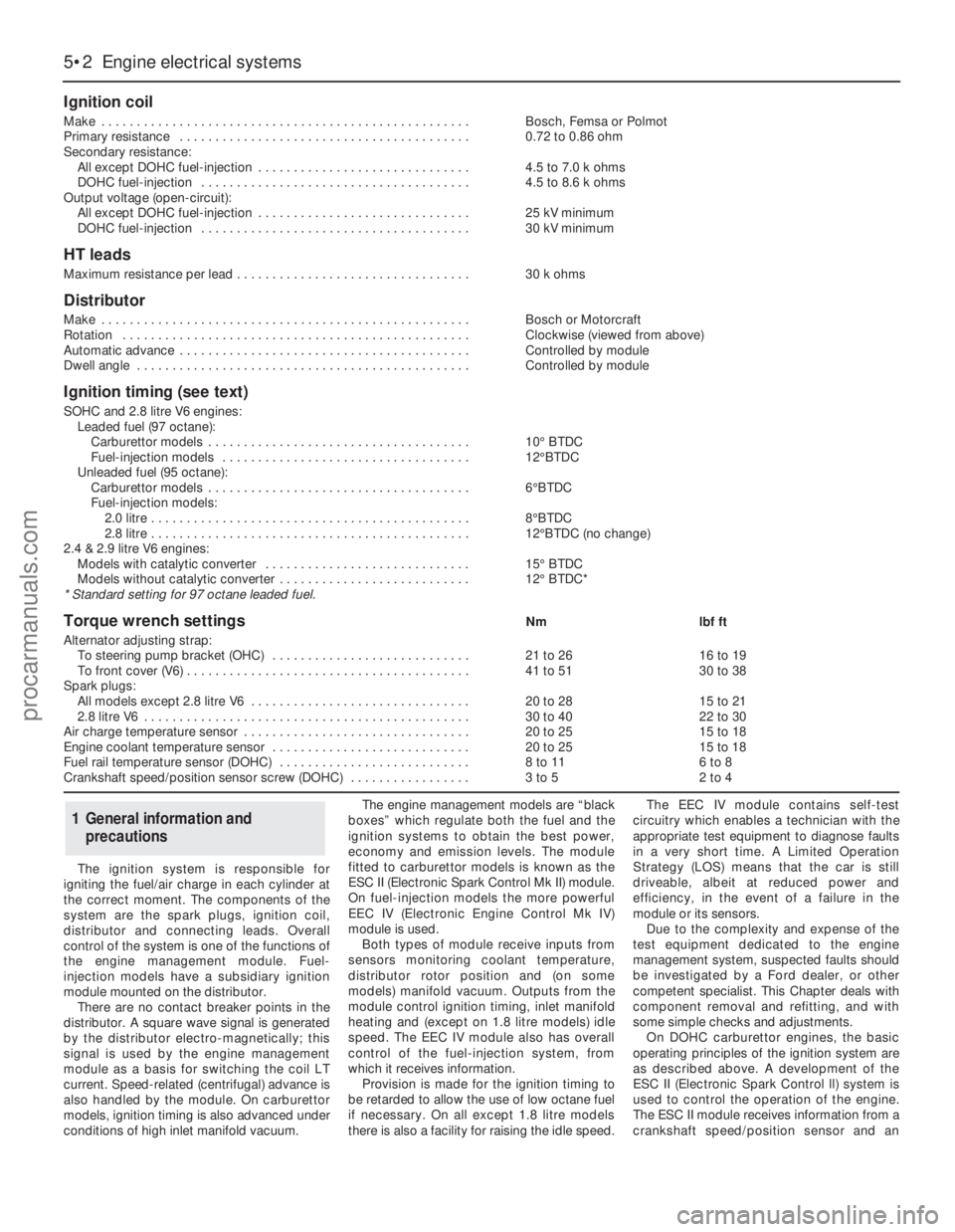
Ignition coil
Make . . . . . . . . . . . . . . . . . . . . . . . . . . . . . . . . . . . . . . . . . . . . . . . . . . . .Bosch, Femsa or Polmot
Primary resistance . . . . . . . . . . . . . . . . . . . . . . . . . . . . . . . . . . . . . . . . .0.72 to 0.86 ohm
Secondary resistance:
All except DOHC fuel-injection . . . . . . . . . . . . . . . . . . . . . . . . . . . . . .4.5 to 7.0 k ohms
DOHC fuel-injection . . . . . . . . . . . . . . . . . . . . . . . . . . . . . . . . . . . . . .4.5 to 8.6 k ohms
Output voltage (open-circuit):
All except DOHC fuel-injection . . . . . . . . . . . . . . . . . . . . . . . . . . . . . .25 kV minimum
DOHC fuel-injection . . . . . . . . . . . . . . . . . . . . . . . . . . . . . . . . . . . . . .30 kV minimum
HT leads
Maximum resistance per lead . . . . . . . . . . . . . . . . . . . . . . . . . . . . . . . . .30 k ohms
Distributor
Make . . . . . . . . . . . . . . . . . . . . . . . . . . . . . . . . . . . . . . . . . . . . . . . . . . . .Bosch or Motorcraft
Rotation . . . . . . . . . . . . . . . . . . . . . . . . . . . . . . . . . . . . . . . . . . . . . . . . .Clockwise (viewed from above)
Automatic advance . . . . . . . . . . . . . . . . . . . . . . . . . . . . . . . . . . . . . . . . .Controlled by module
Dwell angle . . . . . . . . . . . . . . . . . . . . . . . . . . . . . . . . . . . . . . . . . . . . . . .Controlled by module
Ignition timing (see text)
SOHC and 2.8 litre V6 engines:
Leaded fuel (97 octane):
Carburettor models . . . . . . . . . . . . . . . . . . . . . . . . . . . . . . . . . . . . .10°BTDC
Fuel-injection models . . . . . . . . . . . . . . . . . . . . . . . . . . . . . . . . . . .12°BTDC
Unleaded fuel (95 octane):
Carburettor models . . . . . . . . . . . . . . . . . . . . . . . . . . . . . . . . . . . . .6°BTDC
Fuel-injection models:
2.0 litre . . . . . . . . . . . . . . . . . . . . . . . . . . . . . . . . . . . . . . . . . . . . .8°BTDC
2.8 litre . . . . . . . . . . . . . . . . . . . . . . . . . . . . . . . . . . . . . . . . . . . . .12°BTDC (no change)
2.4 & 2.9 litre V6 engines:
Models with catalytic converter . . . . . . . . . . . . . . . . . . . . . . . . . . . . .15°BTDC
Models without catalytic converter . . . . . . . . . . . . . . . . . . . . . . . . . . .12°BTDC*
* Standard setting for 97 octane leaded fuel.
Torque wrench settingsNmlbf ft
Alternator adjusting strap:
To steering pump bracket (OHC) . . . . . . . . . . . . . . . . . . . . . . . . . . . .21 to 2616 to 19
To front cover (V6) . . . . . . . . . . . . . . . . . . . . . . . . . . . . . . . . . . . . . . . .41 to 5130 to 38
Spark plugs:
All models except 2.8 litre V6 . . . . . . . . . . . . . . . . . . . . . . . . . . . . . . .20 to 2815 to 21
2.8 litre V6 . . . . . . . . . . . . . . . . . . . . . . . . . . . . . . . . . . . . . . . . . . . . . .30 to 4022 to 30
Air charge temperature sensor . . . . . . . . . . . . . . . . . . . . . . . . . . . . . . . .20 to 2515 to 18
Engine coolant temperature sensor . . . . . . . . . . . . . . . . . . . . . . . . . . . .20 to 2515 to 18
Fuel rail temperature sensor (DOHC) . . . . . . . . . . . . . . . . . . . . . . . . . . .8 to 116 to 8
Crankshaft speed/position sensor screw (DOHC) . . . . . . . . . . . . . . . . .3 to 52 to 4
procarmanuals.com
Page 120 of 255
engine coolant temperature sensor. The
crankshaft speed/position sensor is activated
by a toothed disc on the rear of the crankshaft,
inside the cylinder block. The disc has 35
equally spaced teeth (one every 10°), with a
gap in the 36th position. The gap is used by
the sensor to determine the crankshaft
position relative to Top Dead Centre (TDC) of
No 1 piston.
The ignition advance is a function of the
ESC II module, and is controlled by vacuum.
The module is connected to the carburettor by
a vacuum pipe, and a transducer in the
module translates the vacuum signal into an
electrical voltage. From the vacuum signal, the
module determines engine load; engine speed
and temperature are determined from the
crankshaft speed/position sensor and the
engine coolant temperature sensor. The
module has a range of spark advance settings
stored in the memory, and a suitable setting is
selected for the relevant engine speed, load
and temperature. The degree of advance can
thus be constantly varied to suit the prevailing
engine speed and load conditions.
On DOHC fuel-injected engines, a
development of the EEC IV (Electronic Engine
Control IV) engine management system is
used to control both the ignition and fuel-
injection systems. The EEC IV module receives
information from a crankshaft speed/position
sensor (the same as that fitted to the
carburettor models), a throttle position sensor,
an engine coolant temperature sensor, a fuel
temperature sensor, an air charge temperature
sensor, a Manifold Absolute Pressure (MAP)
sensor, and a vehicle speed sensor (mounted
on the gearbox). Additionally, on models with
a catalytic converter, an additional input is
supplied to the EEC IV module from an
exhaust gas oxygen (HEGO) sensor. On
models with automatic transmission,
additional sensors are fitted to the
transmission to inform the EEC IV module
when the transmission is in neutral, and when
the downshift is being operated.
The module provides outputs to control the
fuel pump, fuel-injectors, idle speed, ignition
system and automatic transmission .
Additionally, on models with air conditioning,
the EEC IV module disengages the air
conditioning compressor clutch when starting
the engine or when the engine is suddenly
accelerated. On models fitted with a catalytic
converter, the EEC IV module also controls the
carbon canister purge solenoid valve.
Using the inputs from the various sensors,
the EEC IV module computes the optimum
ignition advance, and fuel-injector pulse
duration to suit the prevailing engine
conditions.
On 2.4 & 2.9 litre V6 engines, the system
operates in much the same way as that fitted
to the DOHC fuel-injected engine, noting the
following points.
a)There is no crankshaft speed/position
sensor.
b)The vehicle speed sensor is only fitted to
models equipped with a catalytic
converter.Precautions
ESC II module
Although it will tolerate all normal under-
bonnet conditions, the ESC II module may be
adversely affected by water entry during
steam cleaning or pressure washing of the
engine bay.
If cleaning the engine bay, therefore, take
care not to direct jets of water or steam at the
ESC II module. If this cannot be avoided,
remove the module completely, and protect its
multi-plug with a plastic bag.
Ignition system HT voltage
Take care to avoid receiving electric shocks
from the HT side of the ignition system. Do not
handle HT leads, or touch the distributor or
coil, when the engine is running. When tracing
faults in the HT system, use well insulated
tools to manipulate live leads. Electronic
ignition HT voltage could prove fatal.
Electronic ignition systems
General
Further details of the various systems are
given in the relevant Sections of this Chapter.
While some repair procedures are given, the
usual course of action is to renew the
component concerned. The owner whose
interest extends beyond mere component
renewal should obtain a copy of the
Automobile Electrical & Electronic Systems
Manual, available from the publishers of this
manual.
It is necessary to take extra care when
working on the electrical system, to avoid
damage to semi-conductor devices (diodes
and transistors), and to avoid the risk of
personal injury. In addition to the precautions
given in Safety first!at the beginning of this
manual, observe the following when working
on the system:
Always remove rings, watches, etc before
working on the electrical system.Even with the
battery disconnected, capacitive discharge
could occur if a component’s live terminal is
earthed through a metal object. This could
cause a shock or nasty burn.
Do not reverse the battery connections.
Components such as the alternator, electronic
control units, or any other components having
semi-conductor circuitry, could be irreparably
damaged.
If the engine is being started using jump
leads and a slave battery, connect thebatteries positive-to-positiveand negative-to-
negative(see “Jump starting”). This also
applies when connecting a battery charger.
Never disconnect the battery terminals, the
alternator, any electrical wiring, or any test
instruments, when the engine is running.
Do not allow the engine to turn the alternator
when the alternator is not connected.
Never test for alternator output by “flashing”
the output lead to earth.
Never use an ohmmeter of the type
incorporating a hand-cranked generator for
circuit or continuity testing.
Always ensure that the battery negative lead
is disconnected when working on the
electrical system.
Before using electric-arc welding equipment
on the car, disconnect the battery, alternator,
and components such as the fuel-
injection/ignition electronic control unit, to
protect them from the risk of damage.
Refer to Chapter 13
1In normal use the battery should not require
charging from an external source, unless the
vehicle is laid up for long periods, when it
should be recharged every six weeks or so. If
vehicle use consists entirely of short runs in
darkness it is also possible for the battery to
become discharged. Otherwise, a regular
need for recharging points to a fault in the
battery or elsewhere in the charging system.
2There is no need to disconnect the battery
from the vehicle wiring when using a battery
charger, but switch off the ignition and leave
the bonnet open.
3Domestic battery chargers (up to about 6
amps output) may safely be used overnight
without special precautions. Make sure that
the charger is set to deliver 12 volts before
connecting it. Connect the leads (red or
positive to the positive terminal, black or
negative to the negative terminal) before
switching the charger on at the mains.
4When charging is complete, switch off at
the mains beforedisconnecting the charger
from the battery. Remember that the battery
will be giving off hydrogen gas, which is
potentially explosive.
5Charging at a higher rate should only be
carried out under carefully controlled
conditions. Very rapid or “boost” charging
should be avoided if possible, as it is liable to
cause permanent damage to the battery
through overheating.
6During any sort of charging, battery
electrolyte temperature should never exceed
38°C (100°F). If the battery becomes hot, or
the electrolyte is effervescing vigorously,
charging should be stopped.
3Battery - charging
2Electrical fault-finding - general
information
Engine electrical systems 5•3
5
Warning. The voltages produced
by the electronic ignition system
are considerably higher than those
produced by conventional
systems. Extreme care must be taken when
working on the system with the ignition
switched on. Persons with surgically-
implanted cardiac pacemaker devices
should keep well clear of the ignition
circuits, components and test equipment.
procarmanuals.com
Page 122 of 255
Solenoid check
3Disconnect the battery negative lead, and all
leads from the solenoid.
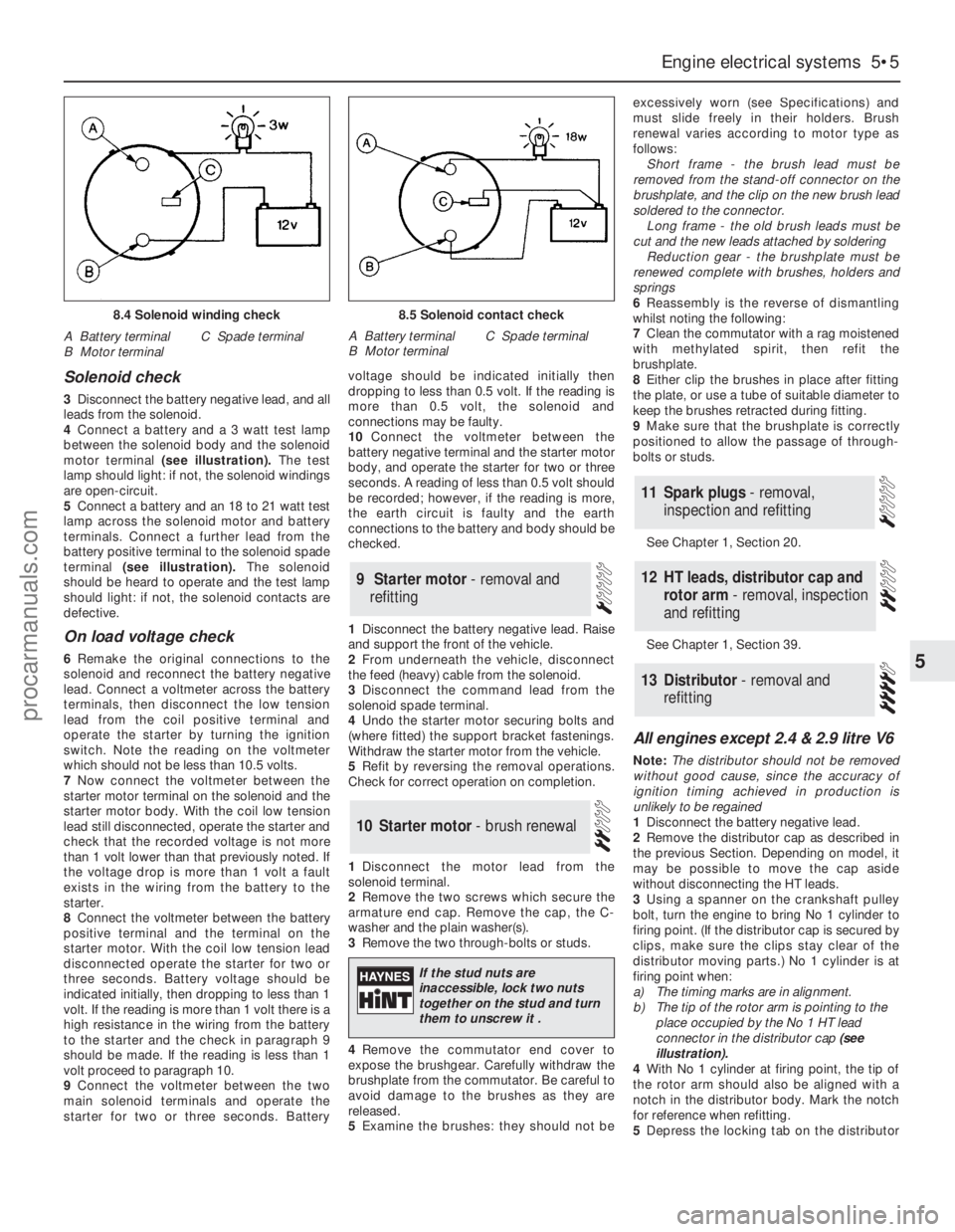
4Connect a battery and a 3 watt test lamp
between the solenoid body and the solenoid
motor terminal (see illustration).The test
lamp should light: if not, the solenoid windings
are open-circuit.
5Connect a battery and an 18 to 21 watt test
lamp across the solenoid motor and battery
terminals. Connect a further lead from the
battery positive terminal to the solenoid spade
terminal(see illustration).The solenoid
should be heard to operate and the test lamp
should light: if not, the solenoid contacts are
defective.
On load voltage check
6Remake the original connections to the
solenoid and reconnect the battery negative
lead. Connect a voltmeter across the battery
terminals, then disconnect the low tension
lead from the coil positive terminal and
operate the starter by turning the ignition
switch. Note the reading on the voltmeter
which should not be less than 10.5 volts.
7Now connect the voltmeter between the
starter motor terminal on the solenoid and the
starter motor body. With the coil low tension
lead still disconnected, operate the starter and
check that the recorded voltage is not more
than 1 volt lower than thatpreviously noted. If
the voltage drop is more than 1 volt a fault
exists in the wiring from the battery to the
starter.
8Connect the voltmeter between the battery
positive terminal and the terminal on the
starter motor. With the coil low tension lead
disconnected operate the starter for two or
three seconds. Battery voltage should be
indicated initially, then dropping to less than 1
volt. If the reading is more than 1 volt there is a
high resistance in the wiring from the battery
to the starter and the check in paragraph 9
should be made. If the reading is less than 1
volt proceed to paragraph 10.
9Connect the voltmeter between the two
main solenoid terminals and operate the
starter for two or three seconds. Batteryvoltage should be indicated initially then
dropping to less than 0.5 volt. If the reading is
more than 0.5 volt, the solenoid and
connections may be faulty.
10Connect the voltmeter between the
battery negative terminal and the starter motor
body, and operate the starter for two or three
seconds. A reading of less than 0.5 volt should
be recorded; however, if the reading is more,
the earth circuit is faulty and the earth
connections to the battery and body should be
checked.
1Disconnect the battery negative lead. Raise
and support the front of the vehicle.
2From underneath the vehicle, disconnect
the feed (heavy) cable from the solenoid.
3Disconnect the command lead from the
solenoid spade terminal.
4Undo the starter motor securing bolts and
(where fitted) the support bracket fastenings.
Withdraw the starter motor from the vehicle.
5Refit by reversing the removal operations.
Check for correct operation on completion.
1Disconnect the motor lead from the
solenoid terminal.
2Remove the two screws which secure the
armature end cap. Remove the cap, the C-
washer and the plain washer(s).
3Remove the two through-bolts or studs.
4Remove the commutator end cover to
expose the brushgear. Carefully withdraw the
brushplate from the commutator. Be careful to
avoid damage to the brushes as they are
released.
5Examine the brushes: they should not beexcessively worn (see Specifications) and
must slide freely in their holders. Brush
renewal varies according to motor type as
follows:
Short frame - the brush lead must be
removed from the stand-off connector on the
brushplate, and the clip on the new brush lead
soldered to the connector.
Long frame - the old brush leads must be
cut and the new leads attached by soldering
Reduction gear - the brushplate must be
renewed complete with brushes, holders and
springs
6Reassembly is the reverse of dismantling
whilst noting the following:
7Clean the commutator with a rag moistened
with methylated spirit, then refit the
brushplate.
8Either clip the brushes in place after fitting
the plate, or use a tube of suitable diameter to
keep the brushes retracted during fitting.
9Make sure that the brushplate is correctly
positioned to allow the passage of through-
bolts or studs.
See Chapter 1, Section 20.
See Chapter 1, Section 39.
All engines except 2.4 & 2.9 litre V6
Note: The distributor should not be removed
without good cause, since the accuracy of
ignition timing achieved in production is
unlikely to be regained
1Disconnect the battery negative lead.
2Remove the distributor cap as described in
the previous Section. Depending on model, it
may be possible to move the cap aside
without disconnecting the HT leads.
3Using a spanner on the crankshaft pulley
bolt, turn the engine to bring No 1 cylinder to
firing point. (If the distributor cap is secured by
clips, make sure the clips stay clear of the
distributor moving parts.) No 1 cylinder is at
firing point when:
a)The timing marks are in alignment.
b)The tip of the rotor arm is pointing to the
place occupied by the No 1 HT lead
connector in the distributor cap (see
illustration).
4With No 1 cylinder at firing point, the tip of
the rotor arm should also be aligned with a
notch in the distributor body. Mark the notch
for reference when refitting.
5Depress the locking tab on the distributor
13Distributor - removal and
refitting
12HT leads, distributor cap and
rotor arm - removal, inspection
and refitting
11Spark plugs - removal,
inspection and refitting
10Starter motor - brush renewal
9Starter motor - removal and
refitting
Engine electrical systems 5•5
5
8.4 Solenoid winding check
A Battery terminal
B Motor terminalC Spade terminal
8.5 Solenoid contact check
A Battery terminal
B Motor terminalC Spade terminal
If the stud nuts are
inaccessible, lock two nuts
together on the stud and turn
them to unscrew it .
procarmanuals.com