reset FORD GT 2018 Owners Manual
[x] Cancel search | Manufacturer: FORD, Model Year: 2018, Model line: GT, Model: FORD GT 2018Pages: 325, PDF Size: 6.61 MB
Page 56 of 325
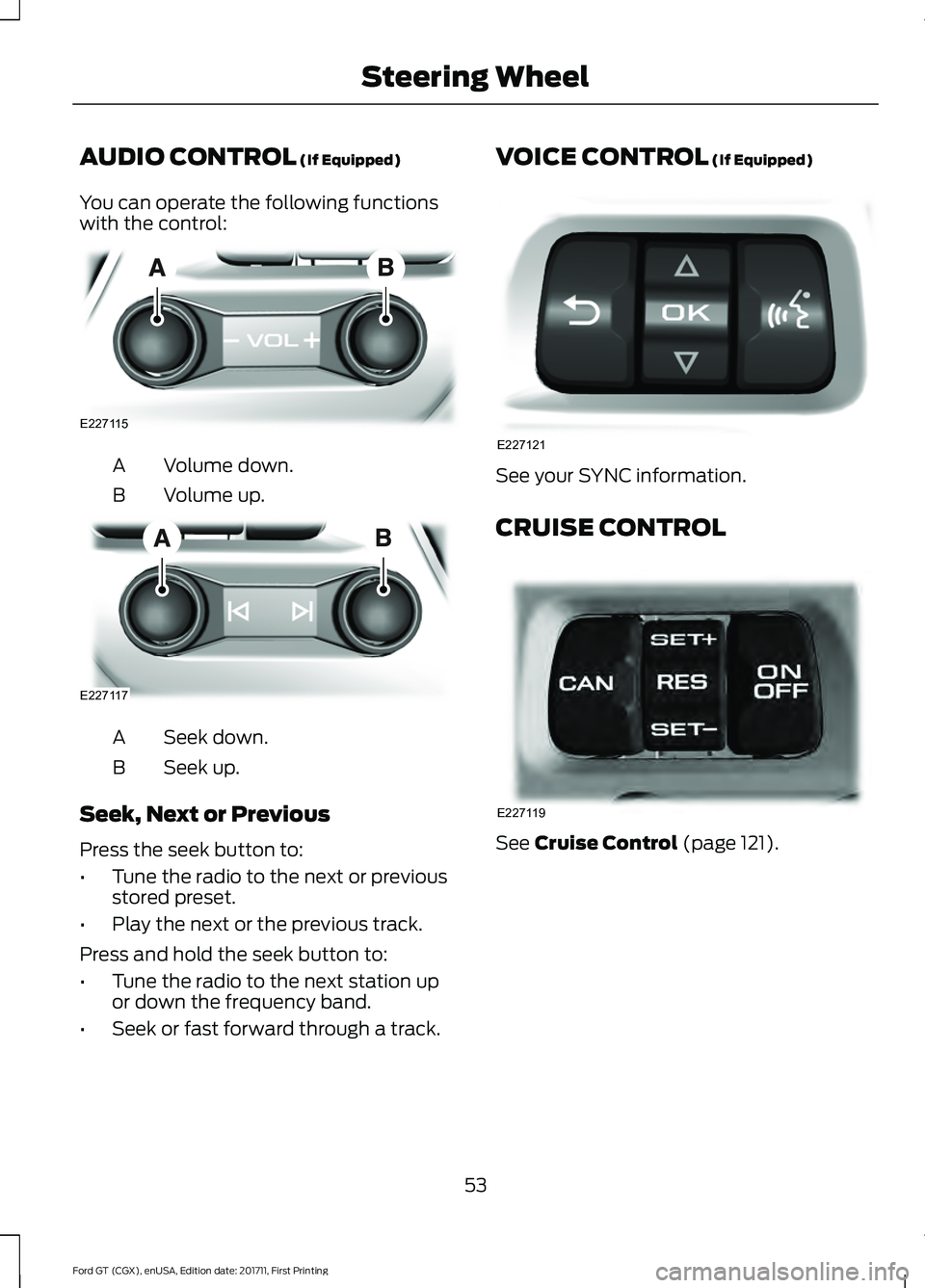
AUDIO CONTROL (If Equipped)
You can operate the following functions
with the control: Volume down.
A
Volume up.
B Seek down.
A
Seek up.
B
Seek, Next or Previous
Press the seek button to:
• Tune the radio to the next or previous
stored preset.
• Play the next or the previous track.
Press and hold the seek button to:
• Tune the radio to the next station up
or down the frequency band.
• Seek or fast forward through a track. VOICE CONTROL (If Equipped)
See your SYNC information.
CRUISE CONTROL
See
Cruise Control (page 121).
53
Ford GT (CGX), enUSA, Edition date: 201711, First Printing Steering WheelE227115 E227117 E227121 E227119
Page 75 of 325
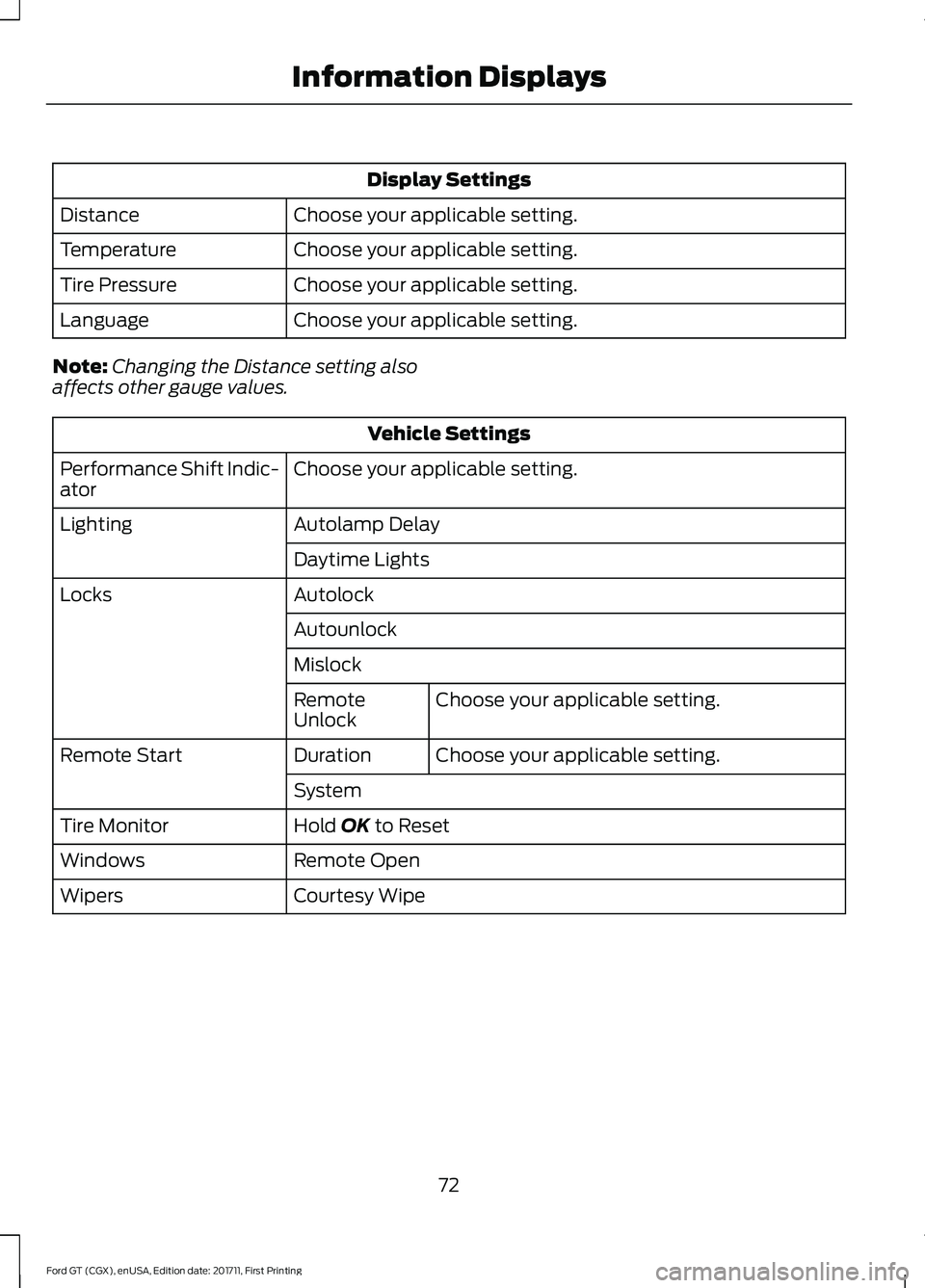
Display Settings
Choose your applicable setting.
Distance
Choose your applicable setting.
Temperature
Choose your applicable setting.
Tire Pressure
Choose your applicable setting.
Language
Note: Changing the Distance setting also
affects other gauge values. Vehicle Settings
Choose your applicable setting.
Performance Shift Indic-
ator
Autolamp Delay
Lighting
Daytime Lights
Autolock
Locks
Autounlock
MislockChoose your applicable setting.
Remote
Unlock
Choose your applicable setting.
Duration
Remote Start
System
Hold OK to Reset
Tire Monitor
Remote Open
Windows
Courtesy Wipe
Wipers
72
Ford GT (CGX), enUSA, Edition date: 201711, First Printing Information Displays
Page 101 of 325
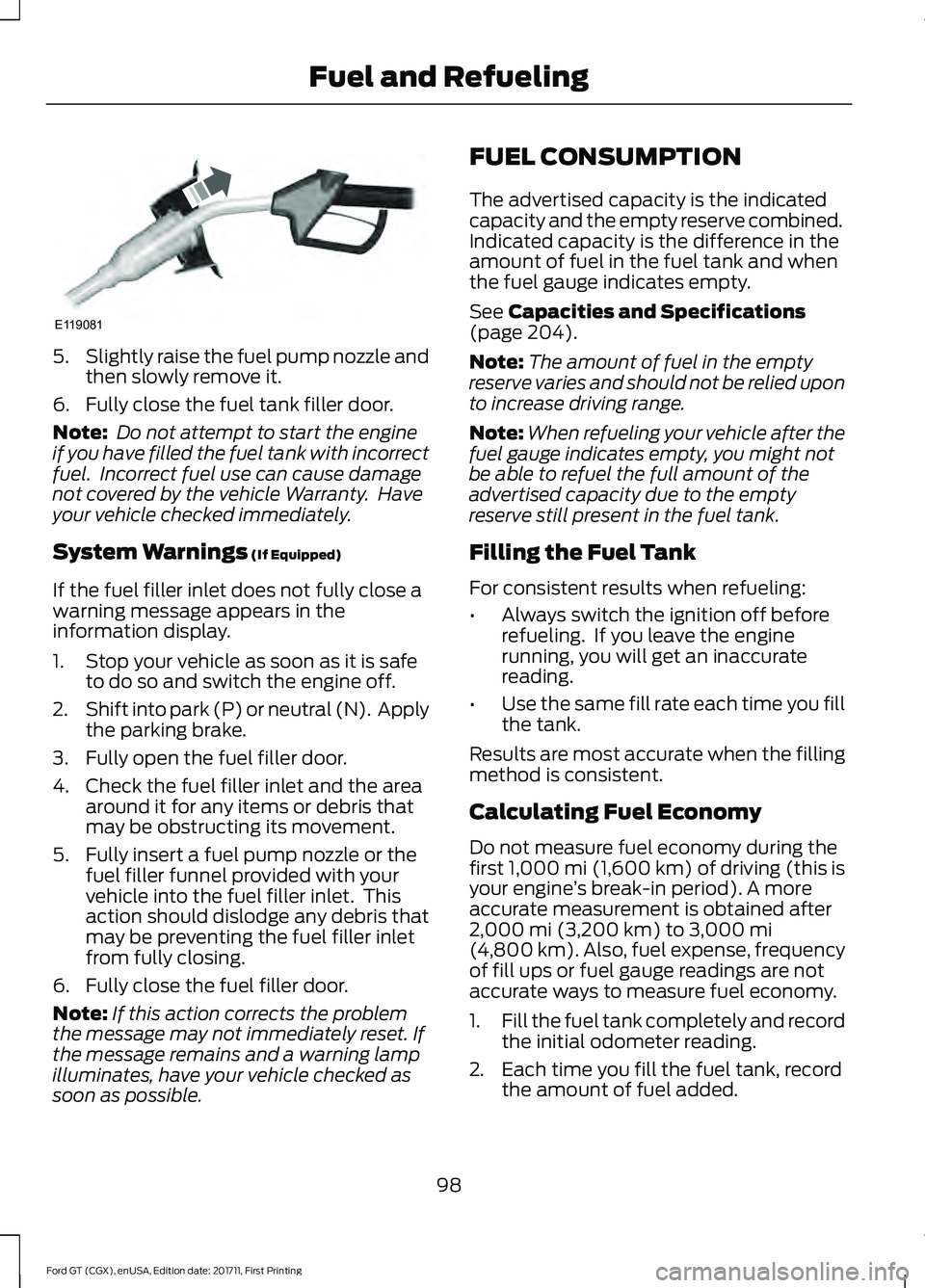
5.
Slightly raise the fuel pump nozzle and
then slowly remove it.
6. Fully close the fuel tank filler door.
Note: Do not attempt to start the engine
if you have filled the fuel tank with incorrect
fuel. Incorrect fuel use can cause damage
not covered by the vehicle Warranty. Have
your vehicle checked immediately.
System Warnings (If Equipped)
If the fuel filler inlet does not fully close a
warning message appears in the
information display.
1. Stop your vehicle as soon as it is safe to do so and switch the engine off.
2. Shift into park (P) or neutral (N). Apply
the parking brake.
3. Fully open the fuel filler door.
4. Check the fuel filler inlet and the area around it for any items or debris that
may be obstructing its movement.
5. Fully insert a fuel pump nozzle or the fuel filler funnel provided with your
vehicle into the fuel filler inlet. This
action should dislodge any debris that
may be preventing the fuel filler inlet
from fully closing.
6. Fully close the fuel filler door.
Note: If this action corrects the problem
the message may not immediately reset. If
the message remains and a warning lamp
illuminates, have your vehicle checked as
soon as possible. FUEL CONSUMPTION
The advertised capacity is the indicated
capacity and the empty reserve combined.
Indicated capacity is the difference in the
amount of fuel in the fuel tank and when
the fuel gauge indicates empty.
See
Capacities and Specifications
(page 204).
Note: The amount of fuel in the empty
reserve varies and should not be relied upon
to increase driving range.
Note: When refueling your vehicle after the
fuel gauge indicates empty, you might not
be able to refuel the full amount of the
advertised capacity due to the empty
reserve still present in the fuel tank.
Filling the Fuel Tank
For consistent results when refueling:
• Always switch the ignition off before
refueling. If you leave the engine
running, you will get an inaccurate
reading.
• Use the same fill rate each time you fill
the tank.
Results are most accurate when the filling
method is consistent.
Calculating Fuel Economy
Do not measure fuel economy during the
first
1,000 mi (1,600 km) of driving (this is
your engine ’s break-in period). A more
accurate measurement is obtained after
2,000 mi (3,200 km)
to 3,000 mi
(4,800 km). Also, fuel expense, frequency
of fill ups or fuel gauge readings are not
accurate ways to measure fuel economy.
1. Fill the fuel tank completely and record
the initial odometer reading.
2. Each time you fill the fuel tank, record the amount of fuel added.
98
Ford GT (CGX), enUSA, Edition date: 201711, First Printing Fuel and RefuelingE119081
Page 123 of 325
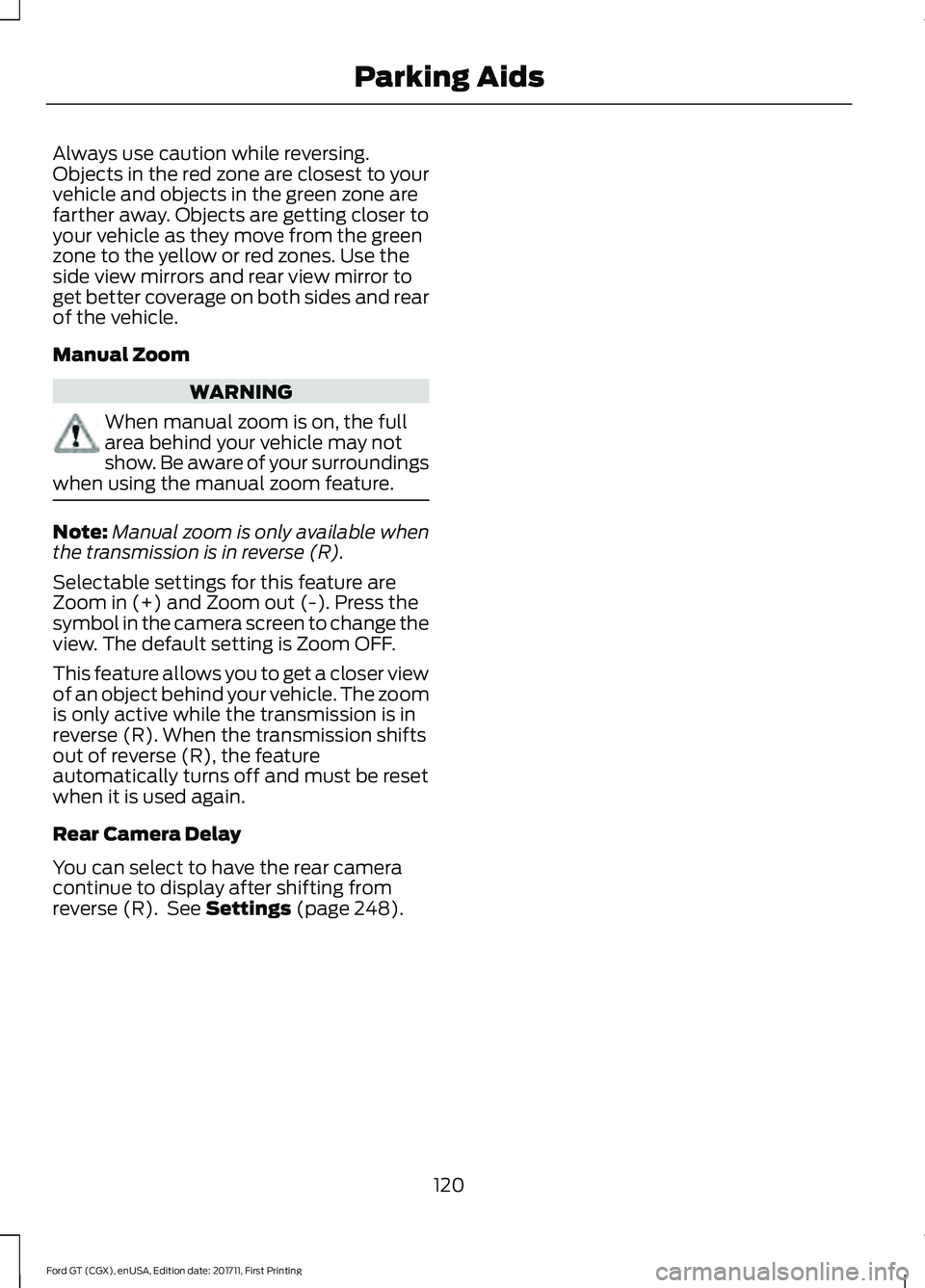
Always use caution while reversing.
Objects in the red zone are closest to your
vehicle and objects in the green zone are
farther away. Objects are getting closer to
your vehicle as they move from the green
zone to the yellow or red zones. Use the
side view mirrors and rear view mirror to
get better coverage on both sides and rear
of the vehicle.
Manual Zoom
WARNING
When manual zoom is on, the full
area behind your vehicle may not
show. Be aware of your surroundings
when using the manual zoom feature. Note:
Manual zoom is only available when
the transmission is in reverse (R).
Selectable settings for this feature are
Zoom in (+) and Zoom out (-). Press the
symbol in the camera screen to change the
view. The default setting is Zoom OFF.
This feature allows you to get a closer view
of an object behind your vehicle. The zoom
is only active while the transmission is in
reverse (R). When the transmission shifts
out of reverse (R), the feature
automatically turns off and must be reset
when it is used again.
Rear Camera Delay
You can select to have the rear camera
continue to display after shifting from
reverse (R). See Settings (page 248).
120
Ford GT (CGX), enUSA, Edition date: 201711, First Printing Parking Aids
Page 149 of 325
FUSE SPECIFICATION CHART
Front Power Distribution Box
WARNINGS
Always disconnect the battery before
servicing high current fuses.
To reduce risk of electrical shock,
always replace the cover to the
power distribution box before
reconnecting the battery or refilling fluid
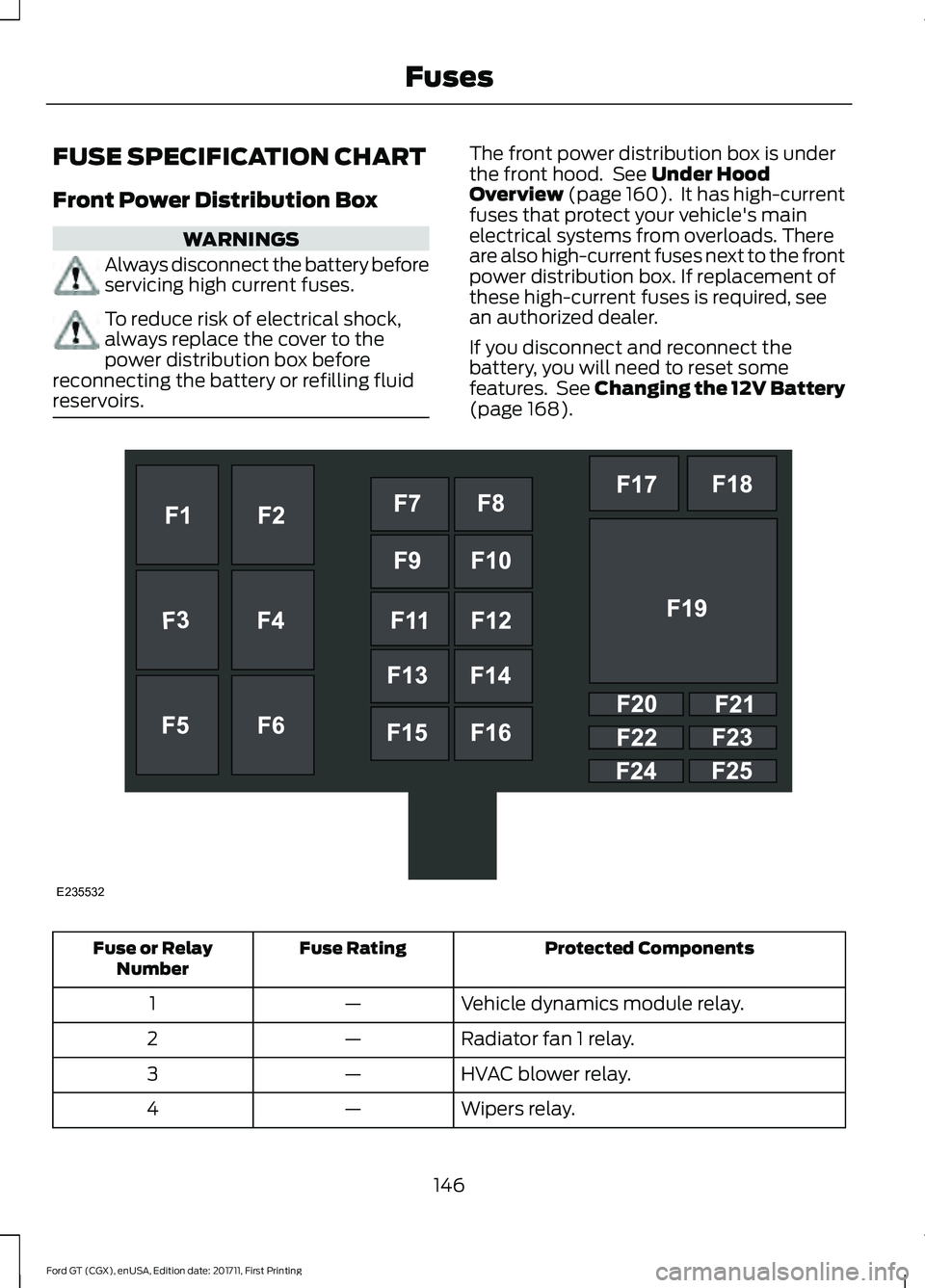
reservoirs. The front power distribution box is under
the front hood. See Under Hood
Overview (page 160). It has high-current
fuses that protect your vehicle's main
electrical systems from overloads. There
are also high-current fuses next to the front
power distribution box. If replacement of
these high-current fuses is required, see
an authorized dealer.
If you disconnect and reconnect the
battery, you will need to reset some
features. See Changing the 12V Battery
(page
168). Protected Components
Fuse Rating
Fuse or Relay
Number
Vehicle dynamics module relay.
—
1
Radiator fan 1 relay.
—
2
HVAC blower relay.
—
3
Wipers relay.
—
4
146
Ford GT (CGX), enUSA, Edition date: 201711, First Printing FusesE235532
Page 151 of 325
Protected Components
Fuse Rating
Fuse or Relay
Number
Electronic door system.
20A 2
24
Right headlamp.
20A 2
25
1 J-case low profile fuse.
2 Mini fuse.
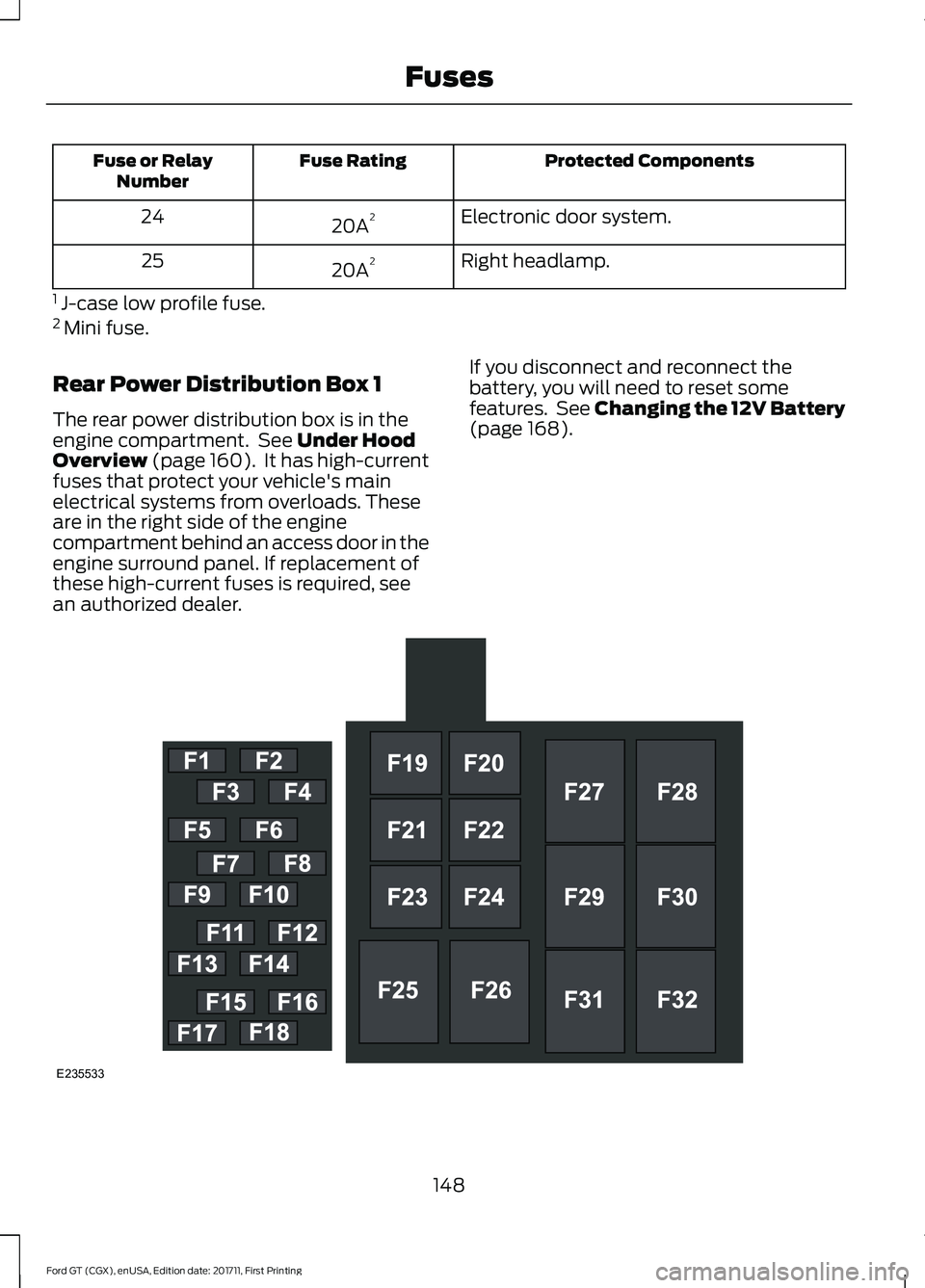
Rear Power Distribution Box 1
The rear power distribution box is in the
engine compartment. See Under Hood
Overview (page 160). It has high-current
fuses that protect your vehicle's main
electrical systems from overloads. These
are in the right side of the engine
compartment behind an access door in the
engine surround panel. If replacement of
these high-current fuses is required, see
an authorized dealer. If you disconnect and reconnect the
battery, you will need to reset some
features. See Changing the 12V Battery
(page
168).
148
Ford GT (CGX), enUSA, Edition date: 201711, First Printing FusesE235533
Page 153 of 325
Protected Components
Fuse Rating
Fuse or Relay
Number
Starter.
30A 2
22
Charge air cooler fan.
30A 2
23
Shunt.
—
24
Charge air cooler fan relay.
—
25
Not used.
—
26
Fuel pump 1 relay.
—
27
AC clutch relay.
—
28
Starter relay.
—
29
Fuel injection relay.
—
30
Fuel pump 2 relay.
—
31
Engine control module relay.
—
32
1 Mini fuse.
2 J-case low profile fuse.
Rear Power Distribution Box 2
The rear power distribution box is in the
engine compartment. See Under Hood
Overview (page 160). It has high-current
fuses that protect your vehicle's main
electrical systems from overloads. These
are in the right side of the engine
compartment behind an access door in the
engine surround panel. If replacement of
these high-current fuses is required, see
an authorized dealer. If you disconnect and reconnect the
battery, you will need to reset some
features. See Changing the 12V Battery
(page
168).
150
Ford GT (CGX), enUSA, Edition date: 201711, First Printing Fuses
Page 167 of 325
Dispose of used engine coolant in an
appropriate manner. Follow your
community
’s regulations and standards
for recycling and disposing of automotive
fluids.
Severe Climates
If you drive in extremely cold climates:
• It may be necessary to increase the
coolant concentration above 50%.
• A coolant concentration of 60%
provides improved freeze point
protection. Coolant concentrations
above 60% decrease the overheat
protection characteristics of the
coolant and may cause engine
damage.
If you drive in extremely hot climates:
• It may be necessary to decrease the
coolant concentration to 40%.
• A coolant concentration of 40%
provides improved overheat protection.
Coolant concentrations below 40%
decrease the freeze and corrosion
protection characteristics of the
coolant and may cause engine
damage.
Vehicles driven year-round in non-extreme
climates should use prediluted coolant for
optimum cooling system and engine
protection.
Coolant Change
At specific mileage intervals, as listed in
the scheduled maintenance information,
the coolant should be changed. Add
prediluted coolant meeting the correct
specification. See Capacities and
Specifications (page 204). Fail-Safe Cooling
Fail-safe cooling allows you to temporarily
drive your vehicle before any incremental
component damage occurs. The fail-safe
distance depends on ambient
temperature, vehicle load and terrain.
How Fail-Safe Cooling Works
If the engine begins to overheat, the
coolant temperature gauge moves toward
the red zone:
A warning lamp illuminates and
a message may appear in the
information display.
If the engine reaches a preset
over-temperature condition, the engine
automatically switches to alternating
cylinder operation. Each disabled cylinder
acts as an air pump and cools the engine.
When this occurs, your vehicle still
operates, however:
• Engine power is limited.
• The air conditioning system turns off.
Continued operation increases the engine
temperature, causing the engine to
completely shut down. Your steering and
braking effort increases in this situation.
When the engine temperature cools, you
can re-start the engine. Have your vehicle
checked as soon as possible to minimize
engine damage.
When Fail-Safe Mode Is Activated WARNINGS
Fail-safe mode is for use during
emergencies only. Operate your
vehicle in fail-safe mode only as long
as necessary to bring your vehicle to rest
in a safe location and seek immediate
repairs. When in fail-safe mode, your
164
Ford GT (CGX), enUSA, Edition date: 201711, First Printing Maintenance
Page 171 of 325
CHANGING THE 12V BATTERY
WARNING
Battery posts, terminals and related
accessories contain lead and lead
compounds. Wash hands after
handling. The Ford GT uses a lithium Ion battery.
The battery is located inside the right front
fender. For battery maintenance or
replacement, contact an authorized dealer.
When a battery replacement is required,
you must use a recommended
replacement battery that matches the
electrical requirements of the vehicle.
Note:
If you add electrical accessories or
components to the vehicle, it may adversely
affect the low voltage battery performance
and durability. This may also affect the
performance of other electrical systems in
the vehicle.
Because your vehicle ’s engine is
electronically controlled by a computer,
some control conditions are maintained
by power from the battery. When the
battery is disconnected or a new battery
is installed, the engine must relearn its idle
and fuel trim strategy for optimum
driveability and performance.
To restore the settings, do the following:
1. Apply the parking brake.
2. Shift into park (P) or neutral (N).
3. Switch off all accessories.
4. Press the brake pedal and start your vehicle. 5. Run the engine until it reaches normal
operating temperature. While the
engine is warming up, complete the
following: Reset the clock. See Audio
System (page 212). Reset the radio
station presets. See Audio System
(page 212).
6. Allow the engine to idle for at least one
minute.
7. Drive the vehicle at least 10 mi (16 km)
to completely relearn the idle trim and
fuel trim strategy.
Note: If you do not allow the engine to
relearn the idle and fuel trim strategy, the
idle quality of your vehicle may be adversely
affected until the engine computer
eventually relearns the idle trim and fuel
trim strategy.
Make sure that you dispose of old batteries
in an environmentally friendly way. Seek
advice from your local authority about
recycling old batteries.
Battery Charger and Maintainer
If you plan to have your GT parked for more
than two weeks without driving it, connect
the battery charger and maintainer
provided. This charger connects simply to
the jump start(+) and (-) posts as shown
in the illustration below.
168
Ford GT (CGX), enUSA, Edition date: 201711, First Printing Maintenance
Page 172 of 325
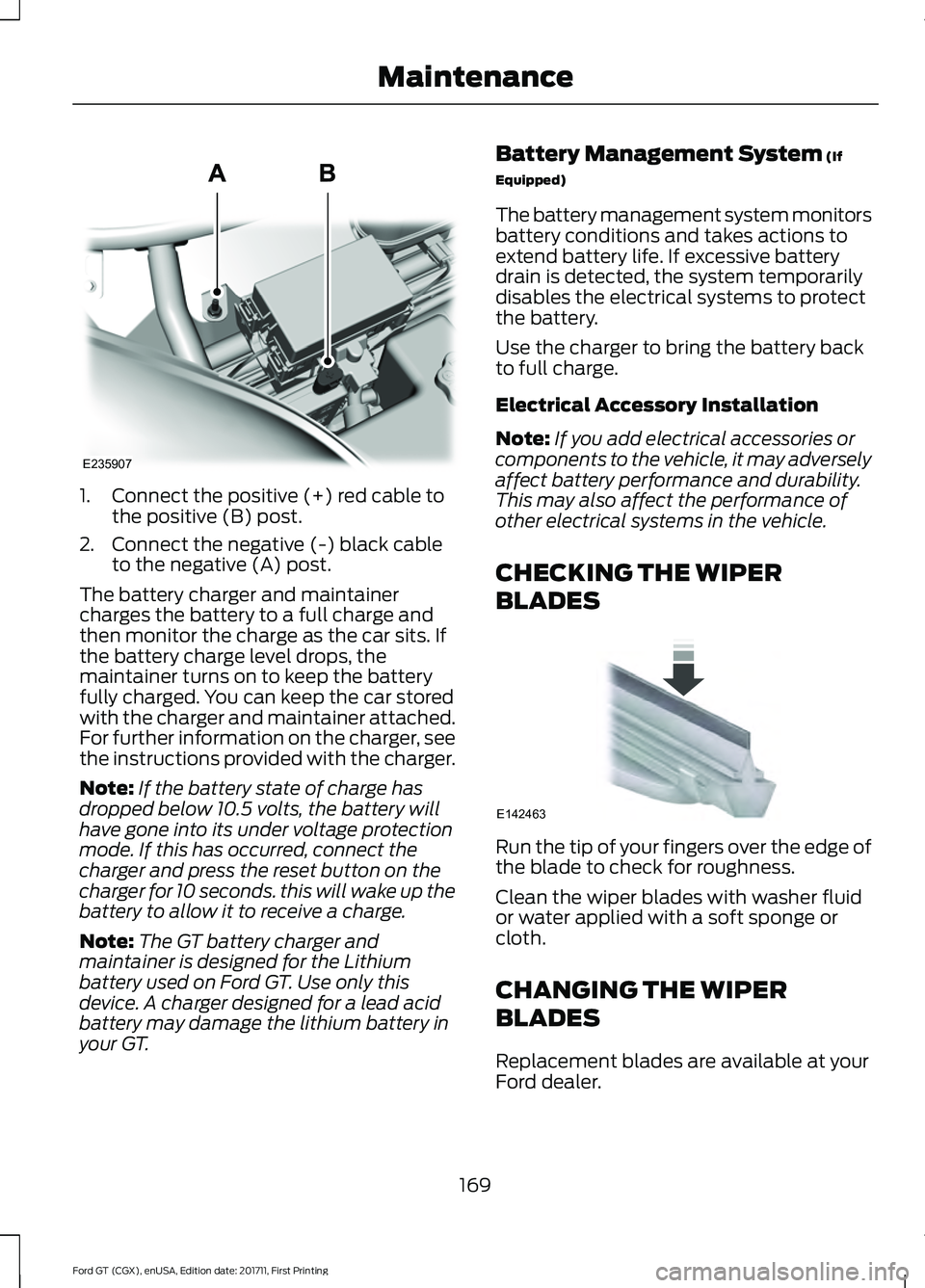
1. Connect the positive (+) red cable to
the positive (B) post.
2. Connect the negative (-) black cable to the negative (A) post.
The battery charger and maintainer
charges the battery to a full charge and
then monitor the charge as the car sits. If
the battery charge level drops, the
maintainer turns on to keep the battery
fully charged. You can keep the car stored
with the charger and maintainer attached.
For further information on the charger, see
the instructions provided with the charger.
Note: If the battery state of charge has
dropped below 10.5 volts, the battery will
have gone into its under voltage protection
mode. If this has occurred, connect the
charger and press the reset button on the
charger for 10 seconds. this will wake up the
battery to allow it to receive a charge.
Note: The GT battery charger and
maintainer is designed for the Lithium
battery used on Ford GT. Use only this
device. A charger designed for a lead acid
battery may damage the lithium battery in
your GT. Battery Management System (If
Equipped)
The battery management system monitors
battery conditions and takes actions to
extend battery life. If excessive battery
drain is detected, the system temporarily
disables the electrical systems to protect
the battery.
Use the charger to bring the battery back
to full charge.
Electrical Accessory Installation
Note: If you add electrical accessories or
components to the vehicle, it may adversely
affect battery performance and durability.
This may also affect the performance of
other electrical systems in the vehicle.
CHECKING THE WIPER
BLADES Run the tip of your fingers over the edge of
the blade to check for roughness.
Clean the wiper blades with washer fluid
or water applied with a soft sponge or
cloth.
CHANGING THE WIPER
BLADES
Replacement blades are available at your
Ford dealer.
169
Ford GT (CGX), enUSA, Edition date: 201711, First Printing MaintenanceE235907 E142463