warning FORD KUGA 2010 1.G Repair Manual
[x] Cancel search | Manufacturer: FORD, Model Year: 2010, Model line: KUGA, Model: FORD KUGA 2010 1.GPages: 226, PDF Size: 8.07 MB
Page 117 of 226
PRINCIPLE OF OPERATION
WARNING
The parking aid does not relieve you
of your responsibility to drive with
due care and attention.
CAUTIONS
Vehicles fitted with a trailer tow
module not approved by us may not
correctly detect obstacles.
The sensors may not detect objects
in heavy rain or other conditions that
cause disruptive reflections.
The sensors may not detect objects
with surfaces that absorb ultrasonic
waves.
The parking aid does not detect
obstacles moving away from the
vehicle. They will only be detected
shortly after they start to move towards
the vehicle again. Take particular care when reversing
with a tow ball arm or rear fitted
accessories e.g. a bicycle carrier, as
the rear parking aid will only indicate the
distance from the bumper to the obstacle. If you use a high pressure spray to
wash your vehicle, only spray the
sensors briefly from a distance not
less than 20 centimetres (8 inches). Note:On vehicles fitted with a tow ball
arm, the parking aid is deactivated automatically when any trailer lamps (orlighting boards) are connected to the13-pin socket via a trailer tow module wehave approved.
Note:Keep the sensors free from dirt,
ice and snow. Do not clean with sharp objects.
Note:The parking aid may emit false
tones if it detects a signal using the same frequency as the sensors or if the vehicleis fully laden.
Note:The outer sensors may detect the
side walls of a garage. If the distance between the outer sensor and the sidewall remains constant for three seconds,the tone will switch off. As you continue,the inner sensors will detect rearwardobjects.
USING THE PARKING AID
Switching the parking aid on
and off
Note:
The parking aid switches off
automatically when you start the engine or when you exceed 16 km/h (10 mph).
Note:The front and rear sensors are
always activated or deactivated together.
The parking aid is per default off. To
switch the parking aid on, press the switch
in the instrument panel or select reverse
gear.
The light in the switch illuminates when
the parking aid is activated.
To turn it off, press the switch again.
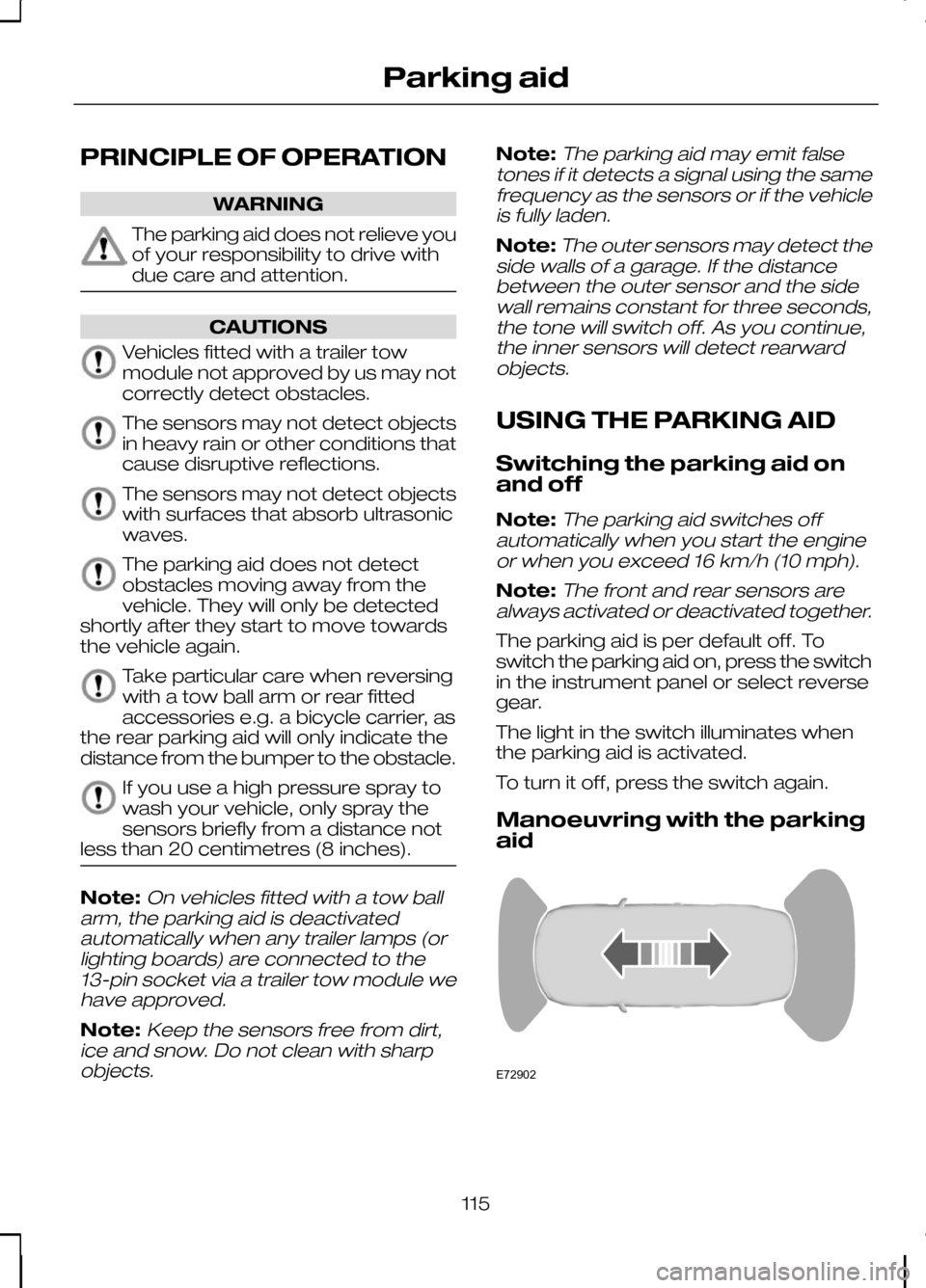
Manoeuvring with the parking
aid 115
Parking aidE72902
Page 118 of 226
Note:If a high pitch warning tone sounds
for three seconds and the light in the switch is flashing, it indicates amalfunction. The system will be disabled.Have the system checked by properlytrained technicians.
You will hear an intermittent tone at a
distance of up to approximately 150
centimetres (59 inches) between the
obstacle and rear bumper, 80 centimetres
(31 inches) between the obstacle and
front bumper and 50 centimetres (20
inches) to the side. Decreasing the
distance accelerates the intermittent tone.
A continuous tone will start at a distance
of less than 30 centimetres (12 inches).
You will hear an alternating tone from the
front and rear if obstacles are closer than
30 centimetres (12 inches) to the front
and rear bumpers.
116
Parking aid
Page 119 of 226
PRINCIPLE OF OPERATION
The camera is a visual aid for use when
reversing.
WARNING
The camera does not relieve you of
your responsibility to drive with due
care and attention.
CAUTIONS
If you use a high pressure spray to
wash your vehicle, only spray the
camera briefly from a distance not
less than 20 centimetres (8 inches). Do not apply pressure to the camera.
The position and the angle of the
camera automatically changes.
Note:Keep the camera free from dirt,
ice and snow. Do not clean with sharp objects, degreaser, wax or organicproducts. Use only a soft cloth.
During operation, guide lines appear in
the display which represent your vehicle's
path and approximate distance from
rearward objects.
USING THE REAR VIEW
CAMERA WARNINGS
The operation of the camera may
vary depending on the ambient
temperature, vehicle and road
conditions. The distances shown in the display
may differ from the actual distance.
Do not place objects in front of the
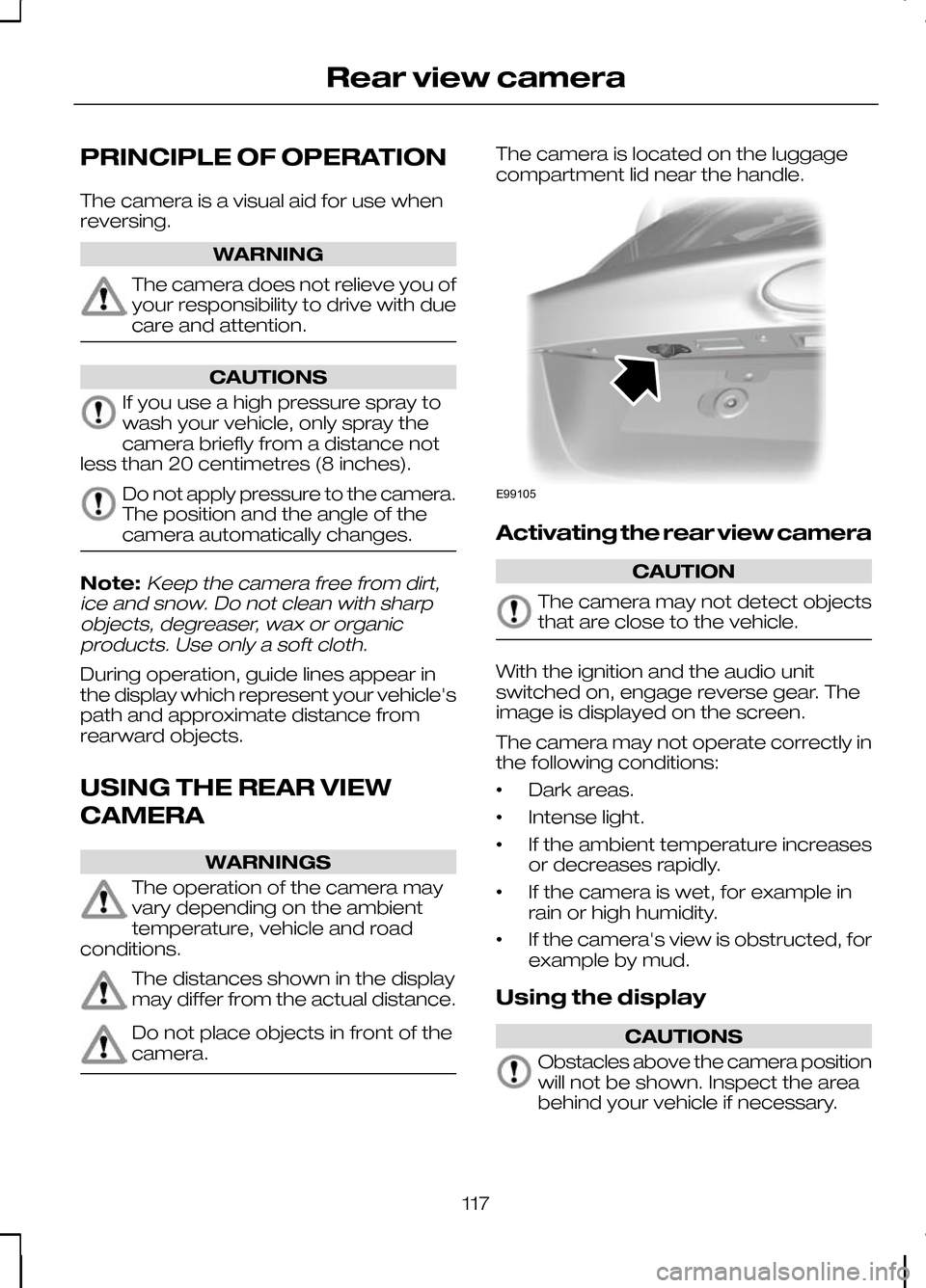
camera. The camera is located on the luggage
compartment lid near the handle.
Activating the rear view camera
CAUTION
The camera may not detect objects
that are close to the vehicle.
With the ignition and the audio unit
switched on, engage reverse gear. The
image is displayed on the screen.
The camera may not operate correctly in
the following conditions:
•
Dark areas.
• Intense light.
• If the ambient temperature increases
or decreases rapidly.
• If the camera is wet, for example in
rain or high humidity.
• If the camera's view is obstructed, for
example by mud.
Using the display CAUTIONS
Obstacles above the camera position
will not be shown. Inspect the area
behind your vehicle if necessary.
117
Rear view cameraE99105
Page 122 of 226
PRINCIPLE OF OPERATION
Cruise control allows you to control your
speed using the switches on the steering
wheel. You can use cruise control when
you exceed approximately 30 km/h (20
mph).
USING CRUISE CONTROL
WARNING
Do not use cruise control in heavy
traffic, on twisty roads or when the
road surface is slippery.
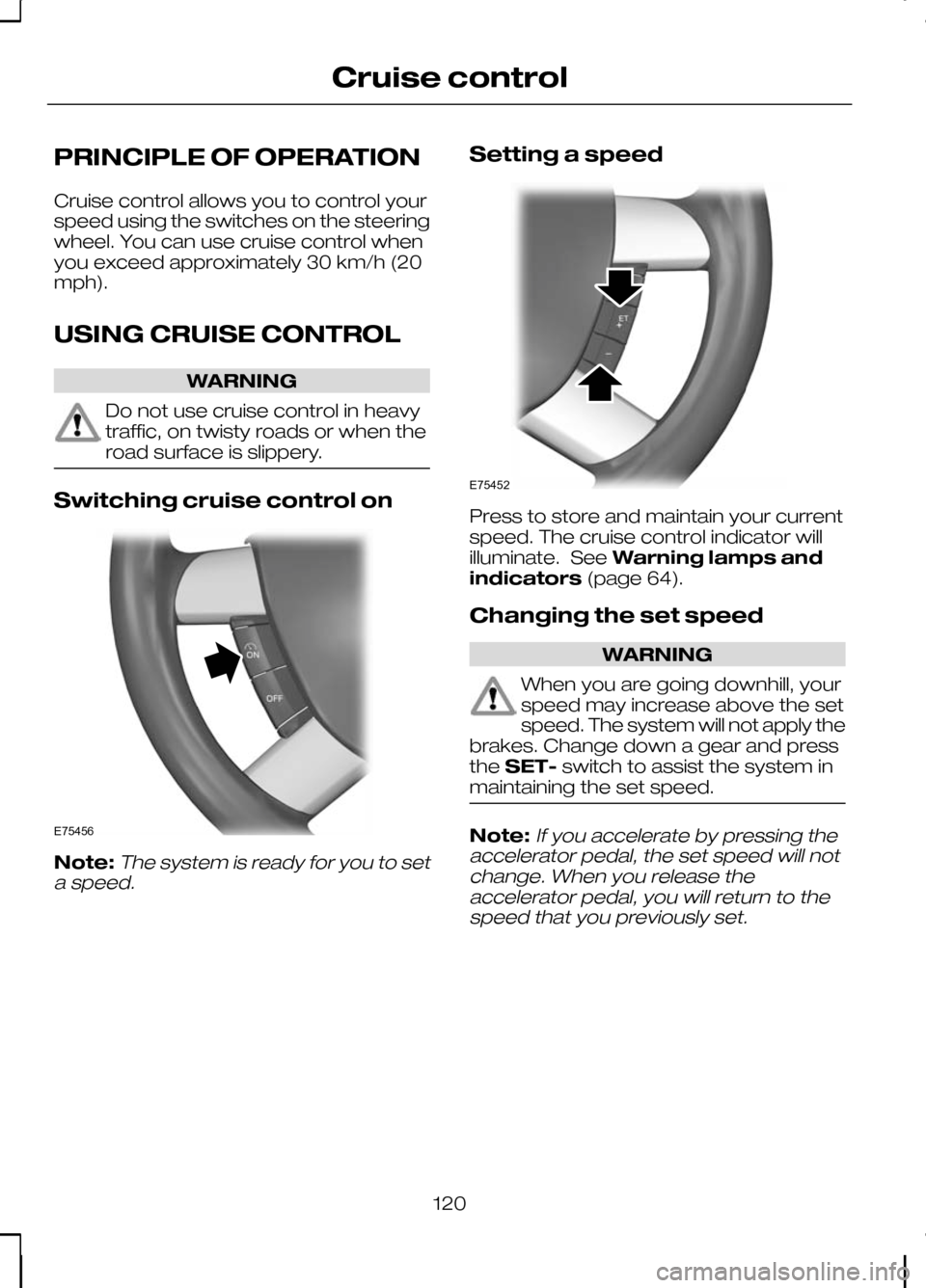
Switching cruise control on
Note:The system is ready for you to set
a speed.
Setting a speed Press to store and maintain your current
speed. The cruise control indicator will
illuminate. See
Warning lamps and
indicators (page 64).
Changing the set speed WARNING
When you are going downhill, your
speed may increase above the set
speed. The system will not apply the
brakes. Change down a gear and press
the SET- switch to assist the system in
maintaining the set speed. Note:
If you accelerate by pressing the
accelerator pedal, the set speed will not change. When you release theaccelerator pedal, you will return to thespeed that you previously set.
120
Cruise controlE75456 E75452
Page 124 of 226
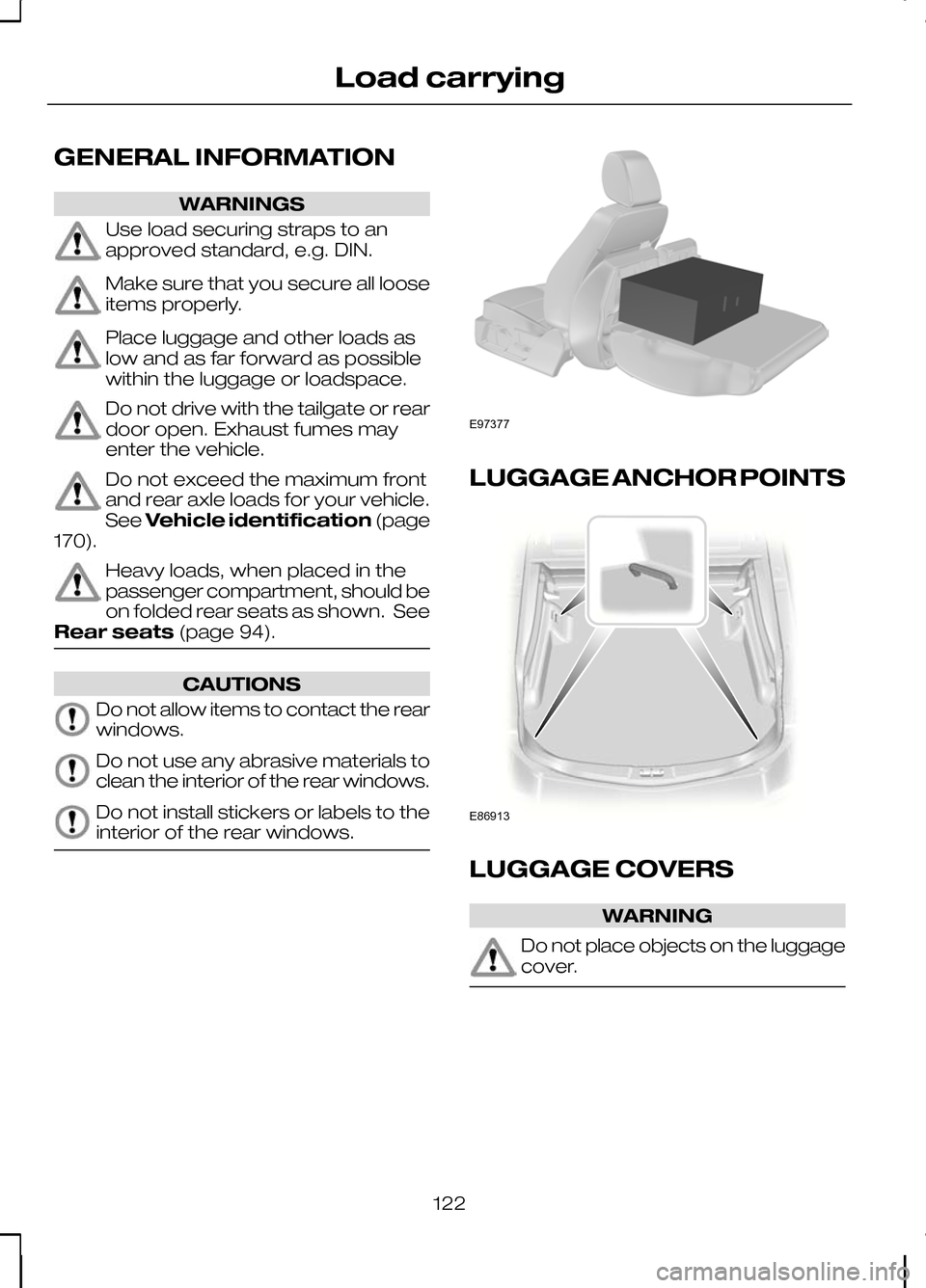
GENERAL INFORMATION
WARNINGS
Use load securing straps to an
approved standard, e.g. DIN.
Make sure that you secure all loose
items properly.
Place luggage and other loads as
low and as far forward as possible
within the luggage or loadspace.
Do not drive with the tailgate or rear
door open. Exhaust fumes may
enter the vehicle.
Do not exceed the maximum front
and rear axle loads for your vehicle.
See
Vehicle identification (page
170). Heavy loads, when placed in the
passenger compartment, should be
on folded rear seats as shown. See
Rear seats (page 94). CAUTIONS
Do not allow items to contact the rear
windows.
Do not use any abrasive materials to
clean the interior of the rear windows.
Do not install stickers or labels to the
interior of the rear windows. LUGGAGE ANCHOR POINTS
LUGGAGE COVERS
WARNING
Do not place objects on the luggage
cover.
122
Load carryingE97377 E86913
Page 125 of 226
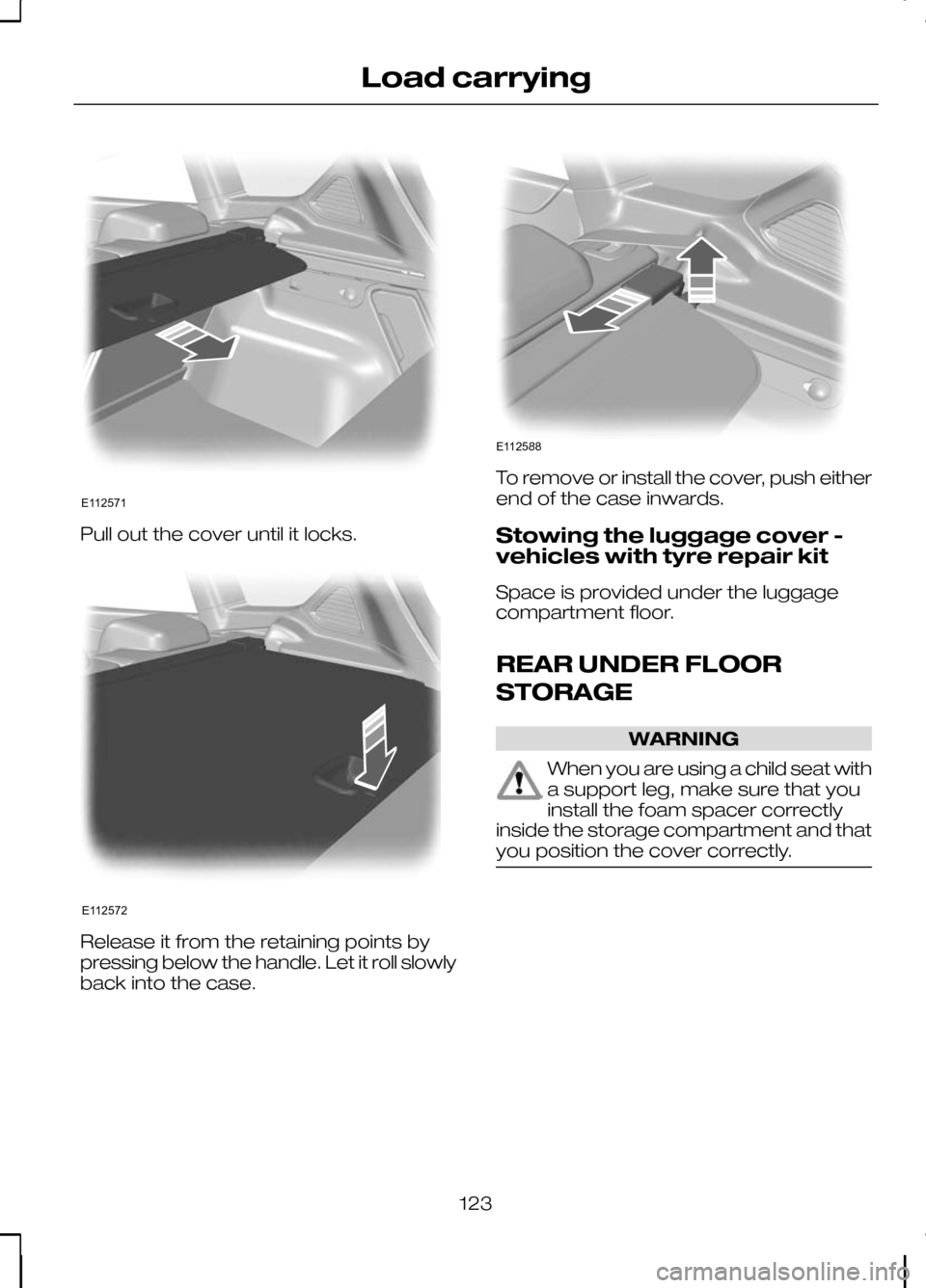
Pull out the cover until it locks.
Release it from the retaining points by
pressing below the handle. Let it roll slowly
back into the case. To remove or install the cover, push either
end of the case inwards.
Stowing the luggage cover -
vehicles with tyre repair kit
Space is provided under the luggage
compartment floor.
REAR UNDER FLOOR
STORAGE
WARNING
When you are using a child seat with
a support leg, make sure that you
install the foam spacer correctly
inside the storage compartment and that
you position the cover correctly. 123
Load carryingE112571 E112572 E112588
Page 126 of 226
ROOF RACKS AND LOAD
CARRIERS
Roof rack
WARNINGS
If you use a roof rack, the fuel
consumption of your vehicle will be
higher and you may experience
different driving characteristics. Read and follow the manufacturer’s
instructions when you are fitting a
roof rack.
CAUTION
Do not exceed the maximum
permissible roof load of 75 kilograms
(165 pounds) (including the roof
rack). Check the security of the roof rack and
tighten its fittings as follows:
•
before starting
• after driving 50 kilometres (30 miles)
• at 1 000 kilometres (600 miles)
intervals. Installing the crossbars WARNING
Distribute the load evenly over the
loading area and keep the centre of
gravity as low as possible. Secure
the load well to prevent it from slipping.
Never place any loads directly onto the
roof surface. CAUTION
Remove the crossbars before
entering an automatic car wash.
Note:The side mounting tracks are
designed such that crossbars (for bicycle carriers, ski carriers etc.) from the Fordaccessories range can be fitted.
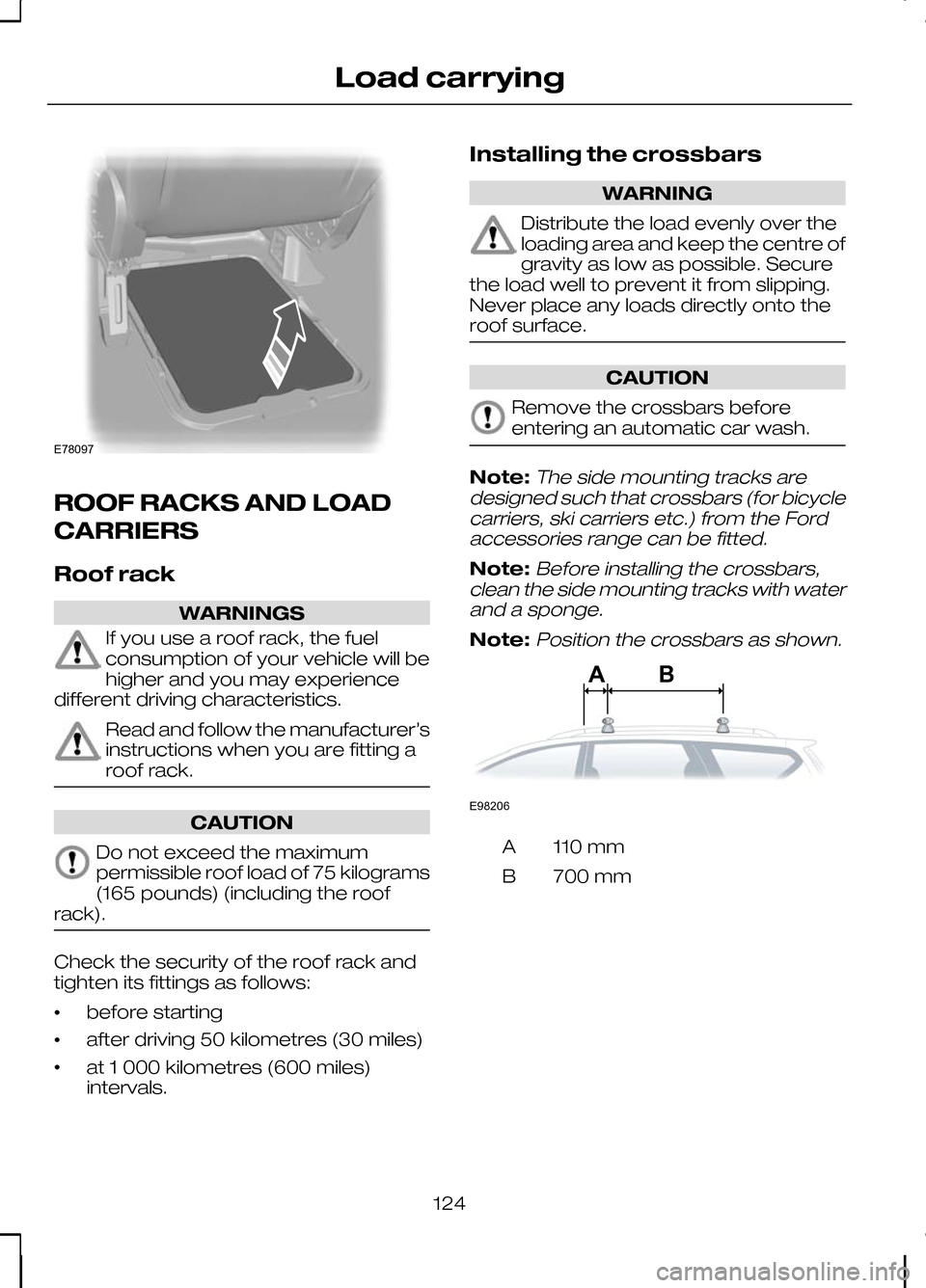
Note:Before installing the crossbars,
clean the side mounting tracks with water and a sponge.
Note:Position the crossbars as shown. 110 mm
A
700 mm
B
124
Load carryingE78097 ABE98206
Page 129 of 226
TOWING A TRAILER
WARNINGS
Do not exceed the maximum gross
train weight stated on the vehicle
identification plate. See
Vehicle
identification (page 170).Do not exceed 100 km/h (62 mph).
The rear tyre pressures must be
increased by 0.2 bar (3 psi) above
specification. See
Technical
specifications (page 168). CAUTIONS
Do not exceed the maximum
permissible nose weight, i.e. vertical
weight on the tow ball, of 100
kilogrammes (220 pounds) for vehicles
with a diesel engine, or 105 kilogrammes
(231 pounds) for vehicles with a petrol
engine. We recommend you purchase a
towing kit from your dealer. Failure to
do so may result in damage to the
engine. Note:Not all vehicles are suitable or
approved to have tow bars fitted. Check with your dealer first.
Place loads as low and central to the
axle(s) of the trailer as possible. If you are
towing with an unladen vehicle, the load
in the trailer should be placed toward the
nose, within the maximum nose load, as
this gives the best stability.
The stability of the vehicle to trailer
combination is very much dependant on
the quality of the trailer. In high altitude regions above 1 000
metres (3 281 feet), the stipulated
maximum permitted gross train weight
must be reduced by 10% for every
additional 1 000 metres (3 281 feet).
Steep gradients WARNING
The overrun brake on a trailer is not
controlled by ABS.
Change down a gear before you reach a
steep downhill gradient.
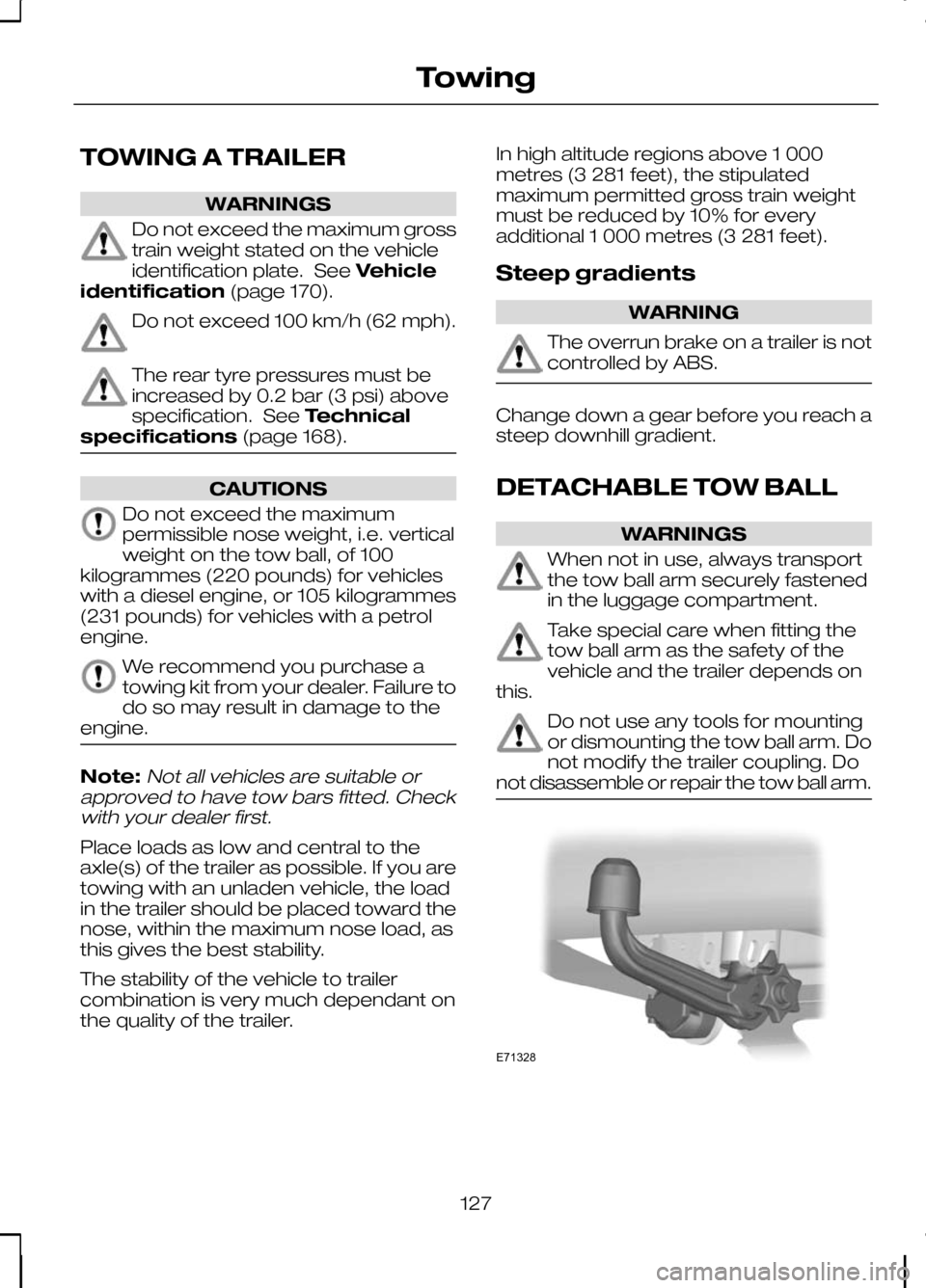
DETACHABLE TOW BALL
WARNINGS
When not in use, always transport
the tow ball arm securely fastened
in the luggage compartment.
Take special care when fitting the
tow ball arm as the safety of the
vehicle and the trailer depends on
this. Do not use any tools for mounting
or dismounting the tow ball arm. Do
not modify the trailer coupling. Do
not disassemble or repair the tow ball arm. 127
TowingE71328
Page 130 of 226
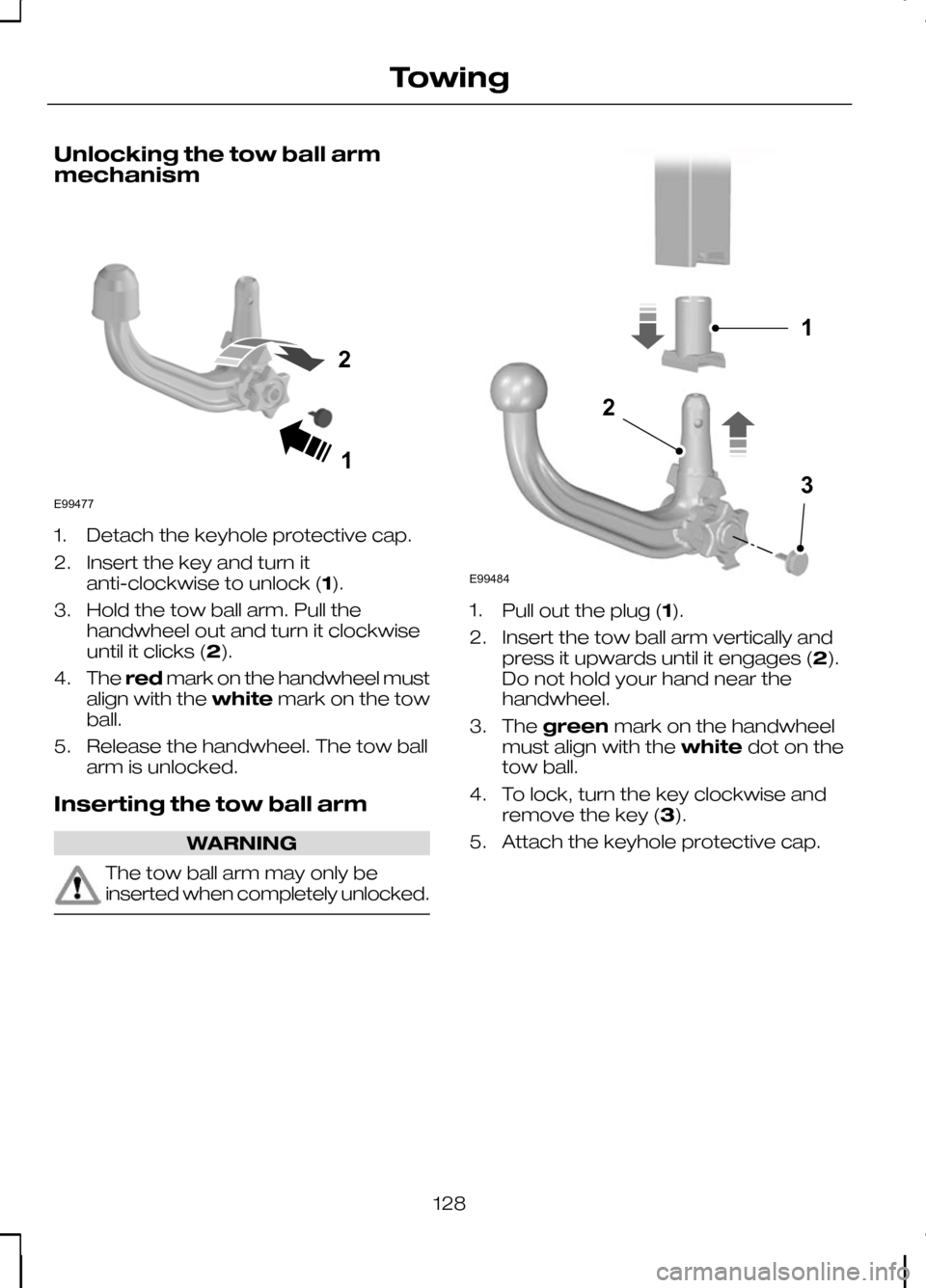
Unlocking the tow ball arm
mechanism
1. Detach the keyhole protective cap.
2. Insert the key and turn it
anti-clockwise to unlock (1).
3. Hold the tow ball arm. Pull the handwheel out and turn it clockwise
until it clicks (2).
4. The red mark on the handwheel must
align with the whitemark on the tow
ball.
5. Release the handwheel. The tow ball arm is unlocked.
Inserting the tow ball arm WARNING
The tow ball arm may only be
inserted when completely unlocked. 1.
Pull out the plug (1).
2. Insert the tow ball arm vertically and press it upwards until it engages (2).
Do not hold your hand near the
handwheel.
3. The green mark on the handwheel
must align with the whitedot on the
tow ball.
4. To lock, turn the key clockwise and remove the key (3).
5. Attach the keyhole protective cap.
128
TowingE9947712 E99484132
Page 131 of 226
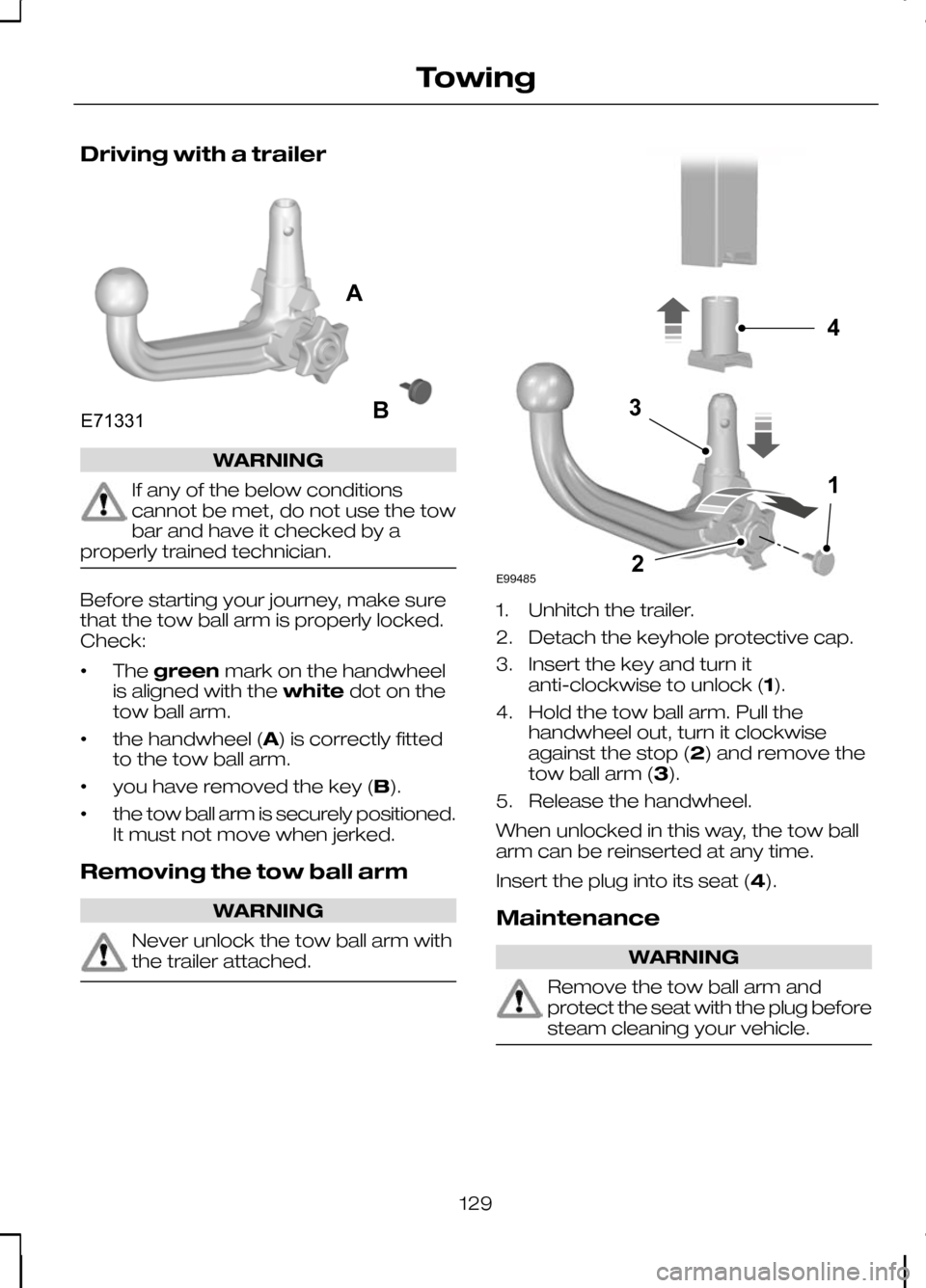
Driving with a trailer
WARNING
If any of the below conditions
cannot be met, do not use the tow
bar and have it checked by a
properly trained technician. Before starting your journey, make sure
that the tow ball arm is properly locked.
Check:
•
The
green mark on the handwheel
is aligned with the whitedot on the
tow ball arm.
• the handwheel (A) is correctly fitted
to the tow ball arm.
• you have removed the key (B).
• the tow ball arm is securely positioned.
It must not move when jerked.
Removing the tow ball arm WARNING
Never unlock the tow ball arm with
the trailer attached. 1. Unhitch the trailer.
2. Detach the keyhole protective cap.
3. Insert the key and turn it
anti-clockwise to unlock (1).
4. Hold the tow ball arm. Pull the handwheel out, turn it clockwise
against the stop (2) and remove the
tow ball arm (3).
5. Release the handwheel.
When unlocked in this way, the tow ball
arm can be reinserted at any time.
Insert the plug into its seat (4).
Maintenance WARNING
Remove the tow ball arm and
protect the seat with the plug before
steam cleaning your vehicle.
129
TowingE71331AB E994854132