ECT FORD KUGA 2011 1.G Workshop Manual
[x] Cancel search | Manufacturer: FORD, Model Year: 2011, Model line: KUGA, Model: FORD KUGA 2011 1.GPages: 2057
Page 390 of 2057
SECTION 418-02 Wiring Harnesses
VEHICLE APPLICATION:
2008.50 Kuga
PAGE
CONTENTS
DIAGNOSIS AND TESTING
418-02-2
Wiring Harness...................................................................................................................
418-02-2
Inspection and Verification..................................................................................................
REMOVAL AND INSTALLATION 418-02-4
Passenger Compartment Wiring Harness..........................................................................
418-02-24
Instrument Panel Wiring Harness.......................................................................................
418-02-37
Engine Compartment Wiring Harness................................................................................ 418-02-1
Wiring Harnesses
418-02-1
.TO MODEL INDEX
BACK TO CHAPTER INDEX
FORD KUGA 2011.0MY WORKSHOP REPAIR MANUAL
Page 391 of 2057
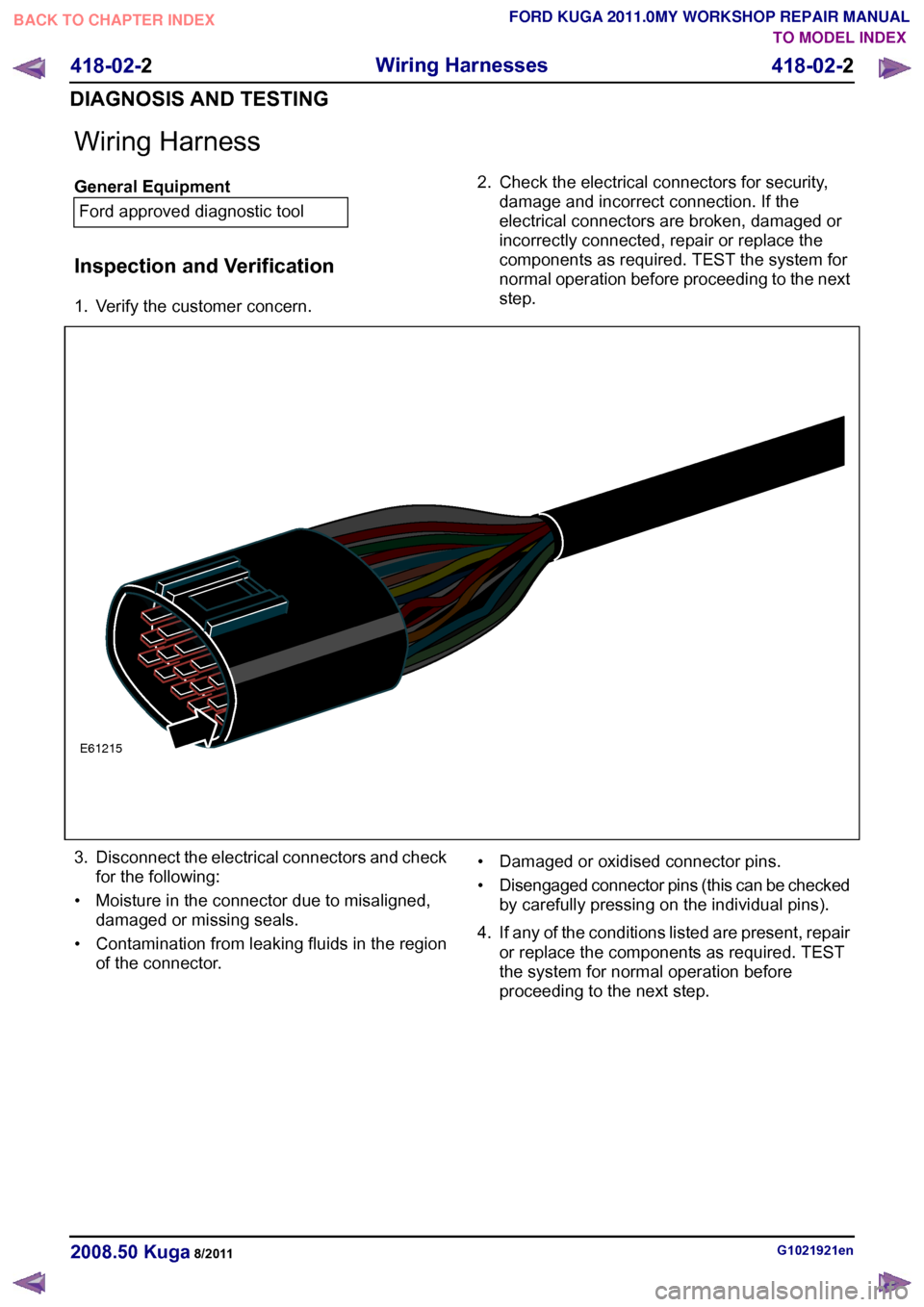
Wiring Harness
General Equipment
Ford approved diagnostic tool
Inspection and Verification
1. Verify the customer concern. 2. Check the electrical connectors for security,
damage and incorrect connection. If the
electrical connectors are broken, damaged or
incorrectly connected, repair or replace the
components as required. TEST the system for
normal operation before proceeding to the next
step. 3. Disconnect the electrical connectors and check
for the following:
• Moisture in the connector due to misaligned, damaged or missing seals.
• Contamination from leaking fluids in the region of the connector. • Damaged or oxidised connector pins.
•
Disengaged connector pins (this can be checked
by carefully pressing on the individual pins).
4. If any of the conditions listed are present, repair or replace the components as required. TEST
the system for normal operation before
proceeding to the next step. G1021921en
2008.50 Kuga 8/2011 418-02-2
Wiring Harnesses
418-02-2
DIAGNOSIS AND TESTINGTO MODEL INDEX
BACK TO CHAPTER INDEX
FORD KUGA 2011.0MY WORKSHOP REPAIR MANUALE61215
Page 392 of 2057
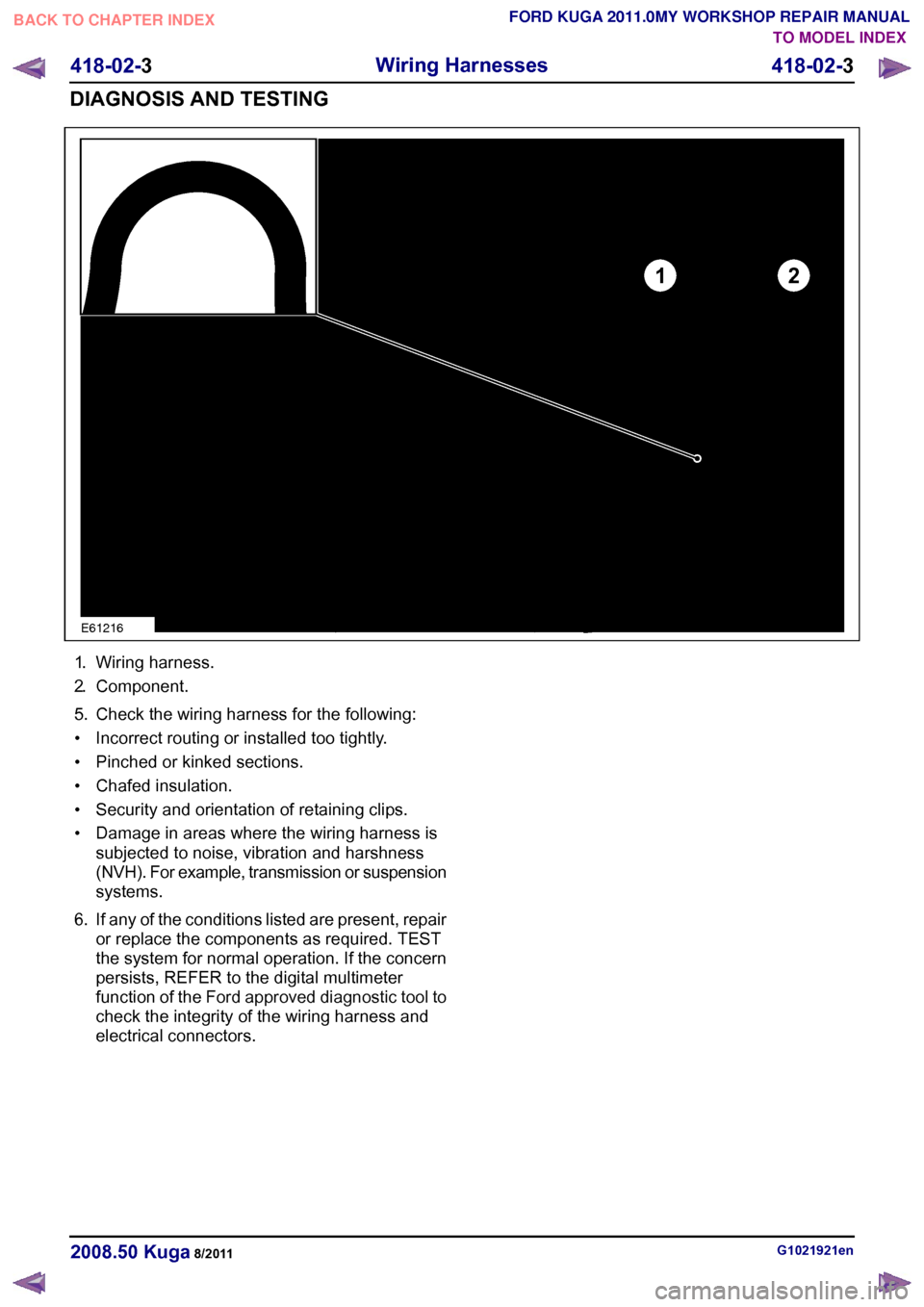
1.
Wiring harness.
2. Component.
5. Check the wiring harness for the following:
• Incorrect routing or installed too tightly.
• Pinched or kinked sections.
• Chafed insulation.
• Security and orientation of retaining clips.
• Damage in areas where the wiring harness is subjected to noise, vibration and harshness
(NVH). For example, transmission or suspension
systems.
6. If any of the conditions listed are present, repair or replace the components as required. TEST
the system for normal operation. If the concern
persists, REFER to the digital multimeter
function of the Ford approved diagnostic tool to
check the integrity of the wiring harness and
electrical connectors. G1021921en
2008.50 Kuga 8/2011 418-02-3
Wiring Harnesses
418-02-3
DIAGNOSIS AND TESTINGTO MODEL INDEX
BACK TO CHAPTER INDEX
FORD KUGA 2011.0MY WORKSHOP REPAIR MANUALE6121621
Page 412 of 2057
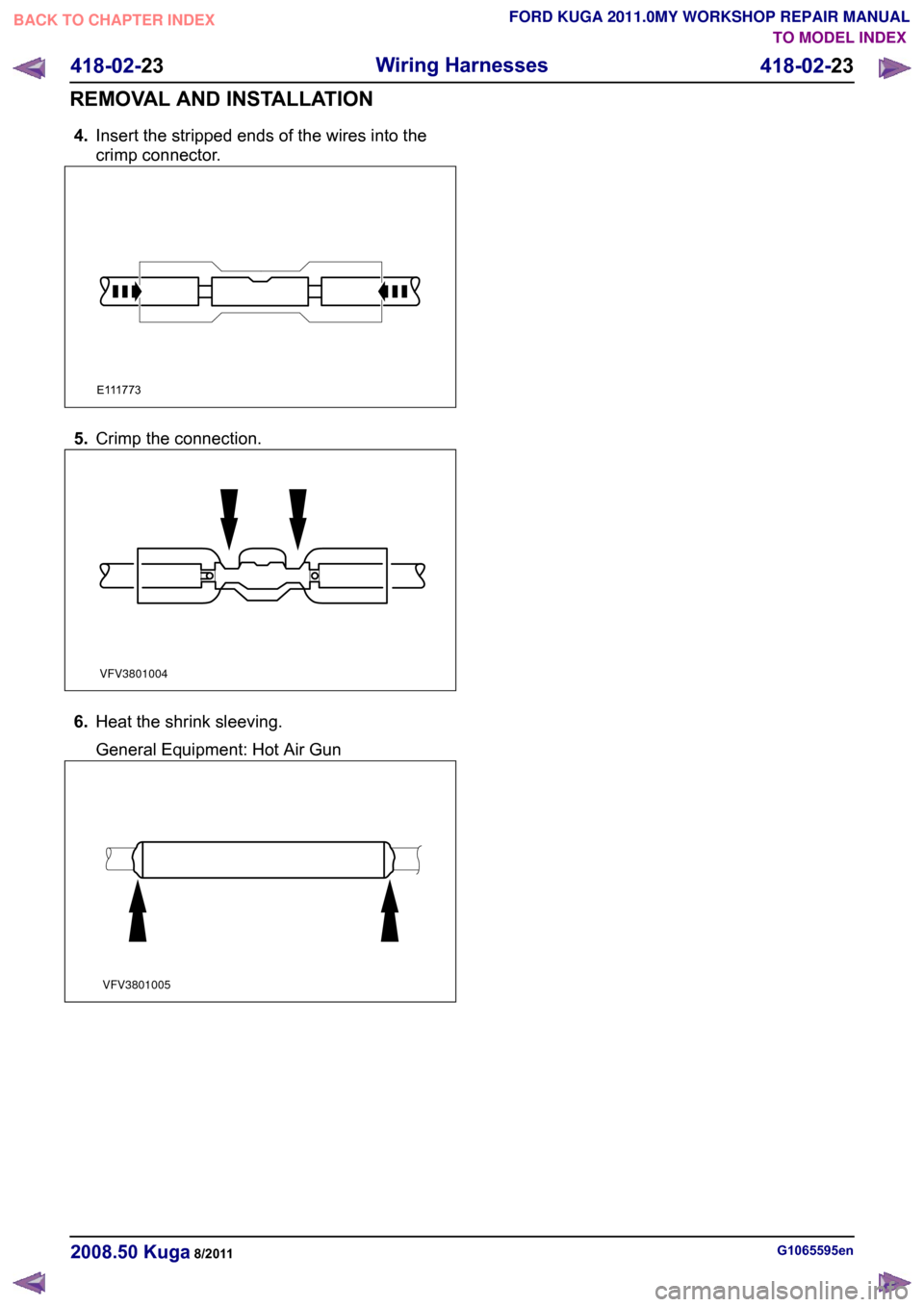
4.
Insert the stripped ends of the wires into the
crimp connector. 5.
Crimp the connection. 6.
Heat the shrink sleeving.
General Equipment: Hot Air Gun G1065595en
2008.50 Kuga 8/2011 418-02-23
Wiring Harnesses
418-02-23
REMOVAL AND INSTALLATIONTO MODEL INDEX
BACK TO CHAPTER INDEX
FORD KUGA 2011.0MY WORKSHOP REPAIR MANUALE111773 VFV3801004 VFV3801005
Page 433 of 2057
SECTION 419-01A Anti-Theft - Active
VEHICLE APPLICATION:
2008.50 Kuga
PAGE
CONTENTS
DESCRIPTION AND OPERATION
419-01A-2
Anti-Theft - Active (Component Location)..........................................................................
419-01A-4
Anti-Theft - Active (Overview).............................................................................................
419-01A-4
Function check - Intrusion sensors.....................................................................................
419-01A-5
Anti-Theft - Active (System Operation and Component Description).................................
419-01A-5
System Diagram.................................................................................................................
419-01A-6
System Operation...............................................................................................................
419-01A-6
Anti-theft warning system...............................................................................................
419-01A-7
Component Description......................................................................................................
419-01A-7
Interior scanning sensors................................................................................................
419-01A-7
Anti-theft alarm horn with integral battery.......................................................................
DIAGNOSIS AND TESTING 419-01A-8
Anti-Theft - Active...............................................................................................................
419-01A-8
Inspection and Verification..................................................................................................
REMOVAL AND INSTALLATION 419-01A-9
Anti-Theft Alarm Horn.........................................................................................................
419-01A-11
Anti-Theft Alarm Horn with Integral Battery........................................................................ 419-01A-1
Anti-Theft - Active
419-01A-1
.TO MODEL INDEX
BACK TO CHAPTER INDEX
FORD KUGA 2011.0MY WORKSHOP REPAIR MANUAL
Page 436 of 2057
Anti-Theft - Active – Overview
The function of the anti-theft alarm system
components can be checked using the GEM's
service mode.
If an exact diagnosis is not possible using the
service mode, a system diagnosis must be carried
out with the Ford diagnostic unit. The last four
trigger signals from the anti-theft alarm signal can
also be read out during this process.
Function check - Intrusion sensors
Activate the anti-theft alarm system is check the
function of the intrusion sensors. After a waiting
time of approx. 30 seconds, perform movements
on both sides of the vehicle interior through the
open side windows. Each movement that is
detected is acknowledged through triggering of the
anti-theft alarm system.
G1065778en
2008.50 Kuga 8/2011 419-01A-4
Anti-Theft - Active
419-01A-4
DESCRIPTION AND OPERATIONTO MODEL INDEX
BACK TO CHAPTER INDEX
FORD KUGA 2011.0MY WORKSHOP REPAIR MANUAL
Page 438 of 2057
Description
Item
High speed CAN (controller area network)
bus (HS-CAN)
1
DLC (data link connector)
2
Medium speed CAN bus (MS-CAN)
3
Instrument cluster (gateway)
4
GEM5
Hood contact switch
6
Folding rear window contact switch
7
Liftgate contact switch
8
Door ajar switch in all four doors
9
Switch for deactivation of interior scanning
sensors (right-hand drive vehicles)
10
Interior scanning sensorsRefer to Component Description: (page
?)
11 Description
Item
Driver's door set/reset switch
12
Driver's door door module
13
Keyless vehicle module (KVM)
14
RF receiver
15
Radio remote control
16
Anti-theft alarm system signal horn
(left-hand drive vehicles)
17
Anti-theft alarm system horn with
integrated battery (right-hand drive
vehicles)Refer to Component Description:
Anti-theft alarm horn with integral battery
(page ?)
18
Hazard warning lights
19
System Operation
Anti-theft warning system
Three anti-theft alarm systems are available,
depending on the market and model version:
• The system with perimeter monitoring detects whenever the doors, the hood, the folding rear
window and the liftgate are opened.
• The system with perimeter and interior monitoring in addition detects unauthorised
access, for example, through a broken window.
• A Thatcham category I anti-theft alarm system (mainly for the British market) is fitted with a
horn that has its own battery power supply; it
also uses slightly different detection strategies.
The anti-theft alarm system outputs an acoustic
and visual signal if unauthorised persons attempt
to gain access to the vehicle.
As a visual warning, the system switches on the
hazard warning lights, whilst the acoustic warning
is done with the anti-theft alarm system horn or the
horn with its own battery power supply.
When the ignition is switched off, the anti-theft
alarm system is activated 20 seconds after any
latch is activated, i.e. the hood, all doors, the
folding rear window and the liftgate are alarmed,
provided that they are fully closed. If the hood, one of the doors, the folding rear
window or the liftgate is not completely closed, it
can be opened without the alarm being triggered
since the system was not activated.
The anti-theft alarm system can be switched off by
unlocking the vehicle either via the remote controls
or the door lock.
NOTE:
To switch off the alarm on a Thatcham
category I anti-theft alarm system, the ignition must
be switched on within 12 seconds of the door being
unlocked with the key.
If the folding rear window or the liftgate is opened
via the remote control, the anti-theft alarm system
blocks the trigger for the alarm system or the
interior monitoring (if fitted) for 20 seconds after
closing.
NOTE: If a window is not fully closed, there is a
risk that a false alarm will be triggered. G1065780en
2008.50 Kuga 8/2011 419-01A-6
Anti-Theft - Active
419-01A-6
DESCRIPTION AND OPERATIONTO MODEL INDEX
BACK TO CHAPTER INDEX
FORD KUGA 2011.0MY WORKSHOP REPAIR MANUAL
Page 439 of 2057
Component Description
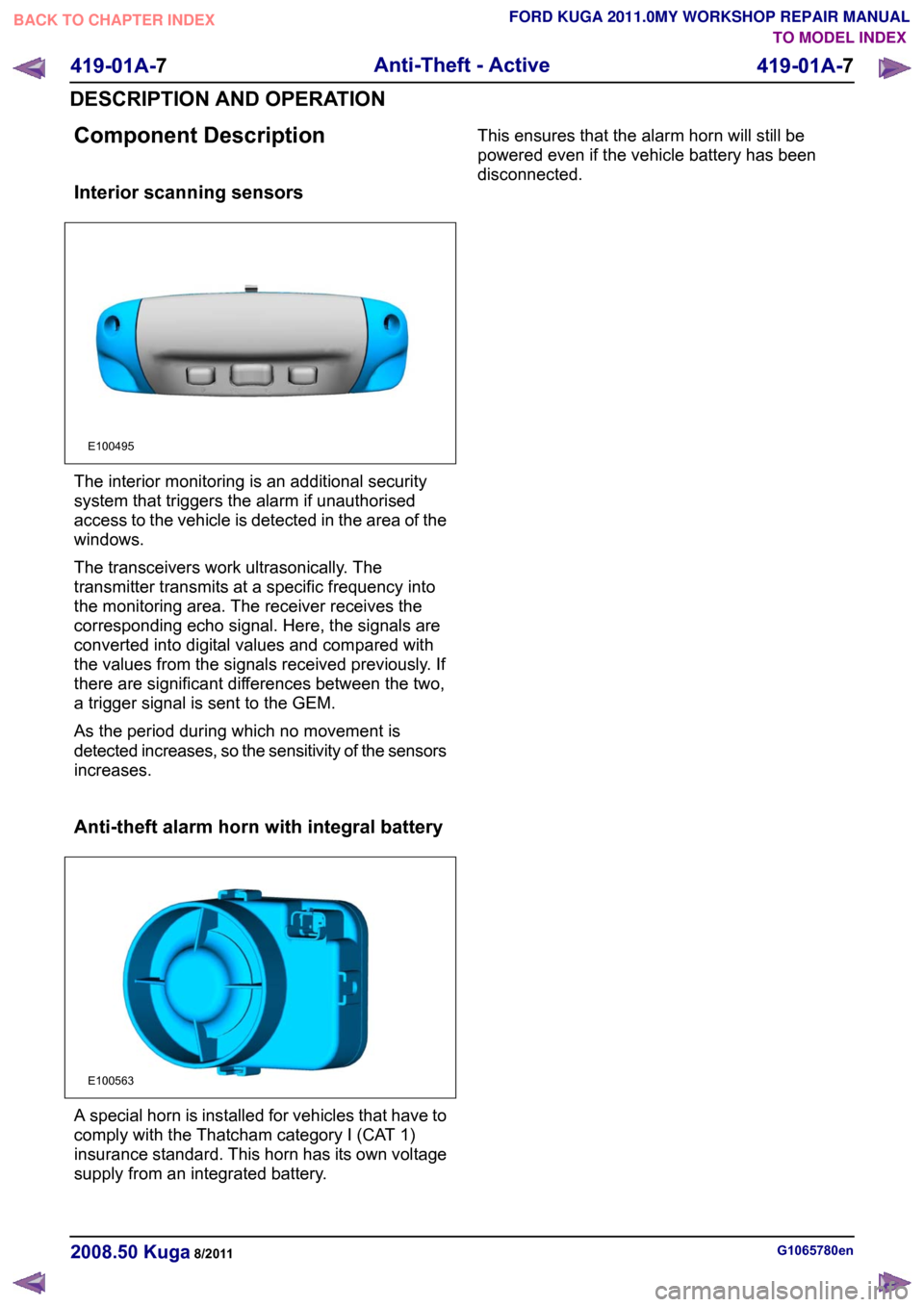
Interior scanning sensors
The interior monitoring is an additional security
system that triggers the alarm if unauthorised
access to the vehicle is detected in the area of the
windows.
The transceivers work ultrasonically. The
transmitter transmits at a specific frequency into
the monitoring area. The receiver receives the
corresponding echo signal. Here, the signals are
converted into digital values and compared with
the values from the signals received previously. If
there are significant differences between the two,
a trigger signal is sent to the GEM.
As the period during which no movement is
detected increases, so the sensitivity of the sensors
increases.
Anti-theft alarm horn with integral battery
A special horn is installed for vehicles that have to
comply with the Thatcham category I (CAT 1)
insurance standard. This horn has its own voltage
supply from an integrated battery. This ensures that the alarm horn will still be
powered even if the vehicle battery has been
disconnected.
G1065780en
2008.50 Kuga 8/2011 419-01A-7
Anti-Theft - Active
419-01A-7
DESCRIPTION AND OPERATIONTO MODEL INDEX
BACK TO CHAPTER INDEX
FORD KUGA 2011.0MY WORKSHOP REPAIR MANUALE100495 E100563
Page 440 of 2057
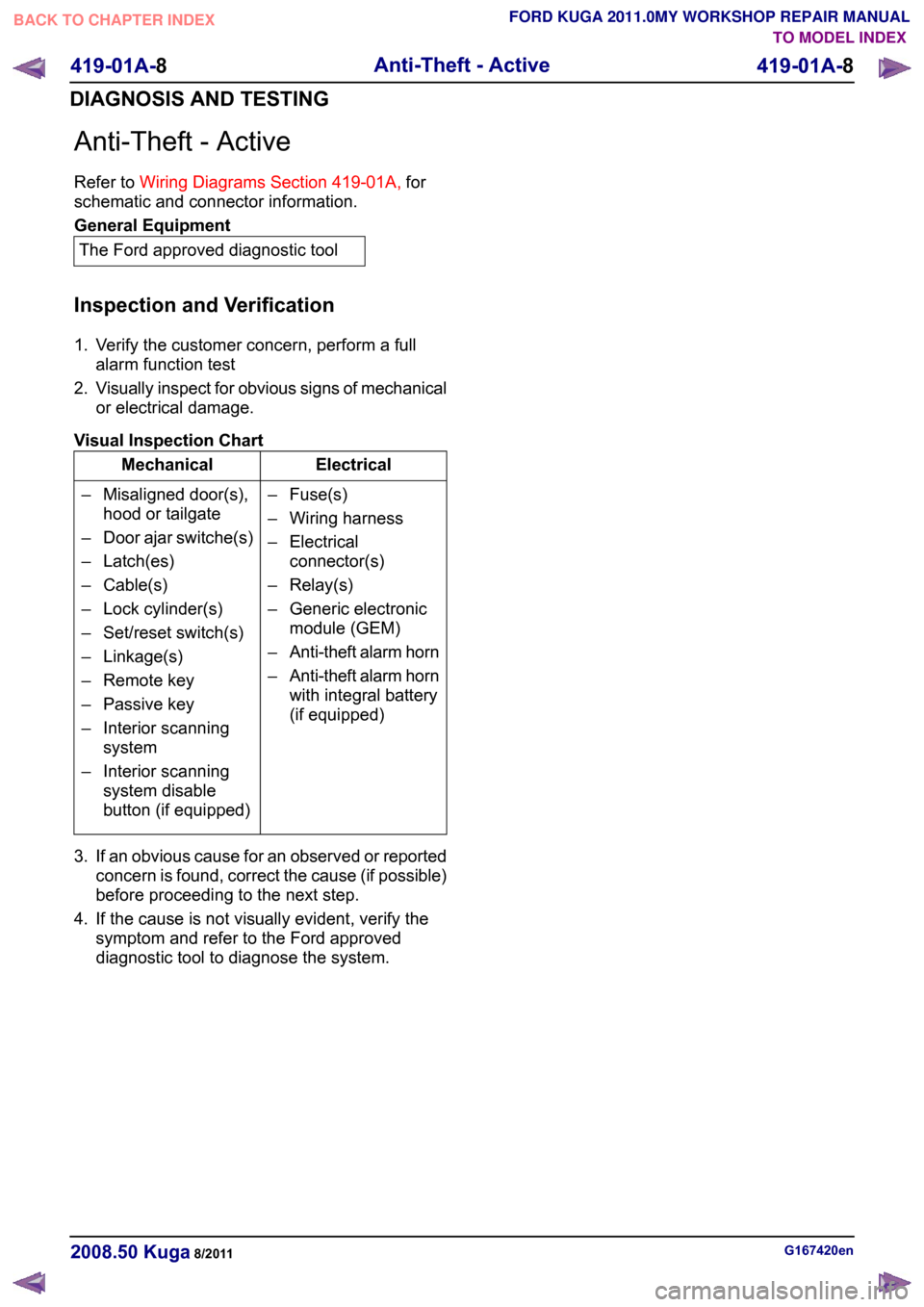
Anti-Theft - Active
Refer to
Wiring Diagrams Section 419-01A, for
schematic and connector information. General Equipment
The Ford approved diagnostic tool
Inspection and Verification
1. Verify the customer concern, perform a full alarm function test
2. Visually inspect for obvious signs of mechanical
or electrical damage.
Visual Inspection Chart Electrical
Mechanical
– Fuse(s)
– Wiring harness
– Electricalconnector(s)
– Relay(s)
– Generic electronic module (GEM)
– Anti-theft alarm horn
– Anti-theft alarm horn
with integral battery
(if equipped)
– Misaligned door(s),
hood or tailgate
– Door ajar switche(s)
– Latch(es)
– Cable(s)
– Lock cylinder(s)
– Set/reset switch(s)
– Linkage(s)
– Remote key
– Passive key
– Interior scanning system
– Interior scanning system disable
button (if equipped)
3. If an obvious cause for an observed or reported concern is found, correct the cause (if possible)
before proceeding to the next step.
4. If the cause is not visually evident, verify the symptom and refer to the Ford approved
diagnostic tool to diagnose the system. G167420en
2008.50 Kuga 8/2011 419-01A-8
Anti-Theft - Active
419-01A-8
DIAGNOSIS AND TESTINGTO MODEL INDEX
BACK TO CHAPTER INDEX
FORD KUGA 2011.0MY WORKSHOP REPAIR MANUAL
Page 444 of 2057
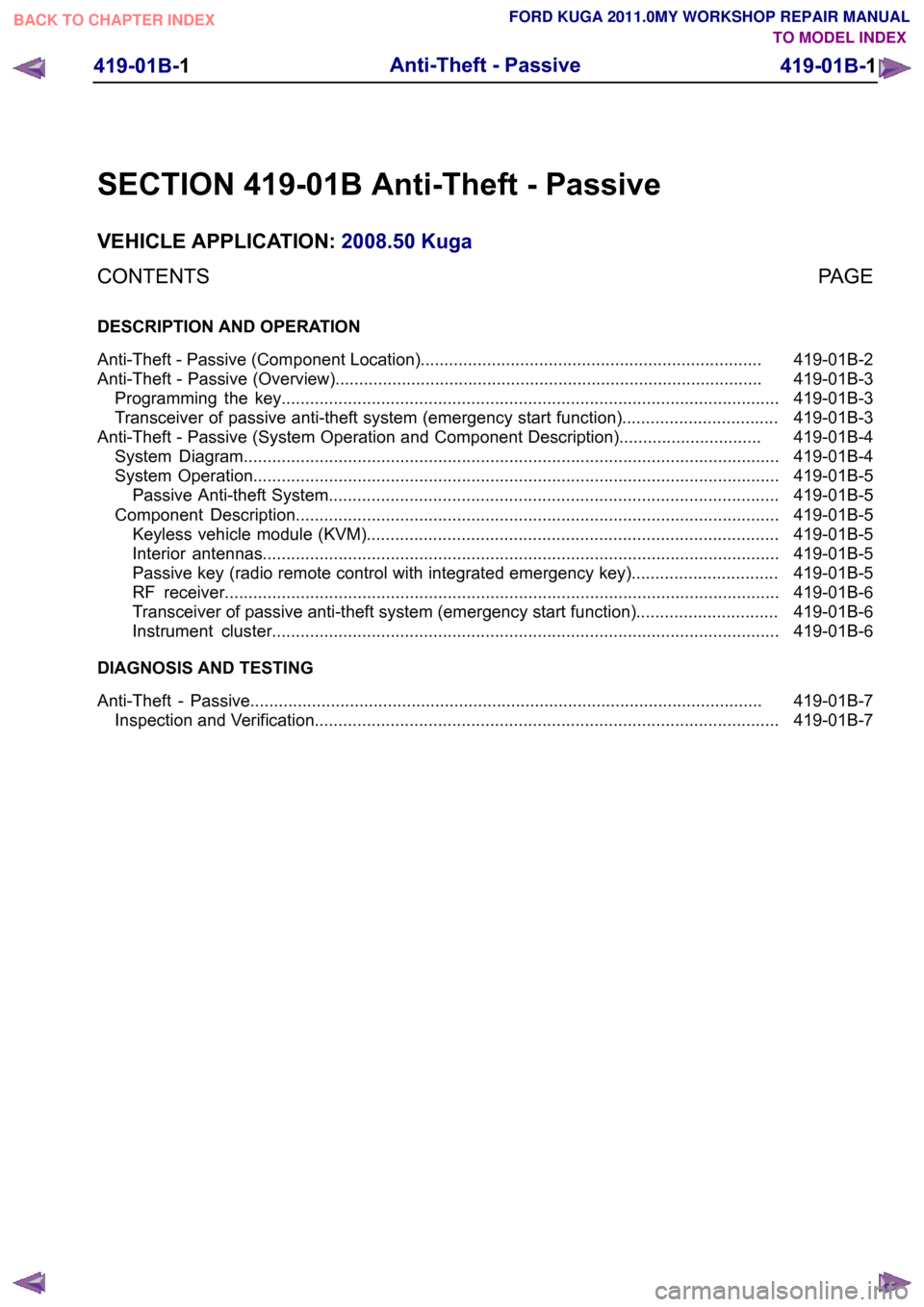
SECTION 419-01B Anti-Theft - Passive
VEHICLE APPLICATION:
2008.50 Kuga
PAGE
CONTENTS
DESCRIPTION AND OPERATION
419-01B-2
Anti-Theft - Passive (Component Location)........................................................................
419-01B-3
Anti-Theft - Passive (Overview)..........................................................................................
419-01B-3
Programming the key.........................................................................................................
419-01B-3
Transceiver of passive anti-theft system (emergency start function).................................
419-01B-4
Anti-Theft - Passive (System Operation and Component Description)..............................
419-01B-4
System Diagram.................................................................................................................
419-01B-5
System Operation...............................................................................................................
419-01B-5
Passive Anti-theft System...............................................................................................
419-01B-5
Component Description......................................................................................................
419-01B-5
Keyless vehicle module (KVM).......................................................................................
419-01B-5
Interior antennas.............................................................................................................
419-01B-5
Passive key (radio remote control with integrated emergency key)...............................
419-01B-6
RF receiver.....................................................................................................................
419-01B-6
Transceiver of passive anti-theft system (emergency start function)..............................
419-01B-6
Instrument cluster...........................................................................................................
DIAGNOSIS AND TESTING 419-01B-7
Anti-Theft - Passive............................................................................................................
419-01B-7
Inspection and Verification.................................................................................................. 419-01B-1
Anti-Theft - Passive
419-01B-1
.TO MODEL INDEX
BACK TO CHAPTER INDEX
FORD KUGA 2011.0MY WORKSHOP REPAIR MANUAL