ESP FORD KUGA 2011 1.G User Guide
[x] Cancel search | Manufacturer: FORD, Model Year: 2011, Model line: KUGA, Model: FORD KUGA 2011 1.GPages: 2057
Page 70 of 2057
Petrol and Petrol-Ethanol Fuel Systems Health and SafetyPrecautions
WARNINGS:
Fuel may not give adequate warning before
toxic or harmful effects arise.
Exposure to fuel can be harmful and can
cause severe health damage or death.
Extreme care must be exercised when
handling hot fluids. Always wash off spilled
fluids from affected areas of skin
immediately.
Highly flammable mixtures are always
present and may ignite when working on
fuel systems. Do not allow naked flames,
sparks or lighted substances to come near
fuel related components.
Fuel must not be used as a cleaning agent.
Keep fuel containers tightly closed, out of
direct sunlight and in a cool area. Keep
away from heat sources, ignition sources
and oxidizing agents.
SKIN CONTACT: Excessive or prolonged
skin contact with diesel fuel may cause
serious skin disorders including skin
cancer.
SKIN CONTACT: Fuel is mildly irritating to
the skin and may cause dermatitis due to
defatting effect. Remove contaminated
clothing. Wash affected areas of skin with
soap and water. Seek medical attention for
any persistent skin irritation or
abnormality. Wash contaminated clothing
before reuse.
EYE CONTACT: Fuel is mildly irritating to
the eyes. Flush with plenty of running
water, blinking as often as possible. Do not
force the eyelid open. Seek medical
attention for any persistent eye irritation
or abnormality.
SWALLOWED: Fuel is moderately toxic
and tends to foam on vomiting. If drawn
into the lungs, inflammation may develop.
Do not induce vomiting. If spontaneous
vomiting occurs place the victim in a
forward position to reduce the risk of fuel
being drawn into the lungs. Give nothing
by mouth. If breathing but unconscious,
place in the recovery position. If breathing has stopped, apply artificial respiration.
Seek immediate medical attention.
INHALED: Fuel is toxic to the respiratory
and other body systems. Exposure may
result in various symptoms including
drowsiness, unconsciousness or severe
health damage. Move a victim to fresh air.
Keep a victim warm and at rest. If
unconscious, place in the recovery
position. If not breathing, apply artificial
respiration. Give cardiac massage if
necessary. Seek immediate medical
attention.
CAUTIONS:
Fuel injection equipment is manufactured
to very precise tolerances and fine
clearances. It is essential that absolute
cleanliness is observed when working with
these components.
Make sure that the workshop area in which
the vehicle is being worked on is as clean
and as dust free as possible.
G548996en2008.50 Kuga8/2011
100-00- 64
General Information
100-00- 64
DESCRIPTION AND OPERATION
TO MODEL INDEX
BACK TO CHAPTER INDEX
FORD KUGA 2011.0MY WORKSHOP REPAIR MANUAL
Page 73 of 2057
Personal protection
Besides the body and limbs, several organs vital
to life are in very particular danger. Because
damage is mostly irreparable, special attention and
comprehensive protection is necessary.
Protective equipment
Always use the appropriate protective equipment:
• Protective helmet or welding mask
• Breathing protection
• Protective clothes gloves and safety boots
• Ear defenders
• Extraction systems
Always carry out an operational check on your
protective equipment every time before you start
working!
Breathing protection
WARNING: Vapor or spray mist containing
isocyanates as a paint base or hardener
can cause toxic respiratory disease
(conditions similar to asthma) leading to
permanent damage, even when inhaled in
the lowest concentrations
The instructions for use provided by the
manufacturer must be observed when working with
breathing protection equipment.
During painting work and in the preparations for
painting, gases, vapors, mists or dusts can appear
in dangerous concentrations.
Breathing protection devices which are
independent of the local atmosphere are most
suitable.
In these types of isolation systems, a compressed
air hose carries natural air from the compressor
line into the protective mask. During supply, the
air undergoes pressure reduction, water removal,
fine filtration and usually warming to natural breath
temperature.
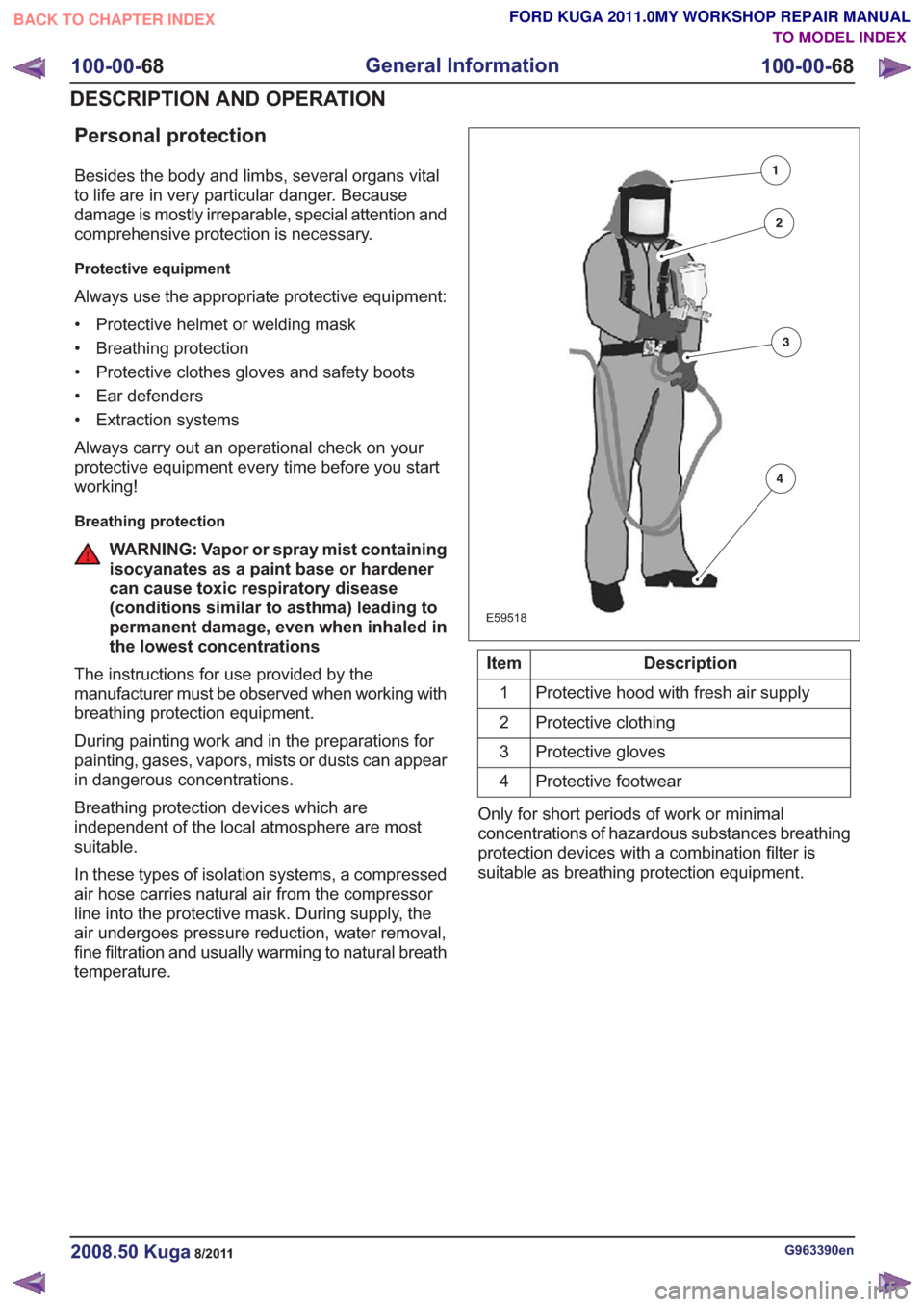
E59518
Description
Item
Protective hood with fresh air supply
1
Protective clothing
2
Protective gloves
3
Protective footwear
4
Only for short periods of work or minimal
concentrations of hazardous substances breathing
protection devices with a combination filter is
suitable as breathing protection equipment.
G963390en2008.50 Kuga8/2011
100-00- 68
General Information
100-00- 68
DESCRIPTION AND OPERATION
TO MODEL INDEX
BACK TO CHAPTER INDEX
FORD KUGA 2011.0MY WORKSHOP REPAIR MANUAL
Page 74 of 2057
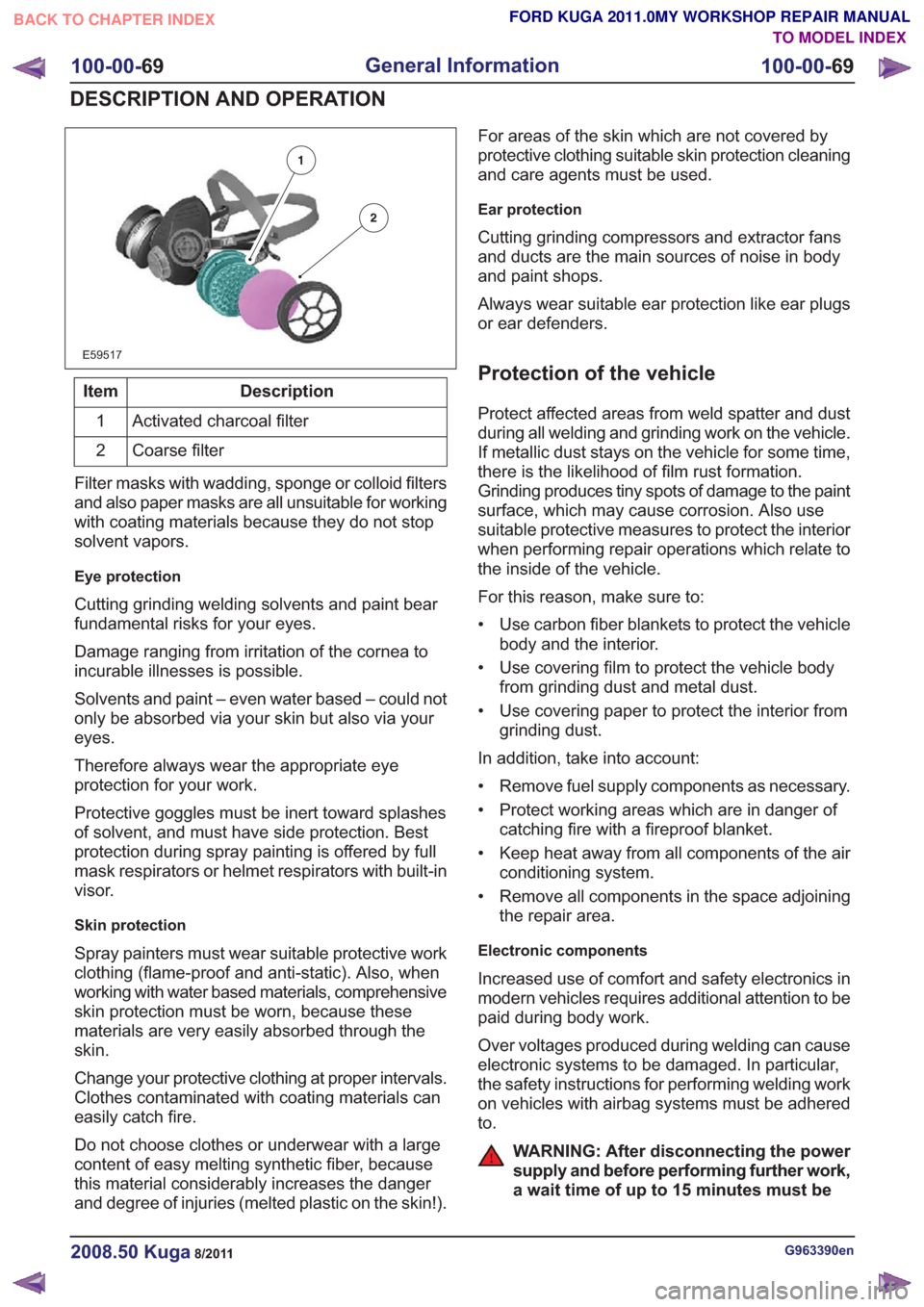
E59517
Description
Item
Activated charcoal filter
1
Coarse filter
2
Filter masks with wadding, sponge or colloid filters
and also paper masks are all unsuitable for working
with coating materials because they do not stop
solvent vapors.
Eye protection
Cutting grinding welding solvents and paint bear
fundamental risks for your eyes.
Damage ranging from irritation of the cornea to
incurable illnesses is possible.
Solvents and paint – even water based – could not
only be absorbed via your skin but also via your
eyes.
Therefore always wear the appropriate eye
protection for your work.
Protective goggles must be inert toward splashes
of solvent, and must have side protection. Best
protection during spray painting is offered by full
mask respirators or helmet respirators with built-in
visor.
Skin protection
Spray painters must wear suitable protective work
clothing (flame-proof and anti-static). Also, when
working with water based materials, comprehensive
skin protection must be worn, because these
materials are very easily absorbed through the
skin.
Change your protective clothing at proper intervals.
Clothes contaminated with coating materials can
easily catch fire.
Do not choose clothes or underwear with a large
content of easy melting synthetic fiber, because
this material considerably increases the danger
and degree of injuries (melted plastic on the skin!). For areas of the skin which are not covered by
protective clothing suitable skin protection cleaning
and care agents must be used.
Ear protection
Cutting grinding compressors and extractor fans
and ducts are the main sources of noise in body
and paint shops.
Always wear suitable ear protection like ear plugs
or ear defenders.
Protection of the vehicle
Protect affected areas from weld spatter and dust
during all welding and grinding work on the vehicle.
If metallic dust stays on the vehicle for some time,
there is the likelihood of film rust formation.
Grinding produces tiny spots of damage to the paint
surface, which may cause corrosion. Also use
suitable protective measures to protect the interior
when performing repair operations which relate to
the inside of the vehicle.
For this reason, make sure to:
• Use carbon fiber blankets to protect the vehicle
body and the interior.
• Use covering film to protect the vehicle body from grinding dust and metal dust.
• Use covering paper to protect the interior from grinding dust.
In addition, take into account:
• Remove fuel supply components as necessary.
• Protect working areas which are in danger of catching fire with a fireproof blanket.
• Keep heat away from all components of the air conditioning system.
• Remove all components in the space adjoining the repair area.
Electronic components
Increased use of comfort and safety electronics in
modern vehicles requires additional attention to be
paid during body work.
Over voltages produced during welding can cause
electronic systems to be damaged. In particular,
the safety instructions for performing welding work
on vehicles with airbag systems must be adhered
to.
WARNING: After disconnecting the power
supply and before performing further work,
a wait time of up to 15 minutes must be
G963390en2008.50 Kuga8/2011
100-00- 69
General Information
100-00- 69
DESCRIPTION AND OPERATION
TO MODEL INDEX
BACK TO CHAPTER INDEX
FORD KUGA 2011.0MY WORKSHOP REPAIR MANUAL
Page 81 of 2057
Noise, Vibration and Harshness (NVH)
Inspection and Verification
1. Verify the customer concern.
2. Visually inspect for obvious signs of mechanicalor electrical damage.
3. If an obvious cause for an observed or reported concern is found, correct the cause (if possible)
before proceeding to the next step.
4. If the concern is not visually evident, verify the symptom and REFER to the Symptom Chart.
How to Use this Diagnostic Procedure
Section
• Noise, vibration and harshness (NVH) concernshave become more important as vehicles have
become more sensitive to these vibrations. This
section is designed to aid in identifying these
concerns.
• The section provides diagnostic procedures based on symptom. If the condition occurs at
high speed, for instance, the most likely place
to start is under Shake and Vibration While
Driving.
• The road test procedure will tell how to sort the conditions into categories and how to tell a
vibration from a shake.
• A series of Road Test Quick Checks are provided to make sure that a cause is either
pinpointed or eliminated.
• Name the condition, proceed to the appropriate section and locate the correct diagnosis. When
the condition is identified, the job is partly done.
• Follow the diagnostic procedure as outlined.
• Quick Checks are described within the step, while more involved tests and adjustments are
outlined in General Procedures.
• Always follow each step exactly and make notes to recall important findings later.
Customer Interview
The road test and customer interview (if available)
provide information that will help identify the
concern and will provide direction to the correct
starting point for diagnosis.
Identify the Condition
NVH usually occur in four areas:
• tires
• engine accessories
• suspension
• driveline
It is important, therefore, that an NVH concern be
isolated into its specific area(s) as soon as
possible. The easiest and quickest way to do this
is to carry out the Road Test as outlined. To assist
in the diagnosis and testing procedure(s), use a
suitable approved NVH diagnosis tester.
Noise Diagnostic Procedure
Non-Axle Noise
The five most common sources of non-axle noise
are exhaust, tires, roof racks, trim panels and
transmission.
Therefore, make sure that none of the following
conditions are the cause of the noise before
proceeding with a driveline teardown and
diagnosis.
• In certain conditions, the pitch of the exhaustmay sound very much like gear noise. At other
times, it can be mistaken for a wheel bearing
rumble.
• Tires, especially snow tires, can have a high pitched tread whine or roar, similar to gear
noise. Radial tires may have this characteristic.
Also, any non-standard tire with an unusual
tread construction may emit a roar or whine
noise.
• Trim panels can also cause whistling or whining noise.
• Clunk may be a metallic noise heard when the automatic transaxle is engaged in "R"
(REVERSE) or "D" (DRIVE) or it may occur
when the throttle is applied or released. It is
caused by backlash somewhere in the driveline.
• Bearing rumble sounds like marbles being tumbled. This condition is usually caused by a
damaged wheel bearing.
G37349en2008.50 Kuga8/2011
100-04- 2
Noise, Vibration and Harshness
100-04- 2
DIAGNOSIS AND TESTING
TO MODEL INDEX
BACK TO CHAPTER INDEX
FORD KUGA 2011.0MY WORKSHOP REPAIR MANUAL
Page 167 of 2057
reprogrammed. However, if the engine hasn't been
run since the last programmed start, the fuel-fired
booster heater will not start up the second time so
as to prevent the battery from being discharged.
The length of time required to pre-heat the vehicle
is calculated in the control unit of the fuel-fired
booster heater and is based on two temperature
values:
• Ambient air temperature: this message is taken
from the GEM via the CAN bus.
• Coolant temperature: this is determined via an internal sensor in the fuel-fired booster heater.
The maximum heating time is 30 minutes at an
outside air temperature of -10 °C or lower. The
heating time decreases proportionally with
increasing ambient temperature until the ambient
temperature is between +15 °C and +20 °C. Then
the minimum heating time is 10 minutes. The
parking heater is deactivated at temperatures
above +20 °C.
The sequence for a programmed start of the
booster heater is as follows:
• Two minutes before the start of the maximum heating time the driver information
system/instrument cluster sends an activation
message to the fuel-fired booster heater via the
CAN bus.
• The fuel-fired booster heater calculates the required heating time and, if necessary, sends
a delay request on the CAN bus.
• At the calculated time, the fuel-fired booster heater starts up. The conditions for start-up are:
engine not running and amount of fuel in the
fuel tank is above 14% of maximum.
• When the coolant temperature reaches +30 °C, the control unit of the fuel-fired booster heater
sends a request to switch on the passenger
compartment blower.
• Eight minutes after the programmed switch-off time, the booster heater stops heating mode
and starts a run-on operation to clean the
system's spark plugs.
• Ten minutes after the switch-off time, the post-cleaning operation is complete. The
additional ten minutes run-on time provides
some leeway in case the driver is late arriving.
After a programmed start-up of the booster heater
it is switched off again after the heating time has
elapsed (or if the fuel level in the fuel tank drops
below 8%). The booster heater stops within 2 minutes of the engine starting. This leaves enough
time to check whether the switch-on conditions for
boost heat mode have been met, thus preventing
the booster heater from having to switch off and
switch back on again. The heater can be switched
off manually at any time from the menu.
Whilst the fuel-fired booster heater is in additional
heating mode and/or parking heating mode, the
instrument cluster receives a fuel consumption
signal; this is used to re-calculate the vehicle's
remaining range and fuel consumption data.
Emergency shutoff
In the event of an accident in which the airbags
are deployed, the control unit of the fuel-fired
booster heater receives a message on the CAN
bus from the restraints control module (RCM).
When this message is received, the booster heater
system switches off immediately.
The booster heater control module deactivates the
system and does not respond to further messages
on the CAN bus. The booster heater control module
needs to be activated with WDS.
Component Description
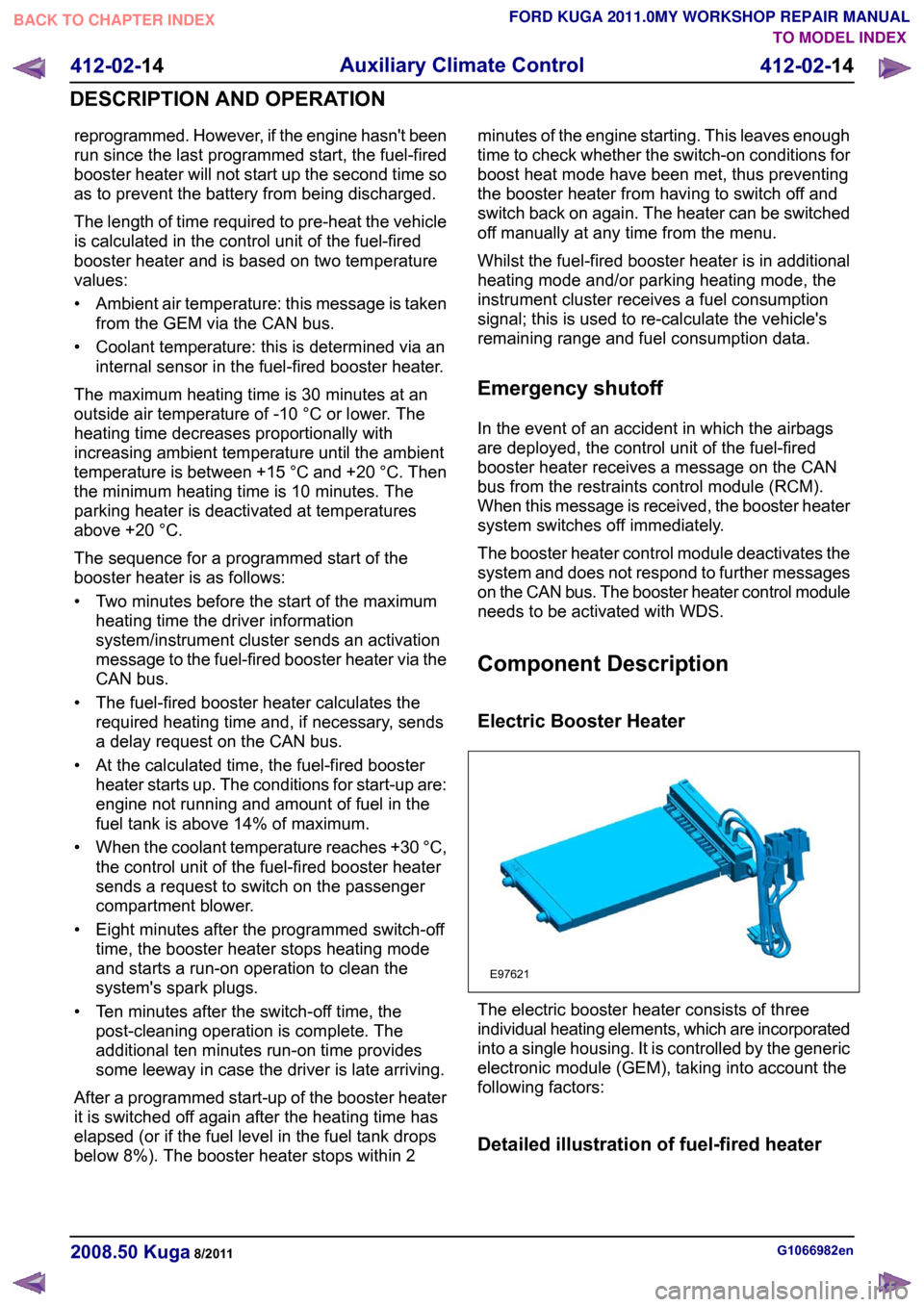
Electric Booster Heater
The electric booster heater consists of three
individual heating elements, which are incorporated
into a single housing. It is controlled by the generic
electronic module (GEM), taking into account the
following factors:
Detailed illustration of fuel-fired heater
G1066982en
2008.50 Kuga 8/2011 412-02-14
Auxiliary Climate Control
412-02-14
DESCRIPTION AND OPERATIONTO MODEL INDEX
BACK TO CHAPTER INDEX
FORD KUGA 2011.0MY WORKSHOP REPAIR MANUALE97621
Page 169 of 2057
Description
Item
Combustion chamber
16
'O' Ring
17 Description
Item
Combustion blower motor cover
18
Glow plug wiring harness
19
Flame sensor
If the flame goes out independently during
operation of the booster heater, a restart is carried
out. If the booster heater does not ignite within 90
seconds of fuel delivery or if the flame goes out
within 15 minutes of starting, a lockout will be
implemented by the flame sensor.
Lockout can be cancelled by switching the booster
heater off then on again, although this may only
be repeated at most 2 times.
Overheat Sensor
The overheating sensor enables the fuel-fired
booster heater module to determine the coolant
temperature, protecting the heater from
overheating. The overheating sensor is installed
next to the coolant temperature sensor under a
cover on the top of the fuel-fired heater.
In the event of overheating (lack of water, poorly
ventilated coolant circuit), the fuel supply to the
heater is interrupted and a lockout occurs. After
the cause of the overheating has been eliminated,
the heater can be restarted by switching it off and
on again, if the coolant temperature is below 70°C.
If the heater overheats ten times in a row, the
control unit is locked.
ECT
The fuel-fired booster heater module uses the
temperature sensor to determine the coolant
temperature, which it then uses to set the starting
and stopping time. The coolant temperature sensor
is installed next to the overheating sensor under a
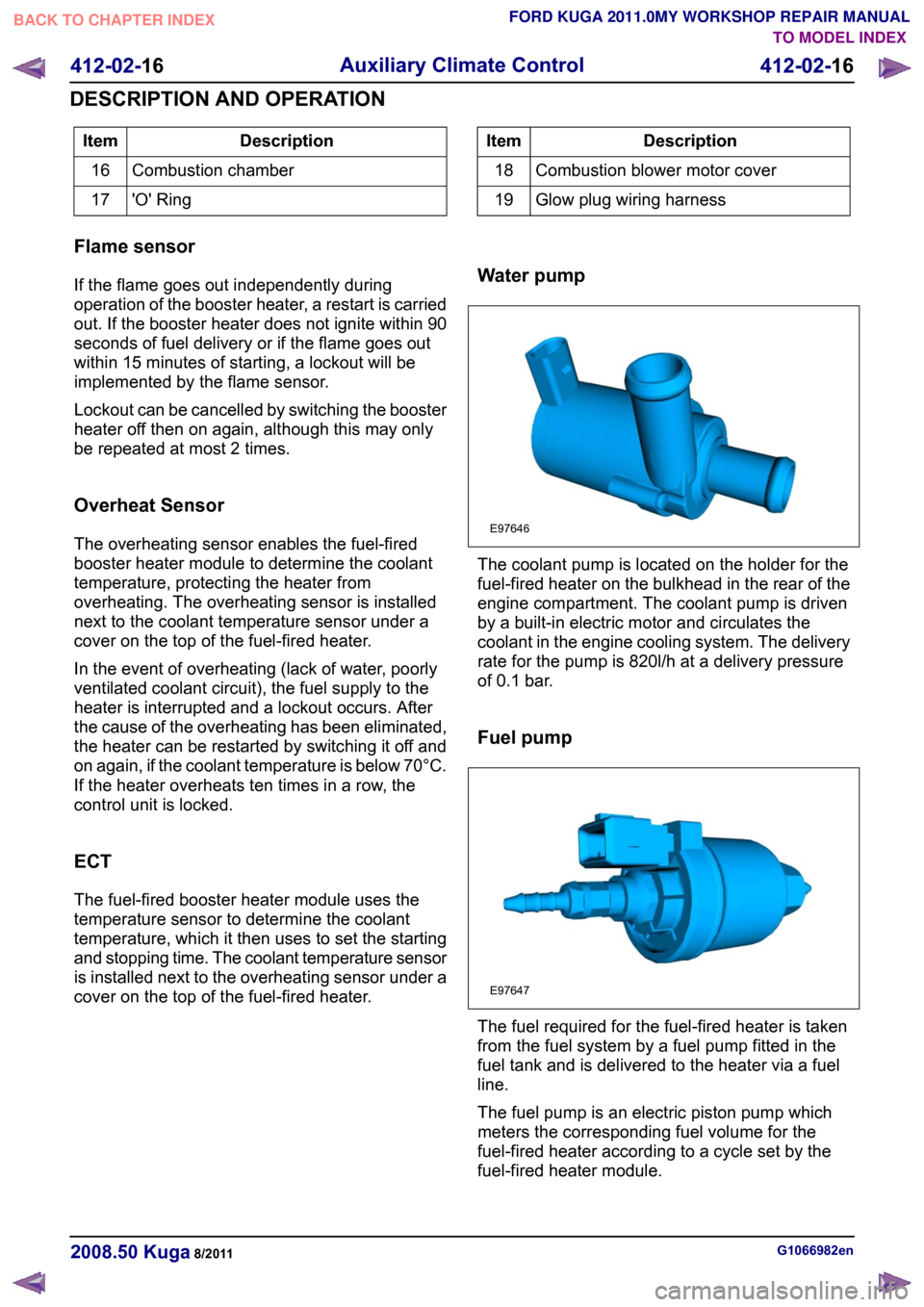
cover on the top of the fuel-fired heater. Water pump The coolant pump is located on the holder for the
fuel-fired heater on the bulkhead in the rear of the
engine compartment. The coolant pump is driven
by a built-in electric motor and circulates the
coolant in the engine cooling system. The delivery
rate for the pump is 820l/h at a delivery pressure
of 0.1 bar.
Fuel pump
The fuel required for the fuel-fired heater is taken
from the fuel system by a fuel pump fitted in the
fuel tank and is delivered to the heater via a fuel
line.
The fuel pump is an electric piston pump which
meters the corresponding fuel volume for the
fuel-fired heater according to a cycle set by the
fuel-fired heater module.
G1066982en
2008.50 Kuga 8/2011 412-02-16
Auxiliary Climate Control
412-02-16
DESCRIPTION AND OPERATIONTO MODEL INDEX
BACK TO CHAPTER INDEX
FORD KUGA 2011.0MY WORKSHOP REPAIR MANUALE97646 E97647
Page 211 of 2057
Description
Item
Rear parking aid sensorRefer to Component Description: Parking
aid sensors (page ?)
7
Rear parking aid sensorRefer to Component Description: Parking
aid sensors (page ?)
8 Description
Item
Rear parking aid sensorRefer to Component Description: Parking
aid sensors (page ?)
9
steering angle sensor
10
Navigation device
11
System Operation
Parking Aid WARNING: It is the driver's responsibility
to stay alert during reversing procedures.
The system may fail to detect small
children or animals.
CAUTION: The driver is responsible for
detecting obstacles and judging the
distance between these and the vehicle.
The system may fail to detect some
hanging objects, barriers, narrow obstacles
or painted surfaces, which could damage
the vehicle. Always pay attention when
parking.
The parking aid provides an audible warning to the
driver if there are any obstacles in front of or behind
the vehicle during reverse parking maneuvers.
At low speeds, the parking aid module uses the
parking aid sensors to monitor the area around the
vehicle. If an object is detected within a monitored
area, the parking aid module emits a warning tone
using the respective parking aid speaker.
The rear parking aid is switched on with the
ignition. However, it is only enabled when reverse
gear is selected.
The front and rear parking aid is always switched
off when the ignition is switched on. It is switched
on when reverse gear is selected or if the parking
aid switch in the center console is actuated up to
a speed of 16 km/h.
The parking aid is switched off when the vehicle is
travelling forwards at more than 16 km/h or if the
parking aid switch in the center console is actuated
again.
When the parking aid module activates the system,
the parking aid switch LED is illuminated. If the
vehicle is only fitted with the rear parking aid, there
is no switch.
The parking aid sensors emit a series of ultrasonic
impulses and switch to receiver mode to receive the echo reflected by an obstacle within the
detection range. The received echo signals are
amplified and converted from an analog signal to
a digital signal by the sensor. The digital signal is
passed to the parking aid module and compared
with pre-programmed data stored in an EEPROM
within the module. The module calculates the
distance to the obstacle by measuring the time
taken between the emitted and received impulses.
If no objects are detected there are no further
warning tones. If an object is detected, repeated
audible tones are emitted from either parking aid
speaker(s) as appropriate. The time delay between
the tones decreases as the distance between the
object and the vehicle decreases, until at
approximately 250 mm (10 inches), the audible
tone becomes continuous.
If the distance between the obstacle and the
vehicle does not decrease, the warning tone
remains constant if the object has been detected
by an internal parking aid sensor. If the obstacle
was detected by an external sensor and the
distance remains unchanged, the warning tone
stops after 3 seconds.
The parking aid module continues to monitor the
distance and will resume the warning tones if a
decrease in distance is detected.
If a trailer is connected to the vehicle, a signal is
sent to the GEM (generic electronic module) via
the trailer relay. This signal is sent to the parking
aid module via the MS CAN bus. When the parking
aid module detects that a trailer is connected to
the vehicle, the rear parking aid sensors are
disabled to prevent constant warnings due to the
close proximity of the trailer.
G1034399en
2008.50 Kuga 8/2011 413-13-12
Parking Aid
413-13-12
DESCRIPTION AND OPERATIONTO MODEL INDEX
BACK TO CHAPTER INDEX
FORD KUGA 2011.0MY WORKSHOP REPAIR MANUAL
Page 266 of 2057

• Surface charge removal procedure
• Dynamic Response procedure for refined
decisiveness on battery diagnostics
• Upgradeable by SD card
• Export data feature to send data to infra red printer
• Voltmeter function
• Date and time indication with every test
• 23 languages included within the battery tester
Using the Midtronics EXP-1050 battery
tester
• Disconnect the battery ground cable at the battery negative (-) post. Note: if using this
battery tester on models where the ground cable
is not accessible, the battery does not have to
be removed from the vehicle and may be tested
using the vehicle's 'jump start post' if the battery
tester is set to the correct mode. In this case,
the battery must be disconnected at the positive
(+) post before testing.
• Connect the positive red clamp of the Midtronics
EXP-1050 battery tester to the battery positive
(+) post.
• Connect the negative black clamp of the Midtronics EXP-1050 battery tester to the
battery negative (-) post or jump start post as
appropriate.
A poor connection will prevent testing and the
battery tester will display the message CHECK
CONNECTION. If this message appears after you have correctly reconnected the clamps, clean the
terminals and reconnect.
It is recommended that batteries are always tested
using both battery posts. However, if used in 'jump
start post' mode, the Midtronics EXP-1050 battery
tester will compensate for the extra resistance of
the additional cable.
1.
Select BATTERY TEST or START-STOP
BATTERY TEST.
– Press the NEXT key to continue.
2. Select the BATTERY LOCATION
– UNDER HOOD
– UNDER SEAT
– OUT OF VEHICLE
– Press the NEXT key to continue.
3. Select the negative POST TYPE (IN-VEHICLE
ONLY)
– BATTERY POST
– JUMP START POST
– JUMP START POST (Battery Monitoring
Sensor)
– Press the NEXT key to continue.
4. Select the BATTERY RATING from the drop
down list.
– Press the NEXT key to test the battery.
5. If the battery under test is not listed in the drop
down list, it can still be selected with the
MANUAL ENTRY mode. This is item 11 of 11
in the list.
The Midtronics EXP-1050 battery tester will display
the word TESTING while it evaluates the battery.
Battery tester results and required actions Action
Battery Tester Reading
Return the battery to service
GOOD BATTERY
Fully recharge the battery and return it to service
GOOD - RECHARGE
Fully charge the battery and retest (failure to fully
charge the battery before retesting may cause false readings)
CHARGE & RETEST G1055063en
2008.50 Kuga 8/2011 414-00-5
Charging System - General Information
414-00-5
DIAGNOSIS AND TESTINGTO MODEL INDEX
BACK TO CHAPTER INDEX
FORD KUGA 2011.0MY WORKSHOP REPAIR MANUAL
Page 305 of 2057
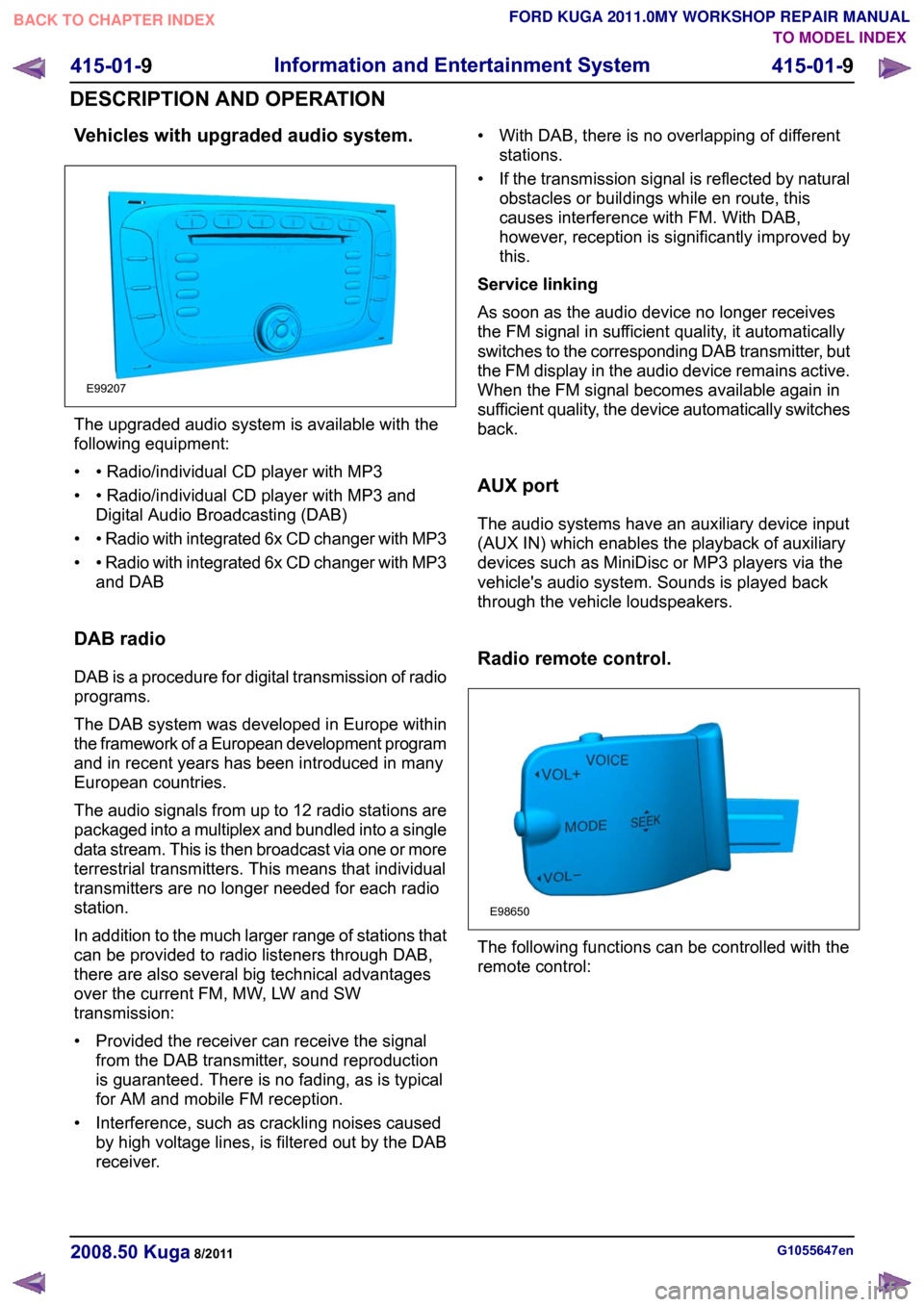
Vehicles with upgraded audio system.
The upgraded audio system is available with the
following equipment:
• • Radio/individual CD player with MP3
• • Radio/individual CD player with MP3 and
Digital Audio Broadcasting (DAB)
• • Radio with integrated 6x CD changer with MP3
• • Radio with integrated 6x CD changer with MP3
and DAB
DAB radio
DAB is a procedure for digital transmission of radio
programs.
The DAB system was developed in Europe within
the framework of a European development program
and in recent years has been introduced in many
European countries.
The audio signals from up to 12 radio stations are
packaged into a multiplex and bundled into a single
data stream. This is then broadcast via one or more
terrestrial transmitters. This means that individual
transmitters are no longer needed for each radio
station.
In addition to the much larger range of stations that
can be provided to radio listeners through DAB,
there are also several big technical advantages
over the current FM, MW, LW and SW
transmission:
• Provided the receiver can receive the signal from the DAB transmitter, sound reproduction
is guaranteed. There is no fading, as is typical
for AM and mobile FM reception.
• Interference, such as crackling noises caused by high voltage lines, is filtered out by the DAB
receiver. • With DAB, there is no overlapping of different
stations.
• If the transmission signal is reflected by natural obstacles or buildings while en route, this
causes interference with FM. With DAB,
however, reception is significantly improved by
this.
Service linking
As soon as the audio device no longer receives
the FM signal in sufficient quality, it automatically
switches to the corresponding DAB transmitter, but
the FM display in the audio device remains active.
When the FM signal becomes available again in
sufficient quality, the device automatically switches
back.
AUX port
The audio systems have an auxiliary device input
(AUX IN) which enables the playback of auxiliary
devices such as MiniDisc or MP3 players via the
vehicle's audio system. Sounds is played back
through the vehicle loudspeakers.
Radio remote control. The following functions can be controlled with the
remote control:
G1055647en
2008.50 Kuga 8/2011 415-01-9
Information and Entertainment System
415-01-9
DESCRIPTION AND OPERATIONTO MODEL INDEX
BACK TO CHAPTER INDEX
FORD KUGA 2011.0MY WORKSHOP REPAIR MANUALE99207 E98650
Page 340 of 2057
The turn signal lamps and side lights are the same as in conventional headlamps.
Bulb color
Current draw
Bulb
Lamp
Clear
35W
D1S
Low-beams
Clear
55W
H1
High beam headlamp
Clear
21W
H21W
Turn signal indicator
Clear
5W
W5W
Side lamp
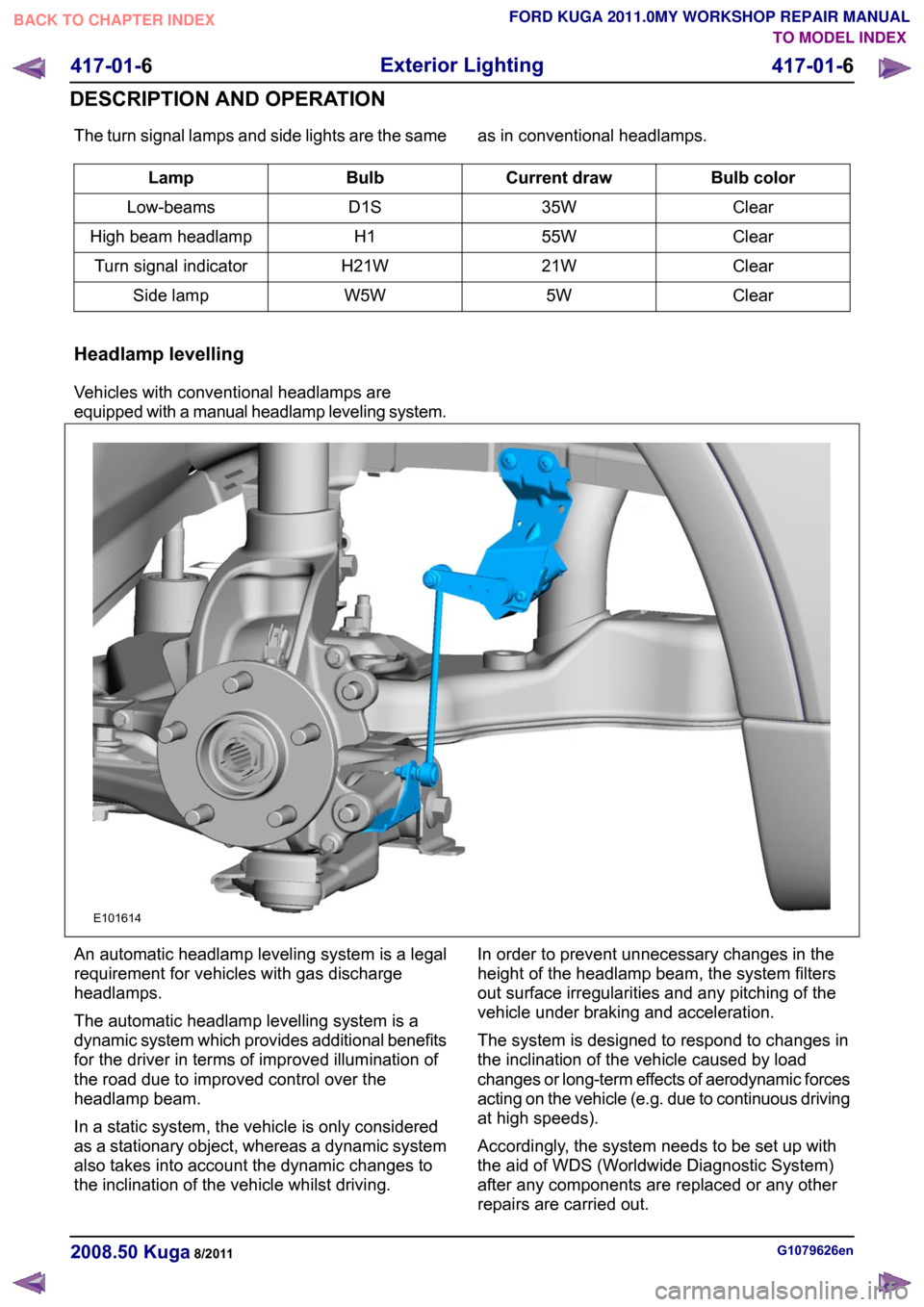
Headlamp levelling
Vehicles with conventional headlamps are
equipped with a manual headlamp leveling system. An automatic headlamp leveling system is a legal
requirement for vehicles with gas discharge
headlamps.
The automatic headlamp levelling system is a
dynamic system which provides additional benefits
for the driver in terms of improved illumination of
the road due to improved control over the
headlamp beam.
In a static system, the vehicle is only considered
as a stationary object, whereas a dynamic system
also takes into account the dynamic changes to
the inclination of the vehicle whilst driving.
In order to prevent unnecessary changes in the
height of the headlamp beam, the system filters
out surface irregularities and any pitching of the
vehicle under braking and acceleration.
The system is designed to respond to changes in
the inclination of the vehicle caused by load
changes or long-term effects of aerodynamic forces
acting on the vehicle (e.g. due to continuous driving
at high speeds).
Accordingly, the system needs to be set up with
the aid of WDS (Worldwide Diagnostic System)
after any components are replaced or any other
repairs are carried out.
G1079626en
2008.50 Kuga 8/2011 417-01-6
Exterior Lighting
417-01-6
DESCRIPTION AND OPERATIONTO MODEL INDEX
BACK TO CHAPTER INDEX
FORD KUGA 2011.0MY WORKSHOP REPAIR MANUALE101614