Gas FORD KUGA 2011 1.G User Guide
[x] Cancel search | Manufacturer: FORD, Model Year: 2011, Model line: KUGA, Model: FORD KUGA 2011 1.GPages: 2057
Page 55 of 2057
Pressurized Equipment
See HighPressure Air, Lubrication and Oil Test
Equipment.
Solder
Solders are mixtures of metals such that the
melting point of the mixture is below that of the
constituent metals (normally lead and tin). Solder
application does not normally give rise to toxic lead
fumes, provided a gas/air flame is used.
Oxy-acetylene flames should not be used, as they
are much hotter and will cause lead fumes to be
produced.
Some fumes may be produced by the application
of any flame to surfaces coated with grease, and
inhalation of these should be avoided.
Removal of excess solder should be undertaken
with care, to make sure that fine lead dust is not
produced, which can give toxic effects if inhaled.
Respiratory protection may be necessary.
Solder spillage and filings should be collected and
removed promptly to prevent general air
contamination by lead.
High standards of personal hygiene are necessary
in order to avoid ingestion of lead or inhalation of
solder dust from clothing.
Solvents
See also Chemical Materials, Fuels (Kerosene),
Fire.
For example acetone, white spirit, toluene, xylene,
trichloroethane.
Used in cleaning and dewaxing materials, paints,
plastics, resins and thinners.
Some may be highly flammable or flammable.
Skin contact will degrease the skin and may result
in irritation and dermatitis following repeated or
prolonged contact. Some can be absorbed through
the skin in toxic or harmful quantities.
Splashes in the eye may cause severe irritation
and could lead to loss of vision.
Brief exposure of high concentrations of vapors or
mists will cause eye and throat irritation,
drowsiness, dizziness, headaches and, in the worst
circumstances, unconsciousness.
Repeated or prolonged exposure to excessive but
lower concentrations of vapors or mists, for which there might not be adequate warning indications,
can cause more serious toxic or harmful effects.
Aspiration into the lungs, for example through
vomiting, is the most serious consequence of
swallowing.
Avoid splashes to the skin, eyes and clothing. Wear
protective gloves, goggles and clothing if
necessary.
Make sure there is good ventilation when in use,
avoid breathing fumes, vapors and spray mists and
keep containers tightly sealed. Do not use in
confined spaces.
When spraying materials containing solvents, for
example paints, adhesive, coatings, use extraction
ventilation or personal respiratory protection in the
absence of adequate general ventilation.
Do not apply heat or flame except under specific
and detailed manufacturers instructions.
Sound Insulation
See
Fibre Insulation, Foams.
Suspended Loads
CAUTION: Never improvise lifting tackle.
There is always a danger when loads are lifted or
suspended. Never work under an unsupported,
suspended or raised load, for example a
suspended engine.
Always make sure that lifting equipment such as
jacks, hoists, axle stands and slings are adequate
and suitable for the job, in good condition and
regularly maintained.
Transmission Brake Bands
See Asbestos.
Underseal
SeeCorrosion Protection.
Viton
In common with many other manufacturers
vehicles, some components have O-rings, seals
or gaskets, which contain a material known as
`Viton'.
G566527en2008.50 Kuga8/2011
100-00- 50
General Information
100-00- 50
DESCRIPTION AND OPERATION
TO MODEL INDEX
BACK TO CHAPTER INDEX
FORD KUGA 2011.0MY WORKSHOP REPAIR MANUAL
Page 56 of 2057
Viton is a fluoroelastomer, that is a synthetic rubber
type material, which contains Fluorine. It is
commonly used for O-rings, gaskets and seals of
all types. Although Viton is the most well known
fluoroelastomer, there are others, including Fluorel
and Tecmoflon.
When used under design conditions
fluoroelastomers are perfectly safe. If, however,
they are exposed to temperatures in excess of
400°C, the material will not burn, but will
decompose, and one of the products formed is
hydrofluoric acid.
This acid is extremely corrosive and may be
absorbed directly, through contact, into the general
body system.
O-rings, seals or gaskets which have been exposed
to very high temperatures will appear charred or
as a black sticky substance.
DO NOT; under any circumstances touch them or
the attached components.
Enquiries should be made to determine whether
Viton or any other fluoroelastomer has been used
in the affected O-ring, seal or gasket. If they are of
natural rubber or nitrile there is no hazard. If in
doubt, be cautious, as the material may be Viton
or any fluoroelastomer.
If Viton or any other fluoroelastomers have been
used, the affected area should be decontaminated
before the commencement of work.
Disposable heavy duty plastic gloves should be
worn at all times, and the affected area washed
down using wire wool and a limewater (calcium
hydroxide) solution to neutralize the acid before
disposing of the decomposed Viton residue and
final cleaning of the area. After use, the plastic
gloves should be discarded carefully and safely.
Welding
See alsoFire, Electric Shock, Gas Cylinders.
Welding processes include Resistance Welding
(Spot Welding), Arc Welding and Gas Welding.
Resistance Welding
This process may cause particles of molten metal
to be emitted at a high velocity, and the eyes and
skin must be protected.
Arc Welding
This process emits a high level of ultra-violet
radiation, which may cause arc-eye, and skin burns
to the operator and to other persons nearby.
Gas-shielded welding processes are particularly
hazardous in this respect. Personal protection must
be worn, and screens used to shield other people.
CONTACT LENS WEARERS ARE ADVISED TO
REVERT TO ORDINARY SPECTACLES WHEN
ARC WELDING as the arc spectrum is believed to
emit microwaves which dry out the fluid between
the lens and the eye. This may result in blindness
when the lens is removed from the eye.
Metal spatter will also occur, and appropriate eye
and skin protection is necessary.
The heat of the welding arc will produce fumes and
gases from the metals being welded, the rods and
from any applied coatings or contamination on the
surfaces being worked on. These gases and fumes
may be toxic and inhalation of these should be
avoided. The use of extraction ventilation to remove
the fumes from the working area may be necessary
particularly in cases where the general ventilation
is poor, or where considerable welding work is
anticipated. In extreme cases or confined spaces
where adequate ventilation cannot be provided,
air-fed respirators may be necessary.
Gas Welding (and Cutting)
Oxy-acetylene torches may be used for welding
and cutting, and special care must be taken to
prevent leakage of these gases, with consequent
risk of fire and explosion.
The process will produce metal spatter and eye
and skin protection is necessary.
The flame is bright, and eye protection should be
used, but the ultra-violet emission is much less
than that from arc welding, and lighter filters may
be used.
The process itself produces few toxic fumes, but
such fumes and gases may be produced from
coatings on the work, particularly during cutting
away of damaged body parts, and inhalation of the
fumes should be avoided.
In brazing, toxic fumes may be produced from the
metals in the brazing rod, and a severe hazard
may arise if brazing rods containing cadmium are
used. In this event particular care must be taken
to avoid inhalation of fumes and expert advice may
be required.
G566527en2008.50 Kuga8/2011
100-00- 51
General Information
100-00- 51
DESCRIPTION AND OPERATION
TO MODEL INDEX
BACK TO CHAPTER INDEX
FORD KUGA 2011.0MY WORKSHOP REPAIR MANUAL
Page 58 of 2057

instructions. Failure to follow this
instruction may result in personal injury
or damage to components.
It is of fundamental importance that certain
essential equipment, for example torque wrenches,
multimeters, exhaust gas analyzers or rolling roads,
are regularly calibrated in accordance with the
manufacturers instructions.
G17373en2008.50 Kuga8/2011
100-00- 56
General Information
100-00- 56
DESCRIPTION AND OPERATION
TO MODEL INDEX
BACK TO CHAPTER INDEX
FORD KUGA 2011.0MY WORKSHOP REPAIR MANUAL
Page 60 of 2057
Standard Workshop Practices
Vehicle in Workshop
When working on a vehicle in the workshop always
make sure that:
– the parking brake is applied or the wheels aresecurely chocked to prevent the vehicle moving
forwards or backwards.
– the key is removed from key operated hood locks before any work is carried out around the
front of the vehicle.
– if the engine is to be run, there is adequate ventilation, or an extraction hose to remove
exhaust fumes.
– there is adequate room to raise the vehicle and remove the wheels, if necessary.
– fender covers are always fitted if any work is to be carried out in the engine compartment.
– the battery is disconnected if working on the engine, underneath the vehicle, or if the vehicle
is raised.
CAUTION: When electric arc welding on a
vehicle, always disconnect the generator
wiring to prevent the possibility of a surge
of current causing damage to the internal
components of the generator.
– if using welding equipment on the vehicle, a suitable fire extinguisher is readily available.
Towing the Vehicle
WARNING: When the vehicle is being
towed, the ignition switch must be in
position II (steering lock released and
warning lamps illuminated). Only then will
the steering, turn signal lamps, horn and
stop lamps be operational. Failure to follow
these instructions may result in personal
injury.
NOTE: The removable towing eye (if equipped),
has a left-hand thread and must be fully tightened
before towing can commence.
When towing is necessary, the vehicle towing eyes
should be used. The rope must be securely
fastened to the towing eyes and must also be
attached to the other vehicle such that the rope will
not foul the bodywork.
When a vehicle with automatic transmission is
towed, the gear selector must be in position N (Neutral). Never tow a vehicle with automatic
transmission at a speed greater than 30 mph (50
km/h) or for a distance greater than 30 miles (50
km). If it is necessary to tow the vehicle a greater
distance, the drive wheels must be lifted clear off
the ground.
Alternatively the vehicle can be transported on a
low loader or a trailer.
Connecting a Slave Battery Using
Jumper Cables
WARNING: If the slave battery has recently
been charged and is gassing, cover the
vent plugs or covers with a damp cloth to
reduce the risk of explosion should arcing
occur when connecting the jumper cables.
Failure to follow these instructions may
result in personal injury.
CAUTIONS:
A discharged battery condition may have
been caused by an electrical short circuit.
If this condition exists there will be an
apparently live circuit on the vehicle even
when all normal circuits are switched off.
This can cause arcing when the jumper
cables are connected.
While it is not recommended that the
vehicle is jump started, it is recognized
that this may occasionally be the only
practical way to mobilize a vehicle. In such
an instance, the discharged battery must
be recharged immediately after jump
starting to avoid permanent damage.
– Always make sure that the jumper cables are adequate for the task. Heavy duty cables must
be used.
– Always make sure that the slave battery is of the same voltage as the vehicle battery. The
batteries must be connected in parallel.
– Always make sure that switched electric circuits are switched off before connecting jumper
cables. This reduces the risk of arcing occurring
when the final connection is made.
G17373en2008.50 Kuga8/2011
100-00- 54
General Information
100-00- 54
DESCRIPTION AND OPERATION
TO MODEL INDEX
BACK TO CHAPTER INDEX
FORD KUGA 2011.0MY WORKSHOP REPAIR MANUAL
Page 65 of 2057
Air Conditioning (A/C) System Health and Safety Precautions
WARNINGS:
Only qualified technicians are allowed to
work on air conditioning (A/C) systems.
Air conditioning (A/C) system components
can become particularly hot or cold.
Make sure that the air conditioning (A/C)
system is at ambient temperature before
carrying out any repair.
When handling refrigerants, always wear
protective goggles and gloves made of
fluoroelastomer. Leather or fabric gloves
are not suitable.
SKIN CONTACT: If liquid refrigerant comes
into contact with the skin, it produces
severe frostbite. Immediately flush affected
areas with plenty of cold running water for
15 minutes. Seek medical attention.
EYE CONTACT: If refrigerant comes into
contact with the eyes, immediately flush
the eyes with plenty of running water for
15 minutes. Seek medical attention.
INHALED: Toxic gases generated when
refrigerant is heated are hazardous to
health. The gases have an irritating smell
and can cause lung damage. The
symptoms can continue for a long time
after having been in contact with the gases.
The gases can cause lung damage even if
the amount of gas in the air is too small to
smell.
Refrigerant is flammable and explosive.
Make sure that refrigerant bottles are not
exposed to temperatures greater than 45°C.
Make sure that the local regulations
regarding work on air conditioning (A/C)
systems are adhered to.
Make sure that refrigerant bottles are
closed properly.
Gaseous refrigerant has a higher density
than air. There is a danger of suffocation
when working close to the ground or in
workshop pits.
Provide adequate ventilation when
handling refrigerant.
Never release refrigerant into the
atmosphere.
Only use special tools, equipment and
lubricants that are approved for the type
of refrigerant being used.
Always follow the manufacturer’s
instructions for the correct servicing unit
operating procedure.
CAUTIONS:
Do not mix refrigerant oils for different
types of refrigerant.
Never mix different types of refrigerant or
equipment intended for them.
Only use refrigerant in gas form when
filling the system through the low-pressure
connection.
Only use refrigerant in liquid form when
filling the system through the
high-pressure connection.
Refrigerant attacks certain plastics. Only
use seals suitable for refrigerant.
If the air conditioning (A/C) compressor is
damaged, the fixed orifice tube can
become blocked with metal particles.
Any sort of blockage in the refrigerant
circuit will damage the air conditioning
(A/C) compressor irreparably.
If the air conditioning (A/C) system has
been opened for a period greater than 2
hours, a new receiver drier must be
installed and the evacuating time to be
increased by a minimum of 2 hours.
NOTE: New air conditioning (A/C) compressors
are delivered prefilled.
NOTE: Refrigerant oil in new air conditioning (A/C)
compressors can contain Teflon, visible as white
particles, which will not harm the system.
G548993en2008.50 Kuga8/2011
100-00- 60
General Information
100-00- 60
DESCRIPTION AND OPERATION
TO MODEL INDEX
BACK TO CHAPTER INDEX
FORD KUGA 2011.0MY WORKSHOP REPAIR MANUAL
Page 66 of 2057
Battery and Battery Charging Health and Safety Precautions
WARNINGS:
Batteries contain sulphuric acid, avoid
contact with skin, eyes or clothing. Wear
safety goggles when working near the
battery to protect against possible
splashing of the acid solution.
EYE CONTACT: If acid comes into contact
with the eyes, flush immediately with
plenty of running water for a minimum of
15 minutes. Seek immediate medical
attention.
SKIN CONTACT: If acid comes into contact
with the skin, flush immediately with plenty
of running water for a minimum of 15
minutes. Seek immediate medical attention.
SWALLOWED: If acid is swallowed, rinse
the mouth with plenty of water and then
drink plenty of water or milk. Do not induce
vomiting. Seek immediate medical
attention.
Batteries normally produce explosive
gases. Do not allow naked flames, sparks
or lighted substances to come near the
battery.
When charging the battery shield your face
and wear safety goggles. Provide adequate
ventilation.
CAUTION: Boost charging with excessive
current or voltage above 16 volts will
damage the battery.
G548994en2008.50 Kuga8/2011
100-00-61
General Information
100-00- 61
DESCRIPTION AND OPERATION
TO MODEL INDEX
BACK TO CHAPTER INDEX
FORD KUGA 2011.0MY WORKSHOP REPAIR MANUAL
Page 73 of 2057
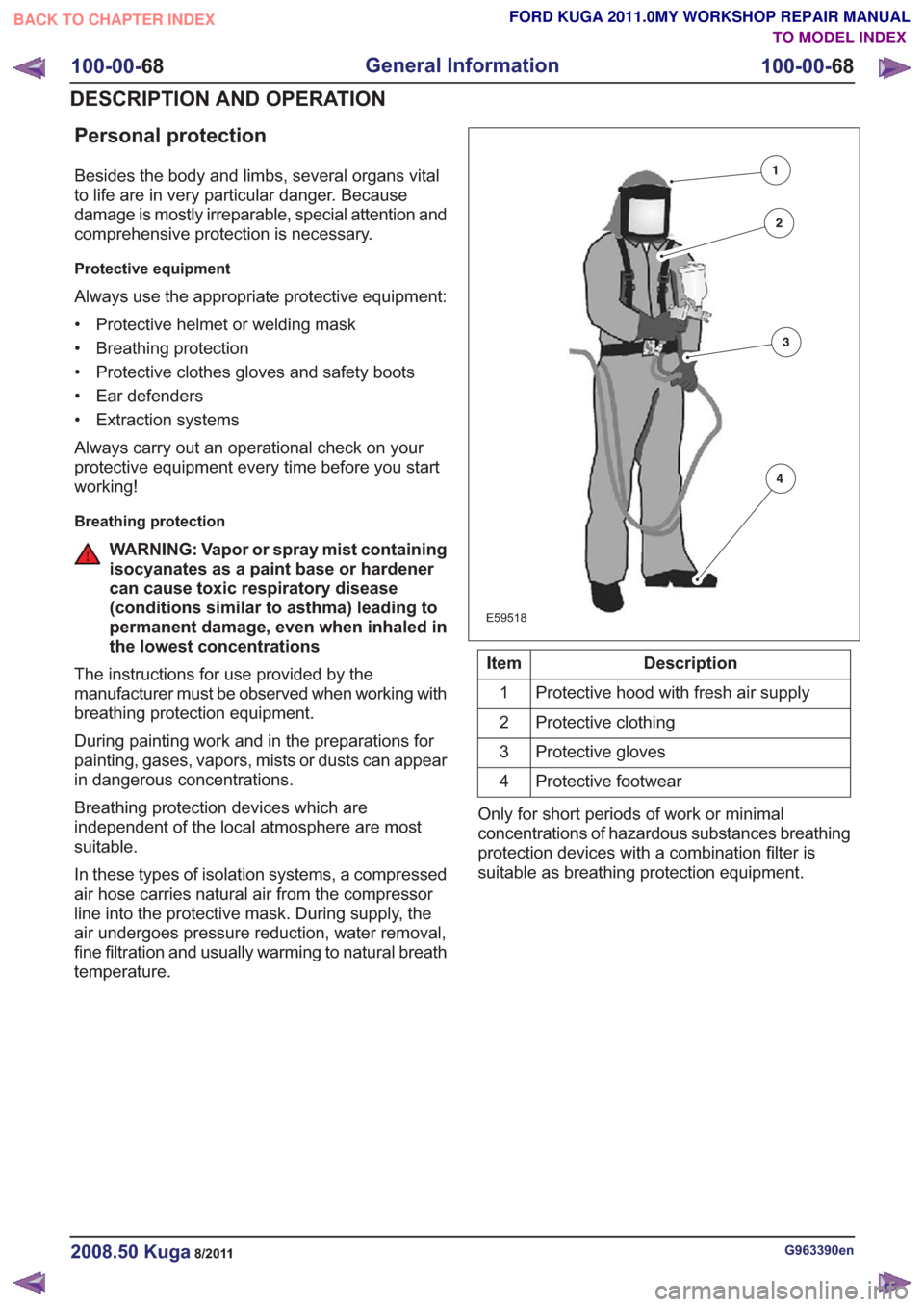
Personal protection
Besides the body and limbs, several organs vital
to life are in very particular danger. Because
damage is mostly irreparable, special attention and
comprehensive protection is necessary.
Protective equipment
Always use the appropriate protective equipment:
• Protective helmet or welding mask
• Breathing protection
• Protective clothes gloves and safety boots
• Ear defenders
• Extraction systems
Always carry out an operational check on your
protective equipment every time before you start
working!
Breathing protection
WARNING: Vapor or spray mist containing
isocyanates as a paint base or hardener
can cause toxic respiratory disease
(conditions similar to asthma) leading to
permanent damage, even when inhaled in
the lowest concentrations
The instructions for use provided by the
manufacturer must be observed when working with
breathing protection equipment.
During painting work and in the preparations for
painting, gases, vapors, mists or dusts can appear
in dangerous concentrations.
Breathing protection devices which are
independent of the local atmosphere are most
suitable.
In these types of isolation systems, a compressed
air hose carries natural air from the compressor
line into the protective mask. During supply, the
air undergoes pressure reduction, water removal,
fine filtration and usually warming to natural breath
temperature.
E59518
Description
Item
Protective hood with fresh air supply
1
Protective clothing
2
Protective gloves
3
Protective footwear
4
Only for short periods of work or minimal
concentrations of hazardous substances breathing
protection devices with a combination filter is
suitable as breathing protection equipment.
G963390en2008.50 Kuga8/2011
100-00- 68
General Information
100-00- 68
DESCRIPTION AND OPERATION
TO MODEL INDEX
BACK TO CHAPTER INDEX
FORD KUGA 2011.0MY WORKSHOP REPAIR MANUAL
Page 168 of 2057
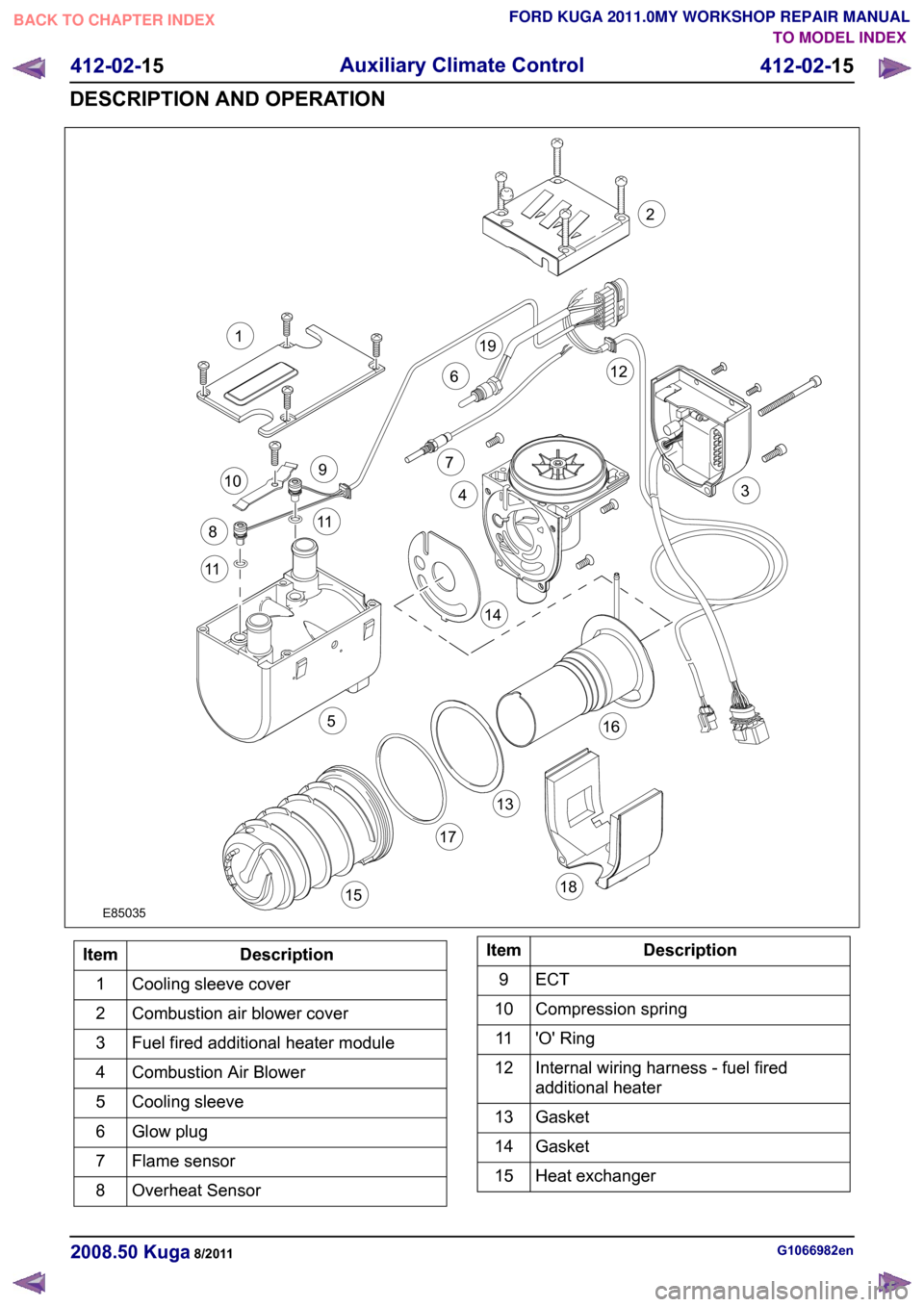
Description
Item
Cooling sleeve cover
1
Combustion air blower cover
2
Fuel fired additional heater module
3
Combustion Air Blower
4
Cooling sleeve
5
Glow plug
6
Flame sensor
7
Overheat Sensor
8 Description
Item
ECT9
Compression spring
10
'O' Ring
11
Internal wiring harness - fuel fired
additional heater
12
Gasket
13
Gasket
14
Heat exchanger
15 G1066982en
2008.50 Kuga 8/2011 412-02-15
Auxiliary Climate Control
412-02-15
DESCRIPTION AND OPERATIONTO MODEL INDEX
BACK TO CHAPTER INDEX
FORD KUGA 2011.0MY WORKSHOP REPAIR MANUALE850351132126791011115144316171518198
Page 263 of 2057

Charging System
Refer to Wiring Diagrams Section 414-02, for
schematic and connector information.
General Equipment
Midtronics EXP-1050 battery tester
Midtronics GR590-2
Ford diagnostic equipment
Inspection and Verification
WARNINGS: Batteries contain sulphuric acid. Avoid
contact with skin, eyes, or clothing. Also,
shield your eyes when working near
batteries to protect against possible
splashing of the acid solution. In case of
acid contact with skin or eyes, flush
immediately with water for a minimum of
15 minutes and get prompt medical
attention. If acid is swallowed, call a
physician immediately. Failure to follow
these instructions may result in personal
injury.
Batteries normally produce explosive
gases which can cause personal injury.
Therefore, do not allow flames, sparks or
lighted substances to come near the
battery. When charging or working near a
battery, always shield your face and
protect your eyes. Always provide
ventilation. Failure to follow these
instructions may result in personal injury.
1. Verify the customer concern.
2. Visually inspect for obvious signs of mechanical
or electrical damage.
Visual Inspection Chart Electrical
Mechanical
– Fuse(s)
– Wiring harness(es)
– Generator
– Electricalconnector(s)
– Battery junction box (BJB)
– Battery
– Battery cables
– Battery monitoring sensor (BMS)
– Charging system warning indicator
–
Accessory drive belt
– Generator
3. If an obvious cause for an observed or reported concern is found, correct the cause (if possible)
before proceeding to the next step.
4. Check the operation of the charging system warning indicator lamp, located in the instrument
cluster. Normal operation is as follows:
Normal Charging System Voltages Charging System
Warning Indicator Operation
Engine to
battery ground
Battery
Gener-
ator B+ Circuit
I Circuit
Ignition Switch
Position
OFF
0V
10-12V
10-12V
0V
Position 0
Illuminated
0V
10-12V
10-12V
0V
Position II
OFF
0V
13-15V
13-15V
13-15V
Position II with
the engine
running
5. If the cause is not visually evident, verify the symptom and refer to the Component Tests. Component Tests
Generator On-Vehicle Tests - No-Load Test
1. Turn off all electrical loads and the ignition
switch. G1055063en
2008.50 Kuga 8/2011 414-00-2
Charging System - General Information
414-00-2
DIAGNOSIS AND TESTINGTO MODEL INDEX
BACK TO CHAPTER INDEX
FORD KUGA 2011.0MY WORKSHOP REPAIR MANUAL
Page 270 of 2057
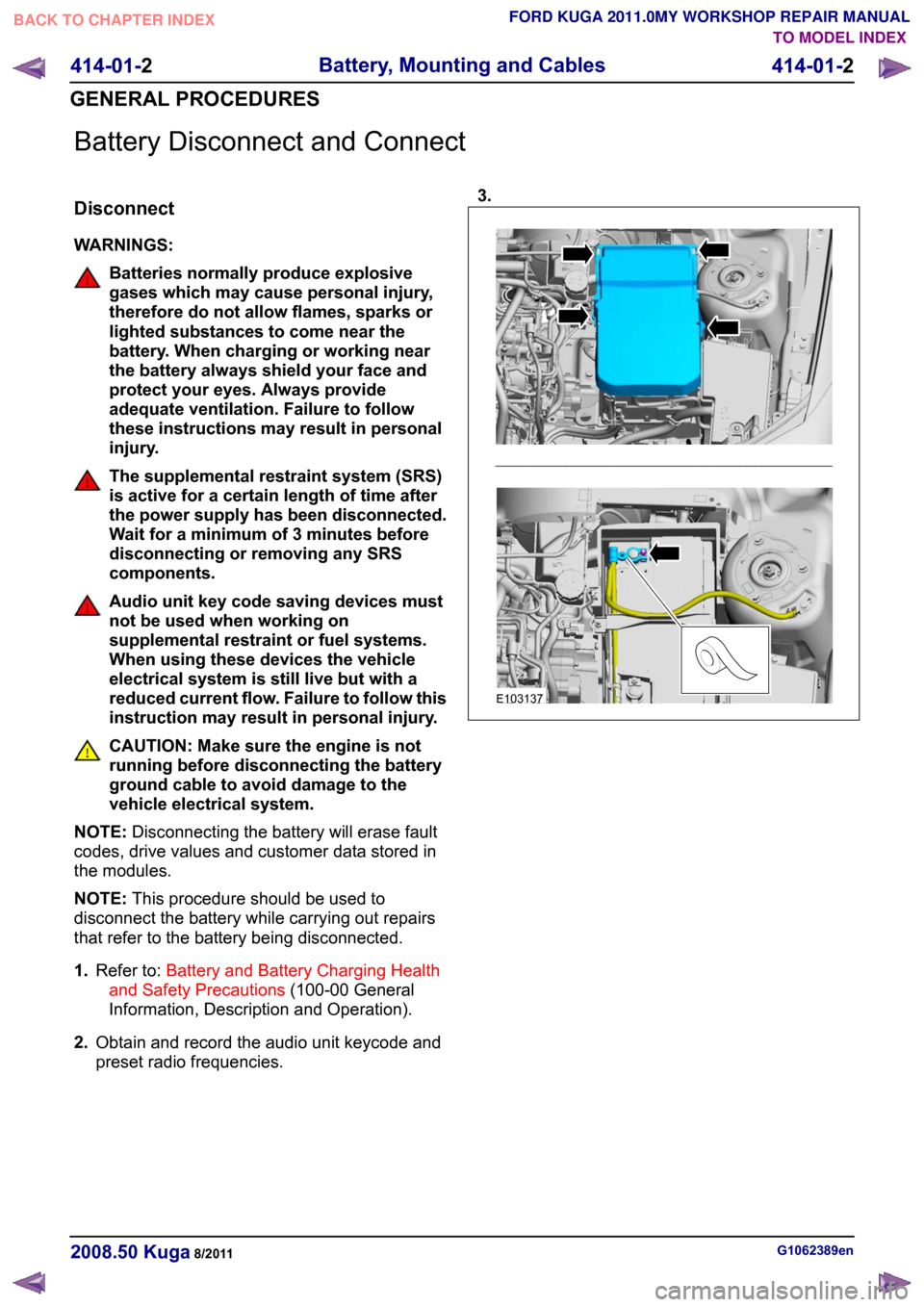
Battery Disconnect and Connect
Disconnect
WARNINGS:
Batteries normally produce explosive
gases which may cause personal injury,
therefore do not allow flames, sparks or
lighted substances to come near the
battery. When charging or working near
the battery always shield your face and
protect your eyes. Always provide
adequate ventilation. Failure to follow
these instructions may result in personal
injury.
The supplemental restraint system (SRS)
is active for a certain length of time after
the power supply has been disconnected.
Wait for a minimum of 3 minutes before
disconnecting or removing any SRS
components.
Audio unit key code saving devices must
not be used when working on
supplemental restraint or fuel systems.
When using these devices the vehicle
electrical system is still live but with a
reduced current flow. Failure to follow this
instruction may result in personal injury.
CAUTION: Make sure the engine is not
running before disconnecting the battery
ground cable to avoid damage to the
vehicle electrical system.
NOTE: Disconnecting the battery will erase fault
codes, drive values and customer data stored in
the modules.
NOTE: This procedure should be used to
disconnect the battery while carrying out repairs
that refer to the battery being disconnected.
1. Refer to: Battery and Battery Charging Health
and Safety Precautions (100-00 General
Information, Description and Operation).
2. Obtain and record the audio unit keycode and
preset radio frequencies. 3.
G1062389en
2008.50 Kuga 8/2011 414-01-2
Battery, Mounting and Cables
414-01-2
GENERAL PROCEDURESTO MODEL INDEX
BACK TO CHAPTER INDEX
FORD KUGA 2011.0MY WORKSHOP REPAIR MANUALE103137