pressure FORD KUGA 2011 1.G Repair Manual
[x] Cancel search | Manufacturer: FORD, Model Year: 2011, Model line: KUGA, Model: FORD KUGA 2011 1.GPages: 2057
Page 1337 of 2057
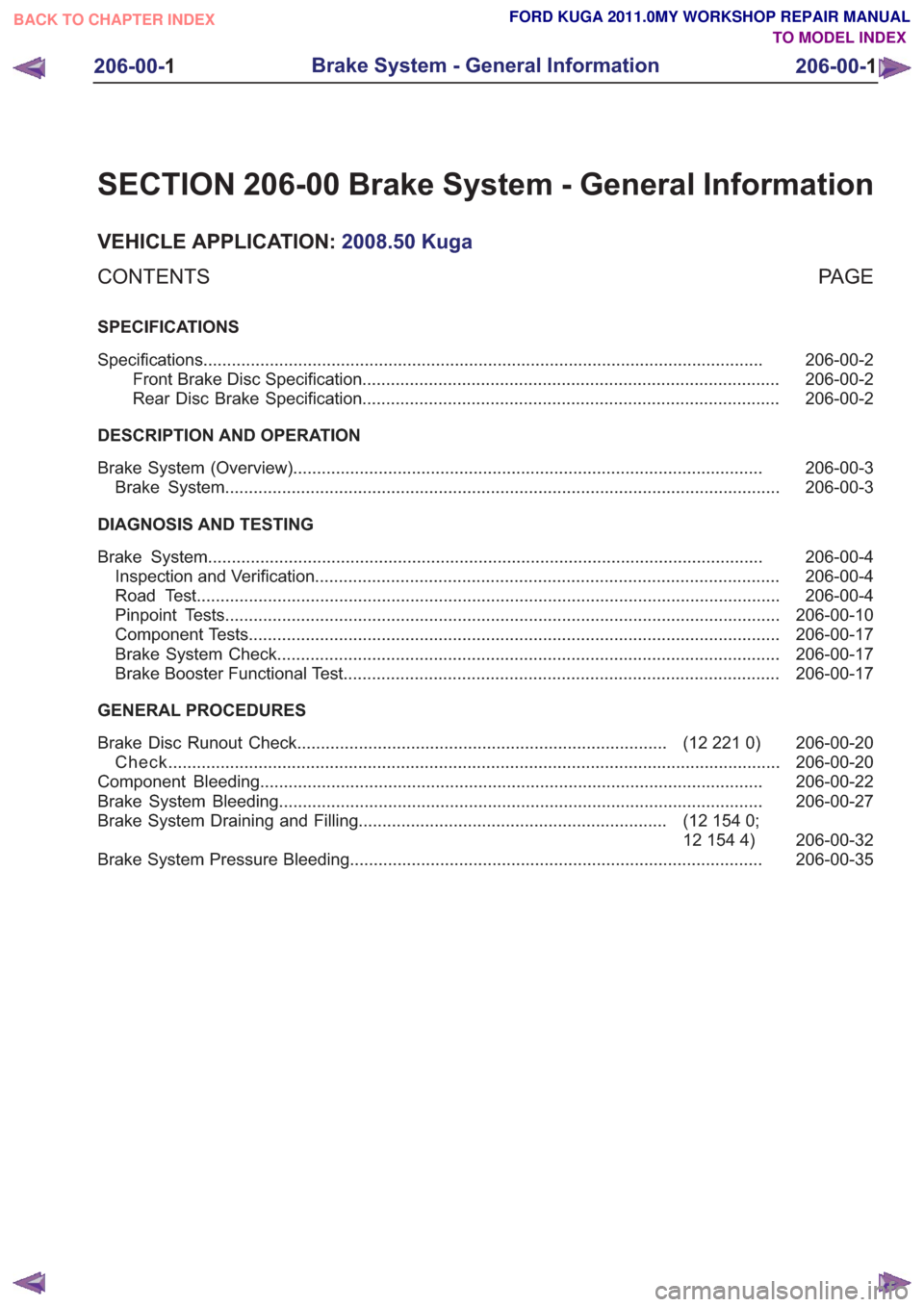
SECTION 206-00 Brake System - General Information
VEHICLE APPLICATION:2008.50 Kuga
PA G E
CONTENTS
SPECIFICATIONS
206-00-2
Specifications ........................................................................\
..............................................
206-00-2
Front Brake Disc Specification ........................................................................\
................
206-00-2
Rear Disc Brake Specification ........................................................................\
................
DESCRIPTION AND OPERATION 206-00-3
Brake System (Overview) ........................................................................\
...........................
206-00-3
Brake System ........................................................................\
.............................................
DIAGNOSIS AND TESTING 206-00-4
Brake System ........................................................................\
.............................................
206-00-4
Inspection and Verification ........................................................................\
..........................
206-00-4
Road Test ........................................................................\
...................................................
206-00-10
Pinpoint Tests ........................................................................\
.............................................
206-00-17
Component Tests ........................................................................\
........................................
206-00-17
Brake System Check ........................................................................\
..................................
206-00-17
Brake Booster Functional Test ........................................................................\
....................
GENERAL PROCEDURES 206-00-20
(12 221 0)
Brake Disc Runout Check ........................................................................\
......
206-00-20
Check ........................................................................\
.........................................................
206-00-22
Component Bleeding ........................................................................\
..................................
206-00-27
Brake System Bleeding ........................................................................\
..............................
206-00-32
(12 154 0;
12 154 4)
Brake System Draining and Filling
.................................................................
206-00-35
Brake System Pressure Bleeding ........................................................................\
...............
206-00-1
Brake System - General Information
206-00- 1
.
TO MODEL INDEX
BACK TO CHAPTER INDEX
FORD KUGA 2011.0MY WORKSHOP REPAIR MANUAL
Page 1340 of 2057
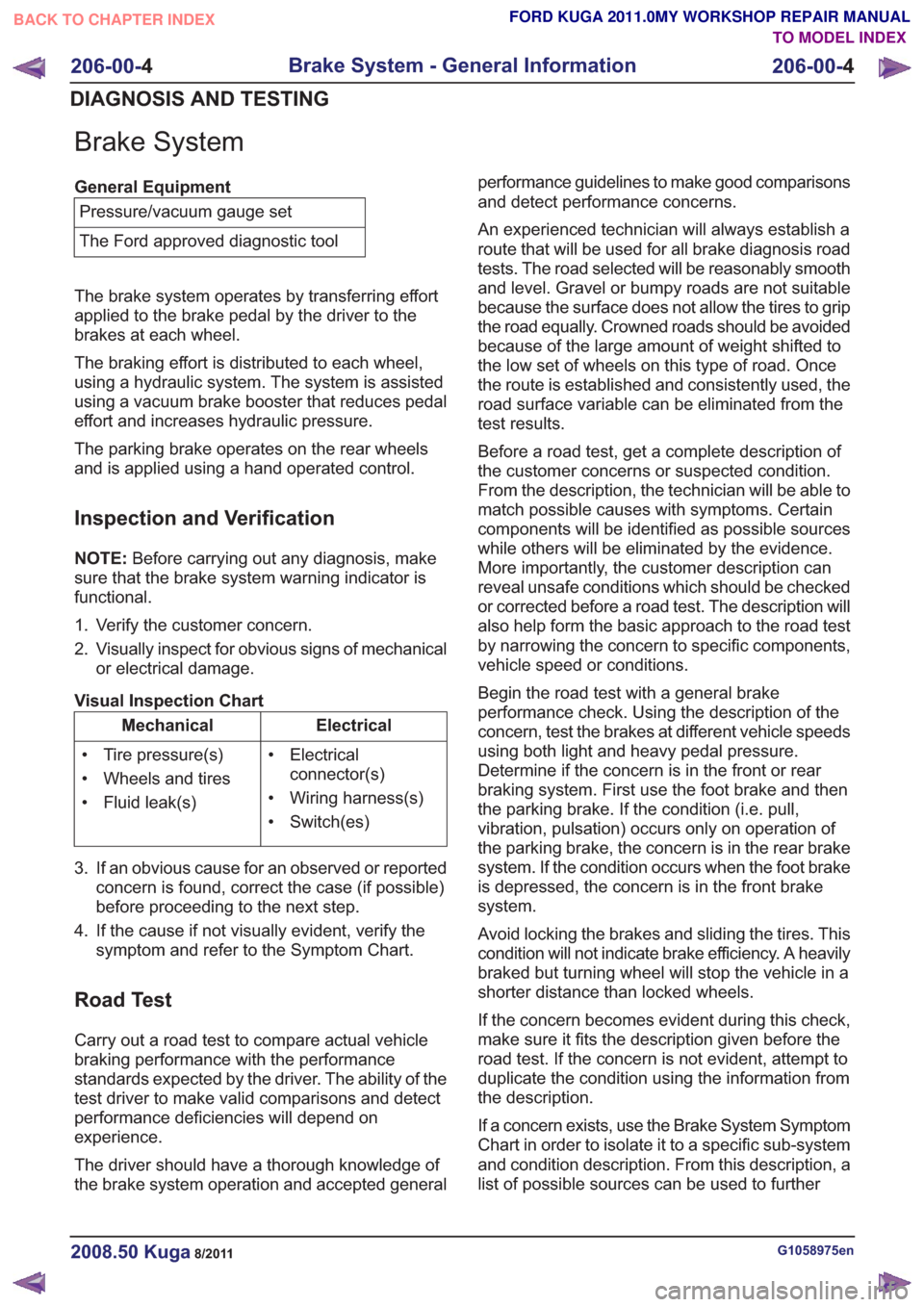
Brake System
General EquipmentPressure/vacuum gauge set
The Ford approved diagnostic tool
The brake system operates by transferring effort
applied to the brake pedal by the driver to the
brakes at each wheel.
The braking effort is distributed to each wheel,
using a hydraulic system. The system is assisted
using a vacuum brake booster that reduces pedal
effort and increases hydraulic pressure.
The parking brake operates on the rear wheels
and is applied using a hand operated control.
Inspection and Verification
NOTE: Before carrying out any diagnosis, make
sure that the brake system warning indicator is
functional.
1. Verify the customer concern.
2. Visually inspect for obvious signs of mechanical or electrical damage.
Visual Inspection Chart
Electrical
Mechanical
• Electricalconnector(s)
• Wiring harness(s)
• Switch(es)
• Tire pressure(s)
• Wheels and tires
• Fluid leak(s)
3. If an obvious cause for an observed or reported concern is found, correct the case (if possible)
before proceeding to the next step.
4. If the cause if not visually evident, verify the symptom and refer to the Symptom Chart.
Road Test
Carry out a road test to compare actual vehicle
braking performance with the performance
standards expected by the driver. The ability of the
test driver to make valid comparisons and detect
performance deficiencies will depend on
experience.
The driver should have a thorough knowledge of
the brake system operation and accepted general performance guidelines to make good comparisons
and detect performance concerns.
An experienced technician will always establish a
route that will be used for all brake diagnosis road
tests. The road selected will be reasonably smooth
and level. Gravel or bumpy roads are not suitable
because the surface does not allow the tires to grip
the road equally. Crowned roads should be avoided
because of the large amount of weight shifted to
the low set of wheels on this type of road. Once
the route is established and consistently used, the
road surface variable can be eliminated from the
test results.
Before a road test, get a complete description of
the customer concerns or suspected condition.
From the description, the technician will be able to
match possible causes with symptoms. Certain
components will be identified as possible sources
while others will be eliminated by the evidence.
More importantly, the customer description can
reveal unsafe conditions which should be checked
or corrected before a road test. The description will
also help form the basic approach to the road test
by narrowing the concern to specific components,
vehicle speed or conditions.
Begin the road test with a general brake
performance check. Using the description of the
concern, test the brakes at different vehicle speeds
using both light and heavy pedal pressure.
Determine if the concern is in the front or rear
braking system. First use the foot brake and then
the parking brake. If the condition (i.e. pull,
vibration, pulsation) occurs only on operation of
the parking brake, the concern is in the rear brake
system. If the condition occurs when the foot brake
is depressed, the concern is in the front brake
system.
Avoid locking the brakes and sliding the tires. This
condition will not indicate brake efficiency. A heavily
braked but turning wheel will stop the vehicle in a
shorter distance than locked wheels.
If the concern becomes evident during this check,
make sure it fits the description given before the
road test. If the concern is not evident, attempt to
duplicate the condition using the information from
the description.
If a concern exists, use the Brake System Symptom
Chart in order to isolate it to a specific sub-system
and condition description. From this description, a
list of possible sources can be used to further
G1058975en2008.50 Kuga8/2011
206-00-
4
Brake System - General Information
206-00- 4
DIAGNOSIS AND TESTING
TO MODEL INDEX
BACK TO CHAPTER INDEX
FORD KUGA 2011.0MY WORKSHOP REPAIR MANUAL
Page 1343 of 2057
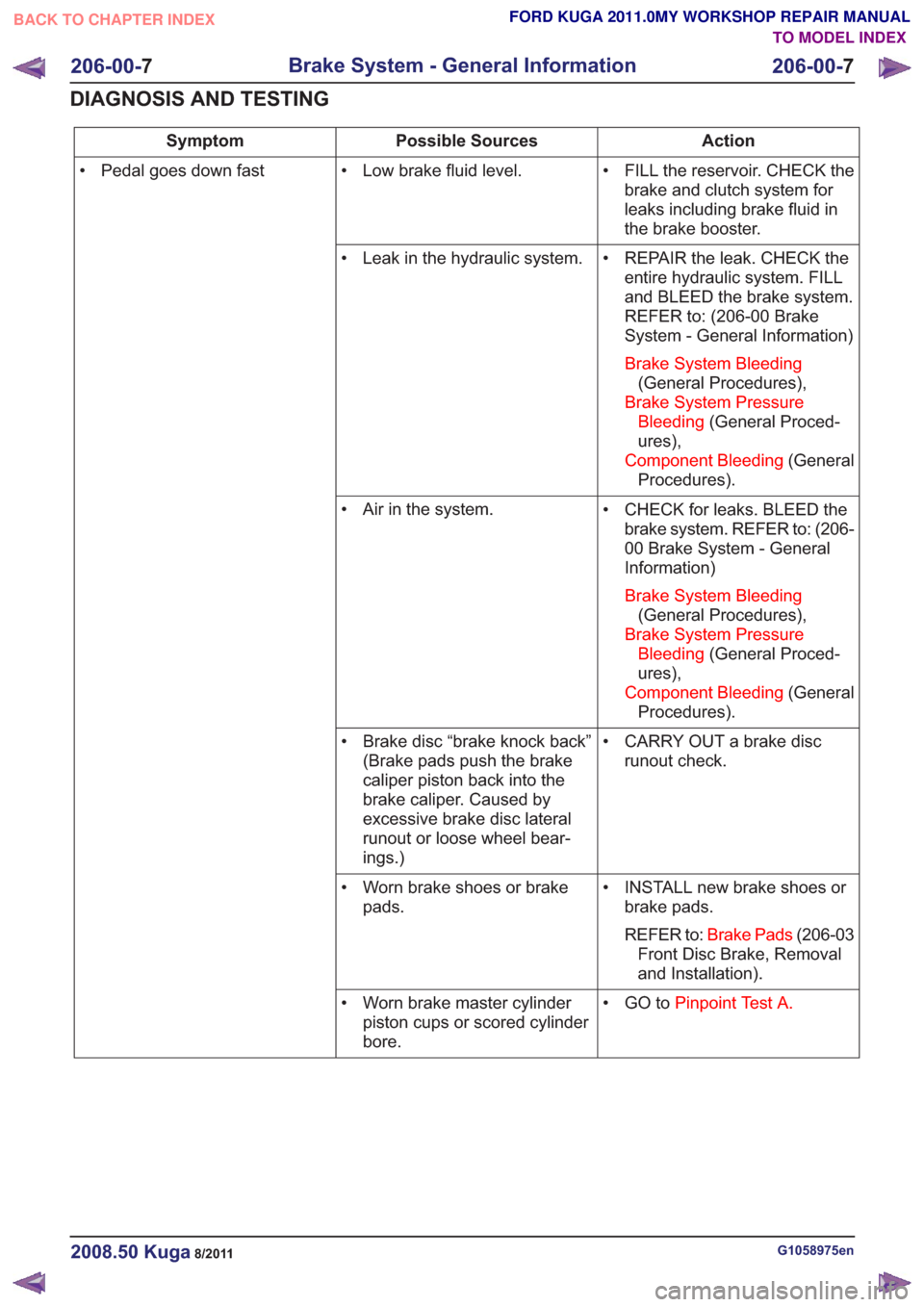
Action
Possible Sources
Symptom
• FILL the reservoir. CHECK thebrake and clutch system for
leaks including brake fluid in
the brake booster.
• Low brake fluid level.
• Pedal goes down fast
• REPAIR the leak. CHECK theentire hydraulic system. FILL
and BLEED the brake system.
REFER to: (206-00 Brake
System - General Information)
Brake System Bleeding (General Procedures),
Brake System Pressure Bleeding (General Proced-
ures),
Component Bleeding (General
Procedures).
• Leak in the hydraulic system.
• CHECK for leaks. BLEED thebrake system. REFER to: (206-
00 Brake System - General
Information)
Brake System Bleeding (General Procedures),
Brake System Pressure Bleeding (General Proced-
ures),
Component Bleeding (General
Procedures).
• Air in the system.
• CARRY OUT a brake discrunout check.
• Brake disc “brake knock back”
(Brake pads push the brake
caliper piston back into the
brake caliper. Caused by
excessive brake disc lateral
runout or loose wheel bear-
ings.)
• INSTALL new brake shoes orbrake pads.
REFER to: Brake Pads (206-03
Front Disc Brake, Removal
and Installation).
• Worn brake shoes or brake
pads.
• GO toPinpoint Test A.
• Worn brake master cylinder
piston cups or scored cylinder
bore.
G1058975en2008.50 Kuga8/2011
206-00- 7
Brake System - General Information
206-00- 7
DIAGNOSIS AND TESTING
TO MODEL INDEX
BACK TO CHAPTER INDEX
FORD KUGA 2011.0MY WORKSHOP REPAIR MANUAL
Page 1344 of 2057
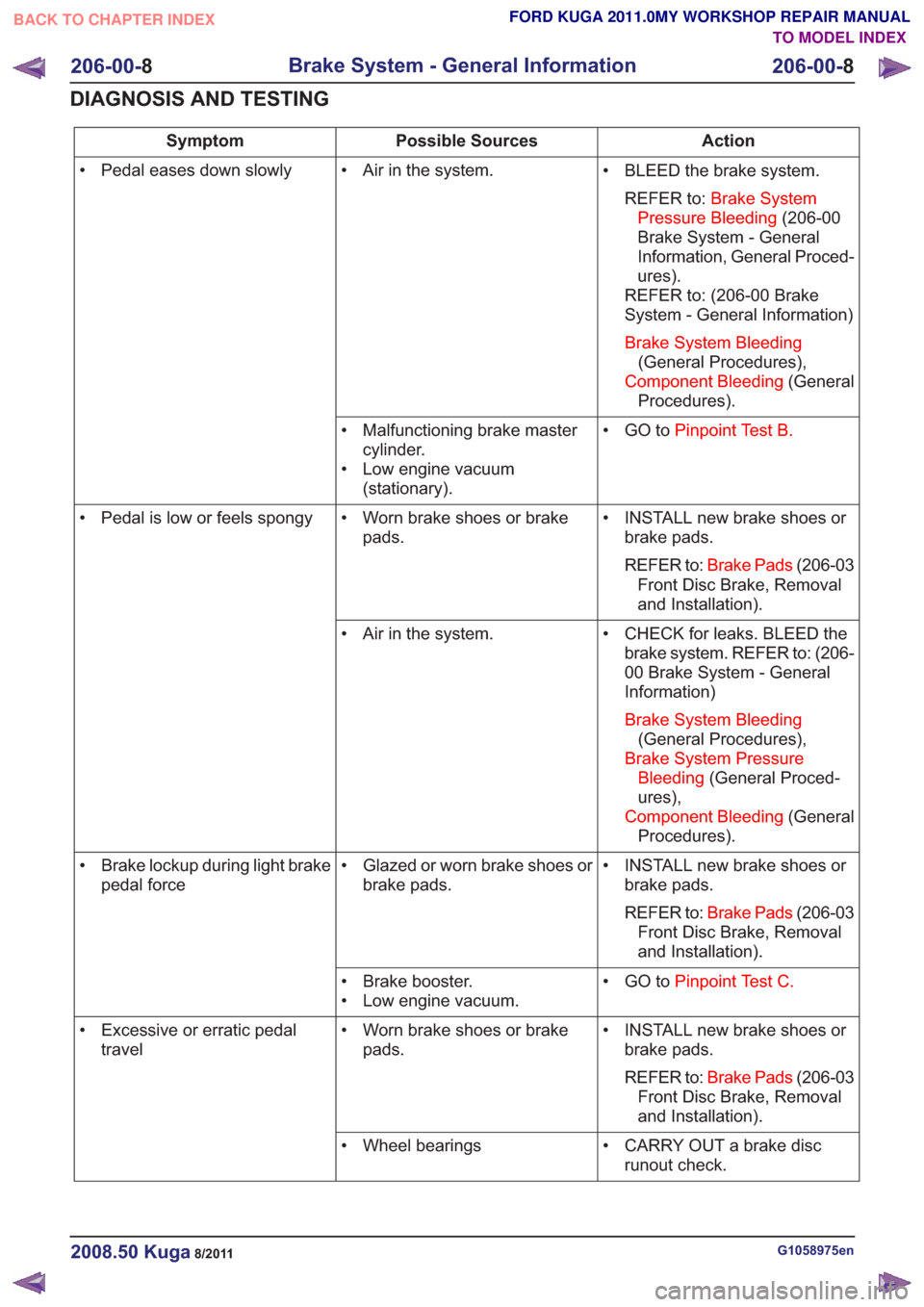
Action
Possible Sources
Symptom
• BLEED the brake system.REFER to: Brake System
Pressure Bleeding (206-00
Brake System - General
Information, General Proced-
ures).
REFER to: (206-00 Brake
System - General Information)
Brake System Bleeding (General Procedures),
Component Bleeding (General
Procedures).
• Air in the system.
• Pedal eases down slowly
• GO toPinpoint Test B.
• Malfunctioning brake master
cylinder.
• Low engine vacuum (stationary).
• INSTALL new brake shoes orbrake pads.
REFER to: Brake Pads (206-03
Front Disc Brake, Removal
and Installation).
• Worn brake shoes or brake
pads.
• Pedal is low or feels spongy
• CHECK for leaks. BLEED thebrake system. REFER to: (206-
00 Brake System - General
Information)
Brake System Bleeding (General Procedures),
Brake System Pressure Bleeding (General Proced-
ures),
Component Bleeding (General
Procedures).
• Air in the system.
• INSTALL new brake shoes orbrake pads.
REFER to: Brake Pads (206-03
Front Disc Brake, Removal
and Installation).
• Glazed or worn brake shoes or
brake pads.
• Brake lockup during light brake
pedal force
• GO toPinpoint Test C.
• Brake booster.
• Low engine vacuum.
• INSTALL new brake shoes orbrake pads.
REFER to: Brake Pads (206-03
Front Disc Brake, Removal
and Installation).
• Worn brake shoes or brake
pads.
• Excessive or erratic pedal
travel
• CARRY OUT a brake discrunout check.
• Wheel bearings
G1058975en2008.50 Kuga8/2011
206-00-
8
Brake System - General Information
206-00- 8
DIAGNOSIS AND TESTING
TO MODEL INDEX
BACK TO CHAPTER INDEX
FORD KUGA 2011.0MY WORKSHOP REPAIR MANUAL
Page 1346 of 2057
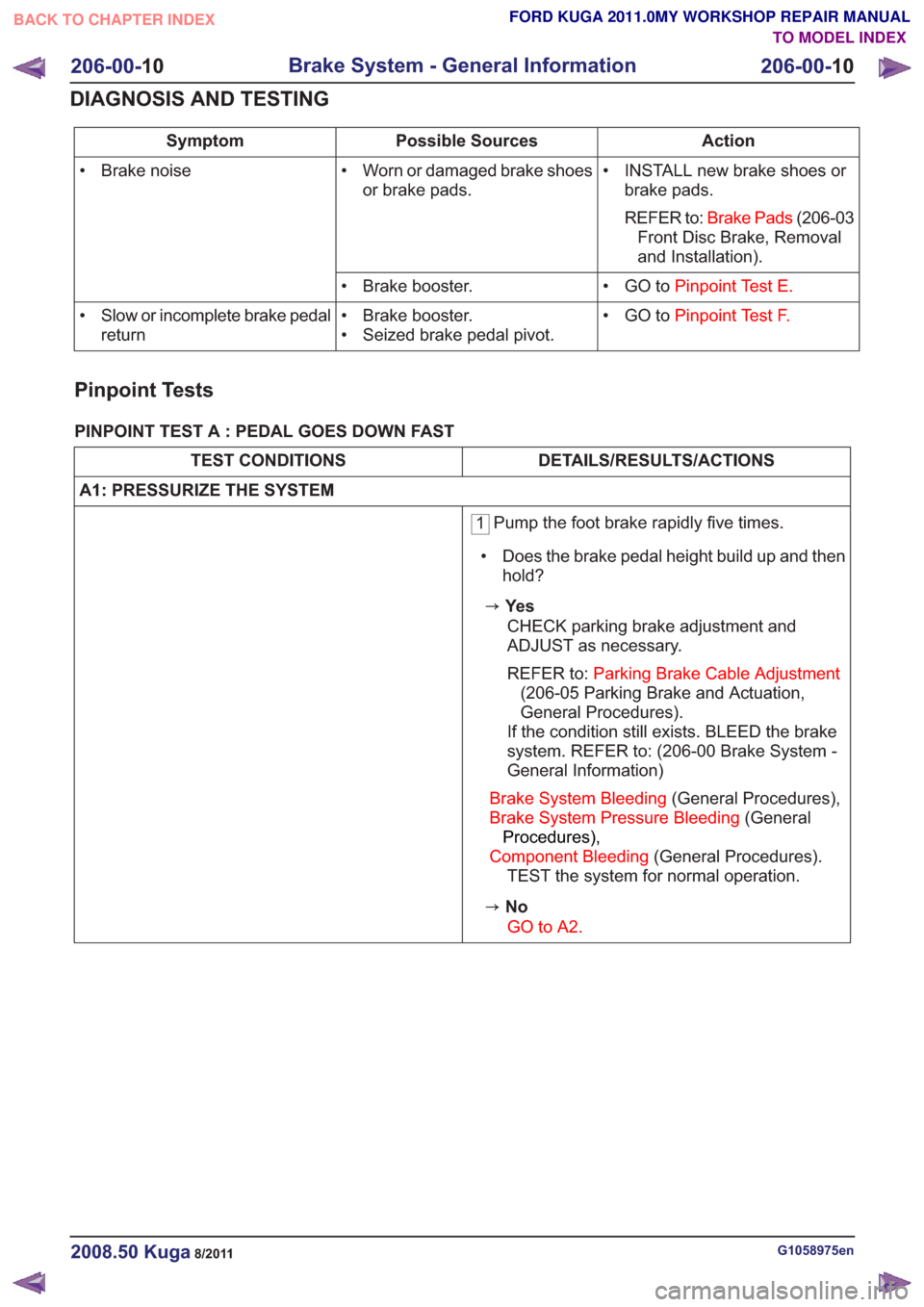
Action
Possible Sources
Symptom
• INSTALL new brake shoes orbrake pads.
REFER to: Brake Pads (206-03
Front Disc Brake, Removal
and Installation).
• Worn or damaged brake shoes
or brake pads.
• Brake noise
• GO toPinpoint Test E.
• Brake booster.
• GO toPinpoint Test F.
• Brake booster.
• Seized brake pedal pivot.
• Slow or incomplete brake pedal
return
Pinpoint Tests
PINPOINT TEST A : PEDAL GOES DOWN FAST
DETAILS/RESULTS/ACTIONS
TEST CONDITIONS
A1: PRESSURIZE THE SYSTEM
1 Pump the foot brake rapidly five times.
• Does the brake pedal height build up and then hold?
zYe s
CHECK parking brake adjustment and
ADJUST as necessary.
REFER to: Parking Brake Cable Adjustment
(206-05 Parking Brake and Actuation,
General Procedures).
If the condition still exists. BLEED the brake
system. REFER to: (206-00 Brake System -
General Information)
Brake System Bleeding (General Procedures),
Brake System Pressure Bleeding (General
Procedures),
Component Bleeding (General Procedures).
TEST the system for normal operation.
zNo
GO to A2.
G1058975en2008.50 Kuga8/2011
206-00- 10
Brake System - General Information
206-00- 10
DIAGNOSIS AND TESTING
TO MODEL INDEX
BACK TO CHAPTER INDEX
FORD KUGA 2011.0MY WORKSHOP REPAIR MANUAL
Page 1347 of 2057
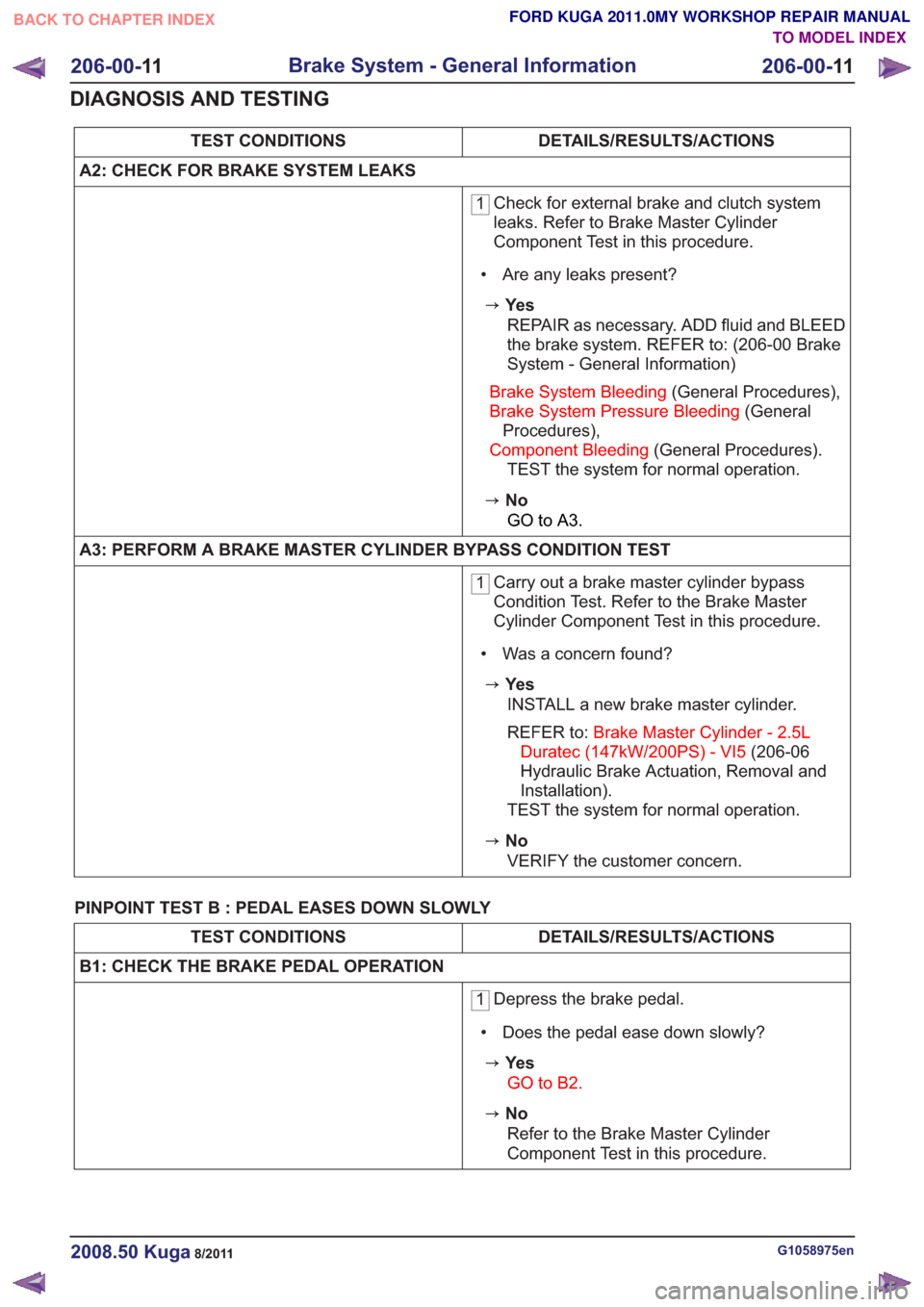
DETAILS/RESULTS/ACTIONS
TEST CONDITIONS
A2: CHECK FOR BRAKE SYSTEM LEAKS
1 Check for external brake and clutch system
leaks. Refer to Brake Master Cylinder
Component Test in this procedure.
• Are any leaks present?
zYe s REPAIR as necessary. ADD fluid and BLEED
the brake system. REFER to: (206-00 Brake
System - General Information)
Brake System Bleeding (General Procedures),
Brake System Pressure Bleeding (General
Procedures),
Component Bleeding (General Procedures).
TEST the system for normal operation.
zNo
GO to A3.
A3: PERFORM A BRAKE MASTER CYLINDER BYPASS CONDITION TEST
1 Carry out a brake master cylinder bypass
Condition Test. Refer to the Brake Master
Cylinder Component Test in this procedure.
• Was a concern found?
zYe s INSTALL a new brake master cylinder.
REFER to: Brake Master Cylinder - 2.5L
Duratec (147kW/200PS) - VI5 (206-06
Hydraulic Brake Actuation, Removal and
Installation).
TEST the system for normal operation.
zNo
VERIFY the customer concern.
PINPOINT TEST B : PEDAL EASES DOWN SLOWLY
DETAILS/RESULTS/ACTIONS
TEST CONDITIONS
B1: CHECK THE BRAKE PEDAL OPERATION
1 Depress the brake pedal.
• Does the pedal ease down slowly?
zYe s GO to B2.
zNoRefer to the Brake Master Cylinder
Component Test in this procedure.
G1058975en2008.50 Kuga8/2011
206-00- 11
Brake System - General Information
206-00- 11
DIAGNOSIS AND TESTING
TO MODEL INDEX
BACK TO CHAPTER INDEX
FORD KUGA 2011.0MY WORKSHOP REPAIR MANUAL
Page 1348 of 2057
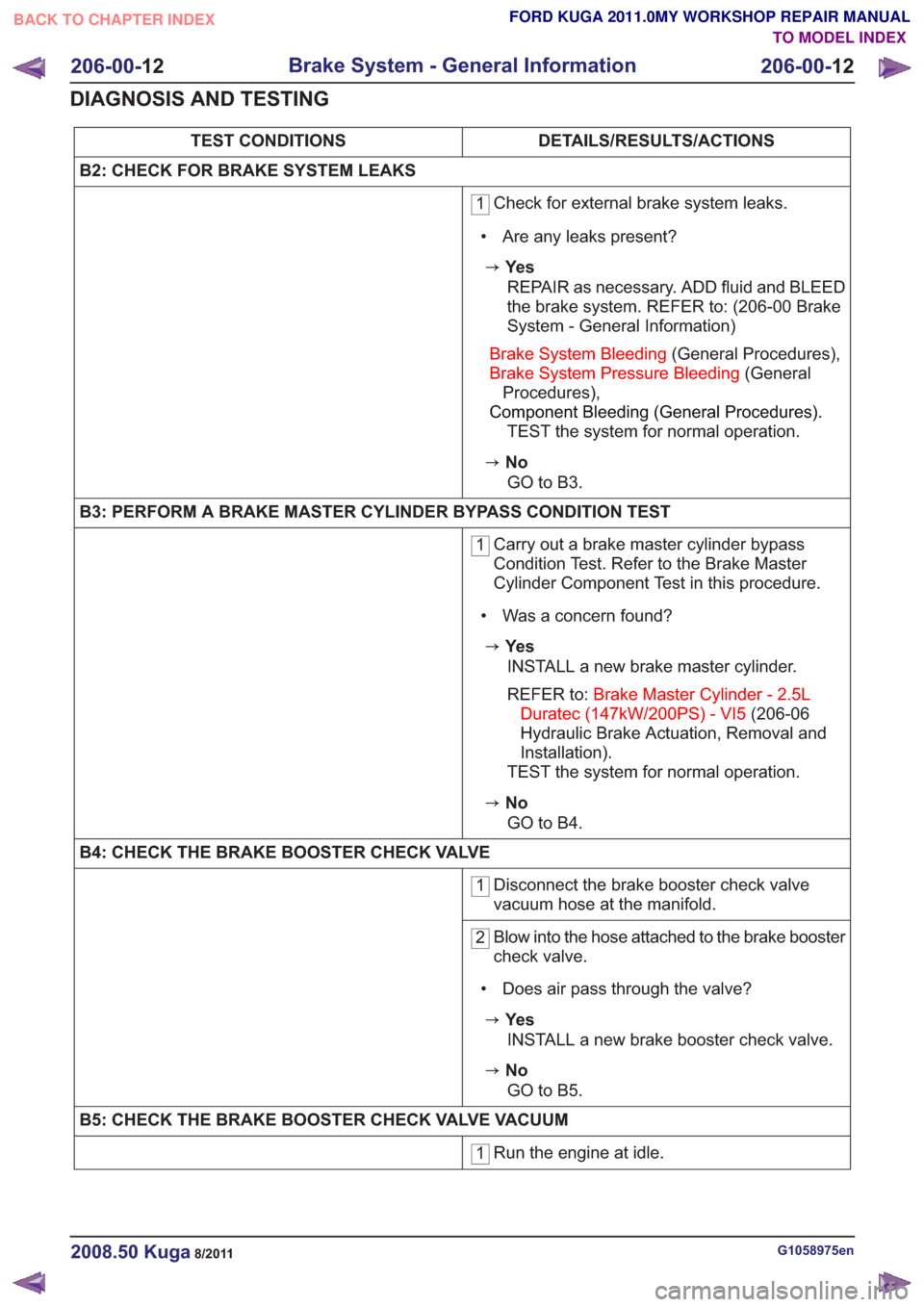
DETAILS/RESULTS/ACTIONS
TEST CONDITIONS
B2: CHECK FOR BRAKE SYSTEM LEAKS
1 Check for external brake system leaks.
• Are any leaks present?
zYe s REPAIR as necessary. ADD fluid and BLEED
the brake system. REFER to: (206-00 Brake
System - General Information)
Brake System Bleeding (General Procedures),
Brake System Pressure Bleeding (General
Procedures),
Component Bleeding (General Procedures).
TEST the system for normal operation.
zNo
GO to B3.
B3: PERFORM A BRAKE MASTER CYLINDER BYPASS CONDITION TEST
1 Carry out a brake master cylinder bypass
Condition Test. Refer to the Brake Master
Cylinder Component Test in this procedure.
• Was a concern found?
zYe s INSTALL a new brake master cylinder.
REFER to: Brake Master Cylinder - 2.5L
Duratec (147kW/200PS) - VI5 (206-06
Hydraulic Brake Actuation, Removal and
Installation).
TEST the system for normal operation.
zNo
GO to B4.
B4: CHECK THE BRAKE BOOSTER CHECK VALVE
1 Disconnect the brake booster check valve
vacuum hose at the manifold.
2Blow into the hose attached to the brake booster
check valve.
• Does air pass through the valve?
zYe s INSTALL a new brake booster check valve.
zNoGO to B5.
B5: CHECK THE BRAKE BOOSTER CHECK VALVE VACUUM
1 Run the engine at idle.
G1058975en2008.50 Kuga8/2011
206-00-
12
Brake System - General Information
206-00- 12
DIAGNOSIS AND TESTING
TO MODEL INDEX
BACK TO CHAPTER INDEX
FORD KUGA 2011.0MY WORKSHOP REPAIR MANUAL
Page 1349 of 2057
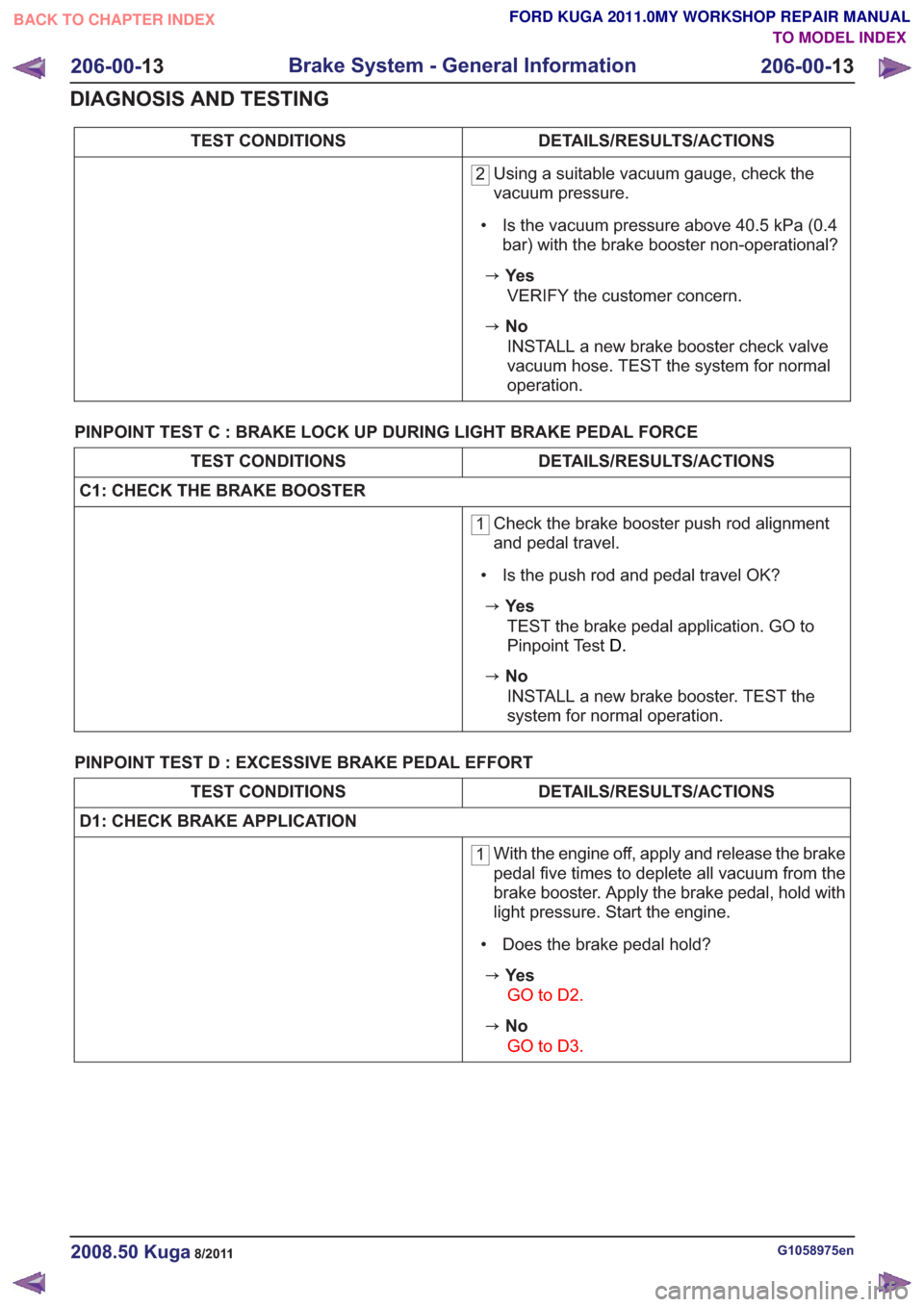
DETAILS/RESULTS/ACTIONS
TEST CONDITIONS
2 Using a suitable vacuum gauge, check the
vacuum pressure.
• Is the vacuum pressure above 40.5 kPa (0.4 bar) with the brake booster non-operational?
zYe s
VERIFY the customer concern.
zNoINSTALL a new brake booster check valve
vacuum hose. TEST the system for normal
operation.
PINPOINT TEST C : BRAKE LOCK UP DURING LIGHT BRAKE PEDAL FORCE
DETAILS/RESULTS/ACTIONS
TEST CONDITIONS
C1: CHECK THE BRAKE BOOSTER
1 Check the brake booster push rod alignment
and pedal travel.
• Is the push rod and pedal travel OK?
zYe s TEST the brake pedal application. GO to
Pinpoint Test D.
zNo
INSTALL a new brake booster. TEST the
system for normal operation.
PINPOINT TEST D : EXCESSIVE BRAKE PEDAL EFFORT
DETAILS/RESULTS/ACTIONS
TEST CONDITIONS
D1: CHECK BRAKE APPLICATION
1 With the engine off, apply and release the brake
pedal five times to deplete all vacuum from the
brake booster. Apply the brake pedal, hold with
light pressure. Start the engine.
• Does the brake pedal hold?
zYe s GO to D2 .
zNo
GO to D3 .
G1058975en2008.50 Kuga8/2011
206-00-13
Brake System - General Information
206-00- 13
DIAGNOSIS AND TESTING
TO MODEL INDEX
BACK TO CHAPTER INDEX
FORD KUGA 2011.0MY WORKSHOP REPAIR MANUAL
Page 1351 of 2057
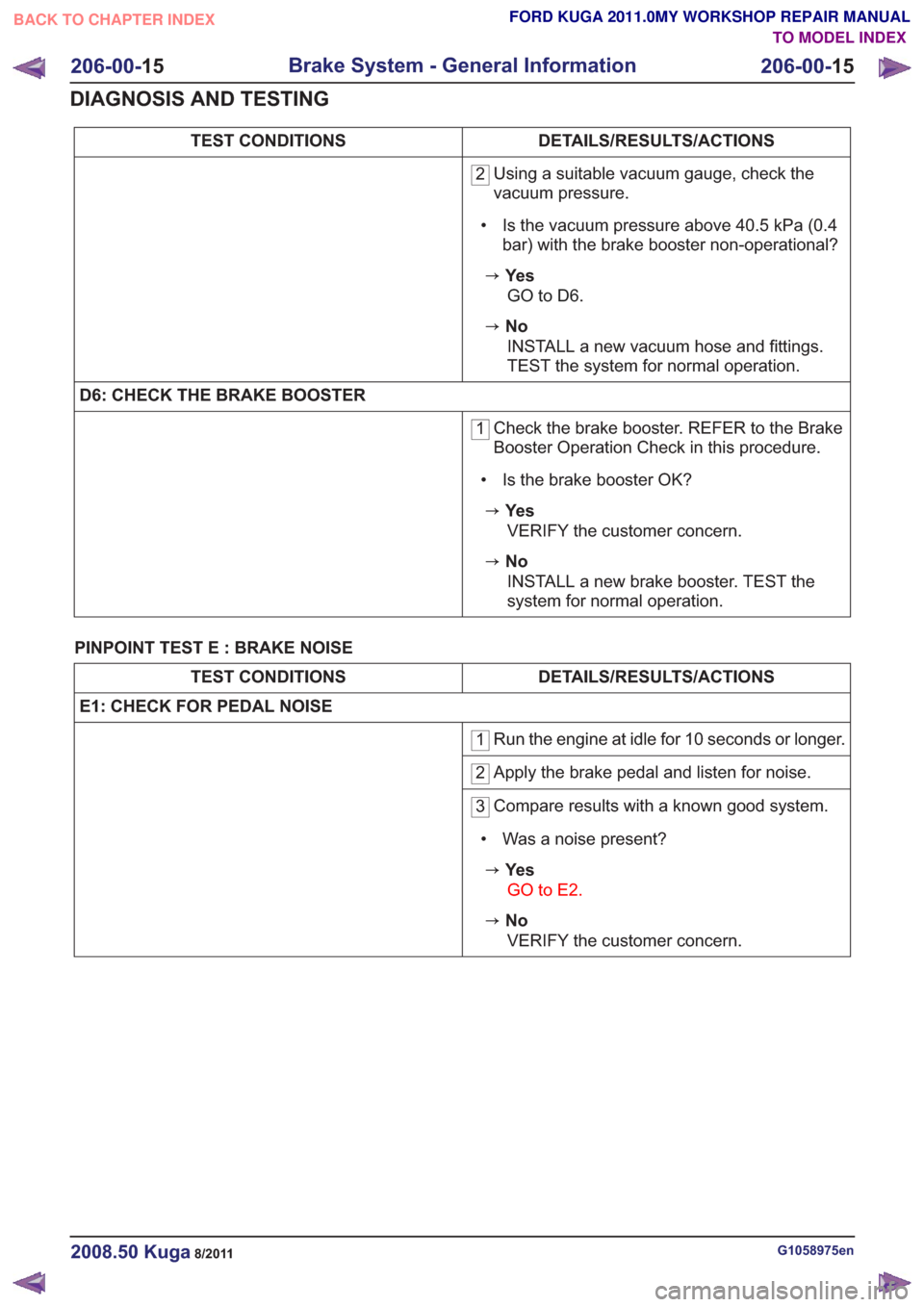
DETAILS/RESULTS/ACTIONS
TEST CONDITIONS
2 Using a suitable vacuum gauge, check the
vacuum pressure.
• Is the vacuum pressure above 40.5 kPa (0.4 bar) with the brake booster non-operational?
zYe s
GO to D6 .
zNo
INSTALL a new vacuum hose and fittings.
TEST the system for normal operation.
D6: CHECK THE BRAKE BOOSTER
1 Check the brake booster. REFER to the Brake
Booster Operation Check in this procedure.
• Is the brake booster OK?
zYe s VERIFY the customer concern.
zNoINSTALL a new brake booster. TEST the
system for normal operation.
PINPOINT TEST E : BRAKE NOISE
DETAILS/RESULTS/ACTIONS
TEST CONDITIONS
E1: CHECK FOR PEDAL NOISE
1 Run the engine at idle for 10 seconds or longer.
2Apply the brake pedal and listen for noise.
3Compare results with a known good system.
• Was a noise present?
zYe s GO to E2.
zNoVERIFY the customer concern.
G1058975en2008.50 Kuga8/2011
206-00- 15
Brake System - General Information
206-00- 15
DIAGNOSIS AND TESTING
TO MODEL INDEX
BACK TO CHAPTER INDEX
FORD KUGA 2011.0MY WORKSHOP REPAIR MANUAL
Page 1352 of 2057
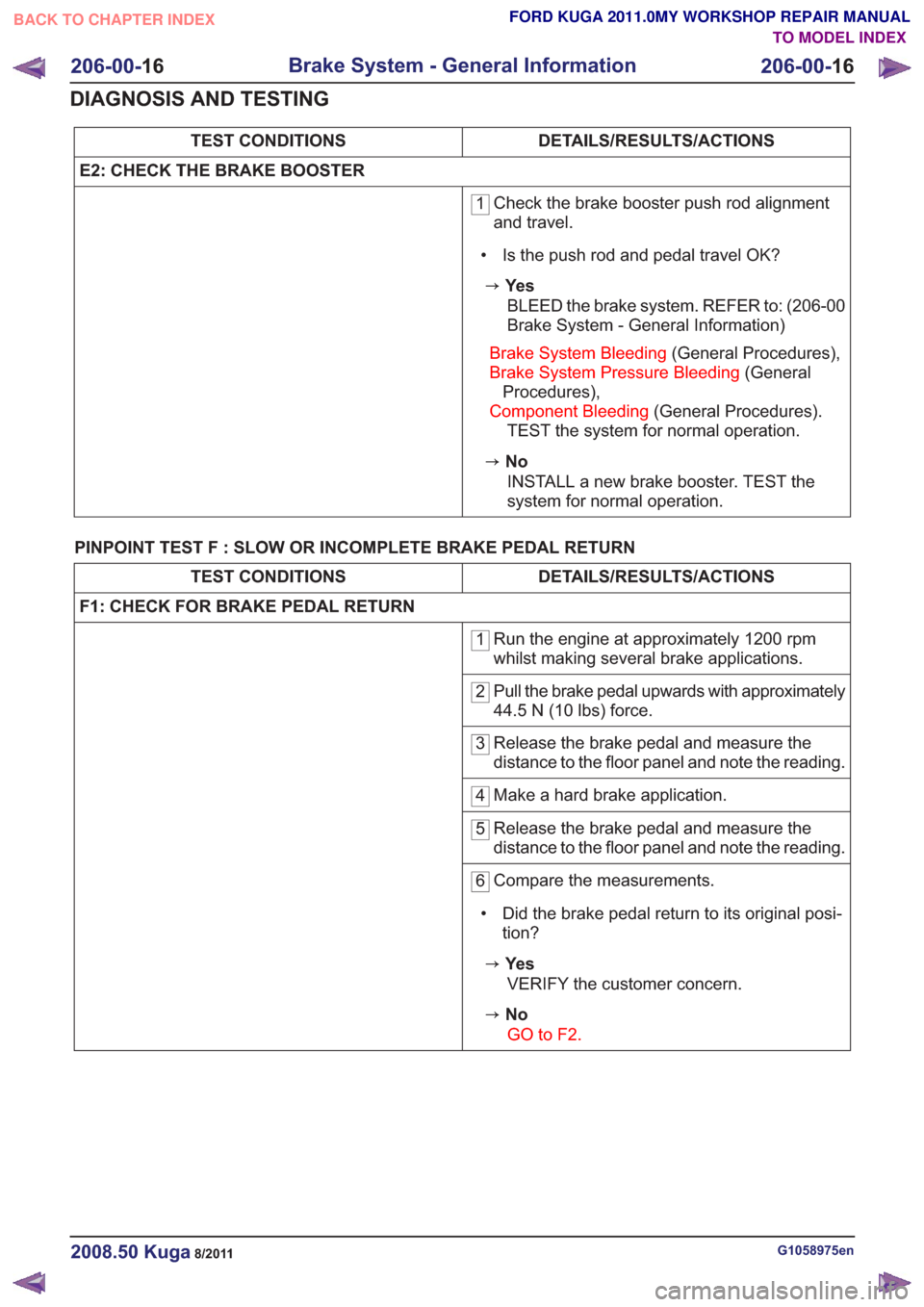
DETAILS/RESULTS/ACTIONS
TEST CONDITIONS
E2: CHECK THE BRAKE BOOSTER
1 Check the brake booster push rod alignment
and travel.
• Is the push rod and pedal travel OK?
zYe s BLEED the brake system. REFER to: (206-00
Brake System - General Information)
Brake System Bleeding (General Procedures),
Brake System Pressure Bleeding (General
Procedures),
Component Bleeding (General Procedures).
TEST the system for normal operation.
zNo
INSTALL a new brake booster. TEST the
system for normal operation.
PINPOINT TEST F : SLOW OR INCOMPLETE BRAKE PEDAL RETURN
DETAILS/RESULTS/ACTIONS
TEST CONDITIONS
F1: CHECK FOR BRAKE PEDAL RETURN
1 Run the engine at approximately 1200 rpm
whilst making several brake applications.
2Pull the brake pedal upwards with approximately
44.5 N (10 lbs) force.
3Release the brake pedal and measure the
distance to the floor panel and note the reading.
4Make a hard brake application.
5Release the brake pedal and measure the
distance to the floor panel and note the reading.
6Compare the measurements.
• Did the brake pedal return to its original posi- tion?
zYe s
VERIFY the customer concern.
zNoGO to F2.
G1058975en2008.50 Kuga8/2011
206-00- 16
Brake System - General Information
206-00- 16
DIAGNOSIS AND TESTING
TO MODEL INDEX
BACK TO CHAPTER INDEX
FORD KUGA 2011.0MY WORKSHOP REPAIR MANUAL