oil level FORD MUSTANG 1969 Volume One Chassis
[x] Cancel search | Manufacturer: FORD, Model Year: 1969, Model line: MUSTANG, Model: FORD MUSTANG 1969Pages: 413, PDF Size: 75.81 MB
Page 226 of 413
04-03-06
Rear Axles — Integral Carrier Type
04-03-06
9. Install a new integral nut and
ivasher on the pinion shaft. (Apply a
small amount of lubricant on the
washer side of the nut.)
10.
Hold the flange with the tool
shown in Fig. 9 while the nut is being
tightened.
11.
Tighten the pinion shaft nut,
rotating the pinion occasionally to in-
sure proper bearing seating, (Fig. 6)
and take frequent preload readings
until the preload is at the original rec-
orded reading established in step 3.
12.
After original preload has been
reached, tighten the pinion nut slowly,
until an additional preload of 6 to 12
in-lbs has been added.
The preload should not exceed the
amount shown above, or bearing fail-
ure may result.
Under no circumstances should the
pinion nut be backed off to lessen pre-
load. If this is done, a new pinion
bearing spacer must be installed. (In
addition, the U-joint flange must
never be hammered on, or pneumatic-
-tools used.)
13.
Remove the oil seal replacer
tool from the transmission extension
housing. Install the front end of the
drive shaft on the transmission output
shaft.
14.
Connect the rear end of the
drive shaft to the axle U-joint flange,
aligning the scribe marks made on the
drive shaft end yoke and the axle U-
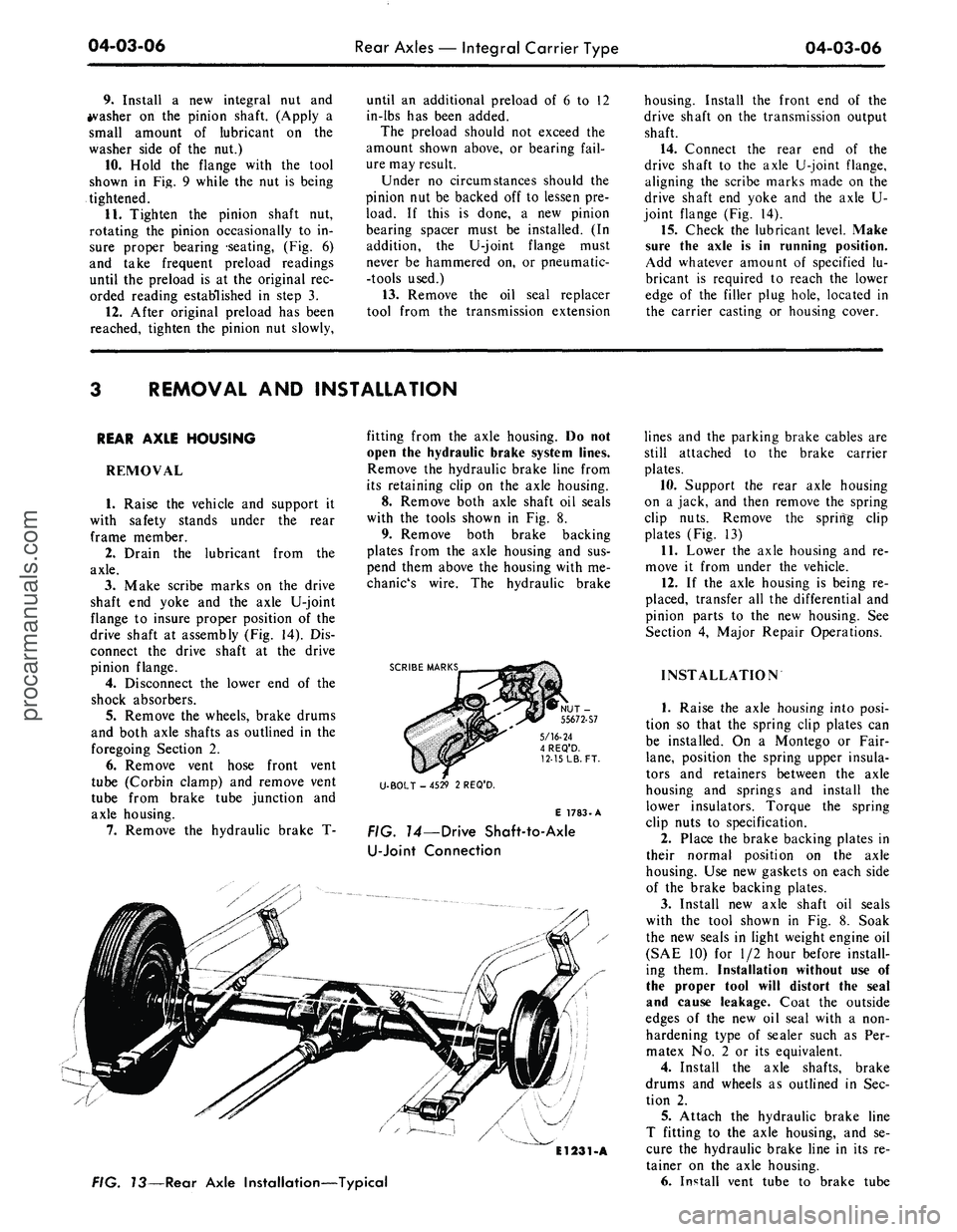
joint flange (Fig. 14).
15.
Check the lubricant level. Make
sure the axle is in running position.
Add whatever amount of specified lu-
bricant is required to reach the lower
edge of the filler plug hole, located in
the carrier casting or housing cover.
REMOVAL AND INSTALLATION
REAR AXLE HOUSING
REMOVAL
1.
Raise the vehicle and support it
with safety stands under the rear
frame member.
2.
Drain the lubricant from the
axle.
3.
Make scribe marks on the drive
shaft end yoke and the axle U-joint
flange to insure proper position of the
drive shaft at assembly (Fig. 14). Dis-
connect the drive shaft at the drive
pinion flange.
4.
Disconnect the lower end of the
shock absorbers.
5.
Remove the wheels, brake drums
and both axle shafts as outlined in the
foregoing Section 2.
6. Remove vent hose front vent
tube (Corbin clamp) and remove vent
tube from brake tube junction and
axle housing.
7.
Remove the hydraulic brake T-
fitting from the axle housing. Do not
open the hydraulic brake system lines.
Remove the hydraulic brake line from
its retaining clip on the axle housing.
8. Remove both axle shaft oil seals
with the tools shown in Fig. 8.
9. Remove both brake backing
plates from the axle housing and sus-
pend them above the housing with me-
chanic's wire. The hydraulic brake
SCRIBE MARKS
5/16-24
4 REQ'D.
12-15
LB.
FT.
U-BOLT - 4529 2 REQ'D.
E 1783-A
FIG. 14—Drive Shaft-to-Axle
U-Joint
Connection
El231-A
FIG. 73—Rear Axle Installation—Typical
lines and the parking brake cables are
still attached to the brake carrier
plates.
10.
Support the rear axle housing
on a jack, and then remove the spring
clip nuts. Remove the spring clip
plates (Fig. 13)
11.
Lower the axle housing and re-
move it from under the vehicle.
12.
If the axle housing is being re-
placed, transfer all the differential and
pinion parts to the new housing. See
Section 4, Major Repair Operations.
INSTALLATION
1.
Raise the axle housing into posi-
tion so that the spring clip plates can
be installed. On a Montego or Fair-
lane,
position the spring upper insula-
tors and retainers between the axle
housing and springs and install the
lower insulators. Torque the spring
clip nuts to specification.
2.
Place the brake backing plates in
their normal position on the axle
housing. Use new gaskets on each side
of the brake backing plates.
3.
Install new axle shaft oil seals
with the tool shown in Fig. 8. Soak
the new seals in light weight engine oil
(SAE 10) for 1/2 hour before install-
ing them. Installation without use of
the proper tool will distort the seal
and cause leakage. Coat the outside
edges of the new oil seal with a non-
hardening type of sealer such as Per-
matex No. 2 or its equivalent.
4.
Install the axle shafts, brake
drums and wheels as outlined in Sec-
tion 2.
5.
Attach the hydraulic brake line
T fitting to the axle housing, and se-
cure the hydraulic brake line in its re-
tainer on the axle housing.
6. Install vent tube to brake tubeprocarmanuals.com
Page 230 of 413
04-03-10
Rear Axles
—
Integral Carrier Type
04-03-10
in
the
case. Drive
the
shaft into place
and install
the
lock
pin
(Fig.
21).
6. Place
the
ring gear
on the
differ-
ential case
and
install
the
bolts.
Tor-
que
the
bolts
to
specification.
7.
If the
differential bearings have
been removed, press them
on as
shown (Fig.
24).
INSTALLATION
OF
DRIVE
PINION
AND
DIFFERENTIAL
CASE
1.
Place
the
shim
and
pinion rear
bearing cone
on the
pinion shaft.
Press
the
bearing
and
shim firmly
against
the
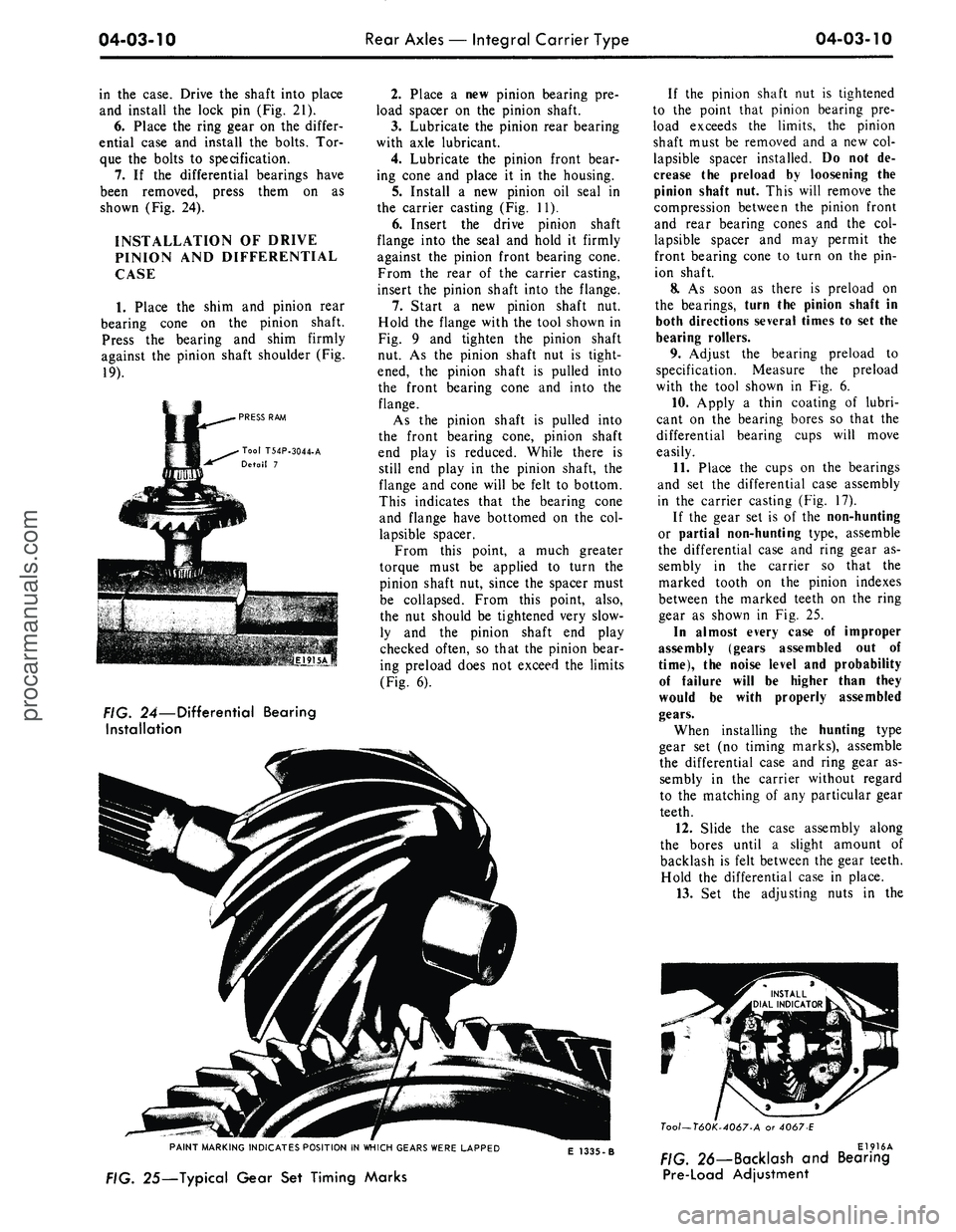
pinion shaft shoulder (Fig.
19).
PRESS RAM
Tool T54P-3044-A
Detail
7
2.
Place
a new
pinion bearing
pre-
load spacer
on the
pinion shaft.
3.
Lubricate
the
pinion rear bearing
with axle lubricant.
4.
Lubricate
the
pinion front bear-
ing cone
and
place
it in the
housing.
5.
Install
a new
pinion
oil
seal
in
the carrier casting (Fig.
11).
6. Insert
the
drive pinion shaft
flange into
the
seal
and
hold
it
firmly
against
the
pinion front bearing cone.
From
the
rear
of the
carrier casting,
insert
the
pinion shaft into
the
flange.
7.
Start
a new
pinion shaft
nut.
Hold
the
flange with
the
tool shown
in
Fig.
9 and
tighten
the
pinion shaft
nut.
As the
pinion shaft
nut is
tight-
ened,
the
pinion shaft
is
pulled into
the front bearing cone
and
into
the
flange.
As
the
pinion shaft
is
pulled into
the front bearing cone, pinion shaft
end play
is
reduced. While there
is
still
end
play
in the
pinion shaft,
the
flange
and
cone will
be
felt
to
bottom.
This indicates that
the
bearing cone
and flange have bottomed
on the col-
lapsible spacer.
From this point,
a
much greater
torque must
be
applied
to
turn
the
pinion shaft
nut,
since
the
spacer must
be collapsed. From this point, also,
the
nut
should
be
tightened very slow-
ly
and the
pinion shaft
end
play
checked often,
so
that
the
pinion bear-
ing preload does
not
exceed
the
limits
(Fig.
6).
FIG. 24—Differential Bearing
Installation
If
the
pinion shaft
nut is
tightened
to
the
point that pinion bearing
pre-
load exceeds
the
limits,
the
pinion
shaft must
be
removed
and a
new
col-
lapsible spacer installed.
Do not de-
crease
the
preload
by
loosening
the
pinion shaft
nut.
This will remove
the
compression between
the
pinion front
and rear bearing cones
and the col-
lapsible spacer
and may
permit
the
front bearing cone
to
turn
on the pin-
ion shaft.
&
As
soon
as
there
is
preload
on
the bearings, turn
the
pinion shaft
in
both directions several times
to set the
bearing rollers.
9. Adjust
the
bearing preload
to
specification. Measure
the
preload
with
the
tool shown
in Fig. 6.
10.
Apply
a
thin coating
of
lubri-
cant
on the
bearing bores
so
that
the
differential bearing cups will move
easily.
11.
Place
the
cups
on the
bearings
and
set the
differential case assembly
in
the
carrier casting (Fig.
17).
If
the
gear
set is of the
non-hunting
or partial non-hunting type, assemble
the differential case
and
ring gear
as-
sembly
in the
carrier
so
that
the
marked tooth
on the
pinion indexes
between
the
marked teeth
on the
ring
gear
as
shown
in Fig. 25.
In almost every case
of
improper
assembly (gears assembled
out of
time),
the
noise level
and
probability
of failure will
be
higher than they
would
be
with properly assembled
gears.
When installing
the
hunting type
gear
set (no
timing marks), assemble
the differential case
and
ring gear
as-
sembly
in the
carrier without regard
to
the
matching
of any
particular gear
teeth.
12.
Slide
the
case assembly along
the bores until
a
slight amount
of
backlash
is
felt between
the
gear teeth.
Hold
the
differential case
in
place.
13.
Set the
adjusting nuts
in the
PAINT MARKING INDICATES POSITION
IN
WHICH GEARS WERE LAPPED
E 1335-B
FIG. 25—Typical Gear
Set
Timing Marks
7oo/—T60K-4067-A or 4067 E
E1916A
FIG. 26—Backlash
and
Bearing
Pre-Load Adjustmentprocarmanuals.com
Page 240 of 413
04-04-09
Rear Axle — Ford Light-Duty (WER)
04-04-09
case several revolutions in each direc-
tion while the bearings are loaded to
seat the bearings in their cups. This
step is important.
5. Again loosen the right nut to re-
lease the preload. Check to see that
the left nut contacts the bearing cup.
Using the dial indicator set-up shown
in Fig. 13, Part 4-1, adjust the preload
to 0.008 to 0.012 case spread for new
bearings or 0.005 to 0.008 for the
original bearings, if re-used.
6. Check the runout of the differen-
tial case flange with a dial indicator.
If the runout does not now exceed
specifications, install a new ring gear,
if the runout still exceeds specifica-
tions,
the ring gear is true and the
trouble is due to either a defective
casting or worn bearings.
7.
Remove the differential case
from the carrier and remove the side
bearings from the case.
8. Install new bearings on the case
hubs,
and again install the differential
assembly in the carrier without the
ring gear.
9. Check the case runout again with
the new bearings. If the runout is now
within limits, the old bearings were
excessively worn. Use the new bear-
ings for assembly. If the runout is still
excessive, the case is defective and
should be replaced.
ASSEMBLY OF AXLE
Refer to Part 4-1 of this Shop
Manual for Cleaning and Inspection
procedures before starting assembly
operations.
ASSEMBLY OF
DIFFERENTIAL CASE
1.
Place the ring gear on the differ-
ential case. Install the retaining bolts
and torque them to specification.
2.
If the differential bearings were
removed, press them on as shown in
Fig. 17.
3.
Insert the pinion gear shaft lock
bolt into the case (loosely).
INSTALLATION OF DRIVE
PINION AND
DIFFERENTIAL CASE
1.
Place the shim(s) and pinion rear
bearing cone on the pinion shaft.
Press the bearing and shim(s) firmly
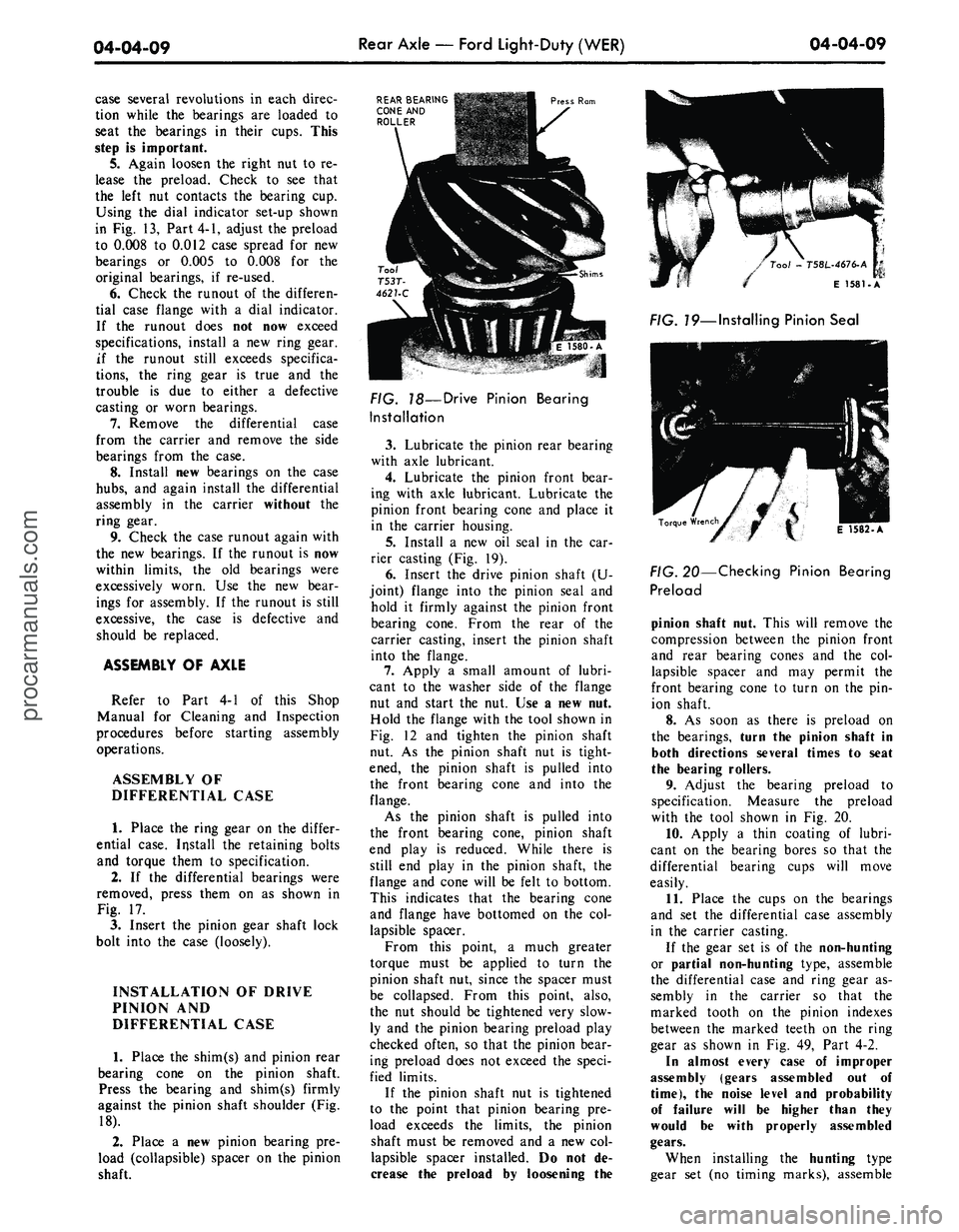
against the pinion shaft shoulder (Fig.
18).
2.
Place a new pinion bearing pre-
load (collapsible) spacer on the pinion
shaft.
REAR BEARING
CONE AND
ROLLER
Press Ram
FIG. 18—Drive Pinion Bearing
Installation
3.
Lubricate the pinion rear bearing
with axle lubricant.
4.
Lubricate the pinion front bear-
ing with axle lubricant. Lubricate the
pinion front bearing cone and place it
in the carrier housing.
5.
Install a new oil seal in the car-
rier casting (Fig. 19).
6. Insert the drive pinion shaft (U-
joint) flange into the pinion seal and
hold it firmly against the pinion front
bearing cone. From the rear of the
carrier casting, insert the pinion shaft
into the flange.
7.
Apply a small amount of lubri-
cant to the washer side of the flange
nut and start the nut. Use a new nut.
Hold the flange with the tool shown in
Fig. 12 and tighten the pinion shaft
nut. As the pinion shaft nut is tight-
ened, the pinion shaft is pulled into
the front bearing cone and into the
flange.
As the pinion shaft is pulled into
the front bearing cone, pinion shaft
end play is reduced. While there is
still end play in the pinion shaft, the
flange and cone will be felt to bottom.
This indicates that the bearing cone
and flange have bottomed on the col-
lapsible spacer.
From this point, a much greater
torque must be applied to turn the
pinion shaft nut, since the spacer must
be collapsed. From this point, also,
the nut should be tightened very slow-
ly and the pinion bearing preload play
checked often, so that the pinion bear-
ing preload does not exceed the speci-
fied limits.
If the pinion shaft nut is tightened
to the point that pinion bearing pre-
load exceeds the limits, the pinion
shaft must be removed and a new col-
lapsible spacer installed. Do not de-
crease the preload by loosening the
/
Tool
-
T58L-4676-A
/ E
1581-A
FIG. 19—Installing Pinion Seal
E 1582-A
FIG. 20—Checking Pinion Bearing
Preload
pinion shaft nut. This will remove the
compression between the pinion front
and rear bearing cones and the col-
lapsible spacer and may permit the
front bearing cone to turn on the pin-
ion shaft.
8. As soon as there is preload on
the bearings, turn the pinion shaft in
both directions several times to seat
the bearing rollers.
9. Adjust the bearing preload to
specification. Measure the preload
with the tool shown in Fig. 20.
10.
Apply a thin coating of lubri-
cant on the bearing bores so that the
differential bearing cups will move
easily.
11.
Place the cups on the bearings
and set the differential case assembly
in the carrier casting.
If the gear set is of the non-hunting
or partial non-hunting type, assemble
the differential case and ring gear as-
sembly in the carrier so that the
marked tooth on the pinion indexes
between the marked teeth on the ring
gear as shown in Fig. 49, Part 4-2.
In almost every case of improper
assembly (gears assembled out of
time),
the noise level and probability
of failure will be higher than they
would be with properly assembled
gears.
When installing the hunting type
gear set (no timing marks), assembleprocarmanuals.com
Page 268 of 413
06-01-02
General Transmission Service
06-01-02
REAR SEAL REPLACEMENT
1.
Remove the drive shaft.
2.
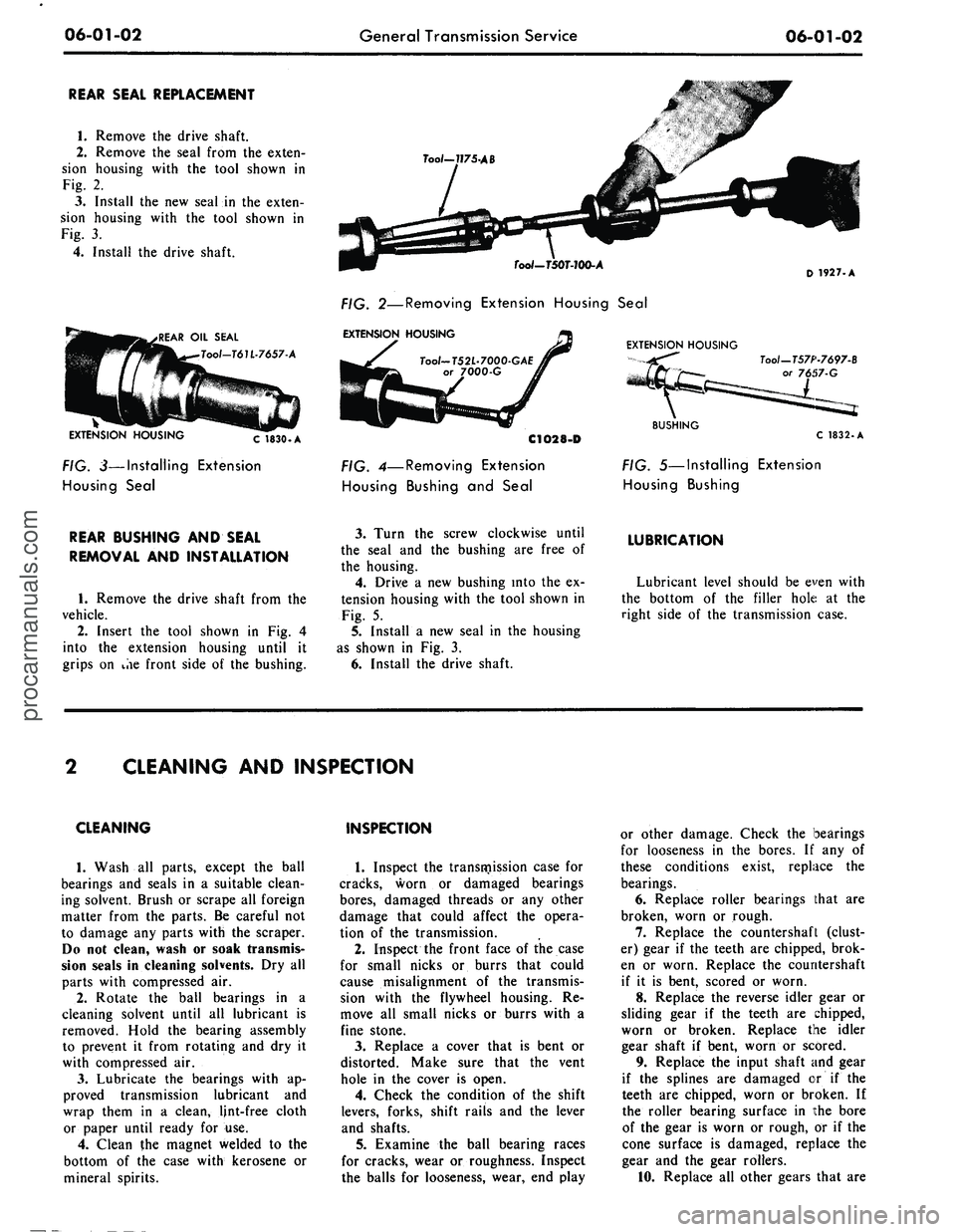
Remove the seal from the exten-
sion housing with the tool shown in
Fig. 2.
3.
Install the new seal in the exten-
sion housing with the tool shown in
Fig. 3.
4.
Install the drive shaft.
.REAR OIL SEAL
Tool-T61L-7657-A
EXTENSION HOUSING
C 1830.A
FIG. 3—Installing Extension
Housing Seal
Too/-7J75-AB
Tool-TSOT-lOO-A
FIG. 2—Removing Extension Housing Seal
EXTENSION HOUSING
Tool-T52L-7000-GAE
or 7000-G
C1O28-D
FIG. 4—Removing Extension
Housing Bushing and Seal
EXTENSION HOUSING
D
1927. A
Tool—T57P-7697-B
57-G
BUSHING
C 1832.A
FIG. 5—Installing Extension
Housing Bushing
REAR BUSHING AND SEAL
REMOVAL AND INSTALLATION
1.
Remove the drive shaft from the
vehicle.
2.
Insert the tool shown in Fig. 4
into the extension housing until it
grips on ihe front side of the bushing.
3.
Turn the screw clockwise until
the seal and the bushing are free of
the housing.
4.
Drive a new bushing into the ex-
tension housing with the tool shown in
Fig. 5.
5.
Install a new seal in the housing
as shown in Fig. 3.
6. Install the drive shaft.
LUBRICATION
Lubricant level should be even with
the bottom of the filler hole at the
right side of the transmission case.
CLEANING AND INSPECTION
CLEANING
1.
Wash all parts, except the ball
bearings and seals in a suitable clean-
ing solvent. Brush or scrape all foreign
matter from the parts. Be careful not
to damage any parts with the scraper.
Do not clean, wash or soak transmis-
sion seals in cleaning solvents. Dry all
parts with compressed air.
2.
Rotate the ball bearings in a
cleaning solvent until all lubricant is
removed. Hold the bearing assembly
to prevent it from rotating and dry it
with compressed air.
3.
Lubricate the bearings with ap-
proved transmission lubricant and
wrap them in a clean, lint-free cloth
or paper until ready for use.
4.
Clean the magnet welded to the
bottom of the case with kerosene or
mineral spirits.
INSPECTION
1.
Inspect the transmission case for
cracks, worn or damaged bearings
bores,
damaged threads or any other
damage that could affect the opera-
tion of the transmission.
2.
Inspect the front face of the case
for small nicks or burrs that could
cause misalignment of the transmis-
sion with the flywheel housing. Re-
move all small nicks or burrs with a
fine stone.
3.
Replace a cover that is bent or
distorted. Make sure that the vent
hole in the cover is open.
4.
Check the condition of the shift
levers, forks, shift rails and the lever
and shafts.
5.
Examine the ball bearing races
for cracks, wear or roughness. Inspect
the balls for looseness, wear, end play
or other damage. Check the bearings
for looseness in the bores. If any of
these conditions exist, replace the
bearings.
6. Replace roller bearings that are
broken, worn or rough.
7.
Replace the countershaft (clust-
er) gear if the teeth are chipped, brok-
en or worn. Replace the countershaft
if it is bent, scored or worn.
8. Replace the reverse idler gear or
sliding gear if the teeth are chipped,
worn or broken. Replace the idler
gear shaft if bent, worn or scored.
9. Replace the input shaft and gear
if the splines are damaged or if the
teeth are chipped, worn or broken. If
the roller bearing surface in the bore
of the gear is worn or rough, or if the
cone surface is damaged, replace the
gear and the gear rollers.
10.
Replace all other gears that areprocarmanuals.com
Page 293 of 413
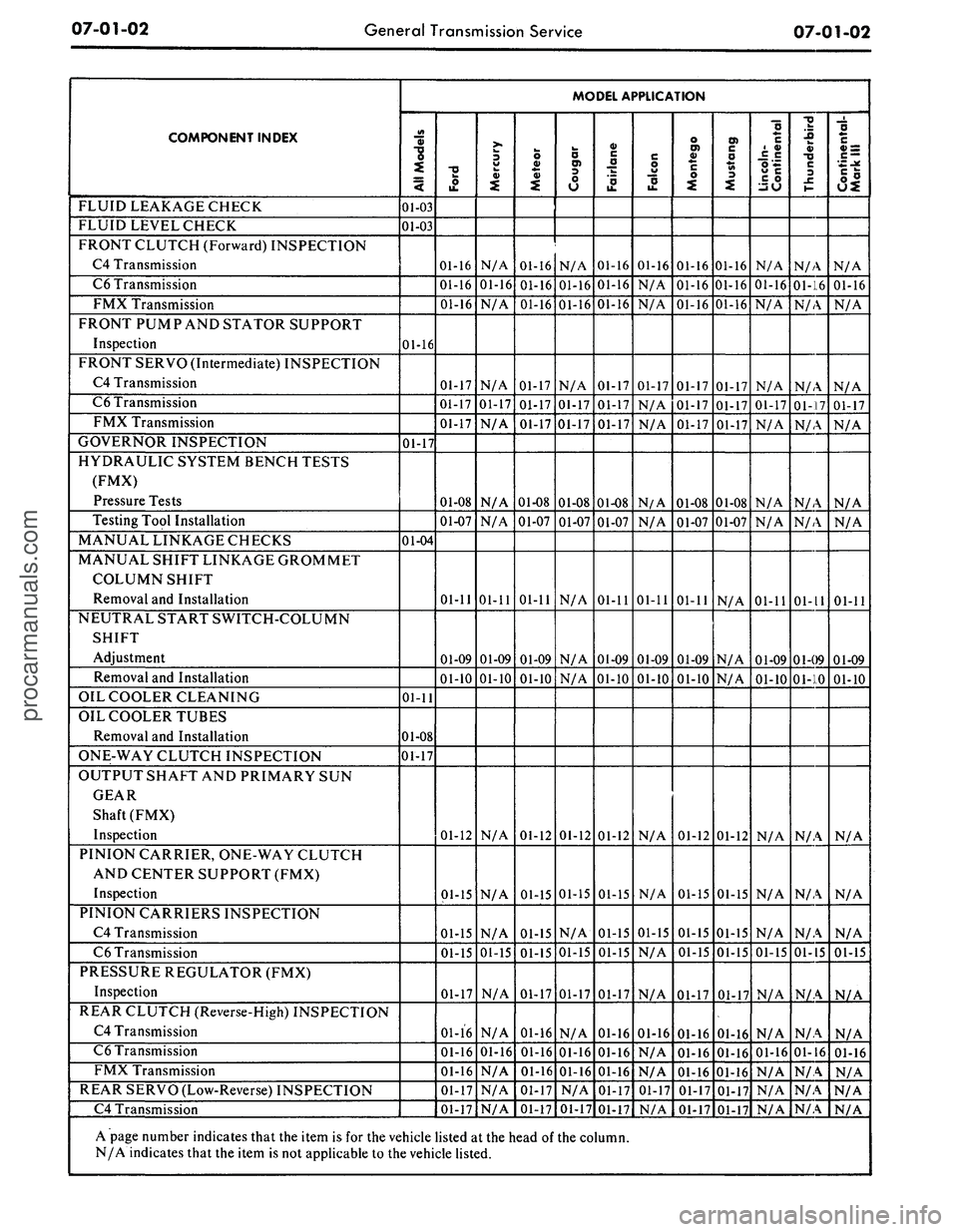
07-01-02
General Transmission Service
07-01-02
COMPONENT INDEX
FLUID LEAKAGE CHECK
FLUID LEVEL CHECK
FRONT CLUTCH (Forward) INSPECTION
C4 Transmission
C6 Transmission
FMX Transmission
FRONT PUMP AND STATOR SUPPORT
Inspection
FRONT SERVO (Intermediate) INSPECTION
C4 Transmission
C6 Transmission
FMX Transmission
GOVERNOR INSPECTION
HYDRAULIC SYSTEM BENCH TESTS
(FMX)
Pressure Tests
Testing Tool Installation
MANUAL LINKAGE CHECKS
MANUAL SHIFT LINKAGE GROMMET
COLUMN SHIFT
Removal and Installation
NEUTRAL START SWITCH-COLUMN
SHIFT
Adjustment
Removal and Installation
OIL COOLER CLEANING
OIL COOLER TUBES
Removal and Installation
ONE-WAY CLUTCH INSPECTION
OUTPUT SHAFT AND PRIMARY SUN
GEAR
Shaft (FMX)
Inspection
PINION CARRIER, ONE-WAY CLUTCH
AND CENTER SUPPORT (FMX)
Inspection
PINION CARRIERS INSPECTION
C4 Transmission
C6 Transmission
PRESSURE REGULATOR (FMX)
Inspection
REAR CLUTCH (Reverse-High) INSPECTION
C4 Transmission
C6 Transmission
FMX Transmission
REAR SERVO (Low-Reverse) INSPECTION
C4 Transmission
MODEL APPLICATION
All
Models
01-03
01-03
01-16
01-17
01-04
01-11
01-08
01-17
Ford
01-16
01-16
01-16
01-17
01-17
01-17
01-08
01-07
01-11
01-09
01-10
01-12
01-15
01-15
01-15
01-17
01-16
01-16
01-16
01-17
01-17
Mercury
N/A
01-16
N/A
N/A
01-17
N/A
N/A
N/A
01-11
01-09
01-10
N/A
N/A
N/A
01-15
N/A
N/A
01-16
N/A
N/A
N/A
Meteor
01-16
01-16
01-16
01-17
01-17
01-17
01-08
01-07
01-11
01-09
01-10
01-12
01-15
01-15
01-15
01-17
01-16
01-16
01-16
01-17
01-17
Cougar
N/A
01-16
01-16
N/A
01-17
01-17
01-08
01-07
N/A
N/A
N/A
01-12
01-15
N/A
01-15
01-17
N/A
01-16
01-16
N/A
01-17
Fairlane
01-16
01-16
01-16
01-17
01-17
01-17
01-08
01-07
01-11
01-09
01-10
01-12
01-15
01-15
01-15
01-17
01-16
01-16
01-16
01-17
01-17
Falcon
01-16
N/A
N/A
01-17
N/A
N/A
N/A
N/A
01-11
01-09
01-10
N/A
N/A
01-15
N/A
N/A
01-16
N/A
N/A
01-17
N/A
Montego
01-16
01-16
01-16
01-17
01-17
01-17
01-08
01-07
01-11
01-09
01-10
01-12
01-15
01-15
01-15
01-17
01-16
01-16
01-16
01-17
01-17
Mustang
01-16
01-16
01-16
01-17
01-17
01-17
01-08
01-07
N/A
N/A
N/A
01-12
01-15
01-15
01-15
01-17
01-16
01-16
01-16
01-17
01-17
Lincoln-
Continental
N/A
01-16
N/A
N/A
01-17
N/A
N/A
N/A
01-11
01-09
01-10
N/A
N/A
N/A
01-15
N/A
N/A
01-16
N/A
N/A
N/A
Thunderbird
N/A
01-16
N/A
N/A
01-17
N/A
N/A
N/A
01-11
01-09
01-10
N/A
N/A
N/A
01-15
N/A
N/A
01-16
N/A
N/A
N/A
Continental-
Mark
III
N/A
01-16
N/A
N/A
01-17
N/A
N/A
N/A
01-11
01-09
01-10
N/A
N/A
N/A
01-15
N/A
N/A
01-16
N/A
N/A
N/A
A page number indicates that the item is for the vehicle listed at the head of the column.
N/A indicates that the item is not applicable to the vehicle listed.
procarmanuals.com
Page 294 of 413
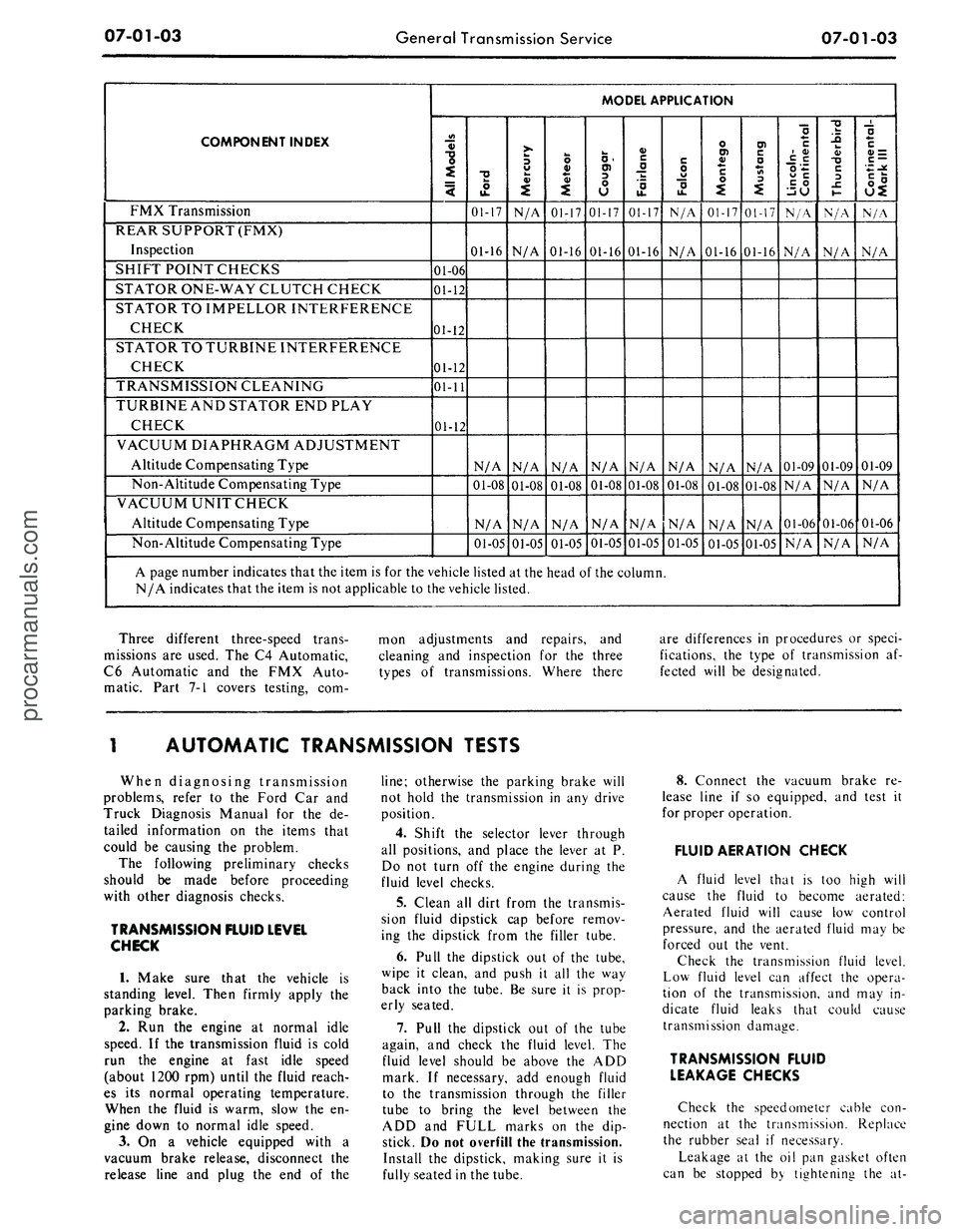
07-01-03
General Transmission Service
07-01-03
COMPONENT INDEX
FMX Transmission
REAR SUPPORT (FMX)
Inspection
SHIFT POINT CHECKS
STATOR ONE-WAY CLUTCH CHECK
STATOR TO IMPELLOR INTERFERENCE
CHECK
STATOR TO TURBINE INTERFERENCE
CHECK
TRANSMISSION CLEANING
TURBINE AND STATOR END PLAY
CHECK
VACUUM DIAPHRAGM ADJUSTMENT
Altitude Compensating Type
Non-Altitude Compensating Type
VACUUM UNIT CHECK
Altitude Compensating Type
Non-Altitude Compensating Type
MODEL APPLICATION
All
Models
01-06
01-12
01-12
01-12
01-11
01-12
Ford
01-17
01-16
N/A
01-08
N/A
01-05
Mercury
N/A
N/A
N/A
01-08
N/A
01-05
Meteor
01-17
01-16
N/A
01-08
N/A
01-05
Cougar
01-17
01-16
N/A
01-08
N/A
01-05
Fairlane
01-17
01-16
N/A
01-08
N/A
01-05
Falcon
N/A
N/A
N/A
01-08
N/A
01-05
Montego
01-17
01-16
N/A
01-08
N/A
01-05
Mustang
01-17
01-16
N/A
01-08
N/A
01-05
Lincoln-
Continental
N/A
N/A
01-09
N/A
01-06
N/A
Thunderbird
N/A
N/A
01-09
N/A
01-06
N/A
Continental-
Mark
III
N/A
N/A
01-09
N/A
01-06
N/A
A page number indicates that the item is for the vehicle listed at the head of the column.
N/A indicates that the item is not applicable to the vehicle listed.
Three different three-speed trans-
missions are used. The C4 Automatic,
C6 Automatic and the FMX Auto-
matic. Part 7-1 covers testing, com-
mon adjustments and repairs, and
cleaning and inspection for the three
types of transmissions. Where there
are differences in procedures or speci-
fications, the type of transmission af-
fected will be designated.
l
AUTOMATIC TRANSMISSION TESTS
When diagnosing transmission
problems, refer to the Ford Car and
Truck Diagnosis Manual for the de-
tailed information on the items that
could be causing the problem.
The following preliminary checks
should be made before proceeding
with other diagnosis checks.
TRANSMISSION FLUID LEVEL
CHECK
1.
Make sure that the vehicle is
standing level. Then firmly apply the
parking brake.
2.
Run the engine at normal idle
speed. If the transmission fluid is cold
run the engine at fast idle speed
(about 1200 rpm) until the fluid reach-
es its normal operating temperature.
When the fluid is warm, slow the en-
gine down to normal idle speed.
3.
On a vehicle equipped with a
vacuum brake release, disconnect the
release line and plug the end of the
line;
otherwise the parking brake will
not hold the transmission in any drive
position.
4.
Shift the selector lever through
all positions, and place the lever at P.
Do not turn off the engine during the
fluid level checks.
5.
Clean all dirt from the transmis-
sion fluid dipstick cap before remov-
ing the dipstick from the filler tube.
6. Pull the dipstick out of the tube,
wipe it clean, and push it all the way
back into the tube. Be sure it is prop-
erly seated.
7.
Pull the dipstick out of the tube
again, and check the fluid level. The
fluid level should be above the ADD
mark. If necessary, add enough fluid
to the transmission through the filler
tube to bring the level between the
ADD and FULL marks on the dip-
stick. Do not overfill the transmission.
Install the dipstick, making sure it is
fully seated in the tube.
8. Connect the vacuum brake re-
lease line if so equipped, and test it
for proper operation.
FLUID AERATION CHECK
A fluid level that is too high will
cause the fluid to become aerated:
Aerated fluid will cause low control
pressure, and the aerated fluid may be
forced out the vent.
Check the transmission fluid level.
Low fluid level can affect the opera-
tion of the transmission, and may in-
dicate fluid leaks that could cause
transmission damage.
TRANSMISSION FLUID
LEAKAGE CHECKS
Check the speedometer cable con-
nection at the transmission. Replace
the rubber seal if necessary.
Leakage at the oil pan gasket often
can be stopped by tightening the at-
procarmanuals.com
Page 299 of 413
07-01-08
General Transmission Service
07-01-08
3.
Install the bench testing tool on
the transmission.
4.
Remove the
1/8-inch
pipe plug
at the transmission case. Turn the
front pump in a clockwise direction at
75-100 rpm until a regular flow of
transmission fluid leaves the hole in
the transmission case. This operation
bleeds the air from the pump.
5.
Install the pressure gauge (77820
or T57L-77820-A) as shown in Fig.
13.
PRESSURE TESTS
Turn the front pump at 75-100 rpm
and note the gauge readings. The
pressure readings on the bench test
must be within the limits as outlined
in Figure 13, for the engine idle check.
If pressure gauge readings are with-
in limits in all selector lever positions,
install the vacuum diaphragm control
rod unit.
COMMON ADJUSTMENTS AND REPAIRS
TRANSMISSION FLUID DRAIN
AND REFILL
Normal maintenance and lubrica-
tion requirements do not necessitate
periodic automatic transmission fluid
changes.
If a major repair, such as a clutch
band, bearing, etc., is required in the
transmission, it will have to be re-
moved for service. At this time the
converter, transmission cooler and
cooler lines must be thoroughly
flushed to remove any dirt.
When filling a dry transmission and
converter, install five quarts of fluid.
Start the engine, shift the selector
lever as outlined below, and check and
add fluid as necessary.
Following are the procedures for
partial drain and refill due to in-
vehicle repair operation.
C4 TRANSMISSION
1.
On PEA models, disconnect the
fluid filler tube from the transmission
oil pan to drain the fluid.
On PEB and PEE models, loosen
the pan attaching bolts to drain the
fluid from the transmission.
2.
When the fluid has stopped
draining from the transmission, re-
move and thoroughly clean the pan
and the screen. Discard the pan gas-
ket.
3.
Place a new gasket on the pan,
and install the pan on the transmis-
sion.
4.
On PEA models, connect the
filler tube to the pan and tighten the
fitting securely.
5.
Add three quarts of fluid to the
transmission through the filler tube.
6. Run the engine at idle speed for
about two minutes, and then run it at
fast idle speed (about 1200 rpm) until
it reaches it's normal operating temp-
erature. Do not race the engine.
7.
Shift the selector lever through
all the positions, place it at P, and
check the fluid level. The fluid level
should be above the ADD mark. If
necessary, add enough fluid io the
transmission to bring the level be-
tween the ADD and FULL marks on
che dipstick. Do not overfill the trans-
mission.
FMX OK C6
TRANSMISSION
1.
Raise the vehicle on a hoist or
jack stands.
2.
Place a drain pan under the
transmission.
3.
Loosen the pan attaching bolts
to drain the fluid from the transmis-
sion.
4.
After the fluid has drained to the
level of the pan flange, remove the
rest of the pan bolts working from the
rear and both sides of the pan to
allow it to drop and drain slowly.
5.
When the fluid has stopped
draining from the transmission, re-
move and thoroughly clean the pan
and the screen. Discard the pan gas-
ket.
6. Place a new gasket on the pan,
and install the pan on the transmis-
sion.
7.
Add three quarts of fluid to the
transmission through the filler tube.
8. Run the engine at idle speed for
about two minutes, and then run it at
fast idle speed (about 1200 rpm) until
it reaches normal operating tempera-
ture.
Do not race the engine.
9. Shift the selector lever through
all the positions, place it at P, and
check the fluid level. The fluid level
should be above the ADD mark. If
necessary, add enough fluid to the
transmission to bring the level be-
tween the ADD and FULL marks on
the dipstick. Do not overfill the trans-
mission.
OIL COOLER TUBE
REMOVAL AND INSTALLATION
When fluid leakage is found at the
oil cooler, the cooler must be re-
placed. Cooler replacement is de-
scribed in the Cooling System Section
of Group 11.
When one or more of the fluid
cooler steel tubes must be replaced,
each replacement tube must be fabri-
cated from the same size steel tubing
as the original line.
Using the old tube as a guide, bend
the new tube as required. Add the
necessary fittings, and install the tube.
After the fittings have been tight-
ened, add fluid as needed, and check
for fluid leaks.
VACUUM DIAPHRAGM
ADJUSTMENT NON-ALTITUDE
COMPENSATING TYPE
The C4 and C6 transmissions are
equipped with an adjustable vacuum
diaphragm assembly. A similar ad-
justable diaphragm has been released
for service with the FMX transmis-
sion. However, the FMX service dia-
phragm is not interchangeable with
that used on C4 and C6 models.
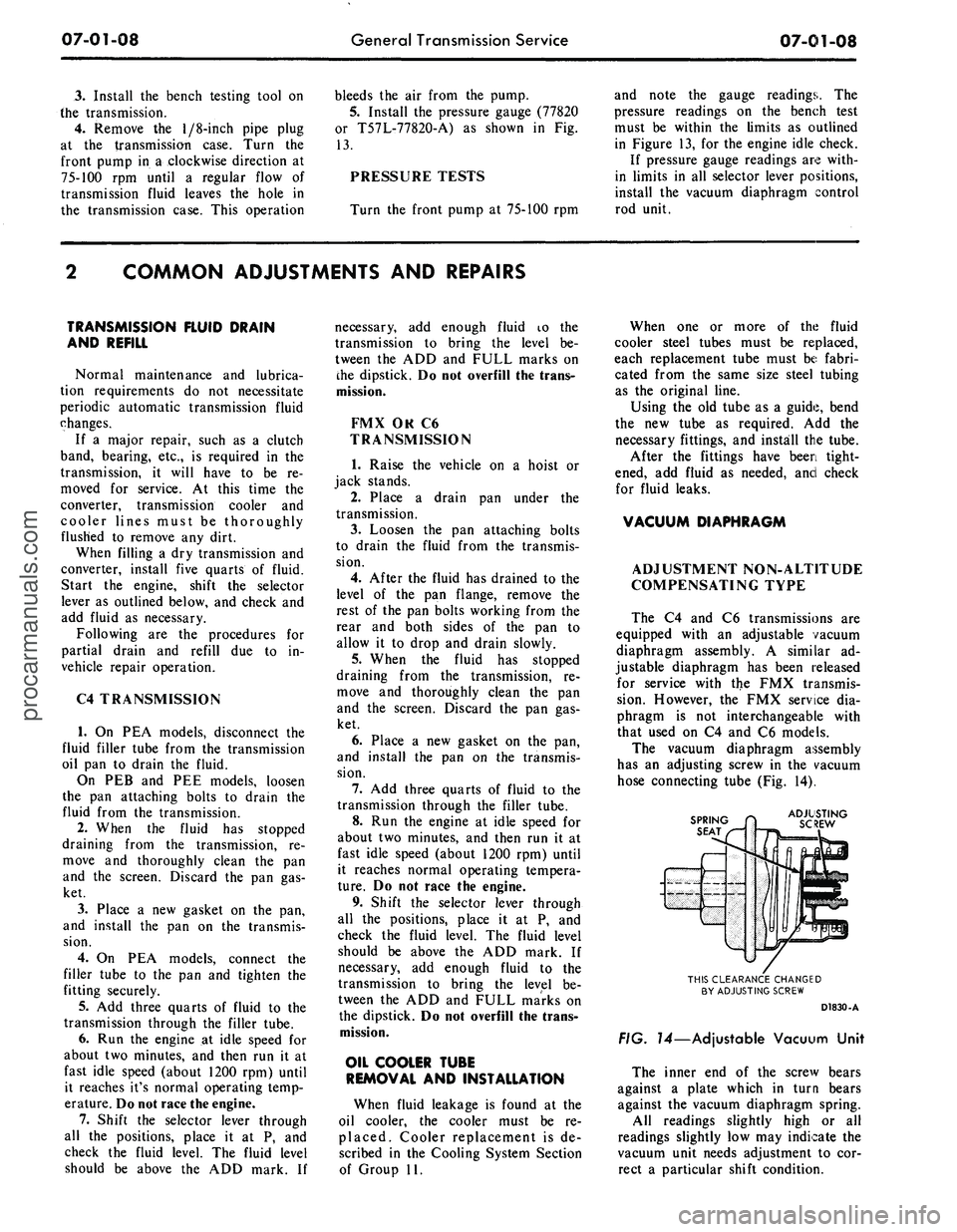
The vacuum diaphragm assembly
has an adjusting screw in the vacuum
hose connecting tube (Fig. 14).
SPRING
SEAT
THIS CLEARANCE CHANGED
BY ADJUSTING SCREW
D1830-A
FIG. 14—Adjustable Vacuum Unit
The inner end of the screw bears
against a plate which in turn bears
against the vacuum diaphragm spring.
All readings slightly high or all
readings slightly low may indicate the
vacuum unit needs adjustment to cor-
rect a particular shift condition.procarmanuals.com
Page 317 of 413
07-02-09
C4 Automatic Transmission
07-02-09
11.
Remove the handle from the se-
lector lever.
12.
Install the selector housing and
lever assembly as shown in Figure 8.
Torque the attaching bolts 4-6 ft-lbs.
13.
Connect the dial indicator light.
14.
Install the pointer back-up
shield on the housing and lever assem-
bly.
15.
Install the dial housing and
tighten the attaching screws.
16.
Install the selector lever handle
and tighten the attaching screw.
17.
Position the selector lever in the
D position.
18.
Raise the vehicle. Install the
transmission manual lever rod to the
selector lever. Adjust the manual link-
age.
19.
Lower the vehicle and check the
transmission operation in each selo:c-
tor lever detent position.
BAND ADJUSTMENT
INTERMEDIATE BAND
1.
Clean all the dirt from the band
adjusting screw area. Remove and dis-
card the locknut.
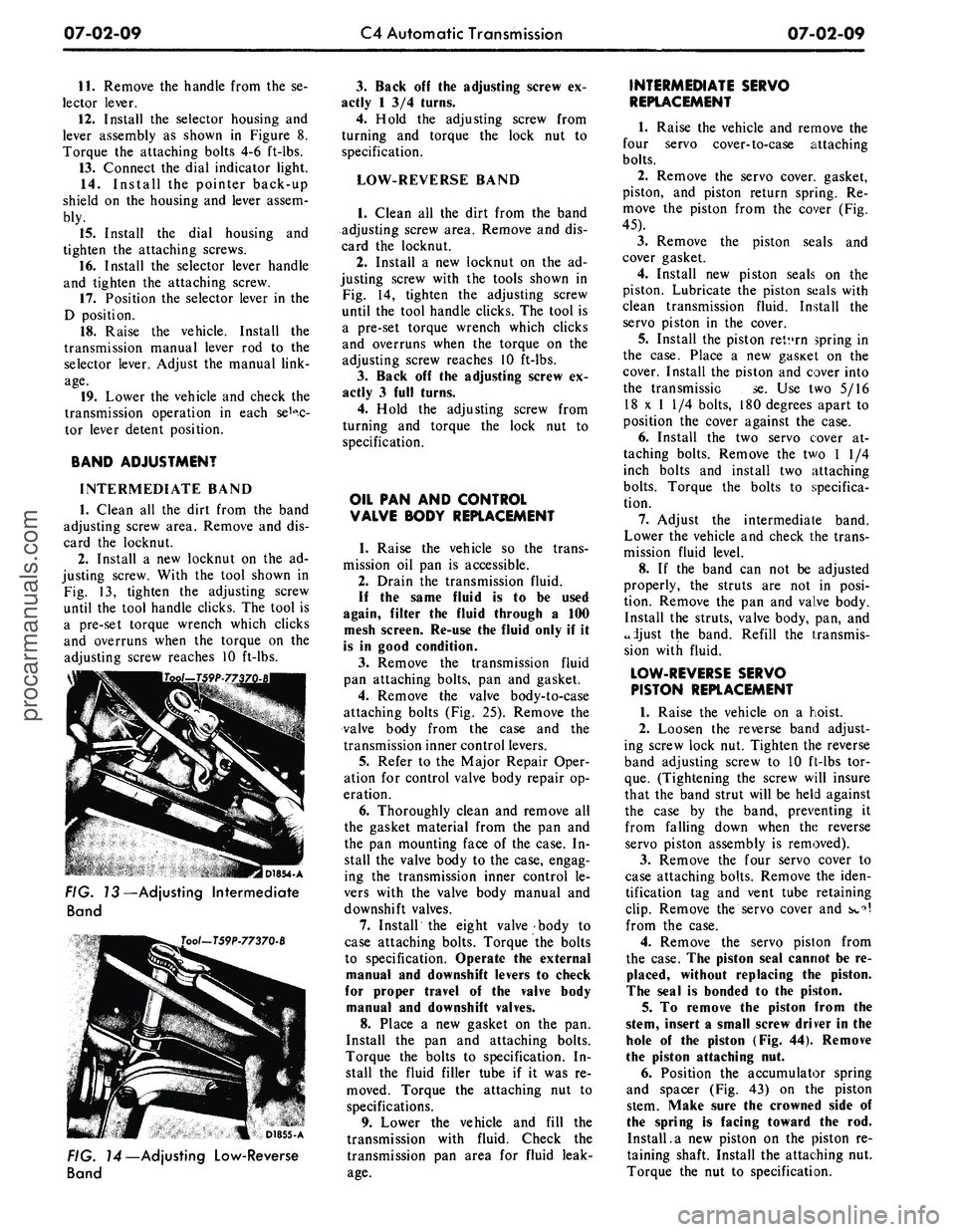
2.
Install a new locknut on the ad-
justing screw. With the tool shown in
Fig. 13, tighten the adjusting screw
until the tool handle clicks. The tool is
a pre-set torque wrench which clicks
and overruns when the torque on the
adjusting screw reaches 10 ft-lbs.
I D1854-A
FIG. 13—Adjusting Intermediate
Band
Tool-T59P-77370-B
D1855-A
FIG. 14—Adjusting Low-Reverse
Band
3.
Back off the adjusting screw ex-
actly 1 3/4 turns.
4.
Hold the adjusting screw from
turning and torque the lock nut to
specification.
LOW-REVERSE BAND
1.
Clean all the dirt from the band
adjusting screw area. Remove and dis-
card the locknut.
2.
Install a new locknut on the ad-
justing screw with the tools shown in
Fig. 14, tighten the adjusting screw
until the tool handle clicks. The tool is
a pre-set torque wrench which clicks
and overruns when the torque on the
adjusting screw reaches 10 ft-lbs.
3.
Back off the adjusting screw ex-
actly 3 full turns.
4.
Hold the adjusting screw from
turning and torque the lock nut to
specification.
OIL PAN AND CONTROL
VALVE BODY REPLACEMENT
1.
Raise the vehicle so the trans-
mission oil pan is accessible.
2.
Drain the transmission fluid.
If the same fluid is to be used
again, filter the fluid through a 100
mesh screen. Re-use the fluid only if it
is in good condition.
3.
Remove the transmission fluid
pan attaching bolts, pan and gasket.
4.
Remove the valve body-to-case
attaching bolts (Fig. 25). Remove the
valve body from the case and the
transmission inner control levers.
5.
Refer to the Major Repair Oper-
ation for control valve body repair op-
eration.
6. Thoroughly clean and remove all
the gasket material from the pan and
the pan mounting face of the case. In-
stall the valve body to the case, engag-
ing the transmission inner control le-
vers with the valve body manual and
downshift valves.
7.
Install the eight valve body to
case attaching bolts. Torque the bolts
to specification. Operate the external
manual and downshift levers to check
for proper travel of the valve body
manual and downshift valves.
8. Place a new gasket on the pan.
Install the pan and attaching bolts.
Torque the bolts to specification. In-
stall the fluid filler tube if it was re-
moved. Torque the attaching nut to
specifications.
9. Lower the vehicle and fill the
transmission with fluid. Check the
transmission pan area for fluid leak-
age.
INTERMEDIATE SERVO
REPLACEMENT
1.
Raise the vehicle and remove the
four servo cover-to-case attaching
bolts.
2.
Remove the servo cover, gasket,
piston, and piston return spring. Re-
move the piston from the cover (Fig.
45).
3.
Remove the piston seals and
cover gasket.
4.
Install new piston seals on the
piston. Lubricate the piston seals with
clean transmission fluid. Install the
servo piston in the cover.
5.
Install the piston retvrn spring in
the case. Place a new gasicet on the
cover. Install the piston and cover into
the transmissic se. Use two 5/16
18 x 1 1/4 bolts, 180 degrees apart to
position the cover against the case.
6. Install the two servo cover at-
taching bolts. Remove the two 1 1/4
inch bolts and install two attaching
bolts.
Torque the bolts to specifica-
tion.
7.
Adjust the intermediate band.
Lower the vehicle and check the trans-
mission fluid level.
8. If the band can not be adjusted
properly, the struts are not in posi-
tion. Remove the pan and valve body.
Install the struts, valve body, pan, and
adjust the band. Refill the transmis-
sion with fluid.
LOW-REVERSE SERVO
PISTON REPLACEMENT
1.
Raise the vehicle on a hoist.
2.
Loosen the reverse band adjust-
ing screw lock nut. Tighten the reverse
band adjusting screw to 10 ft-lbs tor-
que.
(Tightening the screw will insure
that the band strut will be held against
the case by the band, preventing it
from falling down when the reverse
servo piston assembly is removed).
3.
Remove the four servo cover to
case attaching bolts. Remove the iden-
tification tag and vent tube retaining
clip.
Remove the servo cover and s»»^
from the case.
4.
Remove the servo piston from
the case. The piston seal cannot be re-
placed, without replacing the piston.
The seal is bonded to the piston.
5. To remove the piston from the
stem, insert a small screw driver in the
hole of the piston (Fig. 44). Remove
the piston attaching nut.
6. Position the accumulator spring
and spacer (Fig. 43) on the piston
stem. Make sure the crowned side of
the spring is facing toward the rod.
Install.a new piston on the piston re-
taining shaft. Install the attaching nut.
Torque the nut to specification.procarmanuals.com
Page 319 of 413
07-02-11
C4 Automatic Transmission
07-02-11
REMOVAL AND INSTALLATION
An oil impregnated plastic grommet
is incorporated in the end of the man-
ual shift linkage lever arm on all col-
umn shift vehicles. A special tool
T67P-7341-A is required to install the
grommet in the manual lever, and to
install the manual linkage rod into the
grommet. Refer to Part 7-1, Section
2,
for the grommet replacement pro-
cedures.
TRANSMISSION REMOVAL
1.
Raise the vehicle and remove the
converter cover attaching bolts, at the
lower front side of the converter hous-
ing. Remove the cover.
2.
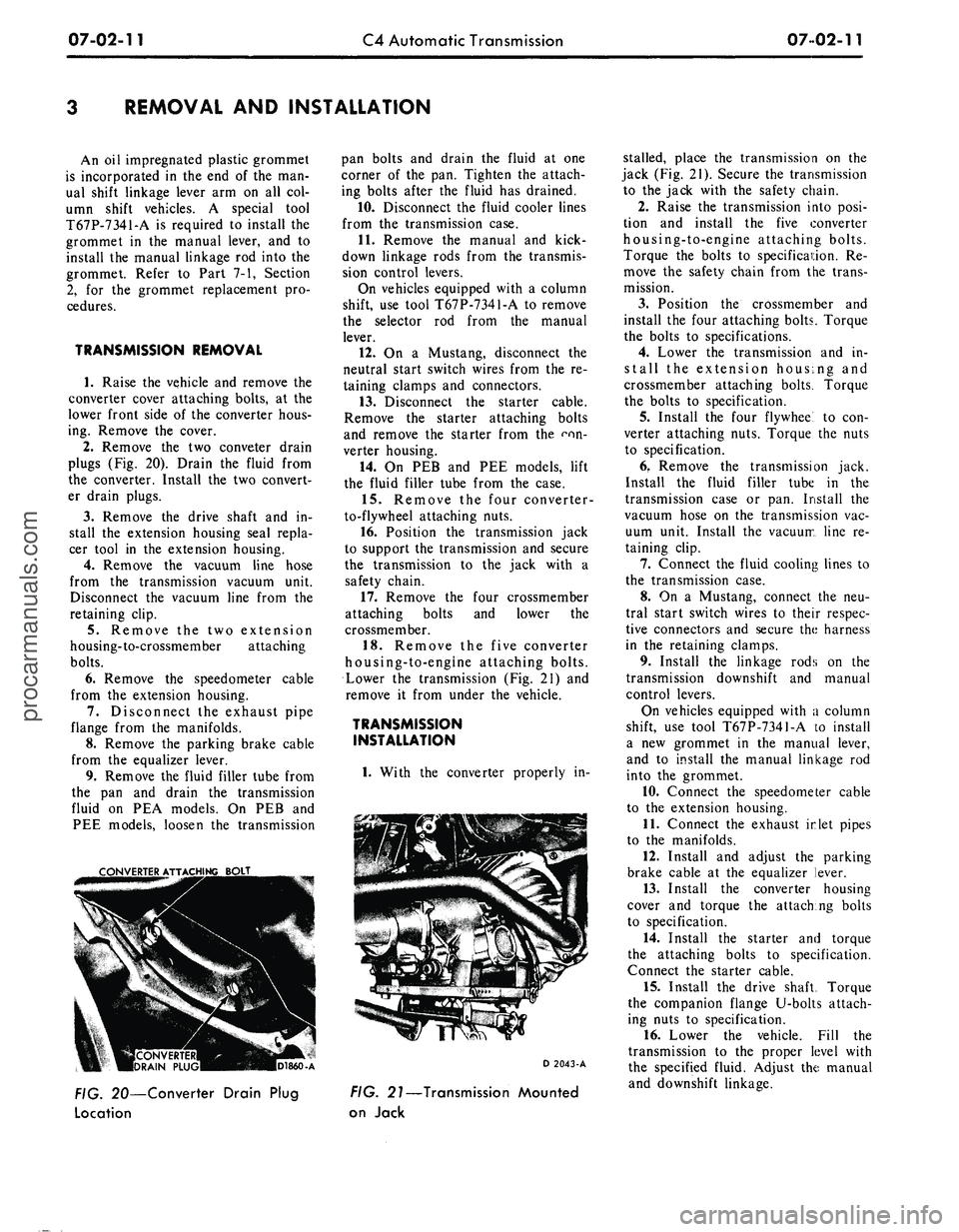
Remove the two conveter drain
plugs (Fig. 20). Drain the fluid from
the converter. Install the two convert-
er drain plugs.
3.
Remove the drive shaft and in-
stall the extension housing seal repla-
cer tool in the extension housing.
4.
Remove the vacuum line hose
from the transmission vacuum unit.
Disconnect the vacuum line from the
retaining clip.
5.
Remove the two extension
housing-to-crossmember attaching
bolts.
6. Remove the speedometer cable
from the extension housing.
7.
Disconnect the exhaust pipe
flange from the manifolds.
8. Remove the parking brake cable
from the equalizer lever.
9. Remove the fluid filler tube from
the pan and drain the transmission
fluid on PEA models. On PEB and
PEE models, loosen the transmission
CONVERTER A
ATT,
pan bolts and drain the fluid at one
corner of the pan. Tighten the attach-
ing bolts after the fluid has drained.
10.
Disconnect the fluid cooler lines
from the transmission case.
11.
Remove the manual and kick-
down linkage rods from the transmis-
sion control levers.
On vehicles equipped with a column
shift, use tool T67P-7341-A to remove
the selector rod from the manual
lever.
12.
On a Mustang, disconnect the
neutral start switch wires from the re-
taining clamps and connectors.
13.
Disconnect the starter cable.
Remove the starter attaching bolts
and remove the starter from the con-
verter housing.
14.
On PEB and PEE models, lift
the fluid filler tube from the case.
15.
Remove the four converter-
to-flywheel attaching nuts.
16.
Position the transmission jack
to support the transmission and secure
the transmission to the jack with a
safety chain.
17.
Remove the four crossmember
attaching bolts and lower the
crossmember.
18.
Remove the five converter
housing-to-engine attaching bolts.
Lower the transmission (Fig. 21) and
remove it from under the vehicle.
TRANSMISSION
INSTALLATION
1.
With the converter properly in-
D 2043-A
FIG. 20—Converter Drain Plug
Location
FIG. 21—Transmission Mounted
on Jack
stalled, place the transmission on the
jack (Fig. 21). Secure the transmission
to the jack with the safety chain.
2.
Raise the transmission into posi-
tion and install the five converter
housing-to-engine attaching bolts.
Torque the bolts to specification. Re-
move the safety chain from the trans-
mission.
3.
Position the crossmember and
install the four attaching bolts. Torque
the bolts to specifications.
4.
Lower the transmission and in-
stall the extension housing and
crossmember attaching bolts. Torque
the bolts to specification.
5.
Install the four flywheel to con-
verter attaching nuts. Torque the nuts
to specification.
6. Remove the transmission jack.
Install the fluid filler tube in the
transmission case or pan. Install the
vacuum hose on the transmission vac-
uum unit. Install the vacuum line re-
taining clip.
7.
Connect the fluid cooling lines to
the transmission case.
8. On a Mustang, connect the neu-
tral start switch wires to their respec-
tive connectors and secure the harness
in the retaining clamps.
9. Install the linkage rods on the
transmission downshift and manual
control levers.
On vehicles equipped with a column
shift, use tool T67P-7341-A to install
a new grommet in the manual lever,
and to install the manual linkage rod
into the grommet.
10.
Connect the speedometer cable
to the extension housing.
11.
Connect the exhaust inlet pipes
to the manifolds.
12.
Install and adjust the parking
brake cable at the equalizer lever.
13.
Install the converter housing
cover and torque the attaching bolts
to specification.
14.
Install the starter and torque
the attaching bolts to specification.
Connect the starter cable.
15.
Install the drive shaft. Torque
the companion flange U-bolts attach-
ing nuts to specification.
16.
Lower the vehicle. Fill the
transmission to the proper level with
the specified fluid. Adjust the manual
and downshift linkage.procarmanuals.com
Page 349 of 413
07-03-09
FMX Transmission
07-03-09
4.
Remove the pointer back-up
shield attaching screws and the shield.
5.
Disconnect the dial indicator
light.
6. Disconnect the neutral start
switch and dial indicator light wires
from their connectors at the dash
panel.
7.
Remove the selector housing and
lever assembly attaching bolts. Re-
move the selector lever and housing.
8. Remove the selector lever to
housing attaching nut. Remove the
lever from the housing.
9. Install the selector lever in the
housing and install the attaching nut.
Torque the nut to 20 to 25 ft-lbs.
10.
Install the selector lever handle.
11.
Position the selector lever as
shown in Figure 10. With a feeler
gauge check the clearance between the
detent pawl and plate. The clearince
should be 0.005 to 0.010 inch. If nec-
essary, adjust the height of the detent
pawl as shown in Figure 10.
12.
Remo"~ the handle from tte se-
lector lever.
13.
Install the selector housing and
lever assembly as shown in Figure 4.
Torque the attaching bolts 4-6 ft-lbs.
14.
Connect the dial indicator light.
15.
Connect the neutral start switch
and dial indicator light wires to their
respective connectors at the dash
panel.
16.
Install the pointer back-up
shield and tighten the attaching
screws.
17.
Install the selector lever handle
and tighten the attaching screw.
18.
Position the selector lever in the
D position.
19.
Raise the vehicle. Install the
transmission manual lever rod to the
selector lever. Adjust the manual link-
age.
20.
Lower the vehicle and check the
transmission operation in each selec-
tor lever detent position.
BAND ADJUSTMENTS
FRONT BAND
ADJUSTMENT
1.
Drain the fluid from the trans-
mission by loosening the pan attach-
ing bolts starting at the rear of the
pan and working toward the front.
When most of the fluid has drained
from the pan, remove the remainder
of the attaching bolts. Use a clean
drain can equipped with a 100-mesh
screen if the fluid is to be reused.
Too/—
7225-C-13B
/A
-inch
Spacer
FRONT SERVO
ACTUATING LEVER
D 2048-A
FIG.
7
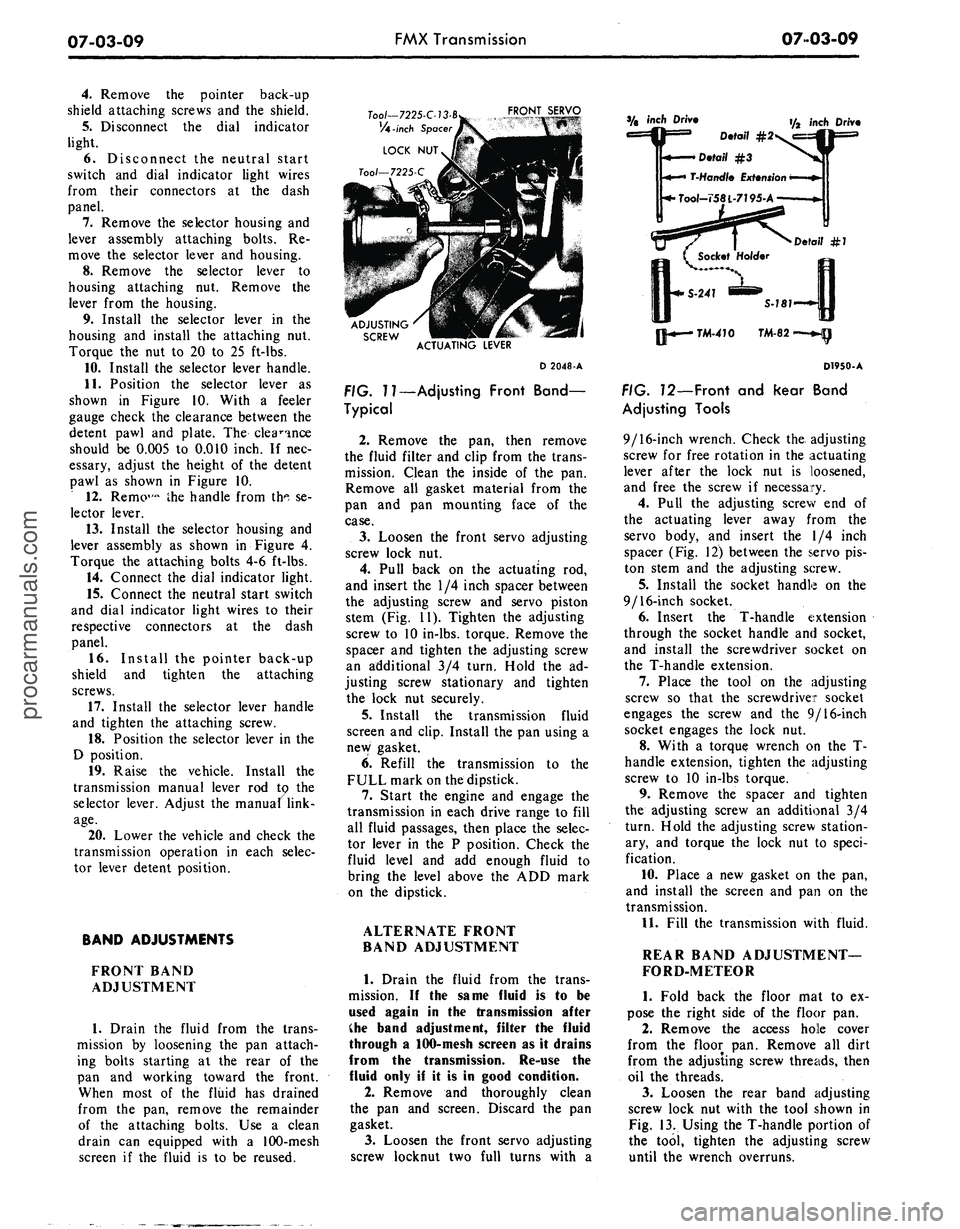
7—Adjusting Front Band—
Typical
2.
Remove the pan, then remove
the fluid filter and clip from the trans-
mission. Clean the inside of the pan.
Remove all gasket material from the
pan and pan mounting face of the
case.
3.
Loosen the front servo adjusting
screw lock nut.
4.
Pull back on the actuating rod,
and insert the 1/4 inch spacer between
the adjusting screw and servo piston
stem (Fig. 11). Tighten the adjusting
screw to 10 in-lbs. torque. Remove the
spacer and tighten the adjusting screw
an additional 3/4 turn. Hold the ad-
justing screw stationary and tighten
the lock nut securely.
5.
Install the transmission fluid
screen and clip. Install the pan using a
new gasket.
6. Refill the transmission to the
FULL mark on the dipstick.
7.
Start the engine and engage the
transmission in each drive range to fill
all fluid passages, then place the selec-
tor lever in the P position. Check the
fluid level and add enough fluid to
bring the level above the ADD mark
on the dipstick.
ALTERNATE FRONT
BAND ADJUSTMENT
1.
Drain the fluid from the trans-
mission. If the same fluid is to be
used again in the transmission after
Che band adjustment, filter the fluid
through a 100-mesh screen as it drains
from the transmission. Re-use the
fluid only if it is in good condition.
2.
Remove and thoroughly clean
the pan and screen. Discard the pan
gasket.
3.
Loosen the front servo adjusting
screw locknut two full turns with a
inch Driv
Detail #2
D.tai\
#3
T-Hond/e
Extension
Tool-758L-7195-A
f/2 inch Driv
Detail
#7
Qj-«—
TM-470 TM-82
D1950-A
FIG. 12—Front and Rear Band
Adjusting Tools
9/16-inch wrench. Check the. adjusting
screw for free rotation in the actuating
lever after the lock nut is loosened,
and free the screw if necessary.
4.
Pull the adjusting screw end of
the actuating lever away from the
servo body, and insert the 1/4 inch
spacer (Fig. 12) between the servo pis-
ton stem and the adjusting screw.
5.
Install the socket handle on the
9/16-inch socket.
6. Insert the T-handle extension
through the socket handle and socket,
and install the screwdriver socket on
the T-handle extension.
7.
Place the tool on the adjusting
screw so that the screwdriver socket
engages the screw and the 9/16-inch
socket engages the lock nut.
8. With a torque wrench on the T-
handle extension, tighten the adjusting
screw to 10 in-lbs torque.
9. Remove the spacer and tighten
the adjusting screw an additional 3/4
turn. Hold the adjusting screw station-
ary, and torque the lock nut to speci-
fication.
10.
Place a new gasket on the pan,
and install the screen and pan on the
transmission.
11.
Fill the transmission with fluid.
REAR BAND ADJUSTMENT—
FORD-METEOR
1.
Fold back the floor mat to ex-
pose the right side of the floor pan.
2.
Remove the access hole cover
from the floor pan. Remove all dirt
from the adjusting screw threads, then
oil the threads.
3.
Loosen the rear band adjusting
screw lock nut with the tool shown in
Fig. 13. Using the T-handle portion of
the tool, tighten the adjusting screw
until the wrench overruns.procarmanuals.com