ECO mode FORD MUSTANG 1969 Volume One Chassis
[x] Cancel search | Manufacturer: FORD, Model Year: 1969, Model line: MUSTANG, Model: FORD MUSTANG 1969Pages: 413, PDF Size: 75.81 MB
Page 248 of 413
05-01-01
05-01-01
Clutch
GROUP
5
PART
5-1
PAGE
Drive Shaft 05-01-01
PART
5-2
General Clutch Service 05-02-01
PART
5-3
Clutch
PART
5-4
Specifications
PAGE
05-03-01
05-04-01
PART
5-1
Drive Shaft
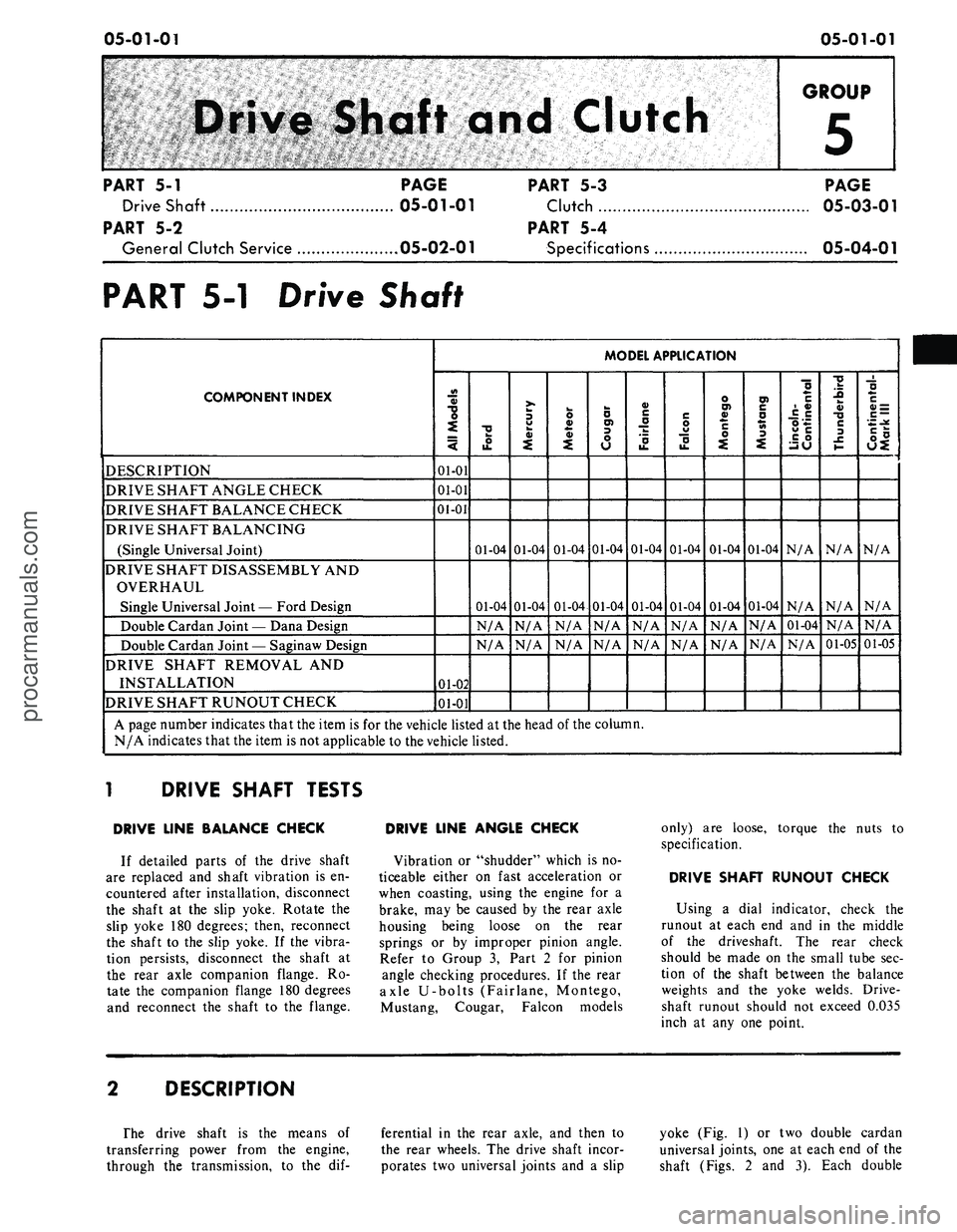
COMPONENT INDEX
DESCRIPTION
DRIVE SHAFT ANGLE CHECK
DRIVE SHAFT BALANCE CHECK
DRIVE SHAFT BALANCING
(Single Universal Joint)
DRIVE SHAFT DISASSEMBLY
AND
OVERHAUL
Single Universal Joint — Ford Design
Double Cardan Joint — Dana Design
Double Cardan Joint — Saginaw Design
DRIVE SHAFT REMOVAL
AND
INSTALLATION
DRIVE SHAFT RUNOUT CHECK
MODEL APPLICATION
All
Models
01-01
01-01
01-01
01-02
01-01
Ford
01-04
01-04
N/A
N/A
Mercury
01-04
01-04
N/A
N/A
Meteor
01-04
01-04
N/A
N/A
Cougar
01-04
01-04
N/A
N/A
Fairlane
01-04
01-04
N/A
N/A
Falcon
01-04
01-04
N/A
N/A
Montego
01-04
01-04
N/A
N/A
Mustang
01-04
01-04
N/A
N/A
Lincoln-
Continental
N/A
N/A
01-04
N/A
Thunderbird
N/A
N/A
N/A
01-05
Continental-
Mark
III
N/A
N/A
N/A
01-05
A page number indicates that the item
is for the
vehicle listed
at the
head
of
the column.
N/A indicates that
the
item
is not
applicable
to the
vehicle listed.
DRIVE SHAFT TESTS
DRIVE LINE BALANCE CHECK
If detailed parts
of the
drive shaft
are replaced
and
shaft vibration
is en-
countered after installation, disconnect
the shaft
at the
slip yoke. Rotate
the
slip yoke
180
degrees; then, reconnect
the shaft
to the
slip yoke.
If the
vibra-
tion persists, disconnect
the
shaft
at
the rear axle companion flange.
Ro-
tate
the
companion flange
180
degrees
and reconnect
the
shaft
to the
flange.
DRIVE LINE ANGLE CHECK
Vibration
or
"shudder" which
is no-
ticeable either
on
fast acceleration
or
when coasting, using
the
engine
for a
brake,
may be
caused
by the
rear axle
housing being loose
on the
rear
springs
or by
improper pinion angle.
Refer
to
Group
3,
Part
2 for
pinion
angle checking procedures.
If the
rear
axle U-bolts (Fairlane, Montego,
Mustang, Cougar, Falcon models
only)
are
loose, torque
the
nuts
to
specification.
DRIVE SHAFT RUNOUT CHECK
Using
a
dial indicator, check
the
runout
at
each
end and in the
middle
of
the
driveshaft.
The
rear check
should
be
made
on the
small tube
sec-
tion
of the
shaft between
the
balance
weights
and the
yoke welds. Drive-
shaft runout should
not
exceed 0.035
inch
at any one
point.
DESCRIPTION
The drive shaft
is the
means
of
transferring power from
the
engine,
through
the
transmission,
to the dif-
ferential
in the
rear axle,
and
then
to
the rear wheels.
The
drive shaft incor-
porates
two
universal joints
and a
slip
yoke
(Fig. 1) or two
double cardan
universal joints,
one at
each
end of the
shaft (Figs.
2 and 3).
Each double
procarmanuals.com
Page 250 of 413

05-01-03
Drive Shaft
05-01-03
DUST SEAL-4859
BALL SOCKET-4A031
UNIVERSAL
JOINT KIT-4635
WASHER
BALL SEAT i \ SPRING
BEARING \\ RETAINER
SEAL
0 \ X \
CENTER
\ \ RETAINER \ YOKE-47R4
SPRING \
BALL SOCKET-4A031
SLIP YOKE-4841
C1770-A
FIG.
3—Drive Shaft and Universal Joints Disassembled —Thunderbird, Continental Mark
REMOVAL AND INSTALLATION
REMOVAL
1.
To maintain drive line balance,
mark the relationship of the rear drive
shaft yoke and the drive pinion flange
of the axle (if the yellow alignment
marks are not visible) with the shaft
so that they may be installed in their
original positions.
2.
Disconnect the rear U-joint or
rear double cardan joint from the
companion flange. Wrap tape around
the loose bearing caps to prevent
them from falling off the spider. Pull
the drive shaft toward the rear of the
vehicle until the slip yoke clears the
transmission extension housing and
the seal. On Lincoln Continental
models, remove the three roller bear-
ing assemblies off the spline teeth in-
side the slip yoke (Fig. 3). Install the
appropriate tool in the extension
housing to prevent lubricant leakage.
INSTALLATION
1.
If either the rubber seal on the
output shaft or the seal in the end of
the transmission extension housing is
damaged in any manner, replace the
seal or seals as required. Also, if the
lugs on the axle pinion flange are
shaved or distorted so that the bear-
ings slide, replace the flange.
2.
On Lincoln Continental models,
install the bearing assemblies over the
spline teeth in the slip yoke. Lubricate
the yoke spline with B8A-19589-A lu-
bricant. This spline is sealed so that
the transmission fluid does not
"wash" away the spline lubricant
(Figs.
4 and 5). Remove the tool from
the extension housing. Install the yoke
on the transmission output shaft. Do
not allow the yoke assembly to bot-
tom on the output shaft with excessive
force.
Install the drive shaft so that the
index marks or the yellow mark (if
visible) on the yoke (light side) is in
line with the yellow mark on the com-
panion flange. This prevents vibration
which occurs when the balance of the
shaft and balance of the axle pinion
flange become additive instead of neu-
01L SEAL (AUTOMATIC TRANSMISSION ONLY)
YOKE
SNAP RING (WRAP TYPE)
. 4—Output Shaft Spline Seal — All except Continental
Mark III and Thunderbird
E U73-Cprocarmanuals.com
Page 271 of 413
06-02-02
Ford Design Three Speed Transmission
06-02-02
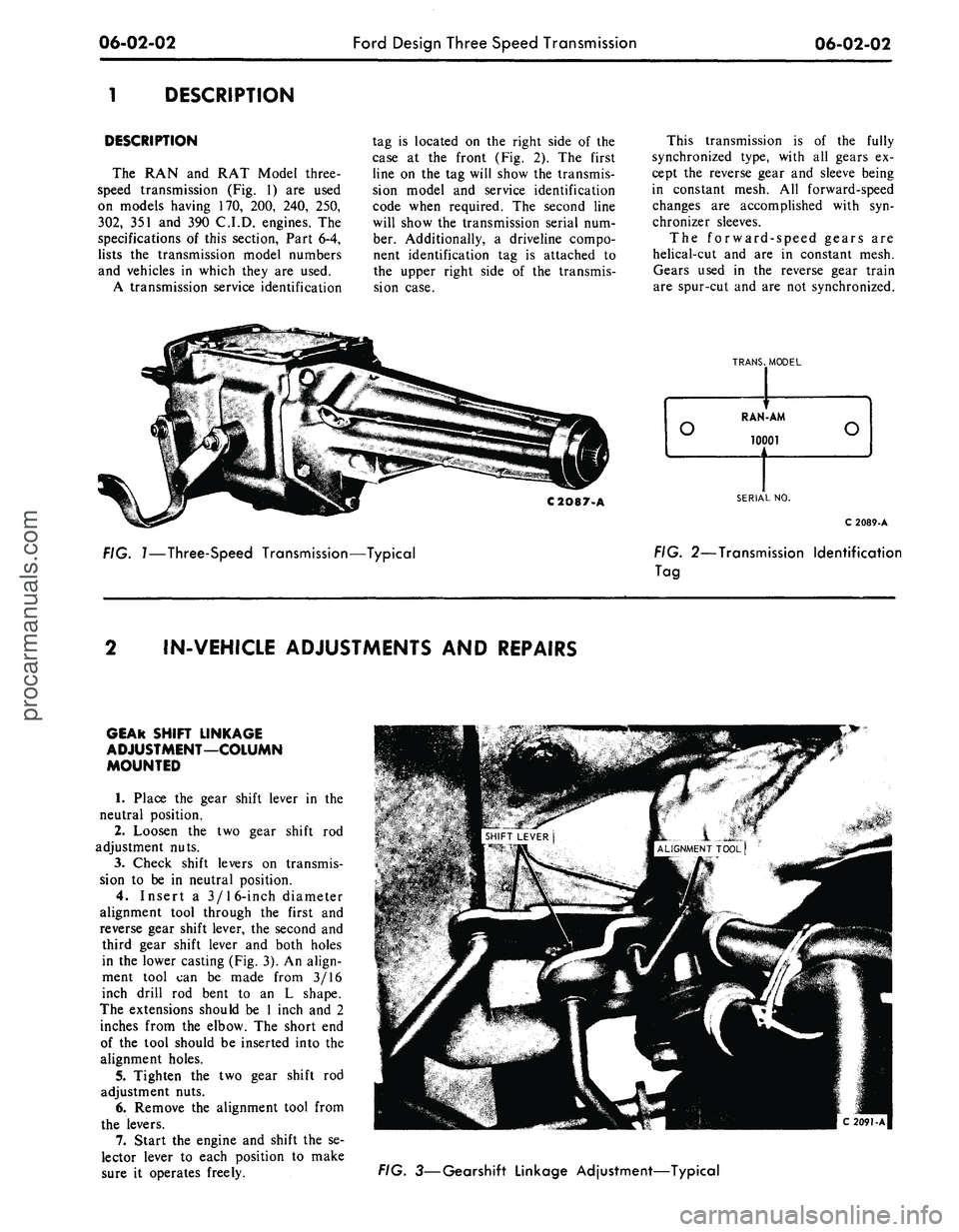
DESCRIPTION
DESCRIPTION
The RAN and RAT Model three-
speed transmission (Fig. 1) are used
on models having 170, 200, 240, 250,
302,
351 and 390 C.I.D. engines. The
specifications of this section, Part 6-4,
lists the transmission model numbers
and vehicles in which they are used.
A transmission service identification
tag is located on the right side of the
case at the front (Fig. 2). The first
line on the tag will show the transmis-
sion model and service identification
code when required. The second line
will show the transmission serial num-
ber. Additionally, a driveline compo-
nent identification tag is attached to
the upper right side of the transmis-
sion case.
This transmission is of the fully
synchronized type, with all gears ex-
cept the reverse gear and sleeve being
in constant mesh. All forward-speed
changes are accomplished with syn-
chronizer sleeves.
The forward-speed gears are
helical-cut and are in constant mesh.
Gears used in the reverse gear train
are spur-cut and are not synchronized.
C2O87-A
FIG.
1—Three-Speed
Transmission—Typical
TRANS.
MODEL
SERIAL
NO.
C 2089-A
FIG.
2—Transmission
Identification
Tag
IN-VEHICLE ADJUSTMENTS
AND
REPAIRS
GEAR SHIFT LINKAGE
ADJUSTMENT—COLUMN
MOUNTED
1. Place the gear shift lever in the
neutral position.
2.
Loosen the two gear shift rod
adjustment nuts.
3.
Check shift levers on transmis-
sion to be in neutral position.
4.
Insert a 3/16-inch diameter
alignment tool through the first and
reverse gear shift lever, the second and
third gear shift lever and both holes
in the lower casting (Fig. 3). An align-
ment tool can be made from 3/16
inch drill rod bent to an L shape.
The extensions should be 1 inch and 2
inches from the elbow. The short end
of the tool should be inserted into the
alignment holes.
5.
Tighten the two gear shift rod
adjustment nuts.
6. Remove the alignment tool from
the levers.
7.
Start the engine and shift the se-
lector lever to each position to make
sure it operates freely.
FIG.
3—Gearshift
Linkage Adjustment—Typicalprocarmanuals.com
Page 274 of 413
06-02-05
Ford Design Three Speed Transmission
06-02-05
Dummy
Shaft
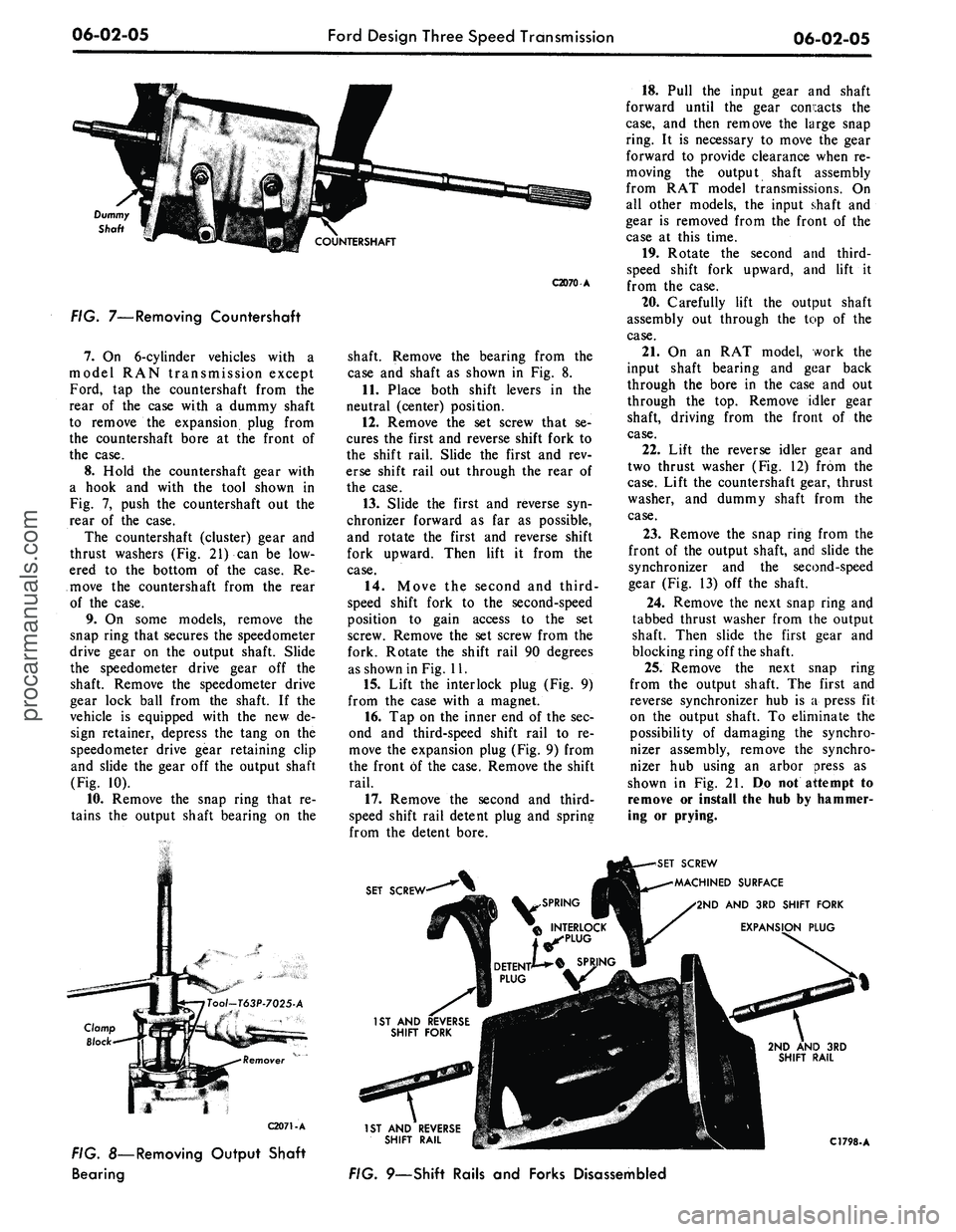
FIG. 7—Removing Countershaft
7.
On 6-cylinder vehicles with a
model RAN transmission except
Ford, tap the countershaft from the
rear of the case with a dummy shaft
to remove the expansion plug from
the countershaft bore at the front of
the case.
8. Hold the countershaft gear with
a hook and with the tool shown in
Fig. 7, push the countershaft out the
rear of the case.
The countershaft (cluster) gear and
thrust washers (Fig. 21) can be low-
ered to the bottom of the case. Re-
move the countershaft from the rear
of the case.
9. On some models, remove the
snap ring that secures the speedometer
drive gear on the output shaft. Slide
the speedometer drive gear off the
shaft. Remove the speedometer drive
gear lock ball from the shaft. If the
vehicle is equipped with the new de-
sign retainer, depress the tang on the
speedometer drive gear retaining clip
and slide the gear off the output shaft
(Fig. 10).
10.
Remove the snap ring that re-
tains the output shaft bearing on the
C2070 A
shaft. Remove the bearing from the
case and shaft as shown in Fig. 8.
11.
Place both shift levers in the
neutral (center) position.
12.
Remove the set screw that se-
cures the first and reverse shift fork to
the shift rail. Slide the first and rev-
erse shift rail out through the rear of
the case.
13.
Slide the first and reverse syn-
chronizer forward as far as possible,
and rotate the first and reverse shift
fork upward. Then lift it from the
case.
14.
Move the second and third-
speed shift fork to the second-speed
position to gain access to the set
screw. Remove the set screw from the
fork. Rotate the shift rail 90 degrees
as shown in Fig. 11.
15.
Lift the interlock plug (Fig. 9)
from the case with a magnet.
16.
Tap on the inner end of the sec-
ond and third-speed shift rail to re-
move the expansion plug (Fig. 9) from
the front of the case. Remove the shift
rail.
17.
Remove the second and third-
speed shift rail detent plug and spring
from the detent bore.
18.
Pull the input gear and shaft
forward until the gear contacts the
case,
and then remove the large snap
ring. It is necessary to move the gear
forward to provide clearance when re-
moving the output shaft assembly
from RAT model transmissions. On
all other models, the input shaft and
gear is removed from the front of the
case at this time.
19.
Rotate the second and third-
speed shift fork upward, and lift it
from the case.
20.
Carefully lift the output shaft
assembly out through the top of the
case.
21.
On an RAT model, work the
input shaft bearing and gear back
through the bore in the case and out
through the top. Remove idler gear
shaft, driving from the front of the
case.
22.
Lift the reverse idler gear and
two thrust washer (Fig. 12) from the
case.
Lift the countershaft gear, thrust
washer, and dummy shaft from the
case.
23.
Remove the snap ring from the
front of the output shaft, and slide the
synchronizer and the second-speed
gear (Fig. 13) off the shaft.
24.
Remove the next snap ring and
tabbed thrust washer from the output
shaft. Then slide the first gear and
blocking ring off the shaft.
25.
Remove the next snap ring
from the output shaft. The first and
reverse synchronizer hub is a press fit
on the output shaft. To eliminate the
possibility of damaging the synchro-
nizer assembly, remove the synchro-
nizer hub using an arbor press as
shown in Fig. 21. Do not attempt to
remove or install the hub by hammer-
ing or prying.
C2071-A
FIG. 8—Removing Output Shaft
Bearing
SET SCREW
SCREW
MACHINED SURFACE
2ND AND 3RD SHIFT FORK
EXPANSION PLUG
1ST AND REVERSE
SHIFT RAIL
FIG. 9—Shift Rails and Forks Disassembled
C1798-Aprocarmanuals.com
Page 278 of 413
06-02-09
Ford Design Three Speed Transmission
06-02-09
PRESS
RAM
OUTPUT SHAFT
SYNCHRONIZER
PRESS
RAM
OUTPUT SHAFT
Tool-T63P7025-A
SYNCHRONIZER
HUB
REMOVAL INSTALLATION c 1718-A
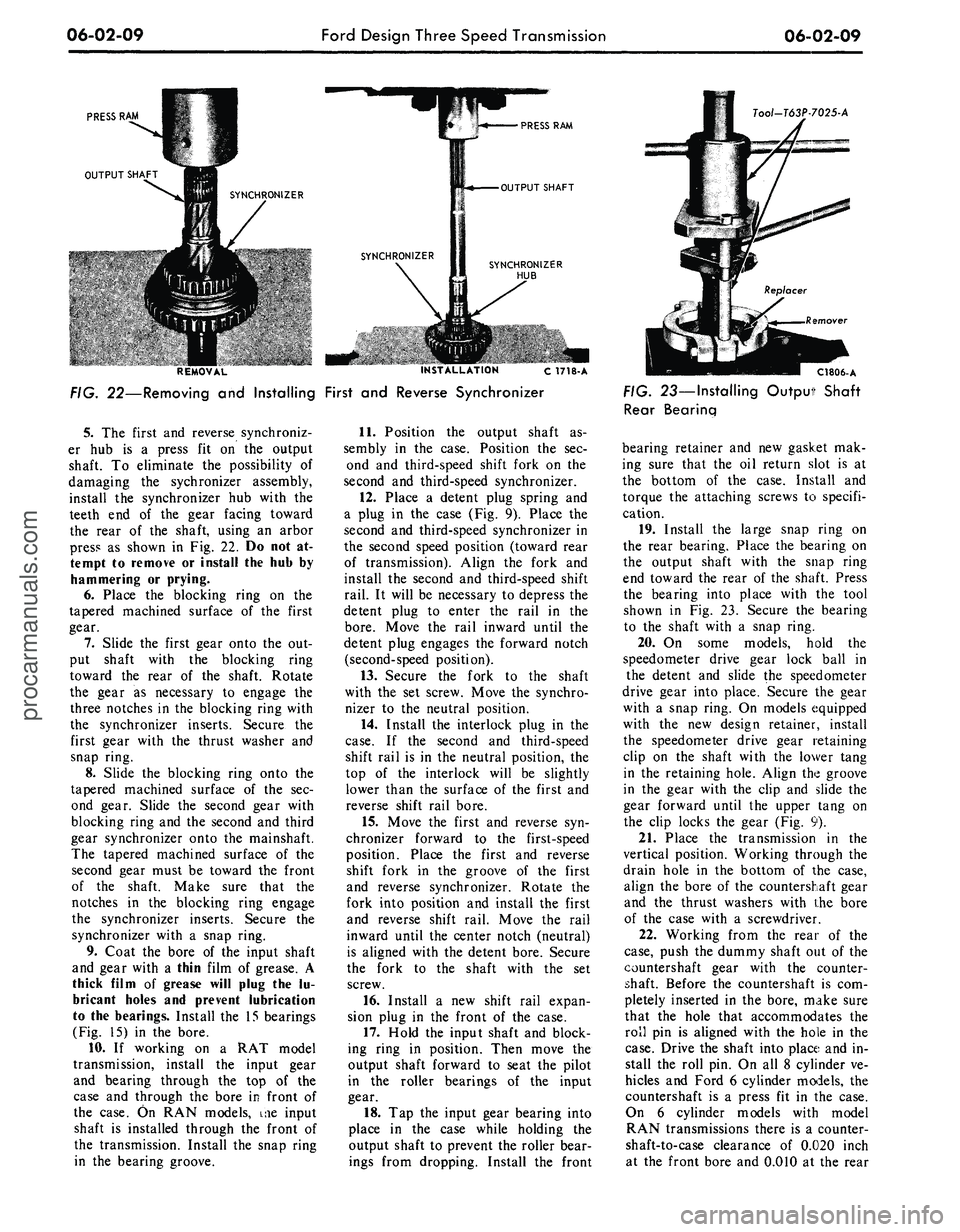
FIG. 22—Removing
and
Installing First
and
Reverse Synchronizer
5.
The
first
and
reverse synchroniz-
er
hub is a
press
fit on the
output
shaft.
To
eliminate
the
possibility
of
damaging
the
sychronizer assembly,
install
the
synchronizer
hub
with
the
teeth
end of the
gear facing toward
the rear
of the
shaft, using
an
arbor
press
as
shown
in Fig. 22. Do not at-
tempt
to
remove
or
install
the hub by
hammering
or
prying.
6. Place
the
blocking ring
on the
tapered machined surface
of the
first
gear.
7.
Slide
the
first gear onto
the out-
put shaft with
the
blocking ring
toward
the
rear
of the
shaft. Rotate
the gear
as
necessary
to
engage
the
three notches
in the
blocking ring with
the synchronizer inserts. Secure
the
first gear with
the
thrust washer
and
snap ring.
8. Slide
the
blocking ring onto
the
tapered machined surface
of the sec-
ond gear. Slide
the
second gear with
blocking ring
and the
second
and
third
gear synchronizer onto
the
mainshaft.
The tapered machined surface
of the
second gear must
be
toward
the
front
of
the
shaft. Make sure that
the
notches
in the
blocking ring engage
the synchronizer inserts. Secure
the
synchronizer with
a
snap ring.
9. Coat
the
bore
of the
input shaft
and gear with
a
thin film
of
grease.
A
thick film
of
grease will plug
the lu-
bricant holes
and
prevent lubrication
to
the
bearings. Install
the 15
bearings
(Fig.
15) in the
bore.
10.
If
working
on a RAT
model
transmission, install
the
input gear
and bearing through
the top of the
case
and
through
the
bore
in
front
of
the case.
On RAN
models,
me
input
shaft
is
installed through
the
front
of
the transmission. Install
the
snap ring
in
the
bearing groove.
11.
Position
the
output shaft
as-
sembly
in the
case. Position
the sec-
ond
and
third-speed shift fork
on the
second
and
third-speed synchronizer.
12.
Place
a
detent plug spring
and
a plug
in the
case
(Fig. 9).
Place
the
second
and
third-speed synchronizer
in
the second speed position (toward rear
of transmission). Align
the
fork
and
install
the
second
and
third-speed shift
rail.
It
will
be
necessary
to
depress
the
detent plug
to
enter
the
rail
in the
bore.
Move
the
rail inward until
the
detent plug engages
the
forward notch
(second-speed position).
13.
Secure
the
fork
to the
shaft
with
the set
screw. Move
the
synchro-
nizer
to the
neutral position.
14.
Install
the
interlock plug
in the
case.
If the
second
and
third-speed
shift rail
is in the
neutral position,
the
top
of the
interlock will
be
slightly
lower than
the
surface
of the
first
and
reverse shift rail bore.
15.
Move
the
first
and
reverse
syn-
chronizer forward
to the
first-speed
position. Place
the
first
and
reverse
shift fork
in the
groove
of the
first
and reverse synchronizer. Rotate
the
fork into position
and
install
the
first
and reverse shift rail. Move
the
rail
inward until
the
center notch (neutral)
is aligned with
the
detent bore. Secure
the fork
to the
shaft with
the set
screw.
16.
Install
a new
shift rail expan-
sion plug
in the
front
of the
case.
17.
Hold
the
input shaft
and
block-
ing ring
in
position. Then move
the
output shaft forward
to
seat
the
pilot
in
the
roller bearings
of the
input
gear.
18.
Tap the
input gear bearing into
place
in the
case while holding
the
output shaft
to
prevent
the
roller bear-
ings from dropping. Install
the
front
C1806-A
FIG. 23—Installing Output Shaft
Rear Bearing
bearing retainer
and new
gasket
mak-
ing sure that
the oil
return slot
is at
the bottom
of the
case. Install
and
torque
the
attaching screws
to
specifi-
cation.
19.
Install
the
large snap ring
on
the rear bearing. Place
the
bearing
on
the output shaft with
the
snap ring
end toward
the
rear
of the
shaft. Press
the bearing into place with
the
tool
shown
in Fig. 23.
Secure
the
bearing
to
the
shaft with
a
snap ring.
20.
On
some models, hold
the
speedometer drive gear lock ball
in
the detent
and
slide
the
speedometer
drive gear into place. Secure
the
gear
with
a
snap ring.
On
models equipped
with
the new
design retainer, install
the speedometer drive gear retaining
clip
on the
shaft with
the
lower tang
in
the
retaining hole. Align
the
groove
in
the
gear with
the
clip
and
slide
the
gear forward until
the
upper tang
on
the clip locks
the
gear
(Fig. 9).
21.
Place
the
transmission
in the
vertical position. Working through
the
drain hole
in the
bottom
of the
case,
align
the
bore
of the
countershaft gear
and
the
thrust washers with
the
bore
of
the
case with
a
screwdriver.
22.
Working from
the
rear
of the
case,
push
the
dummy shaft
out of the
countershaft gear with
the
counter-
shaft. Before
the
countershaft
is com-
pletely inserted
in the
bore, make sure
that
the
hole that accommodates
the
roll
pin is
aligned with
the
hole
in the
case.
Drive
the
shaft into place
and in-
stall
the
roll
pin. On all 8
cylinder
ve-
hicles
and
Ford
6
cylinder models,
the
countershaft
is a
press
fit in the
case.
On
6
cylinder models with model
RAN transmissions there
is a
counter-
shaft-to-case clearance
of
0.020 inch
at
the
front bore
and 0.010 at the
rearprocarmanuals.com
Page 281 of 413
06-03-02
Ford Design Four-Speed Transmission
06-03-02
1 DESCRIPTION
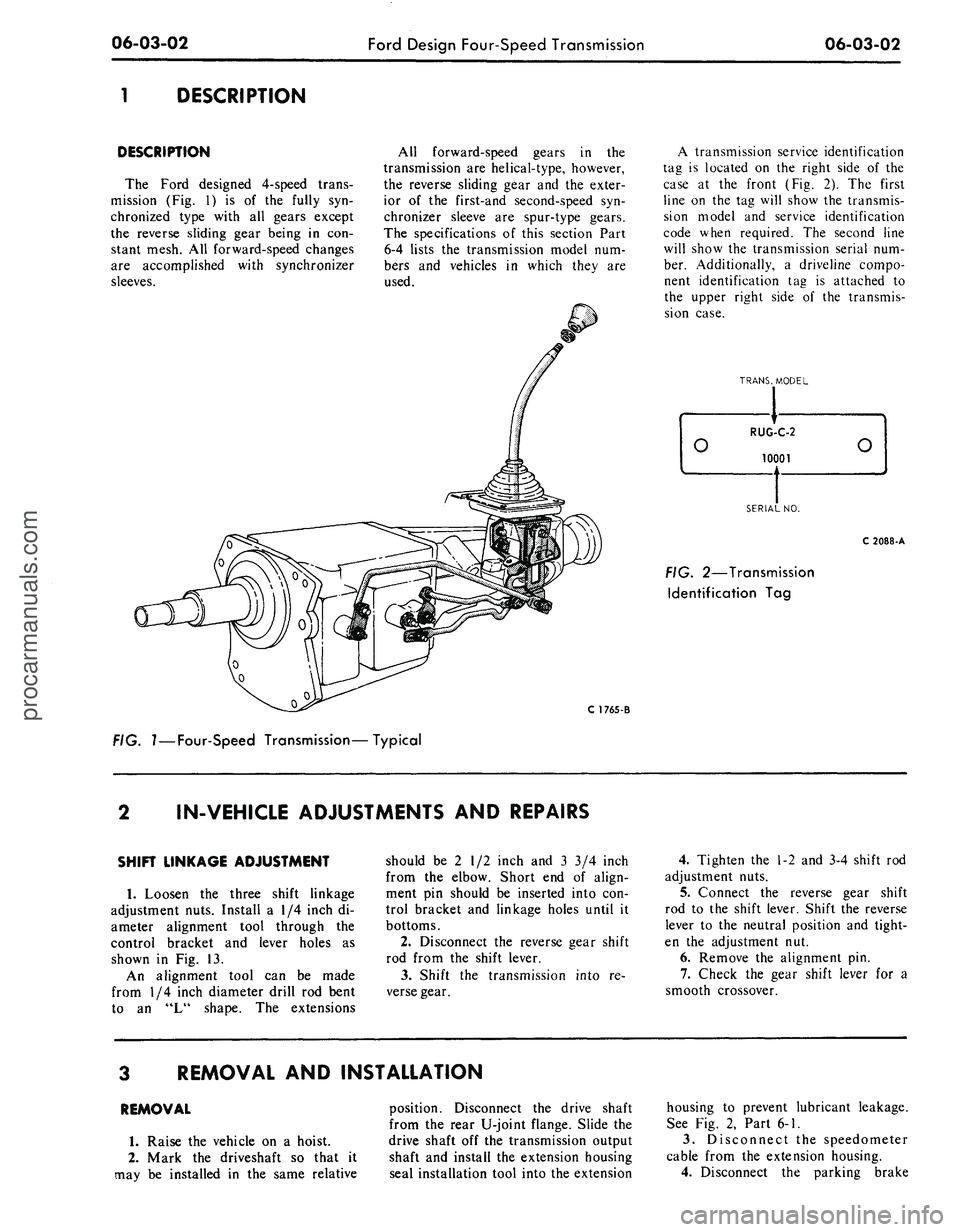
DESCRIPTION
The Ford designed 4-speed trans-
mission
(Fig. 1) is of the
fully
syn-
chronized type with
all
gears except
the reverse sliding gear being
in con-
stant mesh.
All
forward-speed changes
are accomplished with synchronizer
sleeves.
All forward-speed gears
in the
transmission
are
helical-type, however,
the reverse sliding gear
and the
exter-
ior
of the
first-and second-speed
syn-
chronizer sleeve
are
spur-type gears.
The specifications
of
this section Part
6-4 lists
the
transmission model
num-
bers
and
vehicles
in
which they
are
used.
C 1765-B
FIG. 7—Four-Speed Transmission—Typical
A transmission service identification
tag
is
located
on the
right side
of the
case
at the
front
(Fig. 2). The
first
line
on the tag
will show
the
transmis-
sion model
and
service identification
code when required.
The
second line
will show
the
transmission serial
num-
ber. Additionally,
a
driveline compo-
nent identification
tag is
attached
to
the upper right side
of the
transmis-
sion case.
TRANS.
MODEL
O
RUG-C-2
10001
O
SERIAL NO.
C 2088-A
FIG. 2—Transmission
Identification
Tag
IN-VEHICLE ADJUSTMENTS
AND
REPAIRS
SHIFT LINKAGE ADJUSTMENT
1.
Loosen
the
three shift linkage
adjustment nuts. Install
a 1/4
inch
di-
ameter alignment tool through
the
control bracket
and
lever holes
as
shown
in Fig. 13.
An alignment tool
can be
made
from
1/4
inch diameter drill
rod
bent
to
an "L"
shape.
The
extensions
should
be 2 1/2
inch
and 3 3/4
inch
from
the
elbow. Short
end of
align-
ment
pin
should
be
inserted into
con-
trol bracket
and
linkage holes until
it
bottoms.
2.
Disconnect
the
reverse gear shift
rod from
the
shift lever.
3.
Shift
the
transmission into
re-
verse gear.
4.
Tighten
the 1-2 and 3-4
shift
rod
adjustment nuts.
5.
Connect
the
reverse gear shift
rod
to the
shift lever. Shift
the
reverse
lever
to the
neutral position
and
tight-
en
the
adjustment
nut.
6. Remove
the
alignment
pin.
7.
Check
the
gear shift lever
for a
smooth crossover.
REMOVAL
AND
INSTALLATION
REMOVAL
1.
Raise
the
vehicle
on a
hoist.
2.
Mark
the
driveshaft
so
that
it
may
be
installed
in the
same relative
position. Disconnect
the
drive shaft
from
the
rear U-joint flange. Slide
the
drive shaft
off the
transmission output
shaft
and
install
the
extension housing
seal installation tool into the extension
housing
to
prevent lubricant leakage.
See
Fig. 2,
Part
6-1.
3.
Disconnect
the
speedometer
cable from
the
extension housing.
4.
Disconnect
the
parking brakeprocarmanuals.com
Page 282 of 413
06-03-03
Ford Design Four-Speed Transmission
06-03-03
cable from the equalizer lever and sep-
arate the lever from the crossmember.
5.
Remove the hairpin retainer se-
curing the cable to the transmission
rear support crossmember, and then
pull the cable assembly forward and
out of the crossmember.
6. Remove the retaining clip, flat
washer, and spring washer that se-
cures the shift rods to the shift levers.
7.
Remove the bolts that attach the
shift linkage control bracket to the ex-
tension housing and position the as-
sembly out of the way.
8. Support the engine with a trans-
mission jack and remove the extension
housing-to-engine rear support attach-
ing bolts.
9. Raise the rear of the engine high
enough to remove the weight from the
crossmember. Remove the bolts re-
taining the crossmember to the frame
side supports and remove the
crossmember.
10.
Support the transmission on a
jack and remove the bolts that attach
the transmission to the flywheel hous-
ing.
11.
Move the transmission and jack
rearward until the transmission input
shaft clears the flywheel housing. If
necessary, lower the engine enough to
obtain clearance for transmission re-
moval.
Do not depress the clutch pedal
while the transmission is removed.
INSTALLATION
1.
Make sure that the mounting
surface of the transmission and the
flywheel housing are free of dirt,
paint, and burrs. Install two guide
pins in the flywheel housing lower
mounting bolt holes. Move the trans-
mission forward on the guide pins
until the input shaft splines enter the
clutch hub splines and the case is posi-
tioned against the flywheel housing.
2.
Install the two upper transmis-
sion to flywheel housing, mounting
bolts snug, and then remove the two
guide pins. Install the two lower
mounting bolts. Torque all mounting
bolts to specifications.
3.
Raise the rear of the engine and
install the crossmember. Install and
torque the crossmember attaching
bolts to specifications, then lower the
engine.
4.
With the transmission extension
housing resting on the engine rear
support, install the transmission ex-
tension housing attaching bolts. Tor-
que the bolts to specifications.
5.
Position the shift linkage control
bracket to the extension housing and
install the attaching bolts.
6. Secure each shift rod to its re-
spective lever with the spring washer,
flat washer, and retaining pin.
7.
Guide the parking brake cable
assembly through the hole in the
transmission rear support crossmemb-
er. Secure the cable assembly to the
crossmember with the hair pin retain-
er.
8. Insert the parking brake front
cable in the equalizer and install the
equalizer in the bracket on the
crossmember. Secure the parking
brake rear cable to the equalizer.
9. Connect the speedometer cable
to the extension housing.
10.
Remove the extension housing
installation tool and slide the forward
end of the drive shaft over the trans-
mission output shaft. Connect the
drive shaft to the rear U-joint flange.
11.
Place both forward gear shift
levers and the reverse shift lever in the
neutral position and insert a 1/4 inch
diameter alignment tool in the shift
linkage alignment hole (Fig. 17). It
may be necessary to loosen the adjust-
ment nuts to install the alignment
tool. Adjust the linkage as necessary
and tighten the adjustment nuts to
specifications. Remove the alignment
tool.
12.
Fill the transmission to the
proper level with the specified lubri-
cant.
13.
Lower the car. Check tne shift
and crossover motion for full shift en-
gagement and smooth crossover oper-
ation.
MAJOR REPAIR OPERATIONS
DISASSEMBLY
1.
Mount the transmission in a
holding fixture and drain the lubri-
cant.
2.
Remove the cover attaching
screws from the case. Lift the cover
and gasket from the case.
3.
Remove the long spring that re-
tains the detent plug in the case (Fig.
4).
Remove the detent plug with a
small magnet.
4.
Remove the extension housing
attaching screws and lock washers.
Remove the housing and the gasket.
5.
Remove the input shaft bearing
retainer attaching screws. Slide the re-
tainer off the input shaft.
6. Support the countershaft gear
with a wire hook. Working from the
front of the case, push the counter-
shaft out the rear of the case as shown
in Fig. 3. Lower the countershaft to
the bottom of the case with the wire
hook. Remove the hook.
Tool-T64P-711hA
COUNTERSHAFT
C2073-A
FIG. 3—Removing Countershaft
From Case
7.
Place the first and second-speed
gear shift lever and the reverse shift
lever in the neutral position. Place the
third and fourth-speed gear shift lever
in the third-speed position.
8. Remove the attaching screw
from the third and fourth-speed shift
fork. Tap on the inner end of the shift
rail to unseal the expansion plug from
the front of the case. Then withdraw
the third and fourth-speed shift rail
from the front of the case. Do not
lose the interlock pin from the shift
rail.
9. Remove the set screw from the
first and second-speed shift fork.
Slide the first and second-speed shift
rail out the rear of the case.
10.
Remove the interlock plug and
the detent plug from the top of the
case (Fig. 4) with a magnet.
11.
On some models, remove the
snap ring that secures the speedometer
drive gear to the output shaft. Slide
the gear off the shaft, then remove the
speedometer gear drive ball. On mod-
els equipped with the new design re-
tainers, depress the tang on the speed-
ometer drive gear retaining clip and
slide the speedometer gear off the
shaft. (Fig. 5).
12.
Remove the snap ring that se-
cures the output shaft bearing to the
shaft.procarmanuals.com
Page 294 of 413
07-01-03
General Transmission Service
07-01-03
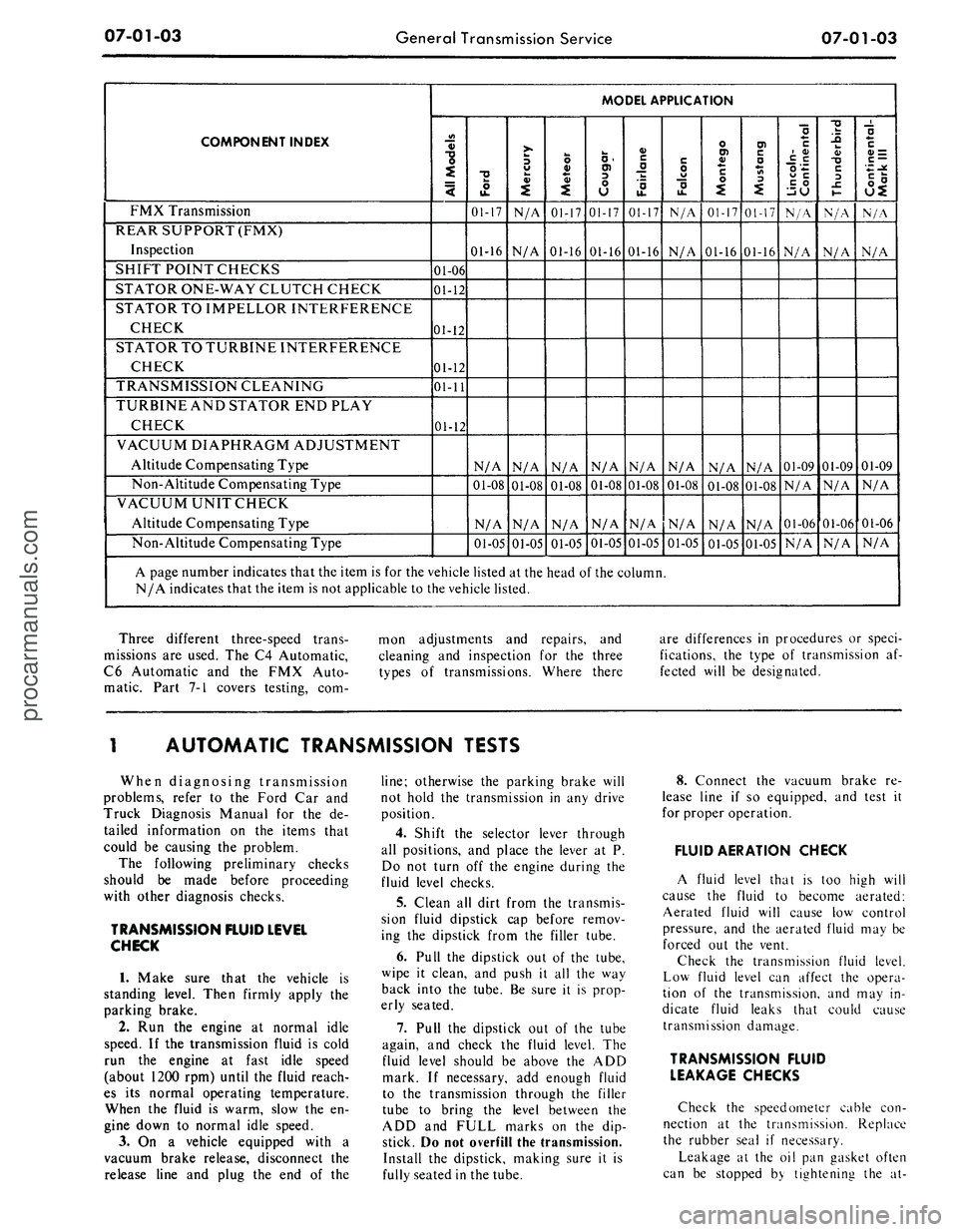
COMPONENT INDEX
FMX Transmission
REAR SUPPORT (FMX)
Inspection
SHIFT POINT CHECKS
STATOR ONE-WAY CLUTCH CHECK
STATOR TO IMPELLOR INTERFERENCE
CHECK
STATOR TO TURBINE INTERFERENCE
CHECK
TRANSMISSION CLEANING
TURBINE AND STATOR END PLAY
CHECK
VACUUM DIAPHRAGM ADJUSTMENT
Altitude Compensating Type
Non-Altitude Compensating Type
VACUUM UNIT CHECK
Altitude Compensating Type
Non-Altitude Compensating Type
MODEL APPLICATION
All
Models
01-06
01-12
01-12
01-12
01-11
01-12
Ford
01-17
01-16
N/A
01-08
N/A
01-05
Mercury
N/A
N/A
N/A
01-08
N/A
01-05
Meteor
01-17
01-16
N/A
01-08
N/A
01-05
Cougar
01-17
01-16
N/A
01-08
N/A
01-05
Fairlane
01-17
01-16
N/A
01-08
N/A
01-05
Falcon
N/A
N/A
N/A
01-08
N/A
01-05
Montego
01-17
01-16
N/A
01-08
N/A
01-05
Mustang
01-17
01-16
N/A
01-08
N/A
01-05
Lincoln-
Continental
N/A
N/A
01-09
N/A
01-06
N/A
Thunderbird
N/A
N/A
01-09
N/A
01-06
N/A
Continental-
Mark
III
N/A
N/A
01-09
N/A
01-06
N/A
A page number indicates that the item is for the vehicle listed at the head of the column.
N/A indicates that the item is not applicable to the vehicle listed.
Three different three-speed trans-
missions are used. The C4 Automatic,
C6 Automatic and the FMX Auto-
matic. Part 7-1 covers testing, com-
mon adjustments and repairs, and
cleaning and inspection for the three
types of transmissions. Where there
are differences in procedures or speci-
fications, the type of transmission af-
fected will be designated.
l
AUTOMATIC TRANSMISSION TESTS
When diagnosing transmission
problems, refer to the Ford Car and
Truck Diagnosis Manual for the de-
tailed information on the items that
could be causing the problem.
The following preliminary checks
should be made before proceeding
with other diagnosis checks.
TRANSMISSION FLUID LEVEL
CHECK
1.
Make sure that the vehicle is
standing level. Then firmly apply the
parking brake.
2.
Run the engine at normal idle
speed. If the transmission fluid is cold
run the engine at fast idle speed
(about 1200 rpm) until the fluid reach-
es its normal operating temperature.
When the fluid is warm, slow the en-
gine down to normal idle speed.
3.
On a vehicle equipped with a
vacuum brake release, disconnect the
release line and plug the end of the
line;
otherwise the parking brake will
not hold the transmission in any drive
position.
4.
Shift the selector lever through
all positions, and place the lever at P.
Do not turn off the engine during the
fluid level checks.
5.
Clean all dirt from the transmis-
sion fluid dipstick cap before remov-
ing the dipstick from the filler tube.
6. Pull the dipstick out of the tube,
wipe it clean, and push it all the way
back into the tube. Be sure it is prop-
erly seated.
7.
Pull the dipstick out of the tube
again, and check the fluid level. The
fluid level should be above the ADD
mark. If necessary, add enough fluid
to the transmission through the filler
tube to bring the level between the
ADD and FULL marks on the dip-
stick. Do not overfill the transmission.
Install the dipstick, making sure it is
fully seated in the tube.
8. Connect the vacuum brake re-
lease line if so equipped, and test it
for proper operation.
FLUID AERATION CHECK
A fluid level that is too high will
cause the fluid to become aerated:
Aerated fluid will cause low control
pressure, and the aerated fluid may be
forced out the vent.
Check the transmission fluid level.
Low fluid level can affect the opera-
tion of the transmission, and may in-
dicate fluid leaks that could cause
transmission damage.
TRANSMISSION FLUID
LEAKAGE CHECKS
Check the speedometer cable con-
nection at the transmission. Replace
the rubber seal if necessary.
Leakage at the oil pan gasket often
can be stopped by tightening the at-
procarmanuals.com
Page 310 of 413
J7-02-02
C4 Automatic Transmission
07-02-02
COMPONENT INDEX
Disassembly and Overhaul
REVERSE RING GEAR AND HUB
Disassembly and Overhaul
SELECTOR LEVER-CONSOLE SHIFT
Removal and Installation
THROTTLE LINKAGE
All
Models
02-22
02-26
02-08
COMPONENT INDEX
Adjustments
TRANSMISSION (Complete)
Removal and Installation
TRANSMISSION CASE BUSHING
Parts Repair or Replacement
TRANSMISSION CASE THREAD REPAIR
All
Models
02-04
02-11
02-18
02-18
DESCRIPTION
CONVERTER HOUSING,
CONVERTER
STATOR SUPPORT
FRONT PUMP CASE
INTERMEDIATE
BAND
LOW-REVERSE DRUM
-,
FORWARD CLUTCH
HUB AND RING GEAR
INPUT
SHELL
REVERSE RING GEAR
LOW REVERSE BAND
ONE-WAY
CLUTCH
GOVERNOR
DISTRIBUTOR
SLEEVE
GOVERNOR
DISTRIBUTOR
SPLINE SEAL
EXTENSION
HOUSING
SPEEDOMETER
DRIVE GEAR
GOVERNOR
REVERSE PLANET CARRIER
FRONT PLANET CARRIER
PARK TOGGLE LEVER
LOW-REVERSE SERVO PISTON
FORWARD CLUTCH
CONTROL LEVERS
FIG.
1—C4
Automatic Transmission
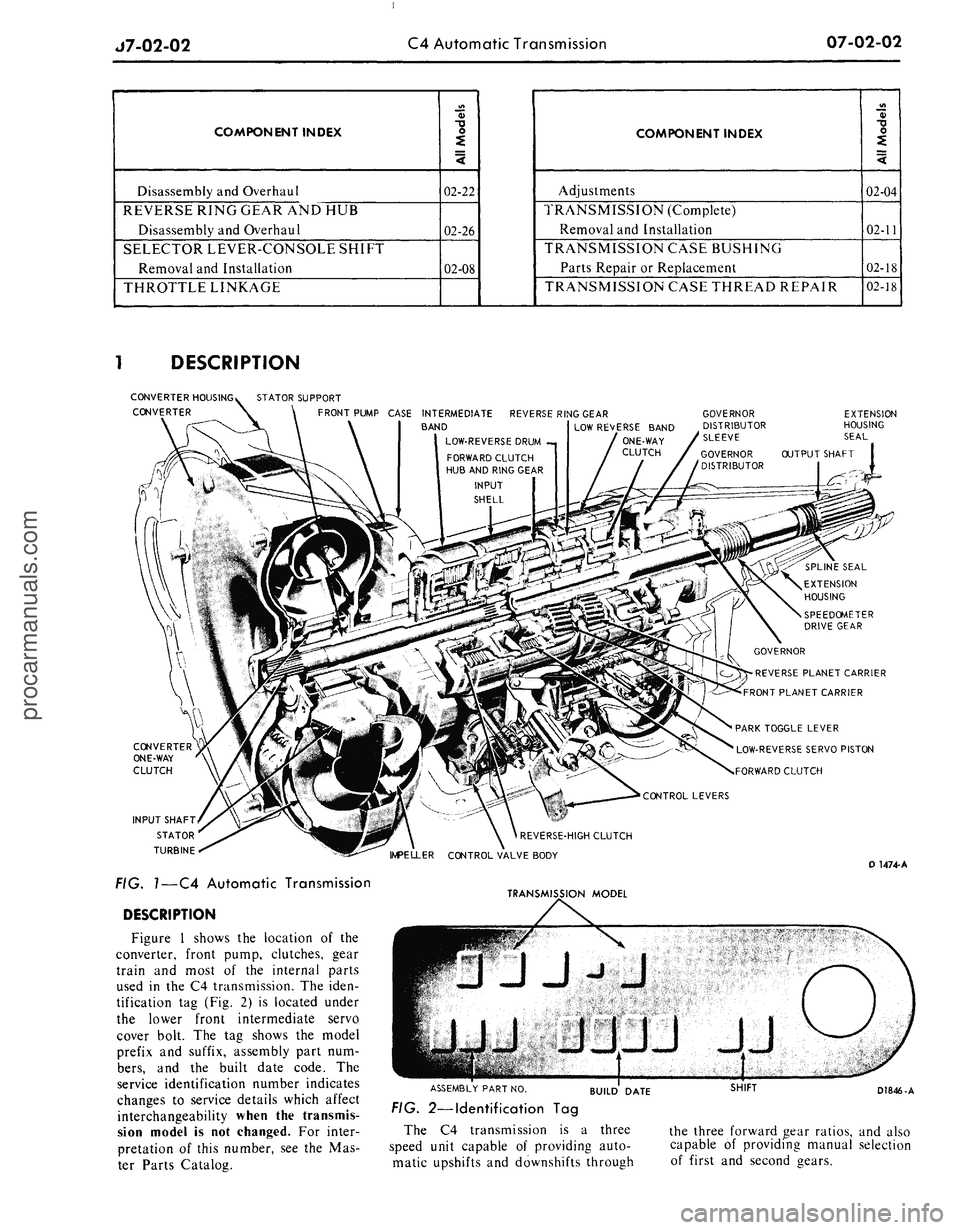
DESCRIPTION
Figure
1
shows
the
location
of the
converter, front pump, clutches, gear
train
and
most
of the
internal parts
used
in
the C4 transmission. The iden-
tification
tag
(Fig.
2) is
located under
the lower front intermediate servo
cover bolt.
The tag
shows
the
model
prefix
and
suffix, assembly part num-
bers,
and the
built date code.
The
service identification number indicates
changes
to
service details which affect
interchangeability when
the
transmis-
sion model
is not
changed.
For
inter-
pretation
of
this number, see the Mas-
ter Parts Catalog.
REVERSE-HIGH CLUTCH
IMPELLER CONTROL VALVE BODY
TRANSMISSION MODEL
D 1474-A
ASSEMBLY PART NO. BUILD DATE
FIG.
2—Identification
Tag
The
C4
transmission
is a
three
speed unit capable
of
providing auto-
matic upshifts
and
downshifts through
SHIFT
D1846-A
the three forward gear ratios,
and
also
capable
of
providing manual selection
of first
and
second gears.
procarmanuals.com
Page 324 of 413
07-02-16
C4 Automatic Transmission
07-02-16
COVER SEAL
STEM NUT
SERVO PISTON STEM
PISTON RETURN SPRING PISTON AND SEAL
(SEAL BONDED TO PISTON)
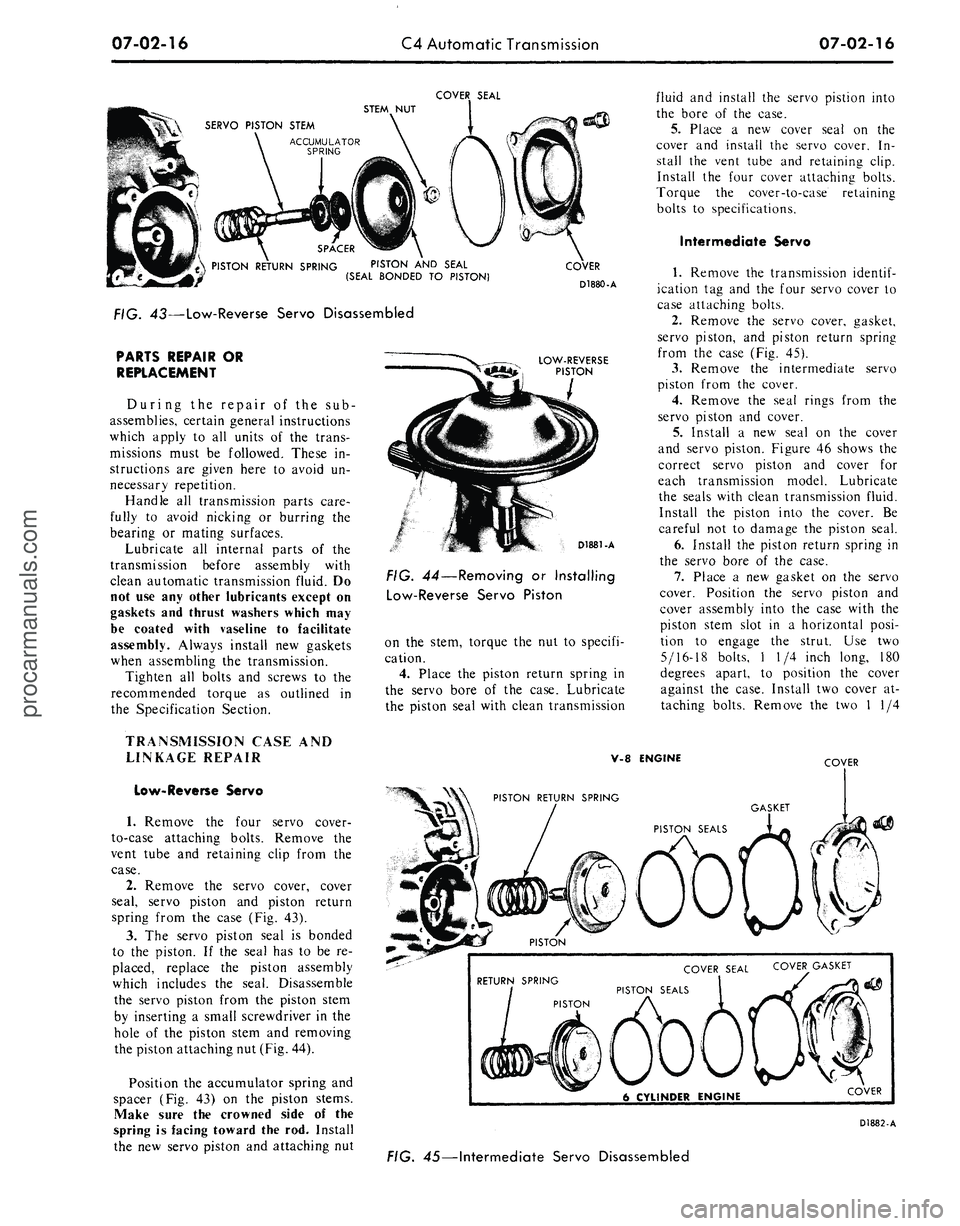
FIG. 43—Low-Reverse Servo Disassembled
PARTS REPAIR OR
REPLACEMENT
During the repair of the sub-
assemblies, certain general instructions
which apply to all units of the trans-
missions must be followed. These in-
structions are given here to avoid un-
necessary repetition.
Handle all transmission parts care-
fully to avoid nicking or burring the
bearing or mating surfaces.
Lubricate all internal parts of the
transmission before assembly with
clean automatic transmission fluid. Do
not use any other lubricants except on
gaskets and thrust washers which may
be coated with vaseline to facilitate
assembly. Always install new gaskets
when assembling the transmission.
Tighten all bolts and screws to the
recommended torque as outlined in
the Specification Section.
TRANSMISSION CASE AND
LINKAGE REPAIR
Low-Reverse Servo
1.
Remove the four servo cover-
to-case attaching bolts. Remove the
vent tube and retaining clip from the
case.
2.
Remove the servo cover, cover
seal, servo piston and piston return
spring from the case (Fig. 43).
3.
The servo piston seal is bonded
to the piston. If the seal has to be re-
placed, replace the piston assembly
which includes the seal. Disassemble
the servo piston from the piston stem
by inserting a small screwdriver in the
hole of the piston stem and removing
the piston attaching nut (Fig. 44).
Position the accumulator spring and
spacer (Fig. 43) on the piston stems.
Make sure the crowned side of the
spring is facing toward the rod. Install
the new servo piston and attaching nut
COVER
D1880-A
LOW-REVERSE
PISTON
D1881-A
FIG. 44—Removing or Installing
Low-Reverse Servo Piston
on the stem, torque the nut to specifi-
cation.
4.
Place the piston return spring in
the servo bore of the case. Lubricate
the piston seal with clean transmission
fluid and install the servo pistion into
the bore of the case.
5.
Place a new cover seal on the
cover and install the servo cover. In-
stall the vent tube and retaining clip.
Install the four cover attaching bolts.
Torque the cover-to-case retaining
bolts to specifications.
Intermediate Servo
1.
Remove the transmission
identif-
ication tag and the four servo cover to
case attaching bolts.
2.
Remove the servo cover, gasket,
servo piston, and piston return spring
from the case (Fig. 45).
3.
Remove the intermediate servo
piston from the cover.
4.
Remove the seal rings from the
servo piston and cover.
5.
Install a new seal on the cover
and servo piston. Figure 46 shows the
correct servo piston and cover for
each transmission model. Lubricate
the seals with clean transmission fluid.
Install the piston into the cover. Be
careful not to damage the piston seal.
6. Install the piston return spring in
the servo bore of the case.
7.
Place a new gasket on the servo
cover. Position the servo piston and
cover assembly into the case with the
piston stem slot in a horizontal posi-
tion to engage the strut. Use two
5/16-18 bolts, 1 1/4 inch long, 180
degrees apart, to position the cover
against the case. Install two cover at-
taching bolts. Remove the two 1 1/4
V-8 ENGINE
COVER
RETURN SPRING
PISTON
COVER SEAL COVER^ GASKET
PISTON SEALS
6 CYLINDER ENGINE
COVER
D1882-A
FIG. 45—Intermediate Servo Disassembledprocarmanuals.com