ECO mode FORD MUSTANG 1969 Volume One Chassis
[x] Cancel search | Manufacturer: FORD, Model Year: 1969, Model line: MUSTANG, Model: FORD MUSTANG 1969Pages: 413, PDF Size: 75.81 MB
Page 342 of 413
07-03-02
FMX Transmission
07-03-02
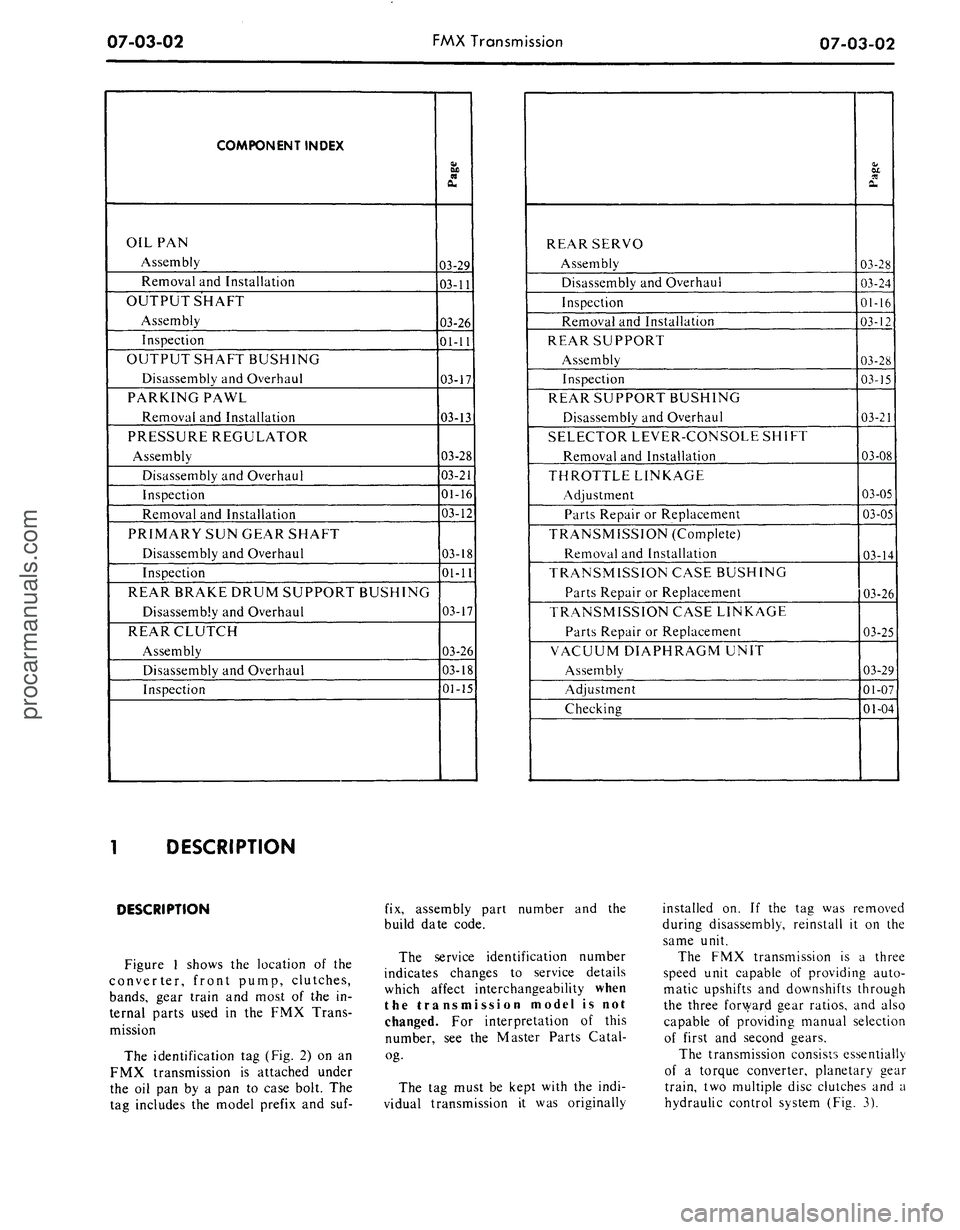
COMPONENT INDEX
OIL PAN
Assembly
Removal and Installation
OUTPUT SHAFT
Assembly
Inspection
OUTPUT SHAFT BUSHING
Disassembly and Overhaul
PARKING PAWL
Removal and Installation
PRESSURE REGULATOR
Assembly
Disassembly and Overhaul
Inspection
Removal and Installation
PRIMARY SUN GEAR SHAFT
Disassembly and Overhaul
Inspection
REAR BRAKE DRUM SUPPORT BUSHING
Disassembly and Overhaul
REAR CLUTCH
Assembly
Disassembly and Overhaul
Inspection
Page
03-29
03-11
03-26
01-11
03-17
03-13
03-28
03-21
01-16
03-12
03-18
01-11
03-17
03-26
03-18
01-15
REAR SERVO
Assembly
Disassembly and Overhaul
Inspection
Removal and Installation
REAR SUPPORT
Assembly
Inspection
REAR SUPPORT BUSHING
Disassembly and Overhaul
SELECTOR LEVER-CONSOLE SHIFT
Removal and Installation
THROTTLE LINKAGE
Adjustment
Parts Repair or Replacement
TRANSMISSION (Complete)
Removal and Installation
TRANSMISSION CASE BUSHING
Parts Repair or Replacement
TRANSMISSION CASE LINKAGE
Parts Repair or Replacement
VACUUM DIAPHRAGM UNIT
Assembly
Adjustment
Checking
Page
03-28
03-24
01-16
03-12
03-28
03-15
03-21
03-08
03-05
03-05
03-14
03-26
03-25
03-29
01-07
01-04
DESCRIPTION
DESCRIPTION
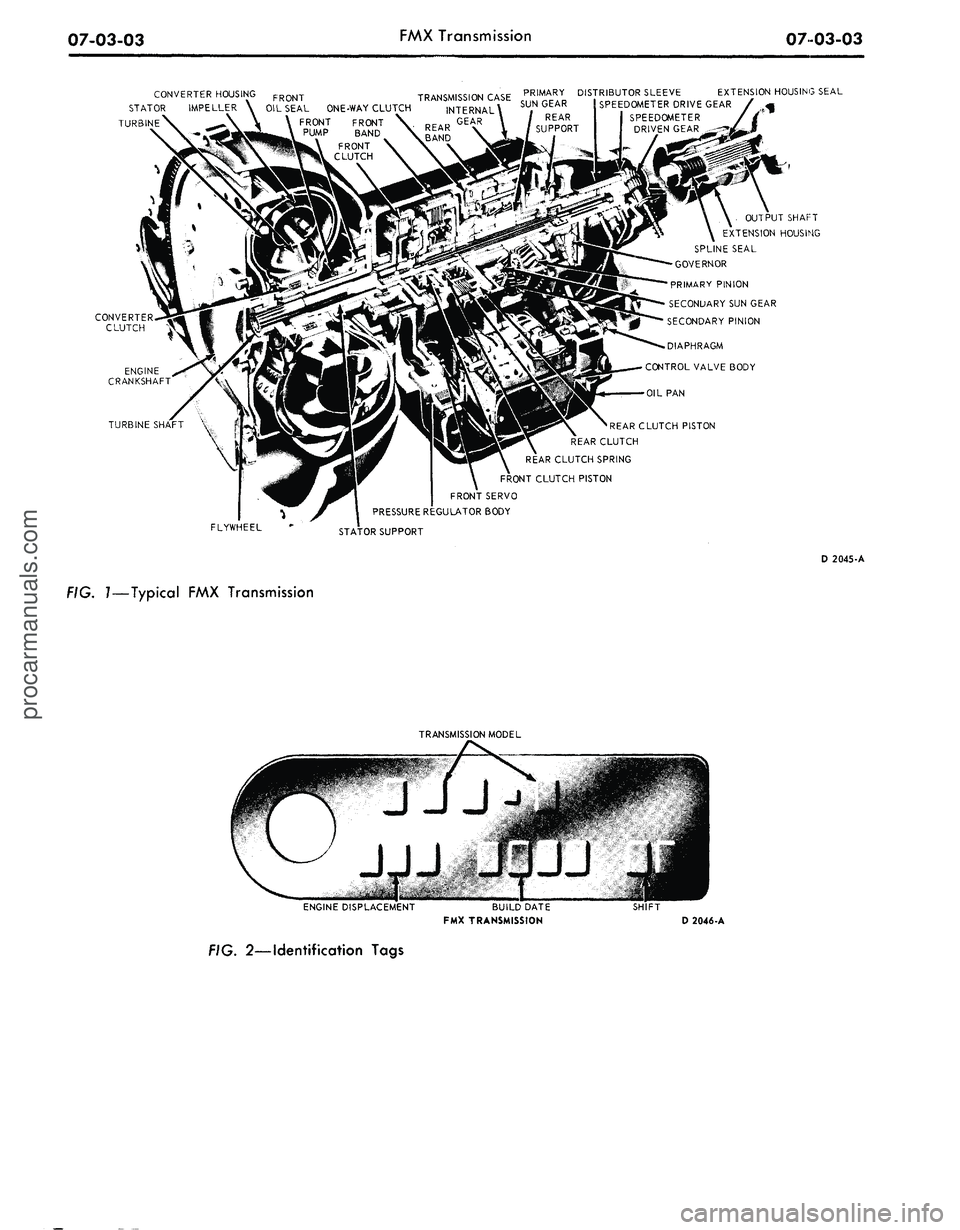
Figure 1 shows the location of the
converter, front pump, clutches,
bands,
gear train and most of the in-
ternal parts used in the FMX Trans-
mission
The identification tag (Fig. 2) on an
FMX transmission is attached under
the oil pan by a pan to case bolt. The
tag includes the model prefix and suf-
fix, assembly part number and the
build date code.
The service identification number
indicates changes to service details
which affect interchangeability when
the transmission model is not
changed. For interpretation of this
number, see the Master Parts Catal-
og-
The tag must be kept with the indi-
vidual transmission it was originally
installed on. If the tag was removed
during disassembly, reinstall it on the
same unit.
The FMX transmission is a three
speed unit capable of providing auto-
matic upshifts and downshifts through
the three forward gear ratios, and also
capable of providing manual selection
of first and second gears.
The transmission consists essentially
of a torque converter, planetary gear
train, two multiple disc clutches and a
hydraulic control system (Fig. 3).
procarmanuals.com
Page 343 of 413
07-03-03
FMX Transmission
0703-03
PRIMARY DISTRIBUTOR SLEEVE EXTENSION HOUSING SEAL
SUN GEAR ! SPEEDOMETER DRIVE GEAR /
OIL SEAL ONE-WAY CLUTCH
FRONT FRONT
PUMP BAND
FRONT
CLUTCH
OUTPUT SHAFT
EXTENSION HOUSING
SPLINE SEAL
GOVERNOR
PRIMARY PINION
SECONDARY SUN GEAR
SECONDARY PINION
DIAPHRAGM
CONTROL VALVE BODY
OIL PAN
TURBINE SHAFT
FLYWHEEL
'REAR CLUTCH PISTON
REAR CLUTCH
REAR CLUTCH SPRING
FRONT CLUTCH PISTON
FRONT SERVO
PRESSURE REGULATOR BODY
STATOR SUPPORT
D 2045-A
FIG. 7—Typical FMX Transmission
TRANSMISSION MODEL
ENGINE DISPLACEMENT
BUILD DATE
FMX TRANSMISSION
SHIFT
D 2046-A
FIG. 2—Identification Tagsprocarmanuals.com
Page 354 of 413
07-03-14
FMX Transmission
07-03-14
REMOVAL AND INSTALLATION
An oil impregnated plastic grommet
is incorporated in the end of the man-
ual shift linkage lever arm on all col-
umn shift vehicles. A special tool
T67P-7341-A is required to install the
grommet in the manual lever, and to
install the manual linkage rod into the
grommet. Refer to Part 7-1, Section
2,
for the grommet replacement pro-
cedures.
TRANSMISSION AND
CONVERTER REPLACEMENT—
FORD-METEOR
REMOVAL
1.
Drive the vehicle on a hoist, but
do not raise at this time.
2.
Remove the two upper bolts and
lock washers which attach the con-
verter housing to the engine.
3.
Raise the vehicle and remove the
cover from the lower front side of the
converter housing. Drain the fluid
from the transmission.
4.
Remove one of the converter
drain plugs. Then rotate the converter
180 degrees and remove the other
plug. Do not attempt to turn the con-
verter with a wrench on the converter
stud nuts. If desired, the converter
may be drained after the unit has been
removed from the vehicle.
5.
Disconnect the fluid filler tube
from the transmission case. Discon-
nect the vacuum hose from the vacu-
um diaphragm unit and the tube from
the extension housing clip.
6. When the fluid has stopped
draining from the transmission and
converter, remove the flywheel to con-
verter nuts and flat washers. Install
the drain plugs in the converter and
torque to specifications. Install the
converter housing front plate to hold
the converter in place when the trans-
mission is removed.
7.
Disconnect the starter cables
from the starter and remove the start-
er.
8. Disconnect the oil cooler lines
from the transmission. Remove the
transmission vent tube.
9. Disconnect the downshift linkage
from the transmission.
10.
Disconnect the selector rod from
the transmission manual lever with
T67P-7341-A.
11.
Disconnect the speedometer
cable from the extension housing, and
remove the driveshaft.
12.
Support the transmission on a
stand. Remove the engine rear support
to transmission bolts, and raise the
transmission slightly to take the
weight off the cross member. Remove
the cross member. Support the rear
part of the engine.
13.
Remove the remaining convert-
er housing to engine attaching bolts.
Move the assembly to the rear and
down to remove it.
INSTALLATION
1.
If the converter has been re-
moved from the converter housing,
carefully position the converter in the
housing, and then install the housing
lower front cover plate to prevent the
converter from slipping out of the
housing.
2.
Install the transmission vent
tube.
Rotate the converter until the
studs adjacent to the drain plugs are
in a vertical position.
3.
Rotate the flywheel as required
to align the drain plug holes with the
drain plugs in the converter. With the
transmission mounted on a support
stand, move the converter and trans-
mission assembly forward into posi-
tion, using care not to damage the fly-
wheel and the converter pilot.
4.
Install the converter lower
housing-to-engine bolts, then torque
the bolts to specification.
5.
Install the cross member.
6. Lower the transmission until the
extension housing rests on the cross
member, and then install the extension
housing-to-cross member bolts.
7.
The converter must rest squarely
against the flywheel. This indicates
that the converter pilot is not binding
in the engine crankshaft.
8. Install the converter attaching
nuts and flat washers. Install the ac-
cess plates.
9. Connect the oil cooler inlet and
outlet lines to the transmission case.
10.
Coat the front universal joint
yoke seal and spline with B8A-
19589-A lubricant, and install the
drive shaft.
11.
Connect the speedometer cable
at the transmission.
12.
Using tool T67P-7341-A install
a new grommet in the manual lever.
Then secure the manual selector rod
to the lever.
13.
Connect the downshift linkage
and bushing at the transmission
throttle lever.
14.
Install the starter motor.
15.
Connect the fluid filter tube to
the transmission case. Connect the
vacuum hose to the vacuum dia-
phragm unit and the tube to its clip.
16.
Lower the transmission support
stand. Then install the upper two con-
verter housing-to-engine bolts and
tighten them to specification.
17.
Lower the vehicle and fill the
transmission with transmission fluid,
following the recommended procedure.
18.
Check the transmission, con-
verter assembly, and fluid cooler lines
for fluid leaks, and then adjust the
manual and downshift linkages.
TRANSMISSION REPLACEMENT
WITHOUT CONVERTER—
FORD-METEOR
The frame construction of the con-
vertible will not permit the transmis-
sion to be moved rearward enough to
clear the turbine shaft from the con-
verter. For this reason, the converter
and transmission must be removed as
a unit from this model.
REMOVAL
1.
Raise the vehicle on a hoist.
2.
Drain the fluid from the trans-
mission.
3.
Disconnect the hose from the
vacuum diaphragm unit and the tube
from its clip. Disconnect the fluid fill-
er tube from the case.
4.
Remove the cover from the lower
front side of the converter housing.
5.
Remove one of the converter
drain plugs. Then rotate the converter
180 degrees and remove the other
plug. Do not attempt to turn the con-
verter with a wrench on the converter
stud nuts.
6. Disconnect the drive shaft from
the rear axle, and remove the drive
shaft.
7.
Disconnect the fluid cooler lines
from the transmission. Remove the
vent tube.
8. Disconnect the downshift linkage
at the transmission.
9. Disconnect the selector rod from
the transmission manual lever with
tool T67P-7341-A.
10.
Disconnect the speedometer
cable at the extension housing.
11.
Remove the two engine rear
support to transmission bolts.
12.
Position a transmission jack
under the transmission and raise it
slightly to take the weight off the
cross member.procarmanuals.com
Page 372 of 413
07-04-03
C-6 Automatic Transmission
07-04-03
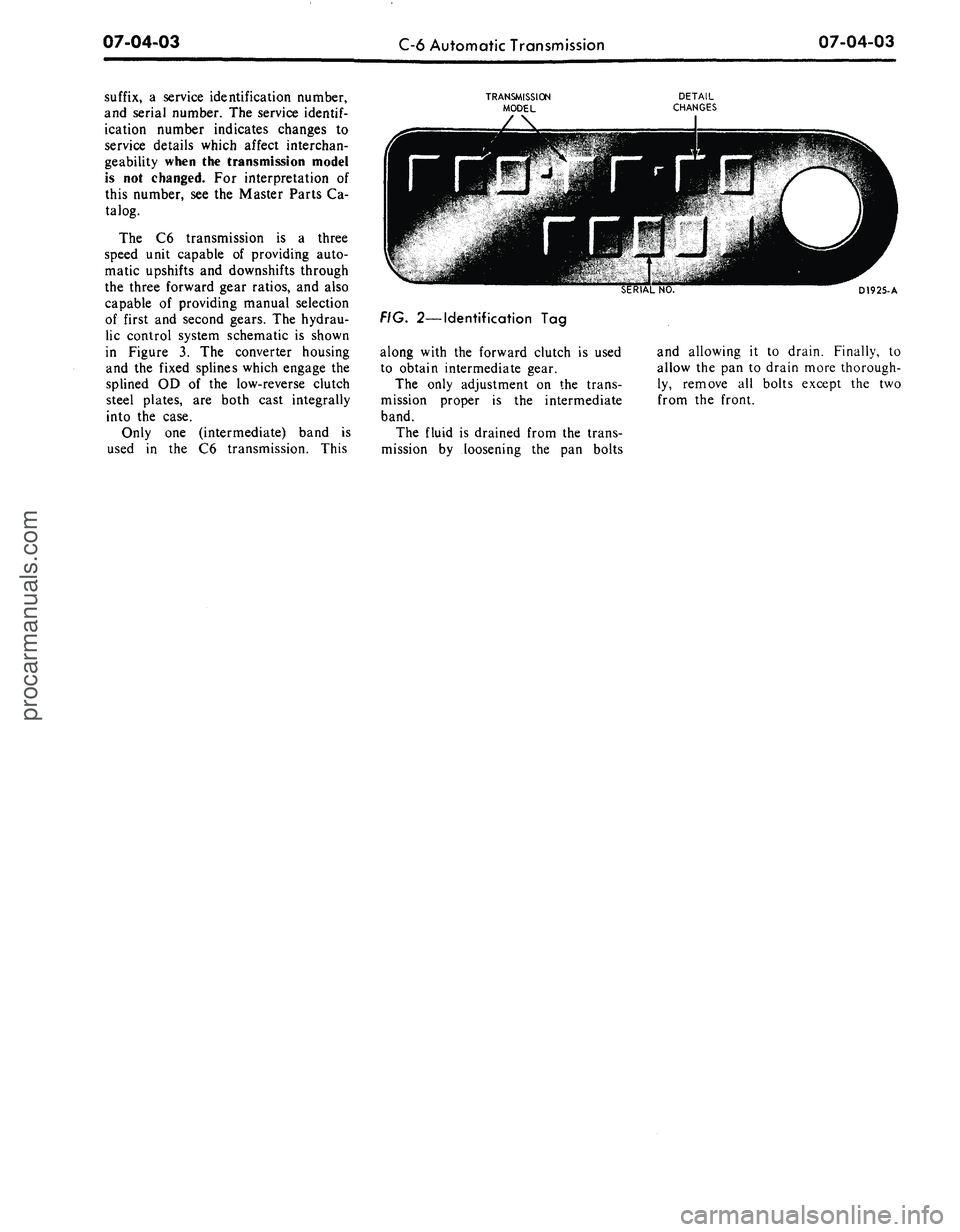
suffix, a service identification number,
and serial number. The service
identif-
ication number indicates changes to
service details which affect interchan-
geability when the transmission model
is not changed. For interpretation of
this number, see the Master Parts Ca-
talog.
The C6 transmission is a three
speed unit capable of providing auto-
matic upshifts and downshifts through
the three forward gear ratios, and also
capable of providing manual selection
of first and second gears. The hydrau-
lic control system schematic is shown
in Figure 3. The converter housing
and the fixed splines which engage the
splined OD of the low-reverse clutch
steel plates, are both cast integrally
into the case.
Only one (intermediate) band is
used in the C6 transmission. This
TRANSMISSION
MODEL
FIG. 2—Identification Tag
along with the forward clutch is used
to obtain intermediate gear.
The only adjustment on the trans-
mission proper is the intermediate
band.
The fluid is drained from the trans-
mission by loosening the pan bolts
D1925-A
and allowing it to drain. Finally, to
allow the pan to drain more thorough-
ly, remove all bolts except the two
from the front.procarmanuals.com