air condition FORD MUSTANG 1969 Volume One Chassis
[x] Cancel search | Manufacturer: FORD, Model Year: 1969, Model line: MUSTANG, Model: FORD MUSTANG 1969Pages: 413, PDF Size: 75.81 MB
Page 299 of 413
07-01-08
General Transmission Service
07-01-08
3.
Install the bench testing tool on
the transmission.
4.
Remove the
1/8-inch
pipe plug
at the transmission case. Turn the
front pump in a clockwise direction at
75-100 rpm until a regular flow of
transmission fluid leaves the hole in
the transmission case. This operation
bleeds the air from the pump.
5.
Install the pressure gauge (77820
or T57L-77820-A) as shown in Fig.
13.
PRESSURE TESTS
Turn the front pump at 75-100 rpm
and note the gauge readings. The
pressure readings on the bench test
must be within the limits as outlined
in Figure 13, for the engine idle check.
If pressure gauge readings are with-
in limits in all selector lever positions,
install the vacuum diaphragm control
rod unit.
COMMON ADJUSTMENTS AND REPAIRS
TRANSMISSION FLUID DRAIN
AND REFILL
Normal maintenance and lubrica-
tion requirements do not necessitate
periodic automatic transmission fluid
changes.
If a major repair, such as a clutch
band, bearing, etc., is required in the
transmission, it will have to be re-
moved for service. At this time the
converter, transmission cooler and
cooler lines must be thoroughly
flushed to remove any dirt.
When filling a dry transmission and
converter, install five quarts of fluid.
Start the engine, shift the selector
lever as outlined below, and check and
add fluid as necessary.
Following are the procedures for
partial drain and refill due to in-
vehicle repair operation.
C4 TRANSMISSION
1.
On PEA models, disconnect the
fluid filler tube from the transmission
oil pan to drain the fluid.
On PEB and PEE models, loosen
the pan attaching bolts to drain the
fluid from the transmission.
2.
When the fluid has stopped
draining from the transmission, re-
move and thoroughly clean the pan
and the screen. Discard the pan gas-
ket.
3.
Place a new gasket on the pan,
and install the pan on the transmis-
sion.
4.
On PEA models, connect the
filler tube to the pan and tighten the
fitting securely.
5.
Add three quarts of fluid to the
transmission through the filler tube.
6. Run the engine at idle speed for
about two minutes, and then run it at
fast idle speed (about 1200 rpm) until
it reaches it's normal operating temp-
erature. Do not race the engine.
7.
Shift the selector lever through
all the positions, place it at P, and
check the fluid level. The fluid level
should be above the ADD mark. If
necessary, add enough fluid io the
transmission to bring the level be-
tween the ADD and FULL marks on
che dipstick. Do not overfill the trans-
mission.
FMX OK C6
TRANSMISSION
1.
Raise the vehicle on a hoist or
jack stands.
2.
Place a drain pan under the
transmission.
3.
Loosen the pan attaching bolts
to drain the fluid from the transmis-
sion.
4.
After the fluid has drained to the
level of the pan flange, remove the
rest of the pan bolts working from the
rear and both sides of the pan to
allow it to drop and drain slowly.
5.
When the fluid has stopped
draining from the transmission, re-
move and thoroughly clean the pan
and the screen. Discard the pan gas-
ket.
6. Place a new gasket on the pan,
and install the pan on the transmis-
sion.
7.
Add three quarts of fluid to the
transmission through the filler tube.
8. Run the engine at idle speed for
about two minutes, and then run it at
fast idle speed (about 1200 rpm) until
it reaches normal operating tempera-
ture.
Do not race the engine.
9. Shift the selector lever through
all the positions, place it at P, and
check the fluid level. The fluid level
should be above the ADD mark. If
necessary, add enough fluid to the
transmission to bring the level be-
tween the ADD and FULL marks on
the dipstick. Do not overfill the trans-
mission.
OIL COOLER TUBE
REMOVAL AND INSTALLATION
When fluid leakage is found at the
oil cooler, the cooler must be re-
placed. Cooler replacement is de-
scribed in the Cooling System Section
of Group 11.
When one or more of the fluid
cooler steel tubes must be replaced,
each replacement tube must be fabri-
cated from the same size steel tubing
as the original line.
Using the old tube as a guide, bend
the new tube as required. Add the
necessary fittings, and install the tube.
After the fittings have been tight-
ened, add fluid as needed, and check
for fluid leaks.
VACUUM DIAPHRAGM
ADJUSTMENT NON-ALTITUDE
COMPENSATING TYPE
The C4 and C6 transmissions are
equipped with an adjustable vacuum
diaphragm assembly. A similar ad-
justable diaphragm has been released
for service with the FMX transmis-
sion. However, the FMX service dia-
phragm is not interchangeable with
that used on C4 and C6 models.
The vacuum diaphragm assembly
has an adjusting screw in the vacuum
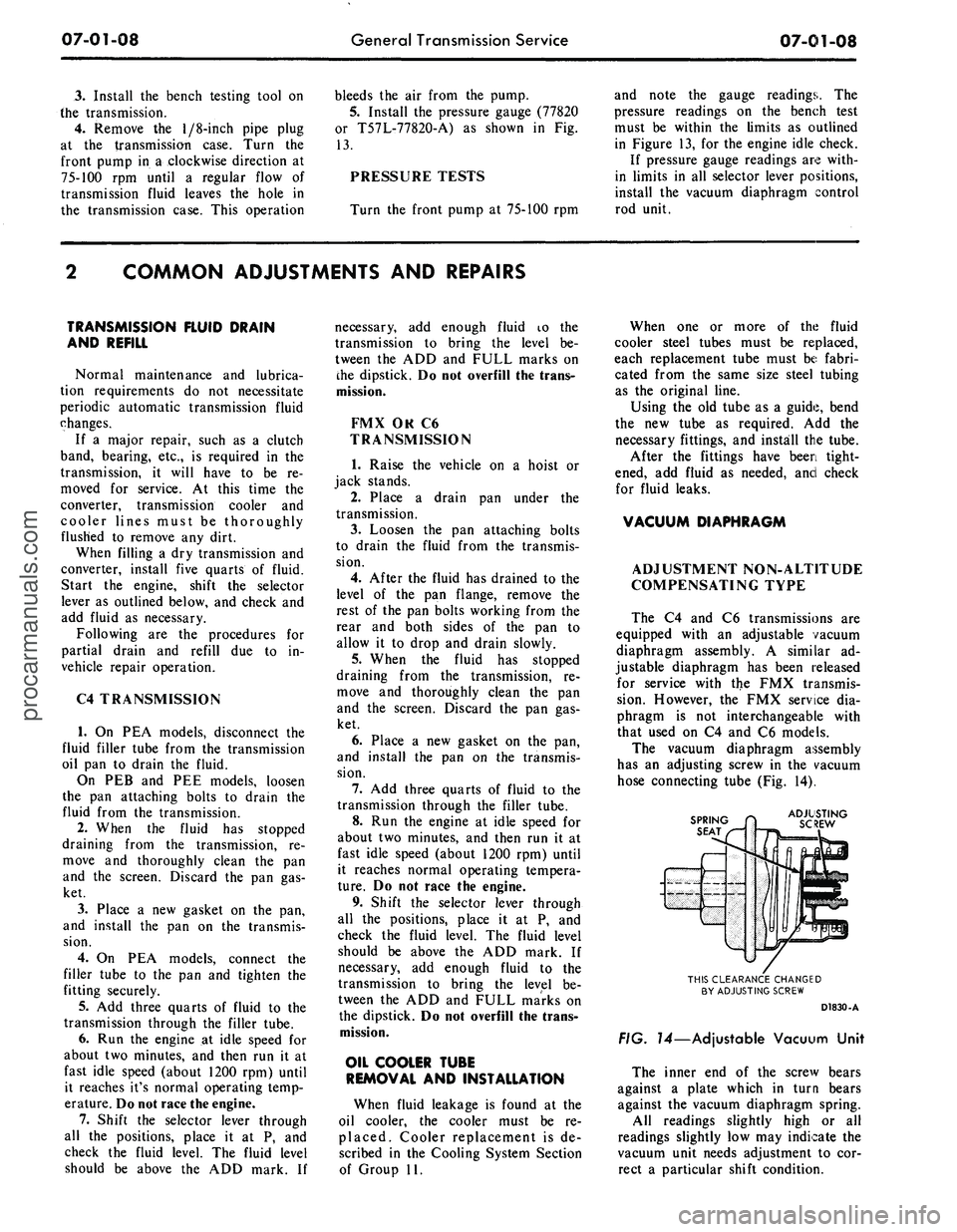
hose connecting tube (Fig. 14).
SPRING
SEAT
THIS CLEARANCE CHANGED
BY ADJUSTING SCREW
D1830-A
FIG. 14—Adjustable Vacuum Unit
The inner end of the screw bears
against a plate which in turn bears
against the vacuum diaphragm spring.
All readings slightly high or all
readings slightly low may indicate the
vacuum unit needs adjustment to cor-
rect a particular shift condition.procarmanuals.com
Page 317 of 413
07-02-09
C4 Automatic Transmission
07-02-09
11.
Remove the handle from the se-
lector lever.
12.
Install the selector housing and
lever assembly as shown in Figure 8.
Torque the attaching bolts 4-6 ft-lbs.
13.
Connect the dial indicator light.
14.
Install the pointer back-up
shield on the housing and lever assem-
bly.
15.
Install the dial housing and
tighten the attaching screws.
16.
Install the selector lever handle
and tighten the attaching screw.
17.
Position the selector lever in the
D position.
18.
Raise the vehicle. Install the
transmission manual lever rod to the
selector lever. Adjust the manual link-
age.
19.
Lower the vehicle and check the
transmission operation in each selo:c-
tor lever detent position.
BAND ADJUSTMENT
INTERMEDIATE BAND
1.
Clean all the dirt from the band
adjusting screw area. Remove and dis-
card the locknut.
2.
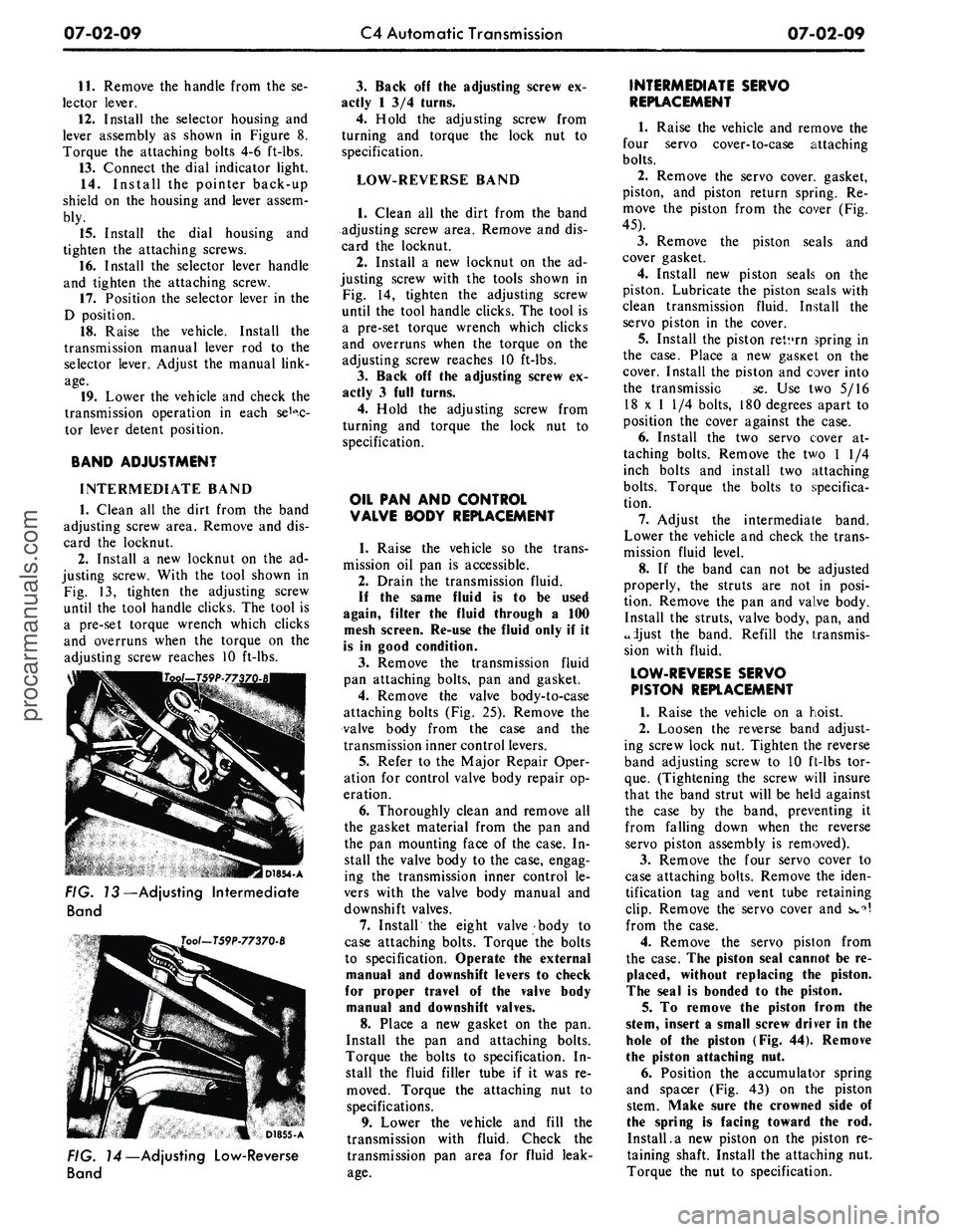
Install a new locknut on the ad-
justing screw. With the tool shown in
Fig. 13, tighten the adjusting screw
until the tool handle clicks. The tool is
a pre-set torque wrench which clicks
and overruns when the torque on the
adjusting screw reaches 10 ft-lbs.
I D1854-A
FIG. 13—Adjusting Intermediate
Band
Tool-T59P-77370-B
D1855-A
FIG. 14—Adjusting Low-Reverse
Band
3.
Back off the adjusting screw ex-
actly 1 3/4 turns.
4.
Hold the adjusting screw from
turning and torque the lock nut to
specification.
LOW-REVERSE BAND
1.
Clean all the dirt from the band
adjusting screw area. Remove and dis-
card the locknut.
2.
Install a new locknut on the ad-
justing screw with the tools shown in
Fig. 14, tighten the adjusting screw
until the tool handle clicks. The tool is
a pre-set torque wrench which clicks
and overruns when the torque on the
adjusting screw reaches 10 ft-lbs.
3.
Back off the adjusting screw ex-
actly 3 full turns.
4.
Hold the adjusting screw from
turning and torque the lock nut to
specification.
OIL PAN AND CONTROL
VALVE BODY REPLACEMENT
1.
Raise the vehicle so the trans-
mission oil pan is accessible.
2.
Drain the transmission fluid.
If the same fluid is to be used
again, filter the fluid through a 100
mesh screen. Re-use the fluid only if it
is in good condition.
3.
Remove the transmission fluid
pan attaching bolts, pan and gasket.
4.
Remove the valve body-to-case
attaching bolts (Fig. 25). Remove the
valve body from the case and the
transmission inner control levers.
5.
Refer to the Major Repair Oper-
ation for control valve body repair op-
eration.
6. Thoroughly clean and remove all
the gasket material from the pan and
the pan mounting face of the case. In-
stall the valve body to the case, engag-
ing the transmission inner control le-
vers with the valve body manual and
downshift valves.
7.
Install the eight valve body to
case attaching bolts. Torque the bolts
to specification. Operate the external
manual and downshift levers to check
for proper travel of the valve body
manual and downshift valves.
8. Place a new gasket on the pan.
Install the pan and attaching bolts.
Torque the bolts to specification. In-
stall the fluid filler tube if it was re-
moved. Torque the attaching nut to
specifications.
9. Lower the vehicle and fill the
transmission with fluid. Check the
transmission pan area for fluid leak-
age.
INTERMEDIATE SERVO
REPLACEMENT
1.
Raise the vehicle and remove the
four servo cover-to-case attaching
bolts.
2.
Remove the servo cover, gasket,
piston, and piston return spring. Re-
move the piston from the cover (Fig.
45).
3.
Remove the piston seals and
cover gasket.
4.
Install new piston seals on the
piston. Lubricate the piston seals with
clean transmission fluid. Install the
servo piston in the cover.
5.
Install the piston retvrn spring in
the case. Place a new gasicet on the
cover. Install the piston and cover into
the transmissic se. Use two 5/16
18 x 1 1/4 bolts, 180 degrees apart to
position the cover against the case.
6. Install the two servo cover at-
taching bolts. Remove the two 1 1/4
inch bolts and install two attaching
bolts.
Torque the bolts to specifica-
tion.
7.
Adjust the intermediate band.
Lower the vehicle and check the trans-
mission fluid level.
8. If the band can not be adjusted
properly, the struts are not in posi-
tion. Remove the pan and valve body.
Install the struts, valve body, pan, and
adjust the band. Refill the transmis-
sion with fluid.
LOW-REVERSE SERVO
PISTON REPLACEMENT
1.
Raise the vehicle on a hoist.
2.
Loosen the reverse band adjust-
ing screw lock nut. Tighten the reverse
band adjusting screw to 10 ft-lbs tor-
que.
(Tightening the screw will insure
that the band strut will be held against
the case by the band, preventing it
from falling down when the reverse
servo piston assembly is removed).
3.
Remove the four servo cover to
case attaching bolts. Remove the iden-
tification tag and vent tube retaining
clip.
Remove the servo cover and s»»^
from the case.
4.
Remove the servo piston from
the case. The piston seal cannot be re-
placed, without replacing the piston.
The seal is bonded to the piston.
5. To remove the piston from the
stem, insert a small screw driver in the
hole of the piston (Fig. 44). Remove
the piston attaching nut.
6. Position the accumulator spring
and spacer (Fig. 43) on the piston
stem. Make sure the crowned side of
the spring is facing toward the rod.
Install.a new piston on the piston re-
taining shaft. Install the attaching nut.
Torque the nut to specification.procarmanuals.com
Page 350 of 413
07-03-10
FMX Transmission
07-03-10
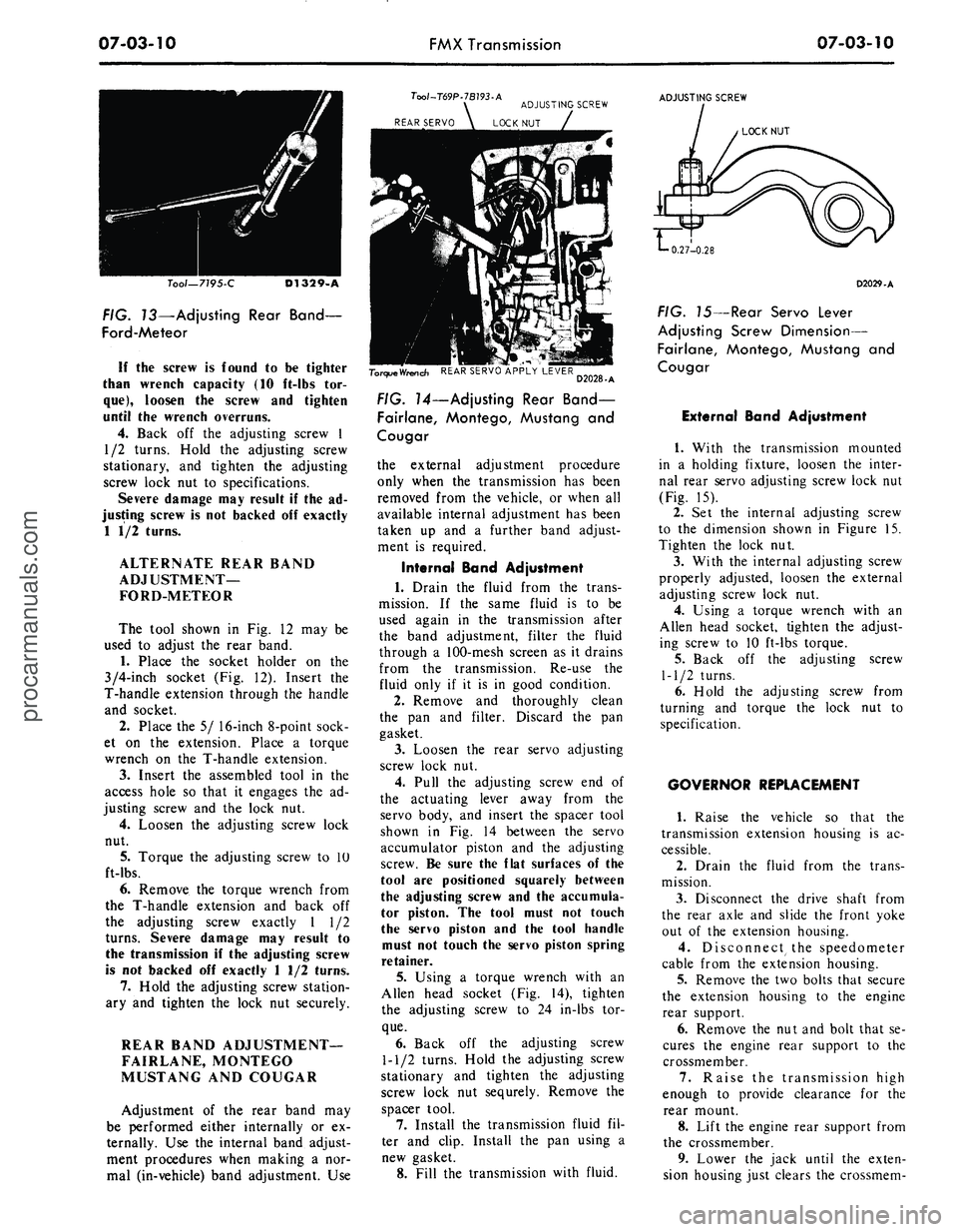
Too/-T69P-7B793-A
ADJUSTING SCREW
REAR SERVO \ LOCK NUT
Tool—7795-C
D1329-A
FIG. 13—Adjusting Rear Band—
Ford-Meteor
If
the
screw
is
found
to be
tighter
than
wrench
capacity
(10
ft-lbs
tor-
que),
loosen
the
screw
and
tighten
until
the
wrench
overruns.
4.
Back off the adjusting screw 1
1/2 turns. Hold the adjusting screw
stationary, and tighten the adjusting
screw lock nut to specifications.
Severe damage may result if the ad-
justing screw is not backed off exactly
1 1/2 turns.
ALTERNATE REAR BAND
ADJUSTMENT—
FORD-METEOR
The tool shown in Fig. 12 may be
used to adjust the rear band.
1.
Place the socket holder on the
3/4-inch socket (Fig. 12). Insert the
T-handle extension through the handle
and socket.
2.
Place the 5/ 16-inch 8-point sock-
et on the extension. Place a torque
wrench on the T-handle extension.
3.
Insert the assembled tool in the
access hole so that it engages the ad-
justing screw and the lock nut.
4.
Loosen the adjusting screw lock
nut.
5.
Torque the adjusting screw to 10
ft-lbs.
6. Remove the torque wrench from
the T-handle extension and back off
the adjusting screw exactly 1 1/2
turns.
Severe
damage
may
result
to
the
transmission
if the
adjusting
screw
is
not
backed
off
exactly
11/2
turns.
7.
Hold the adjusting screw station-
ary and tighten the lock nut securely.
REAR BAND ADJUSTMENT—
FAIRLANE, MONTEGO
MUSTANG AND COUGAR
Adjustment of the rear band may
be performed either internally or ex-
ternally. Use the internal band adjust-
ment procedures when making a nor-
mal (in-vehicle) band adjustment. Use
ADJUSTING SCREW
LOCK NUT
I
IN
TorqueWrench REAR SERVO APPLY LEVER
D2028-A
FIG. 14—Adjusting Rear Band—
Fairlane, Montego, Mustang and
Cougar
the external adjustment procedure
only when the transmission has been
removed from the vehicle, or when all
available internal adjustment has been
taken up and a further band adjust-
ment is required.
Internal Band Adjustment
1.
Drain the fluid from the trans-
mission. If the same fluid is to be
used again in the transmission after
the band adjustment, filter the fluid
through a 100-mesh screen as it drains
from the transmission. Re-use the
fluid only if it is in good condition.
2.
Remove and thoroughly clean
the pan and filter. Discard the pan
gasket.
3.
Loosen the rear servo adjusting
screw lock nut.
4.
Pull the adjusting screw end of
the actuating lever away from the
servo body, and insert the spacer tool
shown in Fig. 14 between the servo
accumulator piston and the adjusting
screw.
Be
sure
the
flat
surfaces
of the
tool
are
positioned
squarely
between
the
adjusting
screw
and the
accumula-
tor
piston.
The
tool must
not
touch
the servo
piston
and the
tool
handle
must
not
touch
the
servo
piston
spring
retainer.
5.
Using a torque wrench with an
Allen head socket (Fig. 14), tighten
the adjusting screw to 24 in-lbs tor-
que.
6. Back off the adjusting screw
1-1/2 turns. Hold the adjusting screw
stationary and tighten the adjusting
screw lock nut sequrely. Remove the
spacer tool.
7.
Install the transmission fluid fil-
ter and clip. Install the pan using a
new gasket.
8. Fill the transmission with fluid.
D2029-A
FIG. 15—Rear Servo Lever
Adjusting Screw Dimension—
Fairlane, Montego, Mustang and
Cougar
External Band Adjustment
1.
With the transmission mounted
in a holding fixture, loosen the inter-
nal rear servo adjusting screw lock nut
(Fig. 15).
2.
Set the internal adjusting screw
to the dimension shown in Figure 15.
Tighten the lock nut.
3.
With the internal adjusting screw
properly adjusted, loosen the external
adjusting screw lock nut.
4.
Using a torque wrench with an
Allen head socket, tighten the adjust-
ing screw to 10 ft-lbs torque.
5.
Back off the adjusting screw
1-1/2 turns.
6. Hold the adjusting screw from
turning and torque the lock nut to
specification.
GOVERNOR REPLACEMENT
1.
Raise the vehicle so that the
transmission extension housing is ac-
cessible.
2.
Drain the fluid from the trans-
mission.
3.
Disconnect the drive shaft from
the rear axle and slide the front yoke
out of the extension housing.
4.
Disconnect the speedometer
cable from the extension housing.
5.
Remove the two bolts that secure
the extension housing to the engine
rear support.
6. Remove the nut and bolt that se-
cures the engine rear support to the
crossmember.
7.
Raise the transmission high
enough to provide clearance for the
rear mount.
8. Lift the engine rear support from
the crossmember.
9. Lower the jack until the exten-
sion housing just clears the crossmem-procarmanuals.com