brakes FORD MUSTANG 1969 Volume One Chassis
[x] Cancel search | Manufacturer: FORD, Model Year: 1969, Model line: MUSTANG, Model: FORD MUSTANG 1969Pages: 413, PDF Size: 75.81 MB
Page 172 of 413
03-12-01
Wheels
And
Tires
03-12-01
PART
3-12
Wheels
And
Tires
COMPONENT INDEX
FRONT
HUB AND
DRUM ASSEMBLY
Removal
and
Installation
FRONT
HUB AND
ROTOR ASSEMBLY
Removal
and
Installation
FRONT WHEEL ASSEMBLY DESCRIPTION
FRONT WHEEL BEARING ADJUSTMENT
FRONT WHEEL GREASE SEAL
AND
BEARING
Removal, Installation, Repacking
HOISTING INSTRUCTIONS
LIFE GUARD TIRE
Balancing
Correcting Vibration
and
Shake
Description
Repairs
REAR WHEEL ASSEMBLY DESCRIPTION
WHEELS AND TIRES (Conventional)
Removal
and
Installation
MODEL APPLICATION
All
Models
12-07
12-07
12-01
12-02
12-05
12-02
12-01
12-03
Ford
N/A
N/A
N/A
N/A
Mercury
N/A
N/A
N/A
N/A
Meteor
N/A
N/A
N/A
N/A
Cougar
N/A
N/A
N/A
N/A
Fairlane
N/A
N/A
N/A
N/A
Falcon
N/A
N/A
N/A
N/A
Montego
N/A
N/A
N/A
N/A
Mustang
N/A
N/A
N/A
N/A
Lincoln-
Continental
12-03
12-03
12-02
12-08
Thunderbird
12-03
12-03
12-02
12-08
Continental-
Mark
III
12-03
12-03
12-02
12-08
A page number indicates that
the
item
is for the
vehicle listed
at the
head
of the
column.
N/A indicates that
the
item
is not
applicable
to the
vehicle listed.
DESCRIPTION
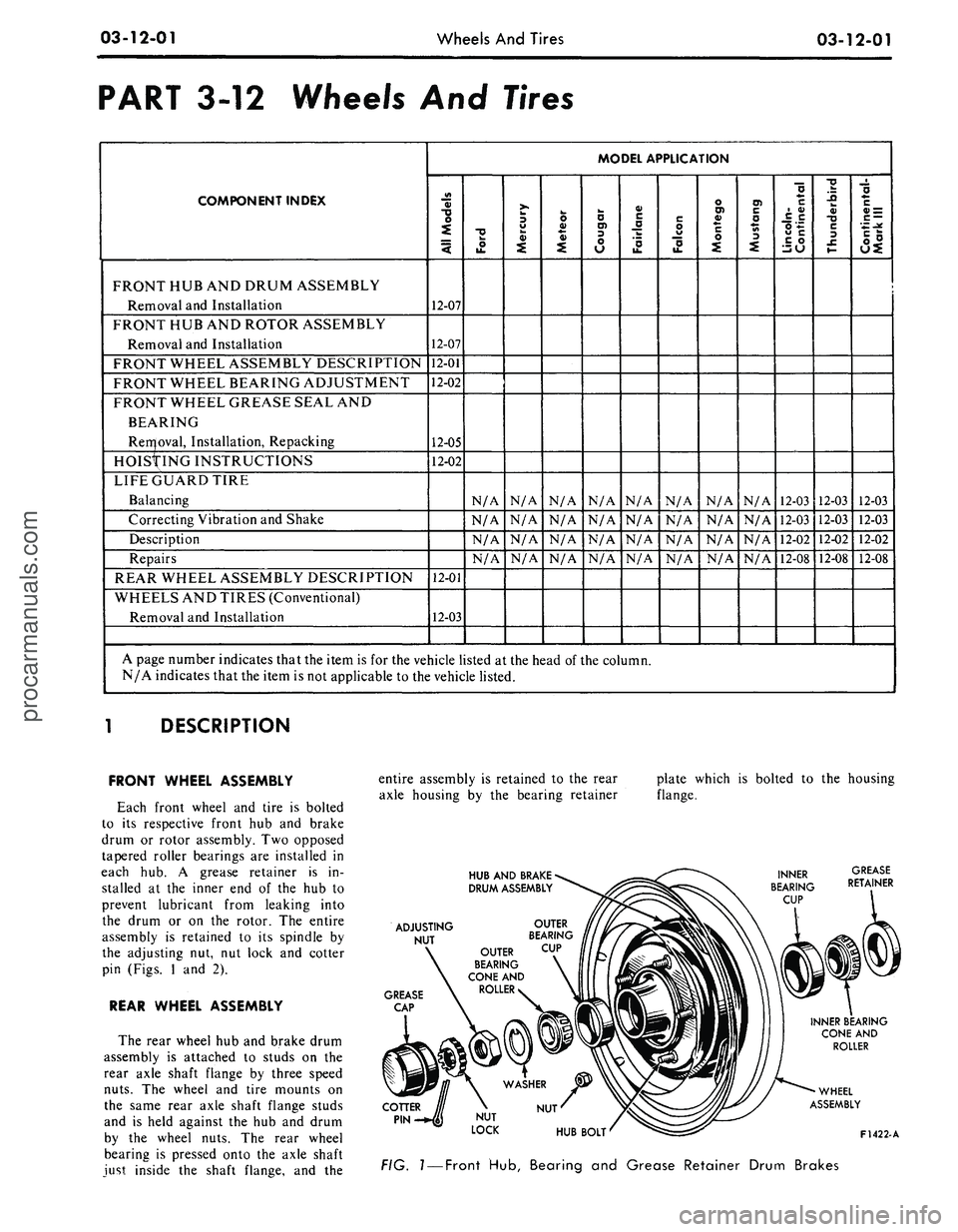
FRONT WHEEL ASSEMBLY
Each front wheel
and
tire
is
bolted
to
its
respective front
hub and
brake
drum
or
rotor assembly.
Two
opposed
tapered roller bearings
are
installed
in
each
hub. A
grease retainer
is in-
stalled
at the
inner
end of the hub to
prevent lubricant from leaking into
the drum
or on the
rotor.
The
entire
assembly
is
retained
to its
spindle
by
the adjusting
nut, nut
lock
and
cotter
pin (Figs.
1 and 2).
REAR WHEEL ASSEMBLY
The rear wheel
hub and
brake drum
assembly
is
attached
to
studs
on the
rear axle shaft flange
by
three speed
nuts.
The
wheel
and
tire mounts
on
the same rear axle shaft flange studs
and
is
held against
the hub and
drum
by
the
wheel nuts.
The
rear wheel
bearing
is
pressed onto
the
axle shaft
just inside
the
shaft flange,
and the
entire assembly
is
retained
to the
rear
axle housing
by the
bearing retainer
HUB
AND
BRAKE
DRUM
ASSEMBLY
plate which
is
bolted
to the
housing
flange.
ADJUSTING
NUT
GREASE
CAP
OUTER
BEARING
OUTER
CUP
BEARING
CONE
AND
ROLLER
NUT
INNER BEARING
CONE
AND
ROLLER
WHEEL
ASSEMBLY
HUB
BOLT'
^£=3^
F1422-A
FIG.
1
—
Front
Hub,
Bearing
and
Grease Retainer Drum Brakes
procarmanuals.com
Page 173 of 413
03-12-02
Wheels
And
Tires
03-12-02
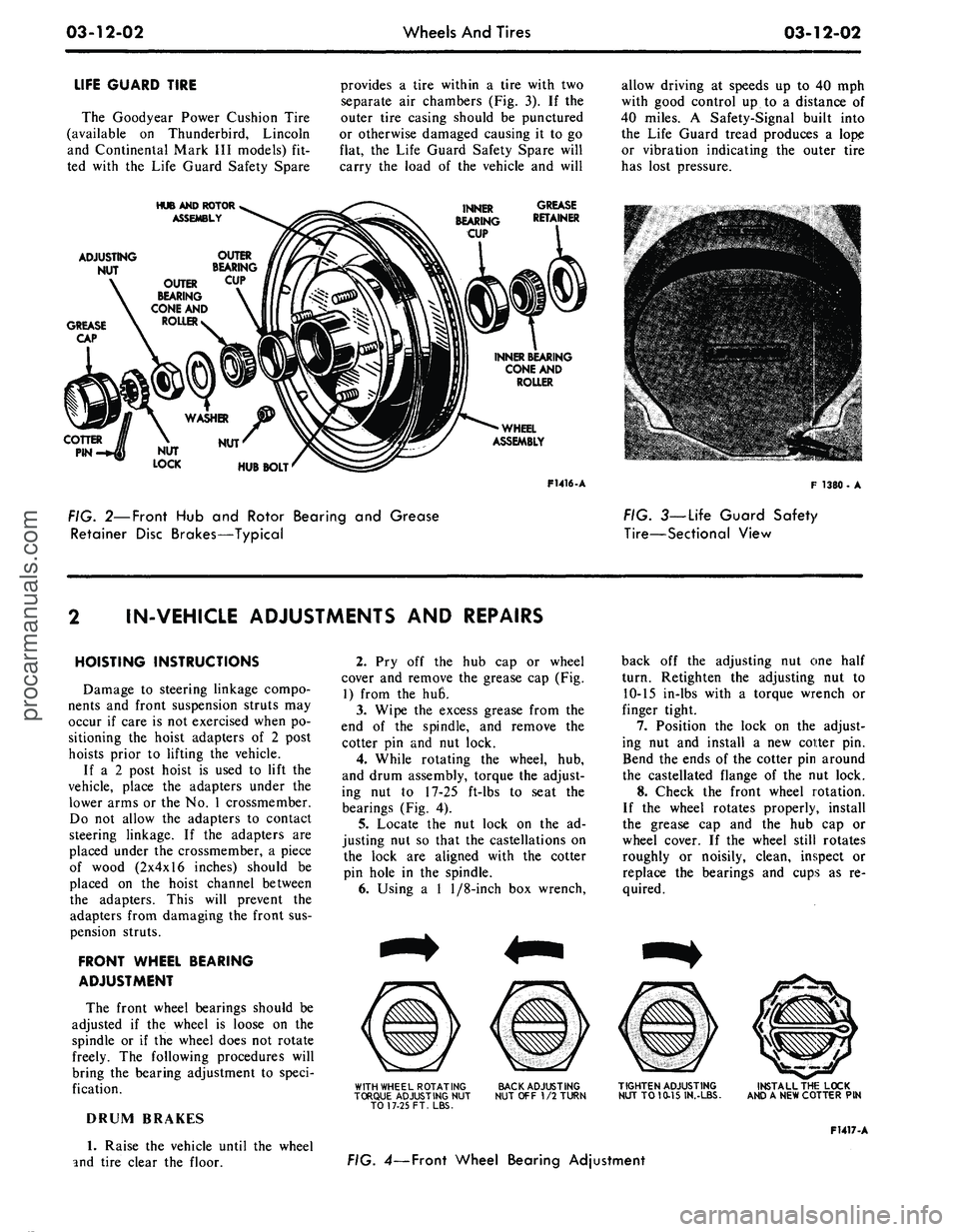
LIFE GUARD TIRE
The Goodyear Power Cushion Tire
(available
on
Thunderbird, Lincoln
and Continental Mark
III
models)
fit-
ted with
the
Life Guard Safety Spare
provides
a
tire within
a
tire with
two
separate
air
chambers
(Fig.
3). If the
outer tire casing should
be
punctured
or otherwise damaged causing
it to go
flat,
the
Life Guard Safety Spare will
carry
the
load
of the
vehicle
and
will
allow driving
at
speeds
up to 40 mph
with good control
up to a
distance
of
40 miles.
A
Safety-Signal built into
the Life Guard tread produces
a
lope
or vibration indicating
the
outer tire
has lost pressure.
HUB AND ROTOR
ASSEMBLY
INNER
BEARING
CUP
GREASE
RETAINER
ADJUSTING
NUT
OUTER
BEARING
CONE
AND
ROLLER
INNER BEARING
CONE
AND
ROLLER
WHEEL
ASSEMBLY
F1416-A
F- 1380 •
A
FIG. 2—Front
Hub and
Rotor Bearing
and
Grease
Retainer Disc Brakes—Typical
FIG. 3—Life Guard Safety
Tire—Sectional View
IN-VEHICLE ADJUSTMENTS AND REPAIRS
HOISTING INSTRUCTIONS
Damage
to
steering linkage compo-
nents
and
front suspension struts
may
occur
if
care
is
not
exercised when
po-
sitioning
the
hoist adapters
of 2
post
hoists prior
to
lifting
the
vehicle.
If
a 2
post hoist
is
used
to
lift
the
vehicle, place
the
adapters under
the
lower arms
or
the No. 1
crossmember.
Do
not
allow
the
adapters
to
contact
steering linkage.
If the
adapters
are
placed under
the
crossmember,
a
piece
of wood (2x4x16 inches) should
be
placed
on the
hoist channel between
the adapters. This will prevent
the
adapters from damaging
the
front
sus-
pension struts.
FRONT WHEEL BEARING
ADJUSTMENT
The front wheel bearings should
be
adjusted
if the
wheel
is
loose
on the
spindle
or if the
wheel does
not
rotate
freely.
The
following procedures will
bring
the
bearing adjustment
to
speci-
fication.
DRUM BRAKES
1.
Raise
the
vehicle until
the
wheel
and tire clear
the
floor.
2.
Pry off the hub cap or
wheel
cover
and
remove
the
grease
cap (Fig.
1) from
the hu6.
3.
Wipe
the
excess grease from
the
end
of the
spindle,
and
remove
the
cotter
pin and nut
lock.
4.
While rotating
the
wheel,
hub,
and drum assembly, torque
the
adjust-
ing
nut to 17-25
ft-lbs
to
seat
the
bearings
(Fig.
4).
5.
Locate
the nut
lock
on the ad-
justing
nut so
that
the
castellations
on
the lock
are
aligned with
the
cotter
pin hole
in the
spindle.
6. Using
a 1
1/8-inch
box
wrench,
WITH WHEEL ROTATING
TORQUE ADJUSTING
NUT
TO 17-25 FT. LBS.
BACK ADJUSTING
NUT
OFF
1/2
TURN
back
off the
adjusting
nut one
half
turn. Retighten
the
adjusting
nut to
10-15 in-lbs with
a
torque wrench
or
finger tight.
7.
Position
the
lock
on the
adjust-
ing
nut and
install
a new
cotter
pin.
Bend
the
ends
of
the
cotter
pin
around
the castellated flange
of the nut
lock.
8. Check
the
front wheel rotation.
If
the
wheel rotates properly, install
the grease
cap and the hub cap or
wheel cover.
If the
wheel still rotates
roughly
or
noisily, clean, inspect
or
replace
the
bearings
and
cups
as re-
quired.
TIGHTEN ADJUSTING
NUT
TO
10-15 IN.-LBS.
INSTALL THE LOCK
AND
A
NEW COTTER
PIN
F1417-A
FIG. 4— Front Wheel Bearing Adjustmentprocarmanuals.com
Page 174 of 413
03-12-03
Wheels And Tires
03-12-03
DISC BRAKES
1.
Raise the vehicle until the wheel
and tire clear the floor.
2.
Pry off the wheel cover and re-
move the grease cap (Fig. 2) from the
hub.
3.
Wipe the excess grease from the
end of the spindle, and remove the ad-
justing nut cotter pin and nut lock.
4.
Loosen the bearing adjusting nut
three turns. Then, rock the wheel,
hub,
and rotor assembly in and out
several times to push the shoe and lin-
ings away from the rotor.
5.
While rotating the wheel, hub,
and rotor assembly, torque the adjust-
ing nut to 17-25 ft-lbs to seat the
bearings (Fig. 4).
6. Back the adjusting nut off one
half turn. Then, retighten the adjust-
ing nut to 10-15 in-lbs with a torque
wrench or finger tight.
7.
Locate the nut lock on the ad-
justing nut so that the castellations on
the lock are aligned with the cotter
pin hole in the spindle.
8. Install a new cotter pin, and
bend the ends of the cotter pin around
the castellated flange of the nut lock.
9. Check the front wheel rotation.
If the wheel rotates properly, install
the grease cap and the hub cap or
wheel cover. If the wheel still rotates
roughly or noisily, clean or replace the
bearings and cups as required.
10.
Before driving the vehicle,
pump the brake pedal several times to
obtain normal brake lining to rotor
clearance and restore normal brake
pedal travel.
BALANCING LIFE
GUARD TIRE
Tires fitted with the Life Guard
Safety Spare are balanced in the same
manner as conventional tires. If an ex-
cessive out of balance condition exists
the following procedure can be used to
correct the condition:
1.
Remove the core housing and de-
flate both air chambers.
2.
Install the core housing.
3.
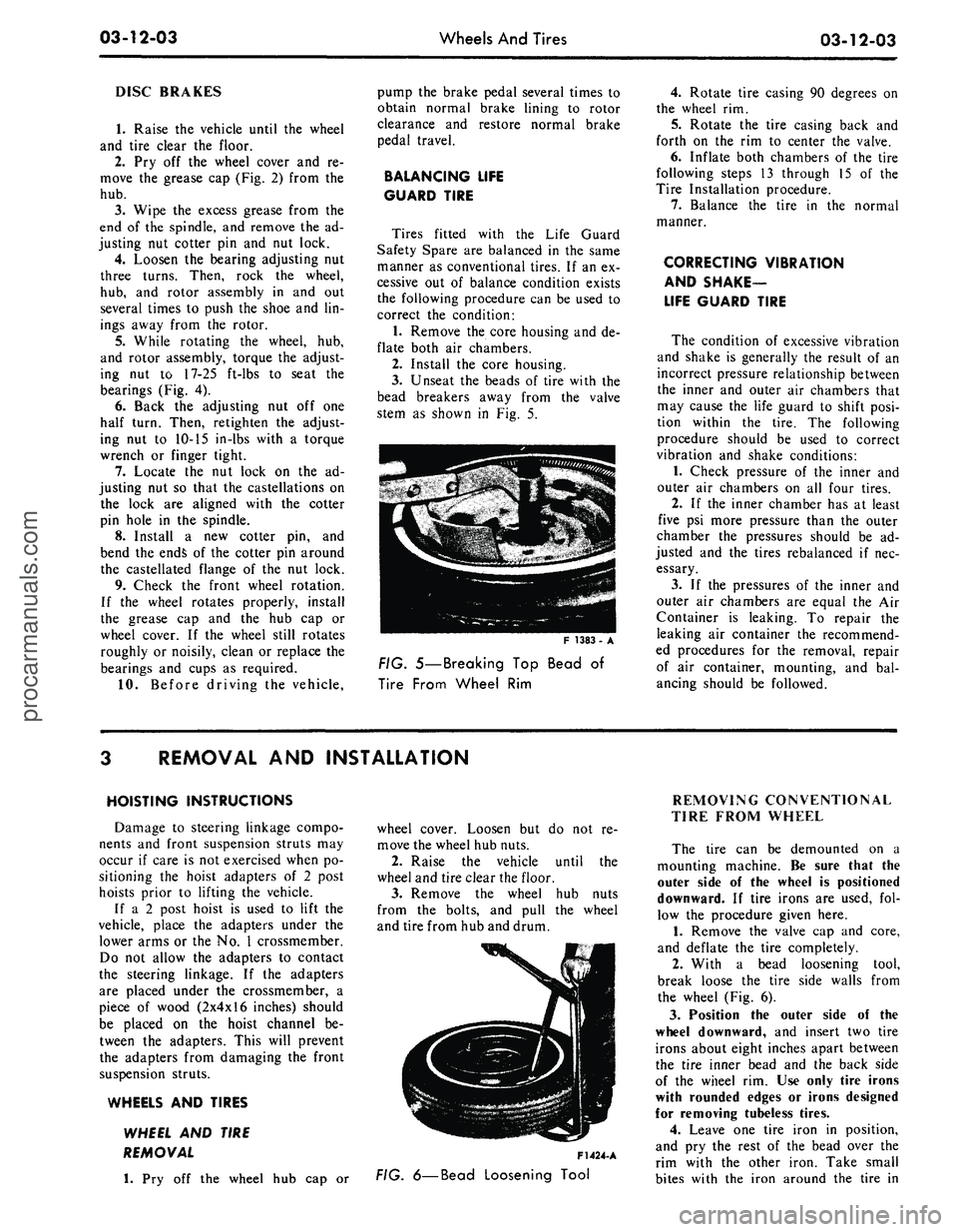
Unseat the beads of tire with the
bead breakers away from the valve
stem as shown in Fig. 5.
F 1383
FIG. 5—Breaking Top Bead of
Tire From Wheel Rim
4.
Rotate tire casing 90 degrees on
the wheel rim.
5.
Rotate the tire casing back and
forth on the rim to center the valve.
6. Inflate both chambers of the tire
following steps 13 through 15 of the
Tire Installation procedure.
7.
Balance the tire in the normal
manner.
CORRECTING VIBRATION
AND SHAKE-
LIFE GUARD TIRE
The condition of excessive vibration
and shake is generally the result of an
incorrect pressure relationship between
the inner and outer air chambers that
may cause the life guard to shift posi-
tion within the tire. The following
procedure should be used to correct
vibration and shake conditions:
1.
Check pressure of the inner and
outer air chambers on all four tires.
2.
If the inner chamber has at least
five psi more pressure than the outer
chamber the pressures should be ad-
justed and the tires rebalanced if nec-
essary.
3.
If the pressures of the inner and
outer air chambers are equal the Air
Container is leaking. To repair the
leaking air container the recommend-
ed procedures for the removal, repair
of air container, mounting, and bal-
ancing should be followed.
REMOVAL AND INSTALLATION
HOISTING INSTRUCTIONS
Damage to steering linkage compo-
nents and front suspension struts may
occur if care is not exercised when po-
sitioning the hoist adapters of 2 post
hoists prior to lifting the vehicle.
If a 2 post hoist is used to lift the
vehicle, place the adapters under the
lower arms or the No. 1 crossmember.
Do not allow the adapters to contact
the steering linkage. If the adapters
are placed under the crossmember, a
piece of wood (2x4x16 inches) should
be placed on the hoist channel be-
tween the adapters. This will prevent
the adapters from damaging the front
suspension struts.
WHEELS AND TIRES
WHEEL AND TIRE
REMOVAL
1.
Pry off the wheel hub cap or
wheel cover. Loosen but do not re-
move the wheel hub nuts.
2.
Raise the vehicle until the
wheel and tire clear the floor.
3.
Remove the wheel hub nuts
from the bolts, and pull the wheel
and tire from hub and drum.
F1424-
A
FIG.
6—Bead
Loosening Tool
REMOVING CONVENTIONAL
TIRE FROM WHEEL
The tire can be demounted on a
mounting machine. Be sure that the
outer side of the wheel is positioned
downward. If tire irons are used, fol-
low the procedure given here.
1.
Remove the valve cap and core,
and deflate the tire completely.
2.
With a bead loosening tool,
break loose the tire side walls from
the wheel (Fig. 6).
3.
Position the outer side of the
wheel downward, and insert two tire
irons about eight inches apart between
the tire inner bead and the back side
of the wheel rim. Use only tire irons
with rounded edges or irons designed
for removing tubeless tires.
4.
Leave one tire iron in position,
and pry the rest of the bead over the
rim with the other iron. Take small
bites with the iron around the tire inprocarmanuals.com
Page 176 of 413
03-12-05
Wheels
And
Tires
03-12-05
and sharp edges from valve hole
in
rim.
8. Mount first tire bead exercising
care
not to
pinch
air
container.
9. Start valve through hole
in rim.
Do
not
pull valve housing into place
at this time.
10.
Mount
the
second bead starting
just past
the
valve
so the
last portion
of
the
bead goes over
the rim at the
valve.
11.
Rotate
the
tire back
and
forth
to center
the
valve housing.
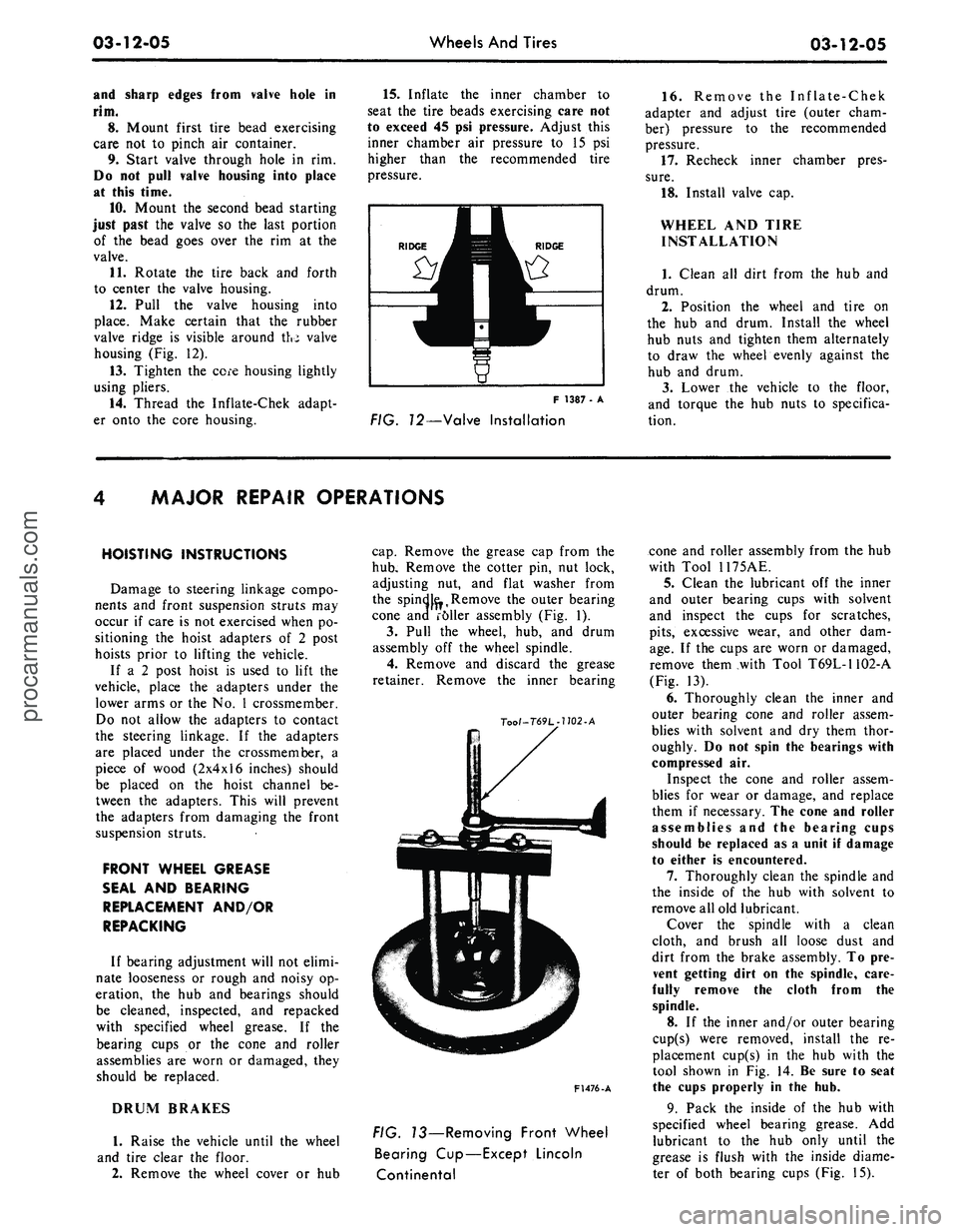
12.
Pull
the
valve housing into
place. Make certain that
the
rubber
valve ridge
is
visible around
thi
valve
housing
(Fig.
12).
13.
Tighten
the
core housing lightly
using pliers.
14.
Thread
the
Inflate-Chek adapt-
er onto
the
core housing.
15.
Inflate
the
inner chamber
to
seat
the
tire beads exercising care
not
to exceed
45 psi
pressure. Adjust this
inner chamber
air
pressure
to 15 psi
higher than
the
recommended tire
pressure.
F 1387
- A
FIG. 12—Valve Installation
16.
Remove
the
Inflate-Chek
adapter
and
adjust tire (outer cham-
ber) pressure
to the
recommended
pressure.
17.
Recheck inner chamber pres-
sure.
18.
Install valve
cap.
WHEEL
AND
TIRE
INSTALLATION
1.
Clean
all
dirt from
the hub and
drum.
2.
Position
the
wheel
and
tire
on
the
hub and
drum. Install
the
wheel
hub nuts
and
tighten them alternately
to draw
the
wheel evenly against
the
hub
and
drum.
3.
Lower
the
vehicle
to the
floor,
and torque
the hub
nuts
to
specifica-
tion.
MAJOR REPAIR OPERATIONS
HOISTING INSTRUCTIONS
Damage
to
steering linkage compo-
nents
and
front suspension struts
may
occur
if
care
is
not
exercised when
po-
sitioning
the
hoist adapters
of 2
post
hoists prior
to
lifting
the
vehicle.
If
a 2
post hoist
is
used
to
lift
the
vehicle, place
the
adapters under
the
lower arms
or the
No.
1
crossmember.
Do
not
allow
the
adapters
to
contact
the steering linkage.
If the
adapters
are placed under
the
crossmember,
a
piece
of
wood (2x4x16 inches) should
be placed
on the
hoist channel
be-
tween
the
adapters. This will prevent
the adapters from damaging
the
front
suspension struts.
FRONT WHEEL GREASE
SEAL
AND
BEARING
REPLACEMENT AND/OR
REPACKING
If bearing adjustment will
not
elimi-
nate looseness
or
rough
and
noisy
op-
eration,
the hub and
bearings should
be cleaned, inspected,
and
repacked
with specified wheel grease.
If the
bearing cups
or the
cone
and
roller
assemblies
are
worn
or
damaged, they
should
be
replaced.
DRUM BRAKES
1.
Raise
the
vehicle until
the
wheel
and tire clear
the
floor.
2.
Remove
the
wheel cover
or hub
cap.
Remove
the
grease
cap
from
the
hub.
Remove
the
cotter
pin,
nut
lock,
adjusting
nut, and
flat washer from
the spindjej, Remove
the
outer bearing
cone
and
roller assembly
(Fig.
1).
3.
Pull
the
wheel,
hub, and
drum
assembly
off the
wheel spindle.
4.
Remove
and
discard
the
grease
retainer. Remove
the
inner bearing
Too/-T69L-J102-A
F1476-A
FIG. 13—Removing Front Wheel
Bearing Cup—Except Lincoln
Continental
cone
and
roller assembly from
the hub
with Tool 1175AE.
5.
Clean
the
lubricant
off the
inner
and outer bearing cups with solvent
and inspect
the
cups
for
scratches,
pits,
excessive wear,
and
other
dam-
age.
If
the
cups
are
worn
or
damaged,
remove them with Tool T69L-1102-A
(Fig.
13).
6. Thoroughly clean
the
inner
and
outer bearing cone
and
roller assem-
blies with solvent
and dry
them thor-
oughly.
Do not
spin
the
bearings with
compressed
air.
Inspect
the
cone
and
roller assem-
blies
for
wear
or
damage,
and
replace
them
if
necessary.
The
cone
and
roller
assemblies
and the
bearing cups
should
be
replaced
as a
unit
if
damage
to either
is
encountered.
7. Thoroughly clean
the
spindle
and
the inside
of the hub
with solvent
to
remove
all old
lubricant.
Cover
the
spindle with
a
clean
cloth,
and
brush
all
loose dust
and
dirt from
the
brake assembly.
To
pre-
vent getting dirt
on the
spindle, care-
fully remove
the
cloth from
the
spindle.
8.
If the
inner and/or outer bearing
cup(s) were removed, install
the re-
placement cup(s)
in the hub
with
the
tool shown
in Fig.
14.
Be
sure
to
seat
the cups properly
in the hub.
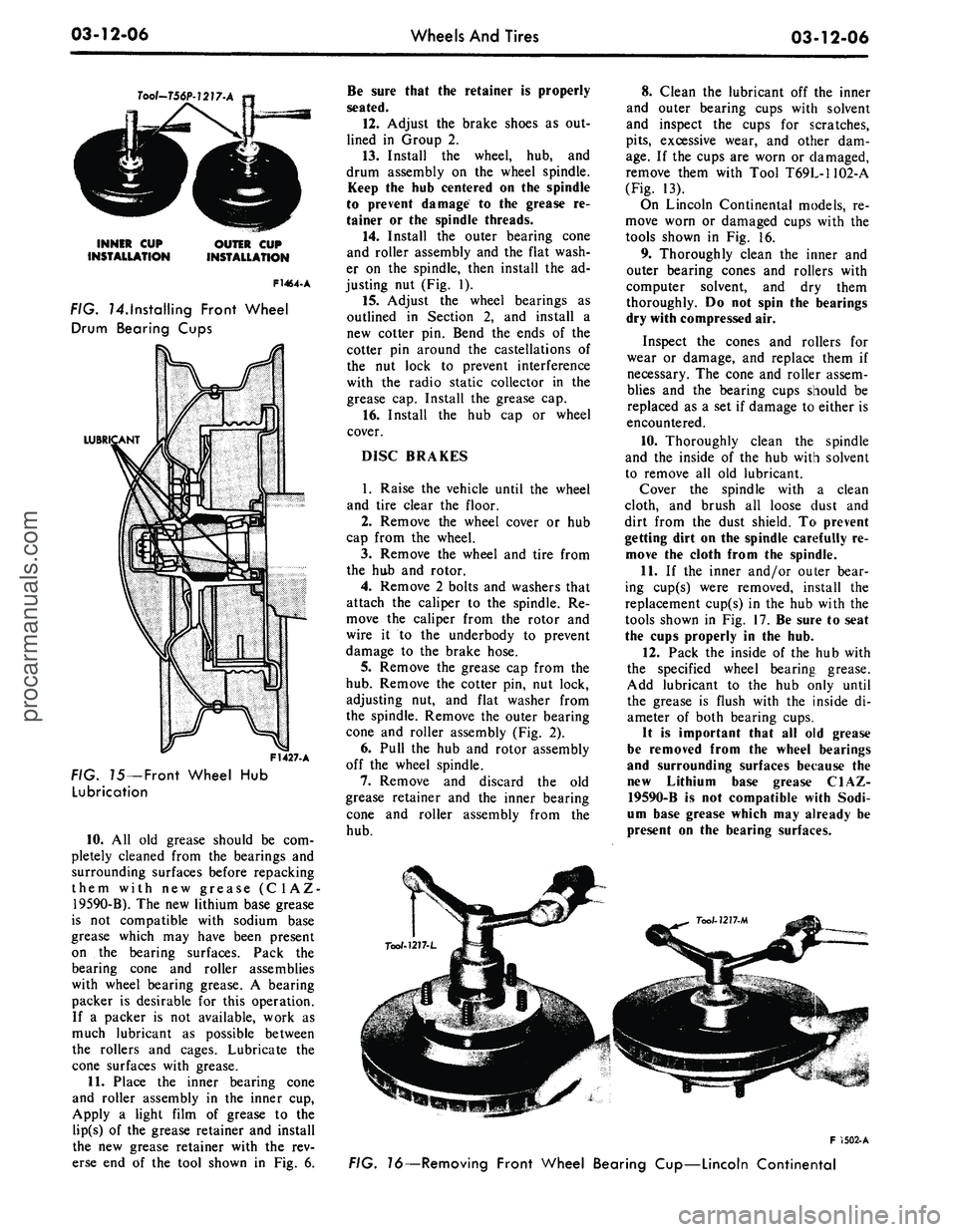
9. Pack
the
inside
of the hub
with
specified wheel bearing grease.
Add
lubricant
to the hub
only until
the
grease
is
flush with
the
inside diame-
ter
of
both bearing cups
(Fig.
15).procarmanuals.com
Page 177 of 413
03-12-06
Wheels And Tires
03-12-06
Tool-T56P-1217-A
INNER CUP
INSTALLATION
OUTER CUP
INSTALLATION
F1464-A
FIG. ^.Installing Front Wheel
Drum Bearing Cups
LUBR
F1427. A
FIG. 75—Front Wheel Hub
Lubrication
10.
All old grease should be com-
pletely cleaned from the bearings and
surrounding surfaces before repacking
them with new grease (C1AZ-
19590-B). The new lithium base grease
is not compatible with sodium base
grease which may have been present
on the bearing surfaces. Pack the
bearing cone and roller assemblies
with wheel bearing grease. A bearing
packer is desirable for this operation.
If a packer is not available, work as
much lubricant as possible between
the rollers and cages. Lubricate the
cone surfaces with grease.
11.
Place the inner bearing cone
and roller assembly in the inner cup,
Apply a light film of grease to the
lip(s) of the grease retainer and install
the new grease retainer with the rev-
erse end of the tool shown in Fig. 6.
Be sure that the retainer is properly
seated.
12.
Adjust the brake shoes as out-
lined in Group 2.
13.
Install the wheel, hub, and
drum assembly on the wheel spindle.
Keep the hub centered on the spindle
to prevent damage to the grease re-
tainer or the spindle threads.
14.
Install the outer bearing cone
and roller assembly and the flat wash-
er on the spindle, then install the ad-
justing nut (Fig. 1).
15.
Adjust the wheel bearings as
outlined in Section 2, and install a
new cotter pin. Bend the ends of the
cotter pin around the castellations of
the nut lock to prevent interference
with the radio static collector in the
grease cap. Install the grease cap.
16.
Install the hub cap or wheel
cover.
DISC BRAKES
1.
Raise the vehicle until the wheel
and tire clear the floor.
2.
Remove the wheel cover or hub
cap from the wheel.
3.
Remove the wheel and tire from
the hub and rotor.
4.
Remove 2 bolts and washers that
attach the caliper to the spindle. Re-
move the caliper from the rotor and
wire it to the underbody to prevent
damage to the brake hose.
5.
Remove the grease cap from the
hub.
Remove the cotter pin, nut lock,
adjusting nut, and flat washer from
the spindle. Remove the outer bearing
cone and roller assembly (Fig. 2).
6. Pull the hub and rotor assembly
off the wheel spindle.
7.
Remove and discard the old
grease retainer and the inner bearing
cone and roller assembly from the
hub.
8. Clean the lubricant off the inner
and outer bearing cups with solvent
and inspect the cups for scratches,
pits,
excessive wear, and other dam-
age.
If the cups are worn or damaged,
remove them with Tool T69L-1102-A
(Fig. 13).
On Lincoln Continental models, re-
move worn or damaged cups with the
tools shown in Fig. 16.
9. Thoroughly clean the inner and
outer bearing cones and rollers with
computer solvent, and dry them
thoroughly. Do not spin the bearings
dry with compressed air.
Inspect the cones and rollers for
wear or damage, and replace them if
necessary. The cone and roller assem-
blies and the bearing cups should be
replaced as a set if damage to either is
encountered.
10.
Thoroughly clean the spindle
and the inside of the hub with solvent
to remove all old lubricant.
Cover the spindle with a clean
cloth, and brush all loose dust and
dirt from the dust shield. To prevent
getting dirt on the spindle carefully re-
move the cloth from the spindle.
11.
If the inner and/or outer bear-
ing cup(s) were removed, install the
replacement cup(s) in the hub with the
tools shown in Fig. 17. Be sure to seat
the cups properly in the hub.
12.
Pack the inside of the hub with
the specified wheel bearing grease.
Add lubricant to the hub only until
the grease is flush with the inside di-
ameter of both bearing cups.
It is important that all old grease
be removed from the wheel bearings
and surrounding surfaces because the
new Lithium base grease C1AZ-
19590-B is not compatible with Sodi-
um base grease which may already be
present on the bearing surfaces.
F 1502-A
FIG. 16—Removing Front Wheel Bearing Cup—Lincoln Continentalprocarmanuals.com
Page 205 of 413
04-02-08
Rear Axle — Removable Carrier Type
04-02-08
REMOVAL AND INSTALLATION
CARRIER ASSEMBLY
REMOVAL
1.
Raise the vehicle on a hoist and
remove the two rear wheels and tires.
2.
Remove the two brake drums (3
Tinnerman nuts at each drum) from
the axle shaft flange studs. If diffi-
culty is experienced in removing the
drums, remove the brake adjuster
knockout slug or rubber plug (if so
equipped) and back off the brake
shoes.
3.
Working through the hole pro-
vided in each axle shaft flange, re-
move the nuts that secure the rear
wheel bearing retainer plate. Pull each
axle shaft assembly out of the axle
housing using axle shaft remover,
Tool 4235-C. (Fig. 4). Care must be
exercised to prevent damage to the
production-type synthetic oil seal, if so
equipped. Any roughing or cutting of
the seal element during removal or in-
stallation can result in early seal fail-
ure.
Install a nut on one of the brake
backing plate attaching bolts to hold
the plate to the axle housing after the
shaft has been removed. Whenever a
rear axle shaft is replaced, the wheel
bearing oil seals must be replaced.
Remove the seals with tool 1175AB.
4.
Make scribe marks on the drive
shaft end yoke and the axle U-joint
flange to insure proper position at as-
sembly. Disconnect the drive shaft at
the rear axle U-joint. Hold the cups
on the spider with tape. Mark the
cups so that they will be in their orig-
inal position relative to the flange
when they are assembled. Remove the
drive shaft from the transmission ex-
tension housing. Install an oil seal re-
placer tool in the housing to prevent
transmission leakage. Refer to the
transmission group for the appropriate
tool.
5.
Clean area around carrier to
housing surfaced with a wire brush and
wipe clean, to prevent dirt entry into
the housing. Place a drain pan under
the carrier and housing, remove the
carrier attaching nuts, and drain the
axle.
Remove the carrier assembly
from the axle housing.
INSTALLATION
Synthetic production-type wheel
bearing seals must not be cleaned,
soaked or washed in cleaning solvent.
1.
Clean the axle housing and
shafts using kerosene and swabs. To
avoid contamination of the grease in
the sealed ball bearings, do not allow
any quantity of solvent directly on the
wheel bearings. Clean the mating sur-
faces of the axle housing and carrier.
2.
Position the differential carrier
on the studs in the axle housing using
a new gasket between carrier and
housing. Install the carrier-to-housing
attaching nuts, and torque them to
specifications.
3.
Remove the oil seal replacer tool
from the transmission extension hous-
ing. Position the drive shaft so that
the front U-joint slip yoke splines to
the transmission output shaft.
4.
Connect the drive shaft to the
axle U-joint flange, aligning the scribe
marks made on the drive shaft end
yoke and the axle U-joint flange dur-
ing the removal procedure. Install the
U-bolts and nuts and torque to speci-
fications.
5.
If the synthetic, production-type
wheel bearing seals were replaced with
service-type leather seals, soak the
new rear wheel bearing oil seals in
SAE 10 oil for 1/2 hour before instal-
lation. Wipe a small amount of an oil
resistant sealer on the outer edge of
each seal before it is installed. Do not
put any of the sealer on the sealing
lip.
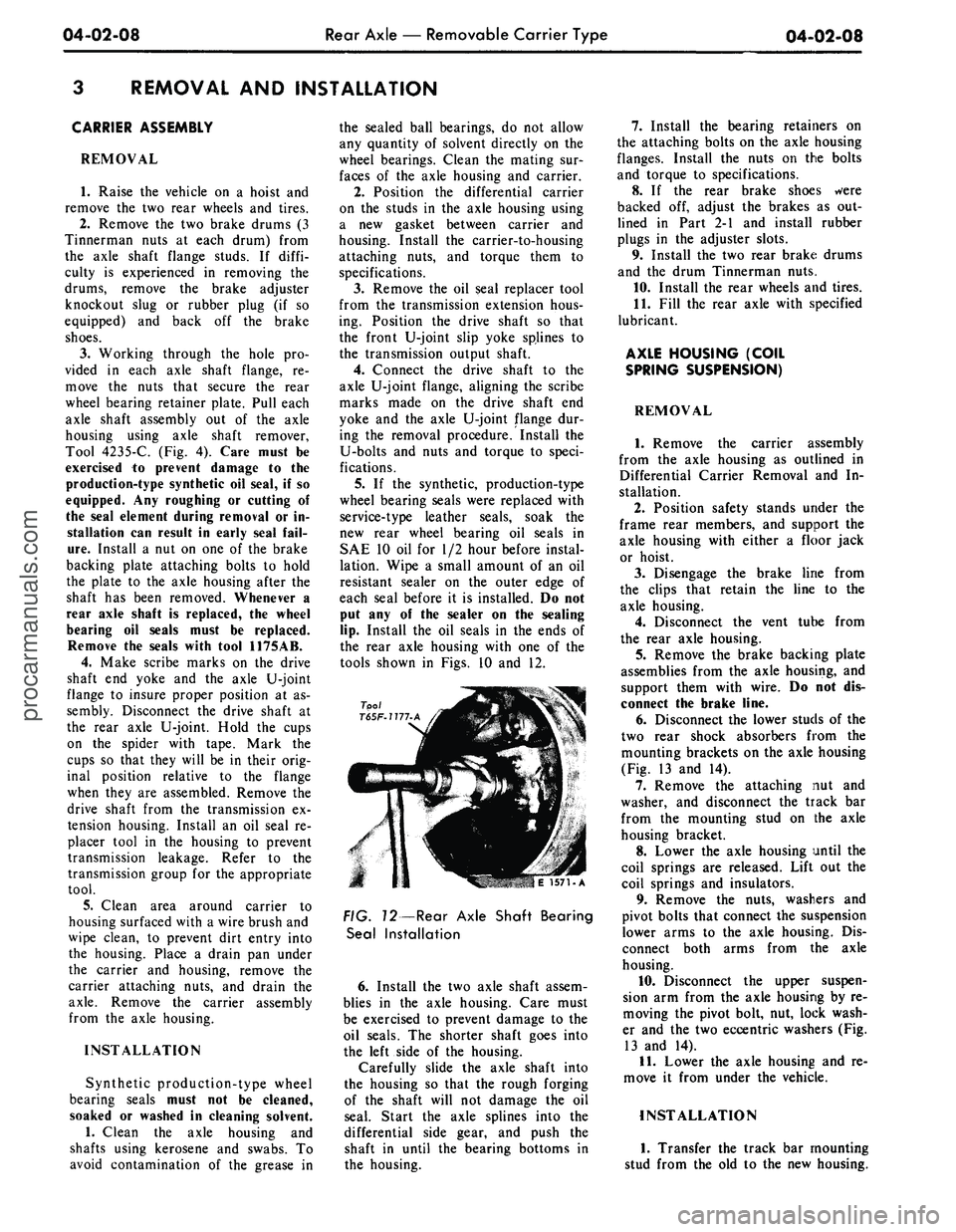
Install the oil seals in the ends of
the rear axle housing with one of the
tools shown in Figs. 10 and 12.
Tool
T65F-1177.A
E 1571-A
FIG. 12—Rear Axle Shaft Bearing
Seal Installation
6. Install the two axle shaft assem-
blies in the axle housing. Care must
be exercised to prevent damage to the
oil seals. The shorter shaft goes into
the left side of the housing.
Carefully slide the axle shaft into
the housing so that the rough forging
of the shaft will not damage the oil
seal. Start the axle splines into the
differential side gear, and push the
shaft in until the bearing bottoms in
the housing.
7.
Install the bearing retainers on
the attaching bolts on the axle housing
flanges. Install the nuts on the bolts
and torque to specifications.
8. If the rear brake shoes were
backed off, adjust the brakes as out-
lined in Part 2-1 and install rubber
plugs in the adjuster slots.
9. Install the two rear brake drums
and the drum Tinnerman nuts.
10.
Install the rear wheels and tires.
11.
Fill the rear axle with specified
lubricant.
AXLE HOUSING (COIL
SPRING SUSPENSION)
REMOVAL
1.
Remove the carrier assembly
from the axle housing as outlined in
Differential Carrier Removal and In-
stallation.
2.
Position safety stands under the
frame rear members, and support the
axle housing with either a floor jack
or hoist.
3.
Disengage the brake line from
the clips that retain the line to the
axle housing.
4.
Disconnect the vent tube from
the rear axle housing.
5.
Remove the brake backing plate
assemblies from the axle housing, and
support them with wire. Do not dis-
connect the brake line.
6. Disconnect the lower studs of the
two rear shock absorbers from the
mounting brackets on the axle housing
(Fig. 13 and 14).
7.
Remove the attaching nut and
washer, and disconnect the track bar
from the mounting stud on the axle
housing bracket.
8. Lower the axle housing until the
coil springs are released. Lift out the
coil springs and insulators.
9. Remove the nuts, washers and
pivot bolts that connect the suspension
lower arms to the axle housing. Dis-
connect both arms from the axle
housing.
10.
Disconnect the upper suspen-
sion arm from the axle housing by re-
moving the pivot bolt, nut, lock wash-
er and the two eccentric washers (Fig.
13 and 14).
11.
Lower the axle housing and re-
move it from under the vehicle.
INSTALLATION
1.
Transfer the track bar mounting
stud from the old to the new housing.procarmanuals.com
Page 208 of 413
04-02-11
Rear Axle — Removable Carrier Type
04-02-11
If the axle housing is new, install a
new vent. The hose attaching portion
must face toward the front of the ve-
hicle.
2.
If leather-type wheel bearing ser-
vice seals are to be installed, soak the
new rear wheel bearing oil seals in
SAE 10 oil for 1/2 hour before instal-
lation. Wipe a small amount of an oil
resistant sealer on the outer edge of
each seal before it is installed. Do not
put any of the sealer on the sealing
lip.
Install the oil seals in the ends of
the axle housing with one of the tools
shown in Fig. 10 and 12.
3.
Position the replacement axle
housing under the vehicle, and raise
the axle with a hoist or floor jack.
Connect the suspension lower arms to
their mounting brackets on the axle
housing with pivot bolts and nuts. Do
not tighten the bolts and nuts at this
point.
4.
Position the suspension upper
arm in its mounting bracket on the
axle housing, and install the adjusting
bolt, eccentric washers, lock washer
and nut. Leave the bolt and nut loose
at this point.
5.
Position the brake lines to the
axle housing, and secure with the re-
taining clips.
6. Install the brake backing plates
on the axle housing flanges.
7.
Connect the track bar to the
mounting stud, install the washer and
attaching nut, and torque to specifica-
tions.
8. Position the rear coil springs and
insulators in the pockets provided.
9. Connect the lower studs of the
two rear shock absorbers to the
mounting brackets on the axle hous-
ing. Install the attaching nuts, and
torque to specifications.
10.
Connect the vent tube to the
vent on the housing. If axle housing is
new, install a new vent.
11.
Clean the mating surfaces of
the axle housing and differential car-
rier. Position the carrier on the
mounting studs on the housing using a
new gasket between carrier and hous-
ing. Install the copper washers and the
carrier-to-housing attaching nuts, and
torque to specifications.
12.
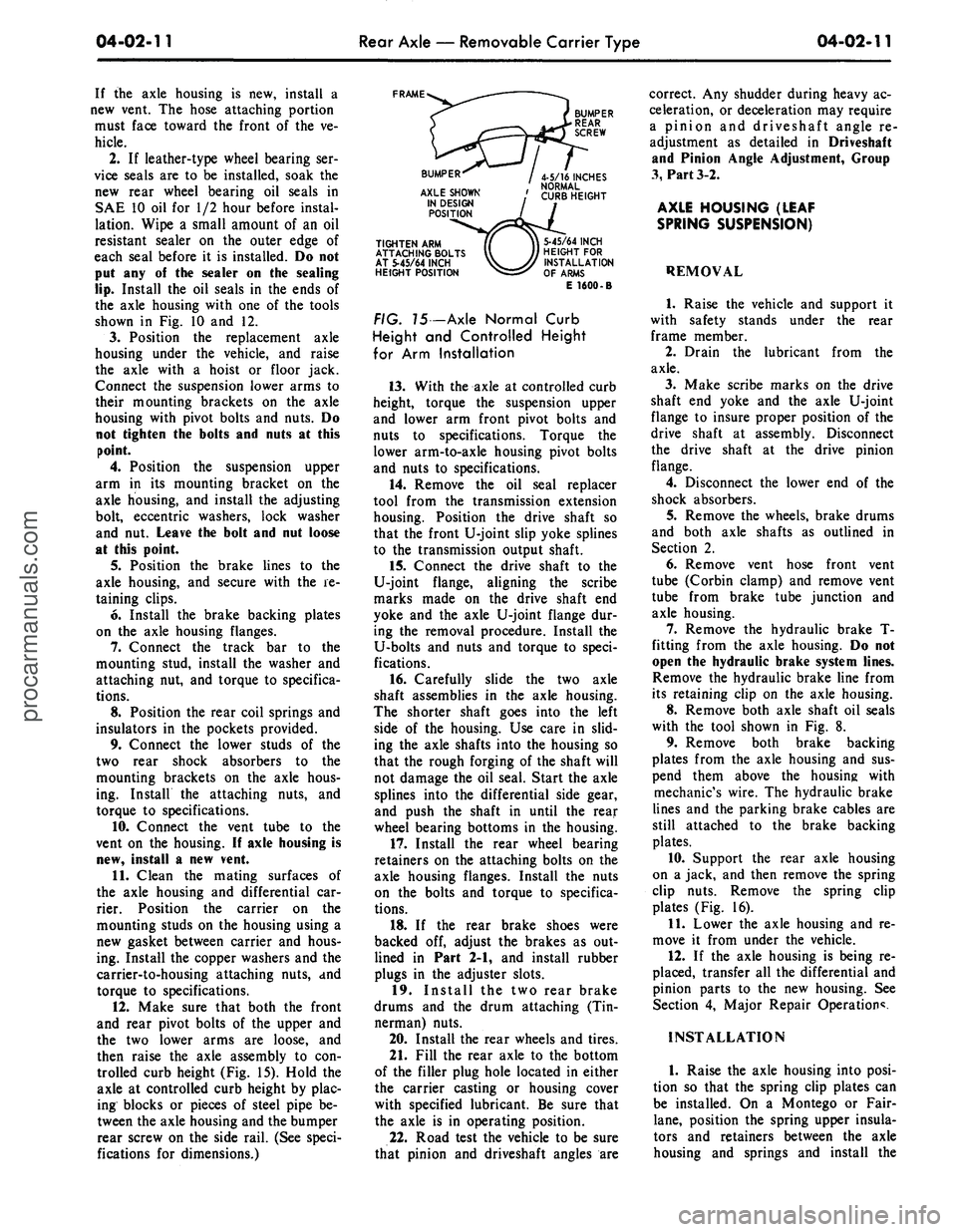
Make sure that both the front
and rear pivot bolts of the upper and
the two lower arms are loose, and
then raise the axle assembly to con-
trolled curb height (Fig. 15). Hold the
axle at controlled curb height by plac-
ing blocks or pieces of steel pipe be-
tween the axle housing and the bumper
rear screw on the side rail. (See speci-
fications for dimensions.)
FRAME
TIGHTEN ARM
ATTACHING BOLTS
AT 5-45/64 INCH
HEIGHT POSITION
5-45/64 INCH
HEIGHT FOR
INSTALLATION
OF ARMS
E 1600-B
FIG. 75 -Axle Normal Curb
Height and Controlled Height
for Arm Installation
13.
With the axle at controlled curb
height, torque the suspension upper
and lower arm front pivot bolts and
nuts to specifications. Torque the
lower arm-to-axle housing pivot bolts
and nuts to specifications.
14.
Remove the oil seal replacer
tool from the transmission extension
housing. Position the drive shaft so
that the front U-joint slip yoke splines
to the transmission output shaft.
15.
Connect the drive shaft to the
U-joint flange, aligning the scribe
marks made on the drive shaft end
yoke and the axle U-joint flange dur-
ing the removal procedure. Install the
U-bolts and nuts and torque to speci-
fications.
16.
Carefully slide the two axle
shaft assemblies in the axle housing.
The shorter shaft goes into the left
side of the housing. Use care in slid-
ing the axle shafts into the housing so
that the rough forging of the shaft will
not damage the oil seal. Start the axle
splines into the differential side gear,
and push the shaft in until the rear
wheel bearing bottoms in the housing.
17.
Install the rear wheel bearing
retainers on the attaching bolts on the
axle housing flanges. Install the nuts
on the bolts and torque to specifica-
tions.
18.
If the rear brake shoes were
backed off, adjust the brakes as out-
lined in Part 2-1, and install rubber
plugs in the adjuster slots.
19.
Install the two rear brake
drums and the drum attaching (Tin-
nerman) nuts.
20.
Install the rear wheels and tires.
21.
Fill the rear axle to the bottom
of the filler plug hole located in either
the carrier casting or housing cover
with specified lubricant. Be sure that
the axle is in operating position.
22.
Road test the vehicle to be sure
that pinion and driveshaft angles are
correct. Any shudder during heavy ac-
celeration, or deceleration may require
a pinion and driveshaft angle re-
adjustment as detailed in Driveshaft
and Pinion Angle Adjustment, Group
3,
Part 3-2.
AXLE HOUSING (LEAF
SPRING SUSPENSION)
REMOVAL
1.
Raise the vehicle and support it
with safety stands under the rear
frame member.
2.
Drain the lubricant from the
axle.
3.
Make scribe marks on the drive
shaft end yoke and the axle U-joint
flange to insure proper position of the
drive shaft at assembly. Disconnect
the drive shaft at the drive pinion
flange.
4.
Disconnect the lower end of the
shock absorbers.
5.
Remove the wheels, brake drums
and both axle shafts as outlined in
Section 2.
6. Remove vent hose front vent
tube (Corbin clamp) and remove vent
tube from brake tube junction and
axle housing.
7.
Remove the hydraulic brake T-
fitting from the axle housing. Do not
open the hydraulic brake system lines.
Remove the hydraulic brake line from
its retaining clip on the axle housing.
8. Remove both axle shaft oil seals
with the tool shown in Fig. 8.
9. Remove both brake backing
plates from the axle housing and sus-
pend them above the housing with
mechanic's wire. The hydraulic brake
lines and the parking brake cables are
still attached to the brake backing
plates.
10.
Support the rear axle housing
on a jack, and then remove the spring
clip nuts. Remove the spring clip
plates (Fig. 16).
11.
Lower the axle housing and re-
move it from under the vehicle.
12.
If the axle housing is being re-
placed, transfer all the differential and
pinion parts to the new housing. See
Section 4, Major Repair Operation*.
INSTALLATION
1.
Raise the axle housing into posi-
tion so that the spring clip plates can
be installed. On a Montego or Fair-
lane,
position the spring upper insula-
tors and retainers between the axle
housing and springs and install theprocarmanuals.com
Page 296 of 413
07-01-05
General Transmission Service
07-01-05
linkage may cause crossleakage and
subsequent transmission failure. Refer
to Linkage Adjustments in Part 7-2,
7-3 or 7-4 for detailed manual linkage
adjustment procedures.
CONTROL PRESSURE
CHECK
When the vacuum diaphragm unit is
operating properly and the downshift
linkage is adjusted properly, all the
transmission shifts (automatic and
kickdown) should occur within the
road speed limits specified in Part 7-5.
If the shifts do not occur within
limits or the transmission slips during
shift point, the following procedure is
suggested to determine engine, trans-
mission, linkage, vacuum diaphragm
unit or valve body problems.
1.
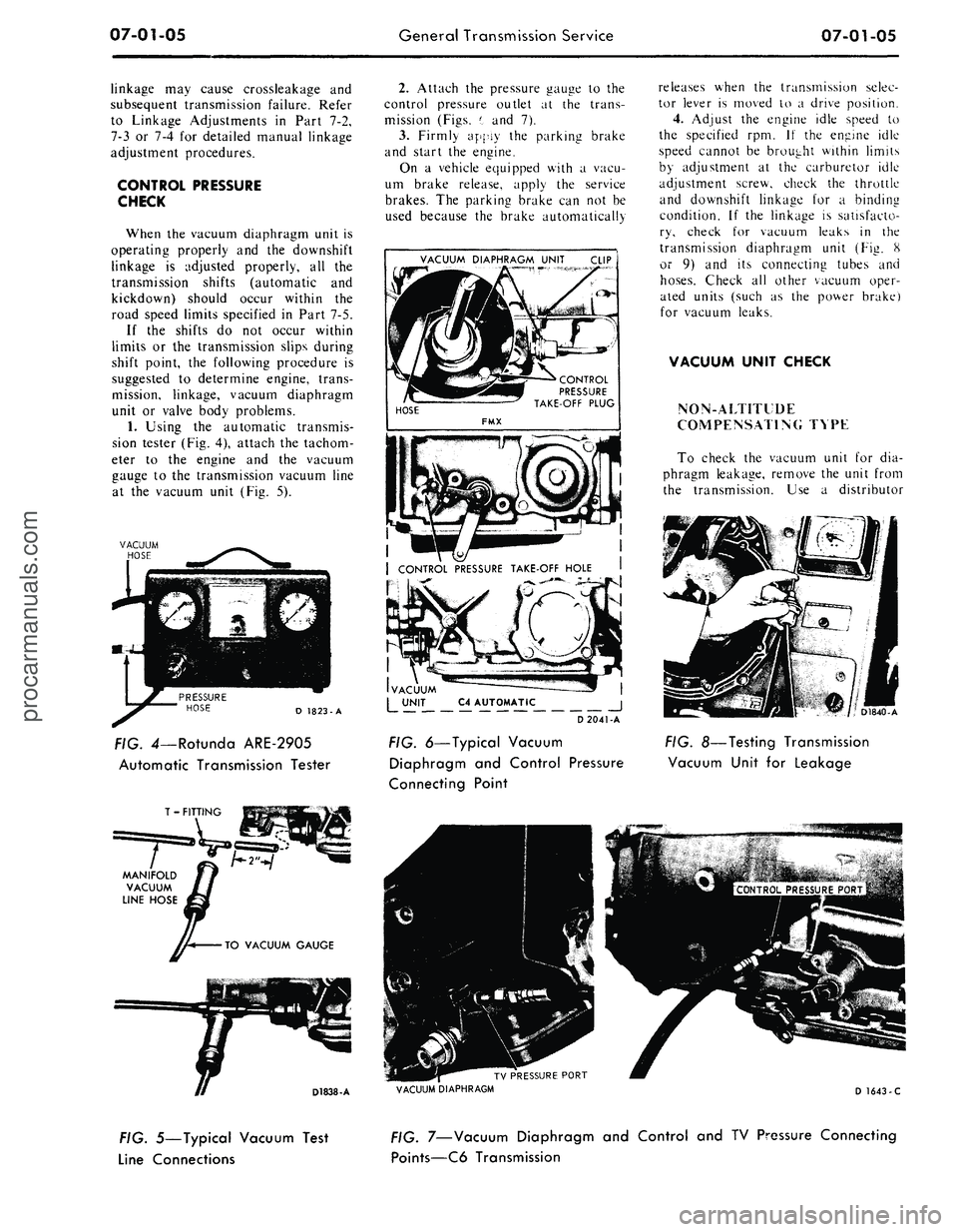
Using the automatic transmis-
sion tester (Fig. 4), attach the tachom-
eter to the engine and the vacuum
gauge to the transmission vacuum line
at the vacuum unit (Fig. 5).
D 1823-A
. 4—Rotunda ARE-2905
Automatic Transmission Tester
T - FITTING
2.
Attach the pressure gauge to the
control pressure outlet at the trans-
mission (Figs. '., and 7).
3.
Firmly apply the parking brake
and start the engine.
On a vehicle equipped with a vacu-
um brake release, apply the service
brakes. The parking brake can not be
used because the brake automatically
VACUUM DIAPHRAGM UNIT
CLIP
I
| CONTROL PRESSURE TAKE-OFF HOLE
D2041-A
FIG. 6—Typical Vacuum
Diaphragm and Control Pressure
Connecting Point
releases when the transmission selec-
tor lever is moved to a drive position.
4.
Adjust the engine idle speed lo
the specified rpm. If the engine idle
speed cannot be brought within limits
by adjustment at the carburetor idle
adjustment screw, check the throttle
and downshift linkage for a binding
condition. If the linkage is satisfacto-
ry, check for vacuum leaks in the
transmission diaphragm unit (Fig. 8
or 9) and its connecting tubes and
hoses.
Check all other vacuum oper-
ated units (such as the power brake)
for vacuum leaks.
VACUUM UNIT CHECK
NON-ALTITIDE
COMPENSATING TYPE
To check the vacuum unit for dia-
phragm leakage, remove the unit from
the transmission. Use a distributor
D1840-A
FIG. 8—Testing Transmission
Vacuum Unit for Leakage
VACUUM DIAPHRAGM
D 1643 -C
FIG. 5—Typical Vacuum Test
Line Connections
FIG.
7—Vacuum
Diaphragm and Control and TV Pressure Connecting
Points—C6 Transmissionprocarmanuals.com