gas FORD MUSTANG 1969 Volume One Chassis
[x] Cancel search | Manufacturer: FORD, Model Year: 1969, Model line: MUSTANG, Model: FORD MUSTANG 1969Pages: 413, PDF Size: 75.81 MB
Page 307 of 413
07-01-16
General Transmission bervice
07-01-16
CENTER SUPPORT
PLANETARY CLUTCH
"CAM TYPE" CLUTCH RACE
CHAMFER ON PRODUCTION
PART, ONLY-SERVICE PART NOT CHAMFERED
PLANET CARRIER
D1938-A
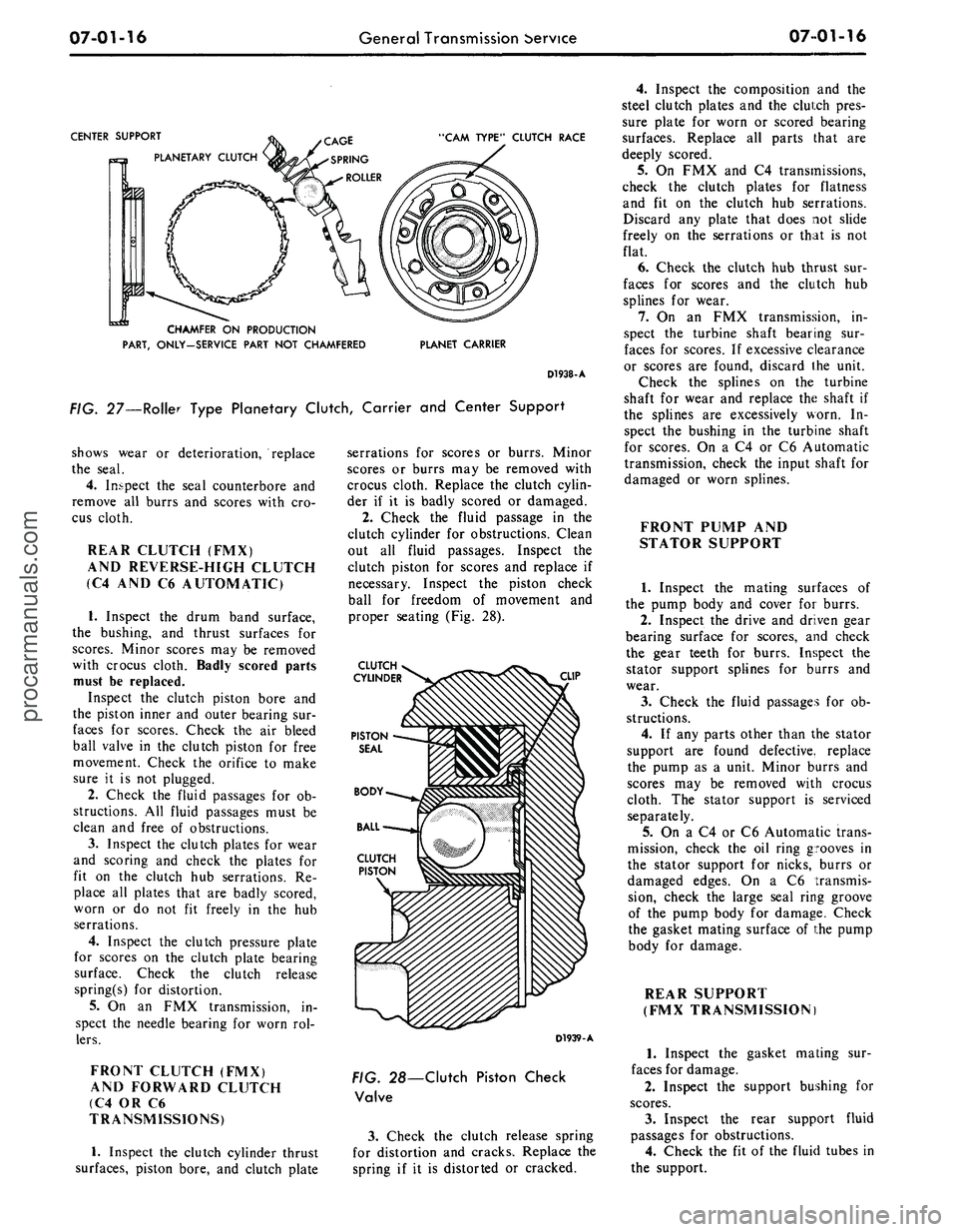
FIG. 27—Roller Type Planetary Clutch, Carrier and Center Support
shows wear or deterioration, replace
the seal.
4.
Inspect the seal counterbore and
remove all burrs and scores with cro-
cus cloth.
REAR CLUTCH (FMX)
AND REVERSE-HIGH CLUTCH
(C4 AND C6 AUTOMATIC)
1.
Inspect the drum band surface,
the bushing, and thrust surfaces for
scores. Minor scores may be removed
with crocus cloth. Badly scored parts
must be replaced.
Inspect the clutch piston bore and
the piston inner and outer bearing sur-
faces for scores. Check the air bleed
ball valve in the clutch piston for free
movement. Check the orifice to make
sure it is not plugged.
2.
Check the fluid passages for ob-
structions. All fluid passages must be
clean and free of obstructions.
3.
Inspect the clutch plates for wear
and scoring and check the plates for
fit on the clutch hub serrations. Re-
place all plates that are badly scored,
worn or do not fit freely in the hub
serrations.
4.
Inspect the clutch pressure plate
for scores on the clutch plate bearing
surface. Check the clutch release
spring(s) for distortion.
5.
On an FMX transmission, in-
spect the needle bearing for worn rol-
lers.
FRONT CLUTCH (FMX)
AND FORWARD CLUTCH
(C4 OR C6
TRANSMISSIONS)
1.
Inspect the clutch cylinder thrust
surfaces, piston bore, and clutch plate
serrations for scores or burrs. Minor
scores or burrs may be removed with
crocus cloth. Replace the clutch cylin-
der if it is badly scored or damaged.
2.
Check the fluid passage in the
clutch cylinder for obstructions. Clean
out all fluid passages. Inspect the
clutch piston for scores and replace if
necessary. Inspect the piston check
ball for freedom of movement and
proper seating (Fig. 28).
CLUTCH
CYLINDER
PISTON
SEAL
CLIP
D1939-A
. 28—Clutch Piston Check
Valve
3.
Check the clutch release spring
for distortion and cracks. Replace the
spring if it is distorted or cracked.
4.
Inspect the composition and the
steel clutch plates and the clutch pres-
sure plate for worn or scored bearing
surfaces. Replace all parts that are
deeply scored.
5.
On FMX and C4 transmissions,
check the clutch plates for flatness
and fit on the clutch hub serrations.
Discard any plate that does not slide
freely on the serrations or that is not
flat.
6. Check the clutch hub thrust sur-
faces for scores and the clutch hub
splines for wear.
7.
On an FMX transmission, in-
spect the turbine shaft bearing sur-
faces for scores. If excessive clearance
or scores are found, discard the unit.
Check the splines on the turbine
shaft for wear and replace the shaft if
the splines are excessively worn. In-
spect the bushing in the turbine shaft
for scores. On a C4 or C6 Automatic
transmission, check the input shaft for
damaged or worn splines.
FRONT PUMP AND
STATOR SUPPORT
1.
Inspect the mating surfaces of
the pump body and cover for burrs.
2.
Inspect the drive and driven gear
bearing surface for scores, and check
the gear teeth for burrs. Inspect the
stator support splines for burrs and
wear.
3.
Check the fluid passages for ob-
structions.
4.
If any parts other than the stator
support are found defective, replace
the pump as a unit. Minor burrs and
scores may be removed with crocus
cloth. The stator support is serviced
separately.
5.
On a C4 or C6 Automatic trans-
mission, check the oil ring grooves in
the stator support for nicks, burrs or
damaged edges. On a C6 transmis-
sion, check the large seal ring groove
of the pump body for damage. Check
the gasket mating surface of the pump
body for damage.
REAR SUPPORT
(FMX TRANSMISSION)
1.
Inspect the gasket mating sur-
faces for damage.
2.
Inspect the support bushing for
scores.
3.
Inspect the rear support fluid
passages for obstructions.
4.
Check the fit of the fluid tubes in
the support.procarmanuals.com
Page 308 of 413
07-01-17
General Transmission Service
07-01-17
PRESSURE REGULATOR
(FMX TRANSMISSION)
1.
Inspect the regulator body and
cover mating surface for burrs.
2.
Check all fluid passages for ob-
structions.
3.
Inspect the control pressure and
converter pressure valves and bores for
burrs and scores. Remove all burrs
carefully with crocus cloth.
4.
Check free movement of the
valves in their bores. The valves
should fall freely into the bores when
both the valve and bore are dry.
5.
Inspect the valve springs and
spacers for distortion.
CONTROL VALVE BODY
1.
Clean all parts thoroughly in
clean solvent, and then blow them dry
with moisture-free compressed air.
2.
Inspect all valve and plug bores
for scores. Check all fluid passages for
obstructions. Inspect the check valve
for free movement. Inspect all mating
surfaces for burrs or distortion. In-
spect all plugs and valves for burrs
and scores. Crocus cloth can be used
to polish valves and plugs if care is
taken to avoid rounding the sharp
edges of the valves and plugs.
3.
Inspect all springs for distortion.
Check all valves and plugs for free
movement in their respective bores.
Valves and plugs, when dry, must fall
from their own weight in their respec-
tive bores.
4.
Roll the manual valve on a flat
surface to check it for a bent condi-
tion.
GOVERNOR
1.
Inspect the governor valves and
bores for scores. Minor scores may be
removed from the valves with crocus
cloth. Replace the governor if the
valves or body is deeply scored.
2.
Check for free movement of the
valves in the bores. The valves should
slide freely of their own weight in the
bores when dry. Inspect fluid passages
in the valve body and counterweight
for obstructions. All fluid passages
must be clean.
3.
Inspect the mating surfaces of
the governor body and governor dis-
tributor (C4 or C6 Automatic) for
burrs and distortion. Mating surfaces
must be smooth and flat.
4.
Check the mating surface of the
governor valve and the counterweight
on a FMX transmission for burrs or
scratches.
5.
When cleaning the governor as-
sembly (C4 Automatic), the oil screen
should be removed from the collector
body and thoroughly blown out with
compressed air.
FRONT SERVO (FMX)
AND INTERMEDIATE
SERVO (C4 AND C6
AUTOMATIC)
1.
Inspect the servo bore for cracks
and the piston bore and the servo pis-
ton stem for scores. Check fluid pas-
sages for obstructions. Replace seals
that are damaged.
2.
On an FMX transmission, check
the actuating lever for free movement,
and inspect it for wear. If necessary to
replace the actuating lever or shaft,
remove the retaining pin and push the
shaft out of the bracket.
Inspect the adjusting screw threads
and the threads in the lever for dam-
age.
3.
Check the servo spring and servo
band strut(s) for distortion.
4.
Inspect the cover seal and gasket
cover sealing surface for defects.
REAR SERVO (FMX)
AND LOW-REVERSE SERVO
(C4 TRANSMISSION)
1.
Inspect the servo body for cracks
and the piston bore for scores.
2.
Check the fluid passages for ob-
structions.
3.
Inspect the band and the struts
for distortion. Inspect the band ends
for cracks.
4.
Inspect the servo spring for dis-
tortion.
5.
Inspect the band lining for exces-
sive wear and bonding to the metal
band.
6. On an FMX transmission, check
the servo body to case mating surface
for burrs. Check the accumulator pis-
ton and the check valve for freedom
of movement. Check the actuating
lever socket for scores.
7.
Replace seals that are damaged.
CASE
Inspect the case for cracks and
stripped threads. Inspect the gasket
surfaces and mating surfaces for
burrs.
Check the vent for obstructions,
and check all fluid passages for ob-
structions and leakage (Figs. 10, 11
and 12).
Inspect the case bushing for scores.
Check all parking linkage parts for
wear or damage.
ONE-WAY CLUTCH
1.
Inspect the outer and inner races
for scores or damaged surface area
where the rollers contact the races. If
the outer race on the C6 transmission
is damaged, the low-reverse clutch hub
must be replaced.
2.
Inspect the rollers and springs
for excessive wear or damage.
3.
Inspect the spring and roller case
for bent or damaged spring retainers.procarmanuals.com
Page 317 of 413
07-02-09
C4 Automatic Transmission
07-02-09
11.
Remove the handle from the se-
lector lever.
12.
Install the selector housing and
lever assembly as shown in Figure 8.
Torque the attaching bolts 4-6 ft-lbs.
13.
Connect the dial indicator light.
14.
Install the pointer back-up
shield on the housing and lever assem-
bly.
15.
Install the dial housing and
tighten the attaching screws.
16.
Install the selector lever handle
and tighten the attaching screw.
17.
Position the selector lever in the
D position.
18.
Raise the vehicle. Install the
transmission manual lever rod to the
selector lever. Adjust the manual link-
age.
19.
Lower the vehicle and check the
transmission operation in each selo:c-
tor lever detent position.
BAND ADJUSTMENT
INTERMEDIATE BAND
1.
Clean all the dirt from the band
adjusting screw area. Remove and dis-
card the locknut.
2.
Install a new locknut on the ad-
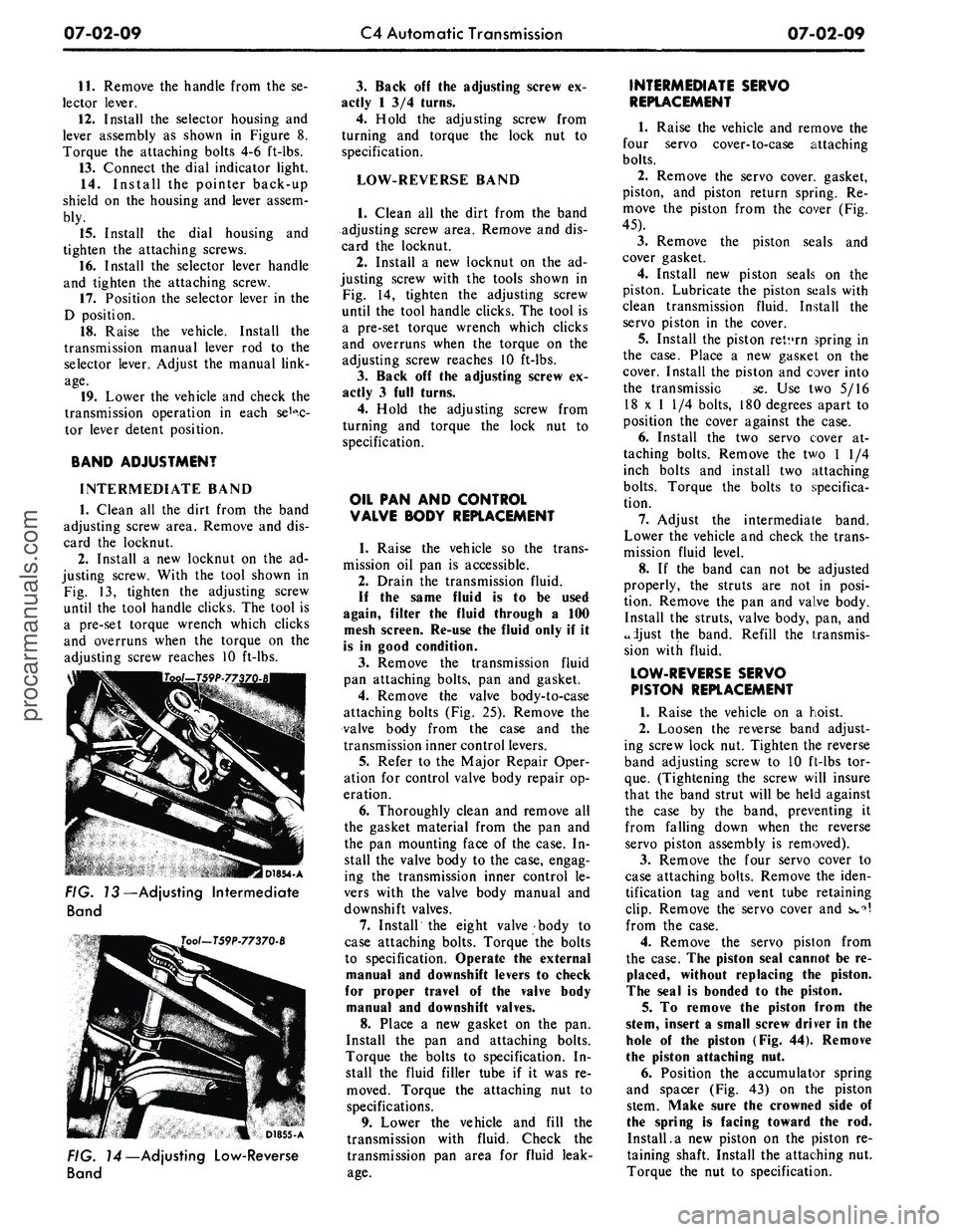
justing screw. With the tool shown in
Fig. 13, tighten the adjusting screw
until the tool handle clicks. The tool is
a pre-set torque wrench which clicks
and overruns when the torque on the
adjusting screw reaches 10 ft-lbs.
I D1854-A
FIG. 13—Adjusting Intermediate
Band
Tool-T59P-77370-B
D1855-A
FIG. 14—Adjusting Low-Reverse
Band
3.
Back off the adjusting screw ex-
actly 1 3/4 turns.
4.
Hold the adjusting screw from
turning and torque the lock nut to
specification.
LOW-REVERSE BAND
1.
Clean all the dirt from the band
adjusting screw area. Remove and dis-
card the locknut.
2.
Install a new locknut on the ad-
justing screw with the tools shown in
Fig. 14, tighten the adjusting screw
until the tool handle clicks. The tool is
a pre-set torque wrench which clicks
and overruns when the torque on the
adjusting screw reaches 10 ft-lbs.
3.
Back off the adjusting screw ex-
actly 3 full turns.
4.
Hold the adjusting screw from
turning and torque the lock nut to
specification.
OIL PAN AND CONTROL
VALVE BODY REPLACEMENT
1.
Raise the vehicle so the trans-
mission oil pan is accessible.
2.
Drain the transmission fluid.
If the same fluid is to be used
again, filter the fluid through a 100
mesh screen. Re-use the fluid only if it
is in good condition.
3.
Remove the transmission fluid
pan attaching bolts, pan and gasket.
4.
Remove the valve body-to-case
attaching bolts (Fig. 25). Remove the
valve body from the case and the
transmission inner control levers.
5.
Refer to the Major Repair Oper-
ation for control valve body repair op-
eration.
6. Thoroughly clean and remove all
the gasket material from the pan and
the pan mounting face of the case. In-
stall the valve body to the case, engag-
ing the transmission inner control le-
vers with the valve body manual and
downshift valves.
7.
Install the eight valve body to
case attaching bolts. Torque the bolts
to specification. Operate the external
manual and downshift levers to check
for proper travel of the valve body
manual and downshift valves.
8. Place a new gasket on the pan.
Install the pan and attaching bolts.
Torque the bolts to specification. In-
stall the fluid filler tube if it was re-
moved. Torque the attaching nut to
specifications.
9. Lower the vehicle and fill the
transmission with fluid. Check the
transmission pan area for fluid leak-
age.
INTERMEDIATE SERVO
REPLACEMENT
1.
Raise the vehicle and remove the
four servo cover-to-case attaching
bolts.
2.
Remove the servo cover, gasket,
piston, and piston return spring. Re-
move the piston from the cover (Fig.
45).
3.
Remove the piston seals and
cover gasket.
4.
Install new piston seals on the
piston. Lubricate the piston seals with
clean transmission fluid. Install the
servo piston in the cover.
5.
Install the piston retvrn spring in
the case. Place a new gasicet on the
cover. Install the piston and cover into
the transmissic se. Use two 5/16
18 x 1 1/4 bolts, 180 degrees apart to
position the cover against the case.
6. Install the two servo cover at-
taching bolts. Remove the two 1 1/4
inch bolts and install two attaching
bolts.
Torque the bolts to specifica-
tion.
7.
Adjust the intermediate band.
Lower the vehicle and check the trans-
mission fluid level.
8. If the band can not be adjusted
properly, the struts are not in posi-
tion. Remove the pan and valve body.
Install the struts, valve body, pan, and
adjust the band. Refill the transmis-
sion with fluid.
LOW-REVERSE SERVO
PISTON REPLACEMENT
1.
Raise the vehicle on a hoist.
2.
Loosen the reverse band adjust-
ing screw lock nut. Tighten the reverse
band adjusting screw to 10 ft-lbs tor-
que.
(Tightening the screw will insure
that the band strut will be held against
the case by the band, preventing it
from falling down when the reverse
servo piston assembly is removed).
3.
Remove the four servo cover to
case attaching bolts. Remove the iden-
tification tag and vent tube retaining
clip.
Remove the servo cover and s»»^
from the case.
4.
Remove the servo piston from
the case. The piston seal cannot be re-
placed, without replacing the piston.
The seal is bonded to the piston.
5. To remove the piston from the
stem, insert a small screw driver in the
hole of the piston (Fig. 44). Remove
the piston attaching nut.
6. Position the accumulator spring
and spacer (Fig. 43) on the piston
stem. Make sure the crowned side of
the spring is facing toward the rod.
Install.a new piston on the piston re-
taining shaft. Install the attaching nut.
Torque the nut to specification.procarmanuals.com
Page 318 of 413
07-02-10
C4 Automatic Transmission
07-02-10
7.
Install
the
piston into
the
case.
Install
a new
seal
on the
cover. Install
the cover
by
using
two
5/16—18 bolts,
1
1/4
inch long,
at
180
degrees apart
to position
the
servo cover
on the
case.
Install
the
vent tube retaining
clip
and
identification
tag.
Install
two
cover attaching bolts. Remove
the two
installing bolts
and
install
the
last
two
attaching bolts. Torque
the
cover-
to-case attaching bolts
to
specifica-
tion.
8. Adjust
the
low-reverse band.
Lower
the
vehicle
and
check
the
trans-
mission fluid level.
9.
If the
band
can not be
adjusted
properly,
the
struts
are not in
posi-
tion. Remove
the
fluid
pan and
valve
body. Install
the
struts, valve body,
pan
and
adjust
the
band. Refill
the
transmission with fluid.
EXTENSION HOUSING
BUSHING
AND
REAR
SEAL REPLACEMENT
1.
Disconnect
the
drive shaft from
the transmission.
2.
When only
the
rear seal needs
replacing, carefully remove
it
with
a
tapered chisel
or the
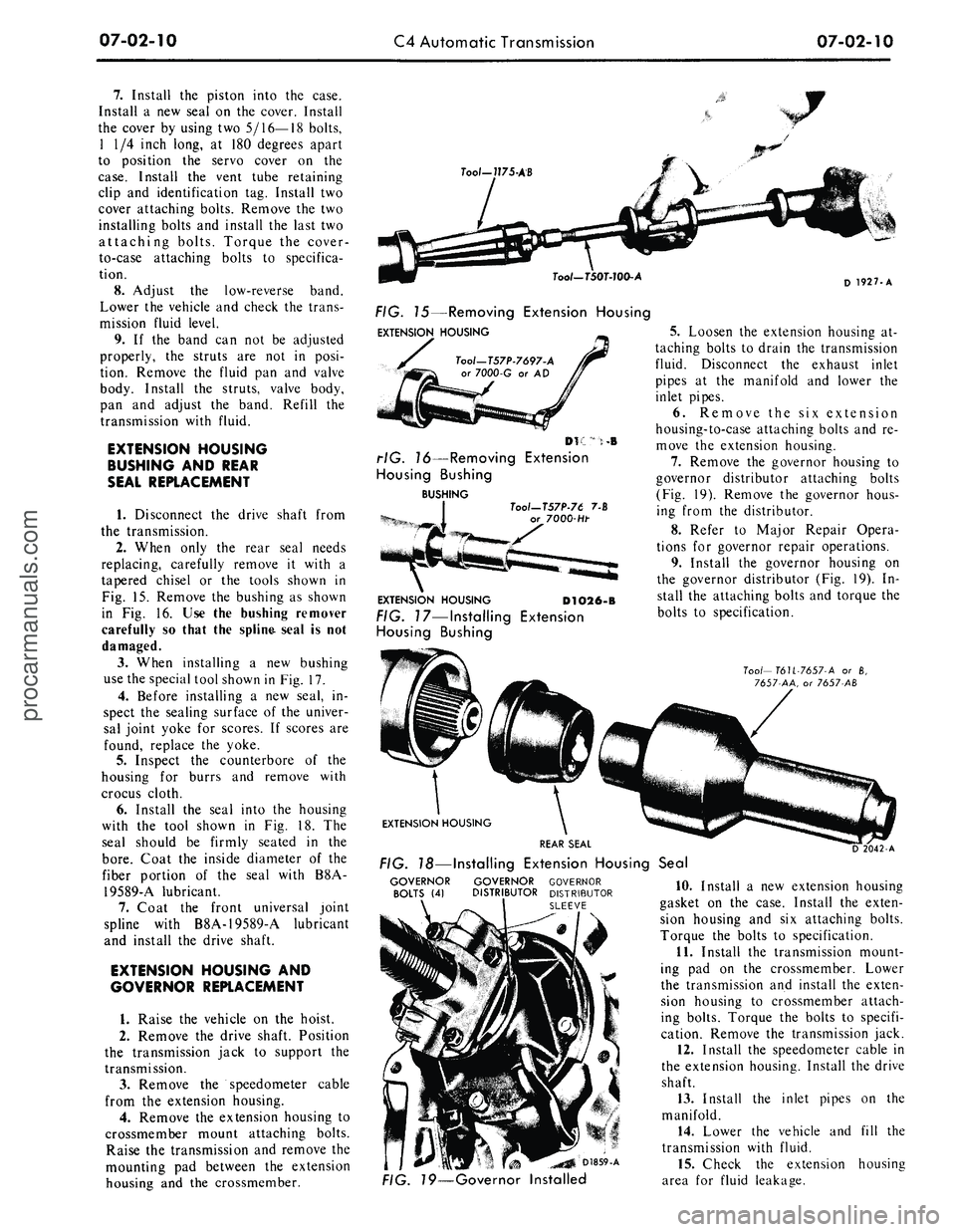
tools shown
in
Fig.
15.
Remove
the
bushing
as
shown
in
Fig. 16. Use the
bushing remover
carefully
so
that
the
spline- seal
is not
damaged.
3.
When installing
a new
bushing
use
the
special tool shown
in
Fig.
17.
4.
Before installing
a new
seal,
in-
spect
the
sealing surface
of the
univer-
sal joint yoke
for
scores.
If
scores
are
found, replace
the
yoke.
5.
Inspect
the
counterbore
of the
housing
for
burrs
and
remove with
crocus cloth.
6. Install
the
seal into
the
housing
with
the
tool shown
in Fig. 18. The
seal should
be
firmly seated
in the
bore.
Coat
the
inside diameter
of the
fiber portion
of the
seal with
B8A-
19589-A lubricant.
7.
Coat
the
front universal joint
spline with B8A-19589-A lubricant
and install
the
drive shaft.
EXTENSION HOUSING
AND
GOVERNOR REPLACEMENT
1.
Raise
the
vehicle
on the
hoist.
2.
Remove
the
drive shaft. Position
the transmission jack
to
support
the
transmission.
3.
Remove
the
speedometer cable
from
the
extension housing.
4.
Remove
the
extension housing
to
crossmember mount attaching bolts.
Raise
the
transmission
and
remove
the
mounting
pad
between
the
extension
housing
and the
crossmember.
Tool—
I775-AB
Tool—
T50T-100-A
FIG. 15—Removing Extension Housing
EXTENSION HOUSING
rIG. 16—Removing Extension
Housing Bushing
BUSHING
I Tool—T57P-76 7-B
^mmmfm^
0^7000-Ht
EXTENSION HOUSING
D1O26-B
FIG. 17—Installing Extension
Housing Bushing
D 1927-A
5.
Loosen
the
extension housing
at-
taching bolts
to
drain
the
transmission
fluid. Disconnect
the
exhaust inlet
pipes
at the
manifold
and
lower
the
inlet pipes.
6. Remove
the six
extension
housing-to-case attaching bolts
and re-
move
the
extension housing.
7.
Remove
the
governor housing
to
governor distributor attaching bolts
(Fig.
19).
Remove
the
governor hous-
ing from
the
distributor.
8. Refer
to
Major Repair Opera-
tions
for
governor repair operations.
9. Install
the
governor housing
on
the governor distributor
(Fig.
19). In-
stall
the
attaching bolts
and
torque
the
bolts
to
specification.
Tool—
T6
U-7657-A
or B,
7657AA,
or
7657-AB
EXTENSION HOUSING
REAR SEAL
FIG. 18—Installing Extension Housing Seal
D 2042-A
GOVERNOR GOVERNOR GOVERNOR
BOLTS
(4)
DISTRIBUTOR DISTRIBUTOR
SLEEVE
I
D1859-A
FIG. 79—Governor Installed
10.
Install
a new
extension housing
gasket
on the
case. Install
the
exten-
sion housing
and six
attaching bolts.
Torque
the
bolts
to
specification.
11.
Install
the
transmission mount-
ing
pad on the
crossmember. Lower
the transmission
and
install
the
exten-
sion housing
to
crossmember attach-
ing bolts. Torque
the
bolts
to
specifi-
cation. Remove
the
transmission jack.
12.
Install
the
speedometer cable
in
the extension housing. Install
the
drive
shaft.
13.
Install
the
inlet pipes
on the
manifold.
14.
Lower
the
vehicle
and
fill
the
transmission with fluid.
15.
Check
the
extension housing
area
for
fluid leakage.procarmanuals.com
Page 320 of 413
07-02-12
C4 Automatic Transmission
07-02-12
MAJOR REPAIR OPERATIONS
Before removing
any of the sub-
assemblies, thoroughly clean
the out-
side
of the
transmission
to
prevent dirt
from entering
the
mechanical parts.
During
the
repair operations, refer
to
Part 7-1
for
common adjustments
and
repairs
or
cleaning
and
inspection
pro-
cedures.
During
the
transmission disassem-
bly
or
assembly operations,
ten
thrust
washers located between
the sub-
assemblies must
be
removed
and in-
stalled.
It is
important that each
thrust washer
be in the
correct posi-
tion during
the
assembly operation.
To properly locate
and
identify
the
thrust washers,
the
various positions
of
the
thrust washers
are
shown
in the
illustrations
and are
numbered
1
through
10. No. 1 is at the
first thrust
washer located
at the
front pump.
The
last thrust washer,
No. 10, is
located
at
the
parking pawl ring gear.
DISASSEMBLY
OF
TRANSMISSION
1.
Remove
the
converter from
the
transmission front pump
and
convert-
er housing.
2.
Remove
the
transmission vacuum
unit with
the
tool shown
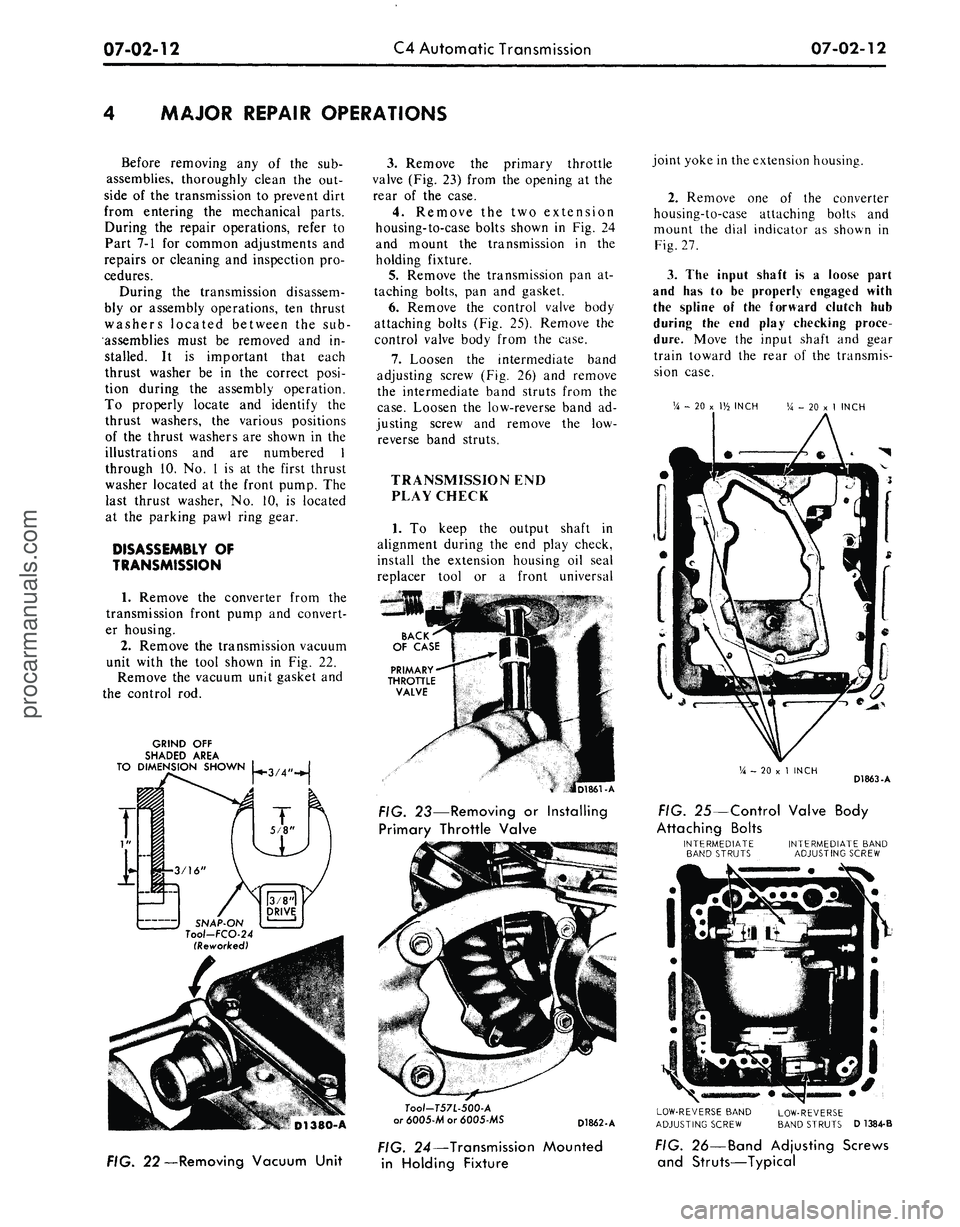
in Fig. 22.
Remove
the
vacuum unit gasket and
the control
rod.
GRIND OFF
SHADED AREA
TO DIMENSION SHOWN L .
SNAP-ON
Tool-FCO-24
(Reworked)
D1380-A
FIG. 22—Removing Vacuum Unit
3.
Remove
the
primary throttle
valve (Fig.
23)
from
the
opening
at the
rear
of the
case.
4.
Remove
the two
extension
housing-to-case bolts shown
in Fig. 24
and mount
the
transmission
in the
holding fixture.
5.
Remove
the
transmission
pan at-
taching bolts,
pan and
gasket.
6. Remove
the
control valve body
attaching bolts (Fig.
25).
Remove
the
control valve body from
the
case.
7.
Loosen
the
intermediate band
adjusting screw
(Fig. 26) and
remove
the intermediate band struts from
the
case.
Loosen
the
low-reverse band
ad-
justing screw
and
remove
the low-
reverse band struts.
TRANSMISSION END
PLAY CHECK
1.
To
keep
the
output shaft
in
alignment during
the end
play check,
install
the
extension housing
oil
seal
replacer tool
or a
front universal
D1861-A
FIG. 23—Removing
or
Installing
Primary Throttle Valve
Tool-T57L-500-A
or 6005-M or 6005-MS
D1862-A
joint yoke in the extension housing.
2.
Remove
one of the
converter
housing-to-case attaching bolts
and
mount
the
dial indicator
as
shown
in
Fig. 27.
3.
The
input shaft
is a
loose part
and
has to be
properly engaged with
the spline
of the
forward clutch
hub
during
the end
play checking proce-
dure.
Move
the
input shaft
and
gear
train toward
the
rear
of the
transmis-
sion case.
V*
- 20 x
V/7 INCH
V*
- 20 x 1
INCH
V*
- 20 x 1
INCH
D1863-A
FIG. 25—Control Valve Body
Attaching Bolts
INTERMEDIATE
BAND STRUTS
INTERMEDIATE BAND
ADJUSTING SCREW
I
LOW-REVERSE BAND
ADJUSTING SCREW
LOW-REVERSE
BAND STRUTS
D
1384-B
FIG.
24—Transmission
Mounted
in Holding Fixture
FIG. 26—Band Adjusting Screws
and Struts—Typicalprocarmanuals.com
Page 322 of 413
07-02-14
C4 Automatic Transmission
07-02-14
FORWARD CLUTCH
FORWARD CLUTCH FRONT PLANET CARRIER INPU^ SHELL
HUB AND
RING GEAR
SUN GEAR
REVERSE-HIGH CLUTCH
THRUST WASHER
NO.
5
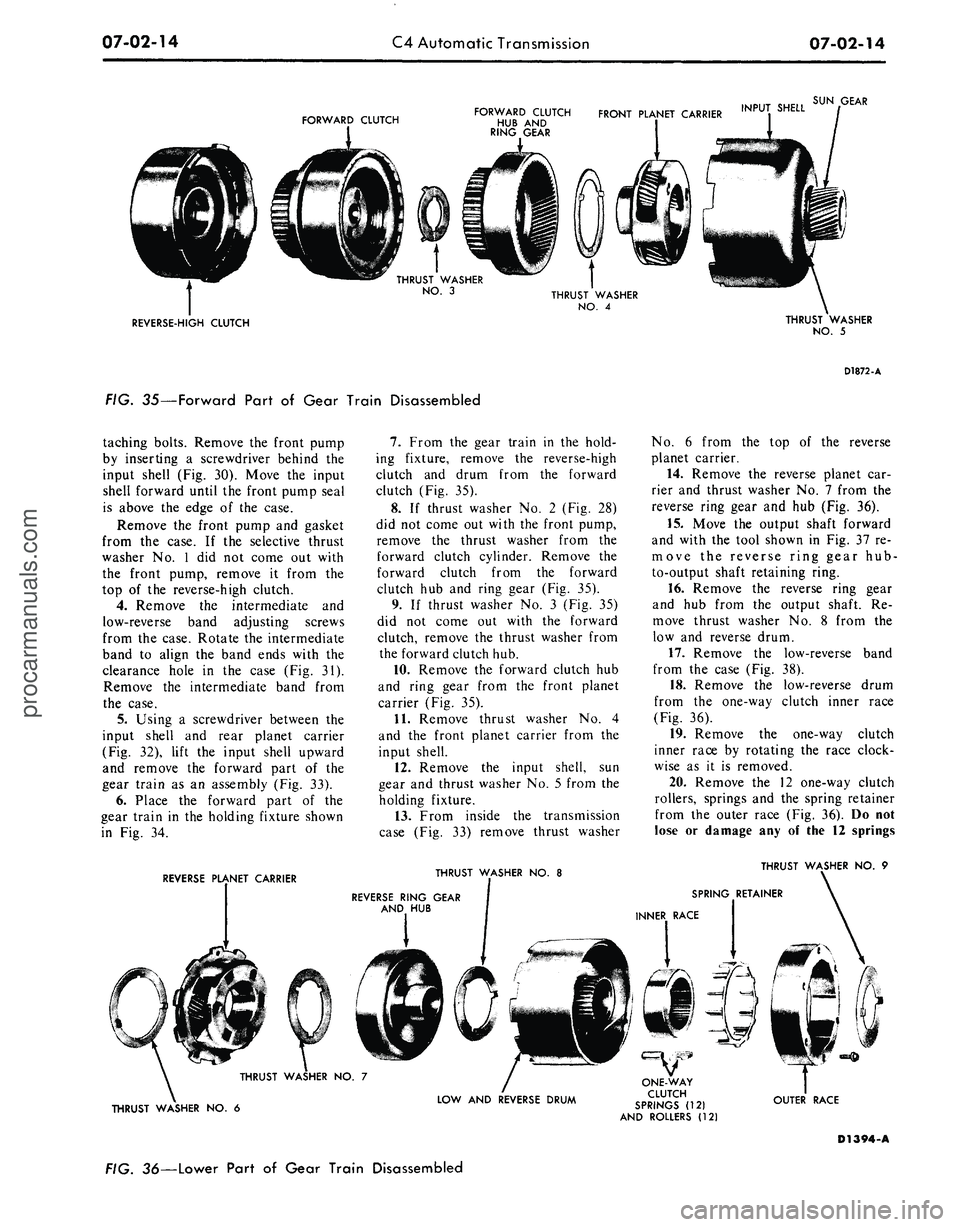
FIG. 35—Forward Part of Gear Train Disassembled
D1872-A
taching bolts. Remove the front pump
by inserting a screwdriver behind the
input shell (Fig. 30). Move the input
shell forward until the front pump seal
is above the edge of the case.
Remove the front pump and gasket
from the case. If the selective thrust
washer No. 1 did not come out with
the front pump, remove it from the
top of the reverse-high clutch.
4.
Remove the intermediate and
low-reverse band adjusting screws
from the case. Rotate the intermediate
band to align the band ends with the
clearance hole in the case (Fig. 31).
Remove the intermediate band from
the case.
5.
Using a screwdriver between the
input shell and rear planet carrier
(Fig. 32), lift the input shell upward
and remove the forward part of the
gear train as an assembly (Fig. 33).
6. Place the forward part of the
gear train in the holding fixture shown
in Fig. 34.
7.
From the gear train in the hold-
ing fixture, remove the reverse-high
clutch and drum from the forward
clutch (Fig. 35).
8. If thrust washer No. 2 (Fig. 28)
did not come out with the front pump,
remove the thrust washer from the
forward clutch cylinder. Remove the
forward clutch from the forward
clutch hub and ring gear (Fig. 35).
9. If thrust washer No. 3 (Fig. 35)
did not come out with the forward
clutch, remove the thrust washer from
the forward clutch hub.
10.
Remove the forward clutch hub
and ring gear from the front planet
carrier (Fig. 35).
11.
Remove thrust washer No. 4
and the front planet carrier from the
input shell.
12.
Remove the input shell, sun
gear and thrust washer No. 5 from the
holding fixture.
13.
From inside the transmission
case (Fig. 33) remove thrust washer
No.
6 from the top of the reverse
planet carrier.
14.
Remove the reverse planet car-
rier and thrust washer No. 7 from the
reverse ring gear and hub (Fig. 36).
15.
Move the output shaft forward
and with the tool shown in Fig. 37 re-
move the reverse ring gear hub-
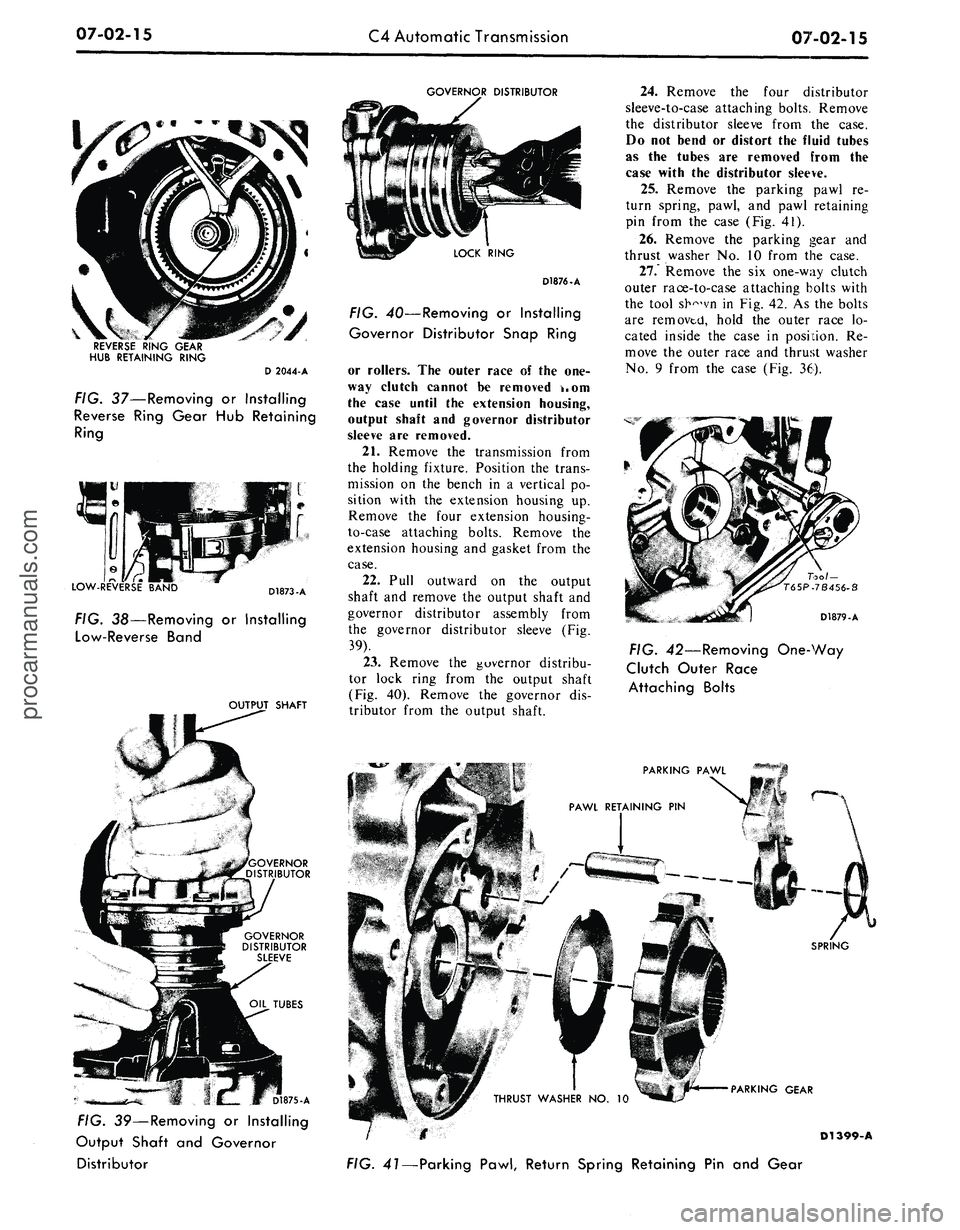
to-output shaft retaining ring.
16.
Remove the reverse ring gear
and hub from the output shaft. Re-
move thrust washer No. 8 from the
low and reverse drum.
17.
Remove the low-reverse band
from the case (Fig. 38).
18.
Remove the low-reverse drum
from the one-way clutch inner race
(Fig. 36).
19.
Remove the one-way clutch
inner race by rotating the race clock-
wise as it is removed.
20.
Remove the 12 one-way clutch
rollers, springs and the spring retainer
from the outer race (Fig. 36). Do not
lose or damage any of the 12 springs
REVERSE PLANET CARRIER
THRUST WASHER NO. 8
THRUST WASHER NO. 9
SPRING RETAINER
INNER RACE
THRUST WASHER NO. 6
LOW AND REVERSE DRUM
ONE-WAY
CLUTCH
SPRINGS (12)
AND ROLLERS (12)
OUTER RACE
D1394-A
FIG. 36—Lower Part of Gear Train Disassembledprocarmanuals.com
Page 323 of 413
07-02-15
C4 Automatic Transmission
07-02-15
GOVERNOR DISTRIBUTOR
REVERSE RING GEAR
HUB RETAINING RING
D 2044-A
FIG.
37—Removing
or
Installing
Reverse
Ring Gear
Hub
Retaining
Ring
I®
LOW-RE'VERSE BAND
D1873-A
FIG.
38—Removing
or
Installing
Low-Reverse
Band
OUTPUT SHAFT
GOVERNOR
DISTRIBUTOR
SLEEVE
D1875-A
FIG.
39—Removing
or
Installing
Output
Shaft
and
Governor
Distributor
LOCK RING
D1876-A
FIG.
40—Removing
or
Installing
Governor
Distributor Snap Ring
or rollers.
The
outer race
of the one-
way clutch cannot
be
removed worn
the case until
the
extension housing,
output shaft
and
governor distributor
sleeve
are
removed.
21.
Remove
the
transmission from
the holding fixture. Position
the
trans-
mission
on the
bench
in a
vertical
po-
sition with
the
extension housing
up.
Remove
the
four extension housing-
to-case attaching bolts. Remove
the
extension housing
and
gasket from
the
case.
22.
Pull outward
on the
output
shaft
and
remove
the
output shaft
and
governor distributor assembly from
the governor distributor sleeve
(Fig.
39).
23.
Remove
the
governor distribu-
tor lock ring from
the
output shaft
(Fig.
40).
Remove
the
governor
dis-
tributor from
the
output shaft.
24.
Remove
the
four distributor
sleeve-to-case attaching bolts. Remove
the distributor sleeve from
the
case.
Do
not
bend
or
distort
the
fluid tubes
as
the
tubes
are
removed from
the
case with
the
distributor sleeve.
25.
Remove
the
parking pawl
re-
turn spring, pawl,
and
pawl retaining
pin from
the
case (Fig.
41).
26.
Remove
the
parking gear
and
thrust washer
No. 10
from
the
case.
27.
Remove
the six
one-way clutch
outer race-to-case attaching bolts with
the tool sh^'vn
in
Fig. 42.
As the
bolts
are removed, hold
the
outer race
lo-
cated inside
the
case
in
position.
Re-
move
the
outer race
and
thrust washer
No.
9
from
the
case (Fig.
36).
Too/-
T65P.7B456-8
D1879-A
FIG.
42—Removing One-Way
Clutch
Outer Race
Attaching
Bolts
PARKING GEAR
i^ffif
THRUST WASHER NO. 10 ^*t^
$
D1399-A
FIG.
41—Parking
Pawl,
Return Spring Retaining
Pin and
Gearprocarmanuals.com
Page 324 of 413
07-02-16
C4 Automatic Transmission
07-02-16
COVER SEAL
STEM NUT
SERVO PISTON STEM
PISTON RETURN SPRING PISTON AND SEAL
(SEAL BONDED TO PISTON)
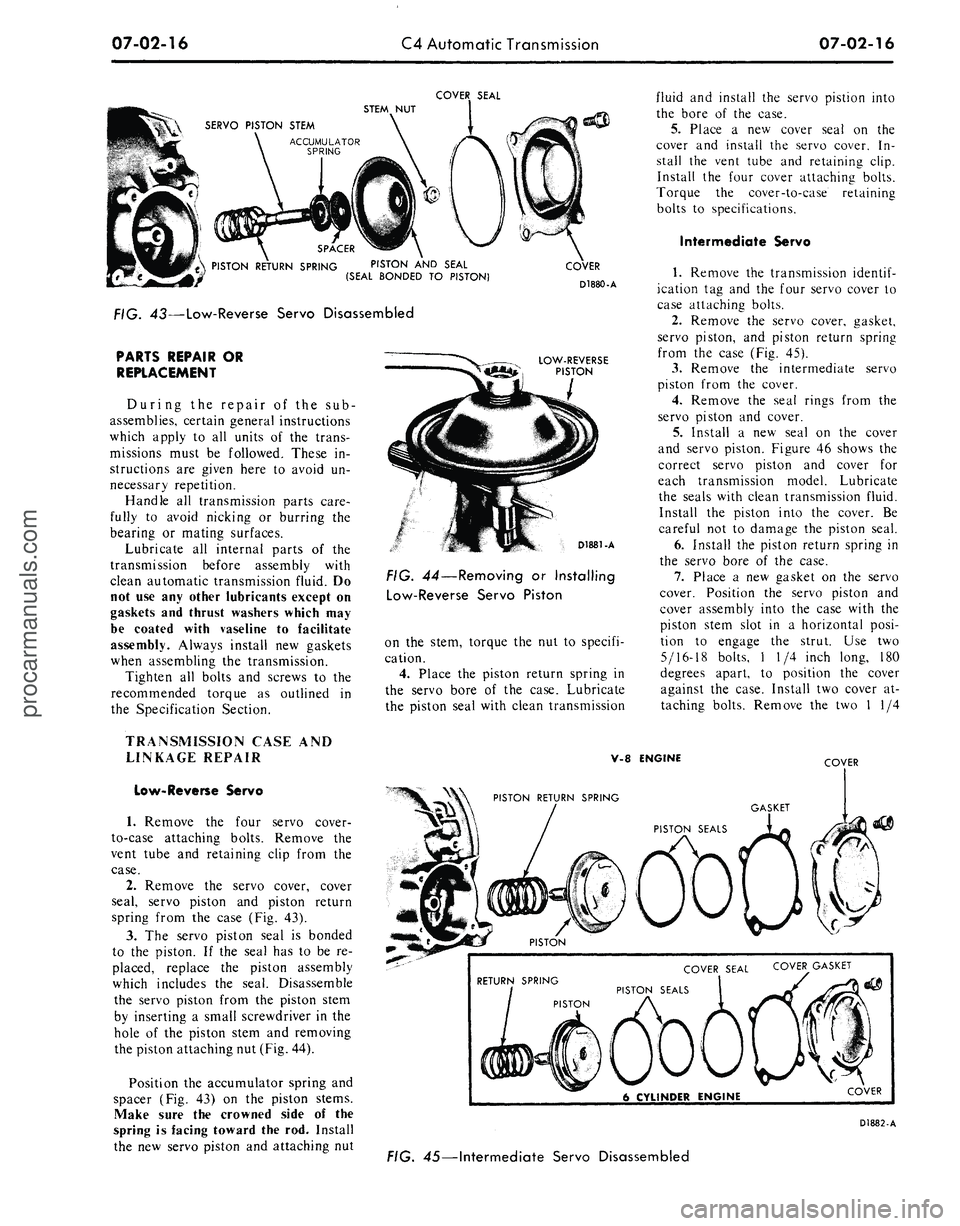
FIG. 43—Low-Reverse Servo Disassembled
PARTS REPAIR OR
REPLACEMENT
During the repair of the sub-
assemblies, certain general instructions
which apply to all units of the trans-
missions must be followed. These in-
structions are given here to avoid un-
necessary repetition.
Handle all transmission parts care-
fully to avoid nicking or burring the
bearing or mating surfaces.
Lubricate all internal parts of the
transmission before assembly with
clean automatic transmission fluid. Do
not use any other lubricants except on
gaskets and thrust washers which may
be coated with vaseline to facilitate
assembly. Always install new gaskets
when assembling the transmission.
Tighten all bolts and screws to the
recommended torque as outlined in
the Specification Section.
TRANSMISSION CASE AND
LINKAGE REPAIR
Low-Reverse Servo
1.
Remove the four servo cover-
to-case attaching bolts. Remove the
vent tube and retaining clip from the
case.
2.
Remove the servo cover, cover
seal, servo piston and piston return
spring from the case (Fig. 43).
3.
The servo piston seal is bonded
to the piston. If the seal has to be re-
placed, replace the piston assembly
which includes the seal. Disassemble
the servo piston from the piston stem
by inserting a small screwdriver in the
hole of the piston stem and removing
the piston attaching nut (Fig. 44).
Position the accumulator spring and
spacer (Fig. 43) on the piston stems.
Make sure the crowned side of the
spring is facing toward the rod. Install
the new servo piston and attaching nut
COVER
D1880-A
LOW-REVERSE
PISTON
D1881-A
FIG. 44—Removing or Installing
Low-Reverse Servo Piston
on the stem, torque the nut to specifi-
cation.
4.
Place the piston return spring in
the servo bore of the case. Lubricate
the piston seal with clean transmission
fluid and install the servo pistion into
the bore of the case.
5.
Place a new cover seal on the
cover and install the servo cover. In-
stall the vent tube and retaining clip.
Install the four cover attaching bolts.
Torque the cover-to-case retaining
bolts to specifications.
Intermediate Servo
1.
Remove the transmission
identif-
ication tag and the four servo cover to
case attaching bolts.
2.
Remove the servo cover, gasket,
servo piston, and piston return spring
from the case (Fig. 45).
3.
Remove the intermediate servo
piston from the cover.
4.
Remove the seal rings from the
servo piston and cover.
5.
Install a new seal on the cover
and servo piston. Figure 46 shows the
correct servo piston and cover for
each transmission model. Lubricate
the seals with clean transmission fluid.
Install the piston into the cover. Be
careful not to damage the piston seal.
6. Install the piston return spring in
the servo bore of the case.
7.
Place a new gasket on the servo
cover. Position the servo piston and
cover assembly into the case with the
piston stem slot in a horizontal posi-
tion to engage the strut. Use two
5/16-18 bolts, 1 1/4 inch long, 180
degrees apart, to position the cover
against the case. Install two cover at-
taching bolts. Remove the two 1 1/4
V-8 ENGINE
COVER
RETURN SPRING
PISTON
COVER SEAL COVER^ GASKET
PISTON SEALS
6 CYLINDER ENGINE
COVER
D1882-A
FIG. 45—Intermediate Servo Disassembledprocarmanuals.com
Page 327 of 413
07-02-19
C4 Automatic Transmission
07-02-19
Tool-T64P-7A128-A
OIL
SCREEN
LOWER
VALVE BODY
-,
-^L*«^M*if
GASKET
UPPER
VALVE BODY
D1891-A
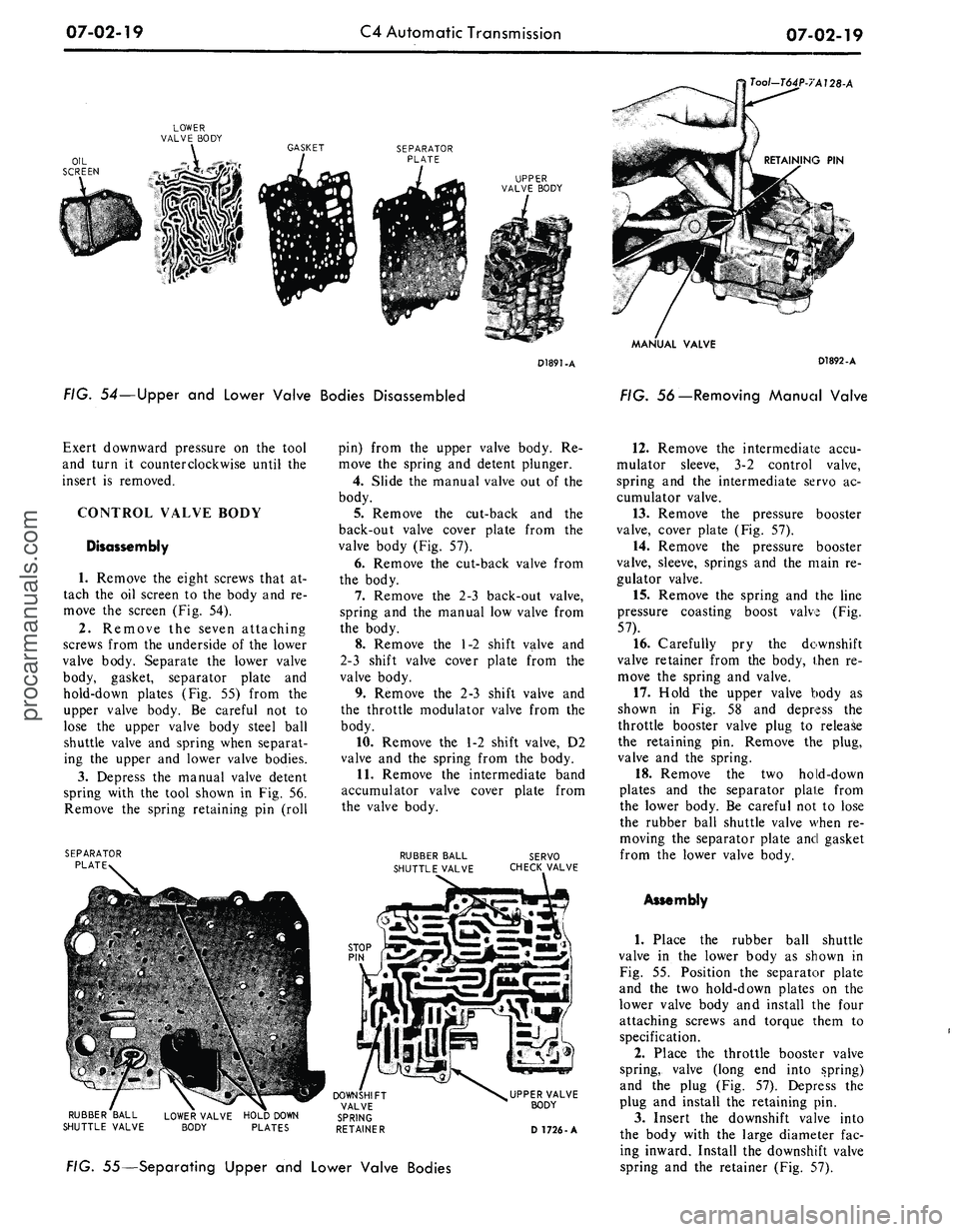
FIG. 54—Upper and Lower Valve Bodies Disassembled
MANUAL VALVE
D1892-A
FIG. 56—Removing Manual Valve
Exert downward pressure on the tool
and turn it counterclockwise until the
insert is removed.
CONTROL VALVE BODY
Disassembly
1.
Remove the eight screws that at-
tach the oil screen to the body and re-
move the screen (Fig. 54).
2.
Remove the seven attaching
screws from the underside of the lower
valve body. Separate the lower valve
body, gasket, separator plate and
hold-down plates (Fig. 55) from the
upper valve body. Be careful not to
lose the upper valve body steel ball
shuttle valve and spring when separat-
ing the upper and lower valve bodies.
3.
Depress the manual valve detent
spring with the tool shown in Fig. 56.
Remove the spring retaining pin (roll
SEPARATOR
PLATE
pin) from the upper valve body. Re-
move the spring and detent plunger.
4.
Slide the manual valve out of the
body.
5.
Remove the cut-back and the
back-out valve cover plate from the
valve body (Fig. 57).
6. Remove the cut-back valve from
the body.
7.
Remove the 2-3 back-out valve,
spring and the manual low valve from
the body.
8. Remove the 1-2 shift valve and
2-3 shift valve cover plate from the
valve body.
9. Remove the 2-3 shift valve and
the throttle modulator valve from the
body.
10.
Remove the 1-2 shift valve, D2
valve and the spring from the body.
11.
Remove the intermediate band
accumulator valve cover plate from
the valve body.
RUBBER BALL
SHUTTLE VALVE
SERVO
CHECK VALVE
RUBBER BALL
SHUTTLE VALVE
UPPER VALVE
BODY
D 1726-A
FIG. 55—Separating Upper and Lower Valve Bodies
12.
Remove the intermediate accu-
mulator sleeve, 3-2 control valve,
spring and the intermediate servo ac-
cumulator valve.
13.
Remove the pressure booster
valve, cover plate (Fig. 57).
14.
Remove the pressure booster
valve, sleeve, springs and the main re-
gulator valve.
15.
Remove the spring and the line
pressure coasting boost valve (Fig.
57).
16.
Carefully pry the downshift
valve retainer from the body, then re-
move the spring and valve.
17.
Hold the upper valve body as
shown in Fig. 58 and depress the
throttle booster valve plug to release
the retaining pin. Remove the plug,
valve and the spring.
18.
Remove the two hold-down
plates and the separator plate from
the lower body. Be careful not to lose
the rubber ball shuttle valve when re-
moving the separator plate and gasket
from the lower valve body.
Assembly
1.
Place the rubber ball shuttle
valve in the lower body as shown in
Fig. 55. Position the separator plate
and the two hold-down plates on the
lower valve body and install the four
attaching screws and torque them to
specification.
2.
Place the throttle booster valve
spring, valve (long end into spring)
and the plug (Fig. 57). Depress the
plug and install the retaining pin.
3.
Insert the downshift valve into
the body with the large diameter fac-
ing inward. Install the downshift valve
spring and the retainer (Fig. 57).procarmanuals.com
Page 329 of 413
07-02-21
C4 Automatic Transmission
07-02-21
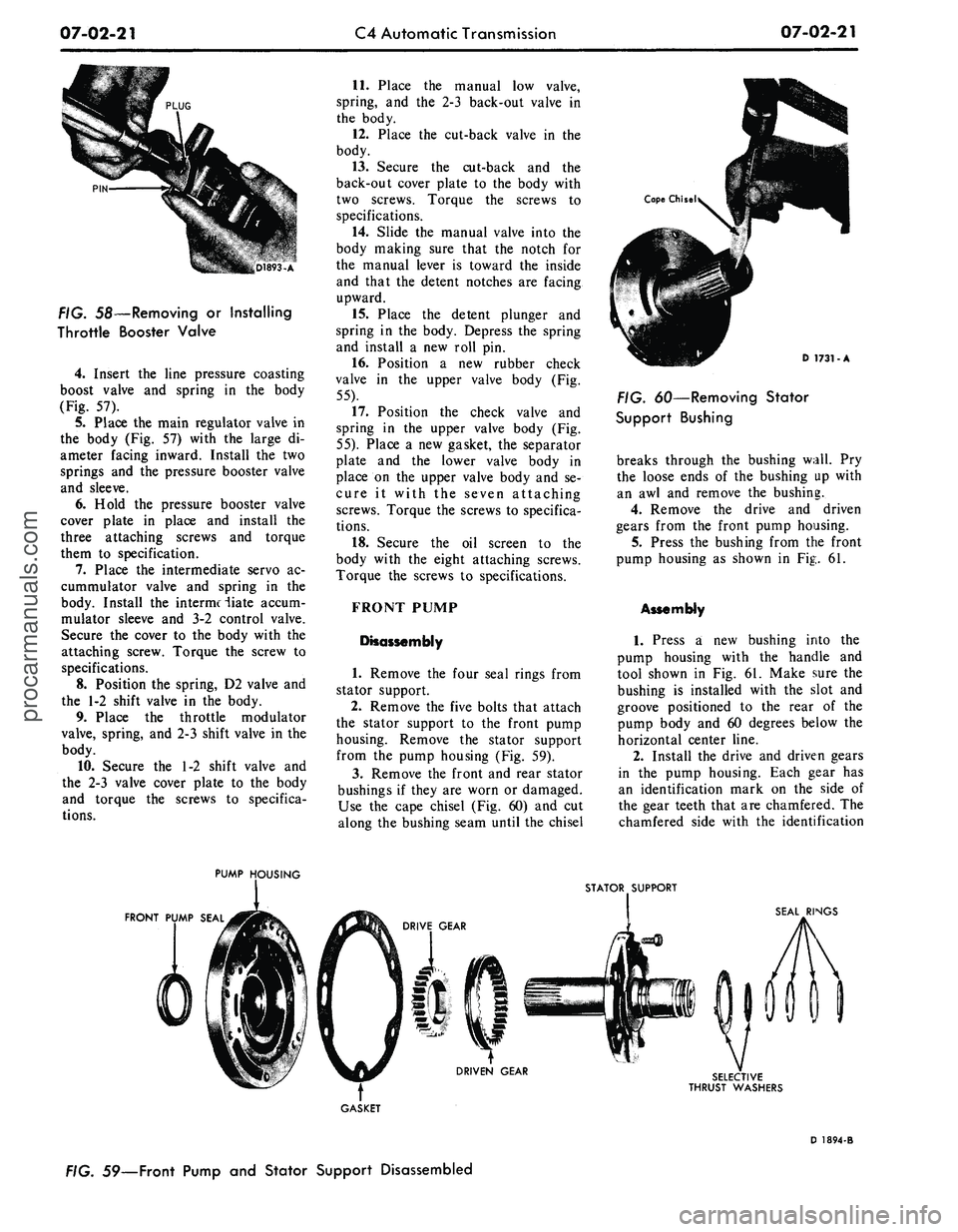
D1893-A
FIG. 58—Removing or Installing
Throttle Booster Valve
4.
Insert the line pressure coasting
boost valve and spring in the body
(Fig. 57).
5.
Place the main regulator valve in
the body (Fig. 57) with the large di-
ameter facing inward. Install the two
springs and the pressure booster valve
and sleeve.
6. Hold the pressure booster valve
cover plate in place and install the
three attaching screws and torque
them to specification.
7.
Place the intermediate servo ac-
cummulator valve and spring in the
body. Install the interim iiate accum-
mulator sleeve and 3-2 control valve.
Secure the cover to the body with the
attaching screw. Torque the screw to
specifications.
8. Position the spring, D2 valve and
the I-2 shift valve in the body.
9. Place the throttle modulator
valve, spring, and 2-3 shift valve in the
body.
10.
Secure the 1-2 shift valve and
the 2-3 valve cover plate to the body
and torque the screws to specifica-
tions.
11.
Place the manual low valve,
spring, and the 2-3 back-out valve in
the body.
12.
Place the cut-back valve in the
body.
13.
Secure the cut-back and the
back-out cover plate to the body with
two screws. Torque the screws to
specifications.
14.
Slide the manual valve into the
body making sure that the notch for
the manual lever is toward the inside
and that the detent notches are facing
upward.
15.
Place the detent plunger and
spring in the body. Depress the spring
and install a new roll pin.
16.
Position a new rubber check
valve in the upper valve body (Fig.
55).
17.
Position the check valve and
spring in the upper valve body (Fig.
55).
Place a new gasket, the separator
plate and the lower valve body in
place on the upper valve body and se-
cure it with the seven attaching
screws. Torque the screws to specifica-
tions.
18.
Secure the oil screen to the
body with the eight attaching screws.
Torque the screws to specifications.
FRONT PUMP
Disassembly
1.
Remove the four seal rings from
stator support.
2.
Remove the five bolts that attach
the stator support to the front pump
housing. Remove the stator support
from the pump housing (Fig. 59).
3.
Remove the front and rear stator
bushings if they are worn or damaged.
Use the cape chisel (Fig. 60) and cut
along the bushing seam until the chisel
D 1731-A
FIG. 60—Removing Stator
Support Bushing
breaks through the bushing wall. Pry
the loose ends of the bushing up with
an awl and remove the bushing.
4.
Remove the drive and driven
gears from the front pump housing.
5.
Press the bushing from the front
pump housing as shown in Fig. 61.
Assembly
1.
Press a new bushing into the
pump housing with the handle and
tool shown in Fig. 61. Make sure the
bushing is installed with the slot and
groove positioned to the rear of the
pump body and 60 degrees below the
horizontal center line.
2.
Install the drive and driven gears
in the pump housing. Each gear has
an identification mark on the side of
the gear teeth that are chamfered. The
chamfered side with the identification
PUMP HOUSING
STATOR SUPPORT
FRONT PUMP SEAL
SEAL RINGS
SELECTIVE
THRUST WASHERS
GASKET
D 1894-B
59—Front Pump and Stator Support Disassembledprocarmanuals.com