power steering FORD MUSTANG 1969 Volume One Chassis
[x] Cancel search | Manufacturer: FORD, Model Year: 1969, Model line: MUSTANG, Model: FORD MUSTANG 1969Pages: 413, PDF Size: 75.81 MB
Page 169 of 413
03-11-01
Eaton Power Steering Pump
03-11-01
PART 3-11 Eaton Power Steering Pump
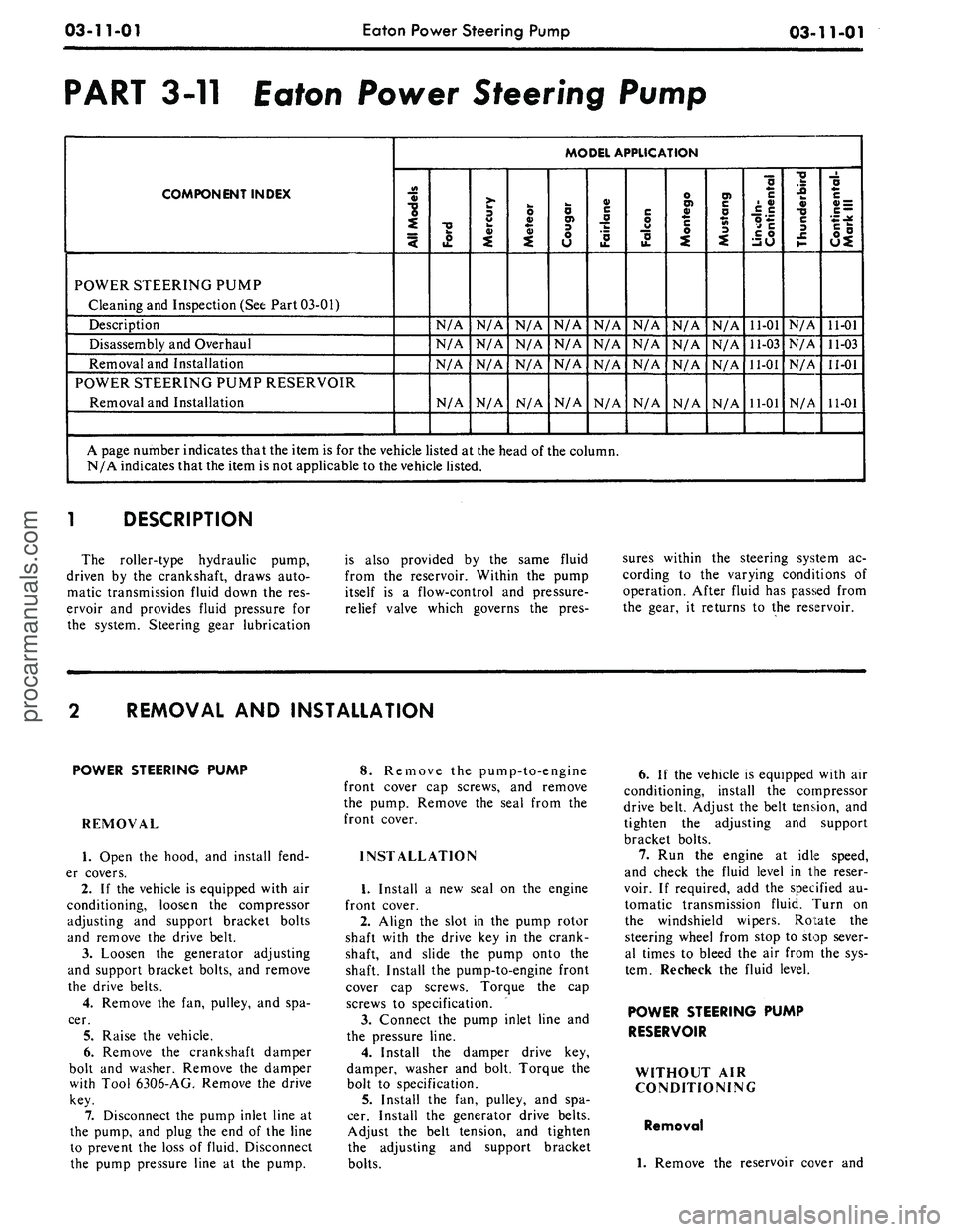
COMPONENT INDEX
MODEL APPLICATION
3
§>
"o
4
POWER STEERING PUMP
Cleaning and Inspection (See Part 03-01)
Description
N/A
N/A
N/A
N/A
N/A
N/A
N/A
N/A
11-01
N/A
11-01
Disassembly and Overhaul
N/A
N/A
N/A
N/A
N/A
N/A
N/A
N/A
11-03
N/A
11-03
Removal and Installation
N/A
N/A
N/A
N/A
N/A
N/A
N/A
N/A
11-01
N/A
11-01
POWER STEERING PUMP RESERVOIR
Removal and Installation
N/A
N/A
N/A
N/A
N/A
N/A
N/A
N/A
11-01
N/A
11-01
A page number indicates that the item is for the vehicle listed at the head of the column.
N/A indicates that the item is not applicable to the vehicle listed.
l
DESCRIPTION
The roller-type hydraulic pump,
driven by the crankshaft, draws auto-
matic transmission fluid down the res-
ervoir and provides fluid pressure for
the system. Steering gear lubrication
is also provided by the same fluid
from the reservoir. Within the pump
itself is a flow-control and pressure-
relief valve which governs the pres-
sures within the steering system ac-
cording to the varying conditions of
operation. After fluid has passed from
the gear, it returns to the reservoir.
REMOVAL AND INSTALLATION
POWER STEERING PUMP
REMOVAL
1.
Open the hood, and install fend-
er covers.
2.
If the vehicle is equipped with air
conditioning, loosen the compressor
adjusting and support bracket bolts
and remove the drive belt.
3.
Loosen the generator adjusting
and support bracket bolts, and remove
the drive belts.
4.
Remove the fan, pulley, and spa-
cer.
5.
Raise the vehicle.
6. Remove the crankshaft damper
bolt and washer. Remove the damper
with Tool 6306-AG. Remove the drive
key.
7.
Disconnect the pump inlet line at
the pump, and plug the end of the line
to prevent the loss of fluid. Disconnect
the pump pressure line at the pump.
8. Remove the pump-to-engine
front cover cap screws, and remove
the pump. Remove the seal from the
front cover.
INSTALLATION
1.
Install a new seal on the engine
front cover.
2.
Align the slot in the pump rotor
shaft with the drive key in the crank-
shaft, and slide the pump onto the
shaft. Install the pump-to-engine front
cover cap screws. Torque the cap
screws to specification.
3.
Connect the pump inlet line and
the pressure line.
4.
Install the damper drive key,
damper, washer and bolt. Torque the
bolt to specification.
5.
Install the fan, pulley, and spa-
cer. Install the generator drive belts.
Adjust the belt tension, and tighten
the adjusting and support bracket
bolts.
6. If the vehicle is equipped with air
conditioning, install the compressor
drive belt. Adjust the belt tension, and
tighten the adjusting and support
bracket bolts.
7.
Run the engine at idle speed,
and check the fluid level in the reser-
voir. If required, add the specified au-
tomatic transmission fluid. Turn on
the windshield wipers. Rotate the
steering wheel from stop to stop sever-
al times to bleed the air from the sys-
tem. Recheck the fluid level.
POWER STEERING PUMP
RESERVOIR
WITHOUT AIR
CONDITIONING
Removal
1.
Remove the reservoir cover andprocarmanuals.com
Page 170 of 413
03-11-02
Eaton Power Steering Pump
03-11-02
gasket. Withdraw the fluid with a suc-
tion gun.
2.
Remove the reservoir bracket-
to-cylinder block upper cap screw and
the lower cap screw and spacer.
3.
Disconnect the reservoir infet line
and the outlet line at the reservoir,
and remove the reservoir.
Installation
1.
Connect the reservoir-to-pump
line (outlet line) at the reservoir, but
do not tighten the clamp.
2.
Attach the reservoir and bracket
to the cylinder block with the upper
cap screw and the lower cap screw
and spacer. Tighten the cap screws.
3.
Tighten the outlet line clamp at
the reservoir. Connect the reservoir
inlet line to the reservoir.
4.
Fill the reservoir with the speci-
fied automatic transmission fluid. Run
the engine, and bleed the system by
cycling the steering gear with the
windshield wipers turned on. Check
for leaks, and recheck the fluid level.
WITH AIR CONDITIONING
Removal
1. Raise the front of the vehicle.
Remove the reservoir-to-pump line
(outlet line) clamp at the reservoir,
but do not disconnect the line at this
time.
2.
Disconnect the reservoir inlet line
at the reservoir.
3.
Remove the reservoir bracket to
the cylinder block upper cap screw.
Support the reservoir and remove the
lower cap screw and spacer.
4.
With a drain pan under the res-
ervoir, disconnect the outlet line hose
from the reservoir tube and allow the
fluid to drain.
5.
Remove the reservoir cover re-
taining nut and the cover. Position the
cover and the reservoir out of the way
and allow them to rest in the engine
compartment.
6. Lower the front of the vehicle.
Remove the fan shroud.
7.
Remove the reservoir and the
cover by manipulating them through
the opening between the radiator and
the compressor drive belt.
Installation
1.
Position the reservoir in the en-
gine compartment. Loosely attach the
reservoir and bracket to the cylinder
block with the upper cap screw.
2.
Install the fan shroud, then raise
the front of the vehicle.
3.
Connect the reservoir-to-pump
line (outlet line) at the reservoir.
4.
Install the reservoir bracket-
to-cylinder block lower cap screw and
spacer. Tighten both the upper and
the lower cap screws.
5.
Connect the reservoir inlet line at
the reservoir. Install the clamps on
both lines. Lower the car, and install
the reservoir cover and attaching nut.
6. Fill the reservoir with the speci-
fied automatic transmission fluid. Run
the engine, and bleed the system by
cycling the steering gear with the
windshield wipers turned on. Check
for leaks, and recheck the fluid level.
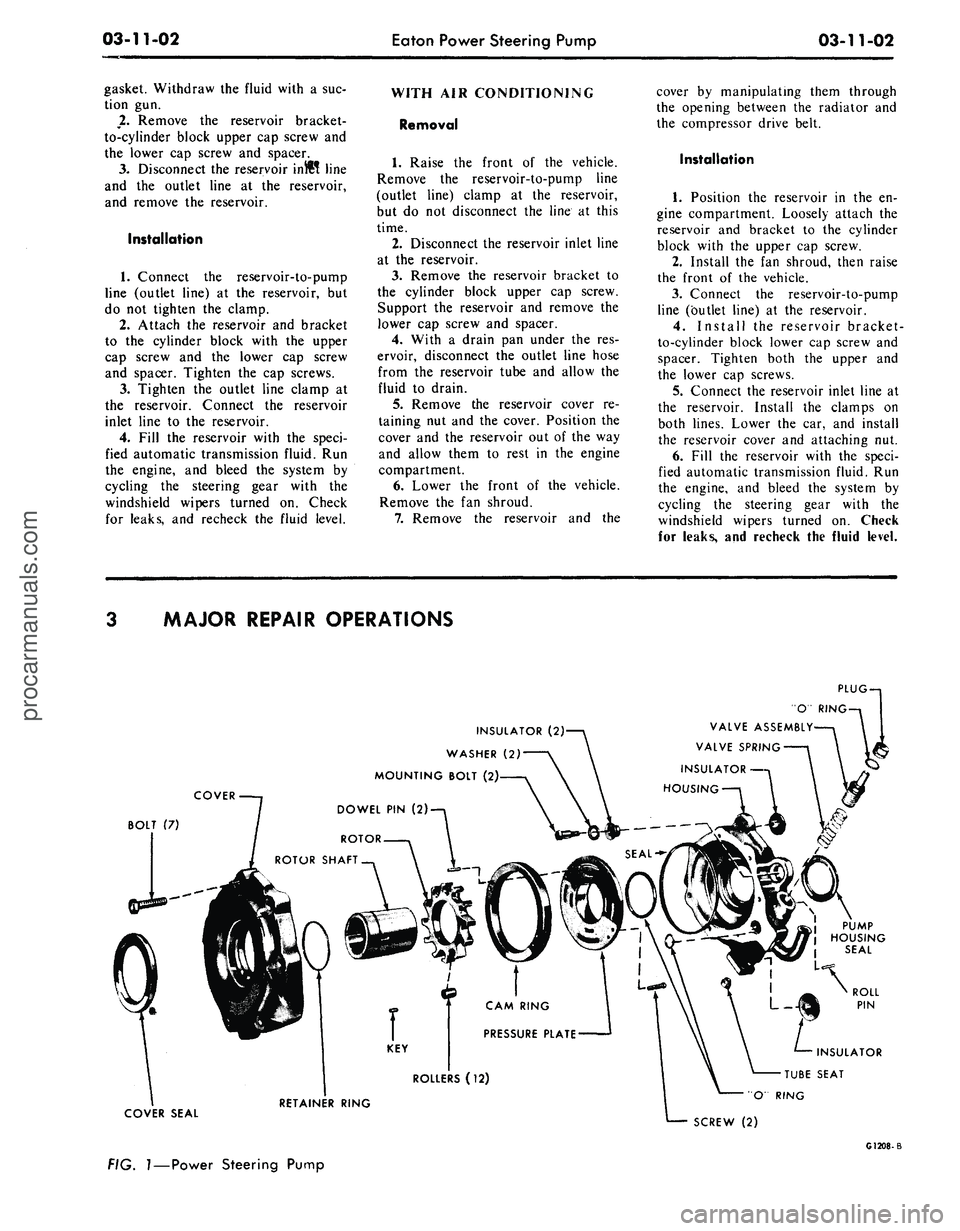
3 MAJOR REPAIR OPERATIONS
INSULATOR (2)
WASHER (2)
MOUNTING BOLT (2)
COVER
BOLT (7)
DOWEL
PIN (2)
ROTOR
ROTOR
SHAFT
COVER
SEAL
PLUG
O RING
VALVE
ASSEMBLY
VALVE
SPRING
INSULATOR
HOUSING
CAM RING
PRESSURE
PLATE
,
PUMP
i
HOUSING
SEAL
ROLL
PIN
INSULATOR
RETAINER
RING
TUBE SEAT
O RING
SCREW
(2)
G12O8-B
FIG.
1
— Power Steering Pumpprocarmanuals.com
Page 171 of 413
03-11-03
Eaton Power Steering Pump
03-11-03
POWER STEERING PUMP
DISASSEMBLY
A clean working area should be
used when overhauling the power
steering pump. Foreign matter picked
up on working parts may cause dam-
age or failure of the unit. Clean con-
tainers should be used for parts.
1.
Drain the fluid from the pump.
Remove the pump cover-to-housing
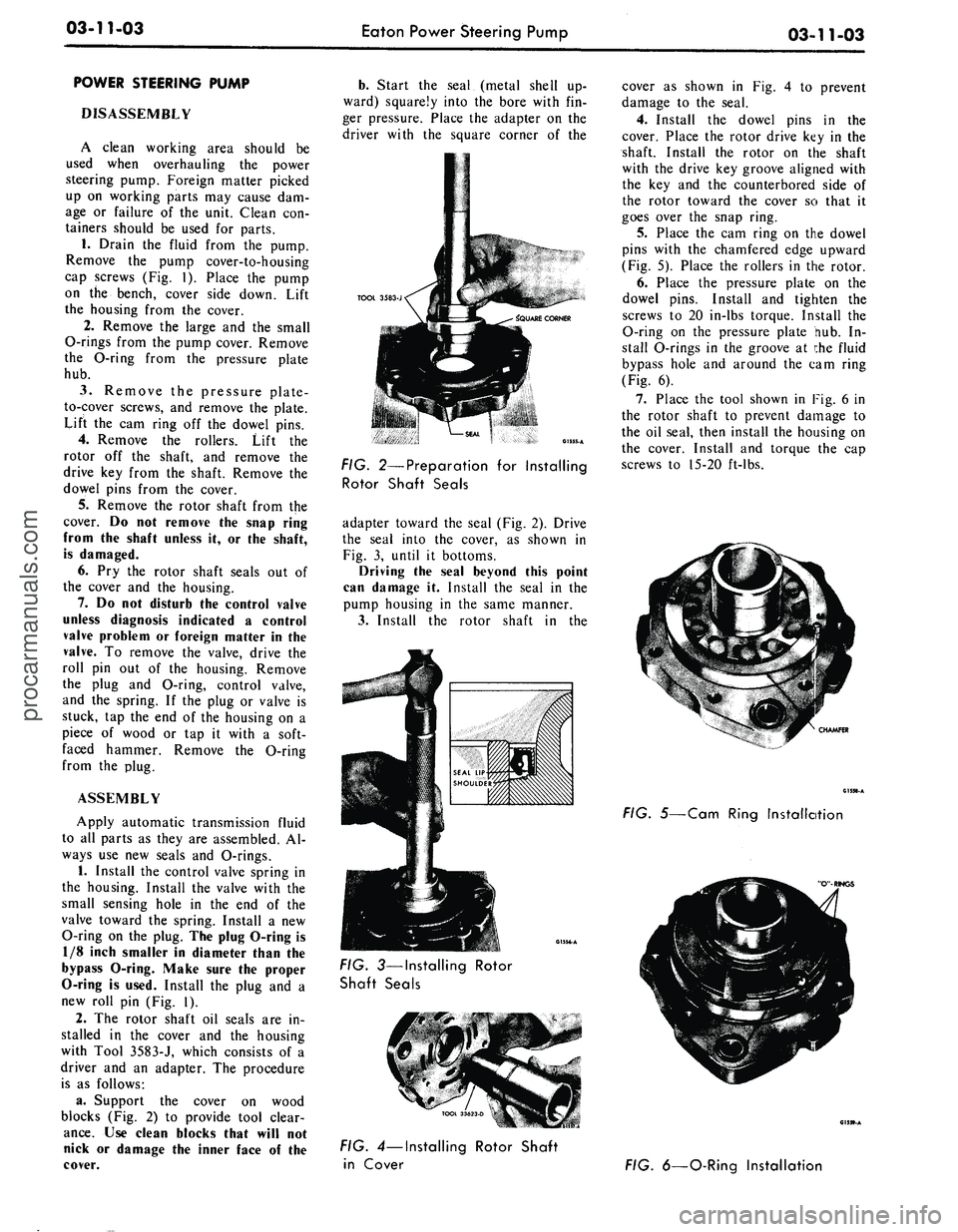
cap screws (Fig. 1). Place the pump
on the bench, cover side down. Lift
the housing from the cover.
2.
Remove the large and the small
O-rings from the pump cover. Remove
the O-ring from the pressure plate
hub.
3.
Remove the pressure plate-
to-cover screws, and remove the plate.
Lift the cam ring off the dowel pins.
4.
Remove the rollers. Lift the
rotor off the shaft, and remove the
drive key from the shaft. Remove the
dowel pins from the cover.
5.
Remove the rotor shaft from the
cover. Do not remove the snap ring
from the shaft unless it, or the shaft,
is damaged.
6. Pry the rotor shaft seals out of
the cover and the housing.
7. Do not disturb the control valve
unless diagnosis indicated a control
valve problem or foreign matter in the
valve. To remove the valve, drive the
roll pin out of the housing. Remove
the plug and O-ring, control valve,
and the spring. If the plug or valve is
stuck, tap the end of the housing on a
piece of wood or tap it with a soft-
faced hammer. Remove the O-ring
from the plug.
ASSEMBLY
Apply automatic transmission fluid
to all parts as they are assembled. Al-
ways use new seals and O-rings.
1.
Install the control valve spring in
the housing. Install the valve with the
small sensing hole in the end of the
valve toward the spring. Install a new
O-ring on the plug. The plug O-ring is
1/8 inch smaller in diameter than the
bypass O-ring. Make sure the proper
O-ring is used. Install the plug and a
new roll pin (Fig. 1).
2.
The rotor shaft oil seals are in-
stalled in the cover and the housing
with Tool 3583-J, which consists of a
driver and an adapter. The procedure
is as follows:
a. Support the cover on wood
blocks (Fig. 2) to provide tool clear-
ance.
Use clean blocks that will not
nick or damage the inner face of the
cover.
b.
Start the seal (metal shell up-
ward) square!y into the bore with fin-
ger pressure. Place the adapter on the
driver with the square corner of the
FIG. 2—Preparation for Installing
Rotor Shaft Seals
adapter toward the seal (Fig. 2). Drive
the seal into the cover, as shown in
Fig. 3, until it bottoms.
Driving the seal beyond this point
can damage it. Install the seal in the
pump housing in the same manner.
3.
Install the rotor shaft in the
FIG. 3—Installing Rotor
Shaft Seals
cover as shown in Fig. 4 to prevent
damage to the seal.
4.
Install the dowel pins in the
cover. Place the rotor drive key in the
shaft. Install the rotor on the shaft
with the drive key groove aligned with
the key and the counterbored side of
the rotor toward the cover so that it
goes over the snap ring.
5.
Place the cam ring on the dowel
pins with the chamfered edge upward
(Fig. 5). Place the rollers in the rotor.
6. Place the pressure plate on the
dowel pins. Install and tighten the
screws to 20 in-lbs torque. Install the
O-ring on the pressure plate hub. In-
stall O-rings in the groove at the fluid
bypass hole and around the cam ring
(Fig. 6).
7.
Place the tool shown in Fig. 6 in
the rotor shaft to prevent damage to
the oil seal, then install the housing on
the cover. Install and torque the cap
screws to 15-20 ft-lbs.
FIG. 5—Cam Ring Installation
FIG. 4—Installing Rotor Shaft
in Cover
FIG. 6—O-Ring Installationprocarmanuals.com
Page 173 of 413
03-12-02
Wheels
And
Tires
03-12-02
LIFE GUARD TIRE
The Goodyear Power Cushion Tire
(available
on
Thunderbird, Lincoln
and Continental Mark
III
models)
fit-
ted with
the
Life Guard Safety Spare
provides
a
tire within
a
tire with
two
separate
air
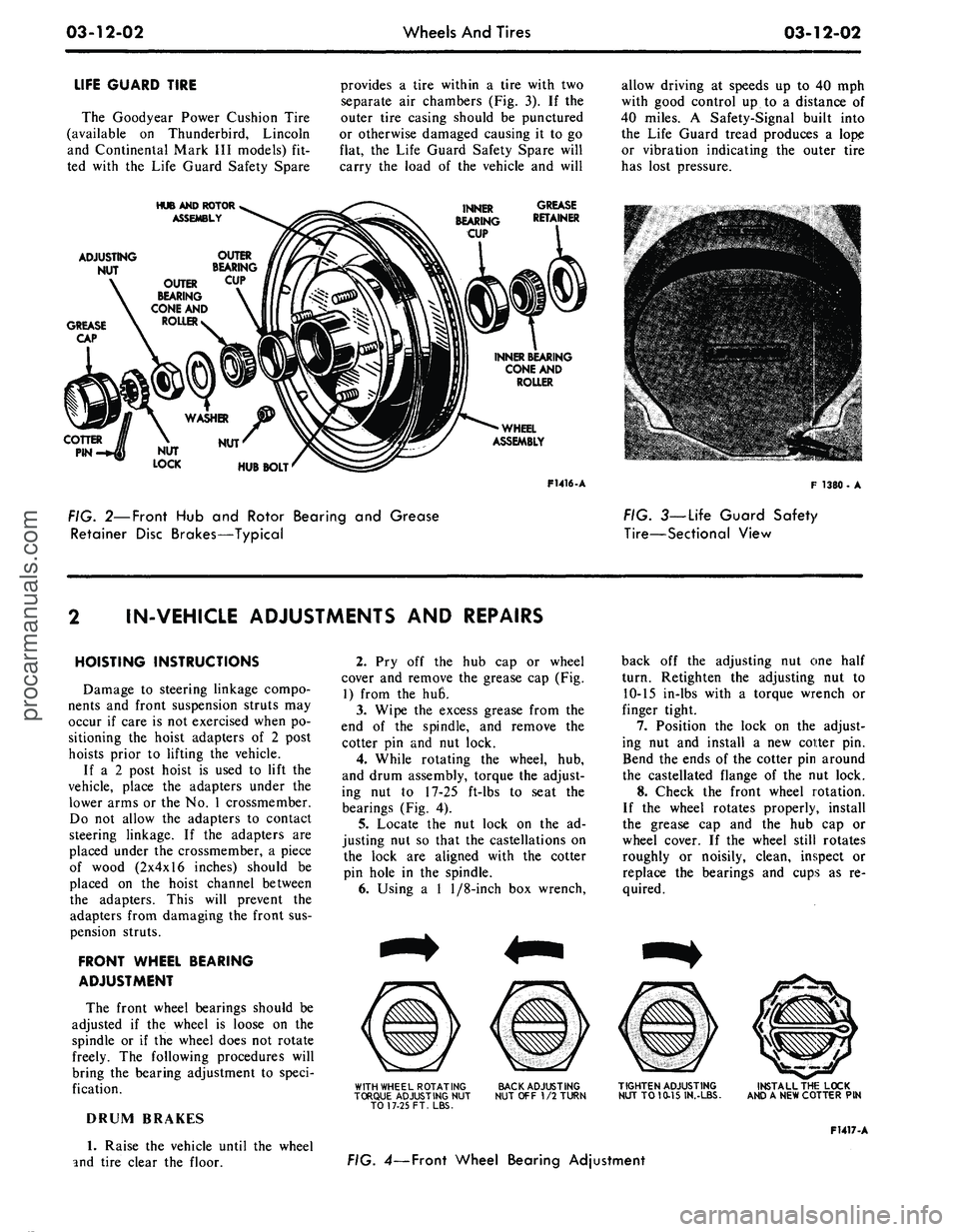
chambers
(Fig.
3). If the
outer tire casing should
be
punctured
or otherwise damaged causing
it to go
flat,
the
Life Guard Safety Spare will
carry
the
load
of the
vehicle
and
will
allow driving
at
speeds
up to 40 mph
with good control
up to a
distance
of
40 miles.
A
Safety-Signal built into
the Life Guard tread produces
a
lope
or vibration indicating
the
outer tire
has lost pressure.
HUB AND ROTOR
ASSEMBLY
INNER
BEARING
CUP
GREASE
RETAINER
ADJUSTING
NUT
OUTER
BEARING
CONE
AND
ROLLER
INNER BEARING
CONE
AND
ROLLER
WHEEL
ASSEMBLY
F1416-A
F- 1380 •
A
FIG. 2—Front
Hub and
Rotor Bearing
and
Grease
Retainer Disc Brakes—Typical
FIG. 3—Life Guard Safety
Tire—Sectional View
IN-VEHICLE ADJUSTMENTS AND REPAIRS
HOISTING INSTRUCTIONS
Damage
to
steering linkage compo-
nents
and
front suspension struts
may
occur
if
care
is
not
exercised when
po-
sitioning
the
hoist adapters
of 2
post
hoists prior
to
lifting
the
vehicle.
If
a 2
post hoist
is
used
to
lift
the
vehicle, place
the
adapters under
the
lower arms
or
the No. 1
crossmember.
Do
not
allow
the
adapters
to
contact
steering linkage.
If the
adapters
are
placed under
the
crossmember,
a
piece
of wood (2x4x16 inches) should
be
placed
on the
hoist channel between
the adapters. This will prevent
the
adapters from damaging
the
front
sus-
pension struts.
FRONT WHEEL BEARING
ADJUSTMENT
The front wheel bearings should
be
adjusted
if the
wheel
is
loose
on the
spindle
or if the
wheel does
not
rotate
freely.
The
following procedures will
bring
the
bearing adjustment
to
speci-
fication.
DRUM BRAKES
1.
Raise
the
vehicle until
the
wheel
and tire clear
the
floor.
2.
Pry off the hub cap or
wheel
cover
and
remove
the
grease
cap (Fig.
1) from
the hu6.
3.
Wipe
the
excess grease from
the
end
of the
spindle,
and
remove
the
cotter
pin and nut
lock.
4.
While rotating
the
wheel,
hub,
and drum assembly, torque
the
adjust-
ing
nut to 17-25
ft-lbs
to
seat
the
bearings
(Fig.
4).
5.
Locate
the nut
lock
on the ad-
justing
nut so
that
the
castellations
on
the lock
are
aligned with
the
cotter
pin hole
in the
spindle.
6. Using
a 1
1/8-inch
box
wrench,
WITH WHEEL ROTATING
TORQUE ADJUSTING
NUT
TO 17-25 FT. LBS.
BACK ADJUSTING
NUT
OFF
1/2
TURN
back
off the
adjusting
nut one
half
turn. Retighten
the
adjusting
nut to
10-15 in-lbs with
a
torque wrench
or
finger tight.
7.
Position
the
lock
on the
adjust-
ing
nut and
install
a new
cotter
pin.
Bend
the
ends
of
the
cotter
pin
around
the castellated flange
of the nut
lock.
8. Check
the
front wheel rotation.
If
the
wheel rotates properly, install
the grease
cap and the hub cap or
wheel cover.
If the
wheel still rotates
roughly
or
noisily, clean, inspect
or
replace
the
bearings
and
cups
as re-
quired.
TIGHTEN ADJUSTING
NUT
TO
10-15 IN.-LBS.
INSTALL THE LOCK
AND
A
NEW COTTER
PIN
F1417-A
FIG. 4— Front Wheel Bearing Adjustmentprocarmanuals.com
Page 180 of 413
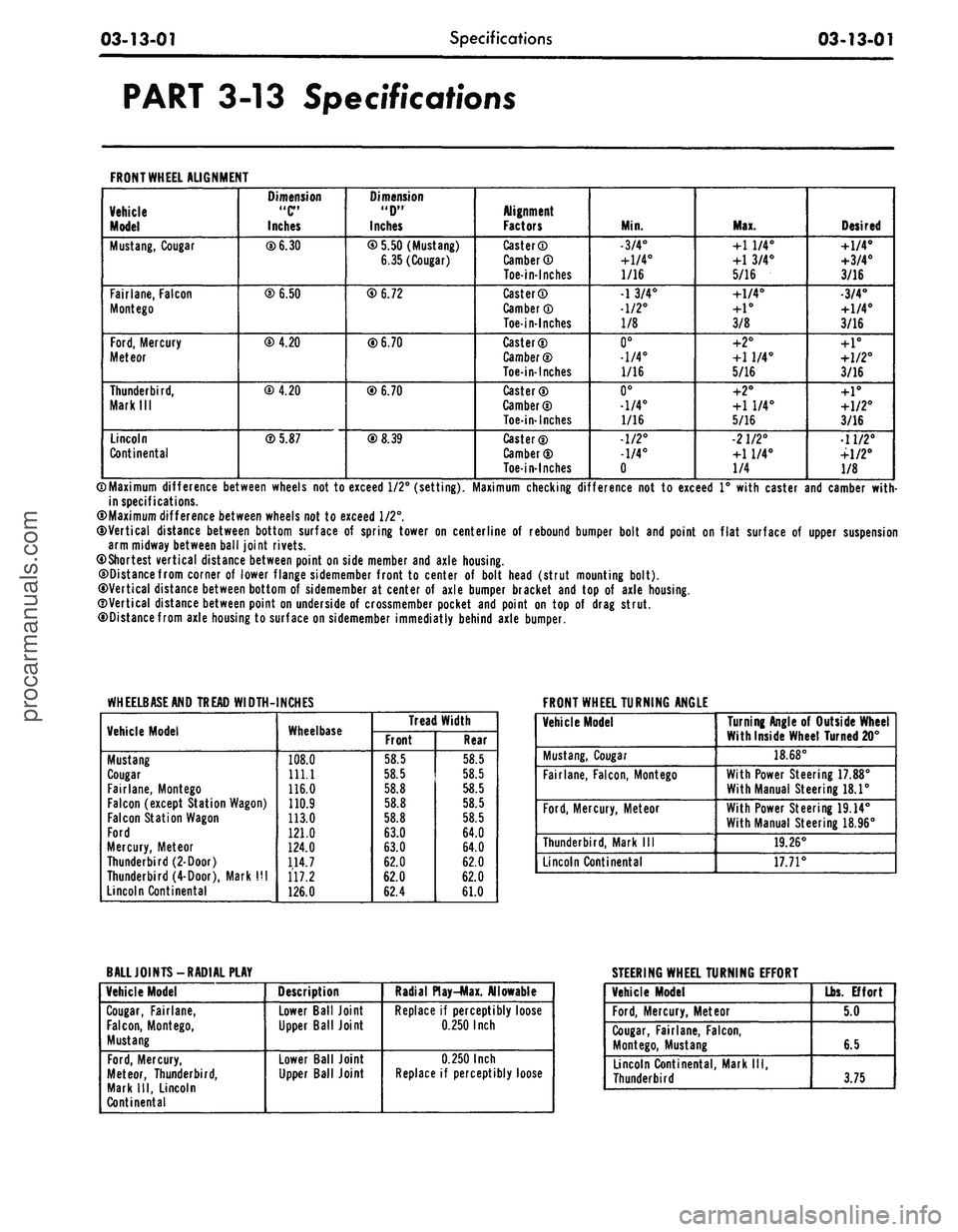
03-13-01
Specifications
03-13-01
PART 3-13 Specifications
FRONT
WHEEL
ALIGNMENT
Vehicle
Model
Mustang,
Cougar
Fairlane, Falcon
Mont
ego
Ford,
Mercury
Meteor
Thunderbird,
Mark III
Lincoln
Continental
Dimension
"C"
Inches
(I) 6.30
® 6.50
©4.20
® 4.20
©5.87
Dimension
"D"
Inches
©5.50 (Mustang)
6.35 (Cougar)
©6.72
©6.70
©6.70
©8.39
Alignment
Factors
Caster©
Camber©
Toe-in-Inches
Caster©
Camber©
Toe-in-Inches
Caster©
Camber©
Toe-in-Inches
Caster©
Camber®
Toe-in-Inches
Caster®
Camber®
Toe-in-Inches
Min.
-3/4°
+1/4°
1/16
-1
3/4°
•1/2°
1/8
0°
•1/4°
1/16
0°
•1/4°
1/16
-1/2°
•1/4°
0
Max.
+1 1/4°
+1 3/4°
5/16
+1/4°
+1°
3/8
+2°
+11/4°
5/16
+2°
+1 1/4°
5/16
-2
1/2°
+11/4°
1/4
Desired
+1/4°
+3/4°
3/16
•3/4°
+1/4°
3/16
+1°
+1/2°
3/16
+1°
+1/2°
3/16
•11/2°
+1/2°
1/8
©Maximum difference between wheels not to exceed 1/2° (setting). Maximum checking difference not to exceed 1° with caster and camber
with-
in specifications.
©Maximum difference between wheels not to exceed 1/2°.
©Vertical distance between bottom surface of spring tower on centerline of rebound bumper bolt and point on flat surface of upper suspension
arm midway between ball joint rivets.
©Shortest vertical distance between point on side member and axle housing.
©Distance from corner of lower flange sidemember front to center of bolt head (strut mounting bolt).
©Vertical distance between bottom of sidemember at center of axle bumper bracket and top of axle housing.
©Vertical distance between point on underside of crossmember pocket and point on top of drag strut.
©Distance from axle housing to surface on sidemember immediatly behind axle bumper.
WHEELBASEAND TREAD WIDTH-INCHES
FRONT WHEEL TURNING ANGLE
Vehicle Model
Mustang
Cougar
Fairlane, Montego
Falcon (except Station Wagon)
Falcon Station Wagon
Ford
Mercury, Meteor
Thunderbird (2-Door)
Thunderbird (4-Door), Mark HI
Lincoln Continental
Wheelbase
108.0
111.1
116.0
110.9
113.0
121.0
124.0
114.7
117.2
126.0
Tread
Front
58.5
58.5
58.8
58.8
58.8
63.0
63.0
62.0
62.0
62.4
Width
Rear
58.5
58.5
5«.5
58.5
58.5
64.0
64.0
62.0
62.0
61.0
Vehicle Model
Mustang,
Cougar
Fairlane, Falcon, Montego
Ford,
Mercury, Meteor
Thunderbird, Mark III
Lincoln Continental
Turning Angle of Outside Wheel
With Inside Wheel Turned 20°
18.68°
With Power Steering 17.88°
With Manual Steering 18.1°
With Power Steering 19.14°
With Manual Steering 18.96°
19.26°
17.71°
BALL JOINTS -RADIAL PLAY
STEERING WHEEL TURNING EFFORT
Vehicle Model
Cougar, Fairlane,
Falcon,
Montego,
Mustang
Ford,
Mercury,
Meteor, Thunderbird,
Mark III, Lincoln
Continental
Description
Lower Ball Joint
Upper Ball Joint
Lower Ball Joint
Upper Ball Joint
Radial Play-Max. Allowable
Replace if perceptibly loose
0.250
Inch
0.250
Inch
Replace if perceptibly loose
Vehicle Model
Ford,
Mercury, Meteor
Cougar, Fairlane, Falcon,
Montego, Mustang
Lincoln Continental, Mark III,
Thunderbird
Lbs.
Effort
5.0
6.5
3.75procarmanuals.com
Page 181 of 413
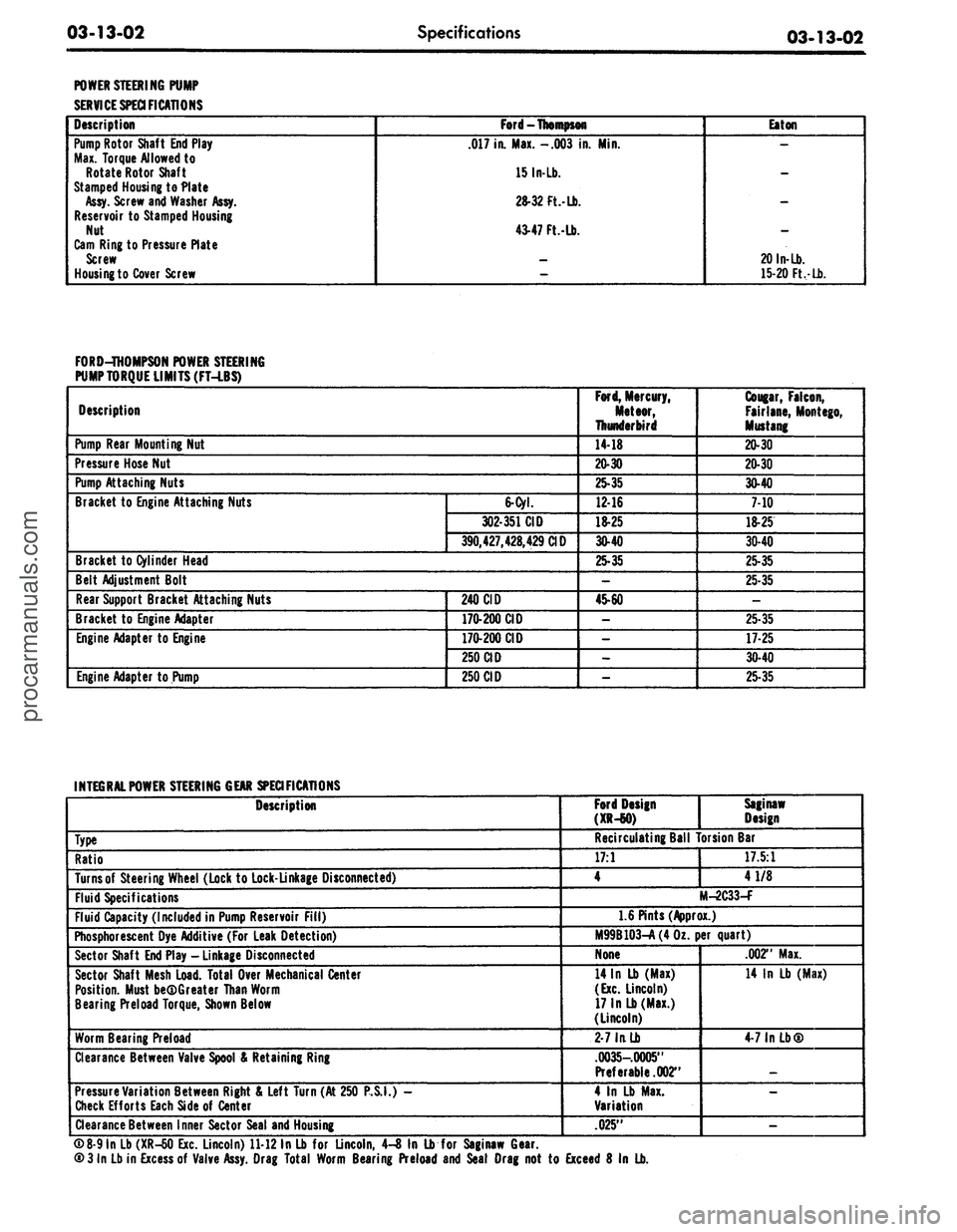
03-13-02
Specifications
03-13-02
POWER STEERING PUMP
SERVICE
SPECIFICATIONS
Description
Pump Rotor Shaft End Play
Max. Torque Allowed
to
Rotate Rotor Shaft
Stamped Housing to Plate
Assy. Screw and Washer Assy.
Reservoir
to
Stamped Housing
Nut
Cam Ring to Pressure Plate
Screw
Housing to Cover Screw
Ford-Thompson
.017 in. Max.-.003 in. Min.
15 In-Lb.
28-32 Ft.-Lb.
43-47 Ft.-Lb.
_
-
Eaton
—
_
-
—
20 In-Lb.
15-20 Ft,-Lb.
FORD-THOMPSON POWER STEERING
PUMP
TORQUE
LIMITS (FT-LBS)
Description
Pump Rear Mounting Nut
Pressure Hose Nut
Pump Attaching Nuts
Bracket
to
Engine Attaching Nuts
6-Cyl.
302-351 CID
390,427,428,429 CID
Bracket
to
Cylinder Head
Belt Adjustment Bolt
Rear Support Bracket Attaching Nuts
Bracket
to
Engine Adapter
Engine Adapter
to
Engine
Engine Adapter
to
Pump
240 CID
170-200 CID
170-200 CID
250 CID
250 CID
Ford,
Mercury,
Meteor,
Thunderbird
14-18
20-30
25-35
1216
18-25
30-40
25-35
-
45-60
-
-
-
-
Cougar, Falcon,
Fairlane, Montego,
Mustang
20-30
20-30
30-40
7-10
18-25
30-40
25-35
25-35
-
25-35
17-25
30-40
25-35
INTEGRAL
POWER
STEERING GEAR SPECIFICATIONS
Description
Type
Ratio
Turns of Steering Wheel (Lock
to
Lock-Linkage Disconnected)
Fluid Specifications
Fluid Capacity (Included in Pump Reservoir Fill)
Phosphorescent Dye Additive (For Leak Detection)
Sector Shaft End Play -Linkage Disconnected
Sector Shaft Mesh Load. Total Over Mechanical Center
Position.
Must beCDGreater Than Worm
Bearing Preload Torque, Shown Below
Worm Bearing Preload
Clearance Between Valve Spool
&
Retaining Ring
Pressure Variation Between Right
&
Left Turn (At 250
P.S.I.)
-
Check Efforts Each Side
of
Center
Clearance Between Inner Sector Seal and Housing
Ford Design
(XR-«0)
Saginaw
Design
Recirculating Ball Torsion Bar
17:1
4
17.5:1
41/8
M-2C33-F
1.6 Pints (Approx.)
M99B103-A(4 0z. per quart)
None
14 In Lb (Max)
(Exc. Lincoln)
17
In
Lb (Max.)
(Lincoln)
2-7 la
U)
.0035-.0005"
Preferable .002"
4
In
Lb Max.
Variation
.025"
.002"
Max.
14
In
Lb (Max)
4-7 In Lb®
_
—
-
©8-9 In Lb (XR-50 Exc. Lincoln) 11-12 In Lb
for
Uncoln,
4-8 In
Lb
for
Saginaw Gear.
® 3 In Lb in Excess of Valve Assy. Drag Total Worm Bearing Preload and Seal Drag
not to
Exceed
8 In
Lb.procarmanuals.com
Page 182 of 413
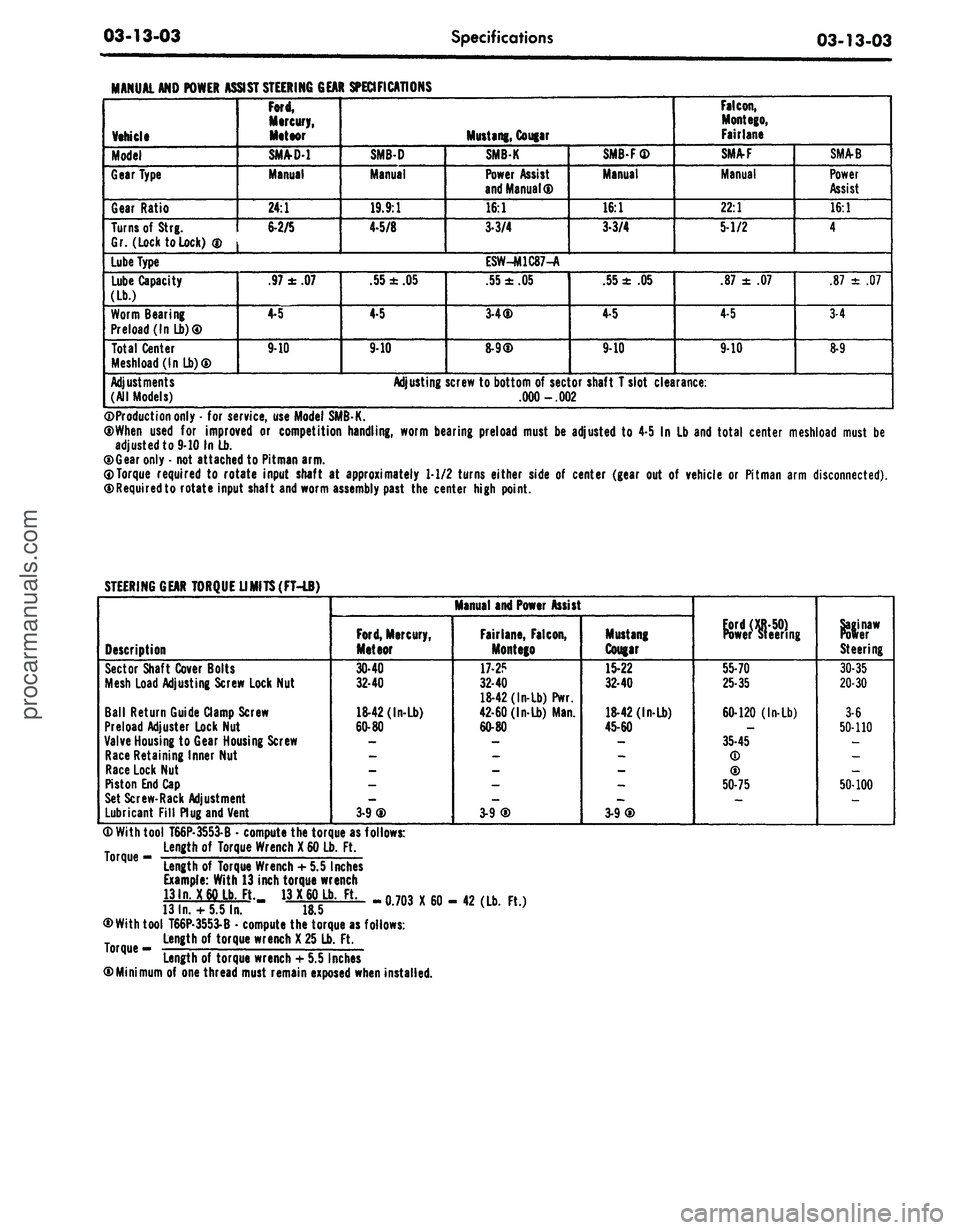
03-13-03
Specifications
03-13-03
MANUAL AND POWER
Vehicle
Model
Gear Type
Gear Ratio
Turns of
Strg.
Gr. (Lock to Lock)
®
Lube Type
Lube Capacity
(Lb.)
Worm Bearing
Preload (In Lb)®
Total Center
Meshload(lnLb)®
Adjustments
(All Models)
ASSIST STEERING GEAR SPECIFICATIONS
Ford,
Mercury,
Meteor
SM/VD-1
Manual
24:1
6-2/5
.97
±
.07
4-5
9-10
SMB-D
Manual
19.9:1
4-5/8
.55
±
.05
4-5
9-10
Adjusting
Mustang, Cougar
SMBK
Power Assist
and Manual®
16:1
3-3/4
ESW-M1C87-A
.55
±
.05
3-4®
8-9®
screw to bottom
of
sector
.000 -.002
SMB-F®
Manual
16:1
3-3/4
.55
±
.05
4-5
9-10
shaft T slot clearance:
Falcon,
Mont ego,
Fairlane
SMA-F
Manual
22:1
5-1/2
.87
±
.07
4-5
9-10
SMA-B
Power
Assist
16:1
4
.87
±
.07
3-4
8-9
©Production only
-
for service, use Model SMB-K.
®When used
for
improved
or
competition handling, worm bearing preload must
be
adjusted
to
4-5
In
Lb and total center meshload must
be
adjusted to 9-10 In Lb.
®Gear only
-
not attached to Pitman arm.
0Torque required
to
rotate input shaft
at
approximately 1-1/2 turns either side
of
center (gear
out of
vehicle
or
Pitman arm disconnected).
©Requiredto rotate input shaft and worm assembly past
the
center high point.
STEERING GEAR TORQUE UMITS(FT-LB)
Description
Sector Shaft Cover Bolts
Mesh Load Adjusting Screw Lock Nut
Ball Return Guide Clamp Screw
Preload Adjuster Lock Nut
Valve Housing
to
Gear Housing Screw
Race Retaining Inner Nut
Race Lock Nut
Piston End Cap
Set Screw-Rack Adjustment
Lubricant Fill Plug and Vent
Manual and Power Assist
Ford,
Mercury,
Meteor
30-40
32-40
18-42 (In-Lb)
60-80
3-9®
Fairlane, Falcon,
Montego
17-2?
32-40
18-42 (In-Lb) Pwr.
42-60 (In-Lb) Man.
60-80
3-9®
Mustang
Cougar
15-22
32-40
18-42 (In-Lb)
45-60
3-9®
Power steering
55-70
25-35
60-120 (In-Lb)
35-45
(D
®
50-75
Steering
30-35
20-30
3-6
50-110
50-100
® With tool T66P-3553-B
•
compute the torque as follows:
Length
of
Torque Wrench
X
60 Lb.
Ft.
°rque
"
Length
of
Torque Wrench
+
5.5 Inches
Example: With 13 inch torque wrench
13ln.
X
60 Lb. Ft. 13
X
60 Lb.
Ft.
13
In.
+
5.5 In.
18.5
®With tool T66P-3553-B
•
compute the torque as follows:
Length
of
torque wrench
X
25 Lb.
Ft.
Length of torque wrench
+
5.5 Inches
©Minimum
of
one thread must remain exposed when installed.
-0.703 X60- 42 (Lb.
Ft.)procarmanuals.com
Page 183 of 413
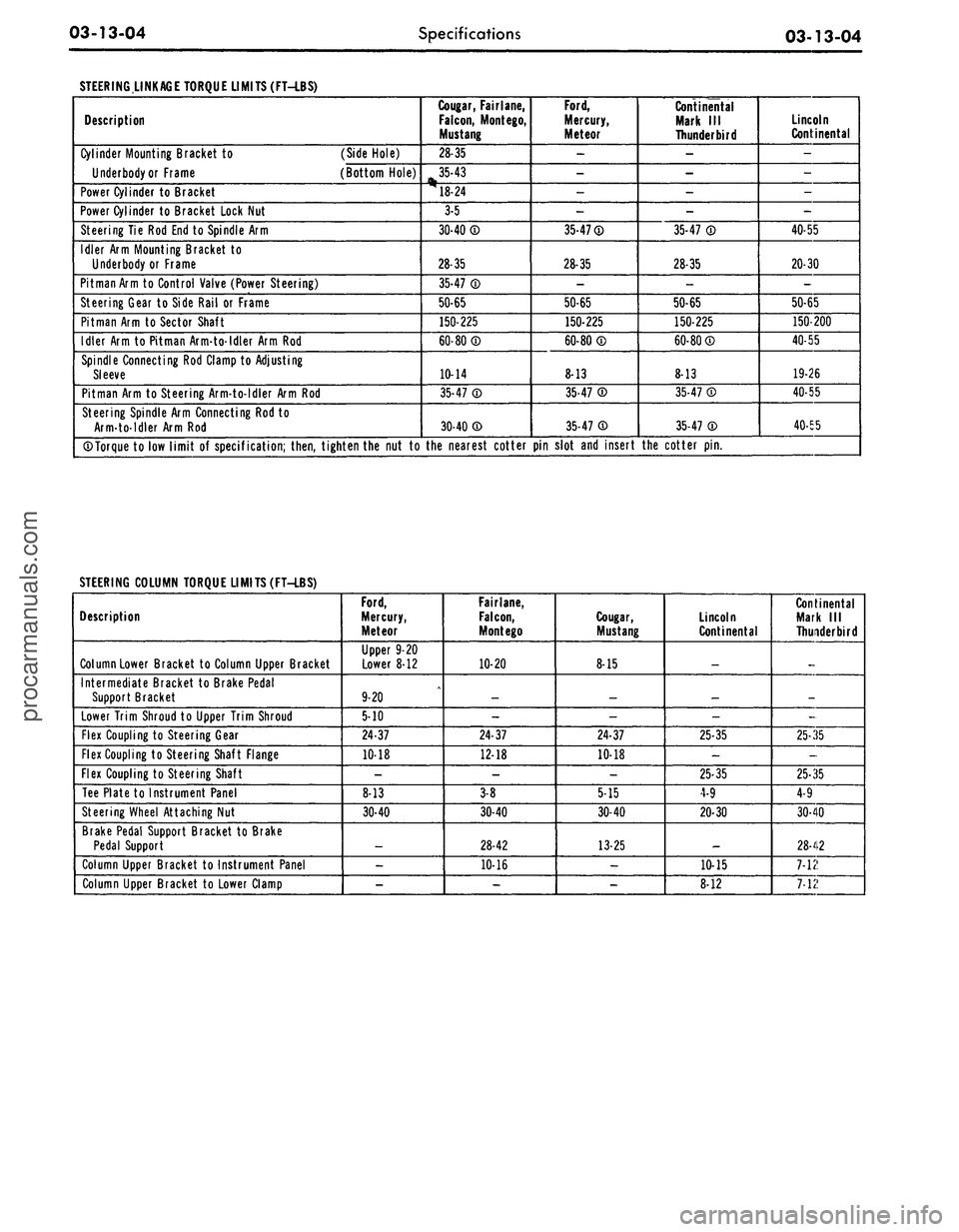
03-13-04
Specifications
03-13-04
STEERING LINKAGE TORQUE LIMITS (FT-LBS)
Description
Cylinder Mounting Bracket
to
(Side Hole)
Underbodyor Frame (Bottom Hole)
Power Cylinder
to
Bracket
Power Cylinder
to
Bracket Lock
Nut
Steering
Tie Rod End to
Spindle
Arm
Idler
Arm
Mounting Bracket
to
Underbody
or
Frame
Pitman Arm
to
Control Valve (Power Steering)
Steering Gear
to
Side Rail
or
Frame
Pitman
Arm to
Sector Shaft
Idler
Arm to
Pitman Arm-to-ldler
Arm Rod
Spindle Connecting
Rod
Clamp
to
Adjusting
Sleeve
Pitman
Arm to
Steering Arm-to-ldler
Arm Rod
Steering Spindle
Arm
Connecting
Rod to
Arm-to-ldler
Arm Rod
Cougar, Fairlane,
Falcon,
Mont
ego,
Mustang
28-35
35-43
18-24
3-5
30-40
©
28-35
35-47
©
50-65
150-225
60-80®
10-14
35-47
©
30-40
©
Ford,
Mercury,
Meteor
-
-
-
-
35-47®
28-35
-
50-65
150-225
60-80
®
8-13
35-47
©
35-47
®
Continental
Mark
III
Thunder bird
-
-
-
-
35-47
©
28-35
-
50-65
150-225
60-80
©
8-13
35-47
©
35-47
©
Lincoln
Continental
-
-
-
-
40-55
20-30
-
50-65
150-200
40-55
19-26
40-55
40-55
CD
Torque
to low
limit
of
specification;
then,
tighten
the nut to the
nearest cotter
pin
slot
and
insert
the
cotter
pin.
STEERING COLUMN TORQUE LIMITS (FT-LBS)
Description
Column Lower Bracket
to
Column Upper Bracket
Intermediate Bracket
to
Brake Pedal
Support Bracket
Lower Trim Shroud
to
Upper Trim Shroud
Flex Coupling
to
Steering Gear
Flex Coupling
to
Steering Shaft Flange
Flex Coupling
to
Steering Shaft
Tee Plate
to
Instrument Panel
Steering Wheel Attaching
Nut
Brake Pedal Support Bracket
to
Brake
Pedal Support
Column Upper Bracket
to
Instrument Panel
Column Upper Bracket
to
Lower Clamp
Ford,
Mercury,
Meteor
Upper
9-20
Lower
8-12
9-20
5-10
24-37
10-18
-
8-13
30-40
_
-
-
Fairlane,
Falcon,
Mont
ego
10-20
_
-
24-37
12-18
-
3-8
30-40
28-42
10-16
-
Cougar,
Mustang
8-15
_
-
24-37
10-18
-
5-15
30-40
13-25
-
-
Lincoln
Continental
_
_
-
25-35
-
25-35
4-9
20-30
_
10-15
8-12
Continental
Mark
III
Thunder bird
_
_
-
25-35
-
25-35
4-9
30-40
28-42
7-12
7-1?procarmanuals.com
Page 187 of 413
03-13-08
Specifications
03-13-08
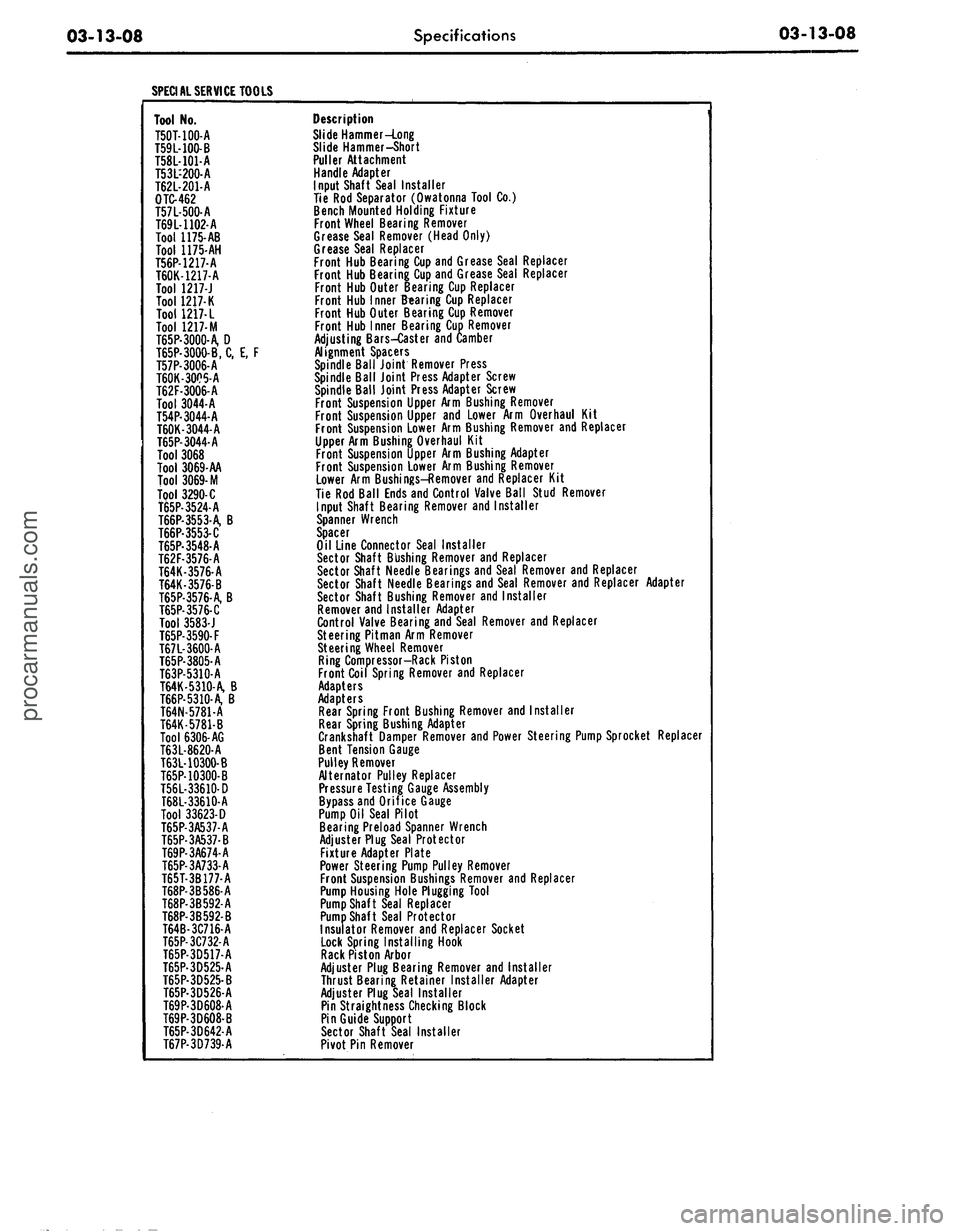
SPECIAL SERVICE TOOLS
Tool No.
T50T-100-A
T59L-100-B
T58L-101-A
T53L-200-A
T62L-201-A
OTC-462
T57L-500-A
T69L-1102-A
Tool 1175-AB
Tool 1175-AH
T56P-1217-A
T60K-1217-A
Tool 1217-J
Tool 1217-K
Tool
1217- L
Tool 1217-M
T65P-3000-A, D
T65P-3000-B, C, E, F
T57P-3006-A
T60K-3005-A
T62F-3006-A
Tool 3044-A
T54P-3044-A
T60K-3044-A
T65P-3044-A
Tool 3068
Tool 3069-AA
Tool
3069-
M
Tool 3290-C
T65P-3524-A
T66P-3553-A, B
T66P-3553-C
T65P-3548-A
T62F-3576-A
T64K-3576-A
T64K-3576-B
T65P-3576-A, B
T65P-3576-C
Tool 3583-J
T65P-3590-F
T67L-3600-A
T65P-3805-A
T63P-5310-A
T64K-5310-A, B
T66P-5310-A, B
T64N-5781-A
T64K-5781-B
Tool 6306-AG
T63L-8620-A
T63L-10300-B
T65P-10300-B
T56L-33610-D
T68L-33610-A
Tool 33623-D
T65P-3A537-A
T65P-3A537-B
T69P-3A674-A
T65P-3A733-A
T65T-3B177-A
T68P-3B586-A
T68P-3B592-A
T68P-3B592-B
T64B-3C716-A
T65P-3C732-A
T65P-3D517-A
T65P-3D525-A
T65P-3D525-B
T65P-3D526-A
T69P-3D608-A
T69P-3D608-B
T65P-3D642-A
T67P-3D739-A
Description
Slide Hammer-Long
Slide Hammer-Short
Puller Attachment
Handle Adapter
Input Shaft Seal Installer
Tie Rod Separator (Owatonna Tool Co.)
Bench Mounted Holding Fixture
Front Wheel Bearing Remover
Grease Seal Remover (Head Only)
Grease Seal Replacer
Front Hub Bearing Cup and Grease Seal Replacer
Front Hub Bearing Cup and Grease Seal Replacer
Front Hub Outer Bearing Cup Replacer
Front Hub Inner Bearing Cup Replacer
Front Hub Outer Bearing Cup Remover
Front Hub Inner Bearing Cup Remover
Adjusting Bars-Caster and Camber
Alignment Spacers
Spindle Ball Joint Remover Press
Spindle Ball Joint Press Adapter Screw
Spindle Ball Joint Press Adapter Screw
Front Suspension Upper Arm Bushing Remover
Front Suspension Upper and Lower Arm Overhaul Kit
Front Suspension Lower Arm Bushing Remover and Replacer
Upper Arm Bushing Overhaul Kit
Front Suspension Upper Arm Bushing Adapter
Front Suspension Lower Arm Bushing Remover
Lower Arm Bushings-Remover and Replacer Kit
Tie Rod Ball Ends and Control Valve Ball Stud Remover
Input Shaft Bearing Remover and Installer
Spanner Wrench
Spacer
Oil Line Connector Seal Installer
Sector Shaft Bushing Remover and Replacer
Sector Shaft Needle Bearings and Seal Remover and Replacer
Sector Shaft Needle Bearings and Seal Remover and Replacer Adapter
Sector Shaft Bushing Remover and Installer
Remover and Installer Adapter
Control Valve Bearing and Seal Remover and Replacer
Steering Pitman Arm Remover
Steering Wheel Remover
Ring Compressor-Rack Piston
Front Coil Spring Remover and Replacer
Adapters
Adapters
Rear Spring Front Bushing Remover and Installer
Rear Spring Bushing Adapter
Crankshaft Damper Remover and Power Steering Pump Sprocket Replacer
Bent Tension Gauge
Pulley Remover
Alternator Pulley Replacer
Pressure Testing Gauge Assembly
Bypass and Orifice Gauge
Pump Oil Seal Pilot
Bearing Preload Spanner Wrench
Adjuster Plug Seal Protector
Fixture Adapter Plate
Power Steering Pump Pulley Remover
Front Suspension Bushings Remover and Replacer
Pump Housing Hole Plugging Tool
Pump Shaft Seal Replacer
Pump Shaft Seal Protector
Insulator Remover and Replacer Socket
Lock Spring Installing Hook
Rack Piston Arbor
Adjuster Plug Bearing Remover and Installer
Thrust Bearing Retainer Installer Adapter
Adjuster Plug Seal Installer
Pin Straightness Checking Block
Pin Guide Support
Sector Shaft Seal Installer
Pivot Pin Removerprocarmanuals.com
Page 295 of 413
07-01-04
General Transmission Service
07-01-04
taching bolts to the proper torque. If
necessary, replace the gasket.
Check the fluid filler tube connec-
tion at the transmission case or pan.
If leakage is found here, install a new
O-ring or tighten the fitting to the
specified torque.
Check the fluid lines and fittings
between the transmission and the
cooler in the radiator tank for loose-
ness,
wear, or damage. If leakage can-
not be stopped by tightening a fitting,
replace the damaged parts.
Check the engine coolant in the ra-
diator. If transmission fluid is present
in the coolant, the cooler in the radia-
tor is probably leaking.
The cooler can be further checked
for leaks by disconnecting the lines
from the cooler fittings and applying
50-75 psi air pressure to the fittings.
Remove the radiator cap to relieve the
pressure build at the exterior of the oil
cooler tank. If the cooler is leaking
and will not hold this pressure the
cooler must be replaced. Cooler re-
placement is described in the Cooling
System Section of Group 11.
If leakage is found at either the
downshift control lever shaft or the
manual lever shaft, replace either or
both seals.
Inspect the pipe plug on the left
side of the transmission case at the
front. If the plug shows leakage, tor-
que the plug to specifications. If tight-
ening does not stop the leaks, replace
the plug. On a C6 transmission, a TV
pressure plug is also provided on the
right rear side of the case.
When converter drain plugs leak,
remove drain plugs with a six-point
wrench. Coat the threads with FoMo-
Co Perfect Seal Sealing Compound or
its equivalent, and install the plugs.
Torque the drain plugs to specifica-
tion. Fluid leakage from the converter
housing may be caused by engine oil
leaking past the rear main bearing or
from oil gallery plugs, or power steer-
ing oil leakage from steering system.
Be sure to determine the exact cause
of the leak before repair procedures
are started.
Oil-soluble aniline or fluorescent dyes
premixed at the rate of 1/2 teaspoon
of dye powder to 1/2 pint of transmis-
sion fluid have proved helpful in locat-
ing the source of the fluid leakage.
Such dyes may be used to determine
whether an engine oil or transmission
fluid leak is present or if the fluid in
the oil cooler leaks into the engine
coolant system. A black light, how-
ever, must be used with the fluorescent
dye solution.
DISHED OR
FLAT WASHER
" O.D.,
a" STEEL PLATE
5/8"X \W,
DRILL TO SUIT
HEX. HEAD SCREW
3/8"-24 X Vl
HEX. NUT W—
24
WELD
TOGETHER
WING
NUT
>/2"_13
THREAD
CHAIN,
10"
LONG
RUBBER PLUG
1
Vi" DIA. X 2"
LONG Vl"
HOLE THRU
APPROXIMATELY
40 DUROMETER
FLAT WASHER
Vs" O.D.
PLUG
VALVE
STANDARD BOLT
W-13
X 4Vl"
LONG SQUARE
THREAD
END
REMOVE HEAD
AND WELD
TO
WASHER
STANDARD 1/8" FITTING-87971-S FOR
RETAPPED DRAIN PLUG THREADS-USE
1/4" OVERSIZE FITTING-87973-S
D 1067-B
WELD TOGETHER
SECURELY—MUST
NOT LEAK
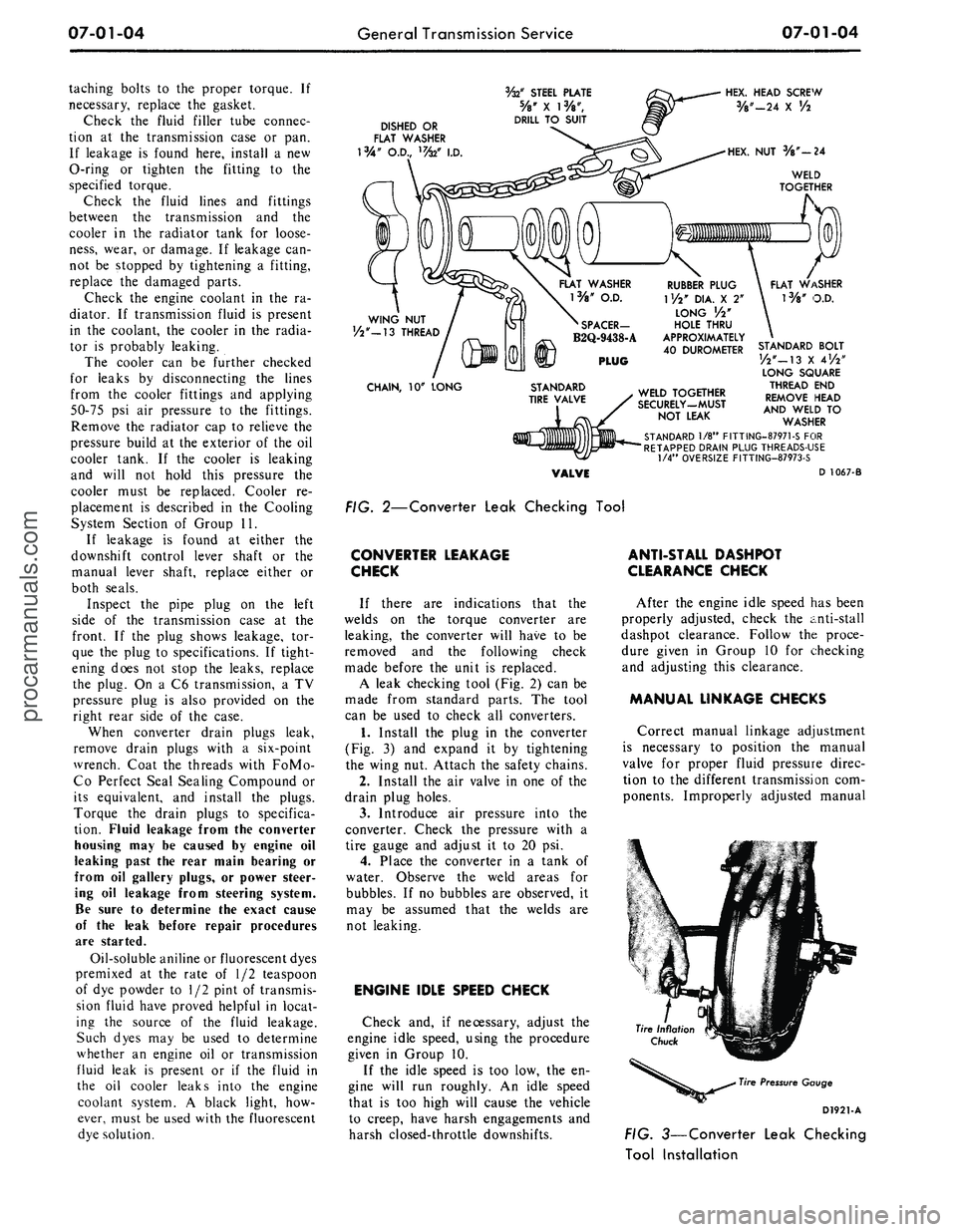
FIG. 2—Converter Leak Checking Tool
CONVERTER LEAKAGE
CHECK
If there are indications that the
welds on the torque converter are
leaking, the converter will have to be
removed and the following check
made before the unit is replaced.
A leak checking tool (Fig. 2) can be
made from standard parts. The tool
can be used to check all converters.
1.
Install the plug in the converter
(Fig. 3) and expand it by tightening
the wing nut. Attach the safety chains.
2.
Install the air valve in one of the
drain plug holes.
3.
Introduce air pressure into the
converter. Check the pressure with a
tire gauge and adjust it to 20 psi.
4.
Place the converter in a tank of
water. Observe the weld areas for
bubbles. If no bubbles are observed, it
may be assumed that the welds are
not leaking.
ENGINE IDLE SPEED CHECK
Check and, if necessary, adjust the
engine idle speed, using the procedure
given in Group 10.
If the idle speed is too low, the en-
gine will run roughly. An idle speed
that is too high will cause the vehicle
to creep, have harsh engagements and
harsh closed-throttle downshifts.
ANTI-STALL DASHPOT
CLEARANCE CHECK
After the engine idle speed has been
properly adjusted, check the anti-stall
dashpot clearance. Follow the proce-
dure given in Group 10 for checking
and adjusting this clearance.
MANUAL LINKAGE CHECKS
Correct manual linkage adjustment
is necessary to position the manual
valve for proper fluid pressure direc-
tion to the different transmission com-
ponents. Improperly adjusted manual
Tire Pressure Gauge
D1921-A
FIG. 3—Converter Leak Checking
Tool Installationprocarmanuals.com