recommended oil FORD MUSTANG 1969 Volume One Chassis
[x] Cancel search | Manufacturer: FORD, Model Year: 1969, Model line: MUSTANG, Model: FORD MUSTANG 1969Pages: 413, PDF Size: 75.81 MB
Page 19 of 413
02-01-08
Brakes
02-01-08
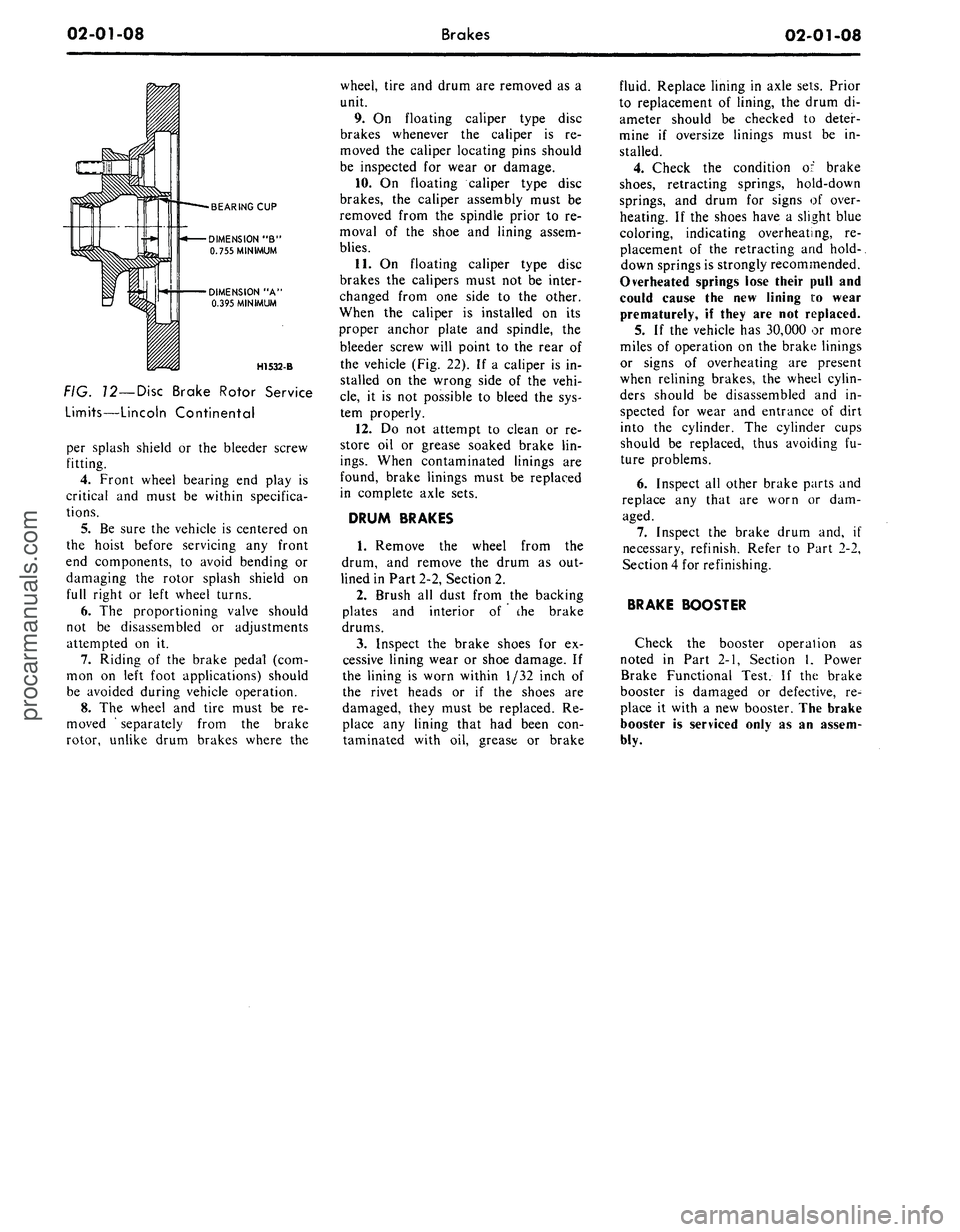
BEARING CUP
DIMENSION "B"
0.755 MINIMUM
DIMENSION "A'
0.395 MINIMUM
H1532-B
FIG. 12—Disc Brake Rotor Service
Limits—Lincoln Continental
per splash shield or the bleeder screw
fitting.
4.
Front wheel bearing end play is
critical and must be within specifica-
tions.
5.
Be sure the vehicle is centered on
the hoist before servicing any front
end components, to avoid bending or
damaging the rotor splash shield on
full right or left wheel turns.
6. The proportioning valve should
not be disassembled or adjustments
attempted on it.
7.
Riding of the brake pedal (com-
mon on left foot applications) should
be avoided during vehicle operation.
8. The wheel and tire must be re-
moved ' separately from the brake
rotor, unlike drum brakes where the
wheel, tire and drum are removed as a
unit.
9. On floating caliper type disc
brakes whenever the caliper is re-
moved the caliper locating pins should
be inspected for wear or damage.
10.
On floating caliper type disc
brakes, the caliper assembly must be
removed from the spindle prior to re-
moval of the shoe and lining assem-
blies.
11.
On floating caliper type disc
brakes the calipers must not be inter-
changed from one side to the other.
When the caliper is installed on its
proper anchor plate and spindle, the
bleeder screw will point to the rear of
the vehicle (Fig. 22). If a caliper is in-
stalled on the wrong side of the vehi-
cle,
it is not possible to bleed the sys-
tem properly.
12.
Do not attempt to clean or re-
store oil or grease soaked brake lin-
ings.
When contaminated linings are
found, brake linings must be replaced
in complete axle sets.
DRUM BRAKES
1.
Remove the wheel from the
drum, and remove the drum as out-
lined in Part 2-2, Section 2.
2.
Brush all dust from the backing
plates and interior of the brake
drums.
3.
Inspect the brake shoes for ex-
cessive lining wear or shoe damage. If
the lining is worn within 1/32 inch of
the rivet heads or if the shoes are
damaged, they must be replaced. Re-
place any lining that had been con-
taminated with oil, grease or brake
fluid. Replace lining in axle sets. Prior
to replacement of lining, the drum di-
ameter should be checked to deter-
mine if oversize linings must be in-
stalled.
4.
Check the condition of brake
shoes,
retracting springs, hold-down
springs, and drum for signs of over-
heating. If the shoes have a slight blue
coloring, indicating overheating, re-
placement of the retracting and hold-.
down springs is strongly recommended.
Overheated springs lose their pull and
could cause the new lining i:o wear
prematurely, if they are not replaced.
5. If the vehicle has 30,000 or more
miles of operation on the brake linings
or signs of overheating are present
when relining brakes, the wheel cylin-
ders should be disassembled and in-
spected for wear and entrance of dirt
into the cylinder. The cylinder cups
should be replaced, thus avoiding fu-
ture problems.
6. Inspect all other brake parts and
replace any that are worn or dam-
aged.
7.
Inspect the brake drum and, if
necessary, refinish. Refer to Part 2-2,
Section 4 for refinishing.
BRAKE BOOSTER
Check the booster operation as
noted in Part 2-1, Section 1, Power
Brake Functional Test. If the brake
booster is damaged or defective, re-
place it with a new booster. The brake
booster is serviced only as an assem-
bly.procarmanuals.com
Page 58 of 413
02-02-39
Brake System
02-02-39
MAJOR REPAIR OPERATIONS
BRAKE DRUM REFINISHING
Minor scores on a brake drum can
be removed with sandpaper. A drum
that is excessively scored or shows a
total indicator runout of over 0.007
inch should be turned down. Remove
only enough stock to eliminate the
scores and true up the drum. The refi-
nished diameter must not exceed 0.060
inch oversize.
Check the inside diameter of the
brake drum with a brake drum mi-
crometer (Tool FRE-14^1).
If the drum diameter is less than
0.030 inch oversize after refinishing^
standard lining may be installed. If
the drum diameter is 0.030—0.060
inch oversize after refinishing, oversize
lining must be installed.
After a drum is turned down, wipe
the refinished surface with a cloth
soaked in clean denatured alcohol. If
one drum is turned down, the opposite
drum on the same axle should also be
cut down to the same size.
ROTOR REFINISHING
Rotunda Disc Brake Attachment,
FRE-2249-2, is the only recommended
tool to refinish the disc brake rotors.
The step-by-step resurfacing procedure
provided with the tool must be ad-
hered to.
The finished braking surfaces of the
rotor must be flat and parallel within
0.0007 inch; lateral runout must not
exceed 0.003 inch total indicator read-
ing, and the surface finish of the brak-
ing surfaces are to be 80/15 micro
inches. The minimum limiting dimen-
sions (Figs. 11 and 12, Part 2-1) from
the inboard bearing cup to the out-
board rotor face and from the inboard
bearing cup to the inboard rotor face
must be observed when removing ma-
terial from the rotor braking surfaces.
On all models except Lincoln Con-
tinental, the limiting dimensions are to
be measured with a ball and gage bar
(Rotunda Kit FRE-70160).
BRAKE SHOE RELINING
Brake linings that are worn to with-
in 1/32 inch of the rivet head or are
less than 0.030 inch thick (bonded lin-
ing) or have been contaminated with
brake fluid, grease or oil must be re-
placed. Failure to replace worn linings
will result in a scored drum. When it
is necessary to replace linings, they
must also be replaced on the wheel on
the opposite side of the vehicle.
Inspect brake shoes for distortion,
cracks, or looseness. If this condition
exists,
the shoe must be discarded. Do
not attempt to repair a defective brake
shoe.
1.
Wash the brake shoes thoroughly
in a clean solvent. Remove all burrs
or rough spots from the shoes.
2.
Check the inside diameter of the
brake drum with a brake drum mi-
crometer (tool FRE-1431). If the di-
ameter is less than 0.030 inches over-
size,
standard lining may be installed.
If the diameter is 0.030—0.060 inches
oversize, oversize lining should be in-
stalled.
3.
Position the new lining on the
shoe.
Starting in the center, insert and
secure the rivets, working alternately
towards each end. Replacement lin-
ings are ground and no further grind-
ing is required.
4.
Check the clearance between the
shoe and lining. The lining must seat
tightly against the shoe with not more
than 0.008 inch clearance between any
two rivets.
RETAINER - 2B245
DUAL MASTER CYLINDER
DISASSEMBLY
1.
Clean the outside of the master
cylinder and remove the filler cover
and diaphragm. Pour out any brake
fluid that remains in the cylinder. Dis-
card the old brake fluid.
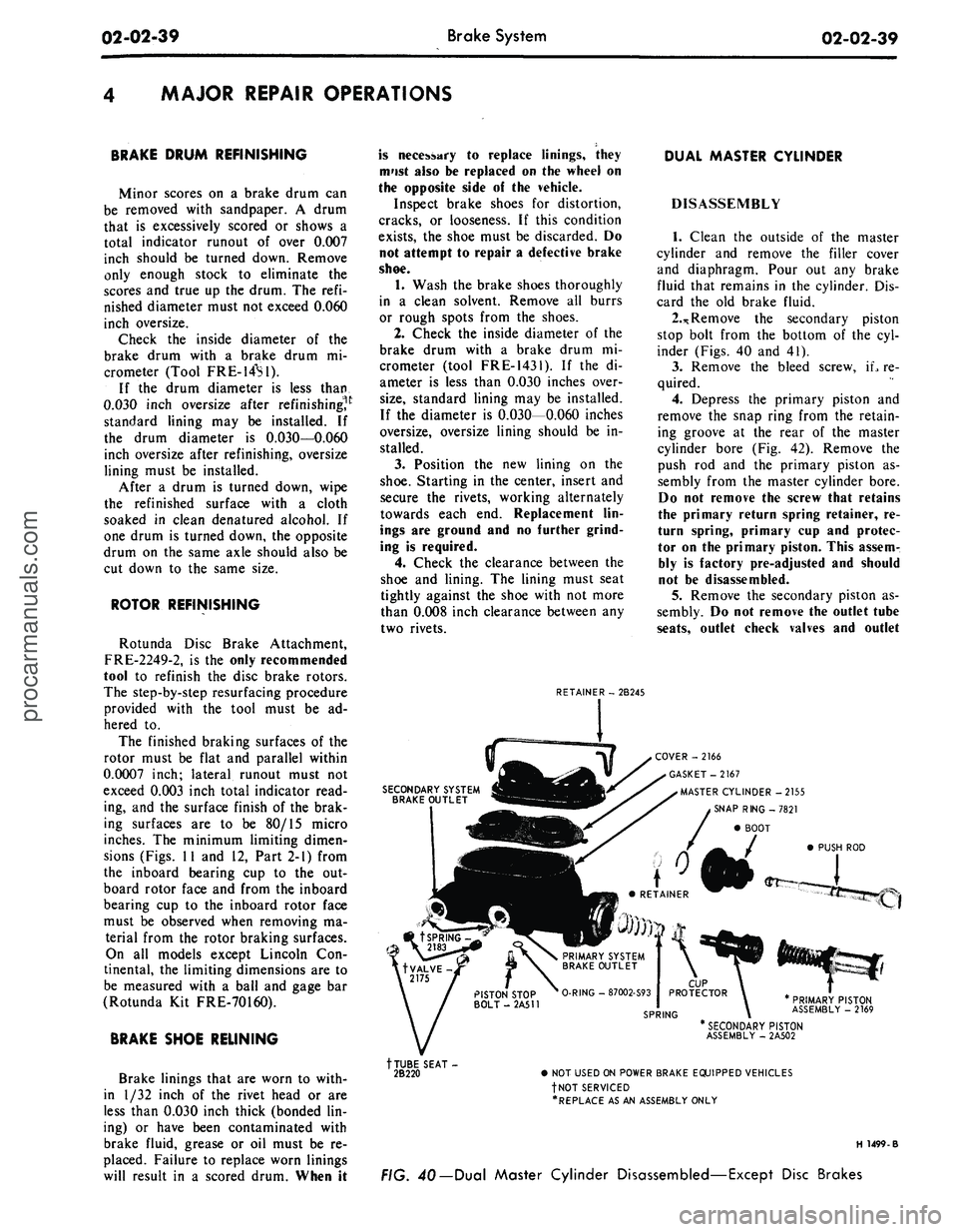
2.*
Remove the secondary piston
stop bolt from the bottom of the cyl-
inder (Figs. 40 and 41).
3.
Remove the bleed screw, iL re-
quired.
4.
Depress the primary piston and
remove the snap ring from the retain-
ing groove at the rear of the master
cylinder bore (Fig. 42). Remove the
push rod and the primary piston as-
sembly from the master cylinder bore.
Do not remove the screw that retains
the primary return spring retainer, re-
turn spring, primary cup and protec-
tor on the primary piston. This assem-
bly is factory pre-adjusted and should
not be disassembled.
5.
Remove the secondary piston as-
sembly. Do not remove the outlet tube
seats,
outlet check valves and outlet
SECONDARY SYSTEM
BRAKE OUTLET
COVER -2166
GASKET-2167
MASTER CYLINDER -2155
SNAP RING -7821
BOOT
PUSH ROD
PRIMARY PISTON
ASSEMBLY - 2169
tTUBE SEAT-
2B220
* SECONDARY PISTON
ASSEMBLY - 2A502
• NOT USED ON POWER BRAKE EQUIPPED VEHICLES
fNOT SERVICED
•REPLACE AS AN ASSEMBLY ONLY
H 1499-B
FIG. 40— Dual Master Cylinder Disassembled—Except Disc Brakesprocarmanuals.com
Page 137 of 413
03-06-03
Manual Steering
03-06-03
MAJOR REPAIR OPERATIONS
STEERING GEAR
DISASSEMBLY
1. Rotate the steering shaft 3 turns
from either stop.
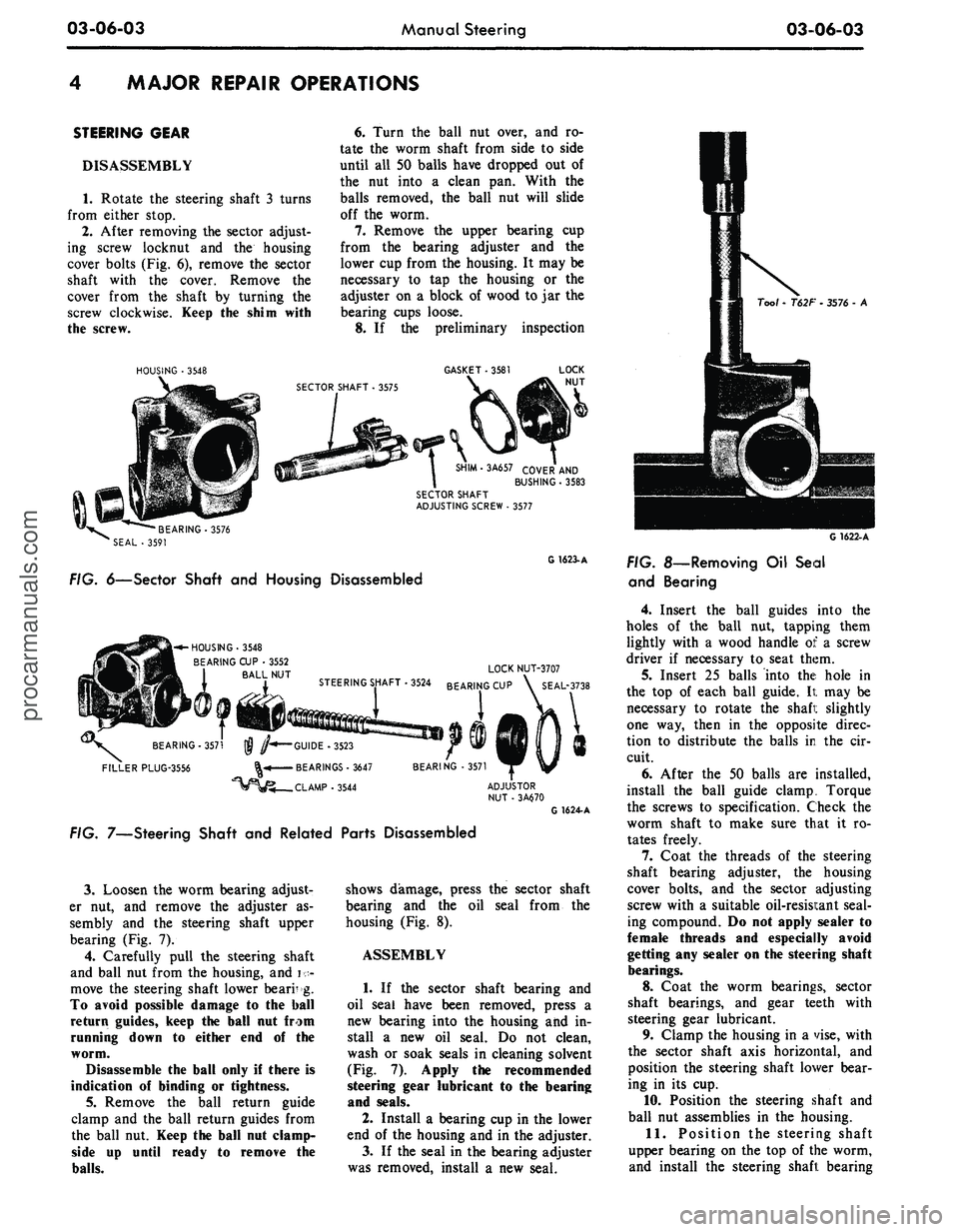
2.
After removing the sector adjust-
ing screw locknut and the housing
cover bolts (Fig. 6), remove the sector
shaft with the cover. Remove the
cover from the shaft by turning the
screw clockwise. Keep the shim with
the screw.
HOUSING
•
3548
6. Turn the ball nut over, and ro-
tate the worm shaft from side to side
until all 50 balls have dropped out of
the nut into a clean pan. With the
balls removed, the ball nut will slide
off the worm.
7. Remove the upper bearing cup
from the bearing adjuster and the
lower cup from the housing. It may be
necessary to tap the housing or the
adjuster on a block of wood to jar the
bearing cups loose.
8. If the preliminary inspection
GASKET
• 3581
SHIM-3A657 COVER
AND
BUSHING
•
3583
SECTOR SHAFT
ADJUSTING SCREW
.
3577
•BEARING-3576
SEAL
- 3591
G 1623-A
FIG. 6—Sector Shaft
and
Housing Disassembled
-^-HOUSING-3548
BEARING
CUP •
3552
BALL
NUT
BEARING-3571
FILLER PLUG-3556
LOCK NUT-3707
3524 BEARING
CUP \
SEAL-3738
•GUIDE -3523
• BEARINGS
•
3647
.CLAMP-3544
BEARING
• 3571
G 1624-A
FIG. 7—Steering Shaft
and
Related Parts Disassembled
3.
Loosen the worm bearing adjust-
er nut, and remove the adjuster as-
sembly and the steering shaft upper
bearing (Fig. 7).
4.
Carefully pull the steering shaft
and ball nut from the housing, and i •-
move the steering shaft lower bearr g.
To avoid possible damage to the ball
return guides, keep
the
ball
nut
from
running down
to
either
end of the
worm.
Disassemble
the
ball only
if
there
is
indication
of
binding
or
tightness.
5.
Remove the ball return guide
clamp and the ball return guides from
the ball
nut.
Keep
the
ball
nut
clamp-
side up until ready to remove the
balls.
shows damage, press the sector shaft
bearing and the oil seal from the
housing (Fig. 8).
ASSEMBLY
1. If the sector shaft bearing and
oil seal have been removed, press a
new bearing into the housing and in-
stall a new oil seal. Do not clean,
wash or soak seals in cleaning solvent
(Fig.
7).
Apply
the
recommended
steering gear lubricant
to the
bearing
and seals.
2.
Install a bearing cup in the lower
end of the housing and in the adjuster.
3.
If the seal in the bearing adjuster
was removed, install a new seal.
Tool
-
T62F
•
3576
- A
G 1622-A
FIG.
8—Removing
Oil
Seal
and Bearing
4.
Insert the ball guides into the
holes of the ball nut, tapping them
lightly with a wood handle of a screw
driver if necessary to seat them.
5.
Insert 25 balls into the hole in
the top of each ball guide. It may be
necessary to rotate the shafi: slightly
one way, then in the opposite direc-
tion to distribute the balls in the cir-
cuit.
6. After the 50 balls are installed,
install the ball guide clamp. Torque
the screws to specification. Check the
worm shaft to make sure that it ro-
tates freely.
7. Coat the threads of the steering
shaft bearing adjuster, the housing
cover bolts, and the sector adjusting
screw with a suitable oil-resisi:ant seal-
ing compound. Do not apply sealer to
female threads and especially avoid
getting any sealer on the steering shaft
bearings.
8.
Coat the worm bearings, sector
shaft bearings, and gear teeth with
steering gear lubricant.
9. Clamp the housing in a vise, with
the sector shaft axis horizontal, and
position the steering shaft lower bear-
ing in its cup.
10.
Position the steering shaft and
ball nut assemblies in the housing.
11.
Position the steering shaft
upper bearing on the top of the worm,
and install the steering shaft bearingprocarmanuals.com
Page 258 of 413
05-02-04
General Clutch Service
05-02-04
CLEANING AND INSPECTION
RELEASE BEARING
Wipe all oil and dirt off the release
bearing. The bearing is prelubricated
and should not be cleaned with sol-
vent.
Inspect the bearing retainer for
loose spring clips and rivets.
Inspect the release bearing assembly
for burrs which may cause the assem-
bly to drag on the transmission bear-
ing retainer. Any such burrs should be
cleaned up with fine crocus cloth. If
burrs are found, inspect the transmis-
sion input shaft bearing retainer for
evidence of scoring. Any scoring
should be polished out with crocus
cloth. Coat the bearing retainer with a
thin film of lithium-base grease
(C3VY-19586-A). Prior to release
bearing installation, apply a light film
of lithium base grease (C3VY-
19586-A) on both sides of the release
lever fork where it contacts the release
bearing hub and retaining springs.
Apply a light film of lithium base
grease (C3VY-19586-A) plate to the
release bearing surface that contacts
the pressure plate fingers. Carefully
fill the grease groove inside the bear-
ing hub with lithium base grease (no
polyethylene). Clean all excess grease
from the bore of the bearing hub. Ex-
cess grease will be forced onto the
spline by the transmission input shaft
bearing retainer and will contaminate
the clutch disc. Also, care must be
exercised when applying lubricants to
the release bearing, release bearing
hub and the release lever fork to avoid
excessive grease from contaminating
the clutch disc.
Hold the bearing inner race and ro-
tate the outer race while applying
pressure to it. If the bearing rotation
is rough or noisy, replace the bearing.
Most release bearing failures are
caused by improper clutch pedal ad-
justments. If the clutch linkage does
not have enough free travel, the re-
lease bearing will constantly touch the
release fingers and will spin whenever
the engine is running.
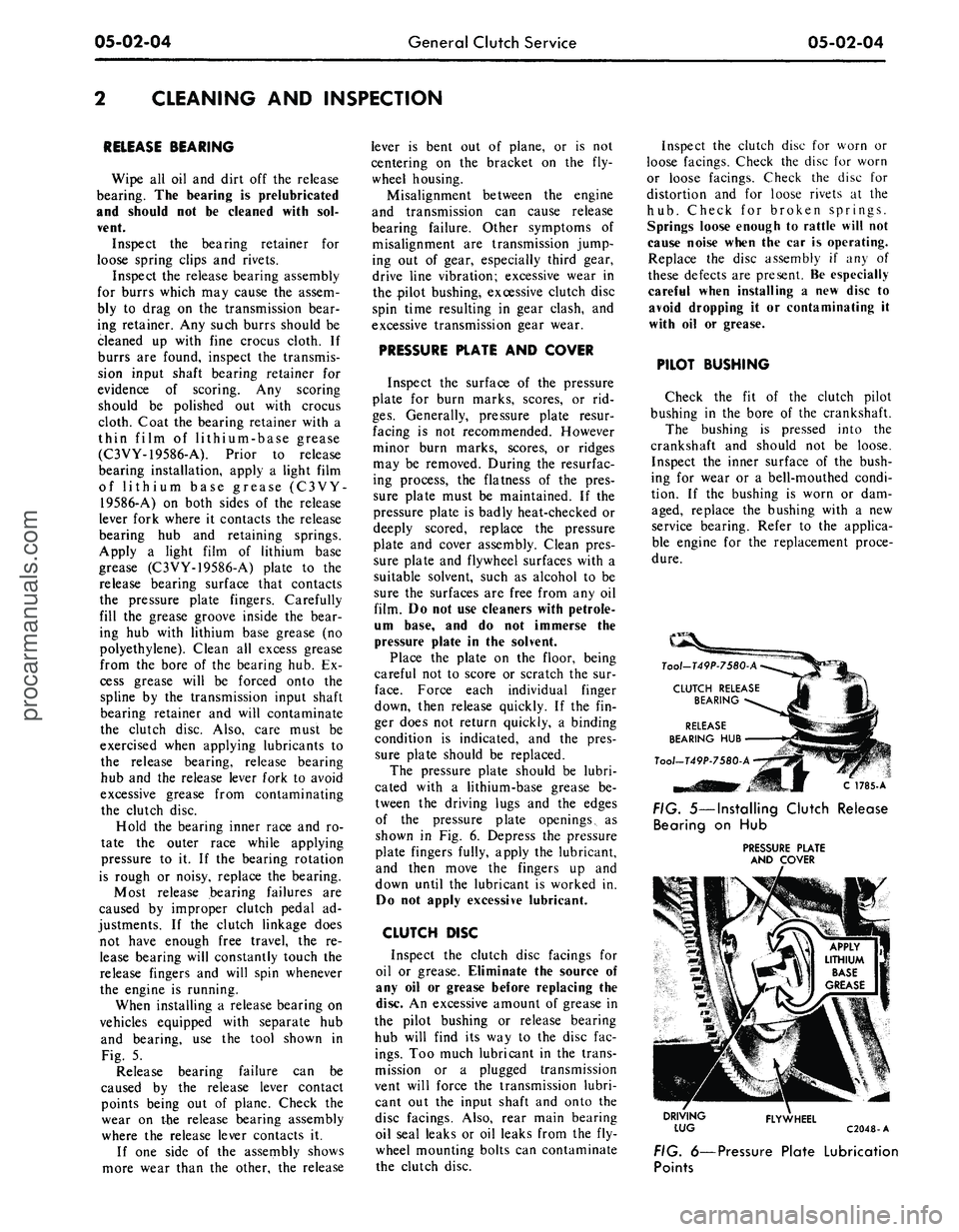
When installing a release bearing on
vehicles equipped with separate hub
and bearing, use the tool shown in
Fig. 5.
Release bearing failure can be
caused by the release lever contact
points being out of plane. Check the
wear on the release bearing assembly
where the release lever contacts it.
If one side of the assembly shows
more wear than the other, the release
lever is bent out of plane, or is not
centering on the bracket on the fly-
wheel housing.
Misalignment between the engine
and transmission can cause release
bearing failure. Other symptoms of
misalignment are transmission jump-
ing out of gear, especially third gear,
drive line vibration; excessive wear in
the pilot bushing, excessive clutch disc
spin time resulting in gear clash, and
excessive transmission gear wear.
PRESSURE PLATE AND COVER
Inspect the surface of the pressure
plate for burn marks, scores, or rid-
ges.
Generally, pressure plate resur-
facing is not recommended. However
minor burn marks, scores, or ridges
may be removed. During the resurfac-
ing process, the flatness of the pres-
sure plate must be maintained. If the
pressure plate is badly heat-checked or
deeply scored, replace the pressure
plate and cover assembly. Clean pres-
sure plate and flywheel surfaces with a
suitable solvent, such as alcohol to be
sure the surfaces are free from any oil
film. Do not use cleaners with petrole-
um base, and do not immerse the
pressure plate in the solvent.
Place the plate on the floor, being
careful not to score or scratch the sur-
face.
Force each individual finger
down, then release quickly. If the fin-
ger does not return quickly, a binding
condition is indicated, and the pres-
sure plate should be replaced.
The pressure plate should be lubri-
cated with a lithium-base grease be-
tween the driving lugs and the edges
of the pressure plate openings, as
shown in Fig. 6. Depress the pressure
plate fingers fully, apply the lubricant,
and then move the fingers up and
down until the lubricant is worked in.
Do not apply excessive lubricant.
CLUTCH DISC
Inspect the clutch disc facings for
oil or grease. Eliminate the source of
any oil or grease before replacing the
disc. An excessive amount of grease in
the pilot bushing or release bearing
hub will find its way to the disc fac-
ings.
Too much lubricant in the trans-
mission or a plugged transmission
vent will force the transmission lubri-
cant out the input shaft and onto the
disc facings. Also, rear main bearing
oil seal leaks or oil leaks from the fly-
wheel mounting bolts can contaminate
the clutch disc.
Inspect the clutch disc for worn or
loose facings. Check the disc for worn
or loose facings. Check the disc for
distortion and for loose rivets at the
hub.
Check for broken springs.
Springs loose enough to rattle will not
cause noise when the car is operating.
Replace the disc assembly if any of
these defects are present. Be especially
careful when installing a new disc to
avoid dropping it or contaminating it
with oil or grease.
PILOT BUSHING
Check the fit of the clutch pilot
bushing in the bore of the crankshaft.
The bushing is pressed into the
crankshaft and should not be loose.
Inspect the inner surface of the bush-
ing for wear or a bell-mouthed condi-
tion. If the bushing is worn or dam-
aged, replace the bushing with a new
service bearing. Refer to the applica-
ble engine for the replacement proce-
dure.
C 1785-A
FIG. 5—Installing Clutch Release
Bearing on Hub
PRESSURE PLATE
AND COVER
DRIVING
LUG
FLYWHEEL
C2048-A
FIG. 6—Pressure Plate Lubrication
Pointsprocarmanuals.com
Page 354 of 413
07-03-14
FMX Transmission
07-03-14
REMOVAL AND INSTALLATION
An oil impregnated plastic grommet
is incorporated in the end of the man-
ual shift linkage lever arm on all col-
umn shift vehicles. A special tool
T67P-7341-A is required to install the
grommet in the manual lever, and to
install the manual linkage rod into the
grommet. Refer to Part 7-1, Section
2,
for the grommet replacement pro-
cedures.
TRANSMISSION AND
CONVERTER REPLACEMENT—
FORD-METEOR
REMOVAL
1.
Drive the vehicle on a hoist, but
do not raise at this time.
2.
Remove the two upper bolts and
lock washers which attach the con-
verter housing to the engine.
3.
Raise the vehicle and remove the
cover from the lower front side of the
converter housing. Drain the fluid
from the transmission.
4.
Remove one of the converter
drain plugs. Then rotate the converter
180 degrees and remove the other
plug. Do not attempt to turn the con-
verter with a wrench on the converter
stud nuts. If desired, the converter
may be drained after the unit has been
removed from the vehicle.
5.
Disconnect the fluid filler tube
from the transmission case. Discon-
nect the vacuum hose from the vacu-
um diaphragm unit and the tube from
the extension housing clip.
6. When the fluid has stopped
draining from the transmission and
converter, remove the flywheel to con-
verter nuts and flat washers. Install
the drain plugs in the converter and
torque to specifications. Install the
converter housing front plate to hold
the converter in place when the trans-
mission is removed.
7.
Disconnect the starter cables
from the starter and remove the start-
er.
8. Disconnect the oil cooler lines
from the transmission. Remove the
transmission vent tube.
9. Disconnect the downshift linkage
from the transmission.
10.
Disconnect the selector rod from
the transmission manual lever with
T67P-7341-A.
11.
Disconnect the speedometer
cable from the extension housing, and
remove the driveshaft.
12.
Support the transmission on a
stand. Remove the engine rear support
to transmission bolts, and raise the
transmission slightly to take the
weight off the cross member. Remove
the cross member. Support the rear
part of the engine.
13.
Remove the remaining convert-
er housing to engine attaching bolts.
Move the assembly to the rear and
down to remove it.
INSTALLATION
1.
If the converter has been re-
moved from the converter housing,
carefully position the converter in the
housing, and then install the housing
lower front cover plate to prevent the
converter from slipping out of the
housing.
2.
Install the transmission vent
tube.
Rotate the converter until the
studs adjacent to the drain plugs are
in a vertical position.
3.
Rotate the flywheel as required
to align the drain plug holes with the
drain plugs in the converter. With the
transmission mounted on a support
stand, move the converter and trans-
mission assembly forward into posi-
tion, using care not to damage the fly-
wheel and the converter pilot.
4.
Install the converter lower
housing-to-engine bolts, then torque
the bolts to specification.
5.
Install the cross member.
6. Lower the transmission until the
extension housing rests on the cross
member, and then install the extension
housing-to-cross member bolts.
7.
The converter must rest squarely
against the flywheel. This indicates
that the converter pilot is not binding
in the engine crankshaft.
8. Install the converter attaching
nuts and flat washers. Install the ac-
cess plates.
9. Connect the oil cooler inlet and
outlet lines to the transmission case.
10.
Coat the front universal joint
yoke seal and spline with B8A-
19589-A lubricant, and install the
drive shaft.
11.
Connect the speedometer cable
at the transmission.
12.
Using tool T67P-7341-A install
a new grommet in the manual lever.
Then secure the manual selector rod
to the lever.
13.
Connect the downshift linkage
and bushing at the transmission
throttle lever.
14.
Install the starter motor.
15.
Connect the fluid filter tube to
the transmission case. Connect the
vacuum hose to the vacuum dia-
phragm unit and the tube to its clip.
16.
Lower the transmission support
stand. Then install the upper two con-
verter housing-to-engine bolts and
tighten them to specification.
17.
Lower the vehicle and fill the
transmission with transmission fluid,
following the recommended procedure.
18.
Check the transmission, con-
verter assembly, and fluid cooler lines
for fluid leaks, and then adjust the
manual and downshift linkages.
TRANSMISSION REPLACEMENT
WITHOUT CONVERTER—
FORD-METEOR
The frame construction of the con-
vertible will not permit the transmis-
sion to be moved rearward enough to
clear the turbine shaft from the con-
verter. For this reason, the converter
and transmission must be removed as
a unit from this model.
REMOVAL
1.
Raise the vehicle on a hoist.
2.
Drain the fluid from the trans-
mission.
3.
Disconnect the hose from the
vacuum diaphragm unit and the tube
from its clip. Disconnect the fluid fill-
er tube from the case.
4.
Remove the cover from the lower
front side of the converter housing.
5.
Remove one of the converter
drain plugs. Then rotate the converter
180 degrees and remove the other
plug. Do not attempt to turn the con-
verter with a wrench on the converter
stud nuts.
6. Disconnect the drive shaft from
the rear axle, and remove the drive
shaft.
7.
Disconnect the fluid cooler lines
from the transmission. Remove the
vent tube.
8. Disconnect the downshift linkage
at the transmission.
9. Disconnect the selector rod from
the transmission manual lever with
tool T67P-7341-A.
10.
Disconnect the speedometer
cable at the extension housing.
11.
Remove the two engine rear
support to transmission bolts.
12.
Position a transmission jack
under the transmission and raise it
slightly to take the weight off the
cross member.procarmanuals.com