rims FORD MUSTANG 1969 Volume One Chassis
[x] Cancel search | Manufacturer: FORD, Model Year: 1969, Model line: MUSTANG, Model: FORD MUSTANG 1969Pages: 413, PDF Size: 75.81 MB
Page 73 of 413
03-01-08
Suspension
—
Steering,
Wheels
And
Tires
—
General Service
03-01-08
3.
Remove the lower (upper on
Mustang and Cougar) cover- to-
housing attaching bolt.
4.
With a clean punch or like in-
strument, clean out or push inward
the loose lubricant in the filler plug
hole and cover to housing attaching
bolt hole.
5.
Slowly turn the steering wheel to
the left stop, lubricant should rise
within the lower cover bolt hole; then
slowly turn the steering wheel to the
right stop, lubricant should rise within
the filler plug hole. If lubricant does
not rise in both the cover bolt hole
and the filler plug hole, add lubricant
until it comes out both holes during
this check.
6. Install the lower (upper on
Mustang and Cougar) cover- to-
housing attaching bolt and the filler
plug.
CLEANING
AND
INSPECTION
FRONT
END
GENERAL
INSPECTION
Do not check and adjust front
wheel alignment without first making
the following inspection for front-end
damage, or wear.
1.
Check for specified air pressures
in all four tires.
2.
Raise the front of the vehicle off
the floor. Shake each front wheel
grasping the upper and lower surfaces
of the tire. Check the front suspension
ball joints and mountings for loose-
ness,
wear, and damage. Check the
brake backing plate mountings. Tor-
que all loose nuts and bolts to specifi-
cation. Replace all worn parts as out-
lined in Part 3-2.
3.
Check the steering gear mount-
ings and all steering linkage connec-
tions for looseness. Torque all mount-
ings to specifications. If any of the
linkage is worn or bent, replace the
parts as outlined in Part 3-5.
4.
Check the front wheel bearings.
If any in-and-out free play is noticed,
adjust the bearings to specifications.
Replace worn or damaged bearings as
outlined in Part 3-12.
5.
Spin each front wheel with a
wheel spinner, and check and balance
each wheel as required.
6. Check the action of the shock
absorbers. If the shock absorbers are
not in good condition, the vehicle may
not settle in a normal, level position,
and front wheel alignment may be af-
fected.
WHEEL INSPECTION
Wheel hub nuts should be inspected
and tightened to specification at pre-
delivery. Loose wheel hub nuts may
cause shimmy and vibration. Elongat-
ed stud holes in the wheels may also
result from loose hub nuts.
Keep the wheels and hubs clean.
Stones wedged between the wheel and
drum and lumps of mud or grease can
unbalance a wheel and tire.
Check for damage that would affect
the runout of the wheels. Wobble or
shimmy caused by a damaged wheel
will eventually damage the wheel bear-
ings.
Inspect the wheel rims for dents
that could permit air to leak from the
tires.
UPPER BALL JOINT
INSPECTION
Ford,
Mercury,
Meteor,
Thunderbird,
Lincoln Continental
and
Continental Mark
III
1.
Raise the vehicle and place floor
jacks beneath the lower arms.
2.
Ask an assistant to grasp the
lower edge of the tire and move the
wheel in and out.
3.
As the wheel is being moved in
and out, observe the upper end of the
spindle and the upper arm.
4.
Any movement between the
upper end of the spindle and the upper
arm indicates ball joint wear and loss
of preload. If any such movement is
observed, replace the upper ball joint.
During
the
foregoing
check,
the
lower ball joint will
be
unloaded
and
may
move.
Disregard
all
such
move-
ment
of the
lower ball
joint.
Also,
do
not mistake loose wheel bearings
for a
worn ball
joint.
Cougar,
Fairlane,
Falcon,
Montego
and
Mustang
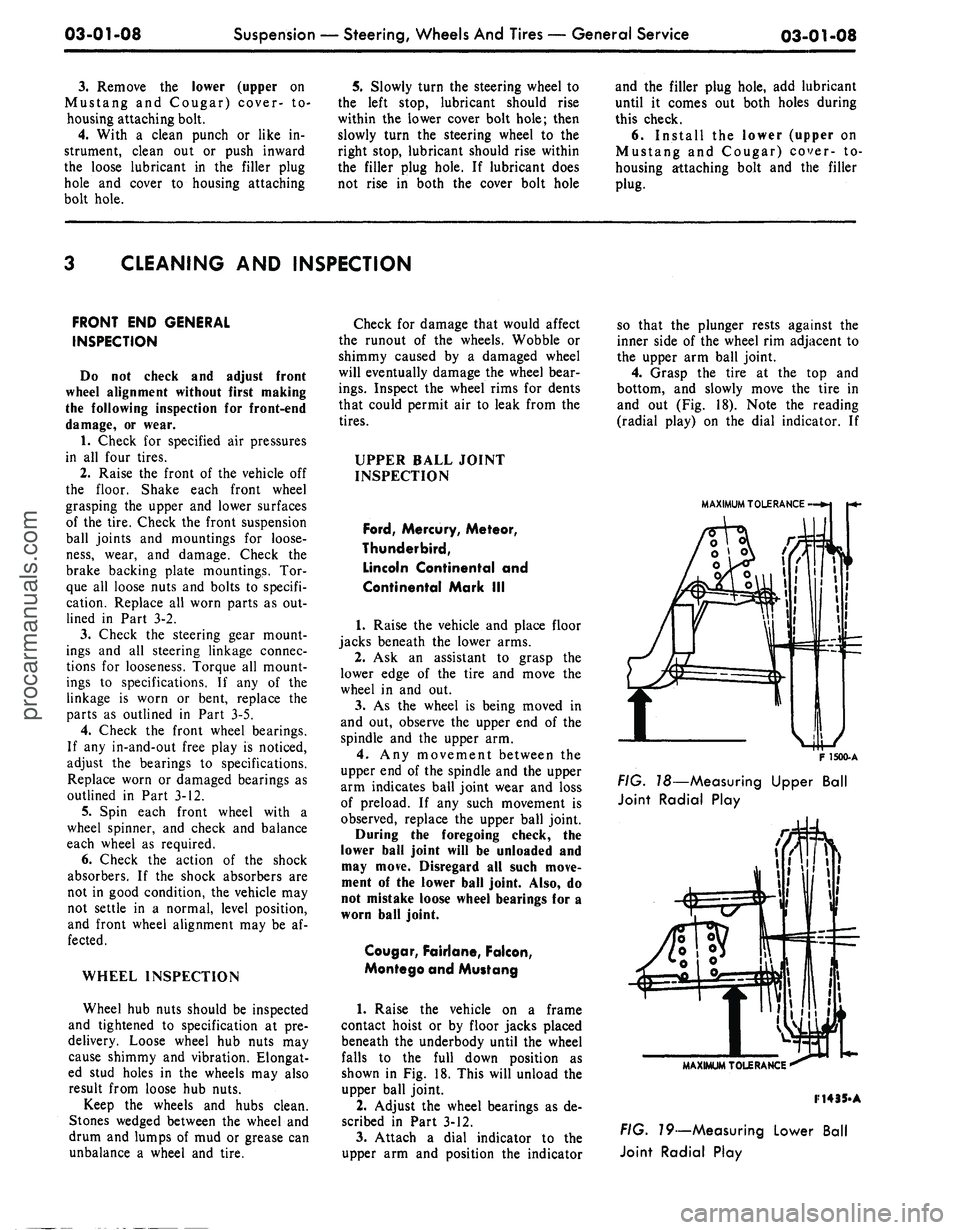
1.
Raise the vehicle on a frame
contact hoist or by floor jacks placed
beneath the underbody until the wheel
falls to the full down position as
shown in Fig. 18. This will unload the
upper ball joint.
2.
Adjust the wheel bearings as de-
scribed in Part 3-12.
3.
Attach a dial indicator to the
upper arm and position the indicator
so that the plunger rests against the
inner side of the wheel rim adjacent to
the upper arm ball joint.
4.
Grasp the tire at the top and
bottom, and slowly move the tire in
and out (Fig. 18). Note the reading
(radial play) on the dial indicator. If
MAXIMUM TOLERANCE
F
1500-A
FIG.
T8—Measuring Upper Ball
Joint Radial Play
MAXIMUM TOLERANCE
F14
35-A
FIG.
79—Measuring Lower Ball
Joint Radial Playprocarmanuals.com
Page 122 of 413
03-05-09
Steering Columns And Linkage
03-05-09
FAIRLANE, FALCON
AND MONTEGO
Removal
1.
Disconnect the battery cable
from the negative post.
2.
Disconnect the turn signal switch
wires at the connector.
3.
Disconnect the neutral start
siwtch (with automatic transmission)
and back-up light switch wires from
the switches.
4.
Disconnect the transmission con-
trol rod(s) from the lever(s) at the
lower end of the column.
5.
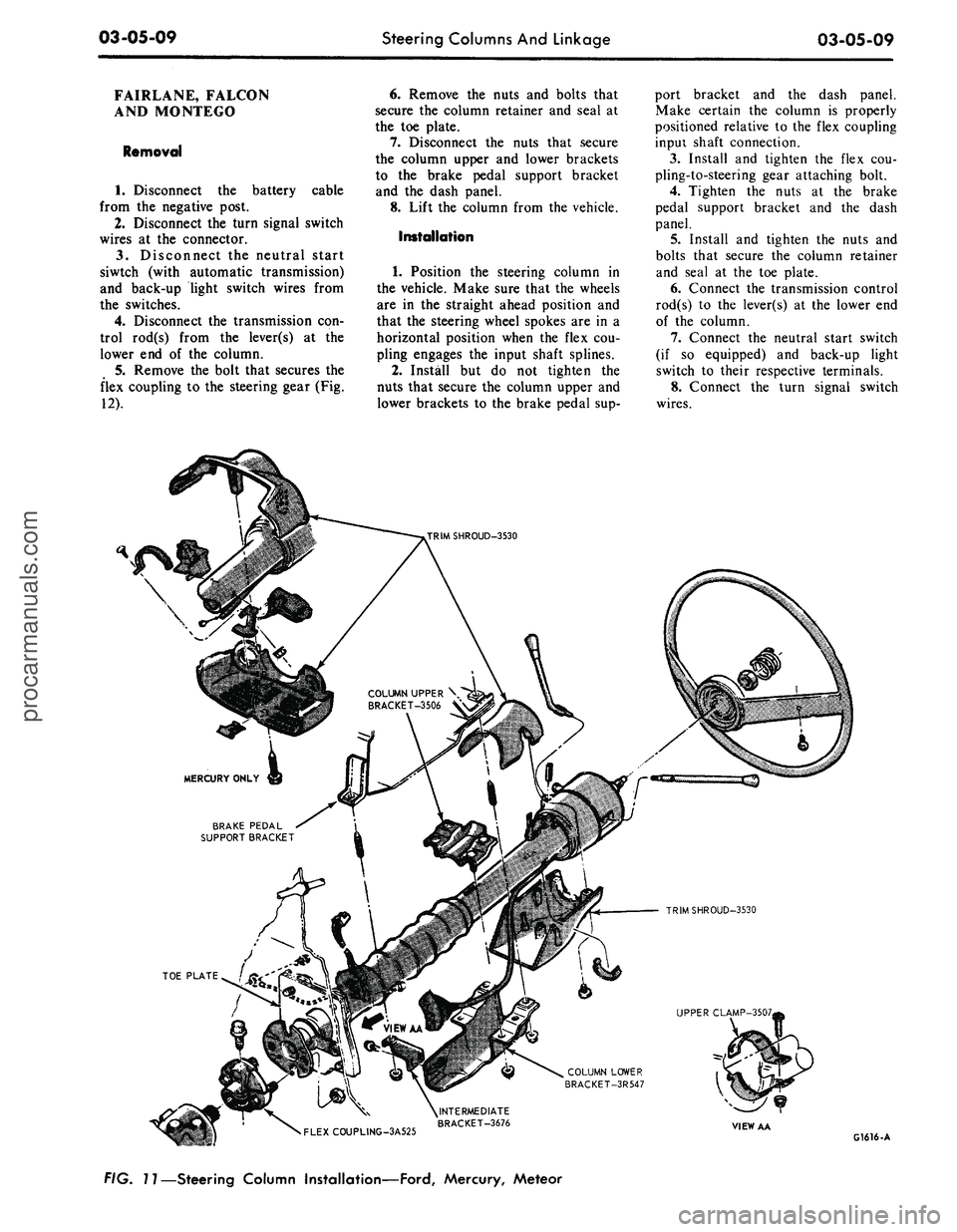
Remove the bolt that secures the
flex coupling to the steering gear (Fig.
12).
6. Remove the nuts and bolts that
secure the column retainer and seal at
the toe plate.
7.
Disconnect the nuts that secure
the column upper and lower brackets
to the brake pedal support bracket
and the dash panel.
8. Lift the column from the vehicle.
Installation
1.
Position the steering column in
the vehicle. Make sure that the wheels
are in the straight ahead position and
that the steering wheel spokes are in a
horizontal position when the flex cou-
pling engages the input shaft splines.
2.
Install but do not tighten the
nuts that secure the column upper and
lower brackets to the brake pedal sup-
port bracket and the dash panel.
Make certain the column is properly
positioned relative to the flex coupling
inpui shaft connection.
3.
Install and tighten the flex cou-
pling-to-steering gear attaching bolt.
4.
Tighten the nuts at the brake
pedal support bracket and the dash
panel.
5.
Install and tighten the nuts and
bolts that secure the column retainer
and seal at the toe plate.
6. Connect the transmission control
rod(s) to the lever(s) at the lower end
of the column.
7.
Connect the neutral start switch
(if so equipped) and back-up light
switch to their respective terminals.
8. Connect the turn signal switch
wires.
COLUMN UPPER \
BRACKET-3506 V
BRAKE PEDAL
SUPPORT BRACKET
TRIMSHROUD-3530
UPPER CLAMP-3507,
COLUMN LOWER
BRACKET-3R547
•
FLEXCOUPLING-3A525
^INTERMEDIATE
BRACKET-3676
VIEW AA
G1616-A
FIG. 11—Steering Column Installation—Ford, Mercury, Meteorprocarmanuals.com