belt FORD MUSTANG 2001 4.G Owner's Manual
[x] Cancel search | Manufacturer: FORD, Model Year: 2001, Model line: MUSTANG, Model: FORD MUSTANG 2001 4.GPages: 240, PDF Size: 2.11 MB
Page 95 of 240
provide a shorter, firmer seating cushion that
encourages safer seating posture and better fit of lap
and shoulder belts on the child.
A belt-positioning booster should be used if the
shoulder belt rests in front of the child's face or
neck, or if the lap belt does not fit snugly on both
thighs, or if the thighs are too short to let the child
sit all the way back on the seat cushion when the
lower legs hang over the edge of the seat cushion.
You may wish to discuss the special needs of your
child with your pediatrician.
SAFETY SEATS FOR CHILDREN
Child and infant or child safety seats
Use a safety seat that is recommended for the size
and weight of the child. Carefully follow all of the
manufacturer's instructions with the safety seat you
put in your vehicle. If you do not install and use the
safety seat properly, the child may be injured in a
sudden stop or collision.
Seating and safety restraints
95
Page 96 of 240
When installing a child safety seat:
²Review and follow
the information
presented in theAir
Bag Supplemental
Restraint System
section in this
chapter.
²Use the correct
safety belt buckle for that seating position (the
buckle closest to the direction the tongue is
coming from).
²Insert the belt tongue into the proper buckle until
you hear a snap and feel it latch. Make sure the
tongue is securely fastened in the buckle.
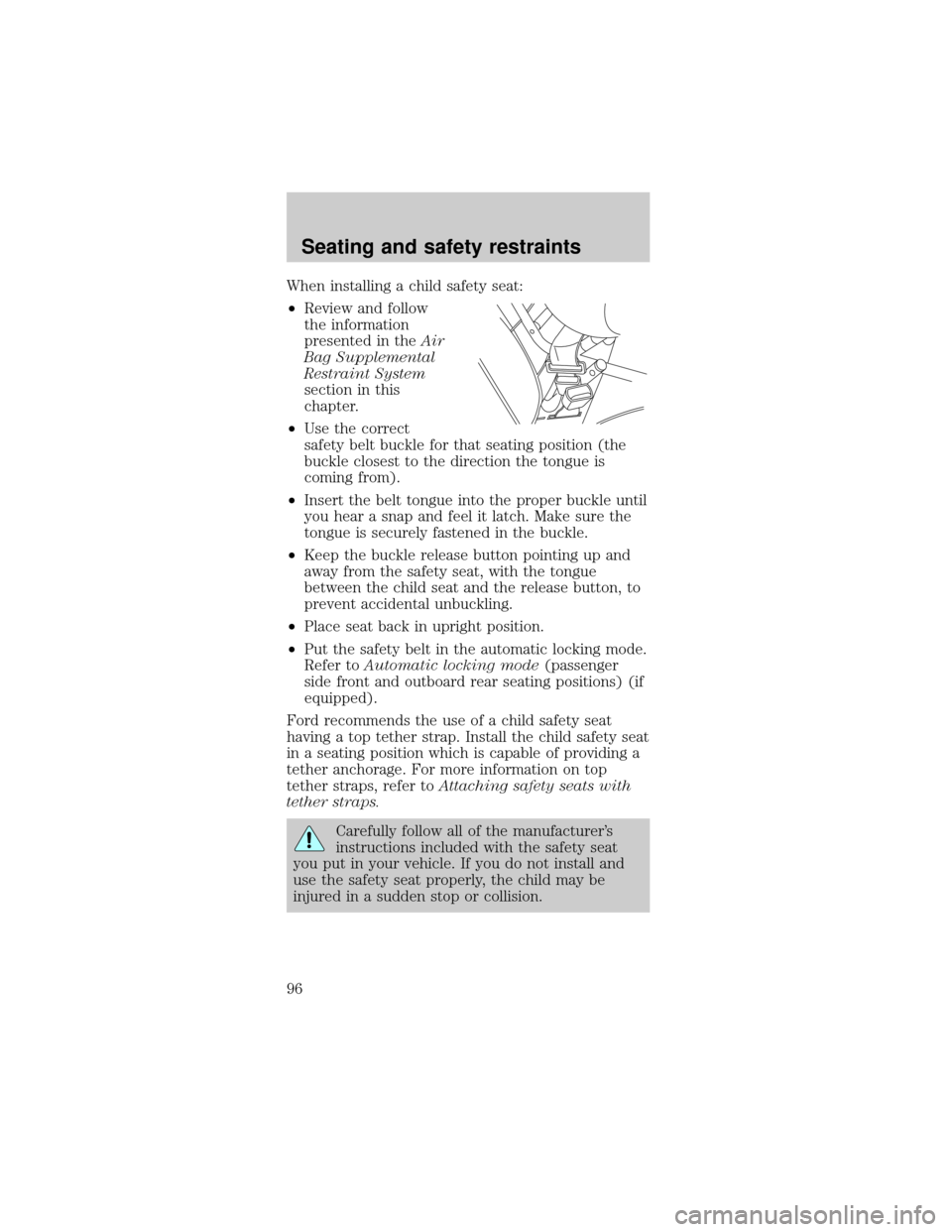
²Keep the buckle release button pointing up and
away from the safety seat, with the tongue
between the child seat and the release button, to
prevent accidental unbuckling.
²Place seat back in upright position.
²Put the safety belt in the automatic locking mode.
Refer toAutomatic locking mode(passenger
side front and outboard rear seating positions) (if
equipped).
Ford recommends the use of a child safety seat
having a top tether strap. Install the child safety seat
in a seating position which is capable of providing a
tether anchorage. For more information on top
tether straps, refer toAttaching safety seats with
tether straps.
Carefully follow all of the manufacturer's
instructions included with the safety seat
you put in your vehicle. If you do not install and
use the safety seat properly, the child may be
injured in a sudden stop or collision.
Seating and safety restraints
96
Page 97 of 240
Installing child safety seats in combination lap
and shoulder belt seating positions
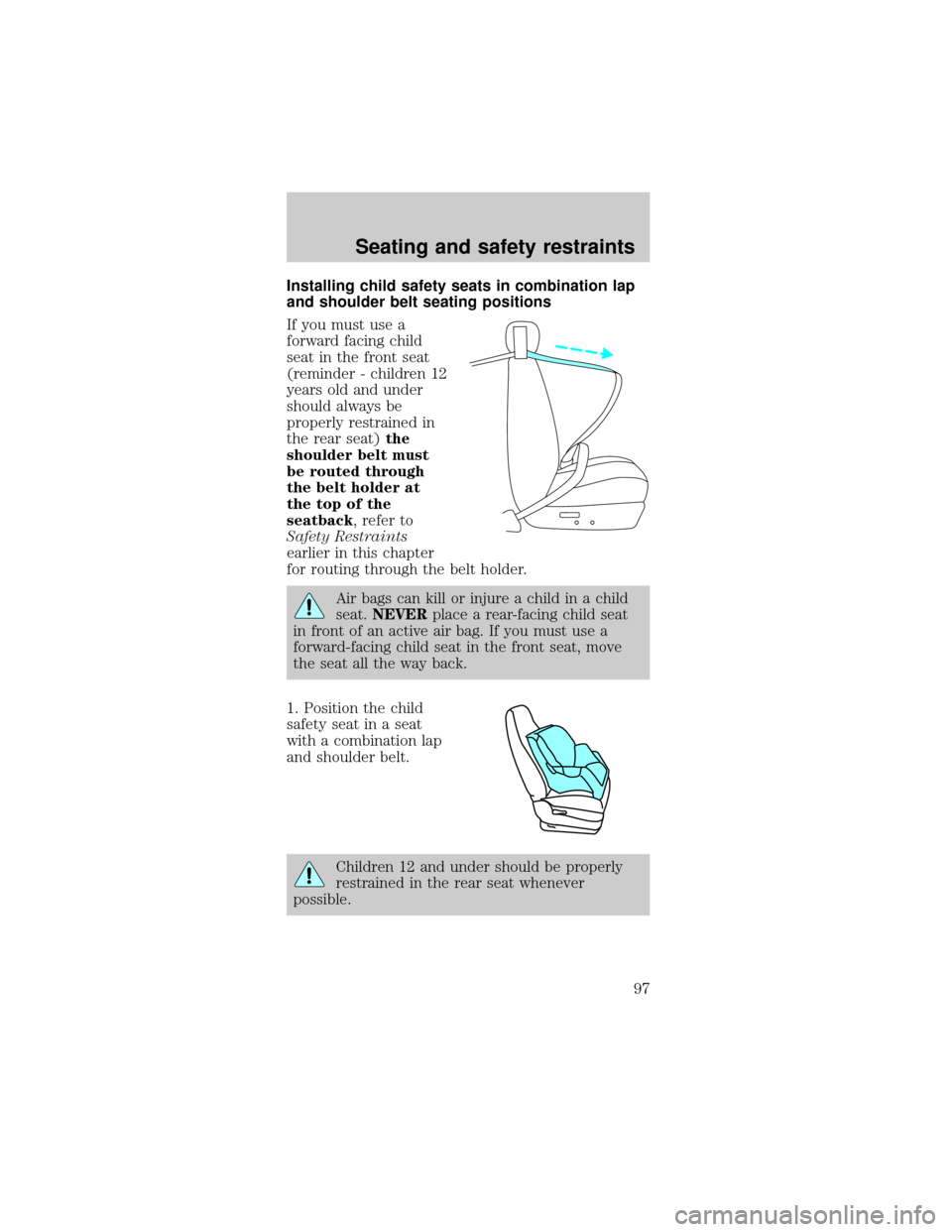
If you must use a
forward facing child
seat in the front seat
(reminder - children 12
years old and under
should always be
properly restrained in
the rear seat)the
shoulder belt must
be routed through
the belt holder at
the top of the
seatback, refer to
Safety Restraints
earlier in this chapter
for routing through the belt holder.
Air bags can kill or injure a child in a child
seat.NEVERplace a rear-facing child seat
in front of an active air bag. If you must use a
forward-facing child seat in the front seat, move
the seat all the way back.
1. Position the child
safety seat in a seat
with a combination lap
and shoulder belt.
Children 12 and under should be properly
restrained in the rear seat whenever
possible.
Seating and safety restraints
97
Page 98 of 240
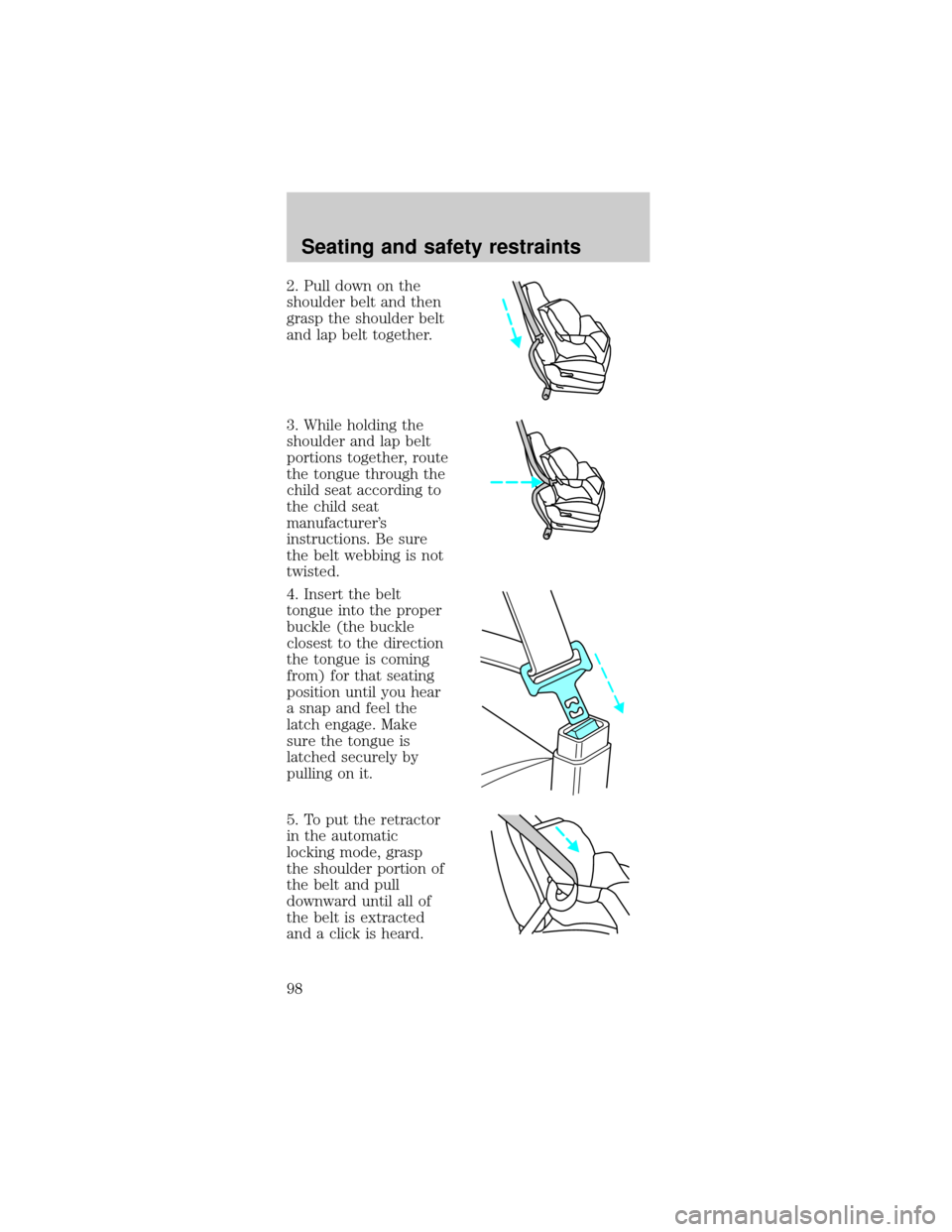
2. Pull down on the
shoulder belt and then
grasp the shoulder belt
and lap belt together.
3. While holding the
shoulder and lap belt
portions together, route
the tongue through the
child seat according to
the child seat
manufacturer's
instructions. Be sure
the belt webbing is not
twisted.
4. Insert the belt
tongue into the proper
buckle (the buckle
closest to the direction
the tongue is coming
from) for that seating
position until you hear
a snap and feel the
latch engage. Make
sure the tongue is
latched securely by
pulling on it.
5. To put the retractor
in the automatic
locking mode, grasp
the shoulder portion of
the belt and pull
downward until all of
the belt is extracted
and a click is heard.
Seating and safety restraints
98
Page 99 of 240
6. Allow the belt to retract. The belt will click as it
retracts to indicate it is in the automatic locking
mode.
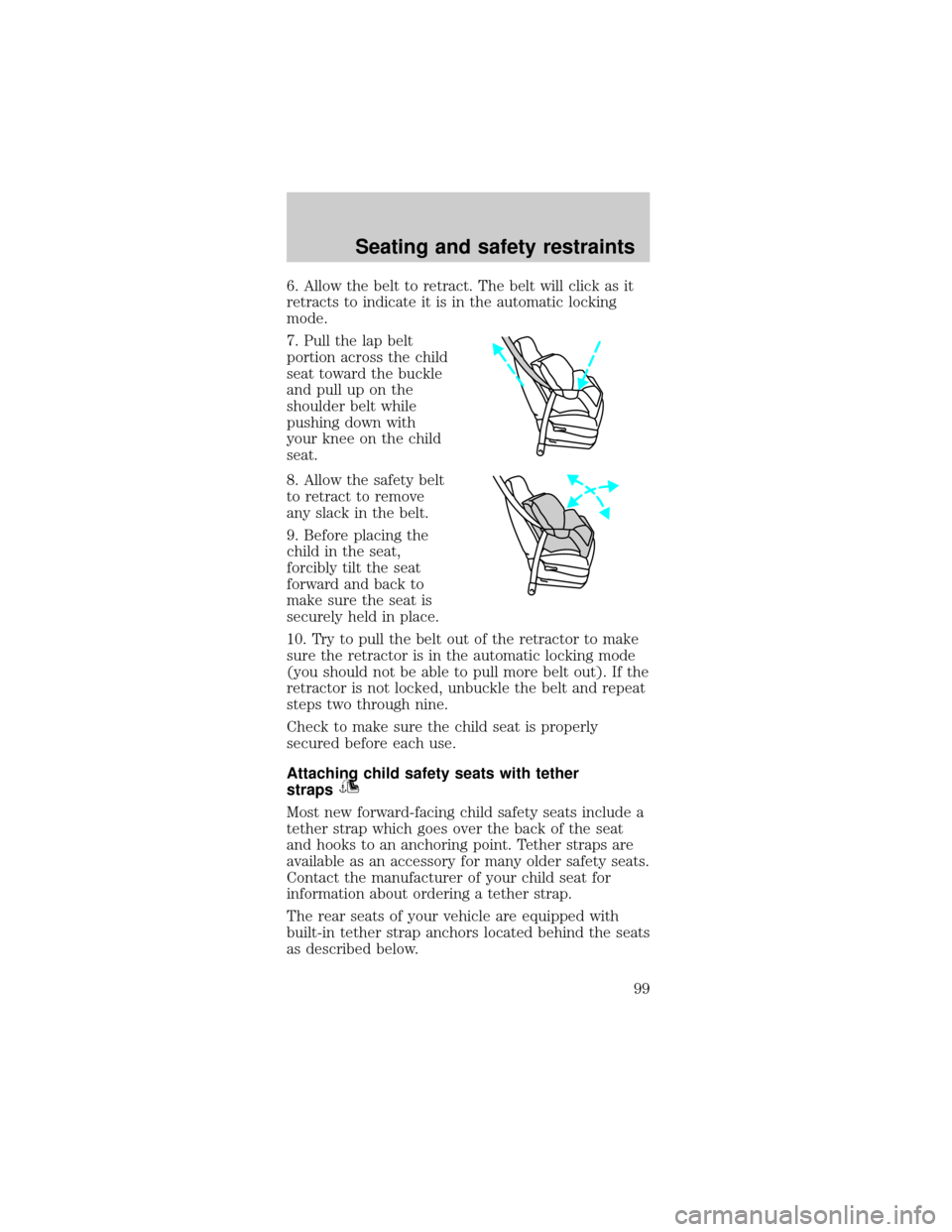
7. Pull the lap belt
portion across the child
seat toward the buckle
and pull up on the
shoulder belt while
pushing down with
your knee on the child
seat.
8. Allow the safety belt
to retract to remove
any slack in the belt.
9. Before placing the
child in the seat,
forcibly tilt the seat
forward and back to
make sure the seat is
securely held in place.
10. Try to pull the belt out of the retractor to make
sure the retractor is in the automatic locking mode
(you should not be able to pull more belt out). If the
retractor is not locked, unbuckle the belt and repeat
steps two through nine.
Check to make sure the child seat is properly
secured before each use.
Attaching child safety seats with tether
straps
Most new forward-facing child safety seats include a
tether strap which goes over the back of the seat
and hooks to an anchoring point. Tether straps are
available as an accessory for many older safety seats.
Contact the manufacturer of your child seat for
information about ordering a tether strap.
The rear seats of your vehicle are equipped with
built-in tether strap anchors located behind the seats
as described below.
Seating and safety restraints
99
Page 102 of 240
If the tether strap is clipped incorrectly, the
child safety seat may not be retained
properly in the event of a collision.
6. Refer to theInstalling child safety seats in
combination lap and shoulder belt seating
positionssection of this chapter for further
instructions to secure the child safety seat.
7. Tighten the child safety seat tether strap
according to the manufacturer's instructions.
If the safety seat is not anchored properly,
the risk of a child being injured in a collision
greatly increases.
Seating and safety restraints
102
Page 104 of 240
Important safety precautions
A computer system controls the engine's idle
revolutions per minute (RPM). When the engine
starts, the idle RPM runs faster to warm the engine.
If the engine idle speed does not slow down
automatically, have the vehicle checked. Do not
allow the vehicle to idle for more than 10 minutes at
high engine RPM.
Before starting the vehicle:
1. Make sure all vehicle occupants have buckled
their safety belts. For more information on safety
belts and their proper usage, refer to theSeating
and safety restraintschapter.
2. Make sure the headlamps and vehicle accessories
are off.
If starting a vehicle with an automatic transmission:
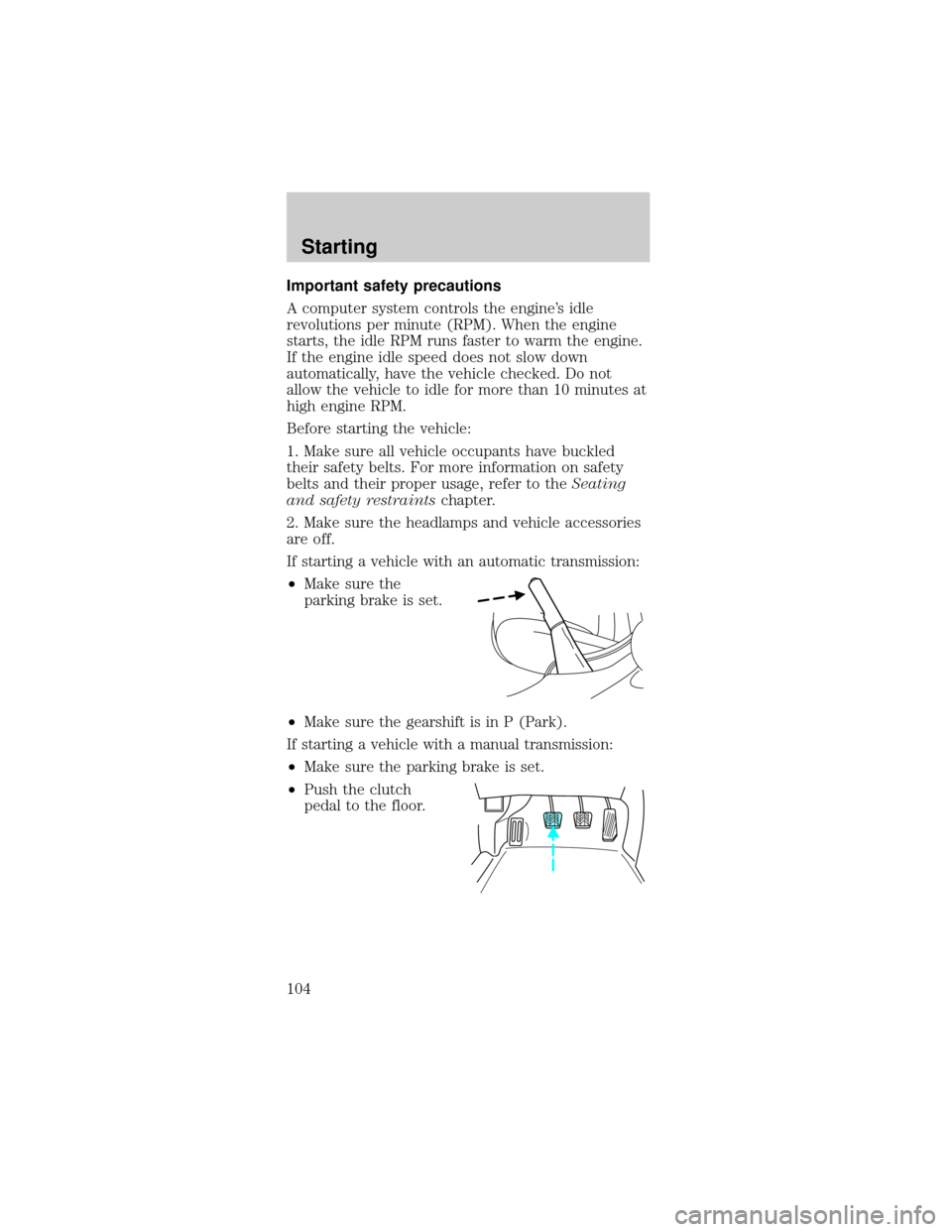
²Make sure the
parking brake is set.
²Make sure the gearshift is in P (Park).
If starting a vehicle with a manual transmission:
²Make sure the parking brake is set.
²Push the clutch
pedal to the floor.
Starting
104
Page 105 of 240
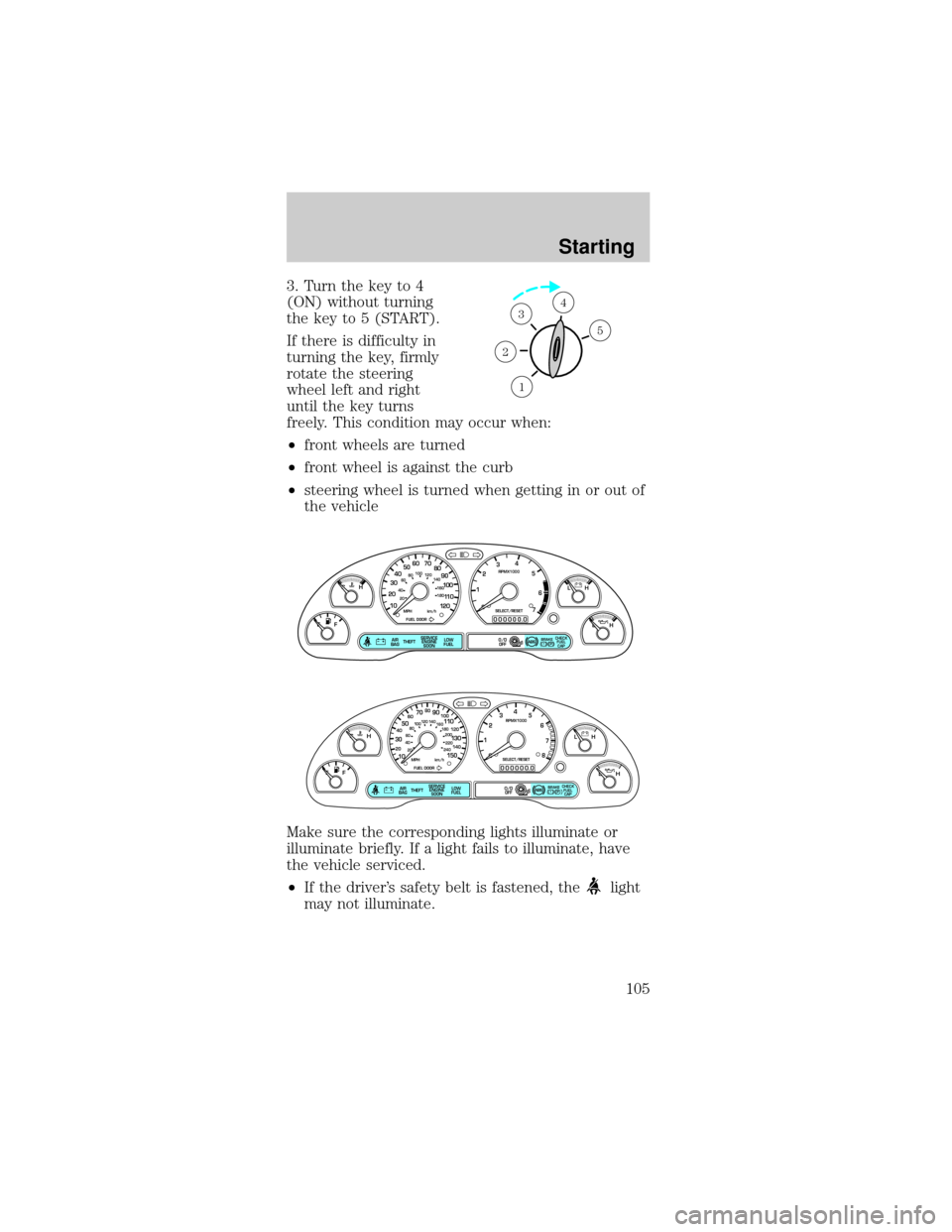
3. Turn the key to 4
(ON) without turning
the key to 5 (START).
If there is difficulty in
turning the key, firmly
rotate the steering
wheel left and right
until the key turns
freely. This condition may occur when:
²front wheels are turned
²front wheel is against the curb
²steering wheel is turned when getting in or out of
the vehicle
Make sure the corresponding lights illuminate or
illuminate briefly. If a light fails to illuminate, have
the vehicle serviced.
²If the driver's safety belt is fastened, the
light
may not illuminate.
1
2
34
5
P! BRAKE
L
0
00000 00
C
E
FH
LH
10 203020 406080100
120
140
160
180
405060 70
80
90
100
11 0
1204
5
6
7 3
2
1
H
THEFT
RPMX1000
FUEL DOORSELECT/RESET
LOW
FUELO/D
OFF AIR
BAGSERVICE
ENGINE
SOON
MPH km/h
ABS
.
CHECK
FUEL
CAP
P! BRAKE
L
0
00000 00
C
E
FH
LH
102040608020 40608010 012 0 14 0
160
180
200
220
240
100
120
140
305070 90
110
13 0
1504
5
6
7
8 3
2
1
H
THEFT
RPMX1000
FUEL DOORSELECT/RESET
LOW
FUELO/D
OFF AIR
BAGSERVICE
ENGINE
SOON
MPH km/h
ABS
.
CHECK
FUEL
CAP
Starting
105
Page 144 of 240
Do not connect the end of the second cable
to the negative (-) terminal of the battery to
be jumped. A spark may cause an explosion of the
gases that surround the battery.
5. Ensure that the cables are clear of fan blades,
belts, moving parts of both engines, or any fuel
delivery system parts.
Jump starting
1. Start the engine of the booster vehicle and run
the engine at moderately increased speed.
2. Start the engine of the disabled vehicle.
3. Once the disabled vehicle has been started, run
both engines for an additional three minutes before
disconnecting the jumper cables.
Removing the jumper cables
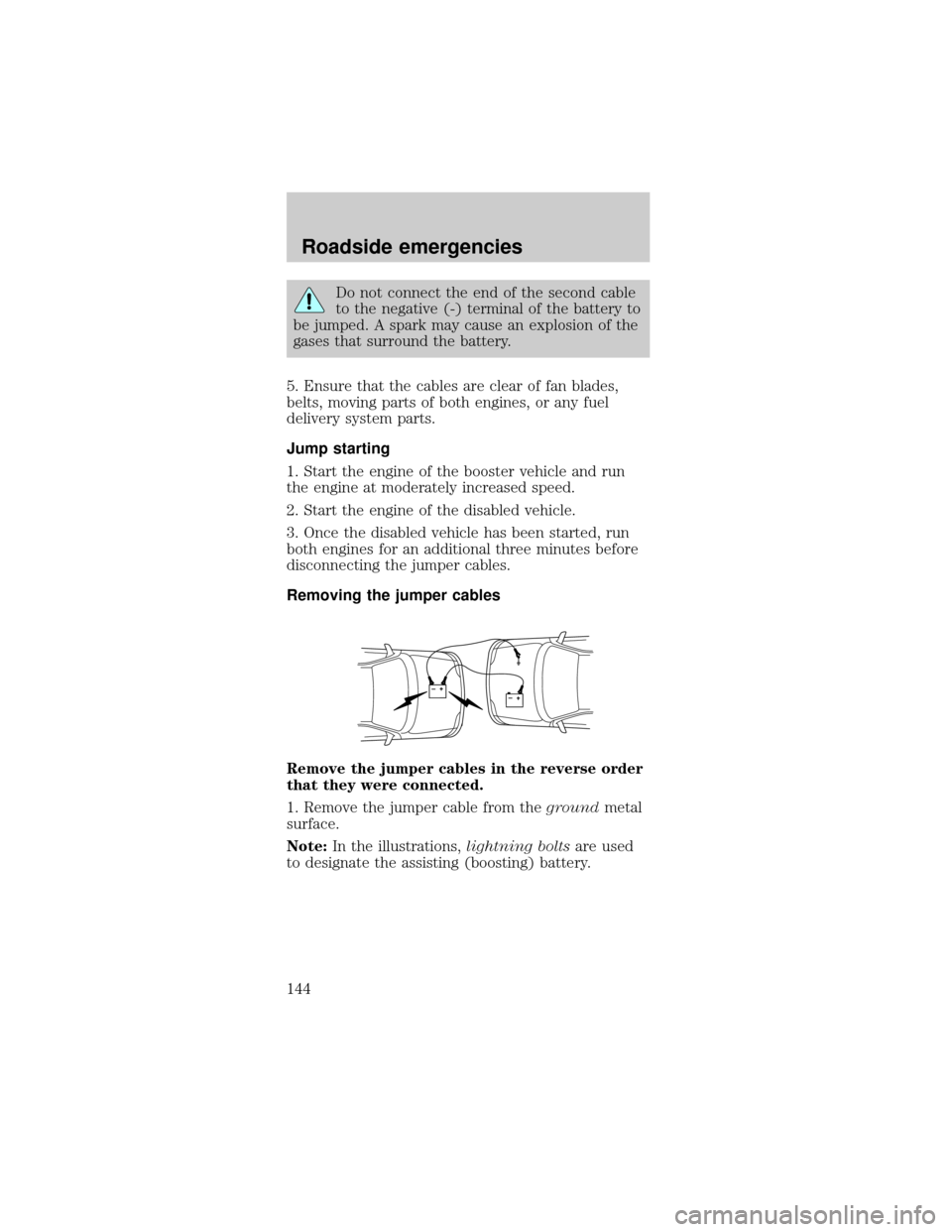
Remove the jumper cables in the reverse order
that they were connected.
1. Remove the jumper cable from thegroundmetal
surface.
Note:In the illustrations,lightning boltsare used
to designate the assisting (boosting) battery.
+–+–
Roadside emergencies
144
Page 146 of 240
will not effect function or durability of the
transmission. Over time, the adaptive learning
process will fully update transmission operation to
its optimum shift feel.
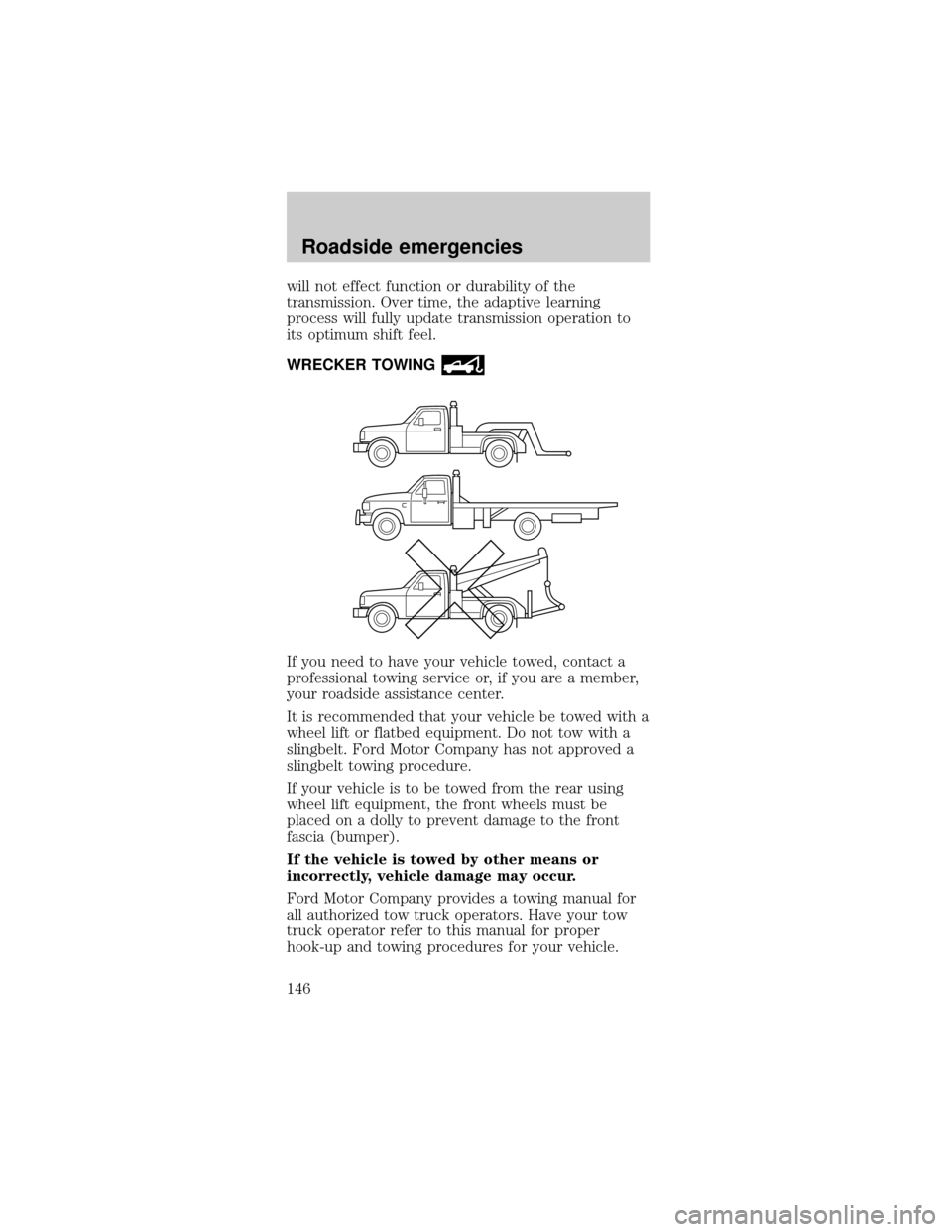
WRECKER TOWING
If you need to have your vehicle towed, contact a
professional towing service or, if you are a member,
your roadside assistance center.
It is recommended that your vehicle be towed with a
wheel lift or flatbed equipment. Do not tow with a
slingbelt. Ford Motor Company has not approved a
slingbelt towing procedure.
If your vehicle is to be towed from the rear using
wheel lift equipment, the front wheels must be
placed on a dolly to prevent damage to the front
fascia (bumper).
If the vehicle is towed by other means or
incorrectly, vehicle damage may occur.
Ford Motor Company provides a towing manual for
all authorized tow truck operators. Have your tow
truck operator refer to this manual for proper
hook-up and towing procedures for your vehicle.
Roadside emergencies
146