wheel FORD MUSTANG 2001 4.G Owner's Manual
[x] Cancel search | Manufacturer: FORD, Model Year: 2001, Model line: MUSTANG, Model: FORD MUSTANG 2001 4.GPages: 240, PDF Size: 2.11 MB
Page 167 of 240
5. If the fluid is low, add fluid in small amounts,
continuously checking the level until it reaches the
correct operating range. Be sure to put the cap back
on the reservoir.
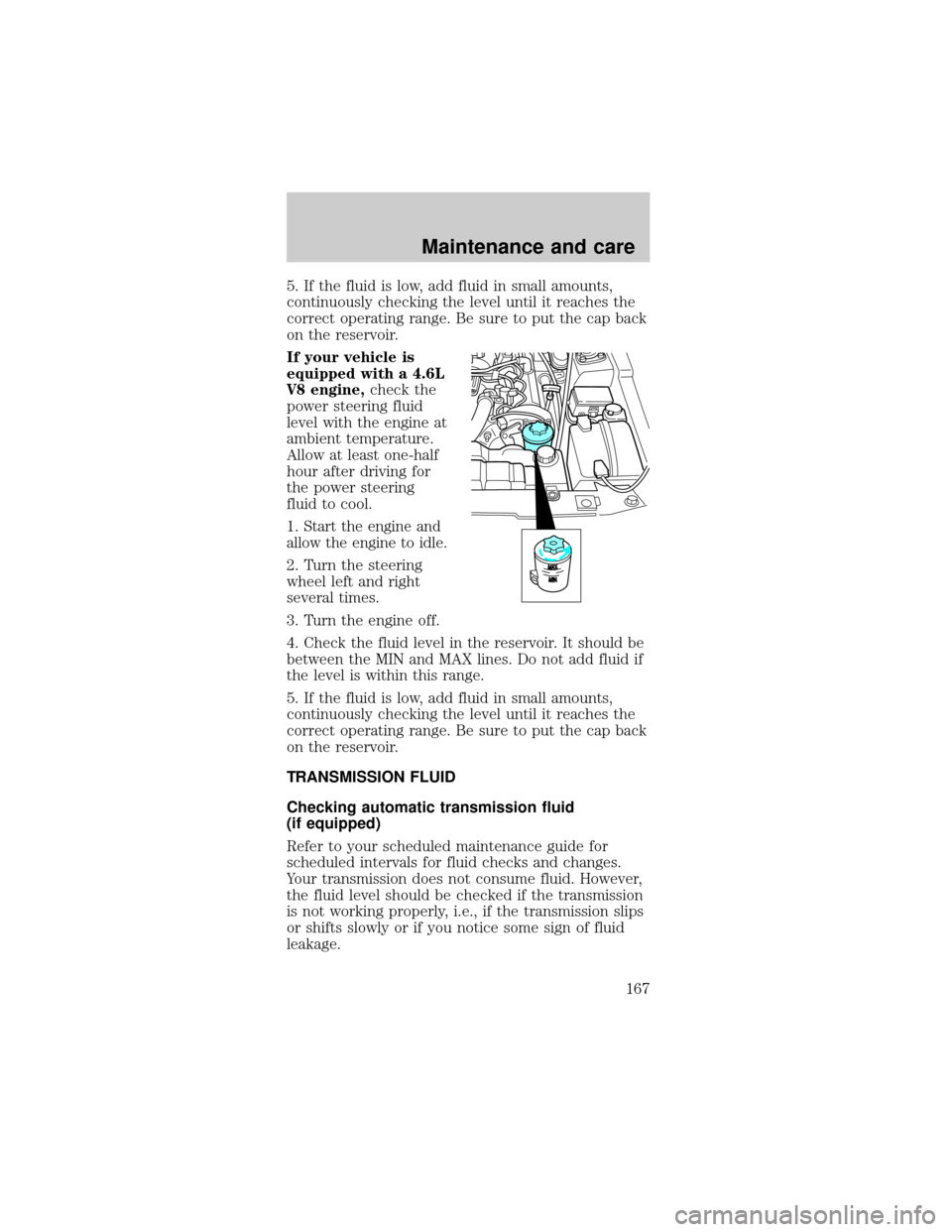
If your vehicle is
equipped with a 4.6L
V8 engine,check the
power steering fluid
level with the engine at
ambient temperature.
Allow at least one-half
hour after driving for
the power steering
fluid to cool.
1.
Start the engine and
allow the engine to idle.
2. Turn the steering
wheel left and right
several times.
3. Turn the engine off.
4. Check the fluid level in the reservoir. It should be
between the MIN and MAX lines. Do not add fluid if
the level is within this range.
5. If the fluid is low, add fluid in small amounts,
continuously checking the level until it reaches the
correct operating range. Be sure to put the cap back
on the reservoir.
TRANSMISSION FLUID
Checking automatic transmission fluid
(if equipped)
Refer to your scheduled maintenance guide for
scheduled intervals for fluid checks and changes.
Your transmission does not consume fluid. However,
the fluid level should be checked if the transmission
is not working properly, i.e., if the transmission slips
or shifts slowly or if you notice some sign of fluid
leakage.MAXMIN
Maintenance and care
167
Page 176 of 240
Traction AA A B C
The traction grades, from highest to lowest are AA,
A, B, and C. Those grades represent the tire's ability
to stop on wet pavement as measured under
controlled conditions on specified government test
surfaces of asphalt and concrete. A tire marked C
may have poor traction performance.
The traction grade assigned to this tire is
based on straight-ahead braking traction
tests, and does not include acceleration, cornering,
hydroplaning or peak traction characteristics.
Temperature A B C
The temperature grades are A (the highest), B, and
C, representing the tire's resistance to the
generation of heat and its ability to dissipate heat
when tested under controlled conditions on a
specified indoor laboratory test wheel. Sustained
high temperature can cause the material of the tire
to degenerate and reduce tire life, and excessive
temperature can lead to sudden tire failure. The
grade C corresponds to a level of performance which
all passenger car tires must meet under the Federal
Motor Vehicle Safety Standard No. 109. Grades B
and A represent higher levels of performance on the
laboratory test wheel than the minimum required by
law.
The temperature grade for this tire is
established for a tire that is properly inflated
and not overloaded. Excessive speed,
underinflation, or excessive loading, either
separately or in combination, can cause heat
buildup and possible tire failure.
Maintenance and care
176
Page 179 of 240
Failure to follow these precautions may
adversely affect the handling of the vehicle
and make it easier for the driver to lose control
and roll over.
Tires that are larger or smaller than your vehicle's
original tires may also affect the accuracy of your
speedometer.
SNOW TIRES AND CHAINS
Driving too fast for conditions creates the
possibility of loss of vehicle control. Driving
at very high speeds for extended periods of time
may result in damage to vehicle components.
Snow tires must be the same size and grade
as the tires you currently have on your
vehicle.
The tires on your vehicle have all weather treads to
provide traction in rain and snow. However, in some
climates, you may need to use snow tires and chains.
Use chains on the tires only in an emergency or if the
law requires them.
Follow these guidelines when using snow tires and
chains:
²Chains may damage aluminum wheels.
²Use only Cable Type chains with size P225/55R16
or 245/45ZR17 tires. Use of SAE Class S chains
may damage your vehicle.
²SAE Class S chains may be used on P205/65R15
tires.
²Install chains securely, verifying that the chains do
not touch any wiring, brake lines or fuel lines.
²Drive cautiously. If you hear the chains rub or
bang against your vehicle, stop and re-tighten the
chains. If this does not work, remove the chains
to prevent damage to your vehicle.
Maintenance and care
179
Page 189 of 240

²Warming up a vehicle on cold mornings is not
required and may reduce fuel economy.
²Resting your foot on the brake pedal while driving
may reduce fuel economy.
²Combine errands and minimize stop-and-go
driving.
Maintenance
²Keep tires properly inflated and use only
recommended size.
²Operating a vehicle with the wheels out of
alignment will reduce fuel economy.
²Use recommended engine oil. Refer toLubricant
specifications.
²Perform all regularly scheduled maintenance
items. Follow the recommended maintenance
schedule and owner maintenance checks found in
your vehicle scheduled maintenance guide.
Conditions
²Heavily loading a vehicle or towing a trailer may
reduce fuel economy at any speed.
²Carrying unnecessary weight may reduce fuel
economy (approximately 0.4 km/L [1 mpg] is lost
for every 180 kg [400 lb] of weight carried).
²Adding certain accessories to your vehicle (for
example bug deflectors, rollbars/light bars,
running boards, ski/luggage racks) may reduce
fuel economy.
²Using fuel blended with alcohol may lower fuel
economy.
²Fuel economy may decrease with lower
temperatures during the first 12±16 km (8±10
miles) of driving.
²Driving on flat terrain offers improved fuel
economy as compared to driving on hilly terrain.
²Transmissions give their best fuel economy when
operated in the top cruise gear and with steady
pressure on the gas pedal.
²Close windows for high speed driving.
Maintenance and care
189
Page 201 of 240

Remove particles such as bird droppings, tree sap,
insect remains, tar spots, road salt and industrial
fallout immediately.
Cleaning the wheels
Wash with the same detergent as the body of your
vehicle. Do not use acid-based or alcohol-based
wheel cleaners, steel wool, fuel or strong detergents.
Never use abrasives that will damage the finish of
special wheel surfaces. Use a tar remover to remove
grease and tar.
The brushes used in some automatic car washes may
damage the finish on your wheels. Before going to a
car wash, find out if the brushes are abrasive.
Cleaning non-painted plastic exterior parts
Use vinyl cleaner for routine cleaning. Clean with a
tar remover if necessary. Do not clean plastic parts
with thinners, solvents or petroleum-based cleaners.
Cleaning mirrors
Do not clean your mirrors with a dry cloth or
abrasive materials. Use a soft cloth and mild
detergent and water. Be careful when removing ice
from outside mirrors because you may damage the
reflective surface.
Cleaning the exterior lamps
Wash with the same detergent as the exterior of
your vehicle. If necessary, use a tar remover such as
Ford Extra Strength Tar and Road Oil Remover
(B7A-19520±AA).
To avoid scratching the lamps, do not use a dry
paper towel, chemical solvents or abrasive cleaners.
Maintenance and care
201
Page 204 of 240
Cleaning the instrument panel
Clean with a damp cloth, then dry with a dry cloth.
Avoid cleaner or polish that increases the gloss of
the upper portion of the instrument panel. The dull
finish in this area helps protect the driver from
undesirable windshield reflection.
Do not use chemical solvents or strong
detergents when cleaning the steering wheel
or instrument panel to avoid contamination of the
air bag system.
Cleaning the instrument cluster lens
Clean with a damp cloth, then dry with a dry cloth.
Do not use household or glass cleaners as these may
damage the lens.
Cleaning seats equipped with side air bags
Remove dust and loose dirt with a whisk broom or a
vacuum cleaner. Remove fresh spots immediately.
Follow the directions that come with the cleaner. Do
not saturate the seat cover with upholstery cleaner.
Do not use chemical solvents or strong
detergents when cleaning the seat mounted
side air bag. Such products could contaminate the
side air bag system and affect performance of the
side air bag in a collision.
Inside windows
Use Ultra-Clear Spray Glass Cleaner
(E4AZ-19C507±AA) for the inside windows if they
become fogged.
Cleaning and maintaining the safety belts
Clean the safety belts with a mild soap solution
recommended for cleaning upholstery or carpets. Do
not bleach or dye the belts, because these actions
may weaken the belt webbing.
Maintenance and care
204
Page 210 of 240
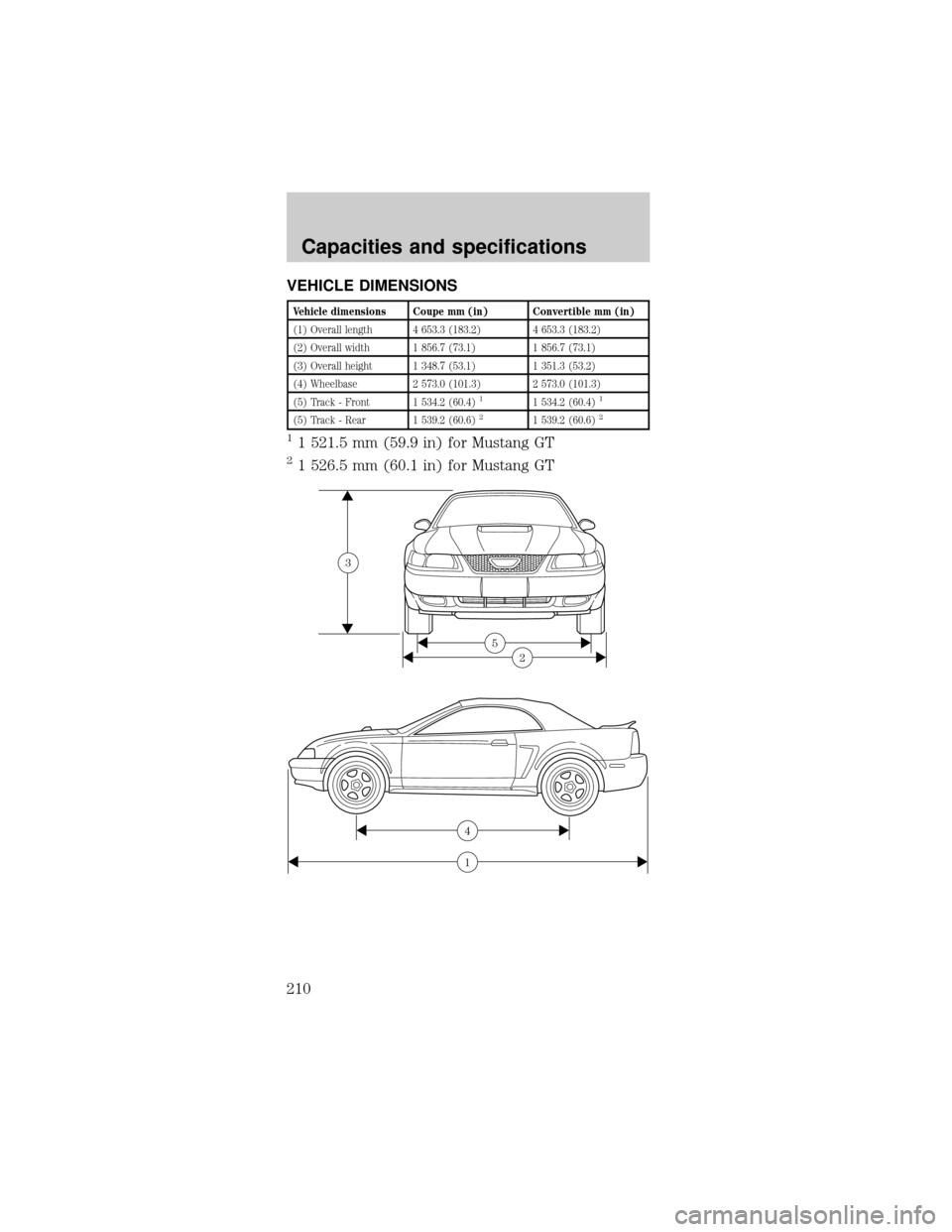
VEHICLE DIMENSIONS
Vehicle dimensions Coupe mm (in) Convertible mm (in)
(1) Overall length 4 653.3 (183.2) 4 653.3 (183.2)
(2) Overall width 1 856.7 (73.1) 1 856.7 (73.1)
(3) Overall height 1 348.7 (53.1) 1 351.3 (53.2)
(4) Wheelbase 2 573.0 (101.3) 2 573.0 (101.3)
(5) Track - Front 1 534.2 (60.4)
11 534.2 (60.4)1
(5) Track - Rear 1 539.2 (60.6)21 539.2 (60.6)2
11 521.5 mm (59.9 in) for Mustang GT
21 526.5 mm (60.1 in) for Mustang GT
25
3
4
1
Capacities and specifications
210
Page 223 of 240

Not all accessories are available for all models.
Vehicle Security
Styled wheel locks
Vehicle security systems
Comfort and convenience
Ash Cup
Cargo nets
Cargo organizers
Dash trim
Electrochromic mirror with compass
Electrochromic mirror with compass and
temperature display
Engine block heaters
Travel equipment
Auto headlamps with daytime running lights (DRL)
Cassette holder
Daytime running lights (DRL)
Fog lights
Heavy-duty battery
Removable luggage rack
Removable luggage rack adapters
Soft luggage cover
Speed control
Protection and appearance equipment
Air bag anti-theft locks
Cargo liners, interior
Carpet floor mats
Cleaners, waxes and polishes
Flat splash guards
Customer assistance
223
Page 229 of 240

C
Capacities for refilling
fluids ........................ 206
Cassette tape
player ......................... 34
Certification Label .. 211
Child safety
restraints ................... 94
child safety belts .... 94
Child safety seats ...... 95
attaching with tether
straps ....................... 99
in front seat ............ 97
in rear seat .............. 97
Cleaning your
vehicle ...................... 199
engine
compartment ......... 202
exterior .................. 200
exterior lamps ....... 201
instrument
cluster lens ............ 204
instrument panel .. 204
interior ........... 204±205
mirrors ................... 201
plastic parts .......... 201
safety belts ............ 204
washing .................. 199
waxing ................... 200
wheels .................... 201
windows ................ 204
wiper blades .......... 202
Climate control (see Air
conditioning or
Heating) ..................... 20
Clock .................... 33, 47
Clutch
adjusting ................ 156operation while
driving ................... 119
recommended shift
speeds .................... 120
Console ...................... 59
Controls
power seat ............... 74
Convertible ................ 61
cleaning ................. 202
installation of the
boot .......................... 62
lowering the
convertible top ........ 61
raising the convertible
top ............................ 63
Coolant
checking and
adding .................... 157
refill
capacities ....... 165, 206
specifications. 208±209
Cruise control (see
Speed control) .......... 53
Customer
Assistance ................ 129
Ford accessories for
your vehicle .......... 221
Ford Extended Service
Plan ........................ 212
Getting assistance
outside the U.S. and
Canada ................... 220
Getting roadside
assistance .............. 129
Getting the service
you need ............... 213
Ordering additional
owner's
literature ............... 225
Index
229
Page 234 of 240

Safety seats for
children ...................... 95
Seat belts (see Safety
restraints) .................. 76
Seats .......................... 73
child safety seats .... 95
cleaning ......... 204±205
easy access/easyout
feature ..................... 75
SecuriLock passive
anti-theft
system .................. 67±69
Servicing your
vehicle ...................... 147
Spark plugs,
specifications ........... 206
, 209±210
Special notice .............. 3
Specification chart,
lubricants ......... 208±209
Speed control ............ 53
Speedometer ............. 15
Starting your
vehicle ...... 103±104, 106
jump starting ........ 141
Steering wheel
tilting ....................... 52
T
Tachometer ............... 16
Tires ......... 137, 175±177
changing ........ 137±138
checking the
pressure ................. 177
replacing ................ 178
rotating .................. 177snow tires and
chains .................... 179
tire grades ............. 176
treadwear .............. 175
Towing ..................... 124
recreational
towing .................... 127
trailer towing ........ 124
wrecker .................. 146
Traction
control ............... 50, 111
active light .............. 12
Traction-lok rear
axle .......................... 122
Transmission
automation
operation ............... 113
fluid, checking and
adding
(automatic) ........... 167
fluid, checking and
adding (manual) ... 170
fluid, refill
capacities ............... 206
lubricant
specifications. 208±209
manual operation .. 119
Trip odometer ........... 17
Trunk ......................... 71
remote release .. 50, 65
Turn signal ............ 8, 51
V
Vehicle
dimensions ............... 210
Vehicle Identification
Number (VIN) ......... 211
Index
234