ignition FORD MUSTANG 2001 4.G Owner's Guide
[x] Cancel search | Manufacturer: FORD, Model Year: 2001, Model line: MUSTANG, Model: FORD MUSTANG 2001 4.GPages: 240, PDF Size: 2.11 MB
Page 119 of 240
MANUAL TRANSMISSION OPERATION
(IF EQUIPPED)
Using the clutch
Vehicles equipped with a manual transmission have a
starter interlock that prevents cranking the engine
unless the clutch pedal is fully depressed.
When starting a vehicle with a manual transmission,
you must:
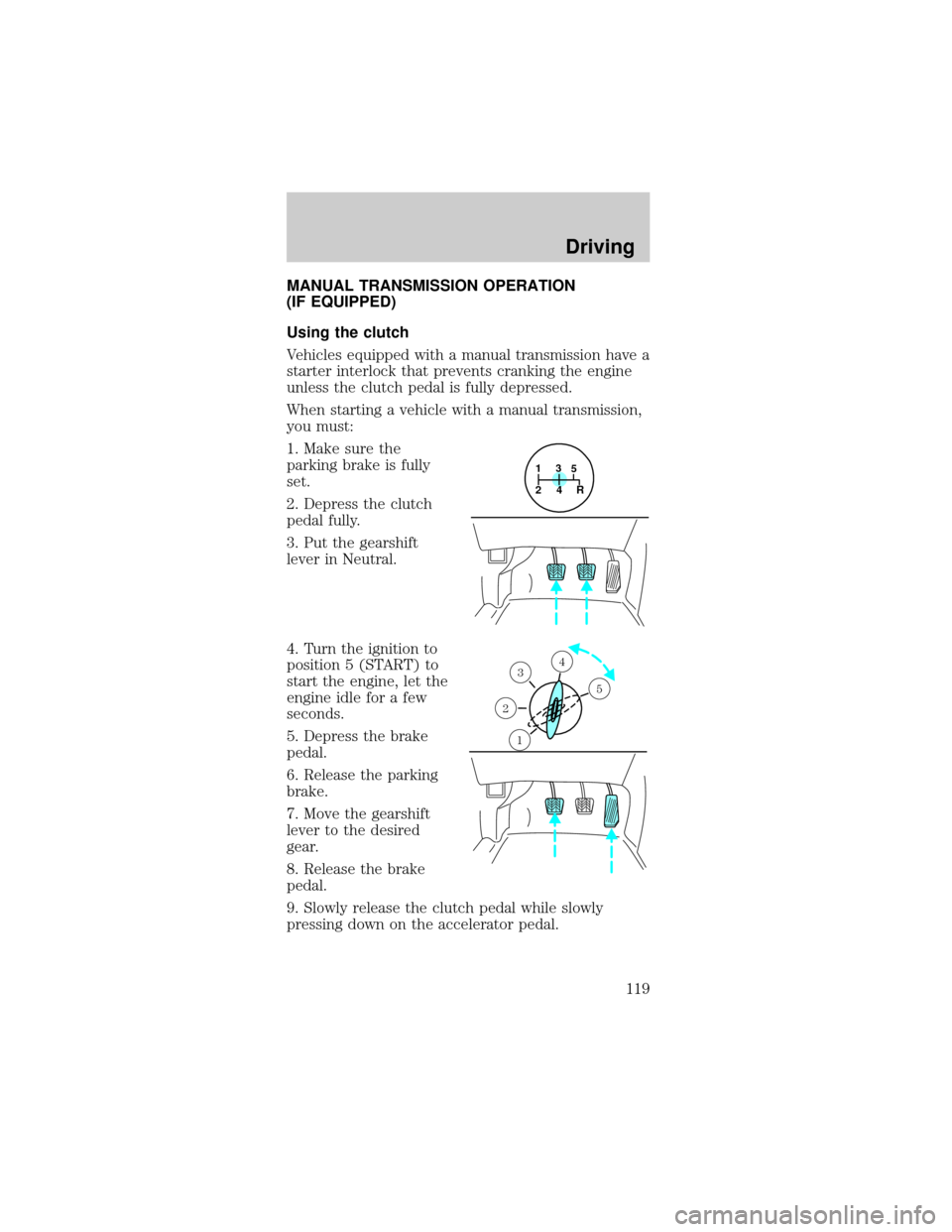
1. Make sure the
parking brake is fully
set.
2. Depress the clutch
pedal fully.
3. Put the gearshift
lever in Neutral.
4. Turn the ignition to
position 5 (START) to
start the engine, let the
engine idle for a few
seconds.
5. Depress the brake
pedal.
6. Release the parking
brake.
7. Move the gearshift
lever to the desired
gear.
8. Release the brake
pedal.
9. Slowly release the clutch pedal while slowly
pressing down on the accelerator pedal.
1
24R3
5
1
2
34
5
Driving
119
Page 121 of 240
4. Turn the ignition key
to position 3 (OFF).
Do not park your vehicle in Neutral, it may
move unexpectedly and injure someone. Use
1 (First) gear and set the parking brake fully.
Reverse
You must be at a complete stop to shift into R
(Reverse). You can shift into R (Reverse) only by
moving the gearshift lever through the neutral plane.
R (Reverse) can not be engaged directly from 5 (5th
gear). This is a feature that protects the
transmission from accidentally shifting into R
(Reverse) when you downshift from 5 (Fifth).
Make sure that your vehicle is at a complete
stop before you shift into R (Reverse). Failure
to do so may damage the transmission.
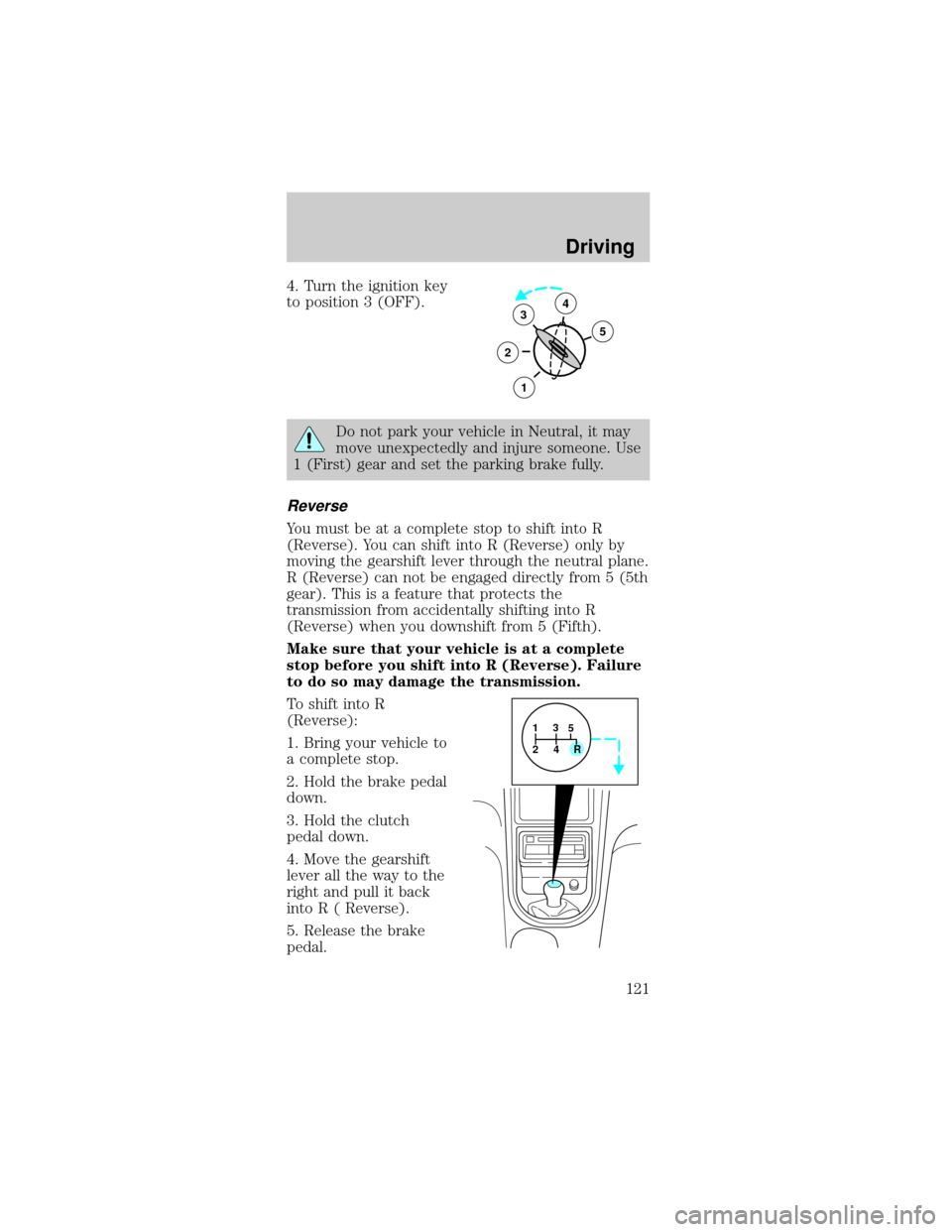
To shift into R
(Reverse):
1. Bring your vehicle to
a complete stop.
2. Hold the brake pedal
down.
3. Hold the clutch
pedal down.
4. Move the gearshift
lever all the way to the
right and pull it back
into R ( Reverse).
5. Release the brake
pedal.
3
2
1
5
4
1
24R3
5
Driving
121
Page 122 of 240
6. Slowly release the clutch pedal.
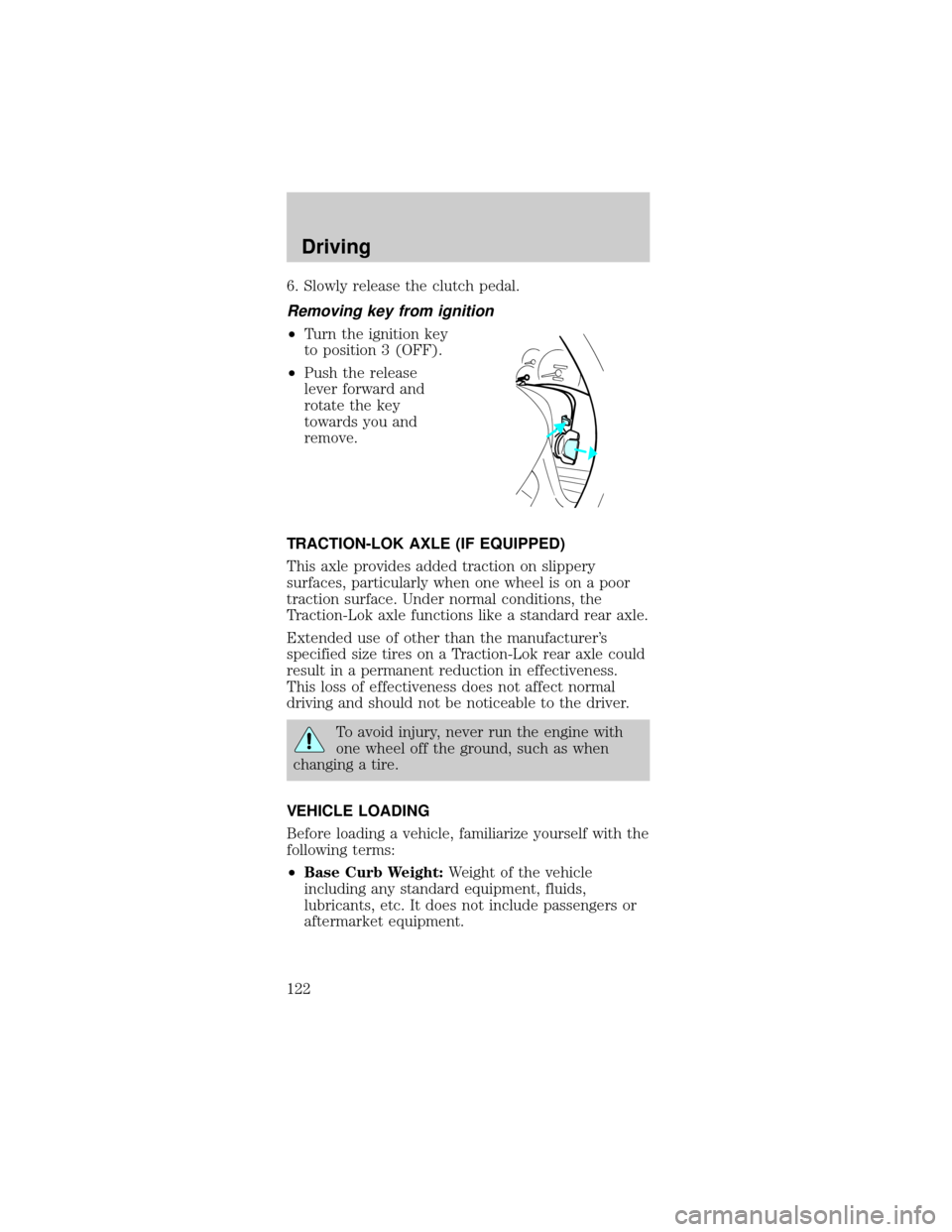
Removing key from ignition
²Turn the ignition key
to position 3 (OFF).
²Push the release
lever forward and
rotate the key
towards you and
remove.
TRACTION-LOK AXLE (IF EQUIPPED)
This axle provides added traction on slippery
surfaces, particularly when one wheel is on a poor
traction surface. Under normal conditions, the
Traction-Lok axle functions like a standard rear axle.
Extended use of other than the manufacturer's
specified size tires on a Traction-Lok rear axle could
result in a permanent reduction in effectiveness.
This loss of effectiveness does not affect normal
driving and should not be noticeable to the driver.
To avoid injury, never run the engine with
one wheel off the ground, such as when
changing a tire.
VEHICLE LOADING
Before loading a vehicle, familiarize yourself with the
following terms:
²Base Curb Weight:Weight of the vehicle
including any standard equipment, fluids,
lubricants, etc. It does not include passengers or
aftermarket equipment.
Driving
122
Page 128 of 240

If a distance of 80 km (50 miles) or a speed of 56
km/h (35 mph) must be exceeded, you must
disconnect the driveshaft. Ford recommends the
driveshaft be removed/installed only by a qualified
technician. See your local dealer for driveshaft
removal/installation.
Improper removal/installation of the driveshaft
can cause transmission fluid loss, damage to
the driveshaft and internal transmission
components.
DRIVING THROUGH WATER
Do not drive quickly through standing water,
especially if the depth is unknown. Traction or brake
capability may be limited and if the ignition system
gets wet, your engine may stall. Water may also
enter your engine's air intake and severely damage
your engine.
If driving through deep or standing water is
unavoidable, proceed very slowly. Never drive
through water that is higher than the bottom of the
hubs (for trucks) or the bottom of the wheel rims
(for cars).
Once through the water, always try the brakes. Wet
brakes do not stop the vehicle as effectively as dry
brakes. Drying can be improved by moving your
vehicle slowly while applying light pressure on the
brake pedal.
Driving through deep water where the
transmission vent tube is submerged may allow
water into the transmission and cause internal
transmission damage.
Driving
128
Page 130 of 240
Should you need to arrange roadside assistance for
yourself, Ford will reimburse a reasonable amount.
To obtain information about reimbursement, call
1±800±241±3673 in the United States for Ford or
Mercury vehicles; or if you own a Lincoln vehicle,
call 1±800±521±4140. Call 1±800±665±2006 in
Canada.
Roadside coverage beyond basic warranty
In the United States, you may purchase additional
roadside assistance coverage beyond this period
through the Ford Auto Club by contacting your Ford
or Lincoln Mercury dealer.
Similarly in Canada, you may purchase additional
coverage beyond the basic coverage period by
consulting the Ford Roadside Assistance Club
brochure or by calling 1±877±294±CLUB
(1±877±294±2582).
HAZARD FLASHER
Use only in an emergency to warn traffic of vehicle
breakdown, approaching danger, etc. The hazard
flashers can be operated when the ignition is off.
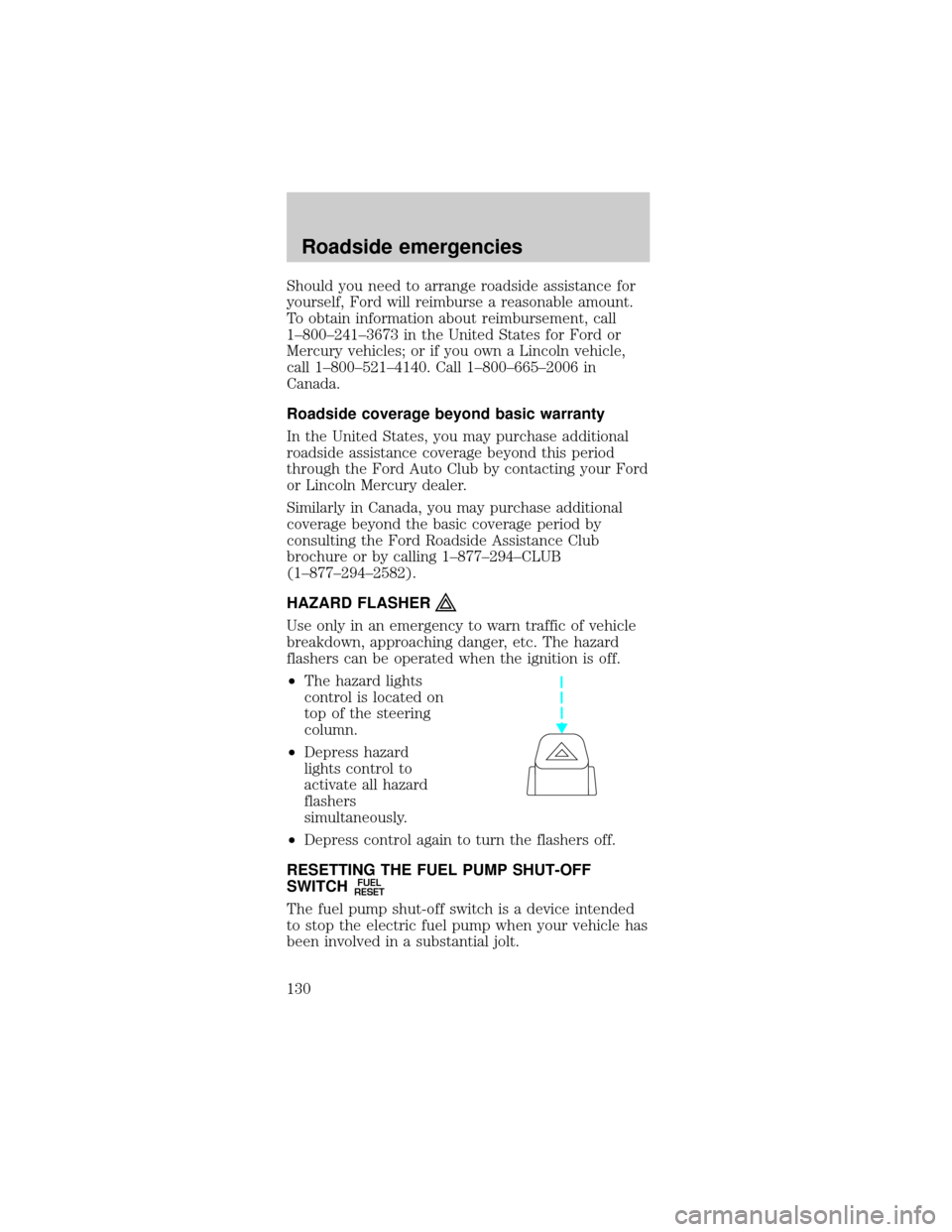
²The hazard lights
control is located on
top of the steering
column.
²Depress hazard
lights control to
activate all hazard
flashers
simultaneously.
²Depress control again to turn the flashers off.
RESETTING THE FUEL PUMP SHUT-OFF
SWITCH
FUEL
RESET
The fuel pump shut-off switch is a device intended
to stop the electric fuel pump when your vehicle has
been involved in a substantial jolt.
Roadside emergencies
130
Page 131 of 240
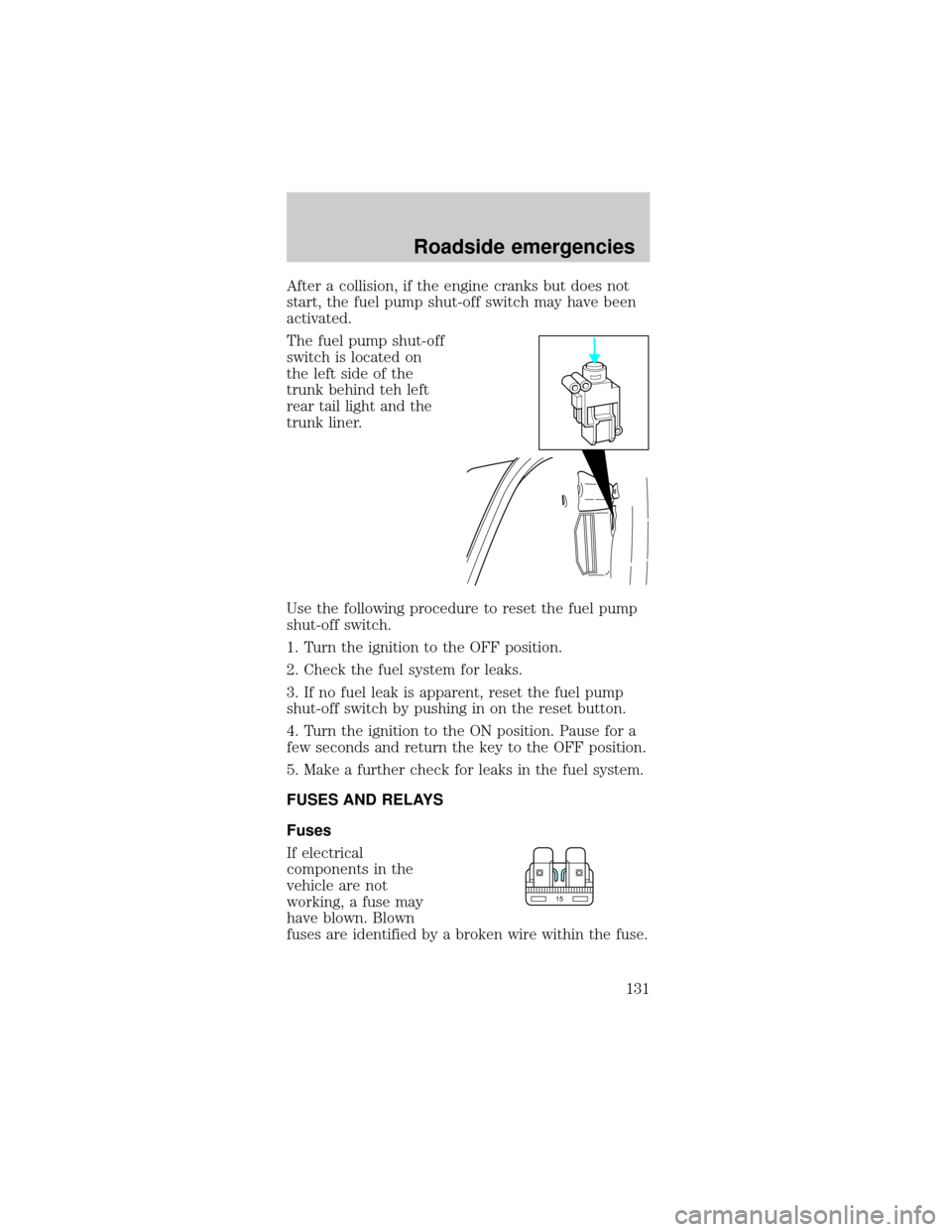
After a collision, if the engine cranks but does not
start, the fuel pump shut-off switch may have been
activated.
The fuel pump shut-off
switch is located on
the left side of the
trunk behind teh left
rear tail light and the
trunk liner.
Use the following procedure to reset the fuel pump
shut-off switch.
1. Turn the ignition to the OFF position.
2. Check the fuel system for leaks.
3. If no fuel leak is apparent, reset the fuel pump
shut-off switch by pushing in on the reset button.
4. Turn the ignition to the ON position. Pause for a
few seconds and return the key to the OFF position.
5. Make a further check for leaks in the fuel system.
FUSES AND RELAYS
Fuses
If electrical
components in the
vehicle are not
working, a fuse may
have blown. Blown
fuses are identified by a broken wire within the fuse.
15
Roadside emergencies
131
Page 136 of 240
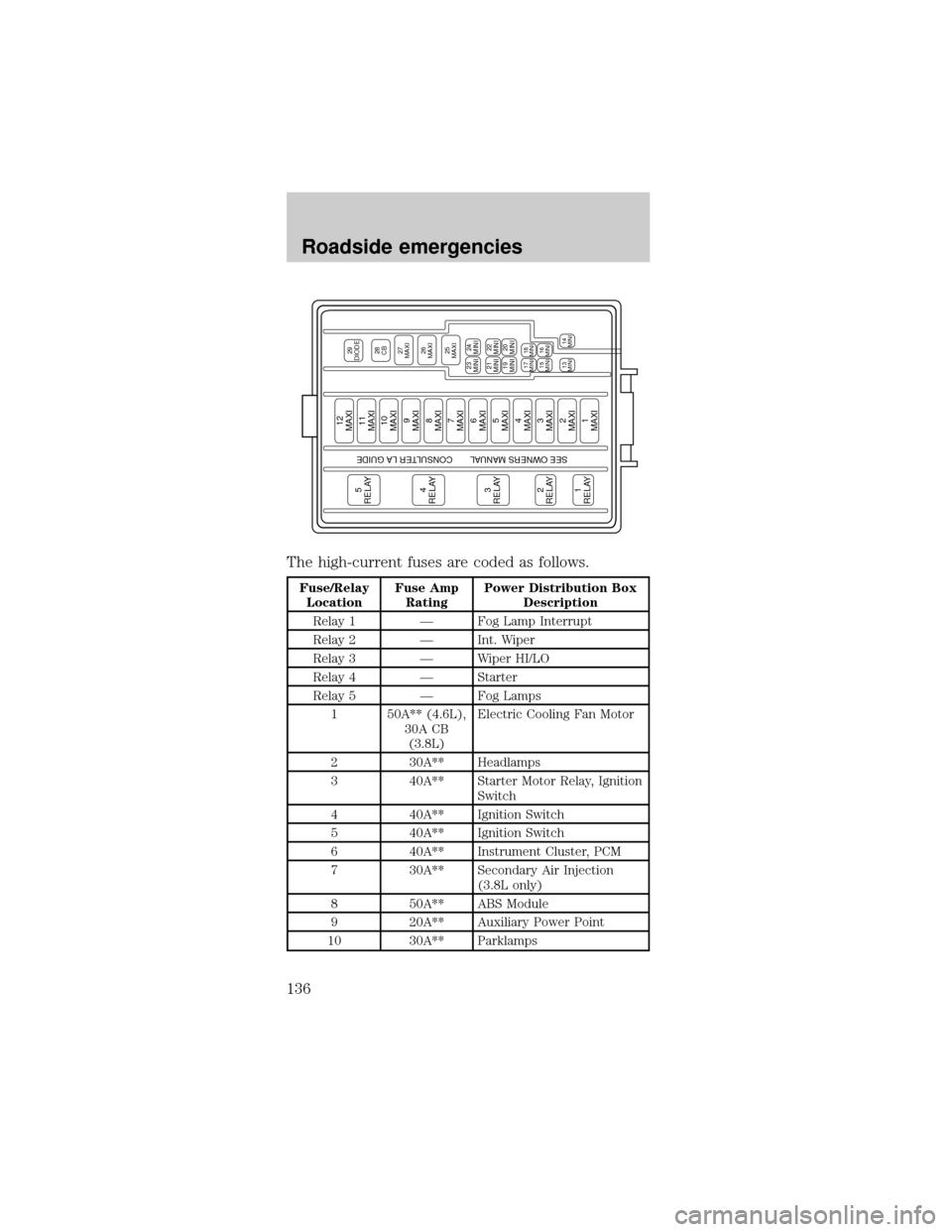
The high-current fuses are coded as follows.
Fuse/Relay
LocationFuse Amp
RatingPower Distribution Box
Description
Relay 1 Ð Fog Lamp Interrupt
Relay 2 Ð Int. Wiper
Relay 3 Ð Wiper HI/LO
Relay 4 Ð Starter
Relay 5 Ð Fog Lamps
1 50A** (4.6L),
30A CB
(3.8L)Electric Cooling Fan Motor
2 30A** Headlamps
3 40A** Starter Motor Relay, Ignition
Switch
4 40A** Ignition Switch
5 40A** Ignition Switch
6 40A** Instrument Cluster, PCM
7 30A** Secondary Air Injection
(3.8L only)
8 50A** ABS Module
9 20A** Auxiliary Power Point
10 30A** Parklamps
5
RELAY4
RELAY3
RELAY2
RELAY1
RELAY
12
MAXI
29
DIODE28
CB27
MAXI26
MAXI25
MAXI23
MINI
24
MINI
21
MINI
22
MINI
19
MINI17
MINI18
MINI15
MINI13
MINI
14
MINI16
MINI20
MINI
11
MAXI10
MAXI9
MAXI8
MAXI7
MAXI6
MAXI5
MAXI4
MAXI3
MAXI2
MAXI1
MAXI
SEE OWNERS MANUAL CONSULTER LA GUIDE
Roadside emergencies
136
Page 183 of 240
ªCheck Fuel Capº illuminates when the ignition is
turned to the ON position to ensure your bulb is
working. When this light turns on, check the fuel
filler cap. Continuing to operate the vehicle with the
Check Fuel Cap light on, can activate the Service
Engine Soon warning. When the fuel filler cap is
properly re-installed, the light(s) will turn off after a
period of normal driving.It may take a long
period of time for the system to detect an
improperly installed fuel filler cap.
If you must replace the fuel filler cap, replace
it with a fuel filler cap that is designed for
your vehicle. The customer warranty may be
void for any damage to the fuel tank or fuel
system if the correct genuine Ford or
Motorcraft fuel filler cap is not used.
The fuel system may be under pressure. If
the fuel filler cap is venting vapor or if you
hear a hissing sound, wait until it stops before
completely removing the fuel filler cap. Otherwise,
fuel may spray out and injure you or others.
If you do not use the proper fuel filler cap,
excessive pressure or vacuum in the fuel
tank may damage the fuel system or cause the fuel
cap to disengage in a collision, which may result in
possible personal injury.
Choosing the right fuel
Use only UNLEADED FUEL. The use of leaded fuel
is prohibited by law and could damage your vehicle.
Do not use fuel containing methanol. It can damage
critical fuel system components.
Your vehicle was not designed to use fuel or fuel
additives with metallic compounds, including
manganese-based compounds containing MMT.
Maintenance and care
183
Page 185 of 240
Many of the world's
automakers issued the
World-wide Fuel
Charter that
recommends gasoline
specifications to
provide improved
performance and
emission control
system protection for your vehicle. Gasolines that
meet the World-wide Fuel Charter should be used
when available. Ask your fuel supplier about
gasolines that meet the World-wide Fuel Charter. In
Canada, look for fuels that display theAuto
Makers' Choiceylogo.
Cleaner air
Ford endorses the use of reformulated
ªcleaner-burningº gasolines to improve air quality.
Running out of fuel
Avoid running out of fuel because this situation may
have an adverse affect on powertrain components.
If you have run out of fuel:
²You may need to cycle the ignition from OFF to
ON several times after refueling, to allow the fuel
system to pump the fuel from the tank to the
engine.
²Your ªService Engine Soonº indicator may come
on. For more information on the ªService Engine
Soonº indicator, refer to theInstrumentation
chapter.
Fuel Filter
For fuel filter replacement, see your dealer or a
qualified service technician. Refer to the scheduled
maintenance guide for the appropriate intervals for
changing the fuel filter.
Maintenance and care
185
Page 187 of 240

For consistent results when filling the fuel tank:
²Turn the engine/ignition switch to the off position
prior to refueling, an error in the reading will
result if the engine is left running.
²Use the same filling rate setting (low Ð medium
Ð high) each time the tank is filled.
²Allow no more than 2 automatic click-offs when
filling.
²Always use fuel with the recommended octane
rating.
²Use a known quality gasoline, preferably a
national brand.
²Use the same side of the same pump and have
the vehicle facing the same direction each time
you fill up.
²Have the vehicle loading and distribution the
same every time.
Your results will be most accurate if your filling
method is consistent.
Calculating fuel economy
1. Fill the fuel tank completely and record the initial
odometer reading (in kilometers or miles).
2. Each time you fill the tank, record the amount of
fuel added (in liters or gallons).
3. After at least three to five tank fill-ups, fill the
fuel tank and record the current odometer reading.
4. Subtract your initial odometer reading from the
current odometer reading.
5. Follow one of the simple calculations in order to
determine fuel economy:
Multiply liters used by 100, then divide by total
kilometers traveled.
Divide total miles traveled by total gallons
used.
Maintenance and care
187