seats FORD MUSTANG 2002 4.G User Guide
[x] Cancel search | Manufacturer: FORD, Model Year: 2002, Model line: MUSTANG, Model: FORD MUSTANG 2002 4.GPages: 264, PDF Size: 2.56 MB
Page 127 of 264
Children and safety belts
If the child is the proper size, restrain the child in a
safety seat.
Children who are too large for child safety seats (as
specified by your child safety seat manufacturer)
should always wear safety belts.
Follow all the important safety restraint and air bag
precautions that apply to adult passengers in your
vehicle.
If the shoulder belt portion of a combination lap and
shoulder belt can be positioned so it does not cross
or rest in front of the child's face or neck, the child
should wear the lap and shoulder belt. Moving the
child closer to the center of the vehicle may help
provide a good shoulder belt fit.
Do not leave children, unreliable adults, or
pets unattended in your vehicle.
To improve the fit of lap and shoulder belts on
children who have outgrown child safety seats, Ford
recommends use of a belt-positioning booster seat
that is labelled as conforming to all applicable
Federal motor vehicle safety standards.
Belt-positioning booster seats raise the child and
provide a shorter, firmer seating cushion that
encourages safer seating posture and better fit of lap
and shoulder belts on the child.
A belt-positioning booster seat should be used if the
shoulder belt rests in front of the child's face or
neck, or if the lap belt does not fit snugly on both
thighs, or if the thighs are too short to let the child
sit all the way back on the seat cushion when the
lower legs hang over the edge of the seat cushion.
You may wish to discuss the special needs of your
child with your pediatrician.
Seating and Safety Restraints
127
Page 128 of 264
SAFETY SEATS FOR CHILDREN
Child and infant or child safety seats
Use a safety seat that is recommended for the size
and weight of the child. Carefully follow all of the
manufacturer's instructions with the safety seat you
put in your vehicle. If you do not install and use the
safety seat properly, the child may be injured in a
sudden stop or collision.
When installing a child safety seat:
²Review and follow
the information
presented in theAir
Bag Supplemental
Restraint System
(SRS) section in this
chapter.
²Use the correct
safety belt buckle for that seating position (the
buckle closest to the direction the tongue is
coming from).
²Insert the belt tongue into the proper buckle until
you hear a snap and feel it latch. Make sure the
tongue is securely fastened in the buckle.
Seating and Safety Restraints
128
Page 129 of 264
²Keep the buckle release button pointing up and
away from the safety seat, with the tongue
between the child seat and the release button, to
prevent accidental unbuckling.
²Place seat back in upright position.
²Put the safety belt in the automatic locking mode.
Refer toAutomatic locking mode(passenger
side front and outboard rear seating positions)
(if equipped) section in this chapter.
Ford recommends the use of a child safety seat
having a top tether strap. Install the child safety seat
in a seating position which is capable of providing a
tether anchorage. For more information on top
tether straps, refer toAttaching child safety seats
with tether straps.in this chapter.
Carefully follow all of the manufacturer's
instructions included with the safety seat
you put in your vehicle. If you do not install and
use the safety seat properly, the child may be
injured in a sudden stop or collision.
Installing child safety seats in combination lap
and shoulder belt seating positions
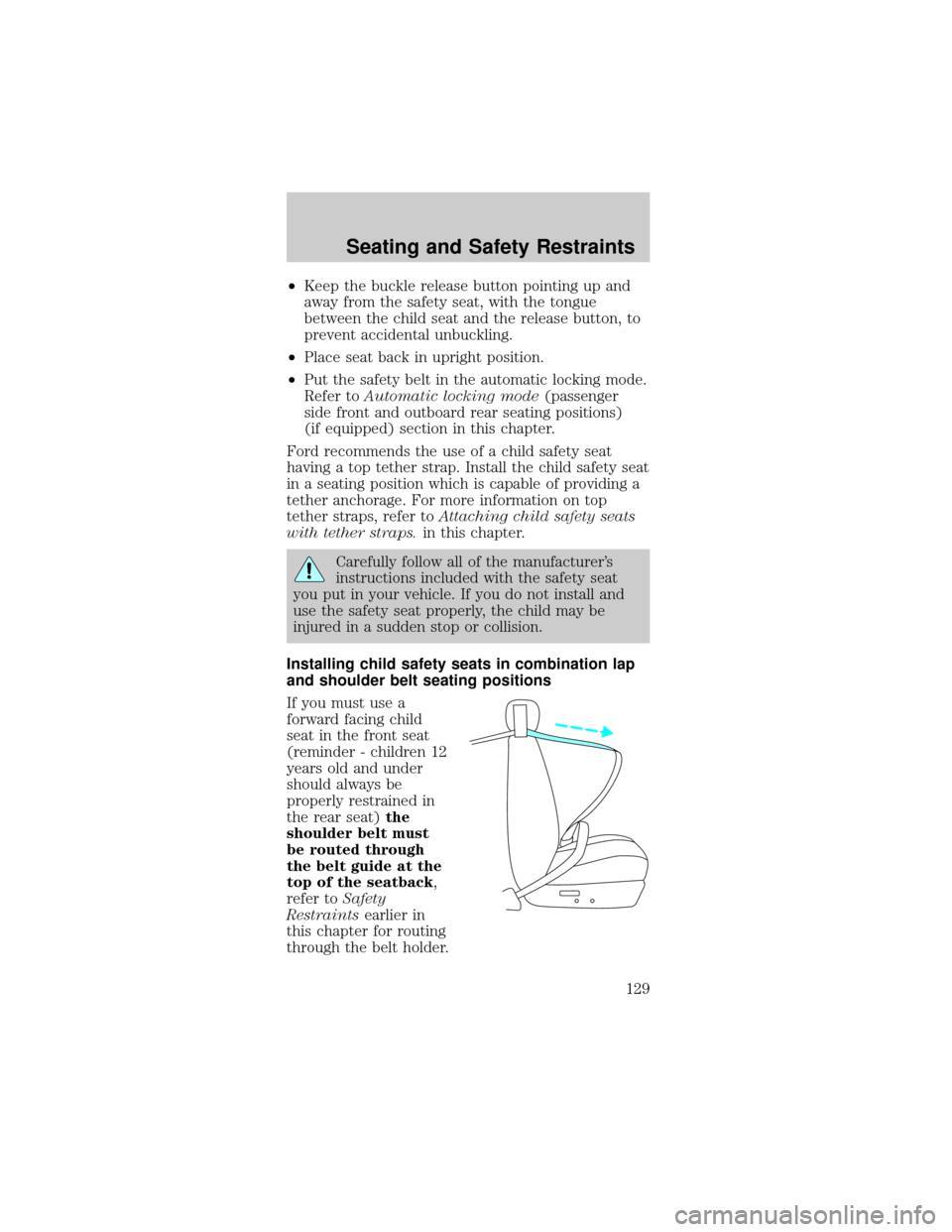
If you must use a
forward facing child
seat in the front seat
(reminder - children 12
years old and under
should always be
properly restrained in
the rear seat)the
shoulder belt must
be routed through
the belt guide at the
top of the seatback,
refer toSafety
Restraintsearlier in
this chapter for routing
through the belt holder.
Seating and Safety Restraints
129
Page 132 of 264
8. Allow the safety belt
to retract to remove
any slack in the belt.
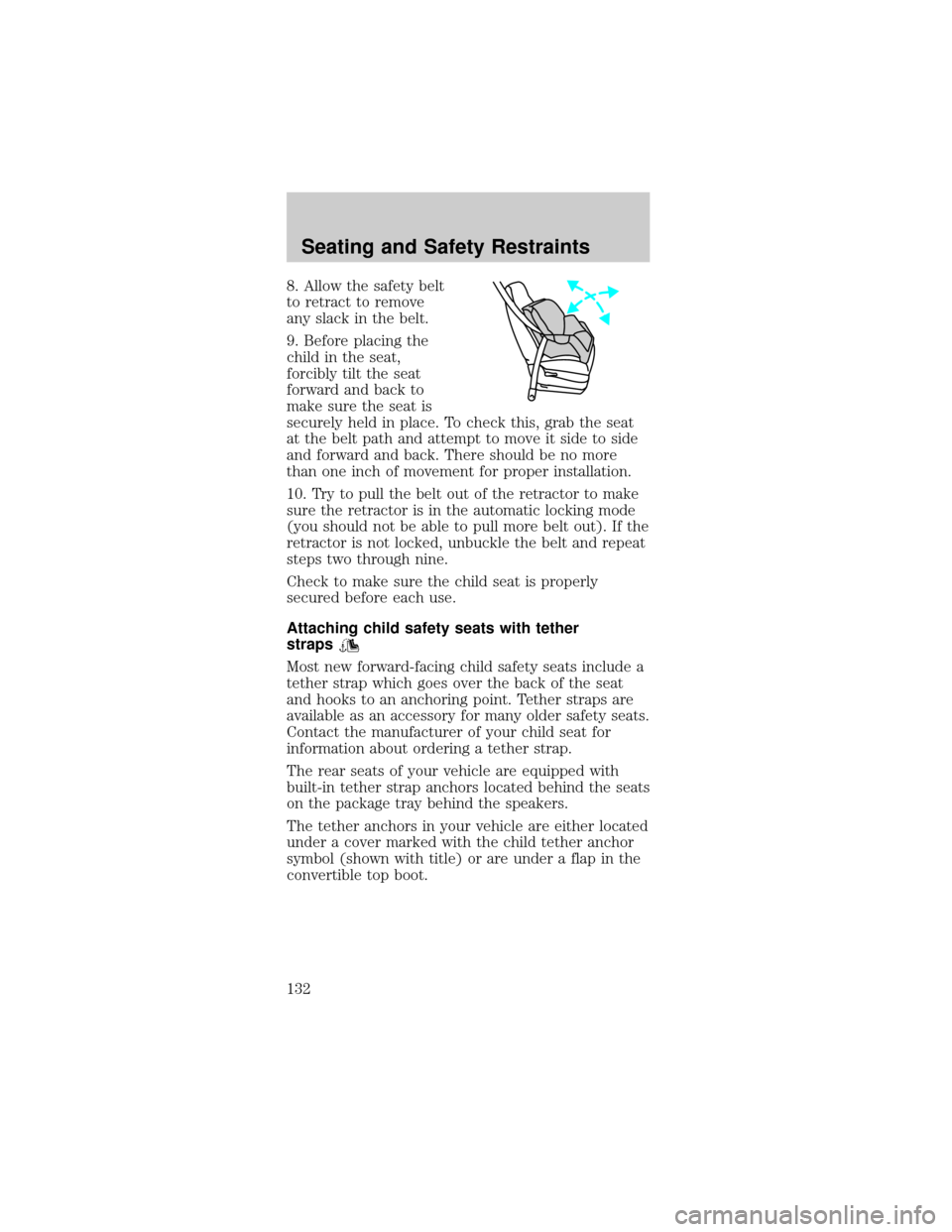
9. Before placing the
child in the seat,
forcibly tilt the seat
forward and back to
make sure the seat is
securely held in place. To check this, grab the seat
at the belt path and attempt to move it side to side
and forward and back. There should be no more
than one inch of movement for proper installation.
10. Try to pull the belt out of the retractor to make
sure the retractor is in the automatic locking mode
(you should not be able to pull more belt out). If the
retractor is not locked, unbuckle the belt and repeat
steps two through nine.
Check to make sure the child seat is properly
secured before each use.
Attaching child safety seats with tether
straps
Most new forward-facing child safety seats include a
tether strap which goes over the back of the seat
and hooks to an anchoring point. Tether straps are
available as an accessory for many older safety seats.
Contact the manufacturer of your child seat for
information about ordering a tether strap.
The rear seats of your vehicle are equipped with
built-in tether strap anchors located behind the seats
on the package tray behind the speakers.
The tether anchors in your vehicle are either located
under a cover marked with the child tether anchor
symbol (shown with title) or are under a flap in the
convertible top boot.
Seating and Safety Restraints
132
Page 135 of 264

If the tether strap is clipped incorrectly, the
child safety seat may not be retained
properly in the event of a collision.
6. Refer to theInstalling child safety seats in
combination lap and shoulder belt seating
positionssection of this chapter for further
instructions to secure the child safety seat.
7. Tighten the child safety seat tether strap
according to the manufacturer's instructions.
If the safety seat is not anchored properly,
the risk of a child being injured in a collision
greatly increases.
Seating and Safety Restraints
135
Page 170 of 264
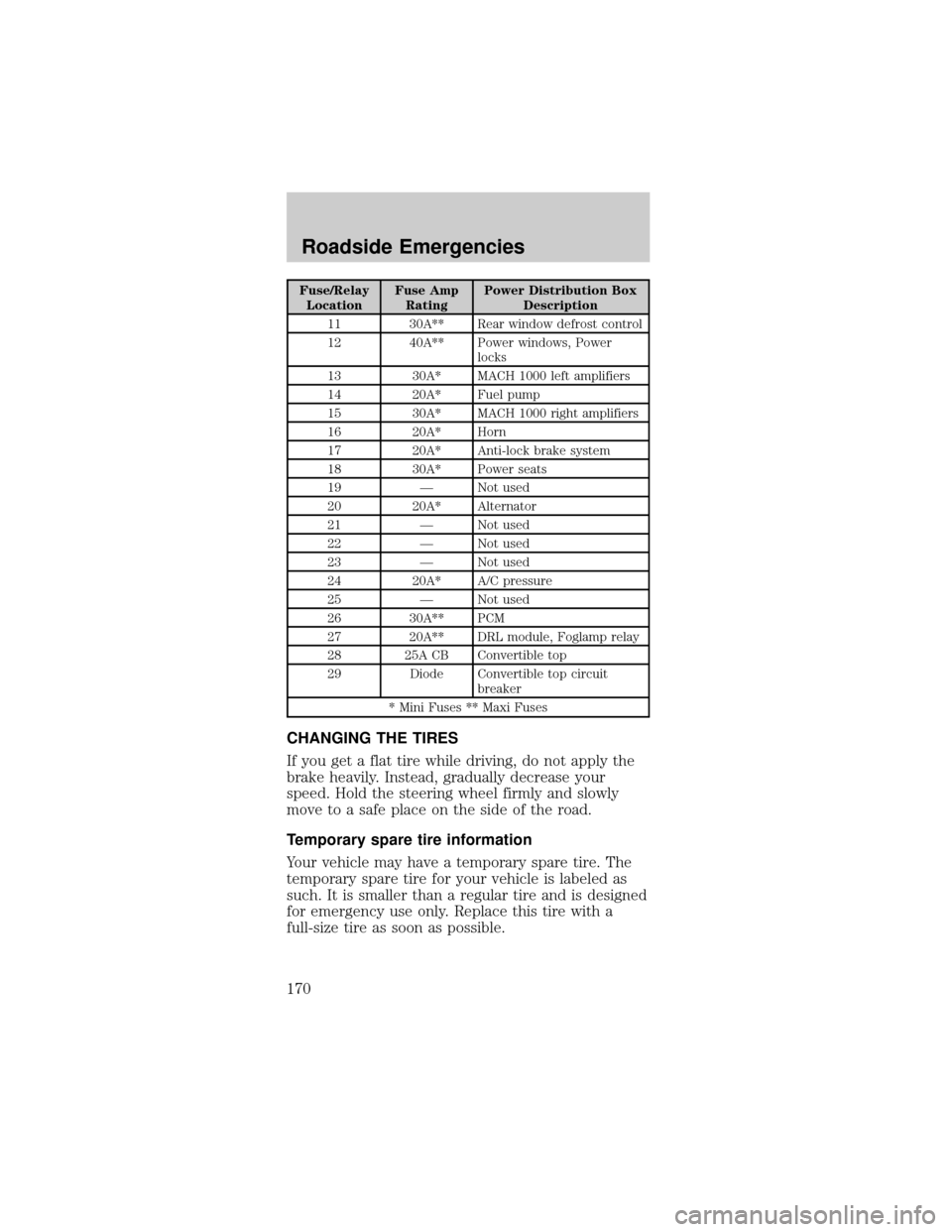
Fuse/Relay
LocationFuse Amp
RatingPower Distribution Box
Description
11 30A** Rear window defrost control
12 40A** Power windows, Power
locks
13 30A* MACH 1000 left amplifiers
14 20A* Fuel pump
15 30A* MACH 1000 right amplifiers
16 20A* Horn
17 20A* Anti-lock brake system
18 30A* Power seats
19 Ð Not used
20 20A* Alternator
21 Ð Not used
22 Ð Not used
23 Ð Not used
24 20A* A/C pressure
25 Ð Not used
26 30A** PCM
27 20A** DRL module, Foglamp relay
28 25A CB Convertible top
29 Diode Convertible top circuit
breaker
* Mini Fuses ** Maxi Fuses
CHANGING THE TIRES
If you get a flat tire while driving, do not apply the
brake heavily. Instead, gradually decrease your
speed. Hold the steering wheel firmly and slowly
move to a safe place on the side of the road.
Temporary spare tire information
Your vehicle may have a temporary spare tire. The
temporary spare tire for your vehicle is labeled as
such. It is smaller than a regular tire and is designed
for emergency use only. Replace this tire with a
full-size tire as soon as possible.
Roadside Emergencies
170
Page 198 of 264
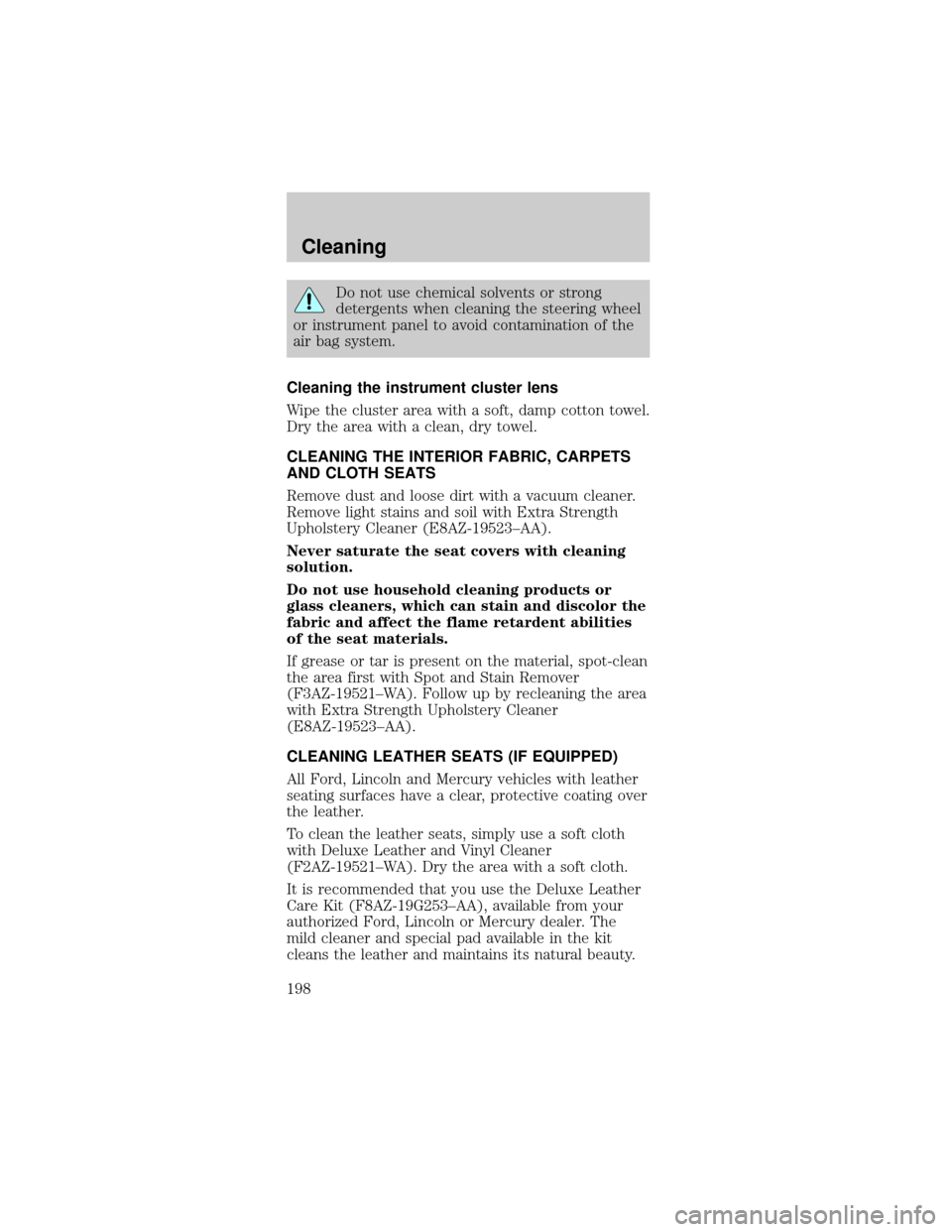
Do not use chemical solvents or strong
detergents when cleaning the steering wheel
or instrument panel to avoid contamination of the
air bag system.
Cleaning the instrument cluster lens
Wipe the cluster area with a soft, damp cotton towel.
Dry the area with a clean, dry towel.
CLEANING THE INTERIOR FABRIC, CARPETS
AND CLOTH SEATS
Remove dust and loose dirt with a vacuum cleaner.
Remove light stains and soil with Extra Strength
Upholstery Cleaner (E8AZ-19523±AA).
Never saturate the seat covers with cleaning
solution.
Do not use household cleaning products or
glass cleaners, which can stain and discolor the
fabric and affect the flame retardent abilities
of the seat materials.
If grease or tar is present on the material, spot-clean
the area first with Spot and Stain Remover
(F3AZ-19521±WA). Follow up by recleaning the area
with Extra Strength Upholstery Cleaner
(E8AZ-19523±AA).
CLEANING LEATHER SEATS (IF EQUIPPED)
All Ford, Lincoln and Mercury vehicles with leather
seating surfaces have a clear, protective coating over
the leather.
To clean the leather seats, simply use a soft cloth
with Deluxe Leather and Vinyl Cleaner
(F2AZ-19521±WA). Dry the area with a soft cloth.
It is recommended that you use the Deluxe Leather
Care Kit (F8AZ-19G253±AA), available from your
authorized Ford, Lincoln or Mercury dealer. The
mild cleaner and special pad available in the kit
cleans the leather and maintains its natural beauty.
Cleaning
198
Page 258 of 264

A
ABS (see Brakes) ... 143
Air bag
supplemental restraint
system .............. 120±121
and child safety
seats ....................... 123
description ............ 121
disposal .................. 126
driver air bag ........ 123
indicator light... 11, 125
operation ............... 123
passenger air bag . 123
Air cleaner filter ..... 246
Air conditioning
manual heating and
air conditioning
system ..................... 67
Antifreeze (see
Engine coolant) ...... 213
Anti-lock brake system
(see Brakes) .... 143±144
Anti-theft system
warning light ........... 11
Audio system
(see Radio) .... 20, 45±46
Automatic
transmission ............ 148
driving an automatic
overdrive ............... 150
fluid, adding .......... 238
fluid, checking ...... 238
fluid, refill
capacities ............... 247
fluid, specification.. 251
Auxiliary power
point ........................... 83Axle
lubricant
specifications. 249, 251
refill capacities ...... 247
traction lok ............ 147
B
Battery ..................... 210
acid, treating
emergencies .......... 210
charging system
warning light ........... 11
jumping a disabled
battery ................... 174
maintenance-free .. 210
replacement,
specifications ........ 246
servicing ................ 210
voltage gauge .......... 17
BeltMinder ............... 114
Brakes .............. 142, 145
anti-lock ......... 143±144
anti-lock brake
system (ABS)
warning light ... 14, 144
brake warning light.. 15
fluid, checking
and adding ............ 235
fluid, refill
capacities ............... 247
fluid,
specifications. 249, 251
lubricant
specifications. 249, 251
parking .................. 142
shift interlock ........ 148
Break-in period ........... 6
Bulbs .......................... 75
Index
258
Page 259 of 264

C
Capacities for
refilling fluids .......... 247
Cargo net ................... 83
CD player ............ 45±46
CD-single premium ... 20
Certification Label .. 253
Changing a tire ....... 170
Child safety
restraints ................. 127
child safety belts .. 127
Child safety seats .... 128
attaching with
tether straps ......... 132
in front seat .......... 129
in rear seat ............ 129
Cleaning your vehicle
engine
compartment ......... 194
exterior .................. 199
instrument
cluster lens ............ 198
instrument panel .. 197
interior ................... 198
plastic parts .......... 196
safety belts ............ 199
washing .................. 192
waxing ................... 192
wheels .................... 193
windows ................ 199
wiper blades .......... 196
Climate control
(see Air conditioning
or Heating) ................ 67
Clock .............. 25, 37, 52
Clutch
adjusting ................ 237operation while
driving ................... 154
recommended
shift speeds ........... 155
Console ...................... 89
Controls
power seat ............. 105
Convertible ................ 90
cleaning ................. 197
installation of
the boot ................... 92
lowering the
convertible top ........ 90
raising the
convertible top ........ 93
Coolant
checking and
adding .................... 213
refill
capacities ....... 220, 247
specifications. 249, 251
Cruise control (see
Speed control) .......... 85
Customer
Assistance ................ 162
Ford accessories
for your vehicle .... 200
Ford Extended
Service Plan .......... 182
Getting assistance
outside the U.S.
and Canada ........... 188
Getting roadside
assistance .............. 162
Getting the service
you need ............... 180
Ordering additional
owner's literature... 189
Index
259
Page 261 of 264

low fuel warning
light .......................... 13
octane rating.. 225, 251
quality .................... 226
running out of fuel 226
safety information
relating to automotive
fuels ....................... 221
Fuses ................ 165±166
G
Gas cap
(see Fuel cap) ... 13, 224
Gas mileage (see
Fuel economy) ........ 227
Gauges ....................... 16
battery voltage
gauge ....................... 17
engine coolant
temperature gauge... 16
engine oil pressure
gauge ....................... 17
fuel gauge ................ 18
odometer ................. 18
speedometer ........... 18
tachometer .............. 19
trip odometer .......... 19
GAWR (Gross Axle
Weight Rating) ........ 158
definition ............... 158
driving with a
heavy load ............. 158
location .................. 158
GVWR (Gross Vehicle
Weight Rating) ........ 158
calculating ............. 158
definition ............... 158
driving with a
heavy load ............. 158
location .................. 158H
Hazard flashers ....... 163
Head restraints ....... 104
Headlamps ................. 71
aiming ...................... 73
bulb specifications .. 75
daytime running
lights ........................ 71
flash to pass ............ 72
high beam ......... 10, 72
replacing bulbs ....... 76
turning on and off .. 71
warning chime ........ 15
Heating
heating and air
conditioning
system ..................... 67
Hood ........................ 203
I
Ignition ............. 136, 251
removing the key .. 157
Infant seats
(see Safety seats) ... 128
Inspection/maintenance
(I/M) testing ............ 233
Instrument panel
cleaning ................. 197
cluster .............. 10, 198
lighting up panel
and interior ............. 72
J
Jack .......................... 170
positioning ............. 170
storage ................... 170
Jump-starting your
vehicle ...................... 174
Index
261