tow FORD MUSTANG 2003 4.G Owner's Manual
[x] Cancel search | Manufacturer: FORD, Model Year: 2003, Model line: MUSTANG, Model: FORD MUSTANG 2003 4.GPages: 256, PDF Size: 2.4 MB
Page 166 of 256
Ifyou use the temporary spare tire
continuously or do not follow these
precautions, the tire could fail, causing you to lose
control of the vehicle, possibly injuring yourself or
others.
When driving with the temporary spare tiredo not:
•use more than one temporary spare tire at a time
•exceed 80 km/h (50 mph) or drive further than 3
200 km (2 000 miles) total under any
circumstances
•load the vehicle beyond maximum vehicle load
rating listed on the tire pressure label on the
inside of the glove compartment door
•tow a trailer
•use tire chains
•drive through an automatic car wash, because of
the vehicle’s reduced ground clearance
•try to repair the temporary spare tire or remove it
from its wheel
•use the wheel for any other type of vehicle
Use of a temporary spare tire at any one wheel
location can lead to impairment of the following:
•handling, stability and braking performance
•comfort and noise
•ground clearance and parking at curbs
•Winter driving capability
Tire change procedure
To prevent the vehicle from moving when
you change a tire, be sure the parking brake
is set, then block (in both directions) the wheel
that is diagonally opposite (other side and end of
the vehicle) to the tire being changed.
Roadside Emergencies
166
Page 175 of 256
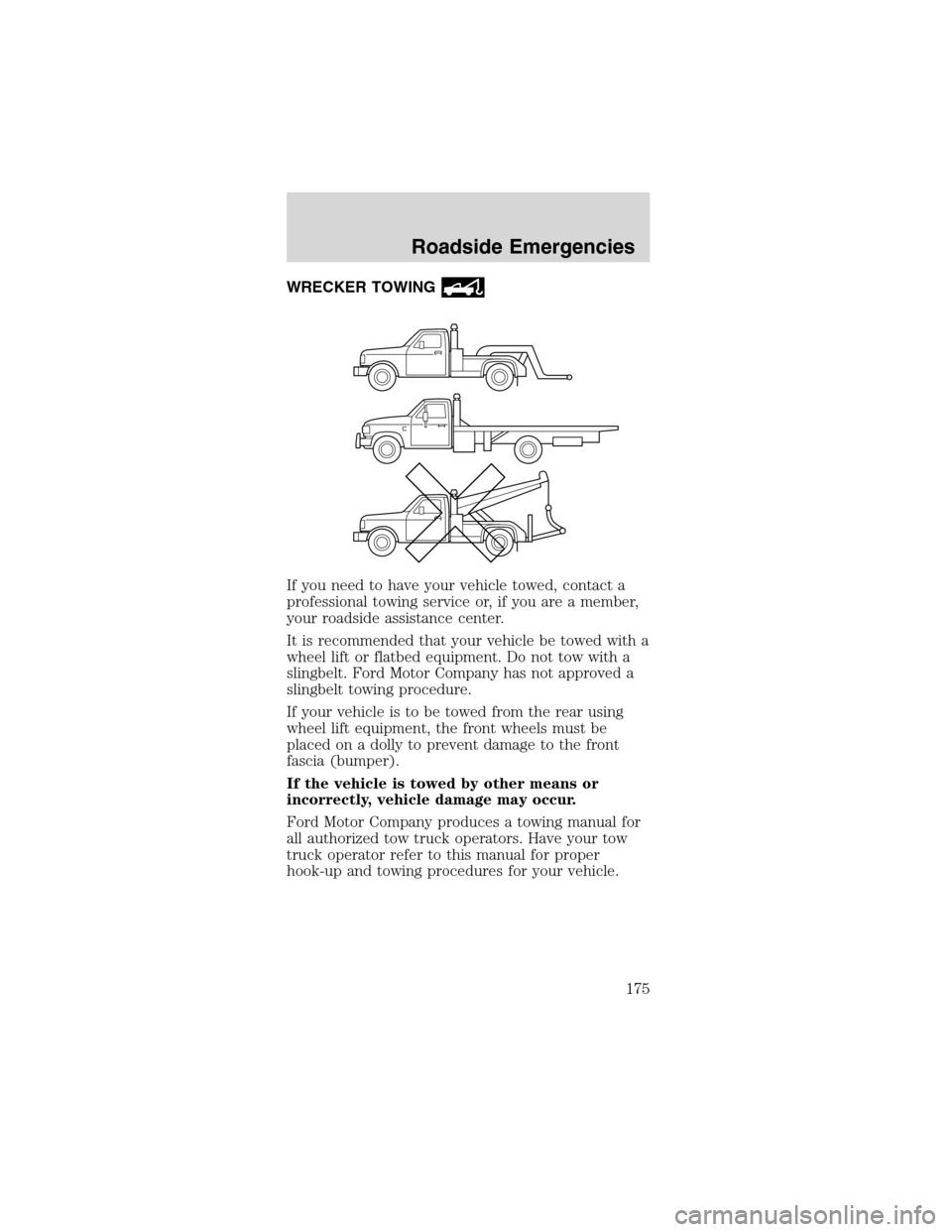
WRECKER TOWING
If you need to have your vehicle towed, contact a
professional towing service or, if you are a member,
your roadside assistance center.
It is recommended that your vehicle be towed with a
wheel lift or flatbed equipment. Do not tow with a
slingbelt. Ford Motor Company has not approved a
slingbelt towing procedure.
If your vehicle is to be towed from the rear using
wheel lift equipment, the front wheels must be
placed on a dolly to prevent damage to the front
fascia (bumper).
If the vehicle is towed by other means or
incorrectly, vehicle damage may occur.
Ford Motor Company produces a towing manual for
all authorized tow truck operators. Have your tow
truck operator refer to this manual for proper
hook-up and towing procedures for your vehicle.
Roadside Emergencies
175
Page 179 of 256
•Protection against covered repair costs after your
Bumper-to-Bumper Warranty expires.
You may purchase Ford ESP from any participating
Ford and Lincoln Mercury and Ford of Canada
dealer. There are several plans available in various
time, distance and deductible combinations which
can be tailored to fit your own driving needs. Ford
ESP also offers reimbursement benefits for towing
and rental coverage.
When you buy Ford ESP, you receive Peace-of-Mind
protection throughout the United States and Canada,
provided by a network of more than 5,000
participating Ford or Lincoln Mercury and Ford of
Canada dealers.
If you did not take advantage of the Ford Extended
Service Plan at the time of purchasing your vehicle,
you may still be eligible. Please contact your dealer
for further information. Since this information is
subject to change, please ask your dealer for
complete details about Ford Extended Service Plan
coverage options, or visit the Ford ESP website at
www.ford-esp.com.
THE DISPUTE SETTLEMENT BOARD
(U.S. ONLY)
The Dispute Settlement Board is:
•an independent, third-party arbitration program
for warranty disputes.
•available free to owners and lessees of qualifying
Ford Motor Company vehicles.
The Dispute Settlement Board may not be available in
all states. Ford Motor Company reserves the right to
change eligibility limitations, modify procedures
and/or to discontinue this service without notice and
without incurring obligations per applicable state law.
What kinds of cases does the Board review?
Unresolved warranty repair concerns or vehicle
performance concerns as on Ford and Lincoln
Mercury cars and Ford and Lincoln Mercury light
Customer Assistance
179
Page 187 of 256
WASHING THE EXTERIOR
Wash your vehicle regularly with cool or lukewarm
water and a neutral Ph shampoo, such as Detail
Wash (ZC-3–A), which is available from your dealer.
•Never use strong household detergents or soap,
such as dish washing or laundry liquid. These
products can discolor and spot painted surfaces.
•Never wash a vehicle that is“hot to the touch”or
during exposure to strong, direct sunlight.
•Always use a clean sponge or carwash mitt with
plenty of water for best results.
•Dry the vehicle with a chamois or soft terry cloth
towel in order to eliminate water spotting.
•It is especially important to wash the vehicle
regularly during the winter months, as dirt and
road salt are difficult to remove and cause
damage to the vehicle.
•Immediately remove items such as gasoline, diesel
fuel, bird droppings and insect deposits because
they can cause damage to the vehicle’s paintwork
and trim over time.
•Remove any exterior accessories, such as
antennas, before entering a car wash.
•Suntan lotions and insect repellents can
damage any painted surface; if these
substances come in contact with your
vehicle, wash off as soon as possible.
WAXING
Applying a polymer paint sealant to your vehicle
every six months will assist in reducing minor
scratches and paint damage.
•Wash the vehicle first.
•Do not use waxes that contain abrasives.
•Do not allow paint sealant to come in contact with
any non-body (low-gloss black) colored trim, such
as grained door handles, roof racks, bumpers, side
moldings, mirror housings or the windshield cowl
area. The paint sealant will“gray”or stain the
parts over time.
Cleaning
187
Page 222 of 256
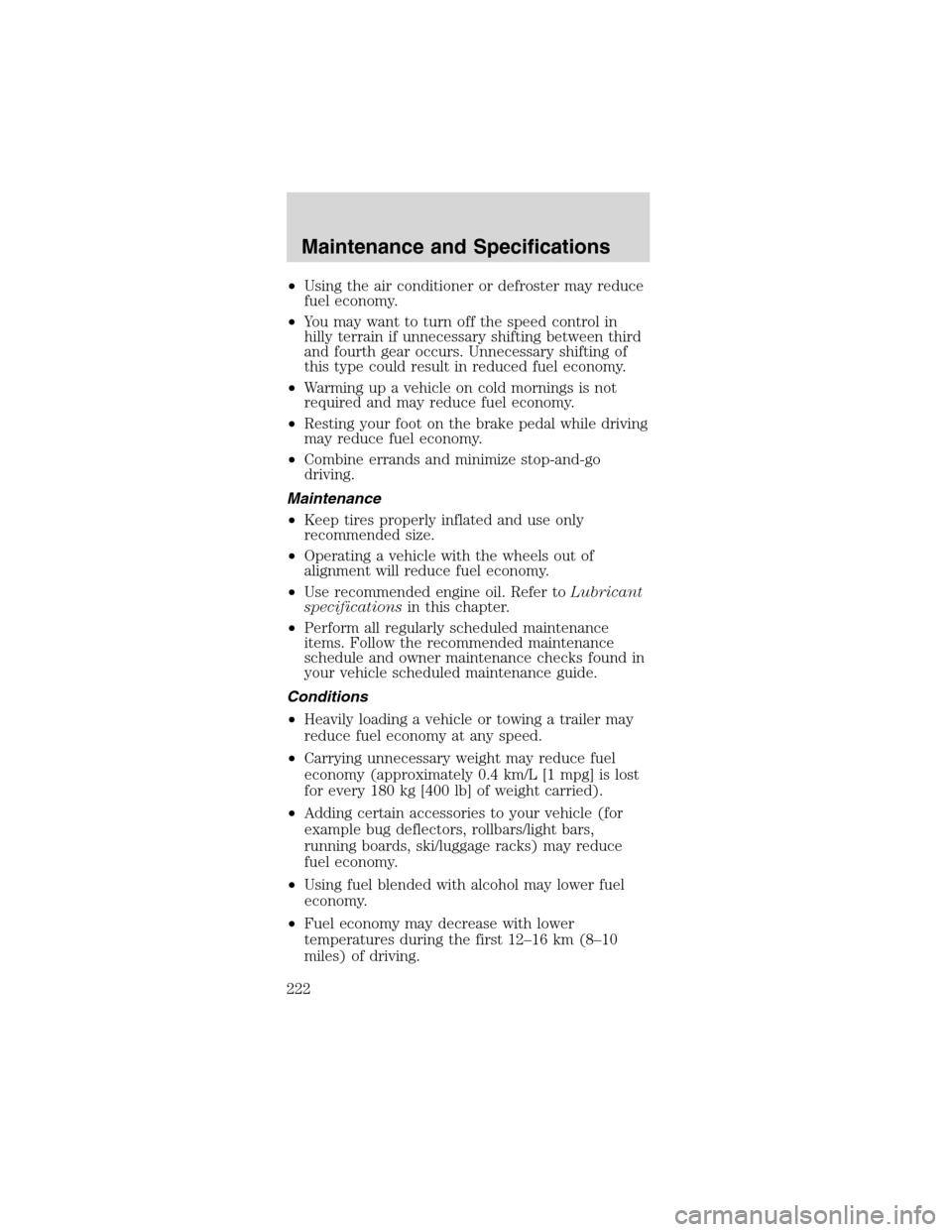
•Using the air conditioner or defroster may reduce
fuel economy.
•You may want to turn off the speed control in
hilly terrain if unnecessary shifting between third
and fourth gear occurs. Unnecessary shifting of
this type could result in reduced fuel economy.
•Warming up a vehicle on cold mornings is not
required and may reduce fuel economy.
•Resting your foot on the brake pedal while driving
may reduce fuel economy.
•Combine errands and minimize stop-and-go
driving.
Maintenance
•Keep tires properly inflated and use only
recommended size.
•Operating a vehicle with the wheels out of
alignment will reduce fuel economy.
•Use recommended engine oil. Refer toLubricant
specificationsin this chapter.
•Perform all regularly scheduled maintenance
items. Follow the recommended maintenance
schedule and owner maintenance checks found in
your vehicle scheduled maintenance guide.
Conditions
•Heavily loading a vehicle or towing a trailer may
reduce fuel economy at any speed.
•Carrying unnecessary weight may reduce fuel
economy (approximately 0.4 km/L [1 mpg] is lost
for every 180 kg [400 lb] of weight carried).
•Adding certain accessories to your vehicle (for
example bug deflectors, rollbars/light bars,
running boards, ski/luggage racks) may reduce
fuel economy.
•Using fuel blended with alcohol may lower fuel
economy.
•Fuel economy may decrease with lower
temperatures during the first 12–16 km (8–10
miles) of driving.
Maintenance and Specifications
222
Page 252 of 256
Jump-starting your
vehicle ...................... 170
K
Keys ..................... 95–97
key in ignition
chime ....................... 14
positions of the
ignition .................. 133
removing from
the ignition ............ 153
L
Lamps
bulb replacement
specifications
chart ........................ 71
cargo lamps ............. 68
daytime running
light .......................... 67
fog lamps ................. 67
headlamps ......... 67, 72
headlamps, flash
to pass ..................... 68
instrument panel,
dimming ................... 68
interior lamps ... 70, 72
replacing
bulbs .................. 71–75
Lane change indicator
(see Turn signal) ...... 70
Lights, warning and
indicator .................... 10
air bag ...................... 11
anti-lock brakes
(ABS) .............. 13, 141
anti-theft ................. 11
brake ........................ 14
charging system ...... 11
fuel cap light ........... 12high beam ............... 10
low fuel .................... 13
overdrive off ............ 13
safety belt ............... 10
service engine
soon ......................... 11
traction control
active ....................... 13
turn signal
indicator .................. 10
Limited slip axle
(see Traction Loc) .. 144
Load limits ............... 154
GAWR .................... 154
GVWR .................... 154
trailer towing ........ 154
Locks
doors ........................ 89
Lubricant
specifications ... 240, 242
Lug nuts,
anti-theft .................. 169
Lumbar support,
seats ......................... 100
M
Manual
transmission ............ 150
fluid capacities ...... 238
lubricant
specifications ........ 242
reverse ................... 152
Mirrors
side view mirrors
(power) ................... 80
Motorcraft
parts ................. 219, 237
O
Octane rating .......... 217
Index
252
Page 254 of 256
Servicing your
vehicle ...................... 194
Spare tire
(see Changing
the Tire) .................. 165
Spark plugs,
specifications ... 237, 242
Specification chart,
lubricants ......... 240, 242
Speed control ............ 80
Speedometer ............. 17
Starting your
vehicle ...... 133–134, 136
jump starting ........ 170
Steering wheel
controls .............. 77, 80
tilting ....................... 77
T
Tachometer ............... 17
Tires ......... 165, 232–234
changing ........ 165–166
checking the
pressure ................. 234
replacing ................ 235
rotating .................. 234
snow tires and
chains .................... 236
tire grades ............. 233
treadwear .............. 232
Towing ..................... 156
recreational
towing .................... 156
trailer towing ........ 156
wrecker .................. 175
Traction control ...... 142
active light .............. 13Traction-lok rear
axle .......................... 144
Transmission
automatic
operation ............... 144
fluid, checking
and adding
(automatic) ........... 228
fluid, checking
and adding
(manual) ............... 231
fluid, refill
capacities ............... 238
lubricant
specifications... 240, 242
manual operation .. 150
Trip odometer ........... 18
Trunk ......................... 89
remote release .. 85, 93
Turn signal .......... 10, 70
V
Vehicle dimensions . 242
Vehicle Identification
Number (VIN) ......... 244
Vehicle loading ........ 154
Ventilating your
vehicle ...................... 138
W
Warning chimes ... 14–15
Warning lights
(see Lights) ............... 10
Washer fluid ............ 199
Water, Driving
through .................... 153
Index
254
Page 255 of 256
Windows
power ....................... 78
Windshield washer
fluid and wipers
checking and
adding fluid ........... 199checking and
cleaning ................... 76
operation ................. 76
replacing wiper
blades ...................... 77
Wrecker towing ....... 175
Index
255