wheel FORD MUSTANG 2004 4.G Owner's Manual
[x] Cancel search | Manufacturer: FORD, Model Year: 2004, Model line: MUSTANG, Model: FORD MUSTANG 2004 4.GPages: 240, PDF Size: 3.62 MB
Page 136 of 240
When a wheel is installed, always remove
any corrosion, dirt or foreign materials
present on the mounting surfaces of the wheel or
the surface of the front disc brake hub and rotor
that contacts the wheel. Installing wheels without
correct metal-to-metal contact at the wheel
mounting surfaces can cause the wheel nuts to
loosen and the wheel to come off while the vehicle
is in motion, resulting in loss of control.
JUMP STARTING YOUR VEHICLE
The gases around the battery can explode if
exposed to flames, sparks, or lit cigarettes. An
explosion could result in injury or vehicle damage.
Batteries contain sulfuric acid which can
burn skin, eyes and clothing, if contacted.
Do not attempt to push-start your vehicle.
Automatic transmissions do not have
push-start capability; doing so may damage the
catalytic converter.
Preparing your vehicle
When the battery is disconnected or a new battery is
installed, the transmission must relearn its shift
strategy. As a result, the transmission may have firm
and/or soft shifts. This operation is considered
normal and will not affect function or durability of
the transmission. Over time, the adaptive learning
process will fully update transmission operation.
1.
Use only a 12–volt supply to start your vehicle.
2. Do not disconnect the battery of the disabled
vehicle as this could damage the vehicle’s electrical
system.
3. Park the booster vehicle close to the hood of the
disabled vehicle making sure the two vehiclesdo
nottouch. Set the parking brake on both vehicles
and stay clear of the engine cooling fan and other
moving parts.
2004 Mustang(mus)
Owners Guide (post-2002-fmt)
USA English(fus)
Roadside Emergencies
136
Page 141 of 240
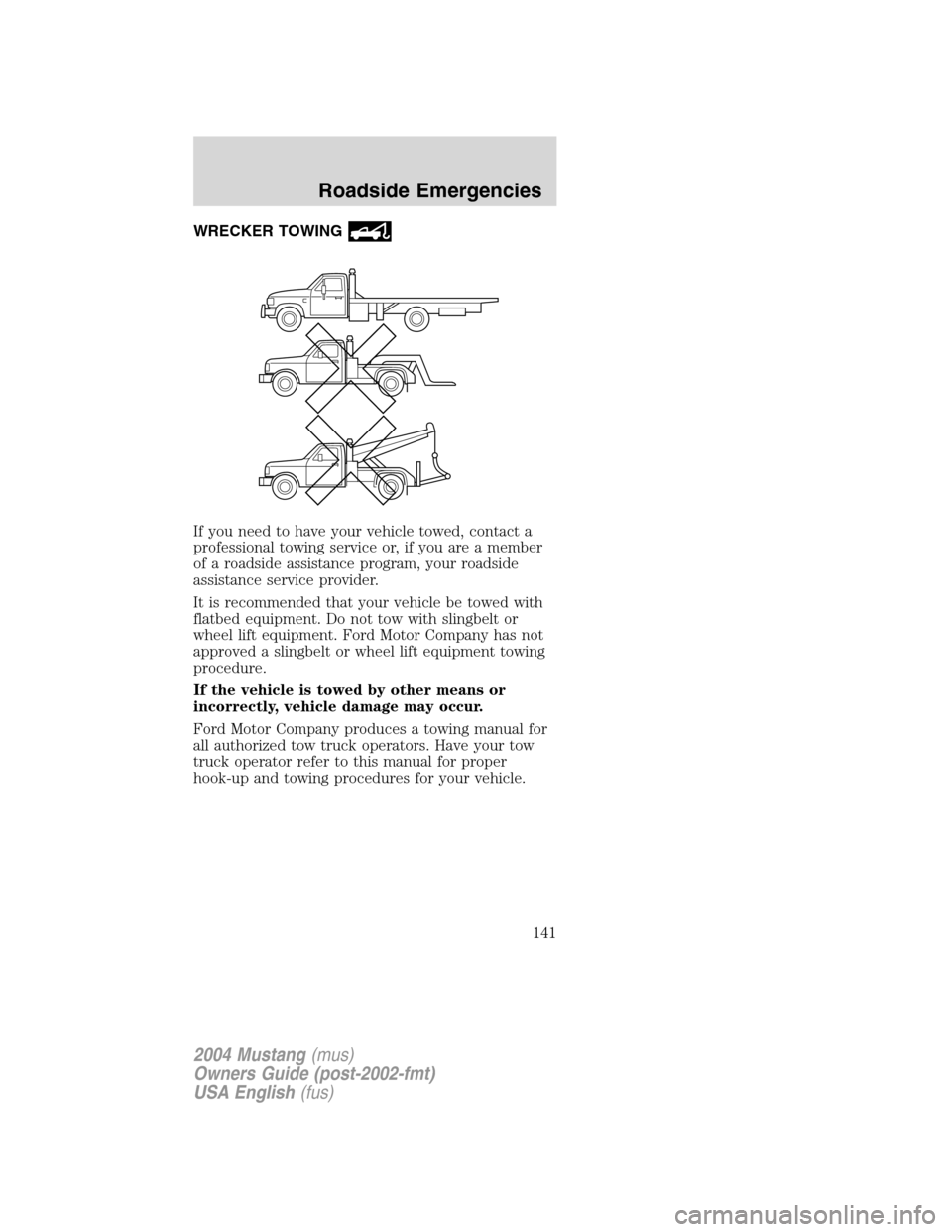
WRECKER TOWING
If you need to have your vehicle towed, contact a
professional towing service or, if you are a member
of a roadside assistance program, your roadside
assistance service provider.
It is recommended that your vehicle be towed with
flatbed equipment. Do not tow with slingbelt or
wheel lift equipment. Ford Motor Company has not
approved a slingbelt or wheel lift equipment towing
procedure.
If the vehicle is towed by other means or
incorrectly, vehicle damage may occur.
Ford Motor Company produces a towing manual for
all authorized tow truck operators. Have your tow
truck operator refer to this manual for proper
hook-up and towing procedures for your vehicle.
2004 Mustang(mus)
Owners Guide (post-2002-fmt)
USA English(fus)
Roadside Emergencies
141
Page 154 of 240
moldings, mirror housings or the windshield cowl
area. The paint sealant will“gray”or stain the
parts over time.
PAINT CHIPS
Your dealer has touch-up paint and sprays to match
your vehicle’s color. Take your color code (printed
on a sticker in the driver’s door jam) to your dealer
to ensure you get the correct color.
•Remove particles such as bird droppings, tree sap,
insect deposits, tar spots, road salt and industrial
fallout before repairing paint chips.
•Always read the instructions before using the
products.
ALUMINUM WHEELS AND WHEEL COVERS
Aluminum wheels and wheel covers are coated with
a clearcoat paint finish. In order to maintain their
shine:
•Clean weekly with Motorcraft Wheel and Tire
Cleaner (ZC-37–A), which is available from your
dealer. Heavy dirt and brake dust accumulation
may require agitation with a sponge. Rinse
thoroughly with a strong stream of water.
•Never apply any cleaning chemical to hot or warm
wheel rims or covers.
•Some automatic car washes may cause damage to
the finish on your wheel rims or covers.
Chemical-strength cleaners, or cleaning chemicals,
in combination with brush agitation to remove
brake dust and dirt, could wear away the
clearcoat finish over time.
•Do not use hydrofluoric acid-based or high
caustic-based wheel cleaners, steel wool, fuels or
strong household detergent.
•To remove tar and grease, use Motorcraft Bug and
Tar Remover (ZC-42), available from your dealer.
2004 Mustang(mus)
Owners Guide (post-2002-fmt)
USA English(fus)
Cleaning
154
Page 158 of 240
Do not use chemical solvents or strong
detergents when cleaning the steering wheel
or instrument panel to avoid contamination of the
air bag system.
•Be certain to wash or wipe your hands clean if
you have been in contact with certain products
such as insect repellent and suntan lotion in order
to avoid possible damage to the interior painted
surfaces.
INTERIOR
For fabric, carpets, cloth seats and safety belts:
•Remove dust and loose dirt with a vacuum
cleaner.
•Remove light stains and soil with Motorcraft Extra
Strength Upholstery Cleaner (ZC-41).
•If grease or tar is present on the material,
spot-clean the area first with Motorcraft Spot and
Stain Remover (ZC-14).
•Never saturate the seat covers with cleaning
solution.
•Do not use household cleaning products or glass
cleaners, which can stain and discolor the fabric
and affect the flame retardant abilities of the seat
materials.
Do not use cleaning solvents, bleach or dye
on the vehicle’s seatbelts, as these actions
may weaken the belt webbing.
LEATHER SEATS (IF EQUIPPED)
Your leather seating surfaces have a clear, protective
coating over the leather.
•To clean, use a soft cloth with Motorcraft Deluxe
Leather and Vinyl Cleaner (ZC-11–A). Dry the
area with a soft cloth.
•To help maintain its resiliency and color, use the
Motorcraft Deluxe Leather Care Kit (ZC-11–D),
available from your authorized dealer.
2004 Mustang(mus)
Owners Guide (post-2002-fmt)
USA English(fus)
Cleaning
158
Page 160 of 240
Motorcraft Custom Bright Metal Cleaner (ZC-15)
Motorcraft Wheel and Tire Cleaner (ZC-37–A)
Motorcraft Dash and Vinyl Cleaner (ZC-38–A)
Motorcraft Car Care Kit (ZC-26)
Ford Premium Car Wash Concentrate
(F2SZ-19523–WC)
Motorcraft Carlite Glass Cleaner (Canada only)
(CXC-100)
Motorcraft Spot and Stain Remover (ZC-14)
Motorcraft Detail Wash (ZC-3–A)
Motorcraft Tire Clean and Shine (ZC-28)
Motorcraft Triple Clean (ZC-13)
Motorcraft Ultra-Clear Spray Glass Cleaner (not
available in Canada) (ZC-23)
Motorcraft Engine Shampoo and Degreaser (ZC-20)
2004 Mustang(mus)
Owners Guide (post-2002-fmt)
USA English(fus)
Cleaning
160
Page 161 of 240
SERVICE RECOMMENDATIONS
To help you service your vehicle:
•We highlight do-it-yourself items in the engine
compartment for easy location.
•We provide a scheduled maintenance guide which
makes tracking routine service easy.
If your vehicle requires professional service, your
dealership can provide the necessary parts and
service. Check yourWarranty Guide/Owner
Information Guideto find out which parts and
services are covered.
Use only recommended fuels, lubricants, fluids and
service parts conforming to specifications. Motorcraft
parts are designed and built to provide the best
performance in your vehicle.
PRECAUTIONS WHEN SERVICING YOUR
VEHICLE
•Do not work on a hot engine.
•
Make sure that nothing gets caught in moving parts.
•Do not work on a vehicle with the engine running
in an enclosed space, unless you are sure you
have enough ventilation.
•Keep all open flames and other burning
(cigarettes) material away from the battery and
all fuel related parts.
Working with the engine off
•Automatic transmission:
1. Set the parking brake and shift to P (Park).
2. Turn off the engine and remove the key.
3. Block the wheels.
•Manual transmission:
1. Set the parking brake, depress the clutch and
place the gearshift in 1 (First).
2. Turn off the engine and remove the key.
3. Block the wheels.
2004 Mustang(mus)
Owners Guide (post-2002-fmt)
USA English(fus)
Maintenance and Specifications
161
Page 162 of 240
Working with the engine on
•Automatic transmission:
1. Set the parking brake and shift to P (Park).
2. Block the wheels.
•Manual transmission:
1. Set the parking brake, depress the clutch and
place the gearshift in N (Neutral).
2. Block the wheels.
Note:Do not start your engine with the air cleaner
removed and do not remove it while the engine is
running.
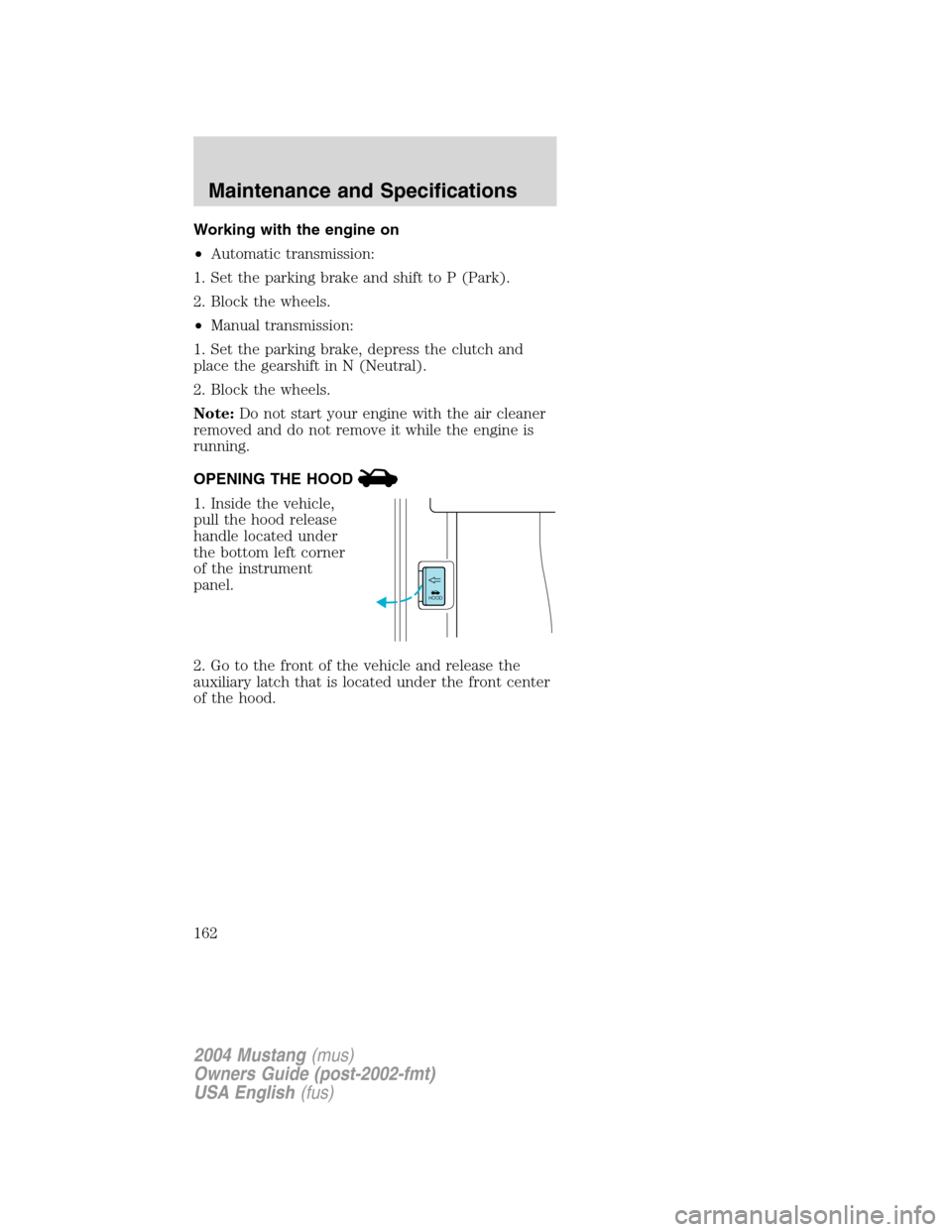
OPENING THE HOOD
1. Inside the vehicle,
pull the hood release
handle located under
the bottom left corner
of the instrument
panel.
2. Go to the front of the vehicle and release the
auxiliary latch that is located under the front center
of the hood.
HOOD
2004 Mustang(mus)
Owners Guide (post-2002-fmt)
USA English(fus)
Maintenance and Specifications
162
Page 190 of 240
![FORD MUSTANG 2004 4.G Owners Manual •Sudden or hard accelerations may reduce fuel
economy.
•Slow down gradually.
•Driving at reasonable speeds (traveling at 88 km/h
[55 mph] uses 15% less fuel than traveling at
105 km/h [65 mph]).](/img/11/5213/w960_5213-189.png "FORD MUSTANG 2004 4.G Owners Manual •Sudden or hard accelerations may reduce fuel
economy.
•Slow down gradually.
•Driving at reasonable speeds (traveling at 88 km/h
[55 mph] uses 15% less fuel than traveling at
105 km/h [65 mph]).")
•Sudden or hard accelerations may reduce fuel
economy.
•Slow down gradually.
•Driving at reasonable speeds (traveling at 88 km/h
[55 mph] uses 15% less fuel than traveling at
105 km/h [65 mph]).
•Revving the engine before turning it off may
reduce fuel economy.
•Using the air conditioner or defroster may reduce
fuel economy.
•You may want to turn off the speed control in
hilly terrain if unnecessary shifting between third
and fourth gear occurs. Unnecessary shifting of
this type could result in reduced fuel economy.
•Warming up a vehicle on cold mornings is not
required and may reduce fuel economy.
•Resting your foot on the brake pedal while driving
may reduce fuel economy.
•Combine errands and minimize stop-and-go
driving.
Maintenance
•Keep tires properly inflated and use only
recommended size.
•Operating a vehicle with the wheels out of
alignment will reduce fuel economy.
•Use recommended engine oil. Refer toLubricant
specificationsin this chapter.
•Perform all regularly scheduled maintenance
items. Follow the recommended maintenance
schedule and owner maintenance checks found in
your vehicle scheduled maintenance guide.
Conditions
•Heavily loading a vehicle or towing a trailer may
reduce fuel economy at any speed.
•Carrying unnecessary weight may reduce fuel
economy (approximately 0.4 km/L [1 mpg] is lost
for every 180 kg [400 lb] of weight carried).
2004 Mustang(mus)
Owners Guide (post-2002-fmt)
USA English(fus)
Maintenance and Specifications
190
Page 195 of 240
2. While the engine idles, turn the steering wheel
left and right several times.
3. Turn the engine off.
4. Check the fluid level on the dipstick. It should be
within the FULL HOT range. Do not add fluid if the
level is within this range.
5. If the fluid is low, add fluid in small amounts,
continuously checking the level until it reaches the
correct operating range. Be sure to put the cap back
on the reservoir.
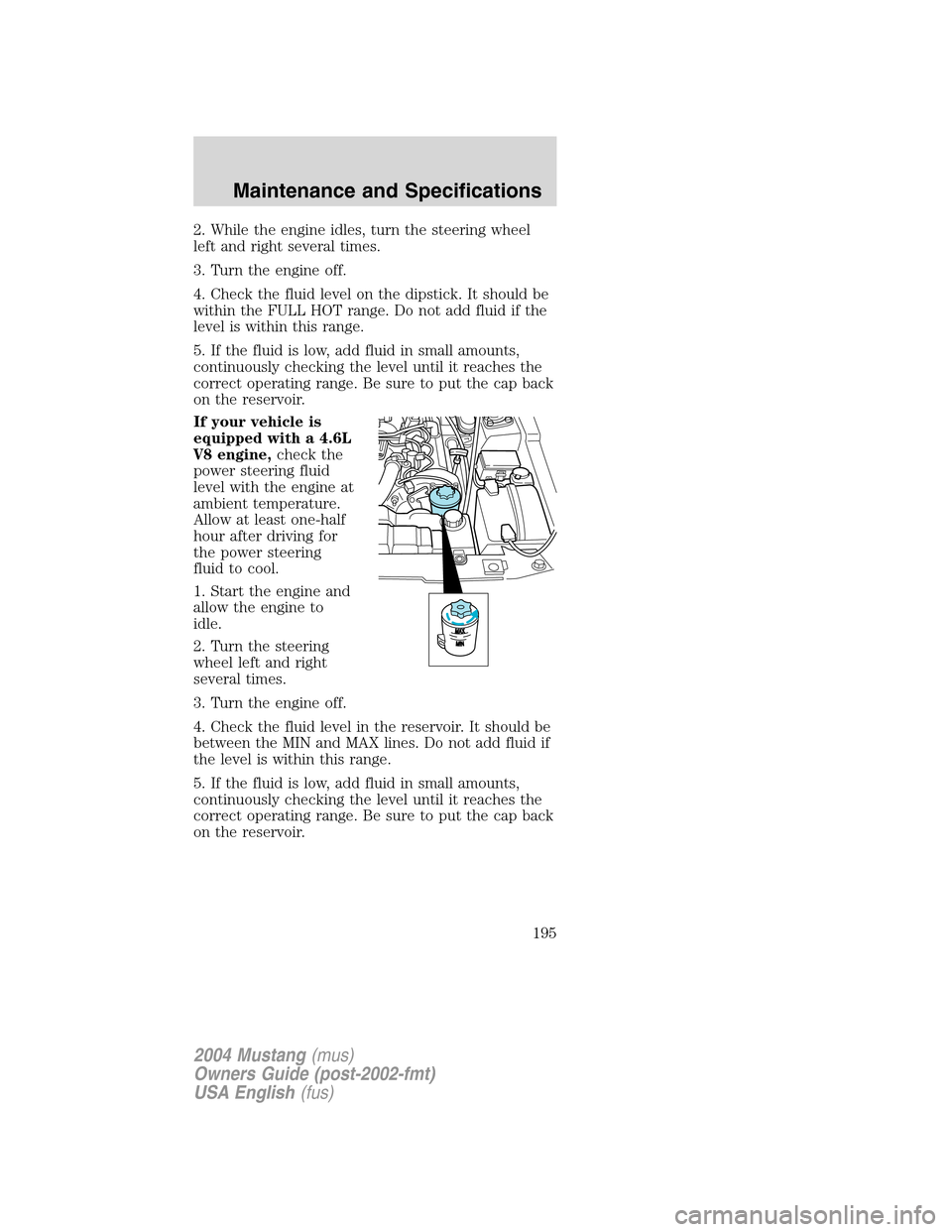
If your vehicle is
equipped with a 4.6L
V8 engine,check the
power steering fluid
level with the engine at
ambient temperature.
Allow at least one-half
hour after driving for
the power steering
fluid to cool.
1. Start the engine and
allow the engine to
idle.
2. Turn the steering
wheel left and right
several times.
3. Turn the engine off.
4. Check the fluid level in the reservoir. It should be
between the MIN and MAX lines. Do not add fluid if
the level is within this range.
5. If the fluid is low, add fluid in small amounts,
continuously checking the level until it reaches the
correct operating range. Be sure to put the cap back
on the reservoir.
MAXMIN
2004 Mustang(mus)
Owners Guide (post-2002-fmt)
USA English(fus)
Maintenance and Specifications
195
Page 201 of 240
Treadwear
The treadwear grade is a comparative rating based
on the wear rate of the tire when tested under
controlled conditions on a specified government test
course. For example, a tire graded 150 would wear
one and one-half (1 1/2) times as well on the
government course as a tire graded 100. The relative
performance of tires depends upon the actual
conditions of their use, however, and may depart
significantly from the norm due to variations in
driving habits, service practices, and differences in
road characteristics and climate.
Traction AA A B C
The traction grades, from highest to lowest are AA,
A, B, and C. The grades represent the tire’s ability to
stop on wet pavement as measured under controlled
conditions on specified government test surfaces of
asphalt and concrete. A tire marked C may have
poor traction performance.
The traction grade assigned to this tire is
based on straight-ahead braking traction
tests, and does not include acceleration, cornering,
hydroplaning or peak traction characteristics.
Temperature A B C
The temperature grades are A (the highest), B and
C, representing the tire’s resistance to the
generation of heat and its ability to dissipate heat
when tested under controlled conditions on a
specified indoor laboratory test wheel. Sustained
high temperature can cause the material of the tire
to degenerate and reduce tire life, and excessive
temperature can lead to sudden tire failure. The
grade C corresponds to a level of performance which
all passenger car tires must meet under the Federal
Motor Vehicle Safety Standard No. 109. Grades B
and A represent higher levels of performance on the
laboratory test wheel than the minimum required by
law.
2004 Mustang(mus)
Owners Guide (post-2002-fmt)
USA English(fus)
Maintenance and Specifications
201