manual transmission FORD MUSTANG 2004 4.G Owners Manual
[x] Cancel search | Manufacturer: FORD, Model Year: 2004, Model line: MUSTANG, Model: FORD MUSTANG 2004 4.GPages: 240, PDF Size: 3.62 MB
Page 77 of 240
•The gearshift is in P (Park) (automatic
transmission) or the neutral position (manual
transmission).
•The ignition switch is in the OFF position.
•All vehicle doors are closed.
•The driver’s safety belt is unbuckled.
•The parklamps/headlamps are in OFF position (If
vehicle is equipped with Autolamps, this will not
affect the procedure).
To reduce the risk of injury, do not
deactivate/activate the Belt Minder feature
while driving the vehicle.
BeltMinder activation and deactivation
procedure
1. Turn the ignition switch to the RUN (or ON)
position. (DO NOT START THE ENGINE.)
2. Wait until the safety belt warning light turns off.
(Approximately 1–2 minutes.)
•Steps 3–5 must be completed within 60 seconds
or the procedure will have to be repeated.
3. Buckle then unbuckle the safety belt three times,
ending with the safety belt unbuckled. This can be
done before or during BeltMinder warning activation.
4. Turn on the parklamps/headlamps, turn off the
parklamps/headlamps.
5. Buckle then unbuckle the safety belt three times,
ending with the safety belt unbuckled.
•After step 5 the safety belt warning light will be
turned on for three seconds.
6. Within seven seconds of the safety belt warning
light turning off, buckle then unbuckle the safety
belt.
•This will disable BeltMinder if it is currently
enabled, or enable BeltMinder if it is currently
disabled.
2004 Mustang(mus)
Owners Guide (post-2002-fmt)
USA English(fus)
Seating and Safety Restraints
77
Page 99 of 240
STARTING
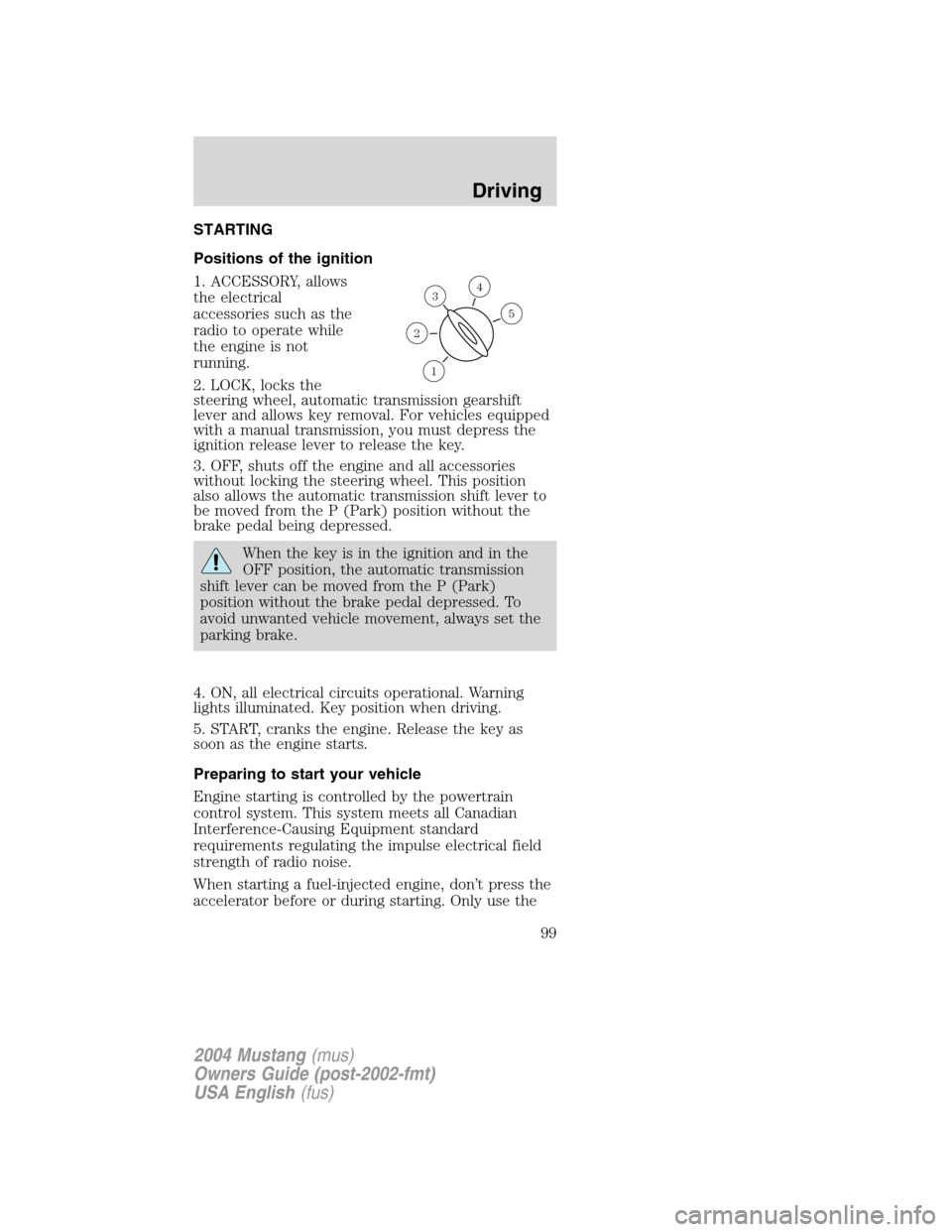
Positions of the ignition
1. ACCESSORY, allows
the electrical
accessories such as the
radio to operate while
the engine is not
running.
2. LOCK, locks the
steering wheel, automatic transmission gearshift
lever and allows key removal. For vehicles equipped
with a manual transmission, you must depress the
ignition release lever to release the key.
3. OFF, shuts off the engine and all accessories
without locking the steering wheel. This position
also allows the automatic transmission shift lever to
be moved from the P (Park) position without the
brake pedal being depressed.
When the key is in the ignition and in the
OFF position, the automatic transmission
shift lever can be moved from the P (Park)
position without the brake pedal depressed. To
avoid unwanted vehicle movement, always set the
parking brake.
4. ON, all electrical circuits operational. Warning
lights illuminated. Key position when driving.
5. START, cranks the engine. Release the key as
soon as the engine starts.
Preparing to start your vehicle
Engine starting is controlled by the powertrain
control system. This system meets all Canadian
Interference-Causing Equipment standard
requirements regulating the impulse electrical field
strength of radio noise.
When starting a fuel-injected engine, don’t press the
accelerator before or during starting. Only use the
3
1
2
5
4
2004 Mustang(mus)
Owners Guide (post-2002-fmt)
USA English(fus)
Driving
99
Page 101 of 240
Before starting the vehicle:
1. Make sure all occupants buckle their safety belts.
For more information on safety belts and their
proper usage, refer to theSeating and Safety
Restraintschapter.
2. Make sure the headlamps and electrical
accessories are off.
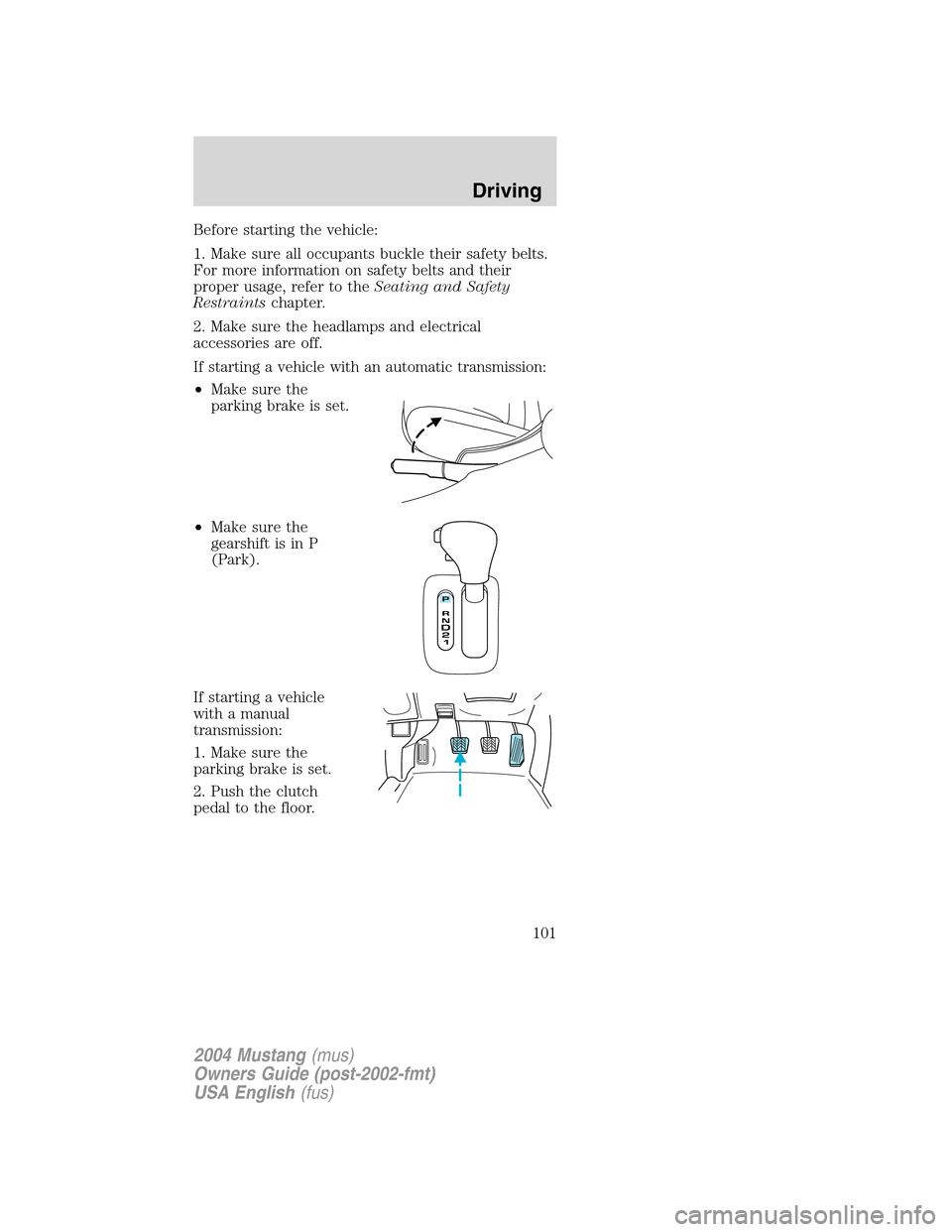
If starting a vehicle with an automatic transmission:
•Make sure the
parking brake is set.
•Make sure the
gearshift is in P
(Park).
If starting a vehicle
with a manual
transmission:
1. Make sure the
parking brake is set.
2. Push the clutch
pedal to the floor.
2004 Mustang(mus)
Owners Guide (post-2002-fmt)
USA English(fus)
Driving
101
Page 106 of 240
Parking brake
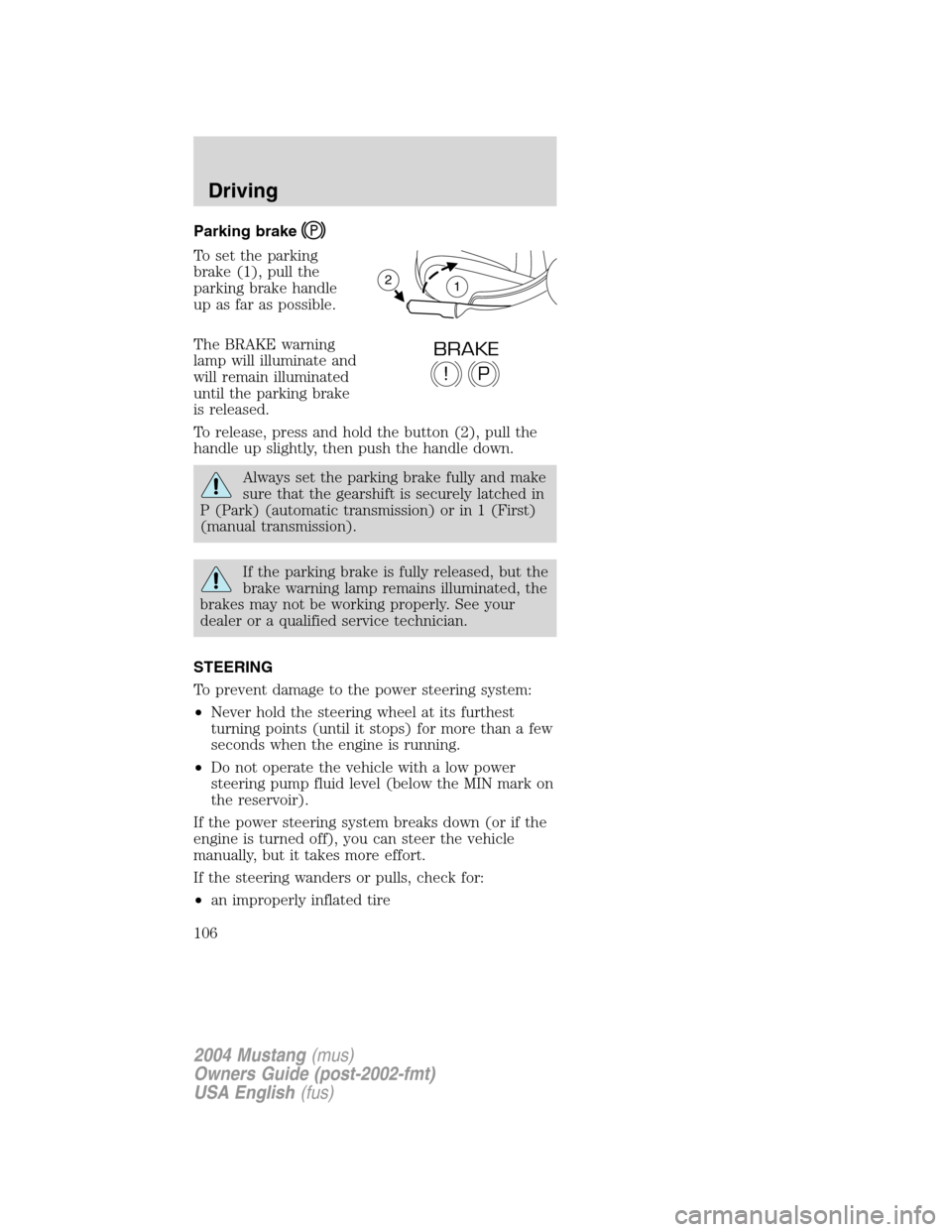
To set the parking
brake (1), pull the
parking brake handle
up as far as possible.
The BRAKE warning
lamp will illuminate and
will remain illuminated
until the parking brake
is released.
To release, press and hold the button (2), pull the
handle up slightly, then push the handle down.
Always set the parking brake fully and make
sure that the gearshift is securely latched in
P (Park) (automatic transmission) or in 1 (First)
(manual transmission).
If the parking brake is fully released, but the
brake warning lamp remains illuminated, the
brakes may not be working properly. See your
dealer or a qualified service technician.
STEERING
To prevent damage to the power steering system:
•Never hold the steering wheel at its furthest
turning points (until it stops) for more than a few
seconds when the engine is running.
•Do not operate the vehicle with a low power
steering pump fluid level (below the MIN mark on
the reservoir).
If the power steering system breaks down (or if the
engine is turned off), you can steer the vehicle
manually, but it takes more effort.
If the steering wanders or pulls, check for:
•an improperly inflated tire
12
P!
BRAKE
2004 Mustang(mus)
Owners Guide (post-2002-fmt)
USA English(fus)
Driving
106
Page 110 of 240
normal and will not affect function or durability of
the transmission. Over time, the adaptive learning
process will fully update transmission operation.
Additionally, whenever the battery is disconnected
or a new battery installed, the strategy must be
relearned.
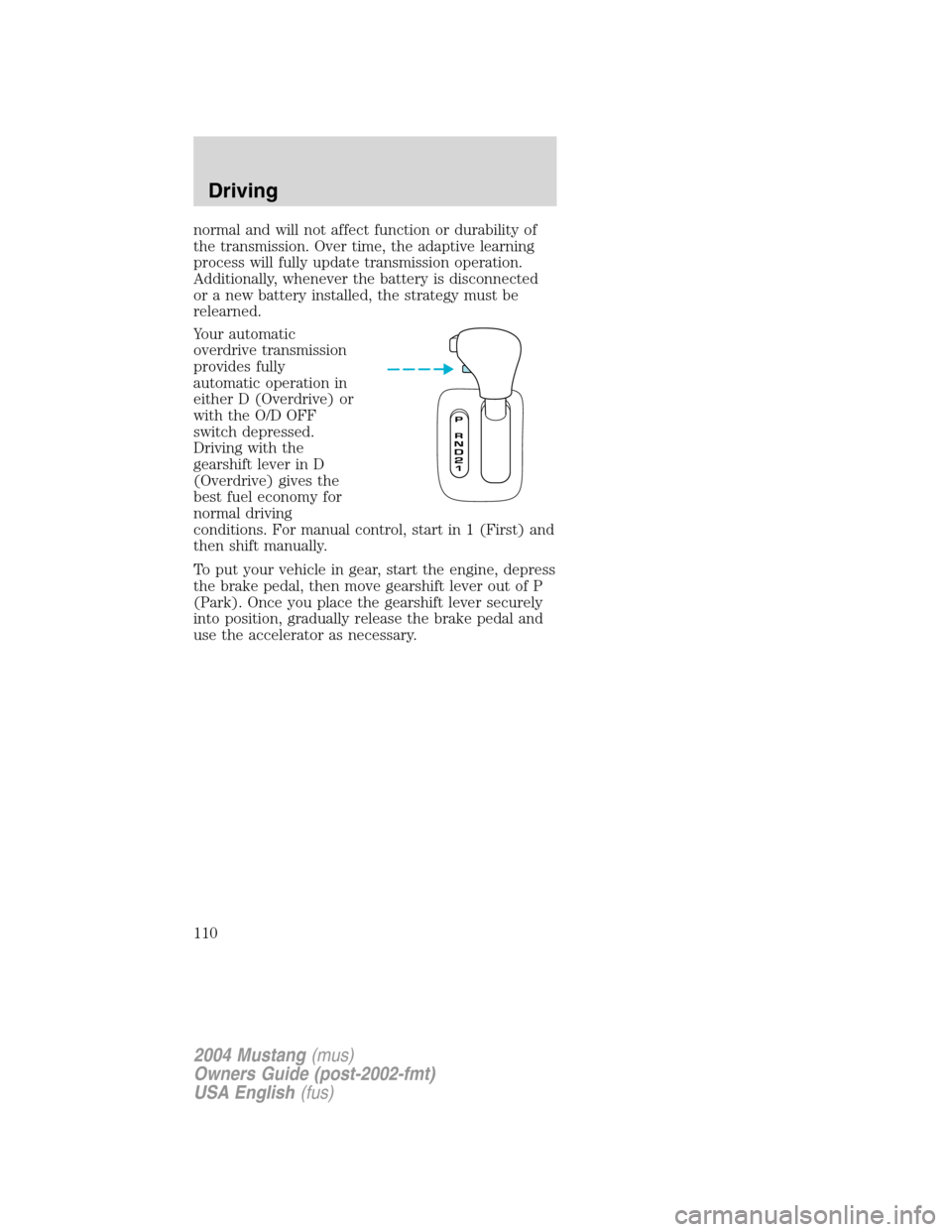
Your automatic
overdrive transmission
provides fully
automatic operation in
either D (Overdrive) or
with the O/D OFF
switch depressed.
Driving with the
gearshift lever in D
(Overdrive) gives the
best fuel economy for
normal driving
conditions. For manual control, start in 1 (First) and
then shift manually.
To put your vehicle in gear, start the engine, depress
the brake pedal, then move gearshift lever out of P
(Park). Once you place the gearshift lever securely
into position, gradually release the brake pedal and
use the accelerator as necessary.
2004 Mustang(mus)
Owners Guide (post-2002-fmt)
USA English(fus)
Driving
110
Page 114 of 240
Do not rock the vehicle for more than a minute
or damage to the transmission and tires may
occur, or the engine may overheat.
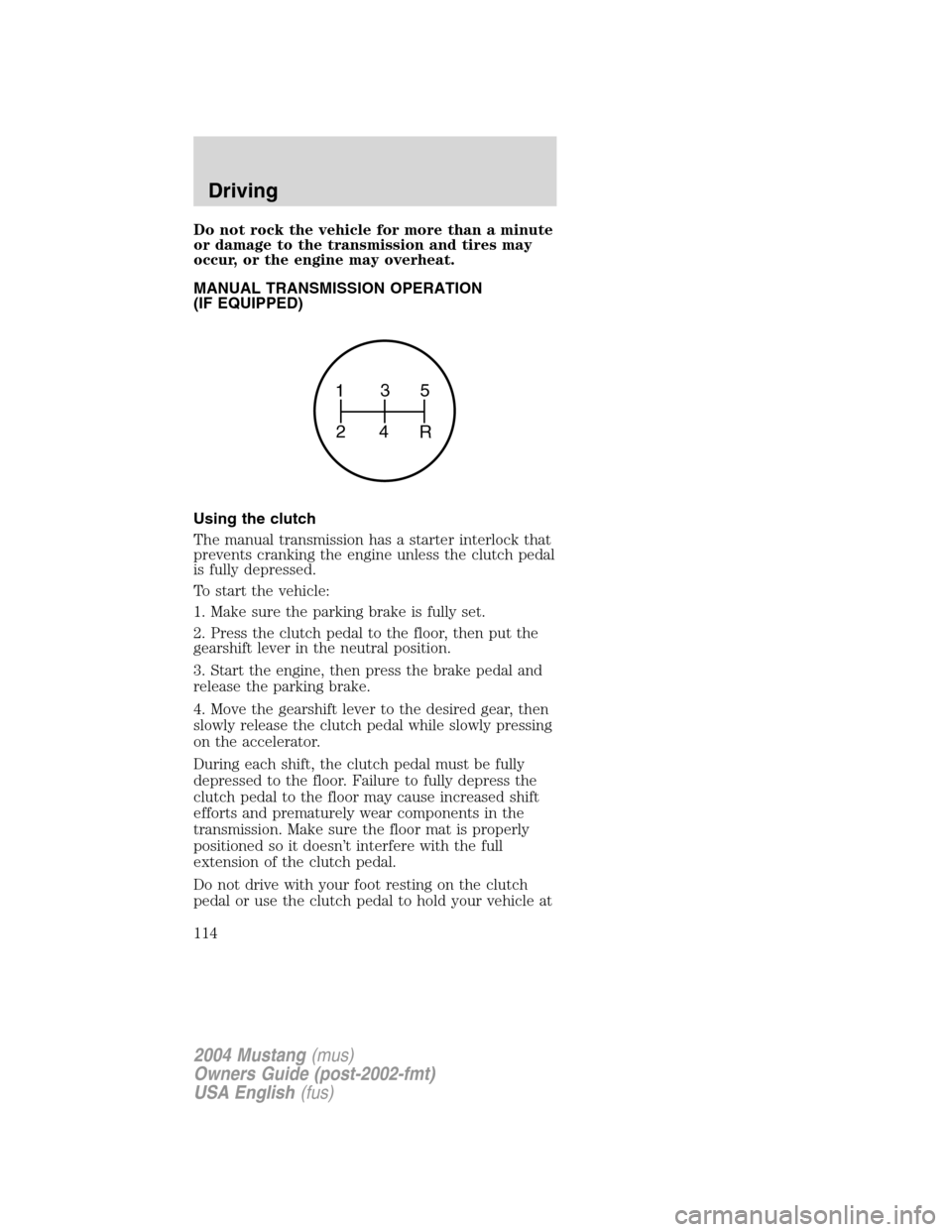
MANUAL TRANSMISSION OPERATION
(IF EQUIPPED)
Using the clutch
The manual transmission has a starter interlock that
prevents cranking the engine unless the clutch pedal
is fully depressed.
To start the vehicle:
1. Make sure the parking brake is fully set.
2. Press the clutch pedal to the floor, then put the
gearshift lever in the neutral position.
3. Start the engine, then press the brake pedal and
release the parking brake.
4. Move the gearshift lever to the desired gear, then
slowly release the clutch pedal while slowly pressing
on the accelerator.
During each shift, the clutch pedal must be fully
depressed to the floor. Failure to fully depress the
clutch pedal to the floor may cause increased shift
efforts and prematurely wear components in the
transmission. Make sure the floor mat is properly
positioned so it doesn’t interfere with the full
extension of the clutch pedal.
Do not drive with your foot resting on the clutch
pedal or use the clutch pedal to hold your vehicle at
135
24
R
2004 Mustang(mus)
Owners Guide (post-2002-fmt)
USA English(fus)
Driving
114
Page 132 of 240
•handling, stability and braking performance
• comfort and noise
• ground clearance and parking at curbs
• Winter driving capability
How to change a flat tire
When one of the front wheels is off the
ground, the transmission alone will not
prevent the vehicle from moving or slipping off the
jack, even if the vehicle is in P (Park) (automatic
transmission) or R (Reverse) (manual
transmission).
To help prevent the vehicle from moving
when you change a tire, be sure the parking
brake is set, then block (in both directions) the
wheel that is diagonally opposite (other side and
end of the vehicle) to the tire being changed.
If the vehicle slips off the jack, you or
someone else could be seriously injured.
Do not attempt to change a tire on the side
of the vehicle close to moving traffic. Pull
far enough off the road to avoid the danger of
being hit when operating the jack or changing the
wheel.
Before changing the tire:
1. Park on a level surface.
2. Activate the hazard flashers.
3. Place the gearshift lever in P (Park) (automatic
transmission) or R (Reverse) (manual transmission).
4. Set the parking brake.
5. Turn off the ignition.
2004 Mustang (mus)
Owners Guide (post-2002-fmt)
USA English (fus)
Roadside Emergencies
132
Page 161 of 240
SERVICE RECOMMENDATIONS
To help you service your vehicle:
•We highlight do-it-yourself items in the engine
compartment for easy location.
•We provide a scheduled maintenance guide which
makes tracking routine service easy.
If your vehicle requires professional service, your
dealership can provide the necessary parts and
service. Check yourWarranty Guide/Owner
Information Guideto find out which parts and
services are covered.
Use only recommended fuels, lubricants, fluids and
service parts conforming to specifications. Motorcraft
parts are designed and built to provide the best
performance in your vehicle.
PRECAUTIONS WHEN SERVICING YOUR
VEHICLE
•Do not work on a hot engine.
•
Make sure that nothing gets caught in moving parts.
•Do not work on a vehicle with the engine running
in an enclosed space, unless you are sure you
have enough ventilation.
•Keep all open flames and other burning
(cigarettes) material away from the battery and
all fuel related parts.
Working with the engine off
•Automatic transmission:
1. Set the parking brake and shift to P (Park).
2. Turn off the engine and remove the key.
3. Block the wheels.
•Manual transmission:
1. Set the parking brake, depress the clutch and
place the gearshift in 1 (First).
2. Turn off the engine and remove the key.
3. Block the wheels.
2004 Mustang(mus)
Owners Guide (post-2002-fmt)
USA English(fus)
Maintenance and Specifications
161
Page 162 of 240
Working with the engine on
•Automatic transmission:
1. Set the parking brake and shift to P (Park).
2. Block the wheels.
•Manual transmission:
1. Set the parking brake, depress the clutch and
place the gearshift in N (Neutral).
2. Block the wheels.
Note:Do not start your engine with the air cleaner
removed and do not remove it while the engine is
running.
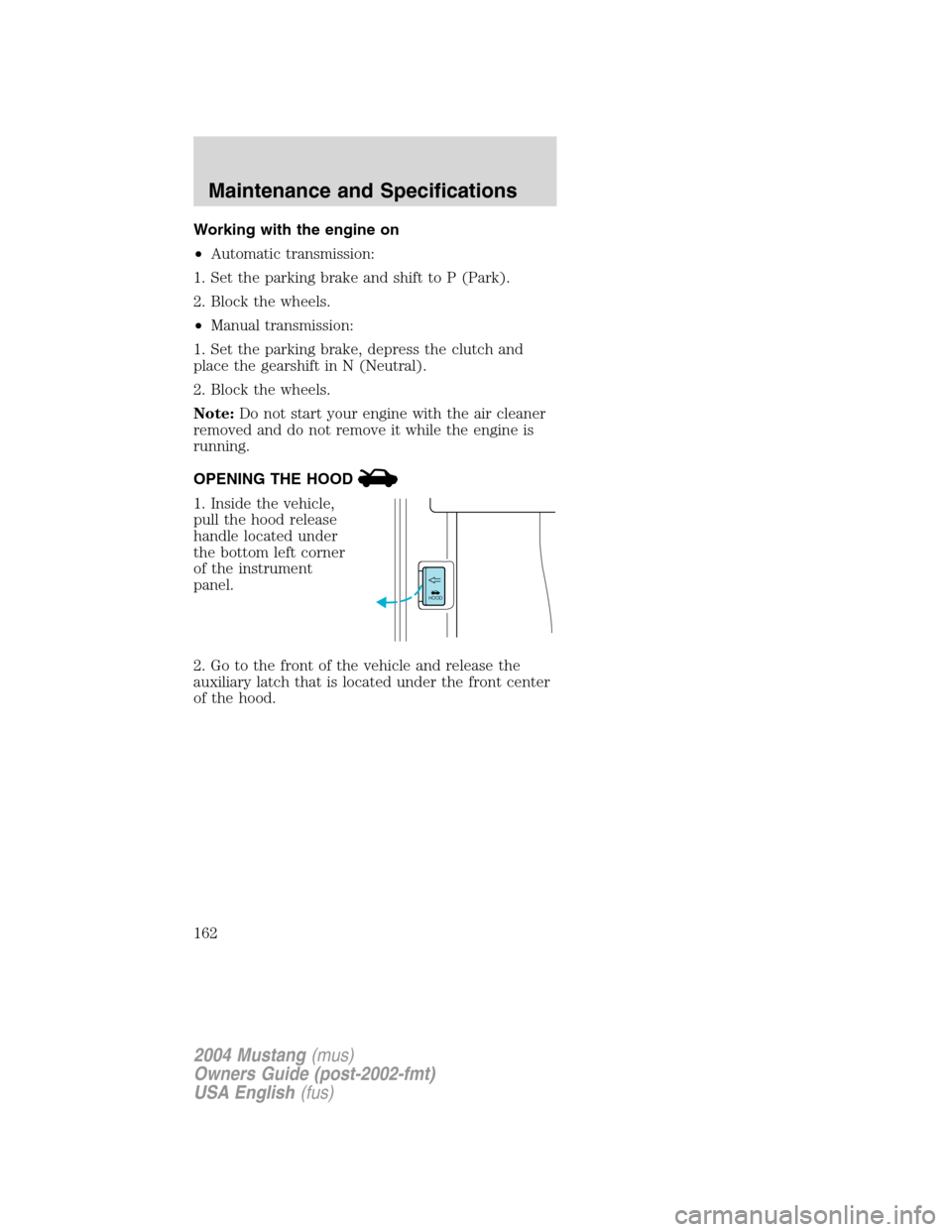
OPENING THE HOOD
1. Inside the vehicle,
pull the hood release
handle located under
the bottom left corner
of the instrument
panel.
2. Go to the front of the vehicle and release the
auxiliary latch that is located under the front center
of the hood.
HOOD
2004 Mustang(mus)
Owners Guide (post-2002-fmt)
USA English(fus)
Maintenance and Specifications
162
Page 167 of 240
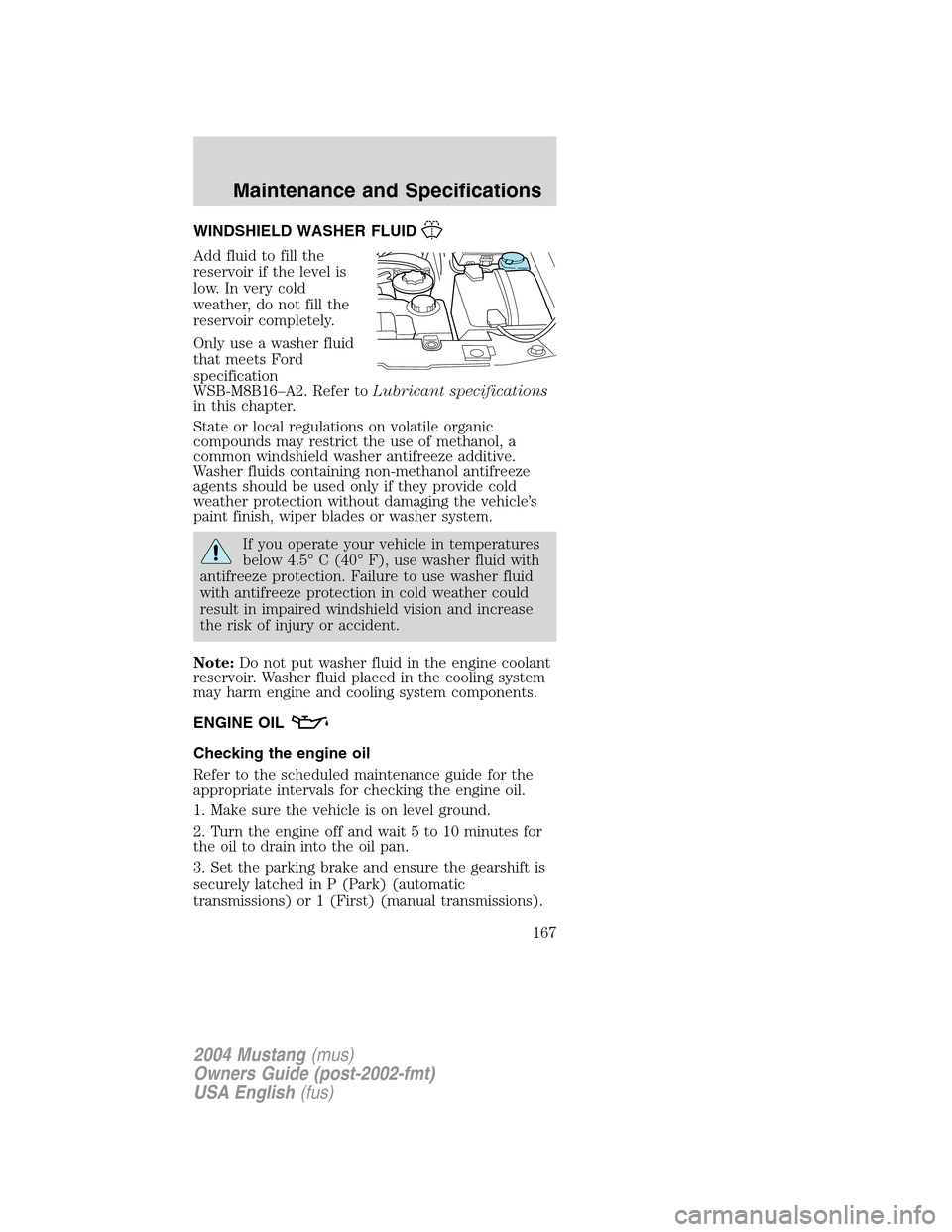
WINDSHIELD WASHER FLUID
Add fluid to fill the
reservoir if the level is
low. In very cold
weather, do not fill the
reservoir completely.
Only use a washer fluid
that meets Ford
specification
WSB-M8B16–A2. Refer toLubricant specifications
in this chapter.
State or local regulations on volatile organic
compounds may restrict the use of methanol, a
common windshield washer antifreeze additive.
Washer fluids containing non-methanol antifreeze
agents should be used only if they provide cold
weather protection without damaging the vehicle’s
paint finish, wiper blades or washer system.
If you operate your vehicle in temperatures
below 4.5°C (40°F), use washer fluid with
antifreeze protection. Failure to use washer fluid
with antifreeze protection in cold weather could
result in impaired windshield vision and increase
the risk of injury or accident.
Note:Do not put washer fluid in the engine coolant
reservoir. Washer fluid placed in the cooling system
may harm engine and cooling system components.
ENGINE OIL
Checking the engine oil
Refer to the scheduled maintenance guide for the
appropriate intervals for checking the engine oil.
1. Make sure the vehicle is on level ground.
2. Turn the engine off and wait 5 to 10 minutes for
the oil to drain into the oil pan.
3. Set the parking brake and ensure the gearshift is
securely latched in P (Park) (automatic
transmissions) or 1 (First) (manual transmissions).
2004 Mustang(mus)
Owners Guide (post-2002-fmt)
USA English(fus)
Maintenance and Specifications
167