ECU FORD MUSTANG 2005 5.G Owner's Manual
[x] Cancel search | Manufacturer: FORD, Model Year: 2005, Model line: MUSTANG, Model: FORD MUSTANG 2005 5.GPages: 240, PDF Size: 2.08 MB
Page 75 of 240
If there is any potential active anti-theft problem with your vehicle,
ensureALL remote entry transmittersare taken to the dealership to
aid in troubleshooting.
Arming the system
When armed, the active anti-theft system is designed to notify you of an
unauthorized entry. When unauthorized entry or towing occurs, the
system will flash the turn signal lamps and interior lamps and sounds the
security horn.
The system is ready to arm whenever the key is out of the ignition. Any
of the following actions will arm the alarm system:
•Press the remote transmitter lock control one time to arm the system.
•Lock all doors using the interior power lock switch while the driver or
passenger door is open and then becomes closed.
•Lock all doors with the key in the key lock cylinder (this willnot
however arm the interior motion or vehicle incline sensing systems).
If all the closures (doors, trunk, hood) are closed, the turn signal lamps
will flash once. If the vehicle is locked again within three seconds, the
vehicle will lock again, the turn signal lamps will flash again and the horn
will chirp.
If any closure is not properly closed, the turn signal lamps will not flash
and the horn will chirp twice.
The system will wait 20 seconds after locking before triggering an alarm.
After the 20–second pre-arm phase, the power door unlock control is
disabled to further protect your vehicle.
Disarming the system
You can disarm the active anti-theft system by any of the following
actions:
•Unlock the doors by using the remote entry transmitter.
•Unlock the doors with the key in the driver door lock cylinder.
•Turn the ignition to the 3 (ON) position with a programmed coded
ignition key.
Note:Unlocking the trunk inhibits the motion sensing system, but the
system continues to monitor the doors, hood and the vehicle incline.
Once the trunk becomes closed the motion sensing system will re-arm.
2005 05+ Mustang(197)
Owners Guide (post-2002-fmt)
USA_English(fus)
Locks and Security
75
Page 85 of 240
Each seating position in your vehicle has a specific safety belt
assembly which is made up of one buckle and one tongue that
are designed to be used as a pair. 1) Use the shoulder belt on the
outside shoulder only. Never wear the shoulder belt under the arm. 2)
Never swing the safety belt around your neck over the inside shoulder.
3) Never use a single belt for more than one person.
Always transport children 12 years old and under in the back
seat and always properly use appropriate child restraints.
Safety belts and seats can become hot in a vehicle that has been
closed up in sunny weather; they could burn a small child. Check
seat covers and buckles before you place a child anywhere near them.
Combination lap and shoulder belts
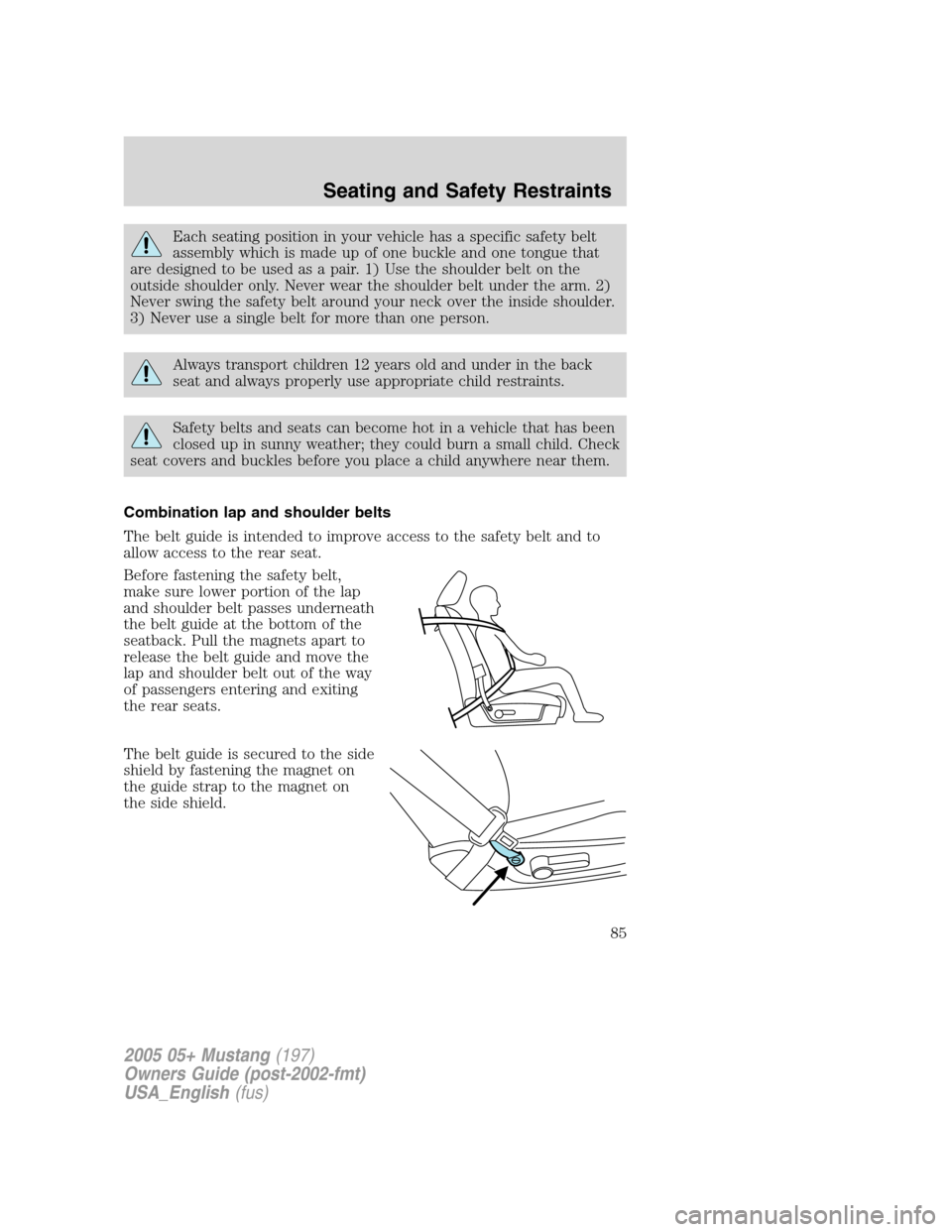
The belt guide is intended to improve access to the safety belt and to
allow access to the rear seat.
Before fastening the safety belt,
make sure lower portion of the lap
and shoulder belt passes underneath
the belt guide at the bottom of the
seatback. Pull the magnets apart to
release the belt guide and move the
lap and shoulder belt out of the way
of passengers entering and exiting
the rear seats.
The belt guide is secured to the side
shield by fastening the magnet on
the guide strap to the magnet on
the side shield.
2005 05+ Mustang(197)
Owners Guide (post-2002-fmt)
USA_English(fus)
Seating and Safety Restraints
85
Page 86 of 240
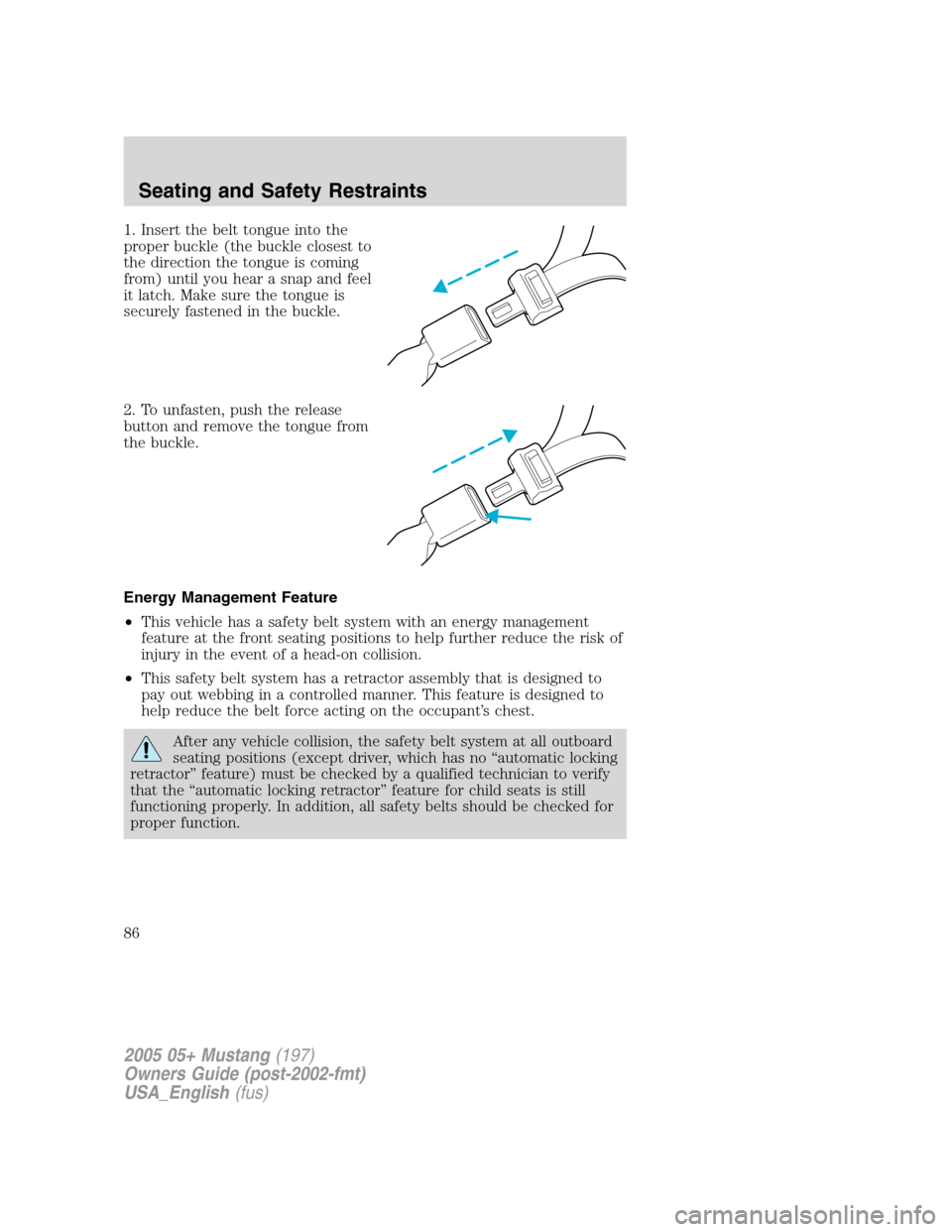
1. Insert the belt tongue into the
proper buckle (the buckle closest to
the direction the tongue is coming
from) until you hear a snap and feel
it latch. Make sure the tongue is
securely fastened in the buckle.
2. To unfasten, push the release
button and remove the tongue from
the buckle.
Energy Management Feature
•This vehicle has a safety belt system with an energy management
feature at the front seating positions to help further reduce the risk of
injury in the event of a head-on collision.
•This safety belt system has a retractor assembly that is designed to
pay out webbing in a controlled manner. This feature is designed to
help reduce the belt force acting on the occupant’s chest.
After any vehicle collision, the safety belt system at all outboard
seating positions (except driver, which has no“automatic locking
retractor”feature) must be checked by a qualified technician to verify
that the“automatic locking retractor”feature for child seats is still
functioning properly. In addition, all safety belts should be checked for
proper function.
2005 05+ Mustang(197)
Owners Guide (post-2002-fmt)
USA_English(fus)
Seating and Safety Restraints
86
Page 107 of 240
Follow all instructions provided by the manufacturer of the
booster seat.
Never put the shoulder belt under a child’s arm or behind the
back because it eliminates the protection for the upper part of
the body and may increase the risk of injury or death in a collision.
Never use pillows, books, or towels to boost a child. They can
slide around and increase the likelihood of injury or death in a
collision.
SAFETY SEATS FOR CHILDREN
Child and infant or child safety seats
Use a safety seat that is recommended for the size and weight of the
child. Carefully follow all of the manufacturer’s instructions with the
safety seat you put in your vehicle. If you do not install and use the
safety seat properly, the child may be injured in a sudden stop or
collision.
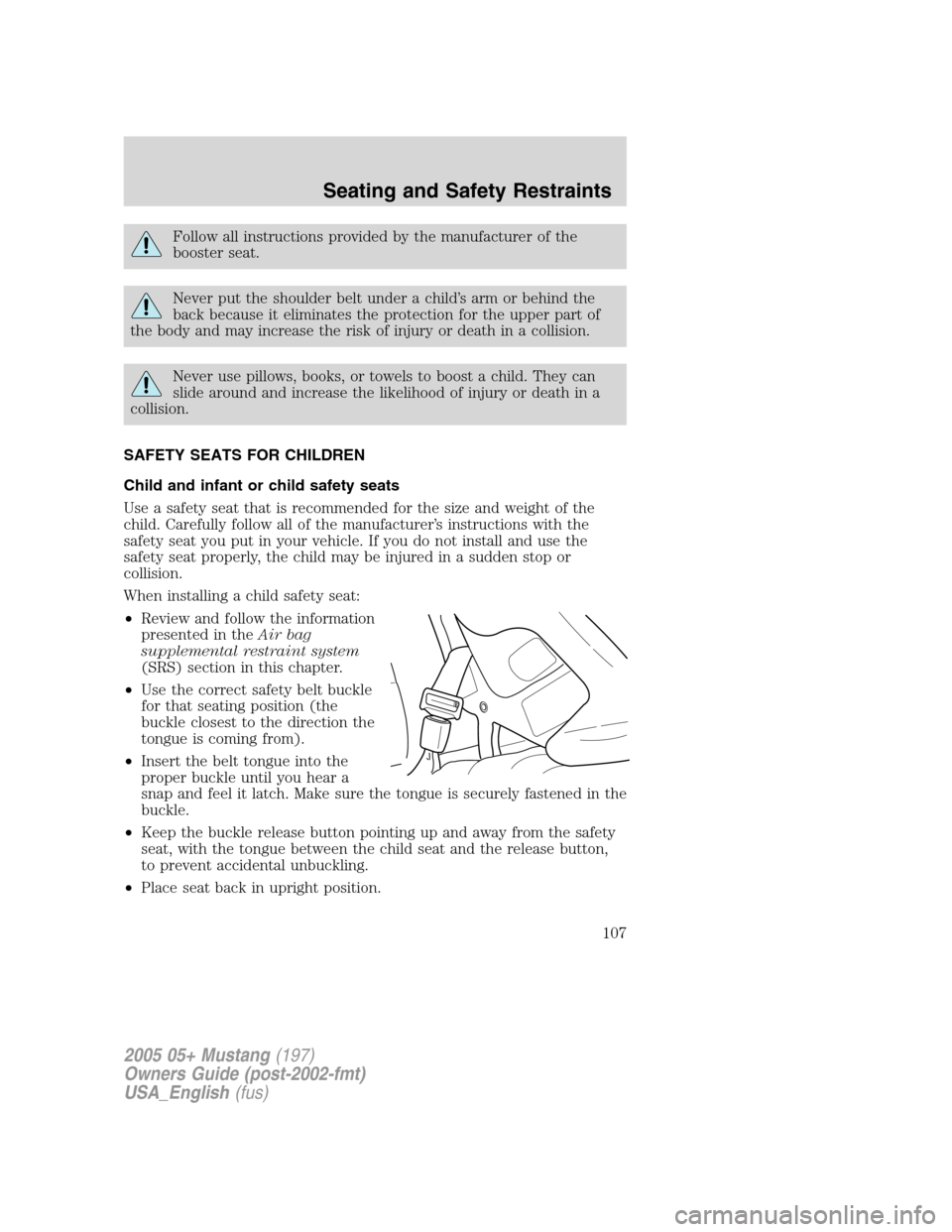
When installing a child safety seat:
•Review and follow the information
presented in theAir bag
supplemental restraint system
(SRS) section in this chapter.
•Use the correct safety belt buckle
for that seating position (the
buckle closest to the direction the
tongue is coming from).
•Insert the belt tongue into the
proper buckle until you hear a
snap and feel it latch. Make sure the tongue is securely fastened in the
buckle.
•Keep the buckle release button pointing up and away from the safety
seat, with the tongue between the child seat and the release button,
to prevent accidental unbuckling.
•Place seat back in upright position.
2005 05+ Mustang(197)
Owners Guide (post-2002-fmt)
USA_English(fus)
Seating and Safety Restraints
107
Page 110 of 240
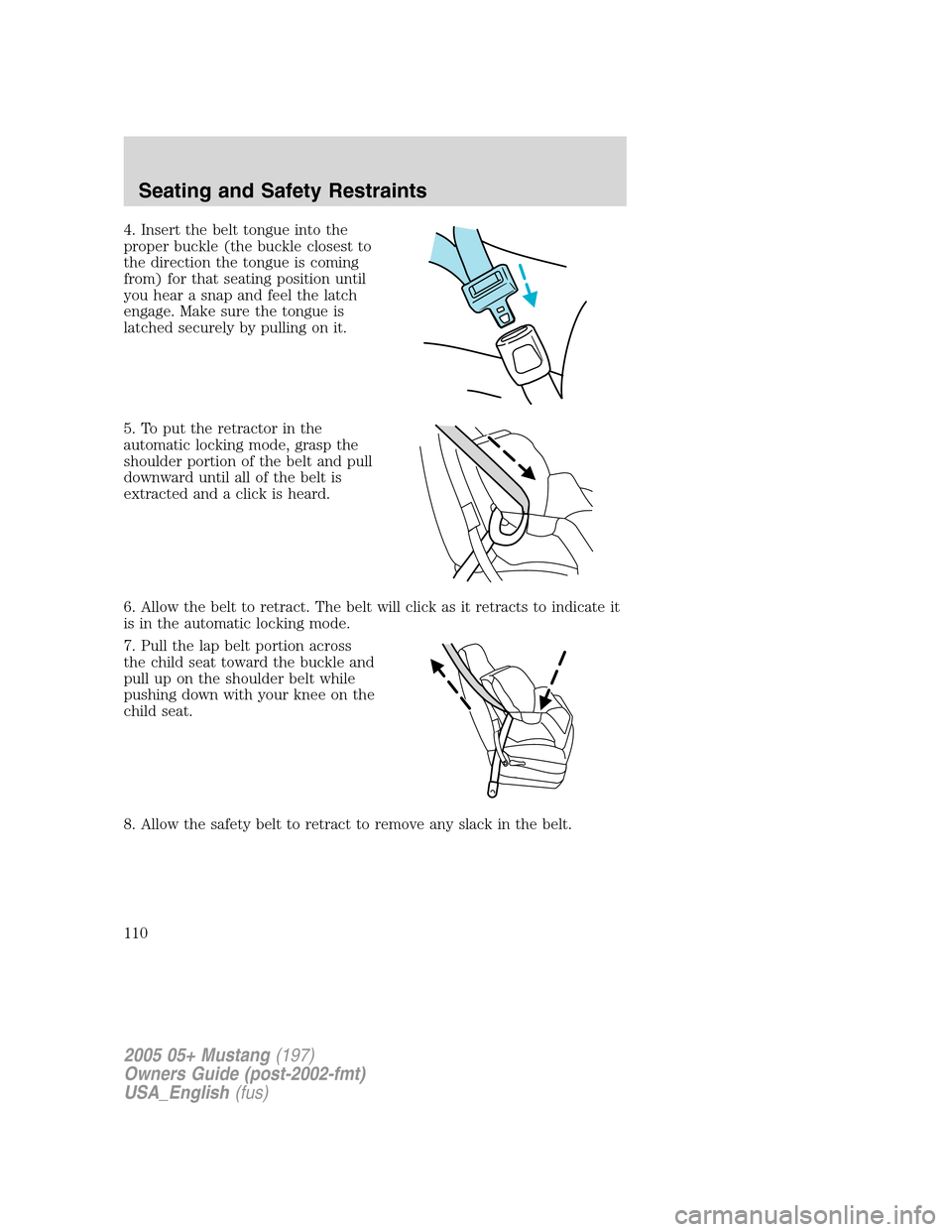
4. Insert the belt tongue into the
proper buckle (the buckle closest to
the direction the tongue is coming
from) for that seating position until
you hear a snap and feel the latch
engage. Make sure the tongue is
latched securely by pulling on it.
5. To put the retractor in the
automatic locking mode, grasp the
shoulder portion of the belt and pull
downward until all of the belt is
extracted and a click is heard.
6. Allow the belt to retract. The belt will click as it retracts to indicate it
is in the automatic locking mode.
7. Pull the lap belt portion across
the child seat toward the buckle and
pull up on the shoulder belt while
pushing down with your knee on the
child seat.
8. Allow the safety belt to retract to remove any slack in the belt.
2005 05+ Mustang(197)
Owners Guide (post-2002-fmt)
USA_English(fus)
Seating and Safety Restraints
110
Page 111 of 240
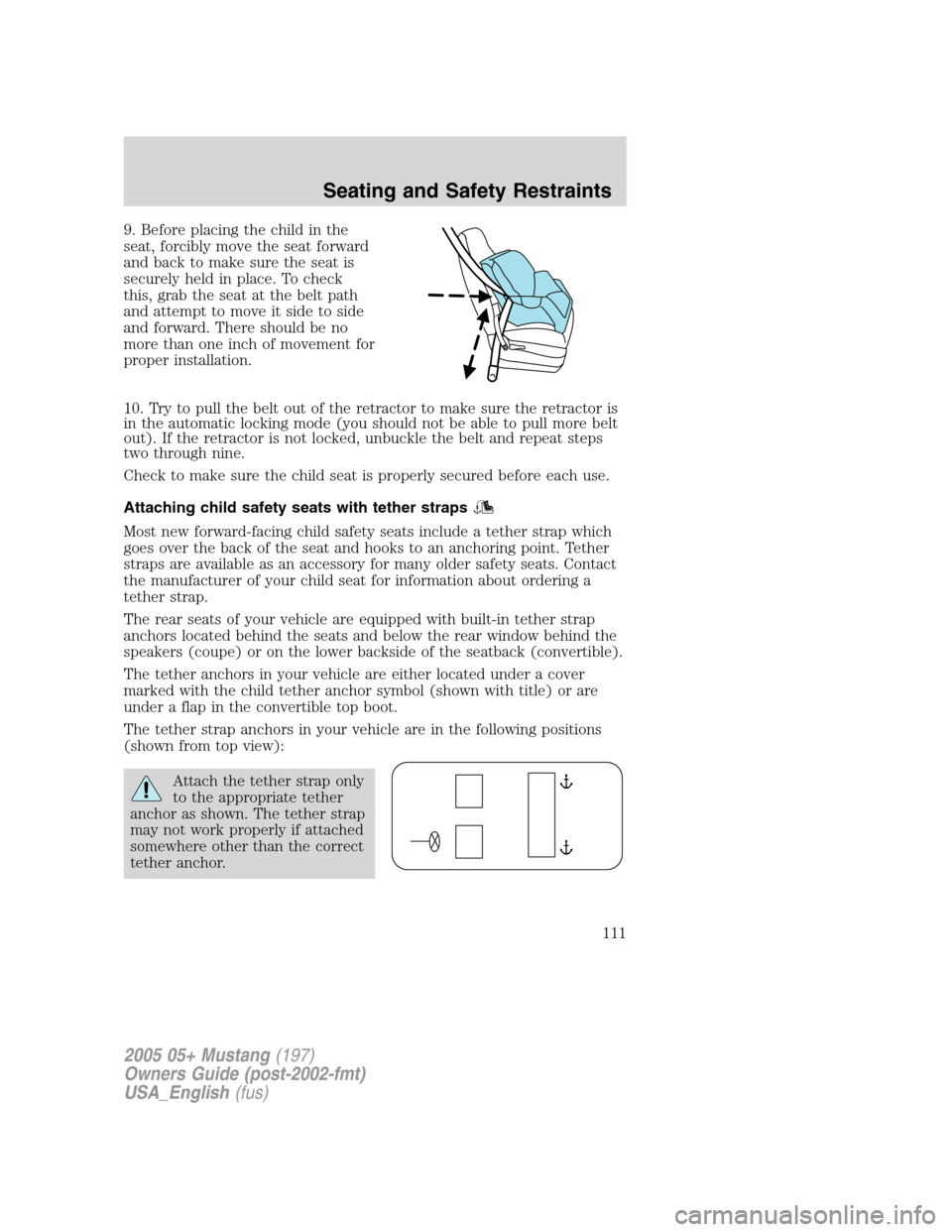
9. Before placing the child in the
seat, forcibly move the seat forward
and back to make sure the seat is
securely held in place. To check
this, grab the seat at the belt path
and attempt to move it side to side
and forward. There should be no
more than one inch of movement for
proper installation.
10. Try to pull the belt out of the retractor to make sure the retractor is
in the automatic locking mode (you should not be able to pull more belt
out). If the retractor is not locked, unbuckle the belt and repeat steps
two through nine.
Check to make sure the child seat is properly secured before each use.
Attaching child safety seats with tether straps
Most new forward-facing child safety seats include a tether strap which
goes over the back of the seat and hooks to an anchoring point. Tether
straps are available as an accessory for many older safety seats. Contact
the manufacturer of your child seat for information about ordering a
tether strap.
The rear seats of your vehicle are equipped with built-in tether strap
anchors located behind the seats and below the rear window behind the
speakers (coupe) or on the lower backside of the seatback (convertible).
The tether anchors in your vehicle are either located under a cover
marked with the child tether anchor symbol (shown with title) or are
under a flap in the convertible top boot.
The tether strap anchors in your vehicle are in the following positions
(shown from top view):
Attach the tether strap only
to the appropriate tether
anchor as shown. The tether strap
may not work properly if attached
somewhere other than the correct
tether anchor.
2005 05+ Mustang(197)
Owners Guide (post-2002-fmt)
USA_English(fus)
Seating and Safety Restraints
111
Page 135 of 240
Snow tires must be the same size and grade as the tires you
currently have on your vehicle.
If your vehicle has P215/65R16 or P235/55R17 tires, they have all
weather treads to provide traction in rain or snow. However, in some
climates, you may need to use snow tires and chains. Use chains on the
tires only in an emergency or if the law requires them.
Follow these guidelines when using snow tires and chains:
•Chains may damage aluminum wheels.
•Use only SAE Class S chains with P215/65R16 tires on the rear of the
vehicle only.
•Do not use tire chains with size P235/55R17 or P255/45R18 tires. Use
of SAE Class S chains or other chain types may damage your vehicle.
•Install chains securely, verifying that the chains do not touch any
wiring, brake lines or fuel lines.
•Drive cautiously. If you hear the chains rub or bang against your
vehicle, stop and re-tighten the chains. If this does not work, remove
the chains to prevent damage to your vehicle.
•If possible, avoid fully loading your vehicle.
•Remove the tire chains when they are no longer needed. Do not use
tire chains on dry roads.
•The suspension insulation and bumpers will help prevent vehicle
damage. Do not remove these components from your vehicle when
using snow tires and chains.
VEHICLE LOADING–WITH AND WITHOUT A TRAILER
This section will guide you in the proper loading of your vehicle and/or
trailer, to keep your loaded vehicle weight within its design rating
capability, with or without a trailer. Properly loading your vehicle will
provide maximum return of vehicle design performance. Before loading
your vehicle, familiarize yourself with the following terms for determining
your vehicle’s weight ratings, with or without a trailer, from the vehicle’s
Safety Certification Label and Tire Label:
Base Curb Weight–is the weight of the vehicle including a full tank of
fuel and all standard equipment. It does not include passengers, cargo, or
optional equipment.
Vehicle Curb Weight–is the weight of your new vehicle when you
picked it up from your dealer plus any aftermarket equipment.
2005 05+ Mustang(197)
Owners Guide (post-2002-fmt)
USA_English(fus)
Tires, Wheels and Loading
135
Page 143 of 240
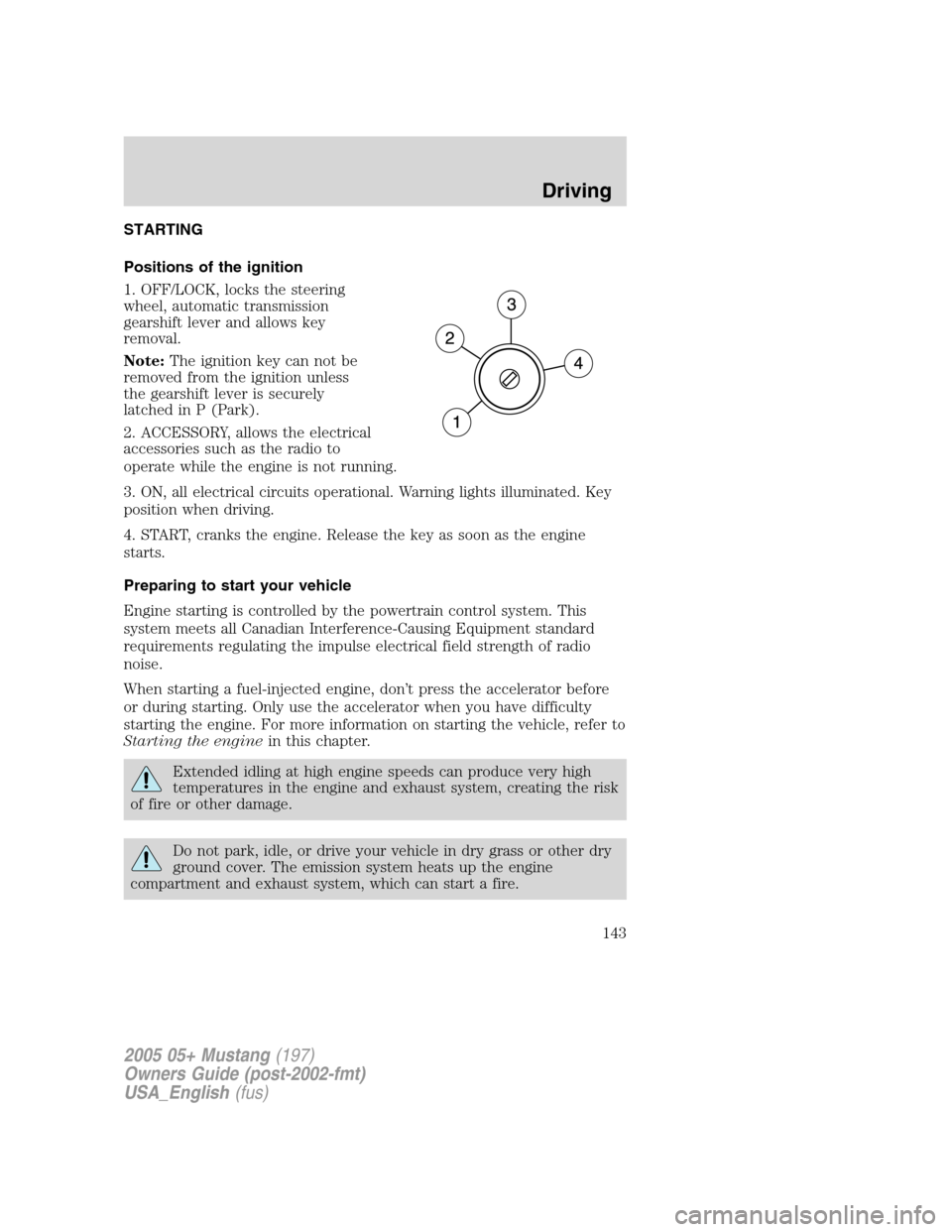
STARTING
Positions of the ignition
1. OFF/LOCK, locks the steering
wheel, automatic transmission
gearshift lever and allows key
removal.
Note:The ignition key can not be
removed from the ignition unless
the gearshift lever is securely
latched in P (Park).
2. ACCESSORY, allows the electrical
accessories such as the radio to
operate while the engine is not running.
3. ON, all electrical circuits operational. Warning lights illuminated. Key
position when driving.
4. START, cranks the engine. Release the key as soon as the engine
starts.
Preparing to start your vehicle
Engine starting is controlled by the powertrain control system. This
system meets all Canadian Interference-Causing Equipment standard
requirements regulating the impulse electrical field strength of radio
noise.
When starting a fuel-injected engine, don’t press the accelerator before
or during starting. Only use the accelerator when you have difficulty
starting the engine. For more information on starting the vehicle, refer to
Starting the enginein this chapter.
Extended idling at high engine speeds can produce very high
temperatures in the engine and exhaust system, creating the risk
of fire or other damage.
Do not park, idle, or drive your vehicle in dry grass or other dry
ground cover. The emission system heats up the engine
compartment and exhaust system, which can start a fire.
2005 05+ Mustang(197)
Owners Guide (post-2002-fmt)
USA_English(fus)
Driving
Driving
143
Page 149 of 240
Brake Assist (if equipped)
The Brake Assist system provides full braking force during panic braking
situations. It detects a rapid application of the brake pedal and
maximizes the amount of brake booster assist, helping the driver to
achieve maximum braking pressure. Once a panic brake application is
detected, the system will remain activated as long as the brake pedal is
depressed. The system is deactivated by releasing the brake pedal.
When the system activates, the brake pedal will travel with very little
effort; this is normal.
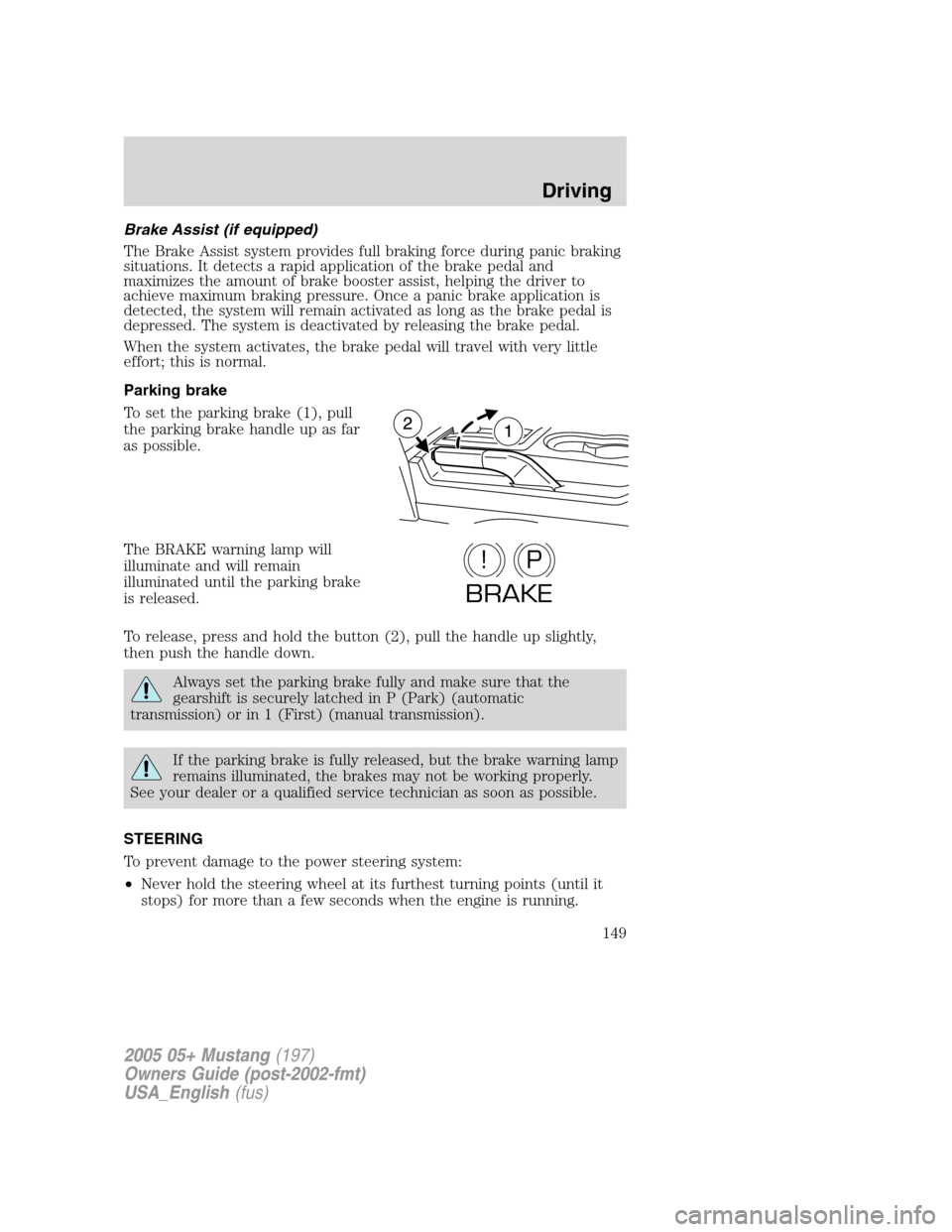
Parking brake
To set the parking brake (1), pull
the parking brake handle up as far
as possible.
The BRAKE warning lamp will
illuminate and will remain
illuminated until the parking brake
is released.
To release, press and hold the button (2), pull the handle up slightly,
then push the handle down.
Always set the parking brake fully and make sure that the
gearshift is securely latched in P (Park) (automatic
transmission) or in 1 (First) (manual transmission).
If the parking brake is fully released, but the brake warning lamp
remains illuminated, the brakes may not be working properly.
See your dealer or a qualified service technician as soon as possible.
STEERING
To prevent damage to the power steering system:
•Never hold the steering wheel at its furthest turning points (until it
stops) for more than a few seconds when the engine is running.
P!
BRAKE
2005 05+ Mustang(197)
Owners Guide (post-2002-fmt)
USA_English(fus)
Driving
149
Page 154 of 240
To put your vehicle in P (Park):
•Come to a complete stop
•Move the gearshift lever and securely latch it in P (Park)
Always set the parking brake fully and make sure the gearshift is
latched in P (Park). Turn the ignition to the LOCK position and
remove the key whenever you leave your vehicle.
R (Reverse)
With the gearshift lever in R (Reverse), the vehicle will move backward.
Always come to a complete stop before shifting into and out of R (Reverse).
N (Neutral)
With the gearshift lever in N (Neutral), the vehicle can be started and is
free to roll. Hold the brake pedal down while in this position.
D (Drive) with Overdrive
The normal driving position for the best fuel economy. Transmission
operates in gears one through five.
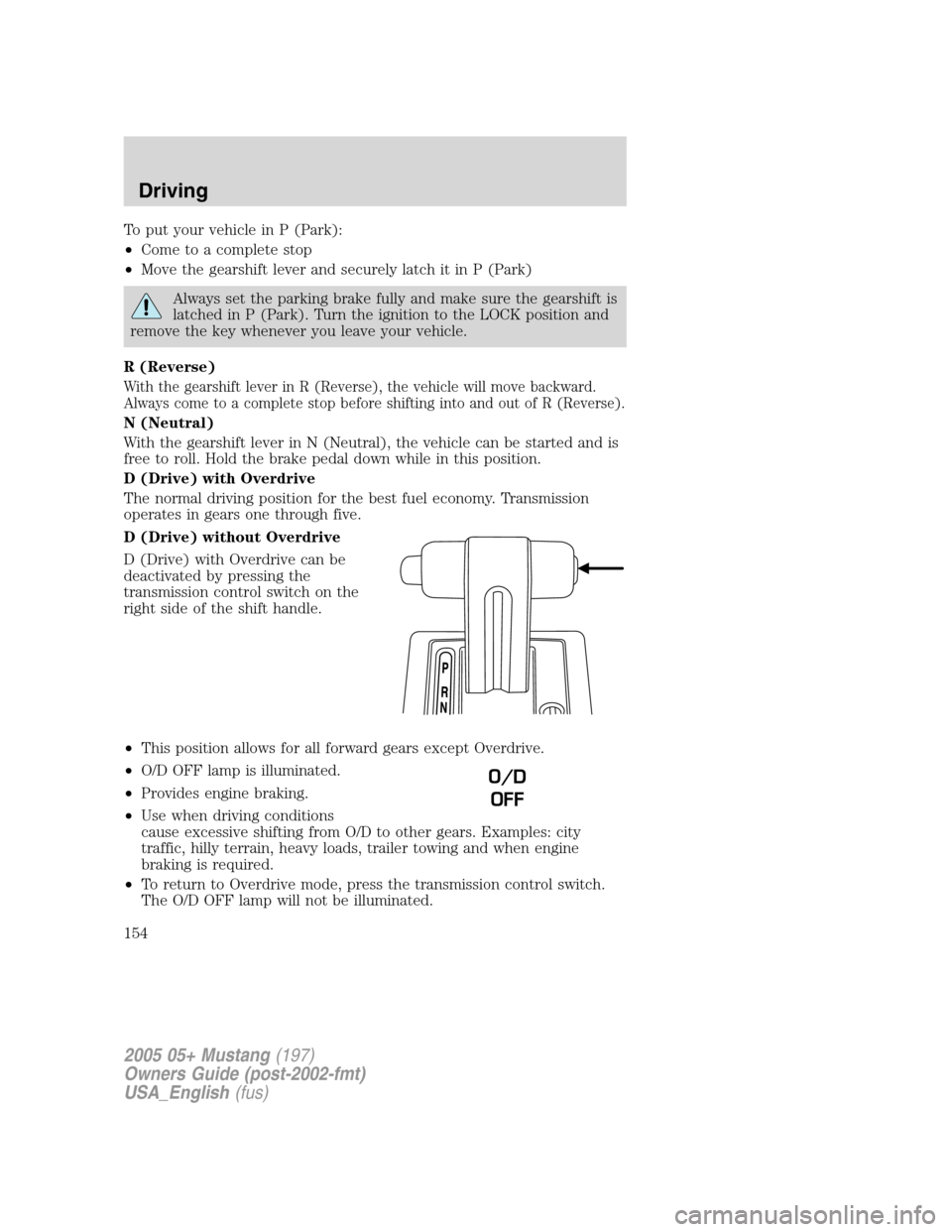
D (Drive) without Overdrive
D (Drive) with Overdrive can be
deactivated by pressing the
transmission control switch on the
right side of the shift handle.
•This position allows for all forward gears except Overdrive.
•O/D OFF lamp is illuminated.
•Provides engine braking.
•Use when driving conditions
cause excessive shifting from O/D to other gears. Examples: city
traffic, hilly terrain, heavy loads, trailer towing and when engine
braking is required.
•To return to Overdrive mode, press the transmission control switch.
The O/D OFF lamp will not be illuminated.
O/D
OFF
2005 05+ Mustang(197)
Owners Guide (post-2002-fmt)
USA_English(fus)
Driving
154