ignition FORD MUSTANG 2010 5.G Workshop Manual
[x] Cancel search | Manufacturer: FORD, Model Year: 2010, Model line: MUSTANG, Model: FORD MUSTANG 2010 5.GPages: 318, PDF Size: 2.91 MB
Page 200 of 318
ABS warning lamp
The ABS lamp in the instrument
cluster momentarily illuminates
when the ignition is turned on. If
the light does not illuminate during
start up, remains on or flashes, the
ABS may be disabled and may need to be serviced.
Even when the ABS is disabled,
normal braking is still effective. If
your BRAKE warning lamp
illuminates with the parking brake
released, have your brake system
serviced immediately.
Using ABS
When hard braking is required, apply continuous force on the brake
pedal; do not pump the brake pedal since this will reduce the
effectiveness of the ABS and will increase your vehicle’s stopping
distance. The ABS will be activated immediately, allowing you to retain
steering control during hard braking and on slippery surfaces. However,
the ABS does not decrease stopping distance.
Parking brake
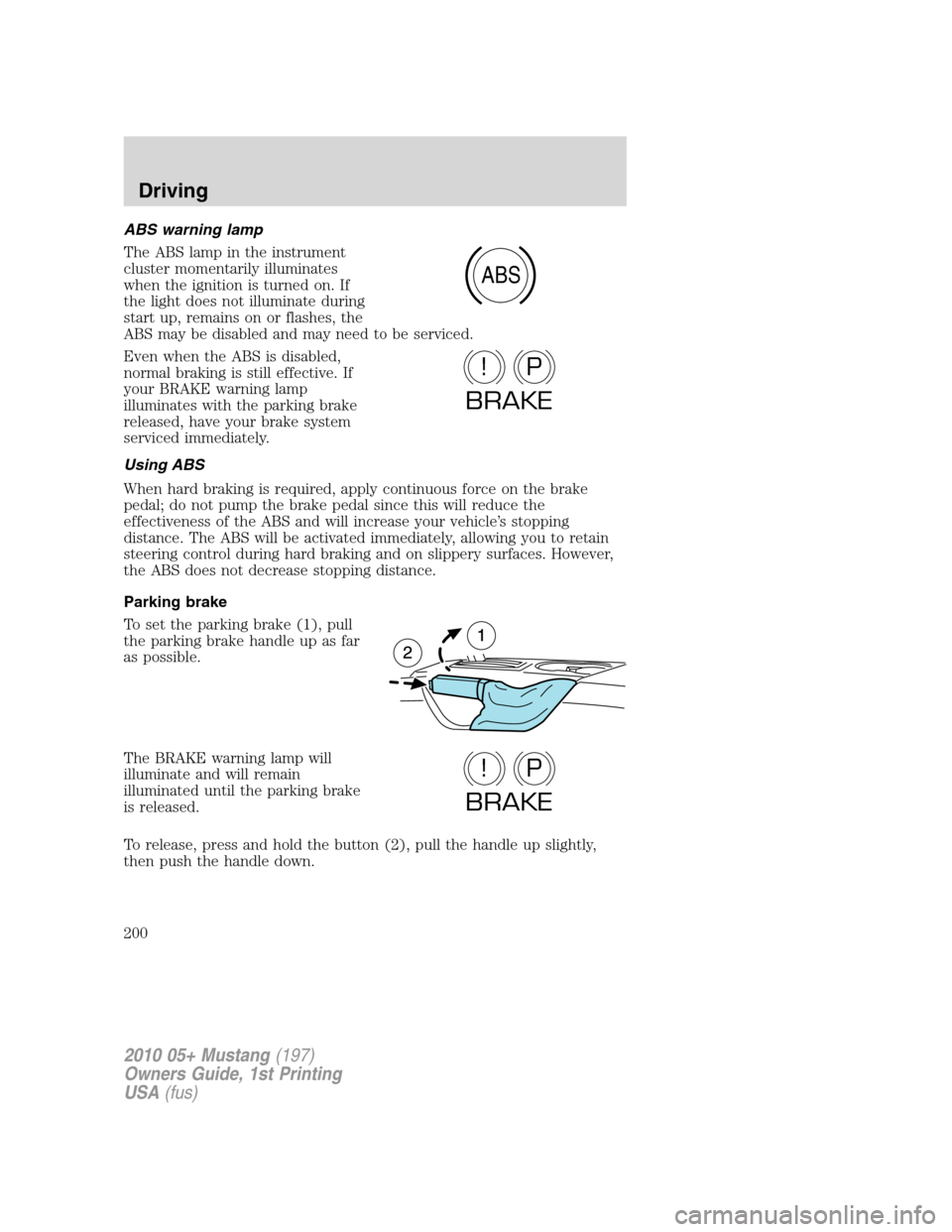
To set the parking brake (1), pull
the parking brake handle up as far
as possible.
The BRAKE warning lamp will
illuminate and will remain
illuminated until the parking brake
is released.
To release, press and hold the button (2), pull the handle up slightly,
then push the handle down.
ABS
P!
BRAKE
P!
BRAKE
2010 05+ Mustang(197)
Owners Guide, 1st Printing
USA(fus)
Driving
200
Page 207 of 318
•Some noise is normal during operation. If the noise is excessive, check
for a low power steering fluid level before seeking service by your
authorized dealer.
•Heavy or uneven steering efforts may be caused by a low power
steering fluid level. Check for a low power steering fluid level before
seeking service by your authorized dealer.
•Do not fill the power steering fluid reservoir above the MAX mark on
the reservoir.
If the power steering system breaks down (or if the engine is turned
off), you can steer the vehicle manually, but it takes more effort.
If the steering wanders or pulls, check for:
•an improperly inflated tire
•uneven tire wear
•loose or worn suspension components
•loose or worn steering components
•improper steering alignment
A high crown in the road or high crosswinds may also make the steering
seem to wander/pull.
TRACTION-LOK™ AXLE (IF EQUIPPED)
This axle provides added traction on slippery surfaces, particularly when
one wheel is on a poor traction surface. Under normal conditions, the
Traction-Lok™ axle functions like a standard rear axle.
Extended use of other than the manufacturer’s specified size tires on a
Traction-Lok™ rear axle could result in a permanent reduction in
effectiveness. This loss of effectiveness does not affect normal driving
and should not be noticeable to the driver.
BRAKE-SHIFT INTERLOCK
This vehicle is equipped with a brake-shift interlock feature that prevents
the gearshift lever from being moved from P (Park) when the ignition is
in the on position unless the brake pedal is depressed.
2010 05+ Mustang(197)
Owners Guide, 1st Printing
USA(fus)
Driving
207
Page 208 of 318
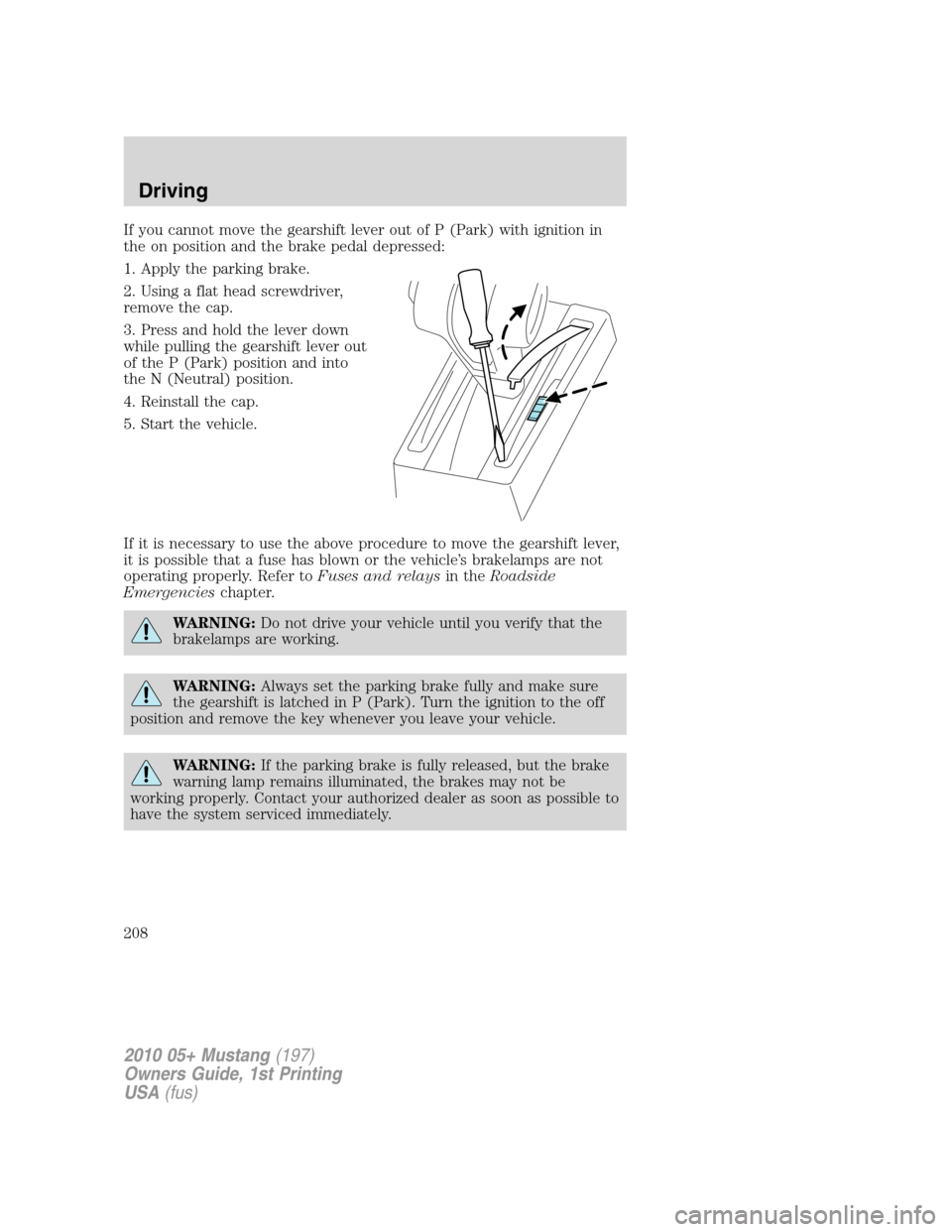
If you cannot move the gearshift lever out of P (Park) with ignition in
the on position and the brake pedal depressed:
1. Apply the parking brake.
2. Using a flat head screwdriver,
remove the cap.
3. Press and hold the lever down
while pulling the gearshift lever out
of the P (Park) position and into
the N (Neutral) position.
4. Reinstall the cap.
5. Start the vehicle.
If it is necessary to use the above procedure to move the gearshift lever,
it is possible that a fuse has blown or the vehicle’s brakelamps are not
operating properly. Refer toFuses and relaysin theRoadside
Emergencieschapter.
WARNING:Do not drive your vehicle until you verify that the
brakelamps are working.
WARNING:Always set the parking brake fully and make sure
the gearshift is latched in P (Park). Turn the ignition to the off
position and remove the key whenever you leave your vehicle.
WARNING:If the parking brake is fully released, but the brake
warning lamp remains illuminated, the brakes may not be
working properly. Contact your authorized dealer as soon as possible to
have the system serviced immediately.
2010 05+ Mustang(197)
Owners Guide, 1st Printing
USA(fus)
Driving
208
Page 210 of 318
WARNING:Always set the parking brake fully and make sure
the gearshift is latched in P (Park). Turn the ignition to the
LOCK position and remove the key whenever you leave your vehicle.
R (Reverse)
With the gearshift lever in R (Reverse), the vehicle will move backward.
Always come to a complete stop before shifting into and out of R
(Reverse).
N (Neutral)
With the gearshift lever in N (Neutral), the vehicle can be started and is
free to roll. Hold the brake pedal down while in this position.
D (Drive) with Overdrive
The normal driving position for the best fuel economy. Transmission
operates in gears one through five.
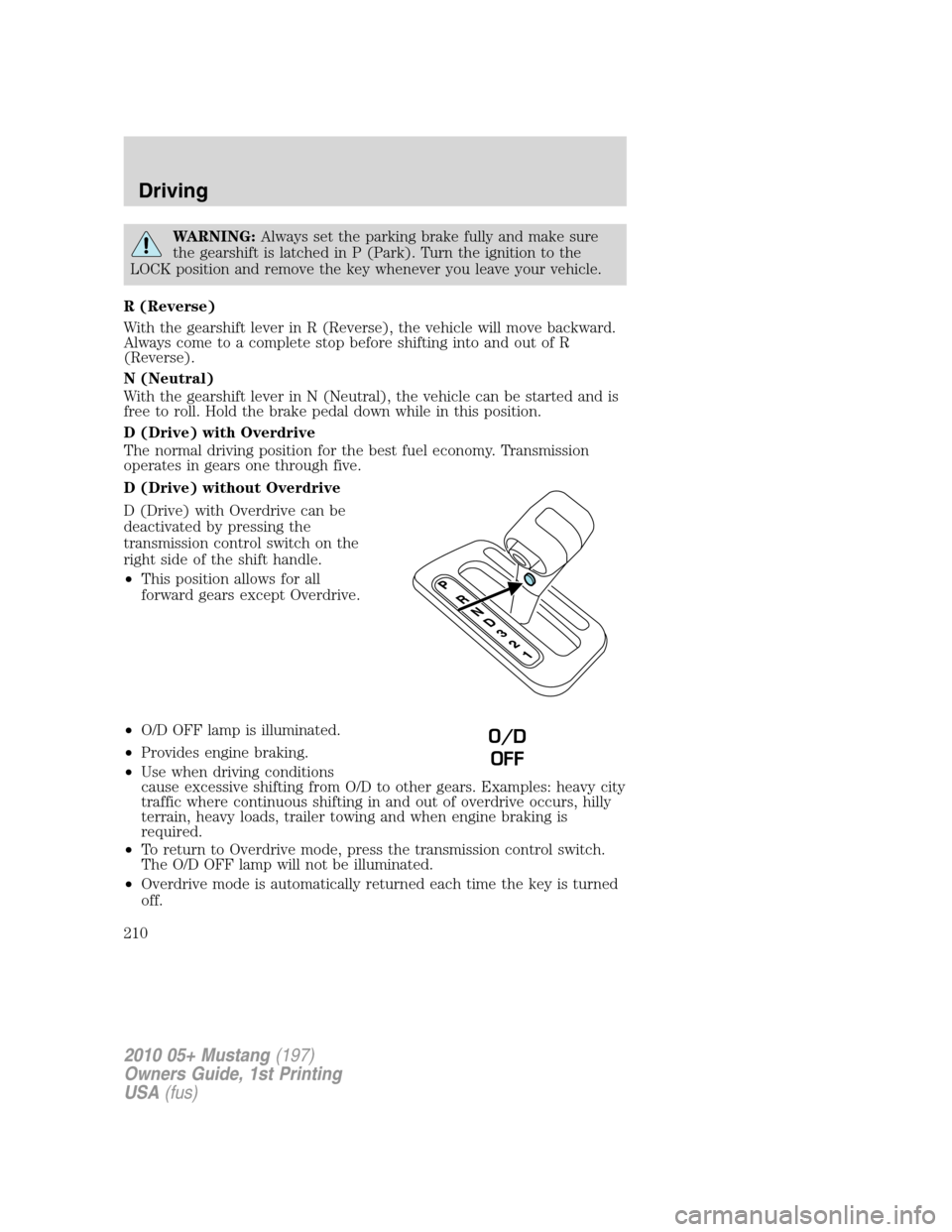
D (Drive) without Overdrive
D (Drive) with Overdrive can be
deactivated by pressing the
transmission control switch on the
right side of the shift handle.
•This position allows for all
forward gears except Overdrive.
•O/D OFF lamp is illuminated.
•Provides engine braking.
•Use when driving conditions
cause excessive shifting from O/D to other gears. Examples: heavy city
traffic where continuous shifting in and out of overdrive occurs, hilly
terrain, heavy loads, trailer towing and when engine braking is
required.
•To return to Overdrive mode, press the transmission control switch.
The O/D OFF lamp will not be illuminated.
•Overdrive mode is automatically returned each time the key is turned
off.
O/D
OFF
2010 05+ Mustang(197)
Owners Guide, 1st Printing
USA(fus)
Driving
210
Page 213 of 318
Recommended shift speeds
Do not downshift into 1 (First) when your vehicle is moving
faster than 15 mph (24 km/h). This will damage the clutch.
Upshift according to the following chart:
Upshifts when accelerating
(recommended for best fuel economy)
Shift from:
1 - 2 11 mph (18 km/h)
2 - 3 19 mph (31 km/h)
3 - 4 30 mph (48 km/h)
4 - 5 40 mph (64 km/h)
Reverse
1. Make sure that your vehicle is at a complete stop before you shift into
R (Reverse). Failure to do so may damage the transmission.
2. Move the gearshift lever into the
neutral position and wait at least
three seconds before shifting into R
(Reverse).
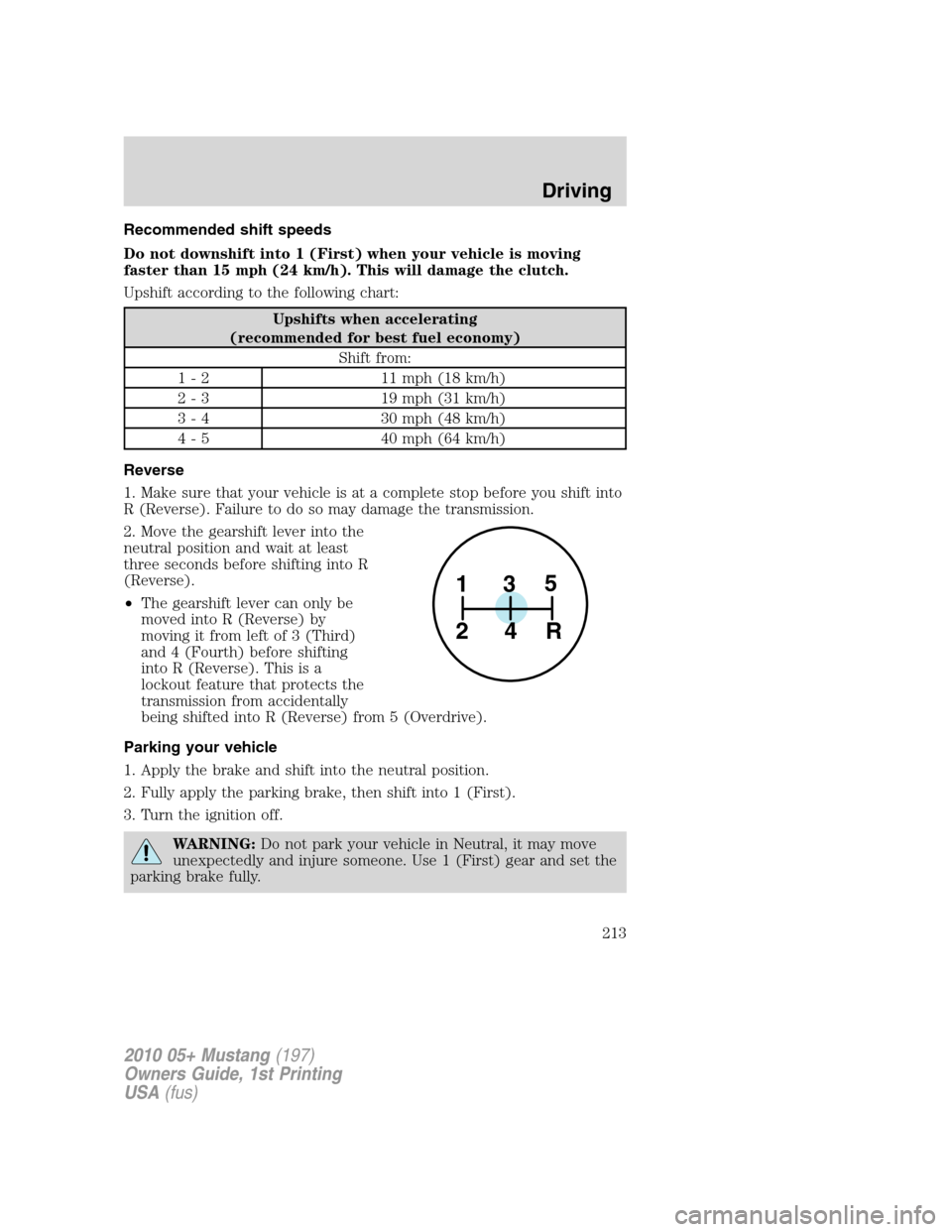
•The gearshift lever can only be
moved into R (Reverse) by
moving it from left of 3 (Third)
and 4 (Fourth) before shifting
into R (Reverse). This is a
lockout feature that protects the
transmission from accidentally
being shifted into R (Reverse) from 5 (Overdrive).
Parking your vehicle
1. Apply the brake and shift into the neutral position.
2. Fully apply the parking brake, then shift into 1 (First).
3. Turn the ignition off.
WARNING:Do not park your vehicle in Neutral, it may move
unexpectedly and injure someone. Use 1 (First) gear and set the
parking brake fully.
1
24R35
2010 05+ Mustang(197)
Owners Guide, 1st Printing
USA(fus)
Driving
213
Page 218 of 318
•towing of your disabled vehicle
•emergency travel expense reimbursement
•travel planning benefits
In Canada, for uninterrupted Roadside Assistance coverage, you may
purchase extended coverage prior to your Basic Warranty’s Roadside
Assistance expiring. For more information and enrollment, contact
1–877–294–2582 or visit our website at www.ford.ca.
Using roadside assistance
Complete the roadside assistance identification card and place it in your
wallet for quick reference. In the United States, this card is found in the
Owner Guide portfolio in the glove compartment. In Canada, the card is
found in theCustomer Information Guidein the glove compartment.
U.S. Ford, Mercury and Lincoln vehicle customers who require Roadside
Assistance, call 1-800-241-3673.
Canadian customers who require roadside assistance, call
1-800-665-2006.
If you need to arrange roadside assistance for yourself, Ford Motor
Company will reimburse a reasonable amount for towing to the nearest
dealership within 35 miles. To obtain reimbursement information, U.S.
Ford, Mercury and Lincoln vehicle customers call 1-800-241-3673.
Customers will be asked to submit their original receipts.
Canadian customers who need to obtain reimbursement information, call
1–800–665–2006.
HAZARD FLASHER CONTROL
The hazard flasher control is located
on the center console next to the
gearshift lever. The hazard flashers
will operate when the ignition is in
any position or if the key is not in
the ignition.
Push in the flasher control and all front and rear direction signals will
flash. Press the flasher control again to turn them off. Use it when your
vehicle is disabled and is creating a safety hazard for other motorists.
Note:With extended use, the flasher may run down your battery.
2010 05+ Mustang(197)
Owners Guide, 1st Printing
USA(fus)
Roadside Emergencies
218
Page 219 of 318
FUEL PUMP SHUT-OFF SWITCHFUEL
RESET
This device stops the electric fuel pump from sending fuel to the engine
when your vehicle has had a substantial jolt.
After an accident, if the engine cranks but does not start, this switch
may have been activated.
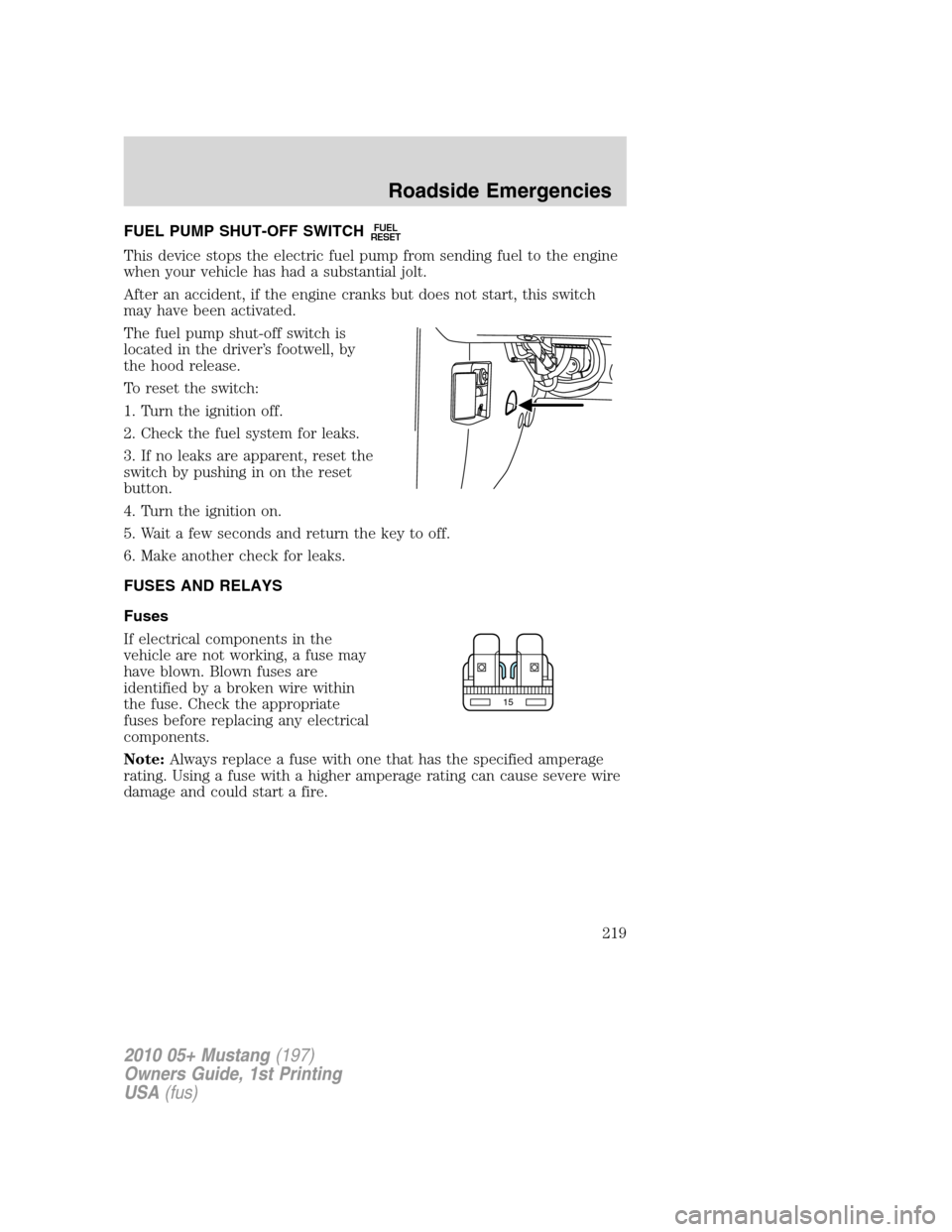
The fuel pump shut-off switch is
located in the driver’s footwell, by
the hood release.
To reset the switch:
1. Turn the ignition off.
2. Check the fuel system for leaks.
3. If no leaks are apparent, reset the
switch by pushing in on the reset
button.
4. Turn the ignition on.
5. Wait a few seconds and return the key to off.
6. Make another check for leaks.
FUSES AND RELAYS
Fuses
If electrical components in the
vehicle are not working, a fuse may
have blown. Blown fuses are
identified by a broken wire within
the fuse. Check the appropriate
fuses before replacing any electrical
components.
Note:Always replace a fuse with one that has the specified amperage
rating. Using a fuse with a higher amperage rating can cause severe wire
damage and could start a fire.
15
2010 05+ Mustang(197)
Owners Guide, 1st Printing
USA(fus)
Roadside Emergencies
219
Page 222 of 318
Fuse/Relay
LocationFuse Amp
RatingProtected Circuits
11 10A Security module
12 7.5A Power mirrors
13 5A Not used (Spare)
14 10A Center information display, Electronic
finish panel, GPS
15 10A Climate control
16 15A Not used (Spare)
17 20A Power door locks
18 20A Not used (Spare)
19 25A Navigation amp
20 15A Diagnostic connector
21 15A Fog lamps
22 15A Park lamps, License lamps
23 15A High beam headlamps
24 20A Horn
25 10A Demand lighting (battery saver)
26 10A Cluster (battery)
27 20A Ignition switch feed
28 5A Audio mute (Start)
29 5A Camera (Run/Start)
30 5A Not used (Spare)
31 10A Restraints Control Module (RCM)
32 10A Passenger Airbag Deactivation
Indicator (PADI), Occupant
Classification Sensor (OCS)
33 10A Not used (Spare)
34 5A Electronic stability control, Steering
angle
35 10A Auxiliary Body Module (ABM)
Run/Start
36 5A Passive Anti-Theft System (PATS)
37 10A Not used (Spare)
2010 05+ Mustang(197)
Owners Guide, 1st Printing
USA(fus)
Roadside Emergencies
222
Page 225 of 318
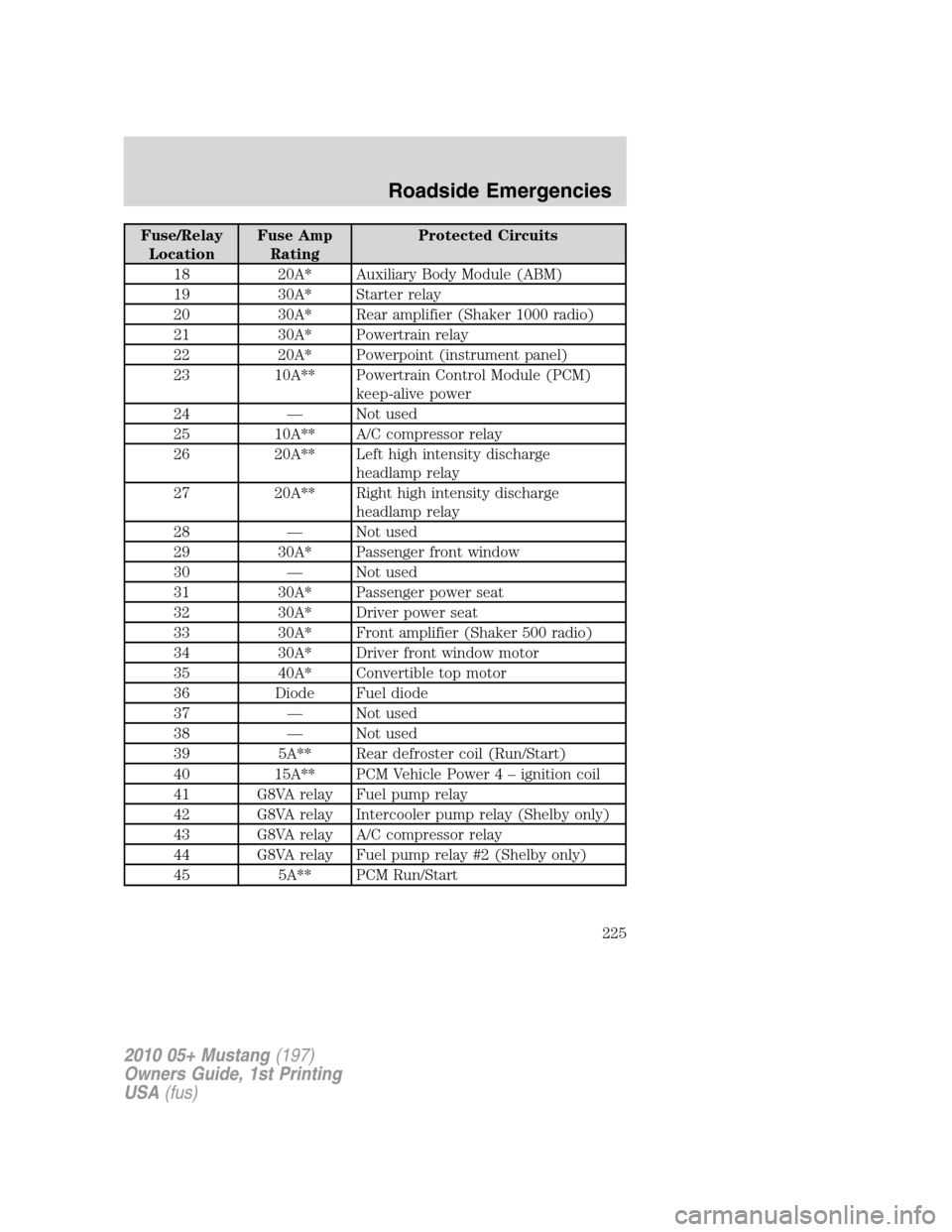
Fuse/Relay
LocationFuse Amp
RatingProtected Circuits
18 20A* Auxiliary Body Module (ABM)
19 30A* Starter relay
20 30A* Rear amplifier (Shaker 1000 radio)
21 30A* Powertrain relay
22 20A* Powerpoint (instrument panel)
23 10A** Powertrain Control Module (PCM)
keep-alive power
24 — Not used
25 10A** A/C compressor relay
26 20A** Left high intensity discharge
headlamp relay
27 20A** Right high intensity discharge
headlamp relay
28 — Not used
29 30A* Passenger front window
30 — Not used
31 30A* Passenger power seat
32 30A* Driver power seat
33 30A* Front amplifier (Shaker 500 radio)
34 30A* Driver front window motor
35 40A* Convertible top motor
36 Diode Fuel diode
37 — Not used
38 — Not used
39 5A** Rear defroster coil (Run/Start)
40 15A** PCM Vehicle Power4–ignition coil
41 G8VA relay Fuel pump relay
42 G8VA relay Intercooler pump relay (Shelby only)
43 G8VA relay A/C compressor relay
44 G8VA relay Fuel pump relay #2 (Shelby only)
45 5A** PCM Run/Start
2010 05+ Mustang(197)
Owners Guide, 1st Printing
USA(fus)
Roadside Emergencies
225
Page 288 of 318
Cleaner air
Ford endorses the use of reformulated “cleaner-burning” gasolines to
improve air quality, per the recommendations in theChoosing the right
fuelsection.
Running out of fuel
Avoid running out of fuel because this situation may have an adverse
effect on powertrain components.
If you have run out of fuel:
•You may need to cycle the ignition from off to on several times after
refueling to allow the fuel system to pump the fuel from the tank to
the engine. On restarting, cranking time will take a few seconds longer
than normal.
•Normally, adding 1 gallon (3.8L) of fuel is enough to restart the
engine. If the vehicle is out of fuel and on a steep grade, more than
1 gallon (3.8L) may be required.
•The service engine soon
indicator may come on. For more
information on the service engine soon indicator, refer toWarning
lights and chimesin theInstrument Clusterchapter.
Refilling with a portable fuel container
With the Easy Fuel™ “no cap” fuel system, use the following directions
when filling from a portable fuel container:
WARNING:Do not insert the nozzle of portable fuel containers
or aftermarket funnels into the Easy Fuel™ system. This could
damage the fuel system and its seal, and may cause fuel to run onto
the ground instead of filling the tank, which could result in serious
personal injury.
WARNING:Do not try to pry open or push open the Easy
Fuel™ system with foreign objects. This could damage the fuel
system and its seal and cause injury to you or others.
When filling the vehicle’s fuel tank from a portable fuel container, use the
funnel included with the vehicle.
2010 05+ Mustang(197)
Owners Guide, 1st Printing
USA(fus)
Maintenance and Specifications
288