towing FORD MUSTANG 2013 5.G Owners Manual
[x] Cancel search | Manufacturer: FORD, Model Year: 2013, Model line: MUSTANG, Model: FORD MUSTANG 2013 5.GPages: 437, PDF Size: 4.96 MB
Page 5 of 437
Parking Aids 179
Sensing system.......................................179
Rear-view camera system...............................180
Cruise Control 183
Driving Aids 185
Steering............................................185
Load Carrying 187
Vehicle loading.......................................187
Towing 194
Trailertowing........................................194
Wrecker towing.......................................196
Recreational towing....................................197
Convertible Top 198
Driving Hints 203
Economical driving....................................203
Floormats..........................................205
Roadside Emergencies 207
Getting roadside assistance..............................207
Hazard warning flashers................................208
Fuel cut-off switch....................................209
Jump-starting the vehicle...............................209
Customer Assistance 212
Reporting safety defects (U.S. only)........................219
Reporting safety defects (Canada only).....................219
Fuses 220
Changing a fuse......................................220
Fuse specification chart.................................221
Table of Contents5
2013 05+ Mustang(197)
Owners Guide gf, 1st Printing
USA(fus)
Page 70 of 437
4. After three seconds but within 10 seconds of turning the ignition off,
insert the second previously coded key into the ignition.
5. Turn the ignition from off to on. Keep the ignition on for at least three
seconds, but no more than 10 seconds.
6. Turn the ignition off and remove the second previously programmed
coded key from the ignition.
7. After three seconds but within 20 seconds of turning the ignition off
and removing the previously programmed coded key, insert the new
unprogrammed key into the ignition.
8. Turn the ignition from off to on. Keep the ignition on for at least six
seconds.
9. Remove the newly programmed coded key from the ignition.
The key will start the vehicle’s engine and will operate the remote entry
system (if the new key is an integrated keyhead transmitter) if it has
been successfully programmed. The theft indicator light will illuminate
for three seconds and then go out to indicate successful programming.
If the key was not successfully programmed, the theft indicator light may
flash on and off. Wait 20 seconds and repeat Steps 1 through 8. Take
your vehicle to your authorized dealer to have the new key programmed
if you are still unsuccessful.
Wait 20 seconds and then repeat this procedure from Step 1 to program
an additional key.
ANTI–THEFT ALARM (IF EQUIPPED)
The active anti-theft system is designed to warn you in the event of
unauthorized vehicle entry and is also designed to help prevent
unwanted towing of the vehicle.
You can choose what is monitored by arming the system in different
ways.
Partial Monitor Mode
To monitor the following:
•Doors
•Hood
•Trunk
Lock the vehicle using the key in the driver door key cylinder.
70Security
2013 05+ Mustang(197)
Owners Guide gf, 1st Printing
USA(fus)
Page 71 of 437
Full Monitor Mode
To monitor the following:
•Doors
•Hood
•Trunk
•Movement inside the vehicle (for convertible models, top must be fully
closed)
•Change in vehicle inclination (such as unwanted towing)
Lock the vehicle using the remote control or the power door lock control
with the accompanying door open and then close all doors.
Note:Do not choose full monitor mode if movement within the vehicle is
likely to occur or when the vehicle is in transport.
Note:For proper operation of the interior motion detection system,
ensure all windows are closed prior to arming the system. This will help
prevent accidental alarm activation due to external influences and ensure
proper interior motion detection. Additionally, the interior motion sensing
system will not arm if either door or the trunk is ajar.
If there is any potential perimeter anti-theft problem with your vehicle,
ensure all integrated keyhead transmitters are brought to the authorized
dealer to aid in troubleshooting.
Arming the System
When armed, the active anti-theft system is designed to notify you of an
unauthorized entry. When unauthorized entry or towing occurs, the
system will flash the turn signal lamps and interior lamps and will sound
the horn.
The system is ready to arm whenever the key is out of the ignition. Any
of the following actions will arm the alarm system:
•Press the lock button on the remote control.
•Lock all doors using the interior power lock switch while the driver or
passenger door is open and then becomes closed.
•Lock the driver door with the key in the key lock cylinder (this will
not, however, arm the interior motion or vehicle incline sensing
systems).
There is a 20 second countdown when any of the above actions occur
before the vehicle becomes armed.
Security71
2013 05+ Mustang(197)
Owners Guide gf, 1st Printing
USA(fus)
Page 181 of 437
WARNING:Back up as slow as possible since higher speeds
might limit your reaction time to stop the vehicle.
WARNING:Use caution when using the rear video camera and
the trunk is ajar. If the trunk is ajar, the camera will be out of
position and the video image may be incorrect. All guidelines (if
enabled) have been removed when the trunk is ajar.
WARNING:Use caution when turning camera features on or off
while in R (Reverse). Make sure the vehicle is not moving.
The rear view camera system provides a video image of the area behind
the vehicle.
During operation, lines appear in the display which represent your
vehicle’s path and proximity to objects behind the vehicle.
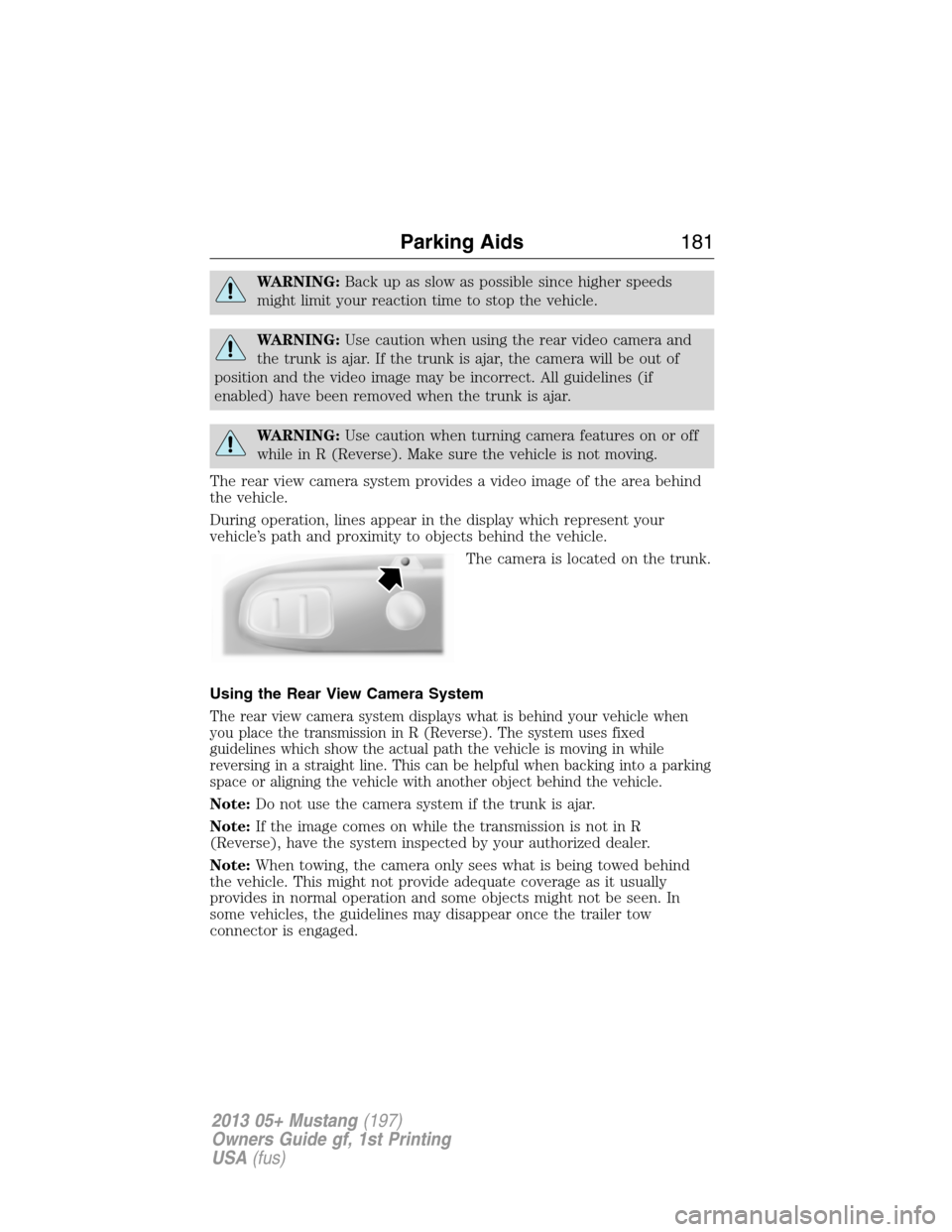
The camera is located on the trunk.
Using the Rear View Camera System
The rear view camera system displays what is behind your vehicle when
you place the transmission in R (Reverse). The system uses fixed
guidelines which show the actual path the vehicle is moving in while
reversing in a straight line. This can be helpful when backing into a parking
space or aligning the vehicle with another object behind the vehicle.
Note:Do not use the camera system if the trunk is ajar.
Note:If the image comes on while the transmission is not in R
(Reverse), have the system inspected by your authorized dealer.
Note:When towing, the camera only sees what is being towed behind
the vehicle. This might not provide adequate coverage as it usually
provides in normal operation and some objects might not be seen. In
some vehicles, the guidelines may disappear once the trailer tow
connector is engaged.
Parking Aids181
2013 05+ Mustang(197)
Owners Guide gf, 1st Printing
USA(fus)
Page 188 of 437
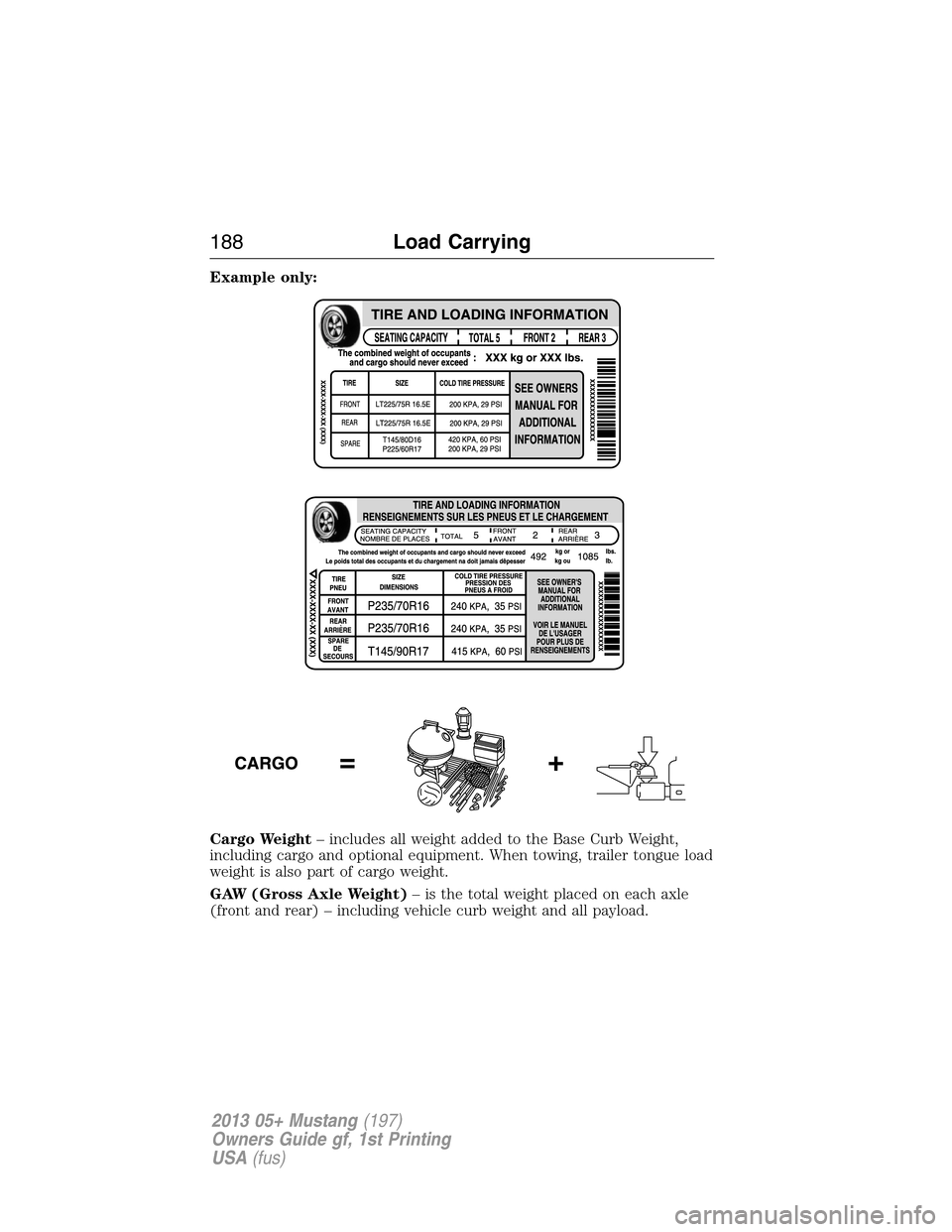
Example only:
Cargo Weight– includes all weight added to the Base Curb Weight,
including cargo and optional equipment. When towing, trailer tongue load
weight is also part of cargo weight.
GAW (Gross Axle Weight)– is the total weight placed on each axle
(front and rear) – including vehicle curb weight and all payload.
188Load Carrying
2013 05+ Mustang(197)
Owners Guide gf, 1st Printing
USA(fus)
Page 189 of 437
GAWR (Gross Axle Weight Rating)– is the maximum allowable
weight that can be carried by a single axle (front or rear).These
numbers are shown on the Safety Compliance Certification Label.
The label shall be affixed to either the door hinge pillar,
door-latch post, or the door edge that meets the door-latch post,
next to the driver’s seating position. The total load on each axle
must never exceed its GAWR.
Note:For trailer towing information refer toTrailer towingfound in
this chapter or theRV and Trailer Towing Guideprovided by your
authorized dealer.
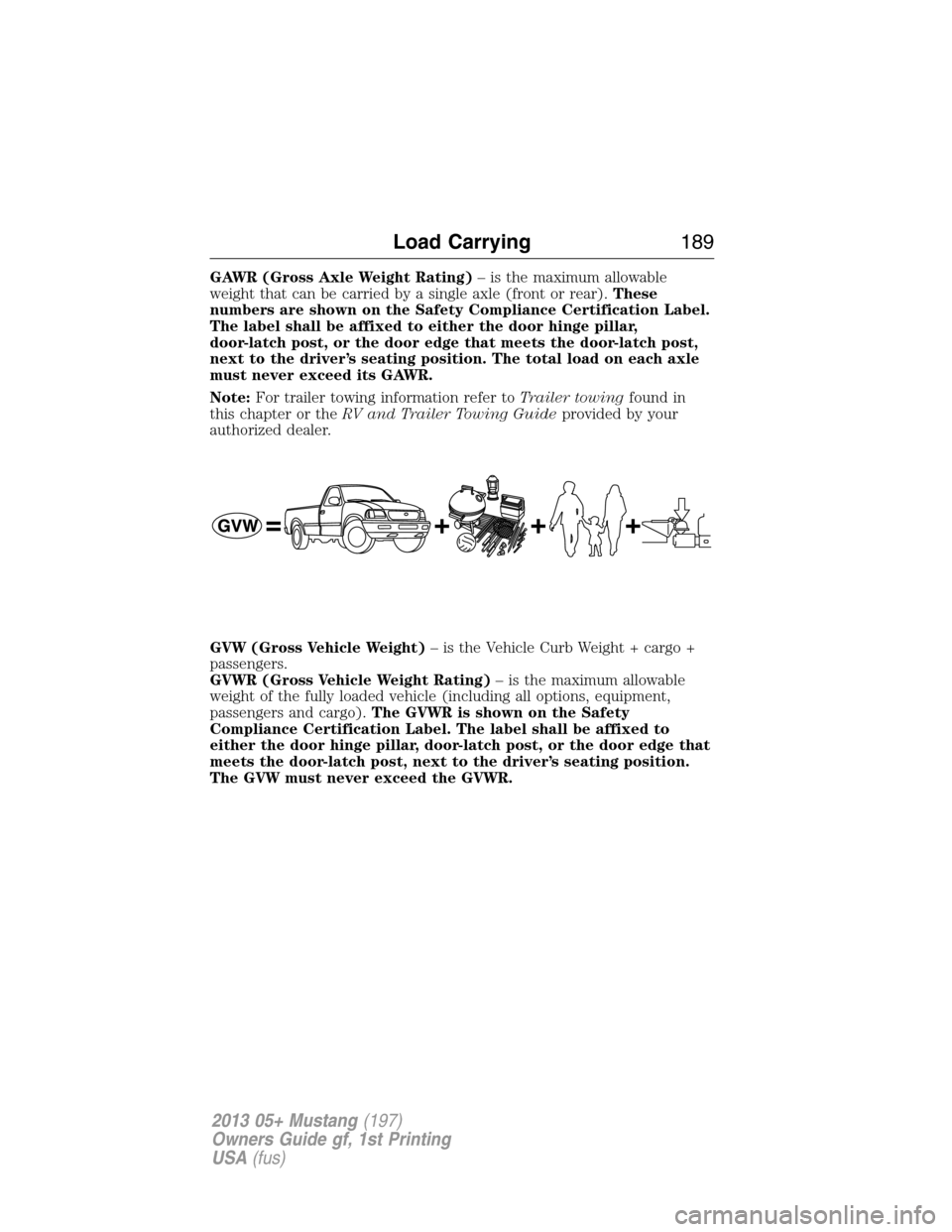
GVW (Gross Vehicle Weight)– is the Vehicle Curb Weight + cargo +
passengers.
GVWR (Gross Vehicle Weight Rating)– is the maximum allowable
weight of the fully loaded vehicle (including all options, equipment,
passengers and cargo).The GVWR is shown on the Safety
Compliance Certification Label. The label shall be affixed to
either the door hinge pillar, door-latch post, or the door edge that
meets the door-latch post, next to the driver’s seating position.
The GVW must never exceed the GVWR.
Load Carrying189
2013 05+ Mustang(197)
Owners Guide gf, 1st Printing
USA(fus)
Page 191 of 437
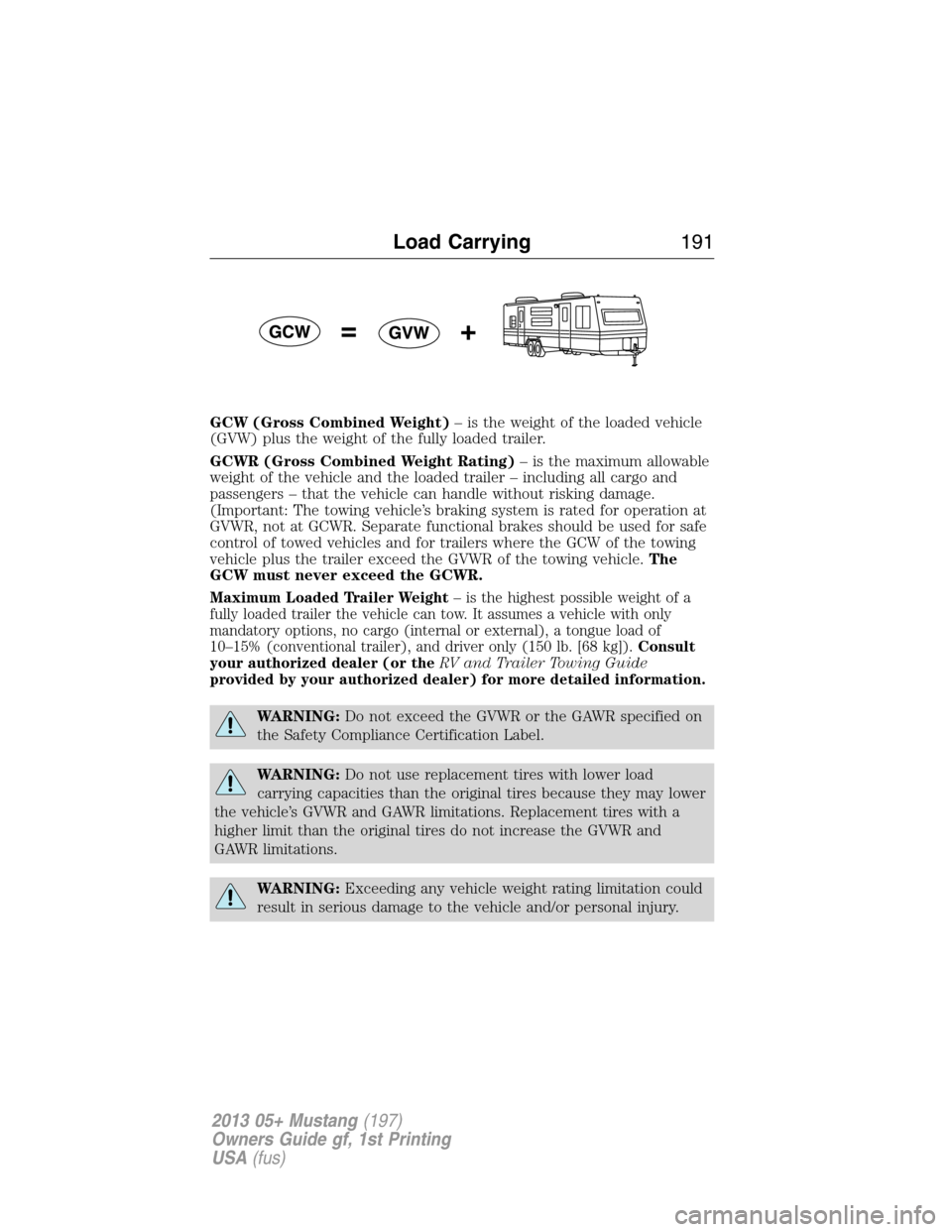
GCW (Gross Combined Weight)– is the weight of the loaded vehicle
(GVW) plus the weight of the fully loaded trailer.
GCWR (Gross Combined Weight Rating)– is the maximum allowable
weight of the vehicle and the loaded trailer – including all cargo and
passengers – that the vehicle can handle without risking damage.
(Important: The towing vehicle’s braking system is rated for operation at
GVWR, not at GCWR. Separate functional brakes should be used for safe
control of towed vehicles and for trailers where the GCW of the towing
vehicle plus the trailer exceed the GVWR of the towing vehicle.The
GCW must never exceed the GCWR.
Maximum Loaded Trailer Weight– is the highest possible weight of a
fully loaded trailer the vehicle can tow. It assumes a vehicle with only
mandatory options, no cargo (internal or external), a tongue load of
10–15% (conventional trailer), and driver only (150 lb. [68 kg]).Consult
your authorized dealer (or theRV and Trailer Towing Guide
provided by your authorized dealer) for more detailed information.
WARNING:Do not exceed the GVWR or the GAWR specified on
the Safety Compliance Certification Label.
WARNING:Do not use replacement tires with lower load
carrying capacities than the original tires because they may lower
the vehicle’s GVWR and GAWR limitations. Replacement tires with a
higher limit than the original tires do not increase the GVWR and
GAWR limitations.
WARNING:Exceeding any vehicle weight rating limitation could
result in serious damage to the vehicle and/or personal injury.
Load Carrying191
2013 05+ Mustang(197)
Owners Guide gf, 1st Printing
USA(fus)
Page 192 of 437
Steps for determining the correct load limit:
1. Locate the statement “The combined weight of occupants and cargo
should never exceed XXX kg or XXX lbs.” on your vehicle’s placard.
2. Determine the combined weight of the driver and passengers that will
be riding in your vehicle.
3. Subtract the combined weight of the driver and passengers from XXX
kg or XXX lbs.
4. The resulting figure equals the available amount of cargo and luggage
load capacity. For example, if the “XXX” amount equals 1,400 lbs. and
there will be five 150 lb. passengers in your vehicle, the amount of
available cargo and luggage load capacity is 650 lbs. (1400–750 (5 x 150)
= 650 lb.). In metric units (635–340 (5 x 68) = 295 kg.)
5. Determine the combined weight of luggage and cargo being loaded on
the vehicle. That weight may not safely exceed the available cargo and
luggage load capacity calculated in Step 4.
6. If your vehicle will be towing a trailer, load from your trailer will be
transferred to your vehicle. Consult this manual to determine how this
reduces the available cargo and luggage load capacity of your vehicle.
The following gives you a few examples on how to calculate the available
amount of cargo and luggage load capacity:
•Another example for your vehicle with 1,400 lb. (635 kg) of cargo and
luggage capacity. You decide to go golfing. Is there enough load
capacity to carry you, 4 of your friends and all the golf bags? You and
four friends average 220 lb. (99 kg) each and the golf bags weigh
approximately 30 lb. (13.5 kg) each. The calculation would be:
1,400 - (5 x 220) - (5 x 30) = 1,400 - 1,100 - 150 = 150 lb. Yes, you
have enough load capacity in your vehicle to transport four friends and
your golf bags. In metric units, the calculation would be:
635 kg - (5 x 99 kg) - (5 x 13.5 kg) = 635 - 495 - 67.5 = 72.5 kg.
192Load Carrying
2013 05+ Mustang(197)
Owners Guide gf, 1st Printing
USA(fus)
Page 194 of 437
TOWING A TRAILER
WARNING:Do not exceed the GVWR or the GAWR specified on
the certification label.
WARNING:Towing trailers beyond the maximum recommended
gross trailer weight exceeds the limit of the vehicle and could
result in engine damage, transmission damage, structural damage, loss
of vehicle control, vehicle rollover and personal injury.
Your vehicle’s load capacity is designated by weight, not by volume, so
you cannot necessarily use all available space when loading a vehicle.
Towing a trailer places an additional load on your vehicle’s engine,
transmission, axle, brakes, tires and suspension. Inspect these
components periodically during, and after, any towing operation.
RECOMMENDED TOWING WEIGHTS
Your vehicle is capable of towing a trailer up to 1000 lb (454 kg) gross
trailer weight with a maximum tongue load of 100 lb (45 kg).Do not
towwith the Boss 302, Boss 302 Laguna Seca, GT Deluxe or Shelby
GT500 models; they are not rated to tow a trailer.
ESSENTIAL TOWING CHECKS
Follow these guidelines to ensure safe towing:
•Do not tow a trailer until your vehicle has been driven at least
1000 miles (1600 kilometers).
•Consult your local motor vehicle laws for towing a trailer.
•Refer to the instructions included with towing accessories for the
proper installation and adjustment specifications.
•Service your vehicle more frequently if you tow a trailer. Refer to your
scheduled maintenance information.
For load specification terms found on the label and instructions on
calculating your vehicle’s load, refer to theLoad Carryingchapter.
Remember to account for the trailer tongue weight as part of the vehicle
load when calculating the total vehicle weight.
Hitches
Do not use a hitch that either clamps onto the bumper or attaches to the
axle. Distribute the trailer load so 10–15% of the total trailer weight is on
the tongue.
194Towing
2013 05+ Mustang(197)
Owners Guide gf, 1st Printing
USA(fus)
Page 195 of 437
Safety Chains
Always connect the safety chains to the vehicle’s hook retainers. To
connect the safety chains, cross them under the trailer tongue and allow
slack for turning corners.
If you use a rental trailer, follow the rental agency’s instructions.
Note:Never attach safety chains to the bumper.
Trailer Brakes
WARNING:Do not connect a trailer’s hydraulic brake system
directly to your vehicle’s brake system. Your vehicle may not have
enough braking power and your chances of having a collision greatly
increase.
Electric brakes and manual, automatic or surge-type trailer brakes are safe
if installed properly and adjusted to the manufacturer’s specifications. The
trailer brakes must meet local and Federal regulations.
The braking system of the tow vehicle is rated for operation at the
GVWR not GCWR.
Trailer Lamps
Trailer lamps are required on most towed vehicles. Ensure all running
lights, brake lights, turn signals and hazard lights are working. Contact
your authorized dealer or trailer rental agency for proper instructions
and equipment for hooking up the lamps.
Before Towing a Trailer
Practice turning, stopping and backing-up to get the feel of the
vehicle-trailer combination before starting on a trip. When turning, make
wider turns so the trailer wheels will clear curbs and other obstacles.
When Towing a Trailer
•Do not drive faster than 70 mph (113 km/h) during the first 500 miles
(800 kilometers) and do not make full-throttle starts.
•Check your hitch, electrical connections and trailer wheel lug nuts
thoroughly after you have traveled 50 miles (80 kilometers).
•Place the gearshift lever in P (Park) to aid in engine and transmission
cooling and A/C efficiency during hot weather while stopped in traffic.
•Turn off the speed control. The speed control may turn off
automatically when you are towing on long, steep grades.
Towing195
2013 05+ Mustang(197)
Owners Guide gf, 1st Printing
USA(fus)