service indicator FORD MUSTANG 2016 6.G User Guide
[x] Cancel search | Manufacturer: FORD, Model Year: 2016, Model line: MUSTANG, Model: FORD MUSTANG 2016 6.GPages: 391, PDF Size: 8.9 MB
Page 144 of 391
PRINCIPLE OF OPERATION
The traction control system helps avoid
drive wheel spin and loss of traction.
If your vehicle begins to slide, the system
applies the brakes to individual wheels
and, when needed, reduces engine power
at the same time. If the wheels spin when
accelerating on slippery or loose surfaces,
the system reduces engine power in order
to increase traction.
USING TRACTION CONTROL
WARNING
The stability and traction control
light illuminates steadily if the
system detects a failure. Make sure
you did not manually disable the traction
control system using the switch. If the
stability control and traction control light
is still illuminating steadily, have the
system serviced by an authorized dealer
immediately. Operating your vehicle with
traction control disabled could lead to an
increased risk of loss of vehicle control,
vehicle rollover, personal injury and death. The system automatically turns on each
time you switch the ignition on.
If your vehicle is stuck in mud or snow,
switching traction control off may be
beneficial as this allows the wheels to spin.
Note:
When you switch traction control off,
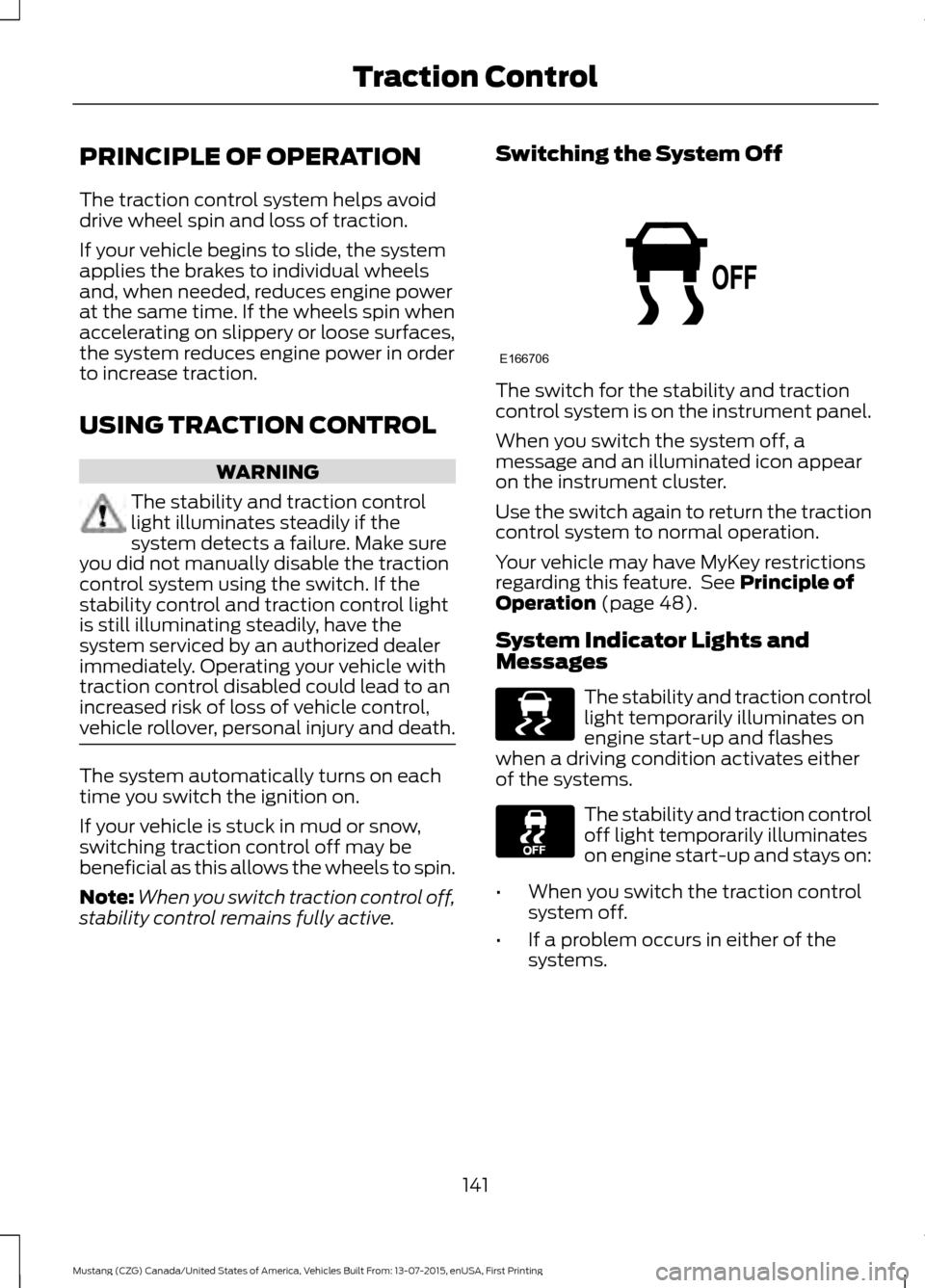
stability control remains fully active. Switching the System Off The switch for the stability and traction
control system is on the instrument panel.
When you switch the system off, a
message and an illuminated icon appear
on the instrument cluster.
Use the switch again to return the traction
control system to normal operation.
Your vehicle may have MyKey restrictions
regarding this feature. See Principle of
Operation (page 48).
System Indicator Lights and
Messages The stability and traction control
light temporarily illuminates on
engine start-up and flashes
when a driving condition activates either
of the systems. The stability and traction control
off light temporarily illuminates
on engine start-up and stays on:
• When you switch the traction control
system off.
• If a problem occurs in either of the
systems.
141
Mustang (CZG) Canada/United States of America, Vehicles Built From: 13-07-2015, enUSA, First Printing Traction ControlE166706 E138639
Page 167 of 391
The following are other situations that may
limit the Cross Traffic Alert performance:
•
Adjacently parked vehicles or objects
obstructing the sensors.
• Approaching vehicles passing at
speeds greater than 37 mph
(60 km/h).
• Driving in reverse faster than
7 mph
(12 km/h).
• Backing out of an angled parking spot.
False Alerts
Note: If your vehicle has a tow bar with a
factory equipped trailer tow module and it
is towing a trailer, the sensors will
automatically turn the Cross Traffic Alert
off. If your vehicle has a tow bar but no
factory equipped trailer tow module, it is
recommended to turn the Cross Traffic Alert
off manually. Operating Cross Traffic Alert
with a trailer attached will cause poor Cross
Traffic Alert performance.
There may be certain instances when there
is a false alert by the Cross Traffic Alert
system that illuminates the alert indicator
with no vehicle in the coverage zone. Some
amount of false alerts are normal; they are
temporary and self-correct.
System Errors
If Cross Traffic Alert senses a problem with
the left or right sensor a message will
appear in the information display. See
(page
80).
Switching the System Off and On
You can temporarily switch Cross Traffic
Alert off in the information display. See
(page
80). When you switch Cross Traffic
Alert off, you will not receive alerts and the
information display will display a system
off message. Note:
The Cross Traffic Alert switches on
whenever the ignition is switched on and
ready to provide appropriate alerts when
the transmission is in reverse (R). Cross
Traffic Alert will not remember the last
selected on or off setting.
You can also have Cross Traffic Alert
switched off permanently at an authorized
dealer. Once switched off permanently,
the system can only be switched back on
at an authorized dealer.
STEERING
Electric Power Steering WARNINGS
The electric power steering system
has diagnostic checks that
continuously monitor the system. If
a fault is detected, a message displays in
the information display. Stop your vehicle
as soon as it is safe to do so. Switch the
ignition off. After at least 10 seconds,
switch the ignition on and watch the
information display for a steering system
warning message. If a steering system
warning message returns, have the system
checked by an authorized dealer. If the system detects an error, you
may not feel a difference in the
steering, however a serious condition
may exist. Obtain immediate service from
an authorized dealer, failure to do so may
result in loss of steering control. Your vehicle has an electric power steering
system. There is no fluid reservoir. No
maintenance is required.
If your vehicle loses electrical power while
you are driving, electric power steering
assistance is lost. The steering system still
operates and you can steer your vehicle
manually. Manually steering your vehicle
requires more effort.
164
Mustang (CZG) Canada/United States of America, Vehicles Built From: 13-07-2015, enUSA, First Printing Driving Aids
Page 182 of 391
ESSENTIAL TOWING CHECKS
Follow these guidelines for safe towing:
•
Do not tow a trailer until you drive your
vehicle at least 1000 miles (1600
kilometers).
• Consult your local motor vehicle laws
for towing a trailer.
• See the instructions included with
towing accessories for the proper
installation and adjustment
specifications.
• Service your vehicle more frequently if
you tow a trailer. See your scheduled
maintenance information.
• If you use a rental trailer, follow the
instructions the rental agency gives
you.
You can find information on load
specification terms found on the tire label
and Safety Compliance label as well as
instructions on calculating your vehicle's
load in the Load Carrying chapter. See
Load Limit (page 170).
Remember to account for the trailer
tongue weight as part of your vehicle load
when calculating the total vehicle weight.
Hitches
Do not use a hitch that either clamps onto
the bumper or attaches to the axle.
Distribute the trailer load so 10-15% of the
total trailer weight is on the tongue.
Safety Chains
Note: Never attach safety chains to the
bumper.
Always connect the safety chains to the
hook retainers of your vehicle hitch.
To connect the safety chains, cross them
under the trailer tongue and allow enough
slack for turning tight corners. Do not allow
the chains to drag on the ground. Trailer Brakes WARNING
Do not connect a trailer's hydraulic
brake system directly to your
vehicle's brake system. Your vehicle
may not have enough braking power and
your chances of having a collision greatly
increase. Electric brakes and manual, automatic or
surge-type trailer brakes are safe if you
install them properly and adjust them to
the manufacturer's specifications. The
trailer brakes must meet local and federal
regulations.
The rating for the tow vehicle's braking
system operation is at the gross vehicle
weight rating, not the gross combined
weight rating.
Trailer Lamps
WARNING
Never connect any trailer lamp wiring
to the vehicle's tail lamp wiring; this
may damage the electrical system
resulting in fire. Contact your authorized
dealer as soon as possible for assistance
in proper trailer tow wiring installation.
Additional electrical equipment may be
required. Trailer lamps are required on most towed
vehicles. Make sure all running lights, brake
lights, direction indicators and hazard lights
are working.
Before Towing a Trailer
Practice turning, stopping and backing up
to get the feel of your vehicle-trailer
combination before starting on a trip.
When turning, make wider turns so the
trailer wheels clear curbs and other
obstacles.
179
Mustang (CZG) Canada/United States of America, Vehicles Built From: 13-07-2015, enUSA, First Printing Towing
Page 193 of 391
This program is separate from the New
Vehicle Limited Warranty, but the coverage
is concurrent with the powertrain coverage
period of your vehicle.
Canadian customers who require roadside
assistance, call 1-800-665-2006.
Vehicles Sold in Canada: Using
Roadside Assistance
Complete the roadside assistance
identification card and place it in your
wallet for quick reference.
In Canada, this card is found in the
Warranty Guide in the glove compartment
of your vehicle.
Vehicles Sold in Canada: Roadside
Assistance Program Coverage
The service is available 24 hours a day,
seven days a week.
Canadian roadside coverage and benefits
may differ from the U.S. coverage.
For complete program coverage details
you may contact your dealer, you can call
us in Canada at 1-800-665-2006, or visit
our website at www.ford.ca.
HAZARD WARNING FLASHERS
Note:
The hazard warning flashers will
operate when the ignition is in any position
or if the key is not in the ignition. If used
when the engine is not running, the battery
will lose charge. As a result, there may be
insufficient power to restart your engine. The hazard flasher control is
located on the instrument panel
by the radio. Use it when your
vehicle is disabled and is creating a safety
hazard for other motorists. •
Press the flasher control and all front
and rear direction indicators flash.
• Press the flasher control again to turn
them off.
FUEL SHUTOFF WARNING
Failure to inspect and, if necessary,
repair fuel leaks after a collision may
increase the risk of fire and serious
injury. Ford Motor Company recommends
that the fuel system be inspected by an
authorized dealer after any collision. In the event of a moderate to severe
collision, this vehicle includes a fuel pump
shut-off feature that stops the flow of fuel
to the engine. Not every impact will cause
a shut-off.
Should your vehicle shut off after a
collision, you may restart your vehicle. For
vehicles equipped with a push button start
system:
1. Press the START/STOP button to
switch off the ignition.
2. Press the brake pedal (automatic transmission) or the clutch pedal
(manual transmission) and press the
START/STOP
button to switch on the
ignition.
3. Remove your foot from the brake or clutch pedal and press the
START/STOP
button to switch off
the ignition.
4. Press the brake or clutch pedal and the
START/STOP
button, or switch on
the ignition only by pressing the
START/STOP
button without
pressing the brake or clutch pedal. Both
ways re-enable the fuel system.
190
Mustang (CZG) Canada/United States of America, Vehicles Built From: 13-07-2015, enUSA, First Printing Roadside EmergenciesE142663
Page 220 of 391
Severe Climates
If you drive in extremely cold climates:
•
It may be necessary to have an
authorized dealer increase the coolant
concentration above 50%.
• A coolant concentration of 60%
provides improved freeze point
protection. Engine coolant
concentrations above 60% decrease
the overheat protection characteristics
of the engine coolant and may cause
engine damage.
If you drive in extremely hot climates:
• It may be necessary to have an
authorized dealer decrease the coolant
concentration to 40%.
• A coolant concentration of 40%
provides improved overheat protection.
Engine coolant concentrations below
40% decrease the freeze and corrosion
protection characteristics of the engine
coolant and may cause engine
damage.
Vehicles driven year-round in non-extreme
climates should use prediluted engine
coolant for optimum cooling system and
engine protection.
What You Should Know About Fail-
Safe Cooling
If you deplete the engine coolant supply,
fail-safe cooling allows you to temporarily
drive your vehicle before you incur
incremental component damage. The
fail-safe distance depends on ambient
temperatures, vehicle load and terrain.
How Fail-Safe Cooling Works
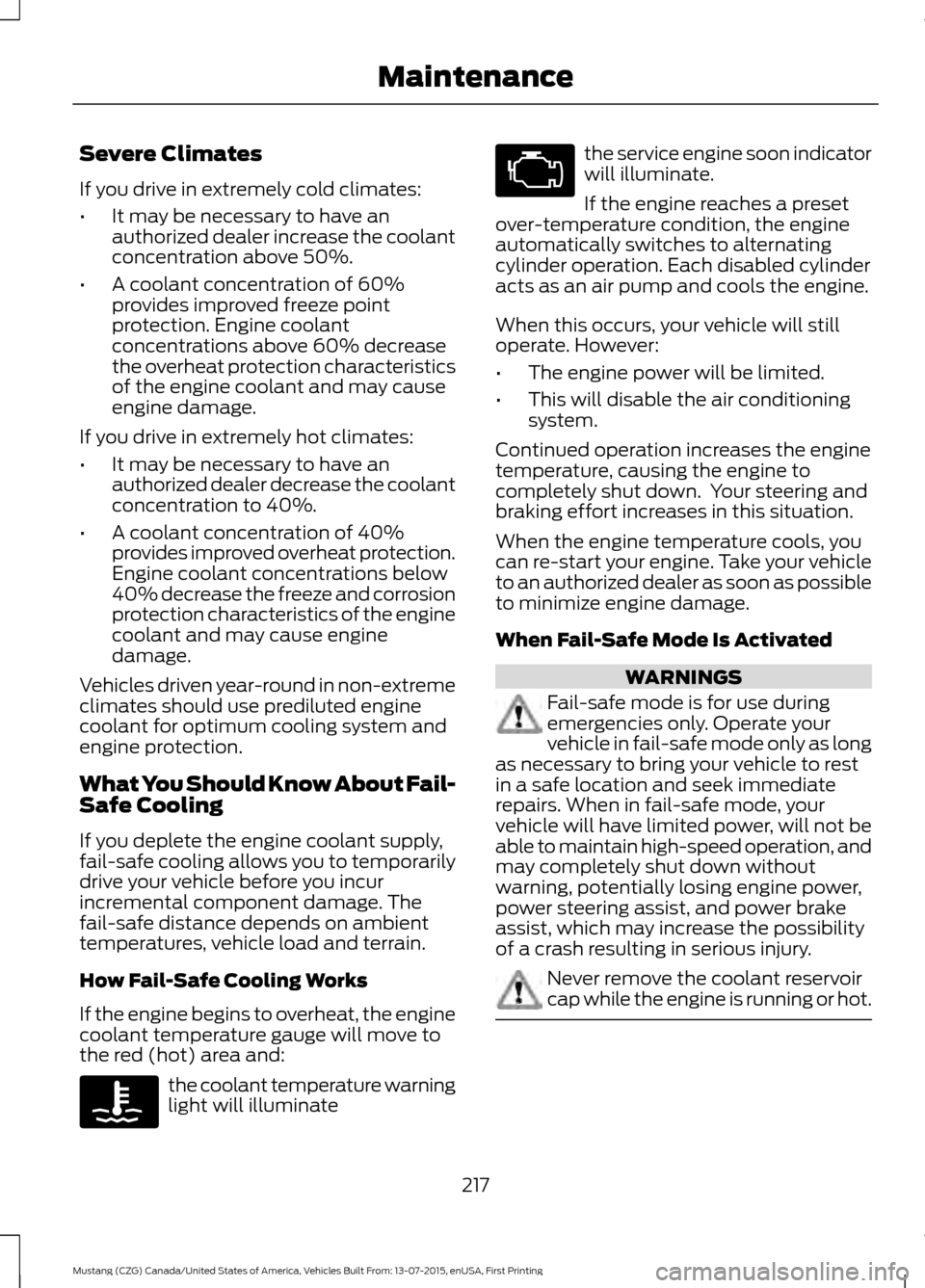
If the engine begins to overheat, the engine
coolant temperature gauge will move to
the red (hot) area and: the coolant temperature warning
light will illuminate the service engine soon indicator
will illuminate.
If the engine reaches a preset
over-temperature condition, the engine
automatically switches to alternating
cylinder operation. Each disabled cylinder
acts as an air pump and cools the engine.
When this occurs, your vehicle will still
operate. However:
• The engine power will be limited.
• This will disable the air conditioning
system.
Continued operation increases the engine
temperature, causing the engine to
completely shut down. Your steering and
braking effort increases in this situation.
When the engine temperature cools, you
can re-start your engine. Take your vehicle
to an authorized dealer as soon as possible
to minimize engine damage.
When Fail-Safe Mode Is Activated WARNINGS
Fail-safe mode is for use during
emergencies only. Operate your
vehicle in fail-safe mode only as long
as necessary to bring your vehicle to rest
in a safe location and seek immediate
repairs. When in fail-safe mode, your
vehicle will have limited power, will not be
able to maintain high-speed operation, and
may completely shut down without
warning, potentially losing engine power,
power steering assist, and power brake
assist, which may increase the possibility
of a crash resulting in serious injury. Never remove the coolant reservoir
cap while the engine is running or hot.
217
Mustang (CZG) Canada/United States of America, Vehicles Built From: 13-07-2015, enUSA, First Printing Maintenance
Page 261 of 391
Please note that the TPMS is not a
substitute for proper tire maintenance, and
it is the driver
’s responsibility to maintain
correct tire pressure, even if under-inflation
has not reached the level to trigger
illumination of the TPMS low tire pressure
telltale.
Your vehicle has also been equipped with
a TPMS malfunction indicator to indicate
when the system is not operating properly.
The TPMS malfunction indicator is
combined with the low tire pressure
telltale. When the system detects a
malfunction, the telltale will flash for
approximately one minute and then remain
continuously illuminated. This sequence
will continue upon subsequent vehicle
start-ups as long as the malfunction exists.
When the malfunction indicator is
illuminated, the system may not be able
to detect or signal low tire pressure as
intended. TPMS malfunctions may occur
for a variety of reasons, including the
installation of replacement or alternate
tires or wheels on the vehicle that prevent
the TPMS from functioning properly.
Always check the TPMS malfunction
telltale after replacing one or more tires or
wheels on your vehicle to ensure that the
replacement or alternate tires and wheels
allow the TPMS to continue to function
properly.
The tire pressure monitoring system
complies with part 15 of the FCC rules and
with RSS-210 of Industry Canada.
Operation is subject to the following two
conditions: (1) This device may not cause
harmful interference, and (2) This device
must accept any interference received,
including interference that may cause
undesired operation. Changing Tires With a Tire
Pressure Monitoring System
Note:
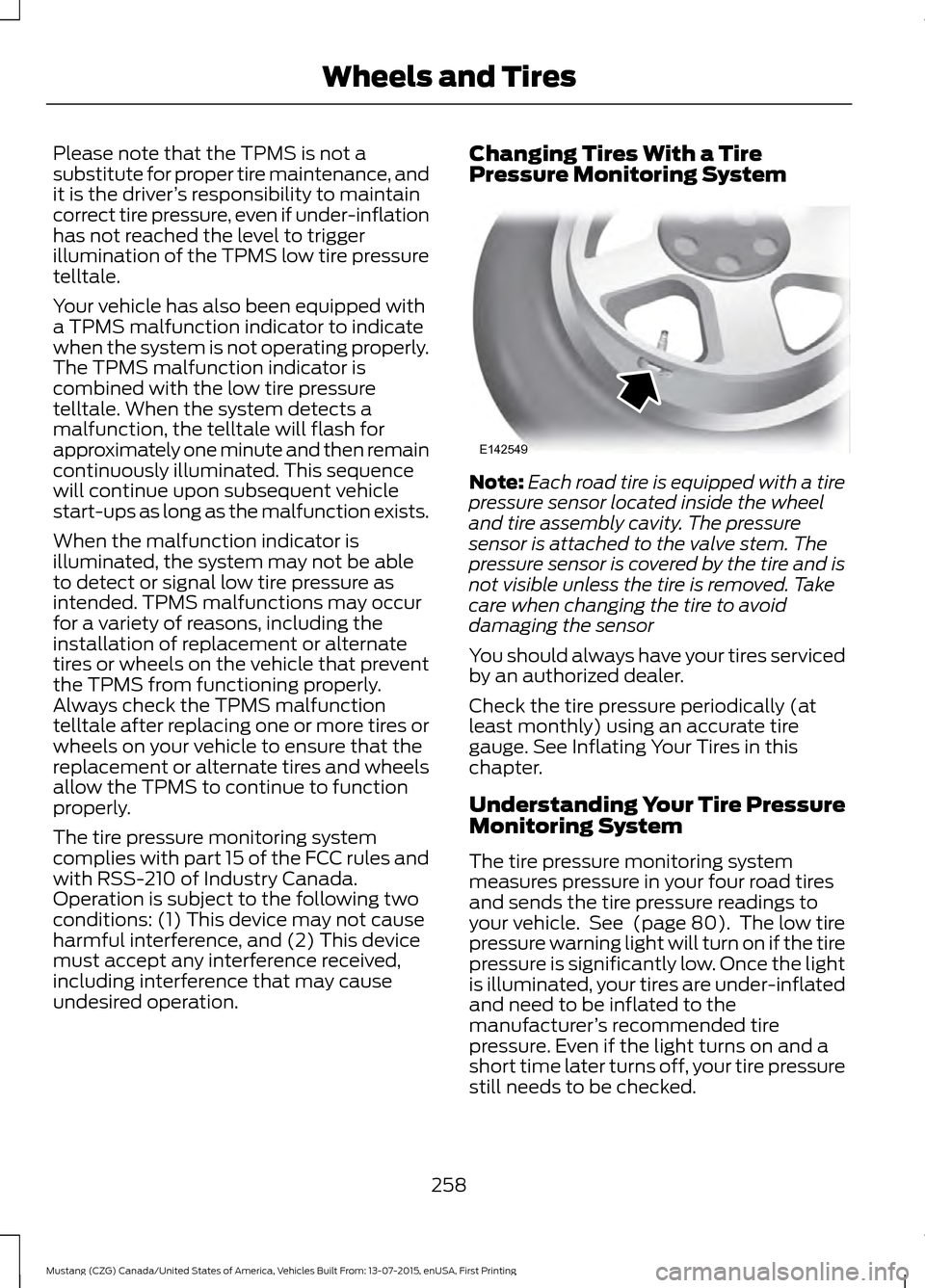
Each road tire is equipped with a tire
pressure sensor located inside the wheel
and tire assembly cavity. The pressure
sensor is attached to the valve stem. The
pressure sensor is covered by the tire and is
not visible unless the tire is removed. Take
care when changing the tire to avoid
damaging the sensor
You should always have your tires serviced
by an authorized dealer.
Check the tire pressure periodically (at
least monthly) using an accurate tire
gauge. See Inflating Your Tires in this
chapter.
Understanding Your Tire Pressure
Monitoring System
The tire pressure monitoring system
measures pressure in your four road tires
and sends the tire pressure readings to
your vehicle. See (page 80). The low tire
pressure warning light will turn on if the tire
pressure is significantly low. Once the light
is illuminated, your tires are under-inflated
and need to be inflated to the
manufacturer ’s recommended tire
pressure. Even if the light turns on and a
short time later turns off, your tire pressure
still needs to be checked.
258
Mustang (CZG) Canada/United States of America, Vehicles Built From: 13-07-2015, enUSA, First Printing Wheels and TiresE142549
Page 264 of 391
How Temperature Affects Your Tire
Pressure
The tire pressure monitoring system
monitors tire pressure in each pneumatic
tire. While driving in a normal manner, a
typical passenger tire inflation pressure
may increase about 2 to 4 psi (14 to 28
kPa) from a cold start situation. If the
vehicle is stationary overnight with the
outside temperature significantly lower
than the daytime temperature, the tire
pressure may decrease about 3 psi (21
kPa) for a drop of 30°F (17°C) in ambient
temperature. This lower pressure value
may be detected by the tire pressure
monitoring system as being significantly
lower than the recommended inflation
pressure and activate the system warning
light for low tire pressure. If the low tire
pressure warning light is on, visually check
each tire to verify that no tire is flat. If one
or more tires are flat, repair as necessary.
Check the air pressure in the road tires. If
any tire is under-inflated, carefully drive
the vehicle to the nearest location where
air can be added to the tires. Inflate all the
tires to the recommended inflation
pressure.
CHANGING A ROAD WHEEL
WARNINGS
The use of tire sealant may damage
your tire pressure monitoring system
and should only be used in roadside
emergencies. If you must use a sealant, the
Ford Tire Mobility Kit sealant should be
used. The tire pressure monitoring system
sensor and valve stem on the wheel must
be replaced by an authorized dealer after
use of the sealant. See Tire Pressure Monitoring
System (page 257). If the tire
pressure monitor sensor becomes
damaged, it will no longer function. Note:
The tire pressure monitoring system
indicator light will illuminate when the spare
tire is in use. To restore the full function of
the monitoring system, all road wheels
equipped with tire pressure monitoring
sensors must be mounted on the vehicle.
If you get a flat tire while driving, do not
apply the brake heavily. Instead, gradually
decrease your speed. Hold the steering
wheel firmly and slowly move to a safe
place on the side of the road.
Have a flat serviced by an authorized
dealer in order to prevent damage to the
tire pressure monitoring system sensors.
See
Tire Pressure Monitoring System
(page 257). Replace the spare tire with a
road tire as soon as possible. During
repairing or replacing of the flat tire, have
the authorized dealer inspect the tire
pressure monitoring system sensor for
damage.
Dissimilar Spare Wheel and Tire
Assembly Information WARNING
Failure to follow these guidelines
could result in an increased risk of
loss of vehicle control, injury or death.
If you have a dissimilar spare wheel and
tire, then it is intended for temporary use
only. This means that if you need to use it,
you should replace it as soon as possible
with a road wheel and tire assembly that
is the same size and type as the road tires
and wheels that were originally provided
by Ford. If the dissimilar spare tire or wheel
is damaged, it should be replaced rather
than repaired.
A dissimilar spare wheel and tire assembly
is defined as a spare wheel and tire
assembly that is different in brand, size or
appearance from the road tires and wheels
and can be one of three types:
261
Mustang (CZG) Canada/United States of America, Vehicles Built From: 13-07-2015, enUSA, First Printing Wheels and Tires
Page 383 of 391
Capacities and Specifications -
3.7L.................................................................279
Specifications..................................................... 280
Capacities and Specifications - 5.0L................................................................283
Specifications..................................................... 284
Capacities and Specifications...............268
Car Wash See: Cleaning the Exterior.............................. 228
Center Console...............................................118
Locking Storage Bin............................................ 118
Changing a Bulb...........................................224 Accessing the Direction Indicator and Fog
Lamp Bulbs..................................................... 224
Lamp Assembly Condensation.................... 224
Replacing Fog Lamp Bulbs (If Equipped)........................................................ 225
Replacing HID Headlamp Bulbs................... 224
Replacing LED Fog Lamp Bulbs (If Equipped)........................................................ 225
Replacing rear, Brake, High-Mount Brake, Rear Direction Indicator and License
Plate Lamp Bulbs......................................... 225
Replacing Reverse Lamp Bulbs.................... 225
Replacing the Direction Indicator Bulbs.................................................................. 225
Changing a Fuse..........................................208 Fuses...................................................................... 208
Changing a Road Wheel............................261 Dissimilar Spare Wheel and Tire Assembly
Information...................................................... 261
Tire Change Procedure.................................... 262
Changing the 12V Battery.........................220 Battery Management System........................ 221
Changing the Engine Air Filter.................227
Changing the Wiper Blades.....................222
Checking MyKey System Status................51
Checking the Wiper Blades......................222
Child Restraint and Seatbelt Maintenance.................................................32
Child Restraint Positioning.........................24
Child Safety
.......................................................15
General Information............................................. 15
Cleaning Leather Seats..............................232
Cleaning Products.......................................228
Cleaning the Alloy Wheels.......................232
Cleaning the Engine
....................................230 Cleaning the Exterior..................................228
Exterior Chrome Parts...................................... 229
Exterior Plastic Parts........................................ 229
Stripes or Graphics............................................ 229
Underbody........................................................... 229
Cleaning the Instrument Panel and Instrument Cluster Lens..........................231
Cleaning the Interior...................................230
Cleaning the Windows and Wiper Blades...........................................................230
Clearing All MyKeys.......................................50
Climate Control..............................................99
Climate Controlled Seats...........................112 Cooled Seats......................................................... 112
Closing the Convertible Top
.....................184
Collision Warning System.........................165
PRINCIPLE OF OPERATION........................... 165
Convertible Top.............................................183
Coolant Check See: Engine Coolant Check............................. 215
Crash Sensors and Airbag Indicator
.........41
Creating a MyKey...........................................49
Programming/Changing Configurable
Settings............................................................... 49
Cross Traffic Alert..........................................161 False Alerts........................................................... 164
Switching the System Off and On...............164
System Errors....................................................... 164
System Lights, Messages and Audible Alerts.................................................................. 163
System Limitations............................................ 163
Using the System................................................ 161
Cruise Control
..................................................62
Principle of Operation........................................ 151
Cruise control See: Using Cruise Control................................. 151
Customer Assistance
..................................194
D
Data Recording
..................................................9
Event Data Recording........................................... 9
Service Data Recording........................................ 9
Daytime Running Lamps
............................68
Type 1 - Conventional
(Non-Configurable)....................................... 68
Type 2 - Configurable......................................... 68
380
Mustang (CZG) Canada/United States of America, Vehicles Built From: 13-07-2015, enUSA, First Printing Index
Page 384 of 391
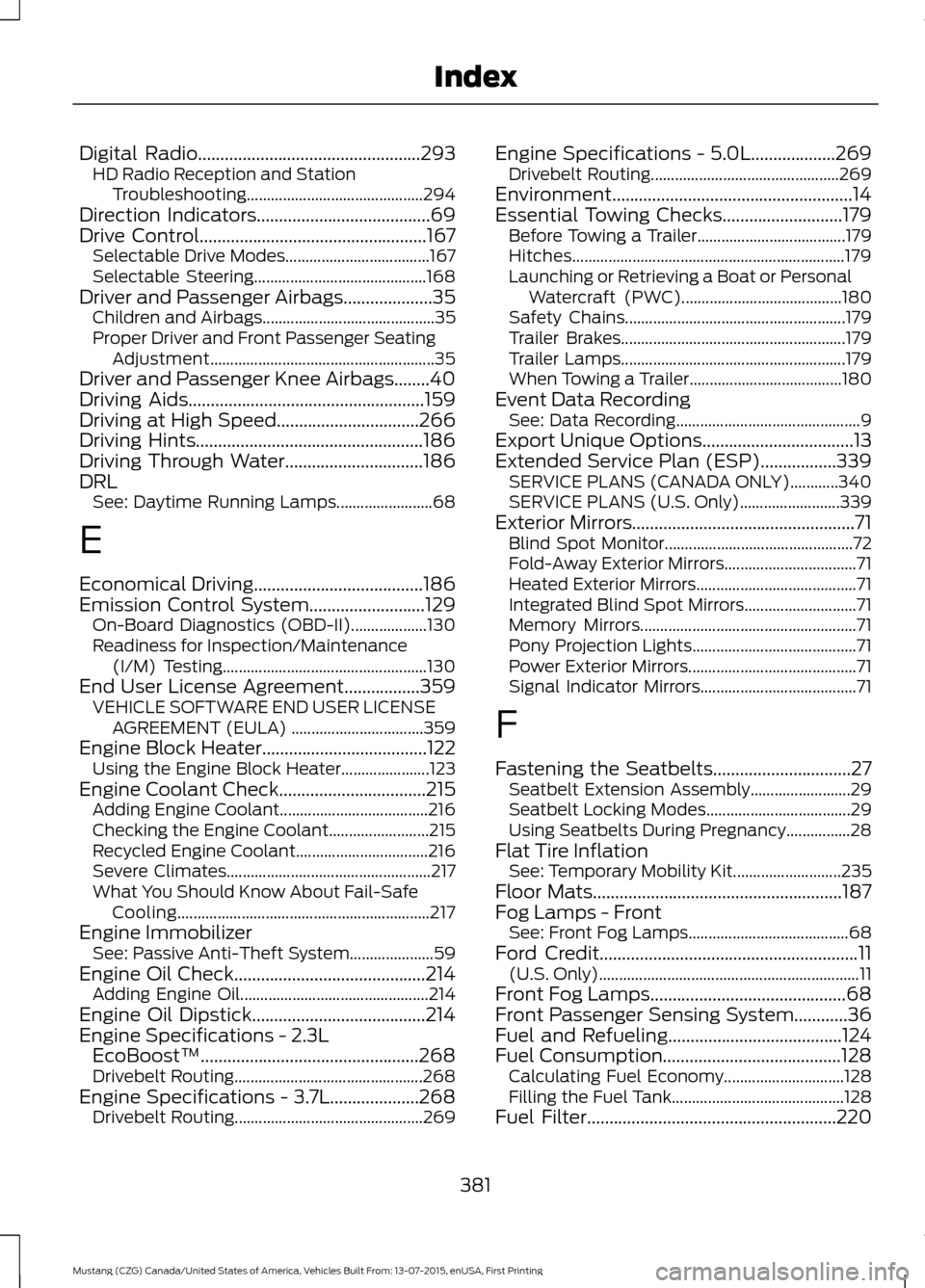
Digital Radio..................................................293
HD Radio Reception and Station
Troubleshooting............................................ 294
Direction Indicators.......................................69
Drive Control
...................................................167
Selectable Drive Modes.................................... 167
Selectable Steering........................................... 168
Driver and Passenger Airbags....................35 Children and Airbags........................................... 35
Proper Driver and Front Passenger Seating Adjustment........................................................ 35
Driver and Passenger Knee Airbags........40
Driving Aids
.....................................................159
Driving at High Speed................................266
Driving Hints...................................................186
Driving Through Water...............................186
DRL See: Daytime Running Lamps........................ 68
E
Economical Driving
......................................186
Emission Control System..........................129
On-Board Diagnostics (OBD-II)................... 130
Readiness for Inspection/Maintenance (I/M) Testing................................................... 130
End User License Agreement.................359 VEHICLE SOFTWARE END USER LICENSE
AGREEMENT (EULA) ................................. 359
Engine Block Heater.....................................122 Using the Engine Block Heater...................... 123
Engine Coolant Check
.................................215
Adding Engine Coolant..................................... 216
Checking the Engine Coolant......................... 215
Recycled Engine Coolant................................. 216
Severe Climates................................................... 217
What You Should Know About Fail-Safe Cooling............................................................... 217
Engine Immobilizer See: Passive Anti-Theft System..................... 59
Engine Oil Check
...........................................214
Adding Engine Oil............................................... 214
Engine Oil Dipstick.......................................214
Engine Specifications - 2.3L EcoBoost™.................................................268
Drivebelt Routing............................................... 268
Engine Specifications - 3.7L....................268 Drivebelt Routing............................................... 269Engine Specifications - 5.0L...................269
Drivebelt Routing............................................... 269
Environment......................................................14
Essential Towing Checks
...........................179
Before Towing a Trailer..................................... 179
Hitches.................................................................... 179
Launching or Retrieving a Boat or Personal Watercraft (PWC)........................................ 180
Safety Chains....................................................... 179
Trailer Brakes........................................................ 179
Trailer Lamps........................................................ 179
When Towing a Trailer...................................... 180
Event Data Recording See: Data Recording.............................................. 9
Export Unique Options..................................13
Extended Service Plan (ESP).................339 SERVICE PLANS (CANADA ONLY)............340
SERVICE PLANS (U.S. Only)......................... 339
Exterior Mirrors..................................................71 Blind Spot Monitor............................................... 72
Fold-Away Exterior Mirrors................................. 71
Heated Exterior Mirrors........................................ 71
Integrated Blind Spot Mirrors............................ 71
Memory Mirrors...................................................... 71
Pony Projection Lights......................................... 71
Power Exterior Mirrors.......................................... 71
Signal Indicator Mirrors....................................... 71
F
Fastening the Seatbelts...............................27 Seatbelt Extension Assembly......................... 29
Seatbelt Locking Modes.................................... 29
Using Seatbelts During Pregnancy................28
Flat Tire Inflation See: Temporary Mobility Kit........................... 235
Floor Mats........................................................187
Fog Lamps - Front See: Front Fog Lamps........................................ 68
Ford Credit
..........................................................11
(U.S. Only)................................................................. 11
Front Fog Lamps............................................68
Front Passenger Sensing System............36
Fuel and Refueling.......................................124
Fuel Consumption........................................128 Calculating Fuel Economy.............................. 128
Filling the Fuel Tank........................................... 128
Fuel Filter
........................................................220
381
Mustang (CZG) Canada/United States of America, Vehicles Built From: 13-07-2015, enUSA, First Printing Index
Page 388 of 391
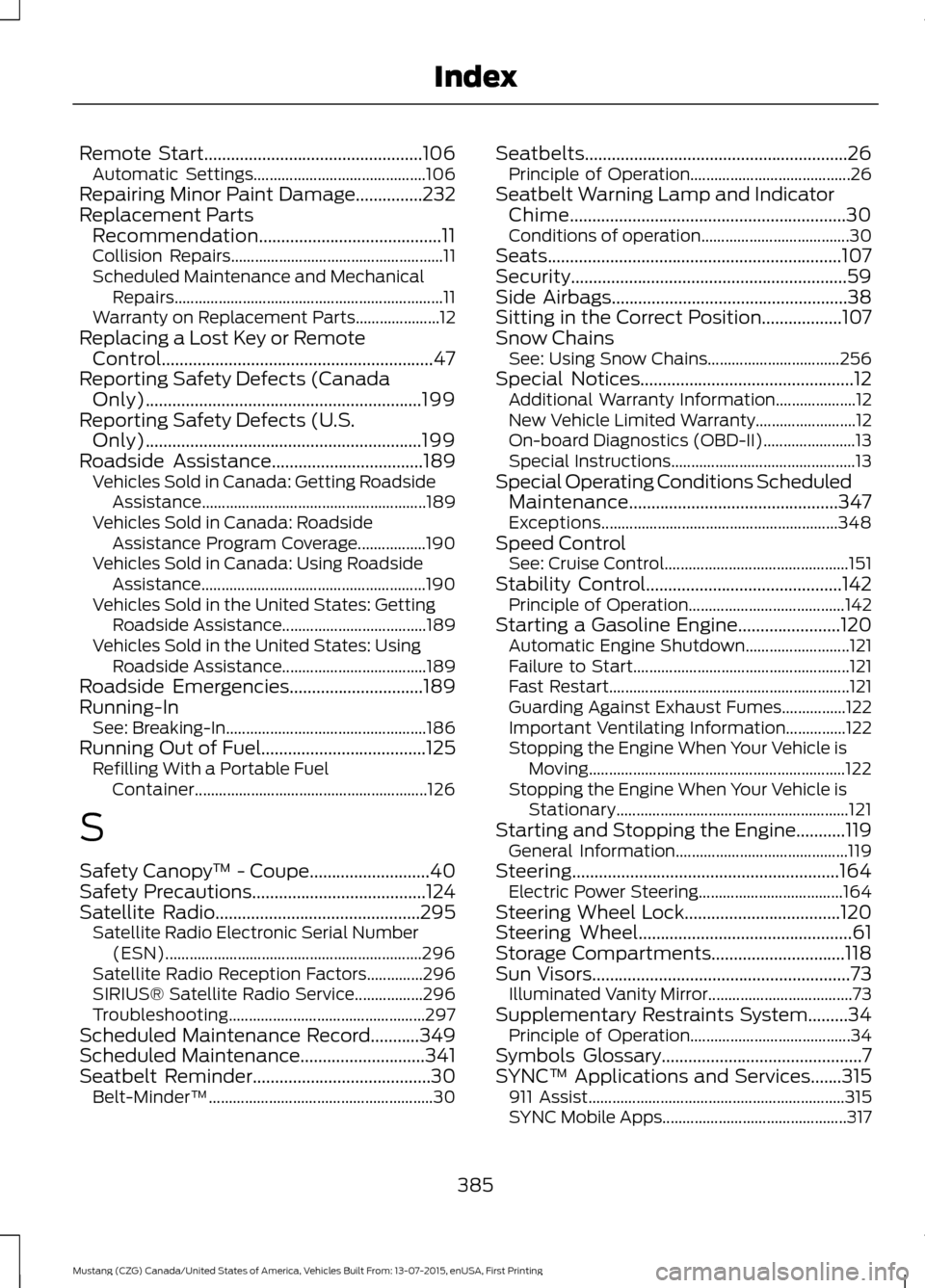
Remote Start.................................................106
Automatic Settings........................................... 106
Repairing Minor Paint Damage...............232
Replacement Parts Recommendation.........................................11
Collision Repairs..................................................... 11
Scheduled Maintenance and Mechanical Repairs................................................................... 11
Warranty on Replacement Parts..................... 12
Replacing a Lost Key or Remote Control.............................................................47
Reporting Safety Defects (Canada Only)
..............................................................199
Reporting Safety Defects (U.S. Only)
..............................................................199
Roadside Assistance..................................189
Vehicles Sold in Canada: Getting Roadside
Assistance........................................................ 189
Vehicles Sold in Canada: Roadside Assistance Program Coverage.................190
Vehicles Sold in Canada: Using Roadside Assistance........................................................ 190
Vehicles Sold in the United States: Getting Roadside Assistance.................................... 189
Vehicles Sold in the United States: Using Roadside Assistance.................................... 189
Roadside Emergencies
..............................189
Running-In See: Breaking-In.................................................. 186
Running Out of Fuel.....................................125 Refilling With a Portable Fuel
Container.......................................................... 126
S
Safety Canopy ™ - Coupe
...........................40
Safety Precautions.......................................124
Satellite Radio..............................................295
Satellite Radio Electronic Serial Number
(ESN)................................................................ 296
Satellite Radio Reception Factors..............296
SIRIUS® Satellite Radio Service.................296
Troubleshooting................................................. 297
Scheduled Maintenance Record...........349
Scheduled Maintenance
............................341
Seatbelt Reminder........................................30
Belt-Minder™........................................................ 30Seatbelts...........................................................26
Principle of Operation........................................ 26
Seatbelt Warning Lamp and Indicator Chime..............................................................30
Conditions of operation..................................... 30
Seats..................................................................107
Security..............................................................59
Side Airbags
.....................................................38
Sitting in the Correct Position..................107
Snow Chains See: Using Snow Chains................................. 256
Special Notices................................................12 Additional Warranty Information.................... 12
New Vehicle Limited Warranty......................... 12
On-board Diagnostics (OBD-II)....................... 13
Special Instructions.............................................. 13
Special Operating Conditions Scheduled Maintenance...............................................347
Exceptions........................................................... 348
Speed Control See: Cruise Control.............................................. 151
Stability Control............................................142 Principle of Operation....................................... 142
Starting a Gasoline Engine
.......................120
Automatic Engine Shutdown.......................... 121
Failure to Start...................................................... 121
Fast Restart............................................................ 121
Guarding Against Exhaust Fumes................122
Important Ventilating Information...............122
Stopping the Engine When Your Vehicle is Moving................................................................ 122
Stopping the Engine When Your Vehicle is Stationary.......................................................... 121
Starting and Stopping the Engine...........119 General Information........................................... 119
Steering............................................................164 Electric Power Steering.................................... 164
Steering Wheel Lock...................................120
Steering Wheel................................................61
Storage Compartments
..............................118
Sun Visors..........................................................73
Illuminated Vanity Mirror.................................... 73
Supplementary Restraints System.........34 Principle of Operation........................................ 34
Symbols Glossary
.............................................7
SYNC™ Applications and Services.......315
911 Assist................................................................ 315
SYNC Mobile Apps.............................................. 317
385
Mustang (CZG) Canada/United States of America, Vehicles Built From: 13-07-2015, enUSA, First Printing Index