service FORD RANGER 1999 2.G Service Manual
[x] Cancel search | Manufacturer: FORD, Model Year: 1999, Model line: RANGER, Model: FORD RANGER 1999 2.GPages: 216, PDF Size: 1.47 MB
Page 183 of 216
Running out of fuel
Avoid running out fuel because this situation may have an adverse affect
on powertrain components.
If you have run out of fuel:
²You may need to crank the engine several times before the system
starts to pump fuel from the tank to the engine.
²Your ªCheck Engineº light may come on. For more information on the
ªCheck Engineº light, refer to theInstrumentationchapter.
Fuel Filter
Your vehicle is equipped with a fuel filter that is mounted on the
underbody.
For fuel filter replacement, see your dealer or a qualified service
technician. Refer to the maintenance guide and or service guide for the
appropriate intervals for changing the fuel filter.
If you replace the fuel filter, replace it with an authorized
Motorcraft part. The customer warranty may be void for any
damage to the fuel system if an authorized Motorcraft fuel filter
is not used.
ESSENTIALS OF GOOD FUEL ECONOMY
Measuring techniques
Your best source of information about actual fuel economy is you, the
driver. You must gather information as accurately and consistently as
possible. Fuel expense, frequency of fillups or fuel gauge readings are
NOT accurate as a measure of fuel economy. We do not recommend
taking fuel economy measurements during the first 1 600 km (1 000
miles) of driving (engine break-in period). You will get a more accurate
measurement after 3 000 km±5 000 km (2 000 miles-3 000 miles).
The advertised fuel capacity of the fuel tank on your vehicle is equal to
the rated refill capacity of the fuel tank as listed in the Refill Capacities
chart in this ªOwner Guide.º The advertised capacity is the amount of
the Indicated Capacity and the Empty Reserve combined. Indicated
Capacity is the difference in the amount of fuel in a full tank and a tank
when the fuel gauge indicates empty. Empty Reserve is the small amount
of usable fuel remaining in the fuel tank after the fuel gauge indicates
empty.
Maintenance and care
183
Page 185 of 216
Driving style Ð good driving and fuel economy habits
Give consideration to the lists that follow and you may be able to change
a number of variables and improve your fuel economy.
Habits
²Smooth, moderate operation can yield up to 10% savings in fuel.
²Steady speeds without stopping will usually give the best fuel
economy.
²Idling for long periods of time (greater than one minute) may waste
fuel.
²Anticipate stopping; slowing down may eliminate the need to stop.
²Sudden or hard accelerations may reduce fuel economy.
²Slow down gradually.
²Drive at reasonable speeds (traveling at 105 km /h [65 mph] uses 15%
more fuel than traveling at 88 km/h [55 mph]).
²Revving the engine before turning it off may reduce fuel economy.
²Use of the air conditioner or defroster may reduce fuel economy.
²Use of speed control (if equipped) may improve fuel economy. Speed
control can help maintain a constant speed and reduce speed changes.
You may want to turn off the speed control in hilly terrain as
unnecessary shifting between third and fourth gears may occur and
could result in reduced fuel economy.
²Warming up a vehicle on cold mornings is not required and may
reduce fuel economy.
²Resting your foot on the brake pedal while driving may reduce fuel
economy.
²Combine errands and minimize stop-and-go driving.
Maintenance
²Keep tires properly inflated and use only recommended size.
²Operating a vehicle with the wheels out of alignment will reduce fuel
economy.
²Use recommended engine oil. Refer toLubricant Specifications.
²Perform all regularly scheduled maintenance items. Follow the
recommended maintenance schedule and owner maintenance checks
found in your vehicle maintenance guide and or service guide.
Maintenance and care
185
Page 187 of 216
²Do not turn off the ignition while your vehicle is moving, especially at
high speeds.
²Have the items listed in your maintenance guide and or service guide
performed according to the specified schedule.
The scheduled maintenance items listed in the maintenance guide and or
service guide are essential to the life and performance of your vehicle
and to its emissions system.
If other than Ford, Motorcraft or Ford-authorized parts are used for
maintenance replacements or for service of components affecting
emission control, such non-Ford parts should be equivalent to genuine
Ford Motor Company parts in performance and durability.
Do not park, idle, or drive your vehicle in dry grass or other dry
ground cover. The emission system heats up the engine
compartment and exhaust system, which can start a fire.
Illumination of the charging system warning light, ªCheck Engineº light
or the temperature warning light, fluid leaks, strange odors, smoke or
loss of oil pressure, could indicate that the emission control system is
not working properly.
Exhaust leaks may result in entry of harmful and potentially
lethal fumes into the passenger compartment.
Do not make any unauthorized changes to your vehicle or engine. By
law, vehicle owners and anyone who manufactures, repairs, items, sells,
leases, trades vehicles, or supervises a fleet of vehicles are not permitted
to intentionally remove an emission control device or prevent it from
working. Information about your vehicle's emission system is on the
Vehicle Emission Control Information Decal located on or near the
engine. This decal identifies engine displacement and gives some tune up
specifications.
Please consult your ªWarranty Guideº for complete emission warranty
information.
Maintenance and care
187
Page 188 of 216
Readiness for inspection/maintenance (I/M) testing
In some localities, it may be a legal requirement to pass an I/M test of
the on-board diagnostic (OBD-II) system. If your ªCheck Engine/Service
Engine Soonº light is on, refer to the description in theWarning Lights
and Chimessection of theInstrumentationchapter. Your vehicle may
not pass the I/M test with the ªCheck Engine/Service Engine Soonº light
on.
If the vehicle's powertrain system or its battery has just been serviced,
the OBD-II system is reset to a ªnot ready for I/M testº condition. To
ready the OBD-II system for I/M testing, a minimum of 30 minutes of city
and highway driving is necessary as described below:
²First, at least 10 minutes of driving on an expressway or highway.
²Next, at least 20 minutes driving in stop-and-go, city-type traffic with
at least four idle periods.
Allow the vehicle to sit for at least eight hours without starting the
engine. Then, start the engine and complete the above driving cycle. The
engine must warm up to its normal operating temperature. Once started,
do not turn off the engine until the above driving cycle is complete.
EXTERIOR BULBS
Replacing exterior bulbs
Check the operation of the following lamps frequently:
²Headlamps
²Foglamps
²High-mount brakelamp
²Brakelamps
²Turn signals
²License plate lamp
²Tail lamps
²Back-up lamps
Do not remove lamp bulbs unless they can be replaced immediately with
new ones. If a bulb is removed for an extended period of time,
contaminants may enter the lamp housings and affect lamp performance.
Maintenance and care
188
Page 194 of 216
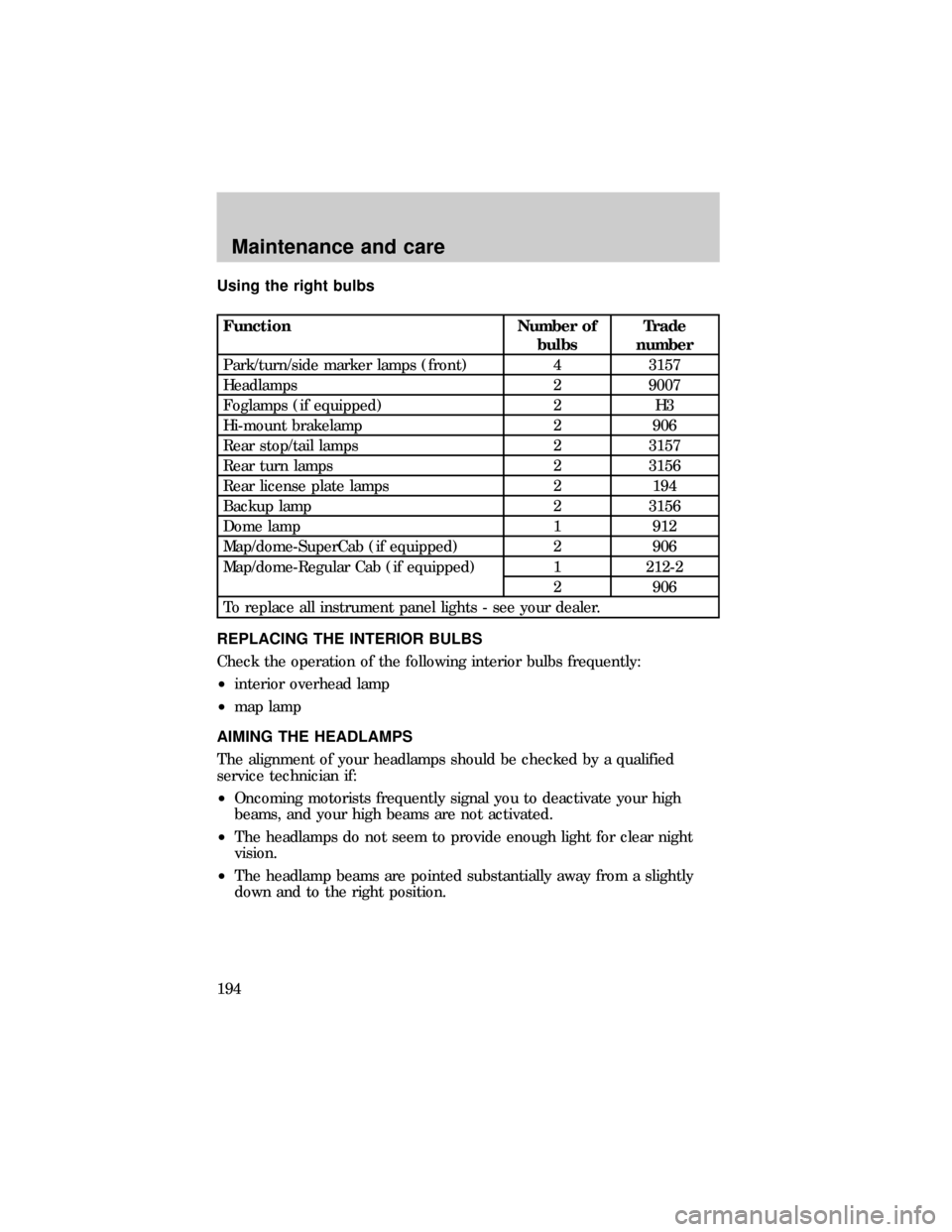
Using the right bulbs
Function Number of
bulbsTrade
number
Park/turn/side marker lamps (front) 4 3157
Headlamps 2 9007
Foglamps (if equipped) 2 H3
Hi-mount brakelamp 2 906
Rear stop/tail lamps 2 3157
Rear turn lamps 2 3156
Rear license plate lamps 2 194
Backup lamp 2 3156
Dome lamp 1 912
Map/dome-SuperCab (if equipped) 2 906
Map/dome-Regular Cab (if equipped) 1 212-2
2 906
To replace all instrument panel lights - see your dealer.
REPLACING THE INTERIOR BULBS
Check the operation of the following interior bulbs frequently:
²interior overhead lamp
²map lamp
AIMING THE HEADLAMPS
The alignment of your headlamps should be checked by a qualified
service technician if:
²Oncoming motorists frequently signal you to deactivate your high
beams, and your high beams are not activated.
²The headlamps do not seem to provide enough light for clear night
vision.
²The headlamp beams are pointed substantially away from a slightly
down and to the right position.
Maintenance and care
194
Page 200 of 216
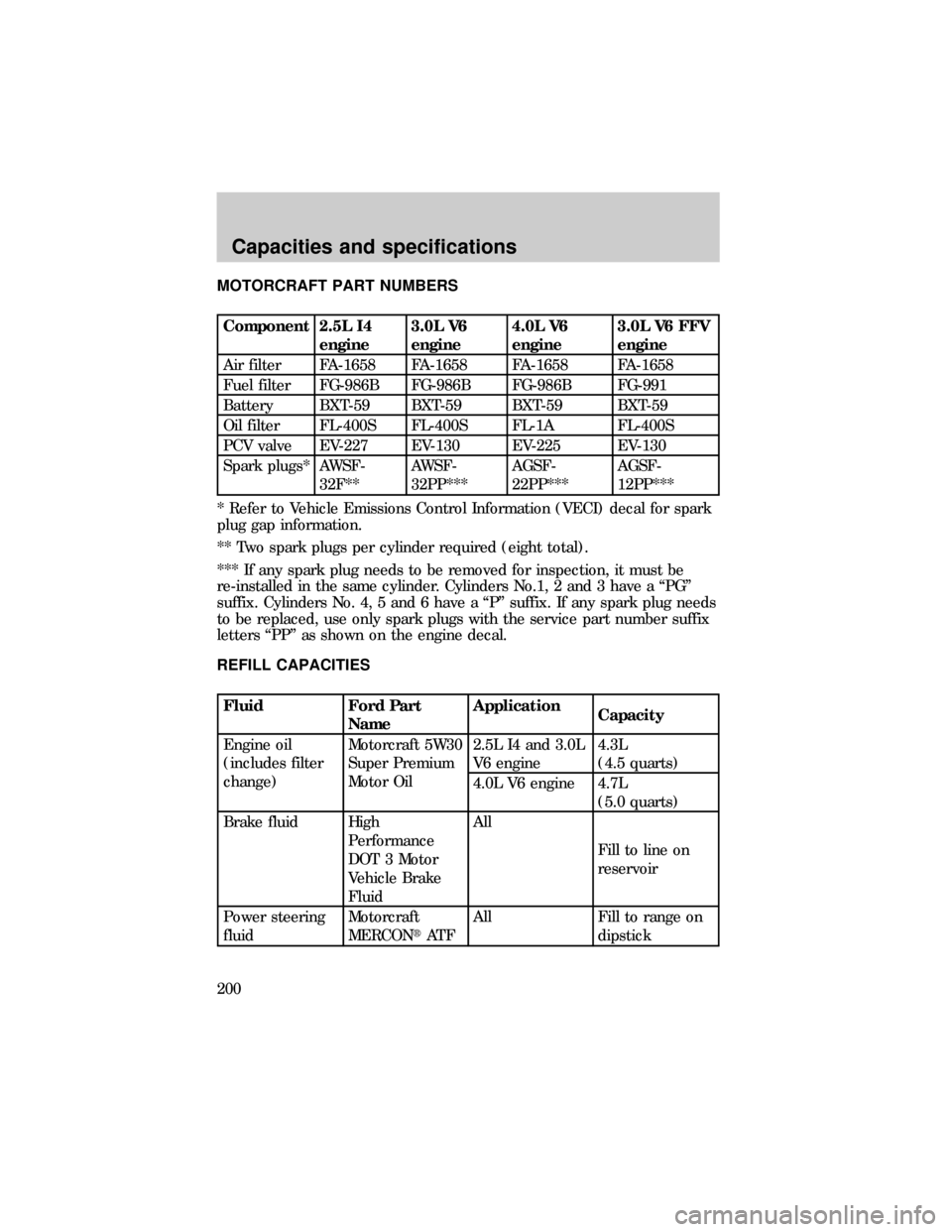
MOTORCRAFT PART NUMBERS
Component 2.5L I4
engine3.0L V6
engine4.0L V6
engine3.0L V6 FFV
engine
Air filter FA-1658 FA-1658 FA-1658 FA-1658
Fuel filter FG-986B FG-986B FG-986B FG-991
Battery BXT-59 BXT-59 BXT-59 BXT-59
Oil filter FL-400S FL-400S FL-1A FL-400S
PCV valve EV-227 EV-130 EV-225 EV-130
Spark plugs* AWSF-
32F**AWSF-
32PP***AGSF-
22PP***AGSF-
12PP***
* Refer to Vehicle Emissions Control Information (VECI) decal for spark
plug gap information.
** Two spark plugs per cylinder required (eight total).
*** If any spark plug needs to be removed for inspection, it must be
re-installed in the same cylinder. Cylinders No.1, 2 and 3 have a ªPGº
suffix. Cylinders No. 4, 5 and 6 have a ªPº suffix. If any spark plug needs
to be replaced, use only spark plugs with the service part number suffix
letters ªPPº as shown on the engine decal.
REFILL CAPACITIES
Fluid Ford Part
NameApplication
Capacity
Engine oil
(includes filter
change)Motorcraft 5W30
Super Premium
Motor Oil2.5L I4 and 3.0L
V6 engine4.3L
(4.5 quarts)
4.0L V6 engine 4.7L
(5.0 quarts)
Brake fluid High
Performance
DOT 3 Motor
Vehicle Brake
FluidAll
Fill to line on
reservoir
Power steering
fluidMotorcraft
MERCONtAT FAll Fill to range on
dipstick
Capacities and specifications
200
Page 202 of 216
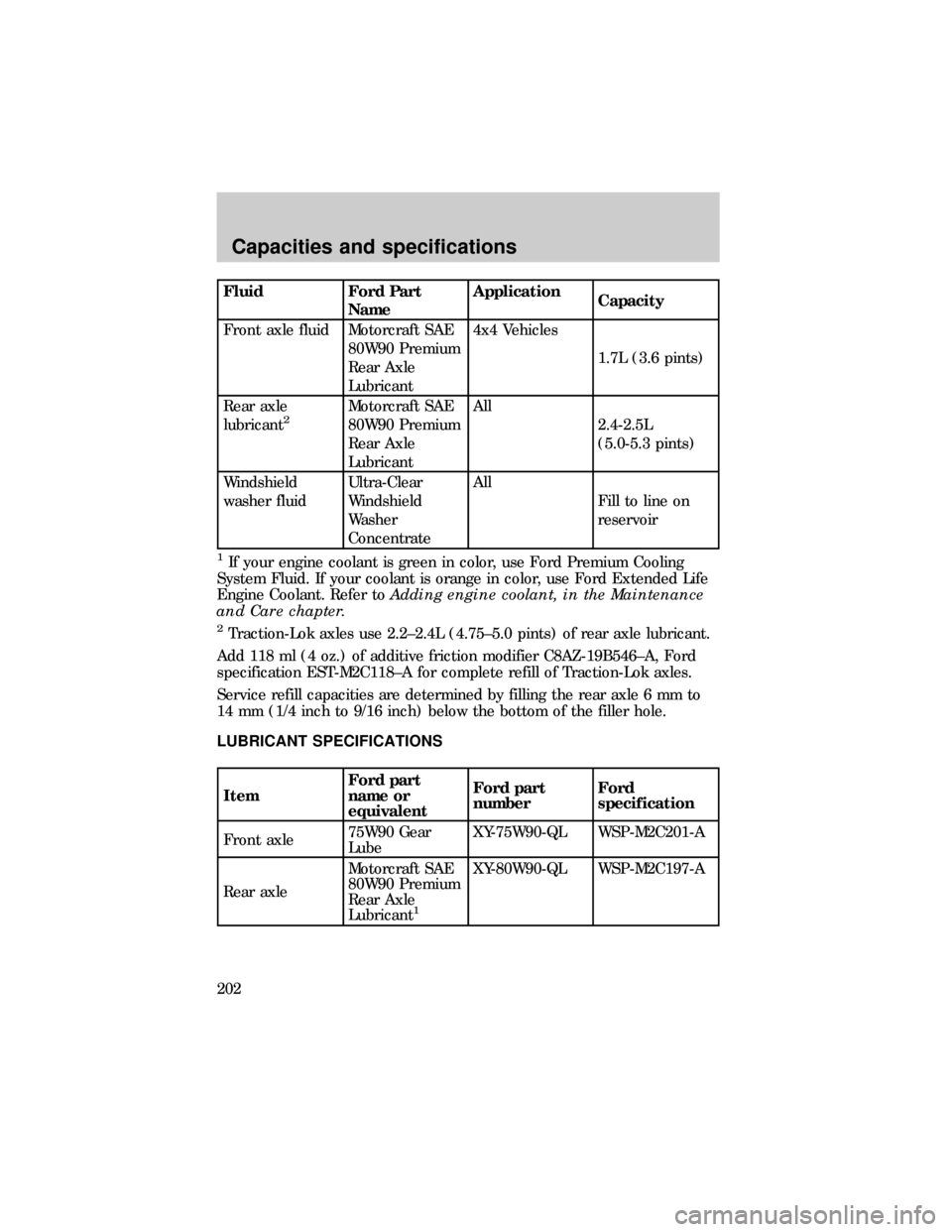
Fluid Ford Part
NameApplication
Capacity
Front axle fluid Motorcraft SAE
80W90 Premium
Rear Axle
Lubricant4x4 Vehicles
1.7L (3.6 pints)
Rear axle
lubricant
2Motorcraft SAE
80W90 Premium
Rear Axle
LubricantAll
2.4-2.5L
(5.0-5.3 pints)
Windshield
washer fluidUltra-Clear
Windshield
Washer
ConcentrateAll
Fill to line on
reservoir
1If your engine coolant is green in color, use Ford Premium Cooling
System Fluid. If your coolant is orange in color, use Ford Extended Life
Engine Coolant. Refer toAdding engine coolant, in the Maintenance
and Care chapter.
2Traction-Lok axles use 2.2±2.4L (4.75±5.0 pints) of rear axle lubricant.
Add 118 ml (4 oz.) of additive friction modifier C8AZ-19B546±A, Ford
specification EST-M2C118±A for complete refill of Traction-Lok axles.
Service refill capacities are determined by filling the rear axle 6 mm to
14 mm (1/4 inch to 9/16 inch) below the bottom of the filler hole.
LUBRICANT SPECIFICATIONS
ItemFord part
name or
equivalentFord part
numberFord
specification
Front axle75W90 Gear
LubeXY-75W90-QL WSP-M2C201-A
Rear axleMotorcraft SAE
80W90 Premium
Rear Axle
Lubricant
1
XY-80W90-QL WSP-M2C197-A
Capacities and specifications
202
Page 210 of 216

Air bag supplemental restraint
system ..........................................81
and child safety seats ..............83
description ................................82
disposal ......................................85
indicator light ...........................85
passenger air bag .....................83
passenger deactivation
switch ....................23,86,87,88,89
Air conditioning
manual heating and air
conditioning system .......19,20,21
Automatic transmission
driving an automatic
overdrive .....108,109,110,111,112
Axle
refill capacities ........................200
Battery
voltage gauge ............................15
Brakes ........................................103
anti-lock .....................103,104,105
anti-lock brake system (ABS)
warning light ...........................104
fluid, checking and adding ....160
shift interlock ..........................107
Break-in period ..........................2,3
Cargo area shade ........................64
Cargo net .....................................64
CD player ....................................51
Child safety seats
attaching with tether straps ....96
in rear seat ................................93
tether anchorage hardware .....96
Cleaning your vehicle ...............195
engine compartment ..............196
exterior .............................196,199
exterior lamps .........................198
interior .....................................199
plastic parts ............................198
washing ....................................195
waxing .....................................195
wheels ......................................196windows ..................................199
wiper blades ............................198
Clutch
fluid ..........................................161
operation while driving ...112,113
recommended shift speeds ....114
Console ........................................64
Coolant ...............................164,165
checking and adding ..............163
refill capacities ........................165
Driveline universal joint and
slip yoke ....................................169
Driving under special
conditions ...........................118,119
sand .........................................119
snow and ice ...........................120
through water .........................119
Emission control system ..........186
Engine
check engine/service engine
soon light .................................6,7
coolant .....................................162
idle speed control ...................170
service points ............154,155,156
starting after a collision .........133
Engine block heater .................100
Engine oil
checking and adding ..............158
dipstick ....................................157
specifications ...................157,159
Exhaust fumes ..........................102
Four-Wheel Drive vehicles ..10,115
description .......................116,117
driving off road .......................118
electronic shift ..............22,23,116
indicator light .........................115
Fuel
choosing the right fuel ...........180
comparisons with EPA fuel
economy estimates .................186
detergent in fuel .....................182
Index
210
Page 216 of 216
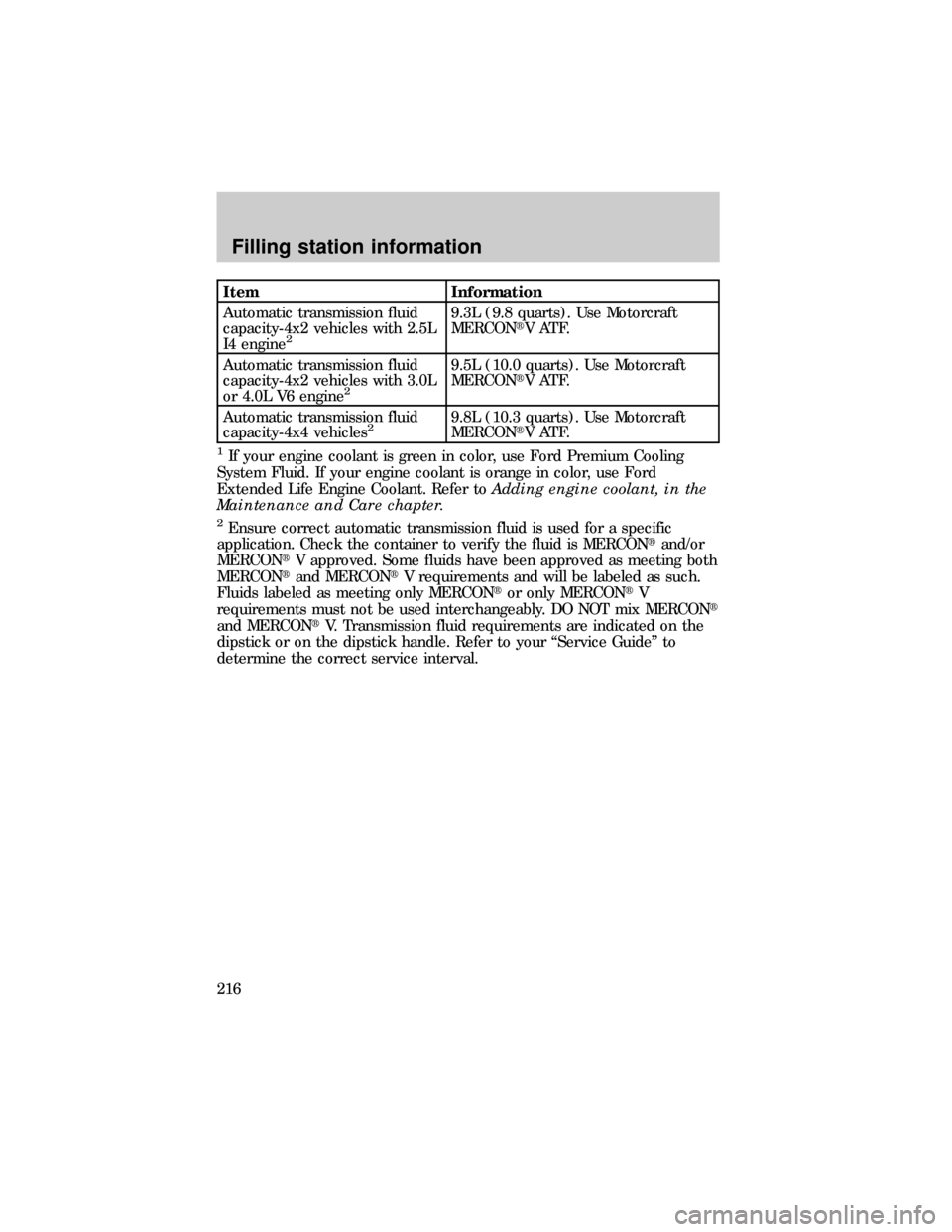
Item Information
Automatic transmission fluid
capacity-4x2 vehicles with 2.5L
I4 engine
2
9.3L (9.8 quarts). Use Motorcraft
MERCONtV ATF.
Automatic transmission fluid
capacity-4x2 vehicles with 3.0L
or 4.0L V6 engine
2
9.5L (10.0 quarts). Use Motorcraft
MERCONtV ATF.
Automatic transmission fluid
capacity-4x4 vehicles
29.8L (10.3 quarts). Use Motorcraft
MERCONtV ATF.
1If your engine coolant is green in color, use Ford Premium Cooling
System Fluid. If your engine coolant is orange in color, use Ford
Extended Life Engine Coolant. Refer toAdding engine coolant, in the
Maintenance and Care chapter.
2Ensure correct automatic transmission fluid is used for a specific
application. Check the container to verify the fluid is MERCONtand/or
MERCONtV approved. Some fluids have been approved as meeting both
MERCONtand MERCONtV requirements and will be labeled as such.
Fluids labeled as meeting only MERCONtor only MERCONtV
requirements must not be used interchangeably. DO NOT mix MERCONt
and MERCONtV. Transmission fluid requirements are indicated on the
dipstick or on the dipstick handle. Refer to your ªService Guideº to
determine the correct service interval.
Filling station information
216