cooling FORD TRANSIT 2015 5.G User Guide
[x] Cancel search | Manufacturer: FORD, Model Year: 2015, Model line: TRANSIT, Model: FORD TRANSIT 2015 5.GPages: 461, PDF Size: 5.82 MB
Page 210 of 461
WARNINGS
Do not add coolant further than the
MAX mark.
To reduce the risk of personal injury,
make sure the engine is cool before
unscrewing the coolant pressure
relief cap. The cooling system is under
pressure; steam and hot liquid can come
out forcefully when the cap is loosened
slightly. Note:
Do not use stop leak pellets, cooling
system sealants or additives as they can
cause damage to the engine cooling or
heating systems. The vehicle warranty does
not cover this damage.
Note: During normal vehicle operation, the
engine coolant may change color from
orange to pink or light red. As long as the
engine coolant is clear and uncontaminated,
this color change does not indicate that the
engine coolant has degraded or that you
drain the engine coolant, flush the system
or replace the engine coolant. •
Do not mix different colors or types of
coolant in your vehicle. Make sure the
correct coolant is used. Mixing of
engine coolants may harm the engine ’s
cooling system. The use of incorrect
coolant may harm engine and cooling
system components and may void the
warranty. Use prediluted engine
coolant meeting the Ford specification.
See Capacities and Specifications
(page 265).
• In case of emergency, you can add a
large amount of water without engine
coolant in order to reach a vehicle
service location. In this instance, you
must have the cooling system drained,
chemically cleaned with Motorcraft
Premium Cooling System Flush, and
refilled with engine coolant as soon as
possible. Water alone (without engine
coolant) can cause engine damage, for
example corrosion, overheating or
freezing.
• Do not use alcohol, methanol, brine or
any engine coolants mixed with alcohol
or methanol antifreeze. Alcohol and
other liquids can cause engine damage,
for example overheating or freezing.
• Do not add extra inhibitors or additives
to the coolant. These can be harmful
and compromise the corrosion
protection of the engine coolant.
Unscrew the cap slowly. Any pressure will
escape as you unscrew the cap.
Whenever you add coolant, check the
coolant level in the coolant reservoir the
next few times you drive the vehicle. If
necessary, add enough prediluted engine
coolant to bring the coolant level to the
correct level.
Recycled Engine Coolant
We do not recommend the use of recycled
engine coolant since a Ford-approved
recycling process is not yet available.
207 Transit (TTH) Canada/United States of America, enUSA, Edition date: 03/2014 Maintenance
Page 211 of 461
Used engine coolant should be disposed
of in an appropriate manner. Follow your
community
’s regulations and standards
for recycling and disposing of automotive
fluids.
Severe Climates
If you drive in extremely cold climates:
• It may be necessary to have a Ford
authorized dealer increase the coolant
concentration above 50%.
• A coolant concentration of 60% will
provide improved freeze point
protection. Engine coolant
concentrations above 60% will
decrease the overheat protection
characteristics of the engine coolant
and may cause engine damage.
If you drive in extremely hot climates:
• It may be necessary to have a Ford
authorized dealer decrease the coolant
concentration to 40%.
• A coolant concentration of 40% will
provide improved overheat protection.
Engine coolant concentrations below
40% will decrease the corrosion or
freeze protection characteristics of the
engine coolant and may cause engine
damage.
Vehicles driven year-round in non-extreme
climates should use prediluted engine
coolant for optimum cooling system and
engine protection.
What You Should Know About Fail-
Safe Cooling
If you deplete the engine coolant supply,
this feature allows you to temporarily drive
your vehicle before you incur incremental
component damage. The fail-safe distance
depends on ambient temperatures, vehicle
load and terrain. How Fail-Safe Cooling Works
If the engine begins to overheat, the engine
coolant temperature gauge will move to
the red area and: The coolant temperature
warning light will illuminate.
The service engine soon
indicator will illuminate.
If the engine reaches a preset
over-temperature condition, the engine
will automatically switch to alternating
cylinder operation. Each disabled cylinder
acts as an air pump and cools the engine.
When this occurs the vehicle will still
operate. However:
• The engine power will be limited.
• This will disable the air conditioning
system.
Continued operation will increase the
engine temperature and the engine will
completely shut down, causing steering
and braking effort to increase.
Once the engine temperature cools, the
engine can be re-started. Take your vehicle
to an authorized dealer as soon as possible
to minimize engine damage.
When Fail-Safe Mode Is Turned On WARNING
Fail-safe mode is for use during
emergencies only. Operate the
vehicle in fail-safe mode only as long
as necessary to bring the vehicle to rest in
a safe location and seek immediate repairs.
When in fail-safe mode, the vehicle will
have limited power, will not be able to
maintain high-speed operation, and may
completely shut down and lose power
steering assist, and power brake assist,
which may increase the possibility of a
crash resulting in serious injury. 208
Transit (TTH) Canada/United States of America, enUSA, Edition date: 03/2014 Maintenance
Page 235 of 461
Cooling system
•
Protect against freezing temperatures.
• When removing your vehicle from
storage, check coolant fluid level.
Confirm that there are no cooling
system leaks and that fluid is at the
recommended level.
Battery
• Check and recharge as necessary. Keep
connections clean.
• If storing your vehicle for more than 30
days without recharging the battery,
we recommend that you disconnect
the battery cables to maintain battery
charge for quick starting.
Note: It is necessary to reset memory
features if battery cables are disconnected.
Brakes
• Make sure the brakes and parking brake
release fully.
Tires
• Maintain recommended air pressure.
Miscellaneous
• Make sure all linkages, cables, levers
and pins under your vehicle are covered
with grease to prevent rust.
• Move vehicles at least 25 ft (7.5 m)
every 15 days to lubricate working parts
and prevent corrosion.
Removing Vehicle From Storage
When your vehicle is ready to come out of
storage, do the following:
• Wash your vehicle to remove any dirt
or grease film build-up on window
surfaces.
• Check windshield wipers for any
deterioration. •
Check under the hood for any foreign
material that may have collected
during storage such as mice or squirrel
nests.
• Check the exhaust for any foreign
material that may have collected
during storage.
• Check tire pressures and set tire
inflation per the Tire Label.
• Check brake pedal operation. Drive
your vehicle
15 ft (4.5 m) back and
forth to remove rust build-up.
• Check fluid levels (including coolant,
oil and gas) to make sure there are no
leaks, and fluids are at recommended
levels.
• If you remove the battery, clean the
battery cable ends and inspect.
Contact an authorized dealer if you have
any concerns or issues.
232 Transit (TTH) Canada/United States of America, enUSA, Edition date: 03/2014 Vehicle Care
Page 274 of 461
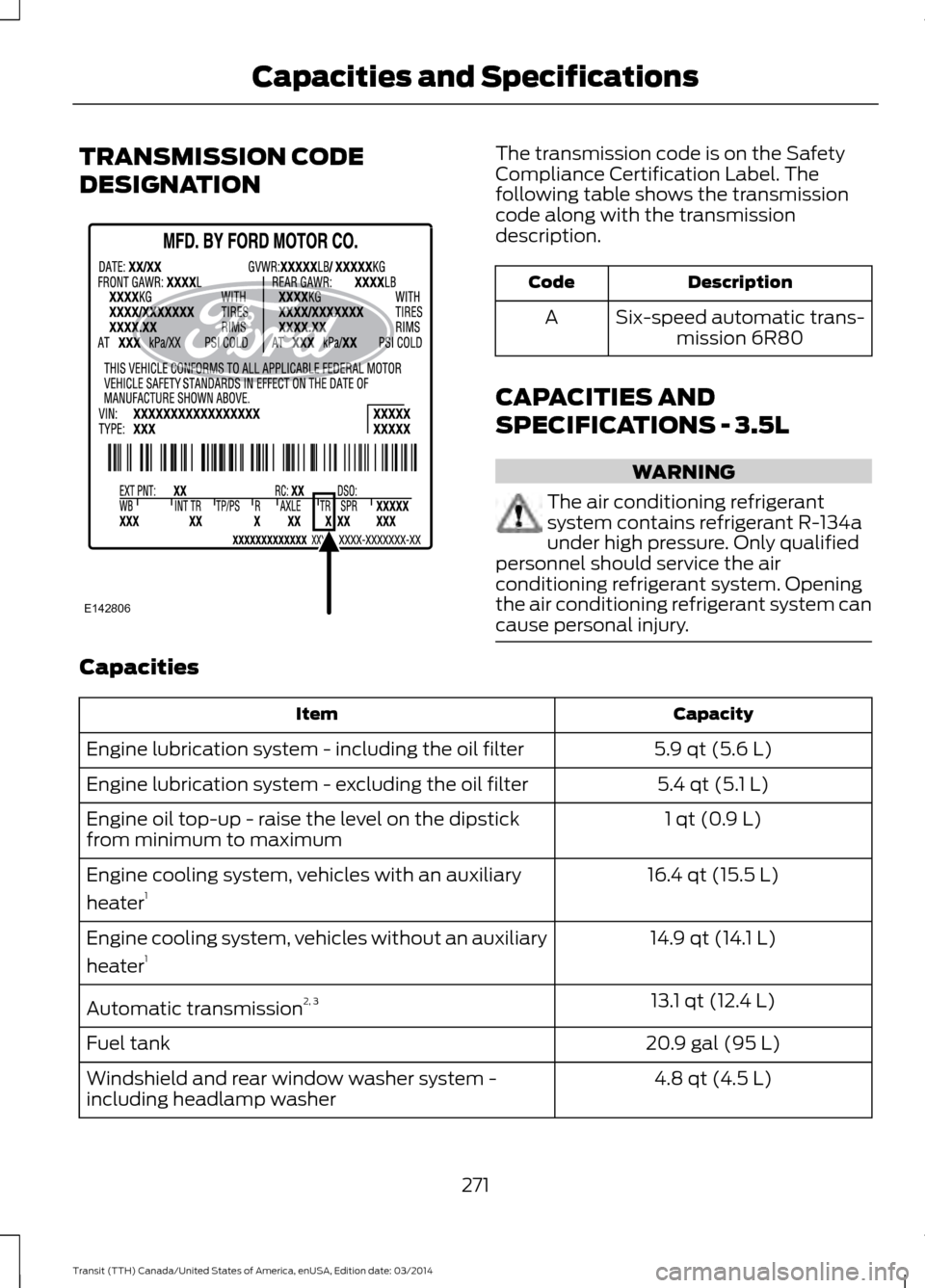
TRANSMISSION CODE
DESIGNATION The transmission code is on the Safety
Compliance Certification Label. The
following table shows the transmission
code along with the transmission
description.
Description
Code
Six-speed automatic trans-mission 6R80
A
CAPACITIES AND
SPECIFICATIONS - 3.5L WARNING
The air conditioning refrigerant
system contains refrigerant R-134a
under high pressure. Only qualified
personnel should service the air
conditioning refrigerant system. Opening
the air conditioning refrigerant system can
cause personal injury. Capacities
Capacity
Item
5.9 qt (5.6 L)
Engine lubrication system - including the oil filter
5.4 qt (5.1 L)
Engine lubrication system - excluding the oil filter
1 qt (0.9 L)
Engine oil top-up - raise the level on the dipstick
from minimum to maximum
16.4 qt (15.5 L)
Engine cooling system, vehicles with an auxiliary
heater 1
14.9 qt (14.1 L)
Engine cooling system, vehicles without an auxiliary
heater 1
13.1 qt (12.4 L)
Automatic transmission 2, 3
20.9 gal (95 L)
Fuel tank
4.8 qt (4.5 L)
Windshield and rear window washer system -
including headlamp washer
271Transit (TTH) Canada/United States of America, enUSA, Edition date: 03/2014 Capacities and SpecificationsE142806
Page 278 of 461
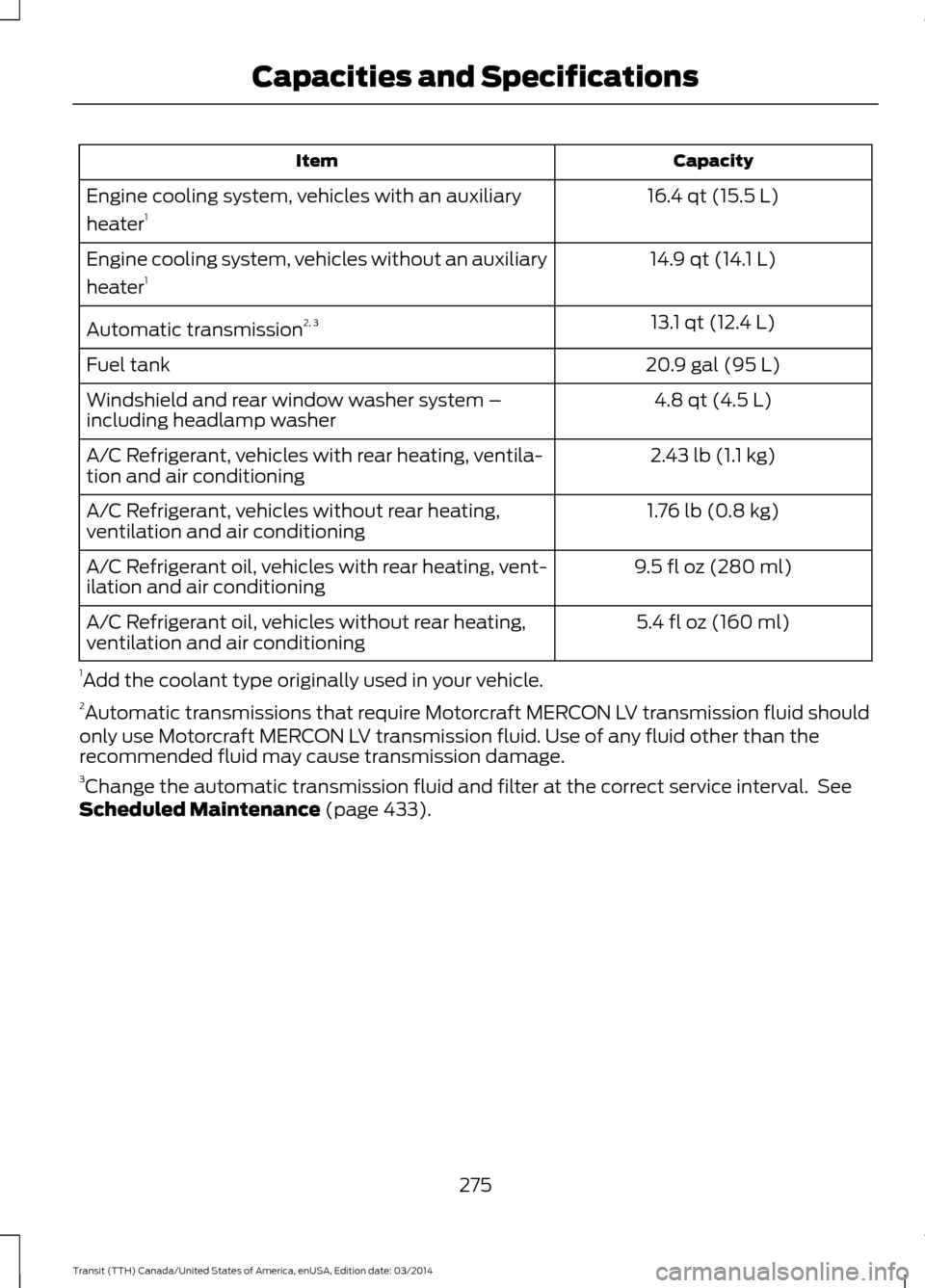
Capacity
Item
16.4 qt (15.5 L)
Engine cooling system, vehicles with an auxiliary
heater 1
14.9 qt (14.1 L)
Engine cooling system, vehicles without an auxiliary
heater 1
13.1 qt (12.4 L)
Automatic transmission 2, 3
20.9 gal (95 L)
Fuel tank
4.8 qt (4.5 L)
Windshield and rear window washer system –
including headlamp washer
2.43 lb (1.1 kg)
A/C Refrigerant, vehicles with rear heating, ventila-
tion and air conditioning
1.76 lb (0.8 kg)
A/C Refrigerant, vehicles without rear heating,
ventilation and air conditioning
9.5 fl oz (280 ml)
A/C Refrigerant oil, vehicles with rear heating, vent-
ilation and air conditioning
5.4 fl oz (160 ml)
A/C Refrigerant oil, vehicles without rear heating,
ventilation and air conditioning
1 Add the coolant type originally used in your vehicle.
2 Automatic transmissions that require Motorcraft MERCON LV transmission fluid should
only use Motorcraft MERCON LV transmission fluid. Use of any fluid other than the
recommended fluid may cause transmission damage.
3 Change the automatic transmission fluid and filter at the correct service interval. See
Scheduled Maintenance (page 433).
275Transit (TTH) Canada/United States of America, enUSA, Edition date: 03/2014 Capacities and Specifications
Page 281 of 461
Use only Motorcraft DOT 4 LV High
Performance Brake Fluid, or equivalent,
meeting WSS-M6C65-A2. Use of any fluid
other than the recommended fluid may
cause brake system damage.
Use multi-purpose grease for door latches,
hood latch, auxiliary hood latch, trunk latch
and seat tracks.
If you use oil and fluids that do not meet
the defined specification and viscosity
grades this may lead to:
•
Component damage which may not be
covered by the vehicle Warranty.
• Longer engine cranking periods.
• Increased emission levels.
• Reduced engine performance. •
Reduced fuel economy.
• Degraded brake performance.
CAPACITIES AND
SPECIFICATIONS - 3.2L
POWER STROKE DIESEL WARNING
The air conditioning refrigerant
system contains refrigerant R-134a
under high pressure. Only qualified
personnel should service the air
conditioning refrigerant system. Opening
the air conditioning refrigerant system can
cause personal injury. Capacities
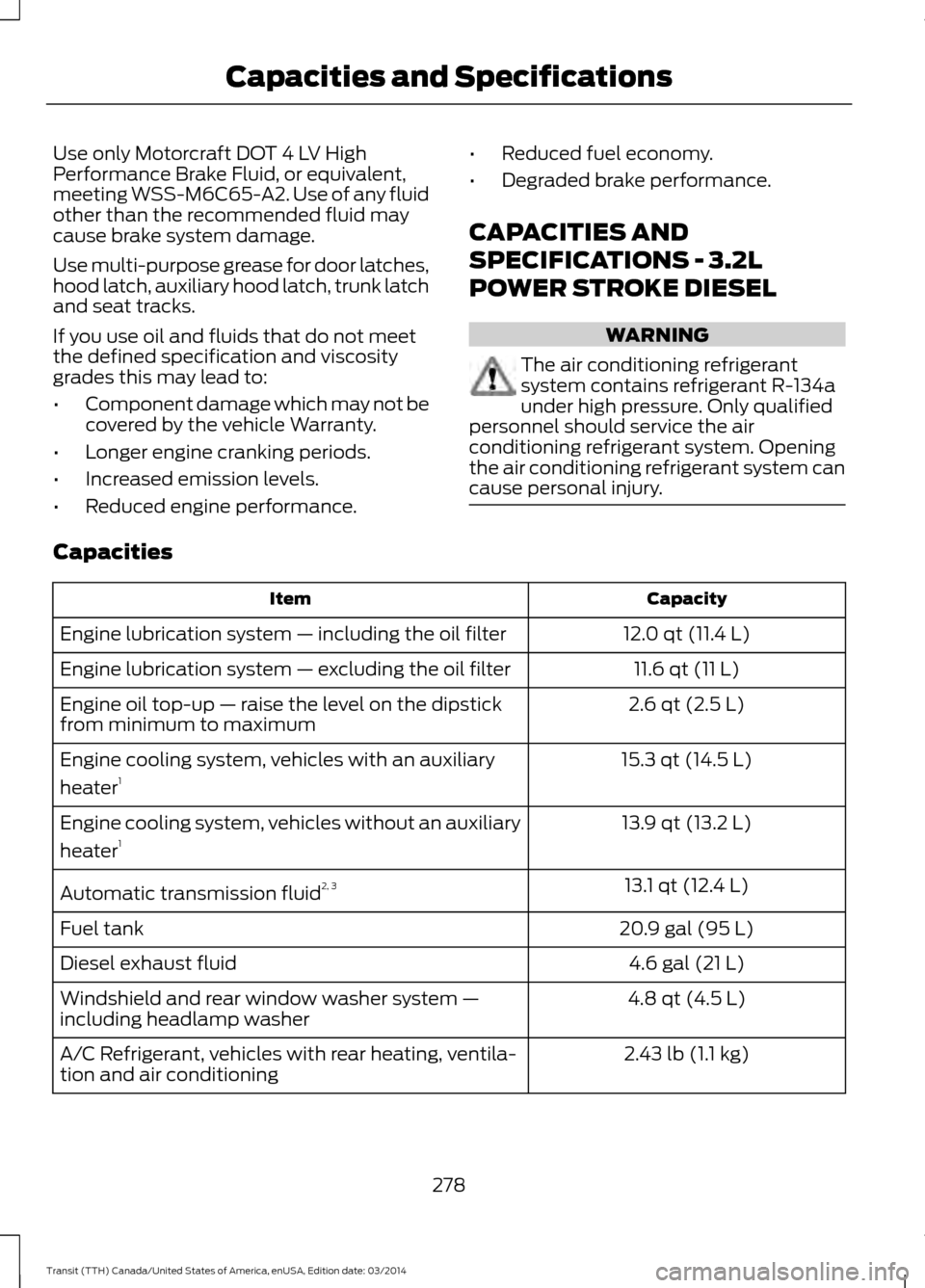
Capacity
Item
12.0 qt (11.4 L)
Engine lubrication system — including the oil filter
11.6 qt (11 L)
Engine lubrication system
— excluding the oil filter
2.6 qt (2.5 L)
Engine oil top-up
— raise the level on the dipstick
from minimum to maximum
15.3 qt (14.5 L)
Engine cooling system, vehicles with an auxiliary
heater 1
13.9 qt (13.2 L)
Engine cooling system, vehicles without an auxiliary
heater 1
13.1 qt (12.4 L)
Automatic transmission fluid 2, 3
20.9 gal (95 L)
Fuel tank
4.6 gal (21 L)
Diesel exhaust fluid
4.8 qt (4.5 L)
Windshield and rear window washer system
—
including headlamp washer
2.43 lb (1.1 kg)
A/C Refrigerant, vehicles with rear heating, ventila-
tion and air conditioning
278Transit (TTH) Canada/United States of America, enUSA, Edition date: 03/2014Capacities and Specifications
Page 438 of 461
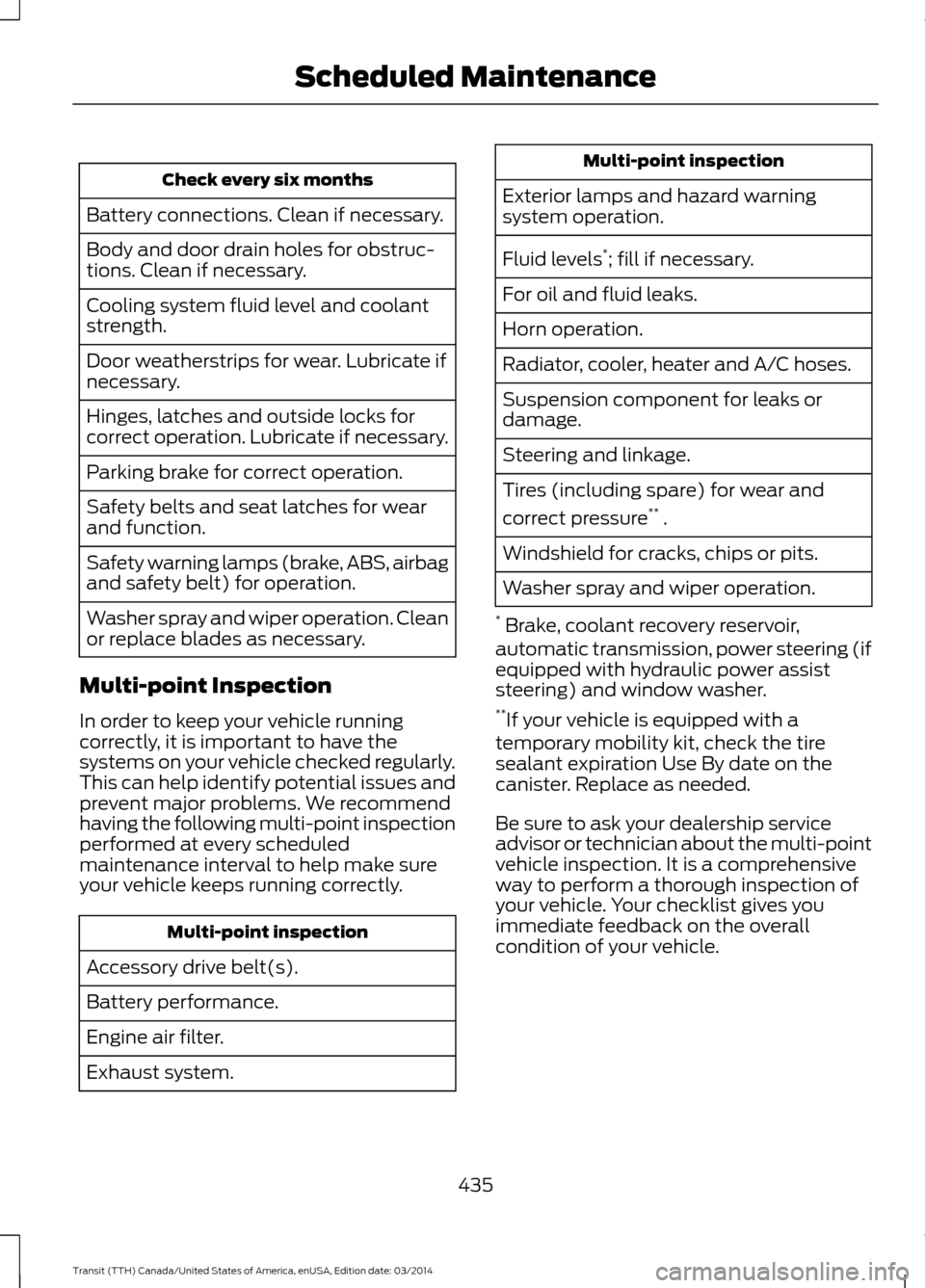
Check every six months
Battery connections. Clean if necessary.
Body and door drain holes for obstruc-
tions. Clean if necessary.
Cooling system fluid level and coolant
strength.
Door weatherstrips for wear. Lubricate if
necessary.
Hinges, latches and outside locks for
correct operation. Lubricate if necessary.
Parking brake for correct operation.
Safety belts and seat latches for wear
and function.
Safety warning lamps (brake, ABS, airbag
and safety belt) for operation.
Washer spray and wiper operation. Clean
or replace blades as necessary.
Multi-point Inspection
In order to keep your vehicle running
correctly, it is important to have the
systems on your vehicle checked regularly.
This can help identify potential issues and
prevent major problems. We recommend
having the following multi-point inspection
performed at every scheduled
maintenance interval to help make sure
your vehicle keeps running correctly. Multi-point inspection
Accessory drive belt(s).
Battery performance.
Engine air filter.
Exhaust system. Multi-point inspection
Exterior lamps and hazard warning
system operation.
Fluid levels *
; fill if necessary.
For oil and fluid leaks.
Horn operation.
Radiator, cooler, heater and A/C hoses.
Suspension component for leaks or
damage.
Steering and linkage.
Tires (including spare) for wear and
correct pressure **
.
Windshield for cracks, chips or pits.
Washer spray and wiper operation.
* Brake, coolant recovery reservoir,
automatic transmission, power steering (if
equipped with hydraulic power assist
steering) and window washer.
** If your vehicle is equipped with a
temporary mobility kit, check the tire
sealant expiration Use By date on the
canister. Replace as needed.
Be sure to ask your dealership service
advisor or technician about the multi-point
vehicle inspection. It is a comprehensive
way to perform a thorough inspection of
your vehicle. Your checklist gives you
immediate feedback on the overall
condition of your vehicle.
435 Transit (TTH) Canada/United States of America, enUSA, Edition date: 03/2014 Scheduled Maintenance
Page 440 of 461
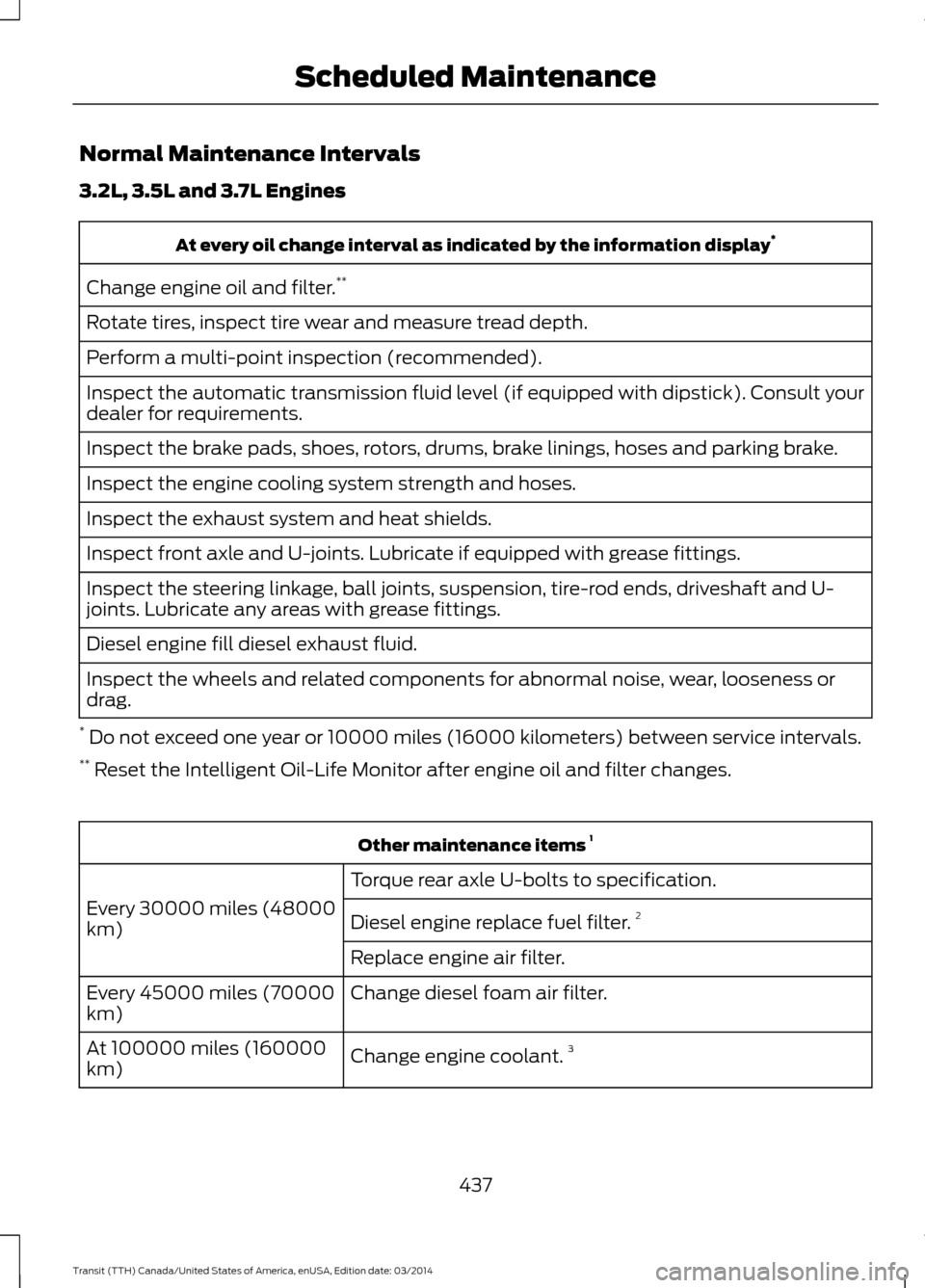
Normal Maintenance Intervals
3.2L, 3.5L and 3.7L Engines
At every oil change interval as indicated by the information display
*
Change engine oil and filter. **
Rotate tires, inspect tire wear and measure tread depth.
Perform a multi-point inspection (recommended).
Inspect the automatic transmission fluid level (if equipped with dipstick). Consult your
dealer for requirements.
Inspect the brake pads, shoes, rotors, drums, brake linings, hoses and parking brake.
Inspect the engine cooling system strength and hoses.
Inspect the exhaust system and heat shields.
Inspect front axle and U-joints. Lubricate if equipped with grease fittings.
Inspect the steering linkage, ball joints, suspension, tire-rod ends, driveshaft and U-
joints. Lubricate any areas with grease fittings.
Diesel engine fill diesel exhaust fluid.
Inspect the wheels and related components for abnormal noise, wear, looseness or
drag.
* Do not exceed one year or 10000 miles (16000 kilometers) between service intervals.
** Reset the Intelligent Oil-Life Monitor after engine oil and filter changes. Other maintenance items
1
Torque rear axle U-bolts to specification.
Every 30000 miles (48000
km) Diesel engine replace fuel filter. 2
Replace engine air filter.
Change diesel foam air filter.
Every 45000 miles (70000
km)
Change engine coolant.3
At 100000 miles (160000
km)
437Transit (TTH) Canada/United States of America, enUSA, Edition date: 03/2014 Scheduled Maintenance
Page 454 of 461
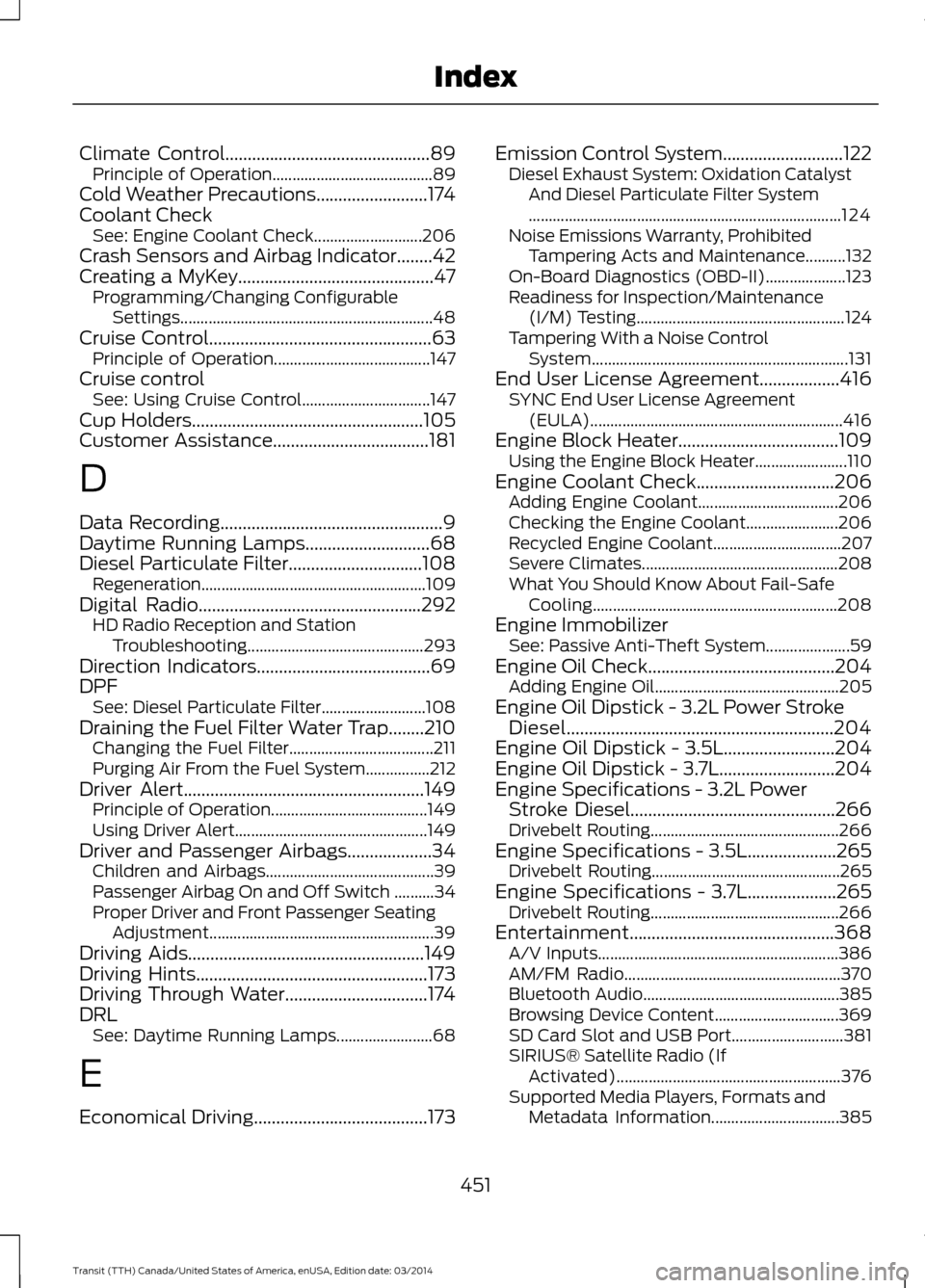
Climate Control..............................................89
Principle of Operation........................................ 89
Cold Weather Precautions
.........................174
Coolant Check See: Engine Coolant Check........................... 206
Crash Sensors and Airbag Indicator........42
Creating a MyKey............................................47 Programming/Changing Configurable
Settings............................................................... 48
Cruise Control
..................................................63
Principle of Operation....................................... 147
Cruise control See: Using Cruise Control................................ 147
Cup Holders....................................................105
C
ustomer Assistance...................................181
D
Data Recording..................................................9
Daytime Running Lamps
............................68
Diesel Particulate Filter..............................108 R
egeneration........................................................ 109
Digital Radio..................................................
292
HD Radio Reception and Station
Troubleshooting............................................ 293
Direction Indicators.......................................69
DPF See: Diesel Particulate Filter.......................... 108
Draining the Fuel Filter Water Trap........210 Changing the Fuel Filter.................................... 211
Purging Air From the Fuel System................212
Driver Alert
......................................................149
Principle of Operation....................................... 149
Using Driver Alert................................................ 149
Driver and Passenger Airbags...................34 Children and Airbags.......................................... 39
Passenger Airbag On and Off Switch ..........34
Proper Driver and Front Passenger Seating Adjustment........................................................ 39
Driving Aids.....................................................149
Driving Hints
....................................................173
Driving Through Water................................174
DRL S
ee: Daytime Running Lamps........................68
E
Economical Driving
.......................................173 Emission Control System...........................122
Diesel Exhaust System: Oxidation Catalyst
And Diesel Particulate Filter System
........................................................................\
...... 124
Noise Emissions Warranty, Prohibited Tampering Acts and Maintenance..........132
On-Board Diagnostics (OBD-II).................... 123
Readiness for Inspection/Maintenance (I/M) Testing.................................................... 124
Tampering With a Noise Control System................................................................ 131
End User License Agreement..................416 SYNC End User License Agreement
(EULA)............................................................... 416
Engine Block Heater....................................109 Using the Engine Block Heater....................... 110
Engine Coolant Check...............................206 Adding Engine Coolant................................... 206
Checking the Engine Coolant....................... 206
Recycled Engine Coolant................................ 207
Severe Climates................................................. 208
What You Should Know About Fail-Safe Cooling............................................................. 208
Engine Immobilizer See: Passive Anti-Theft System.....................59
Engine Oil Check..........................................204 Adding Engine Oil.............................................. 205
Engine Oil Dipstick - 3.2L Power Stroke Diesel............................................................204
Engine Oil Dipstick - 3.5L.........................204
Engine Oil Dipstick - 3.7L..........................204
Engine Specifications - 3.2L Power Stroke Diesel..............................................266
Drivebelt Routing............................................... 266
Engine Specifications - 3.5L....................265 Driv
ebelt Routing............................................... 265
Engine Specifications - 3.7L....................265 Drivebelt Routing............................................... 266
Entertainment..............................................368 A/V Inputs............................................................ 386
AM/FM Radio...................................................... 370
Bluetooth Audio................................................. 385
Browsing Device Content............................... 369
SD Card Slot and USB Port............................ 381
SIRIUS® Satellite Radio (If Activated)........................................................ 376
Supported Media Players, Formats and Metadata Information................................ 385
451 Transit (TTH) Canada/United States of America, enUSA, Edition date: 03/2014 Index
Page 456 of 461
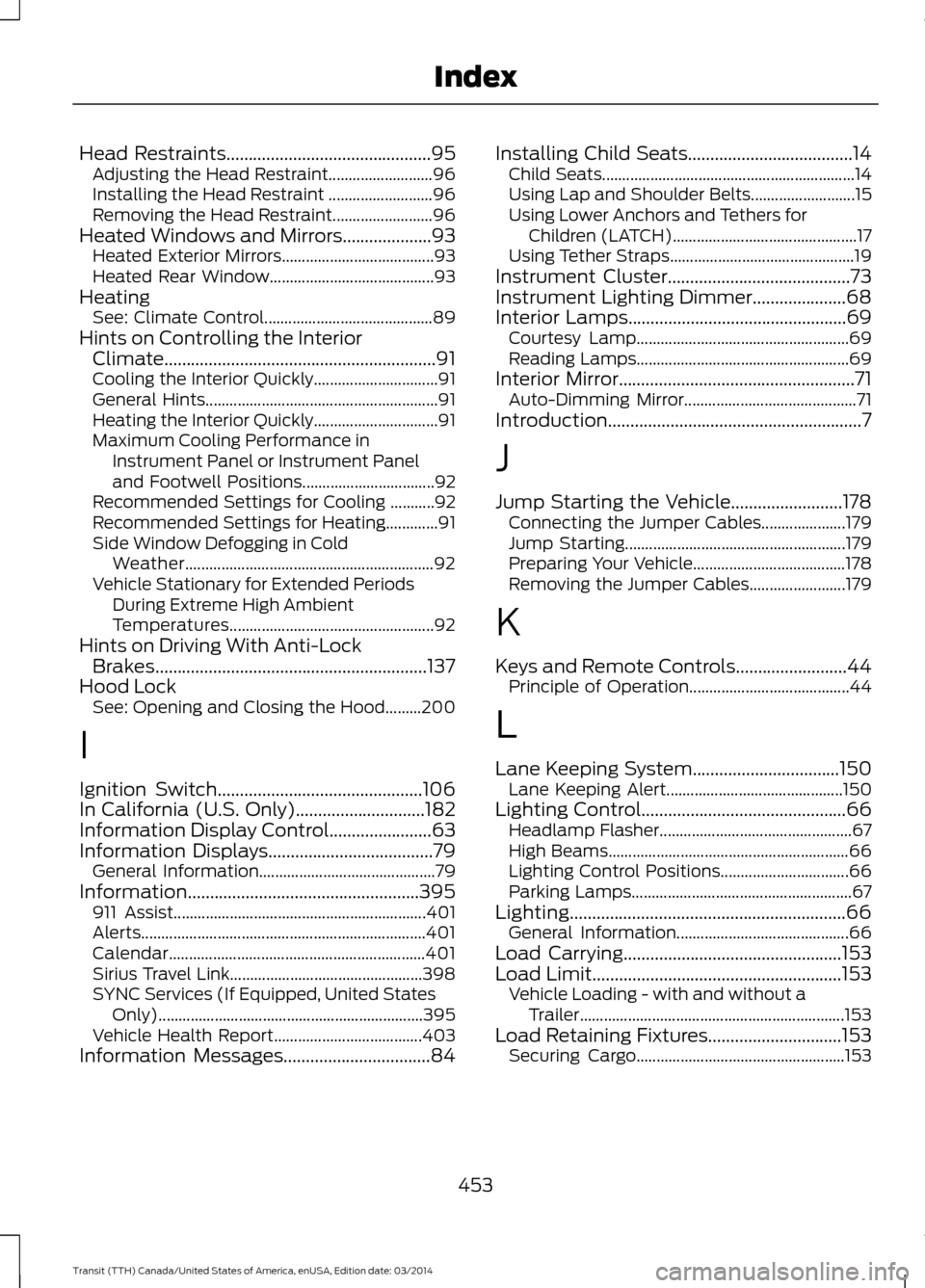
Head Restraints..............................................95
Adjusting the Head Restraint.......................... 96
Installing the Head Restraint .......................... 96
Removing the Head Restraint......................... 96
Heated Windows and Mirrors....................93 He
ated Exterior Mirrors...................................... 93
Heated Rear Window......................................... 93
Heating See: Climate Control.......................................... 89
Hints on Controlling the Interior Climate.............................................................91
Cooling the Interior Quickly............................... 91
General Hints.......................................................... 91
Heating the Interior Quickly............................... 91
Maximum Cooling Performance in Instrument Panel or Instrument Panel
and Footwell Positions................................. 92
Recommended Settings for Cooling ...........92
Recommended Settings for Heating.............91
Side Window Defogging in Cold Weather.............................................................. 92
Vehicle Stationary for Extended Periods During Extreme High Ambient
Temperatures................................................... 92
Hints on Driving With Anti-Lock Brakes.............................................................137
Hood Lock See: Opening and Closing the Hood.........200
I
Ignition Switch..............................................106
In C
alifornia (U.S. Only).............................182
Information Display Control
.......................63
Information Displays.....................................79 General Information............................................ 79
Information....................................................395 911 Assist............................................................... 401
Alerts....................................................................... 401
Calendar................................................................ 401
Sirius Travel Link................................................ 398
SYNC Services (If Equipped, United States Only).................................................................. 395
Vehicle Health Report..................................... 403
Information Messages.................................84 Installing Child Seats.....................................14
Child Seats............................................................... 14
Using Lap and Shoulder Belts.......................... 15
Using Lower Anchors and Tethers for Children (LATCH).............................................. 17
Using Tether Straps.............................................. 19
Instrument Cluster.........................................73
Instrument Lighting Dimmer.....................68
Interior Lamps
.................................................69
Courtesy Lamp..................................................... 69
Reading Lamps..................................................... 69
Interior Mirror.....................................................71 Auto-Dimming Mirror........................................... 71
Introduction.........................................................7
J
Jump Starting the Vehicle
.........................178
Connecting the Jumper Cables..................... 179
Jump Starting....................................................... 179
Preparing Your Vehicle...................................... 178
Removing the Jumper Cables........................ 179
K
Keys and Remote Controls.........................44 Principle of Operation........................................ 44
L
Lane Keeping System.................................150 Lane Keeping Alert............................................ 150
Lighting Control..............................................66 Headlamp Flasher................................................ 67
High Beams............................................................ 66
Lighting Control Positions................................ 66
Parking Lamps....................................................... 67
Lighting..............................................................66 General Information........................................... 66
Load Carrying.................................................
153
Load Limit........................................................153
Vehicle Loading - with and without a
Trailer.................................................................. 153
Load Retaining Fixtures..............................
153
Securing Cargo.................................................... 153
453 Transit (TTH) Canada/United States of America, enUSA, Edition date: 03/2014 Index