air filter FORD TRANSIT 2016 5.G User Guide
[x] Cancel search | Manufacturer: FORD, Model Year: 2016, Model line: TRANSIT, Model: FORD TRANSIT 2016 5.GPages: 411, PDF Size: 5.65 MB
Page 182 of 411
•
Do not rest your foot on the brake
pedal while driving.
• Avoid carrying unnecessary weight.
• Avoid adding particular accessories to
your vehicle (e.g. bug deflectors,
rollbars/light bars, running boards, ski
racks).
• Avoid driving with the wheels out of
alignment.
COLD WEATHER
PRECAUTIONS
The functional operation of some
components and systems can be affected
at temperatures below -13°F (-25°C).
DRIVING THROUGH WATER WARNING
Do not drive through flowing or deep
water as you may lose control of your
vehicle.
Note:
Driving through standing water can
cause vehicle damage.
Note: Engine damage can occur if water
enters the air filter.
Before driving through standing water,
check the depth. Never drive through water
that is higher than the bottom of the wheel
hubs. When driving through standing water, drive
very slowly and do not stop your vehicle.
Your brake performance and traction may
be limited. After driving through water and
as soon as it is safe to do so:
•
Lightly press the brake pedal to dry the
brakes and to check that they work.
• Check that the horn works.
• Check that the exterior lights work.
• Turn the steering wheel to check that
the steering power assist works.
FLOOR MATS WARNINGS
Always use floor mats that are
designed to fit the foot well of your
vehicle. Only use floor mats that
leave the pedal area unobstructed. Only
use floor mats that are firmly secured to
retention posts so that they cannot slip out
of position and interfere with the pedals
or impair safe operation of your vehicle in
other ways. Pedals that cannot move freely can
cause loss of vehicle control and
increase the risk of serious personal
injury.
179
Transit (TTH) Canada/United States of America, enUSA, First Printing Driving HintsE176913
Page 198 of 411
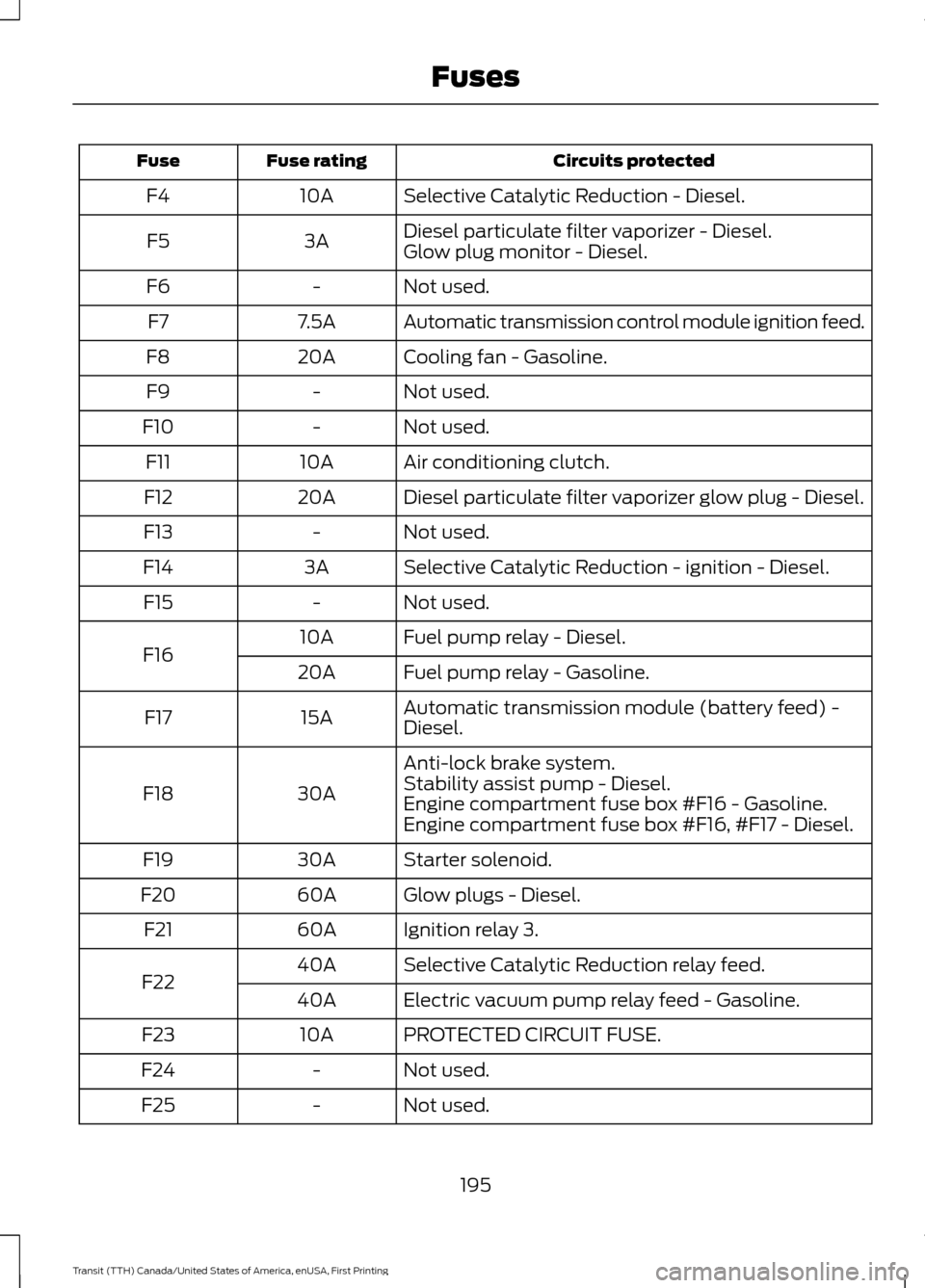
Circuits protected
Fuse rating
Fuse
Selective Catalytic Reduction - Diesel.
10A
F4
Diesel particulate filter vaporizer - Diesel.
3A
F5
Glow plug monitor - Diesel.
Not used.
-
F6
Automatic transmission control module ignition feed.
7.5A
F7
Cooling fan - Gasoline.
20A
F8
Not used.
-
F9
Not used.
-
F10
Air conditioning clutch.
10A
F11
Diesel particulate filter vaporizer glow plug - Diesel.
20A
F12
Not used.
-
F13
Selective Catalytic Reduction - ignition - Diesel.
3A
F14
Not used.
-
F15
Fuel pump relay - Diesel.
10A
F16 Fuel pump relay - Gasoline.
20A
Automatic transmission module (battery feed) -
Diesel.
15A
F17
Anti-lock brake system.
30A
F18 Stability assist pump - Diesel.
Engine compartment fuse box #F16 - Gasoline.
Engine compartment fuse box #F16, #F17 - Diesel.
Starter solenoid.
30A
F19
Glow plugs - Diesel.
60A
F20
Ignition relay 3.
60A
F21
Selective Catalytic Reduction relay feed.
40A
F22 Electric vacuum pump relay feed - Gasoline.
40A
PROTECTED CIRCUIT FUSE.
10A
F23
Not used.
-
F24
Not used.
-
F25
195
Transit (TTH) Canada/United States of America, enUSA, First Printing Fuses
Page 212 of 411
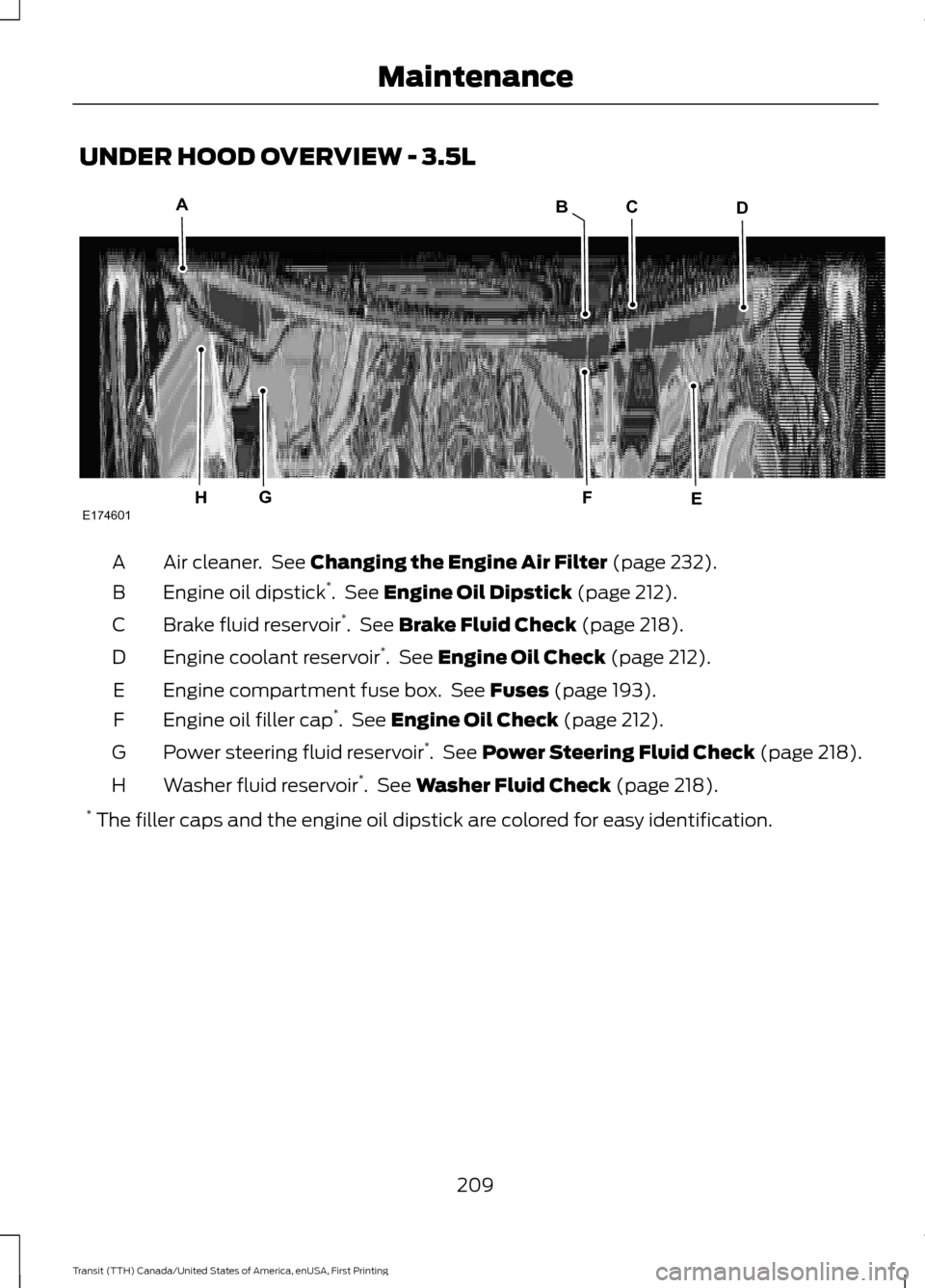
UNDER HOOD OVERVIEW - 3.5L
Air cleaner. See Changing the Engine Air Filter (page 232).
A
Engine oil dipstick *
. See
Engine Oil Dipstick (page 212).
B
Brake fluid reservoir *
. See
Brake Fluid Check (page 218).
C
Engine coolant reservoir *
. See
Engine Oil Check (page 212).
D
Engine compartment fuse box. See
Fuses (page 193).
E
Engine oil filler cap *
. See
Engine Oil Check (page 212).
F
Power steering fluid reservoir *
. See
Power Steering Fluid Check (page 218).
G
Washer fluid reservoir *
. See
Washer Fluid Check (page 218).
H
* The filler caps and the engine oil dipstick are colored for easy identification.
209
Transit (TTH) Canada/United States of America, enUSA, First Printing MaintenanceE174601
ACD
EGH
B
F
Page 213 of 411
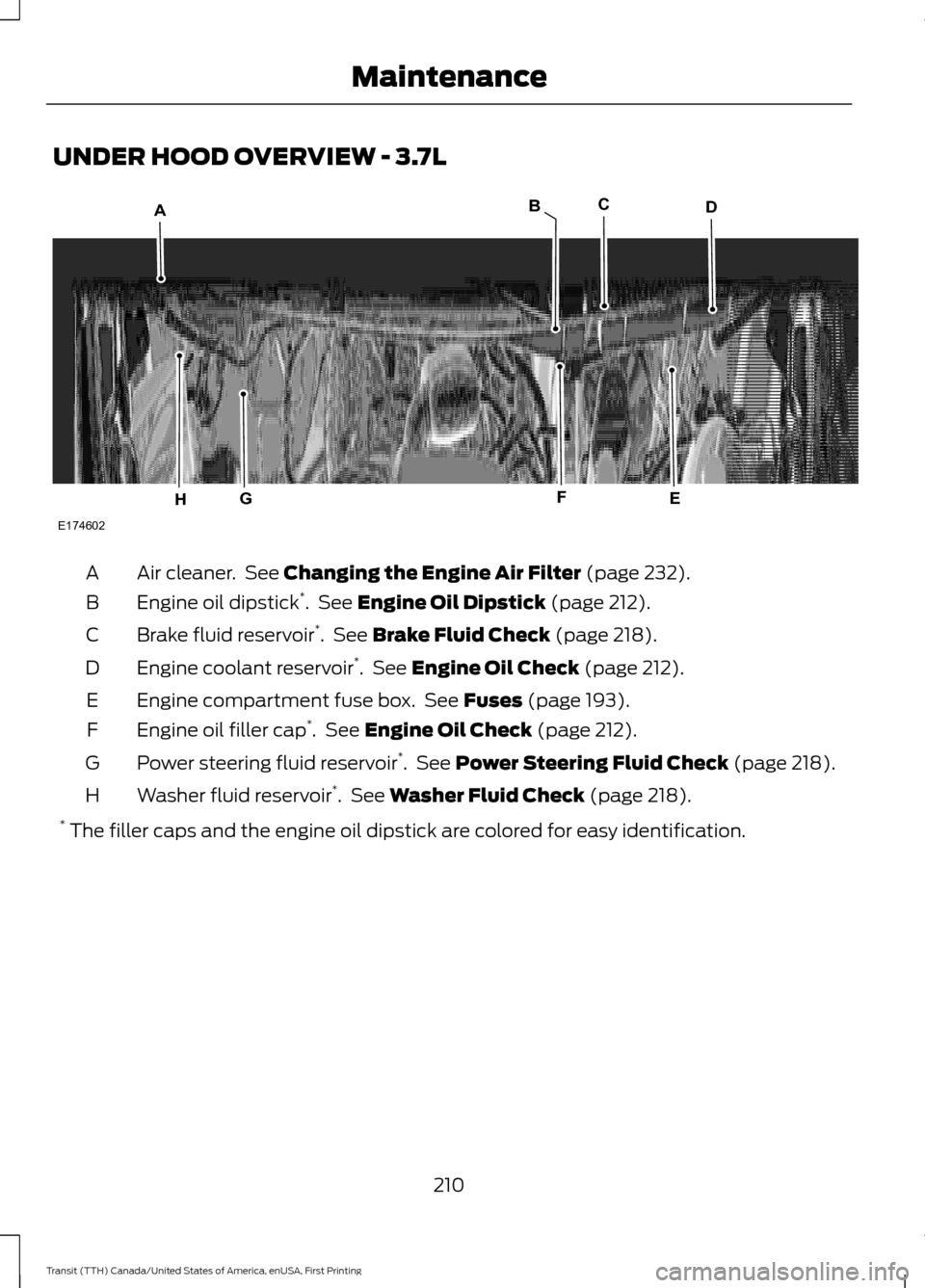
UNDER HOOD OVERVIEW - 3.7L
Air cleaner. See Changing the Engine Air Filter (page 232).
A
Engine oil dipstick *
. See
Engine Oil Dipstick (page 212).
B
Brake fluid reservoir *
. See
Brake Fluid Check (page 218).
C
Engine coolant reservoir *
. See
Engine Oil Check (page 212).
D
Engine compartment fuse box. See
Fuses (page 193).
E
Engine oil filler cap *
. See
Engine Oil Check (page 212).
F
Power steering fluid reservoir *
. See
Power Steering Fluid Check (page 218).
G
Washer fluid reservoir *
. See
Washer Fluid Check (page 218).
H
* The filler caps and the engine oil dipstick are colored for easy identification.
210
Transit (TTH) Canada/United States of America, enUSA, First Printing MaintenanceE174602
ACD
EGH
B
F
Page 214 of 411
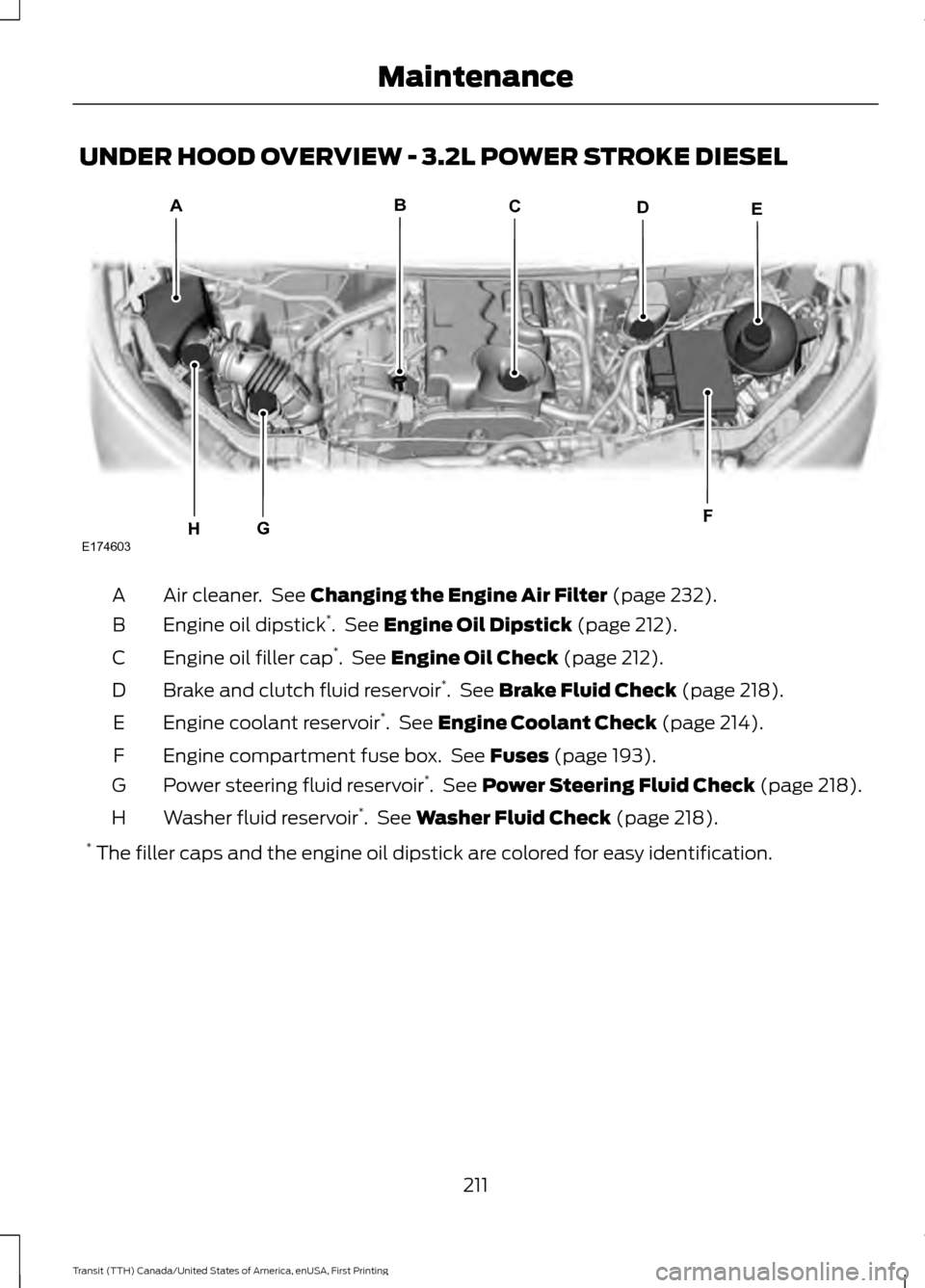
UNDER HOOD OVERVIEW - 3.2L POWER STROKE DIESEL
Air cleaner. See Changing the Engine Air Filter (page 232).
A
Engine oil dipstick *
. See
Engine Oil Dipstick (page 212).
B
Engine oil filler cap *
. See
Engine Oil Check (page 212).
C
Brake and clutch fluid reservoir *
. See
Brake Fluid Check (page 218).
D
Engine coolant reservoir *
. See
Engine Coolant Check (page 214).
E
Engine compartment fuse box. See
Fuses (page 193).
F
Power steering fluid reservoir *
. See
Power Steering Fluid Check (page 218).
G
Washer fluid reservoir *
. See
Washer Fluid Check (page 218).
H
* The filler caps and the engine oil dipstick are colored for easy identification.
211
Transit (TTH) Canada/United States of America, enUSA, First Printing MaintenanceE174603
ABCDE
FGH
Page 217 of 411
•
Sustained high-speed driving at Gross
Vehicle Weight Rating (maximum
loaded weight for vehicle operation).
• Sustained use of diesel fuel other than
ultra-low sulfur diesel (ULSD).
OIL CHANGE INDICATOR
RESET
Resetting the Oil Life Monitoring
System
Only reset the oil life monitoring system
after changing the engine oil and oil filter.
1. Switch the ignition on. Do not start the
engine. For vehicles with push-button
start, press and hold the start button
for two seconds without pressing the
brake pedal. Do not start the engine.
2. Press the accelerator and brake pedals
at the same time.
3. Keep the accelerator and brake pedals
fully pressed.
4. After three seconds, a message confirming that the reset is in progress
will be displayed.
5. After 25 seconds, a message confirming that the reset is complete
will be displayed.
6. Release the accelerator and brake pedals.
7. The message confirming that the reset
is complete will no longer be displayed.
8. Switch the ignition off. For vehicles with
push-button start, press the start
button to switch the ignition off. ENGINE COOLANT CHECK
Checking the Engine Coolant
When the engine is cold, check the
concentration and level of the engine
coolant at the intervals listed in the
scheduled maintenance information. See
Scheduled Maintenance (page 363).
Note: Make sure that the level is between
the MIN and MAX marks on the coolant
reservoir.
Note: Coolant expands when it is hot. The
level may extend beyond the MAX mark.
Note: If the level is at the MIN mark, below
the MIN mark, or empty, add coolant
immediately. See
Adding Engine Coolant
in this chapter.
The coolant concentration should be
maintained within 48% to 50%, which
equates to a freeze point between -30°F
(-34°C) and -34°F (-37°C).
Note: For best results, coolant
concentration should be tested with a
refractometer, for example Robinair®
Coolant and Battery Refractometer 75240.
We do not recommend the use of
hydrometers or coolant test strips for
measuring coolant concentrations.
Note: Automotive fluids are not
interchangeable. Do not use engine coolant,
antifreeze or windshield washer fluid outside
of its specified function and vehicle location.
Adding Engine Coolant WARNINGS
Do not add engine coolant when the
engine is hot. Steam and scalding
liquids released from a hot cooling
system can burn you badly. Also, spilling
coolant on hot engine parts can burn you.
214
Transit (TTH) Canada/United States of America, enUSA, First Printing Maintenance
Page 223 of 411
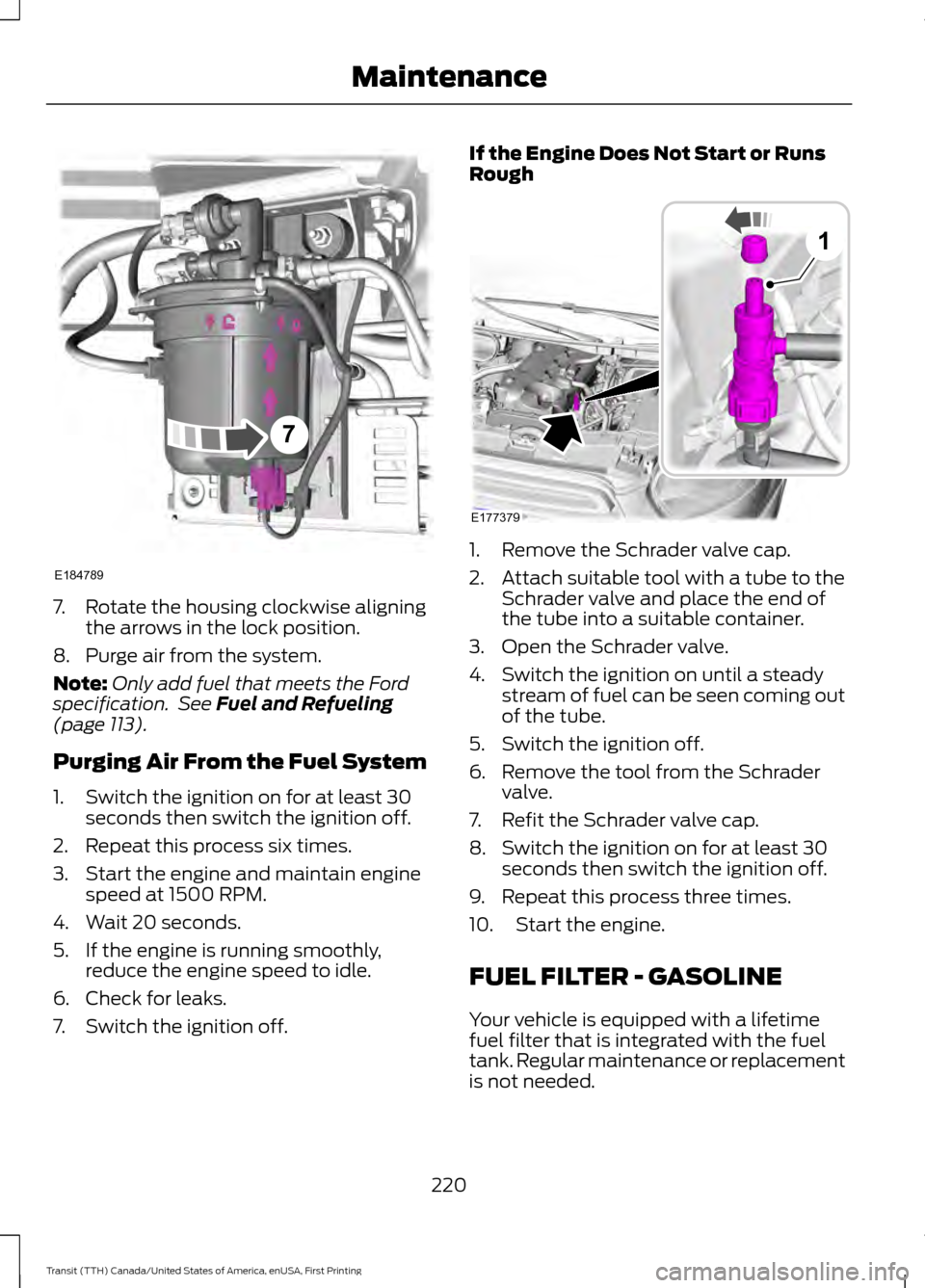
7. Rotate the housing clockwise aligning
the arrows in the lock position.
8. Purge air from the system.
Note: Only add fuel that meets the Ford
specification. See Fuel and Refueling
(page 113).
Purging Air From the Fuel System
1. Switch the ignition on for at least 30 seconds then switch the ignition off.
2. Repeat this process six times.
3. Start the engine and maintain engine speed at 1500 RPM.
4. Wait 20 seconds.
5. If the engine is running smoothly, reduce the engine speed to idle.
6. Check for leaks.
7. Switch the ignition off. If the Engine Does Not Start or Runs
Rough
1. Remove the Schrader valve cap.
2. Attach suitable tool with a tube to the
Schrader valve and place the end of
the tube into a suitable container.
3. Open the Schrader valve.
4. Switch the ignition on until a steady stream of fuel can be seen coming out
of the tube.
5. Switch the ignition off.
6. Remove the tool from the Schrader valve.
7. Refit the Schrader valve cap.
8. Switch the ignition on for at least 30 seconds then switch the ignition off.
9. Repeat this process three times.
10. Start the engine.
FUEL FILTER - GASOLINE
Your vehicle is equipped with a lifetime
fuel filter that is integrated with the fuel
tank. Regular maintenance or replacement
is not needed.
220
Transit (TTH) Canada/United States of America, enUSA, First Printing MaintenanceE184789
7 E177379
1
Page 235 of 411
CHANGING THE ENGINE AIR
FILTER
WARNING
To reduce the risk of vehicle damage
and personal burn injuries, do not
start your engine with the air cleaner
removed and do not remove it while the
engine is running. Only use the specified replacement air
filter. See Capacities and Specifications
(page 274).
Note: Failure to use the correct air filter
element may result in severe engine
damage. Resulting component damage
may not be covered by the vehicle Warranty.
Change the air filter element at the correct
interval. See
Scheduled Maintenance
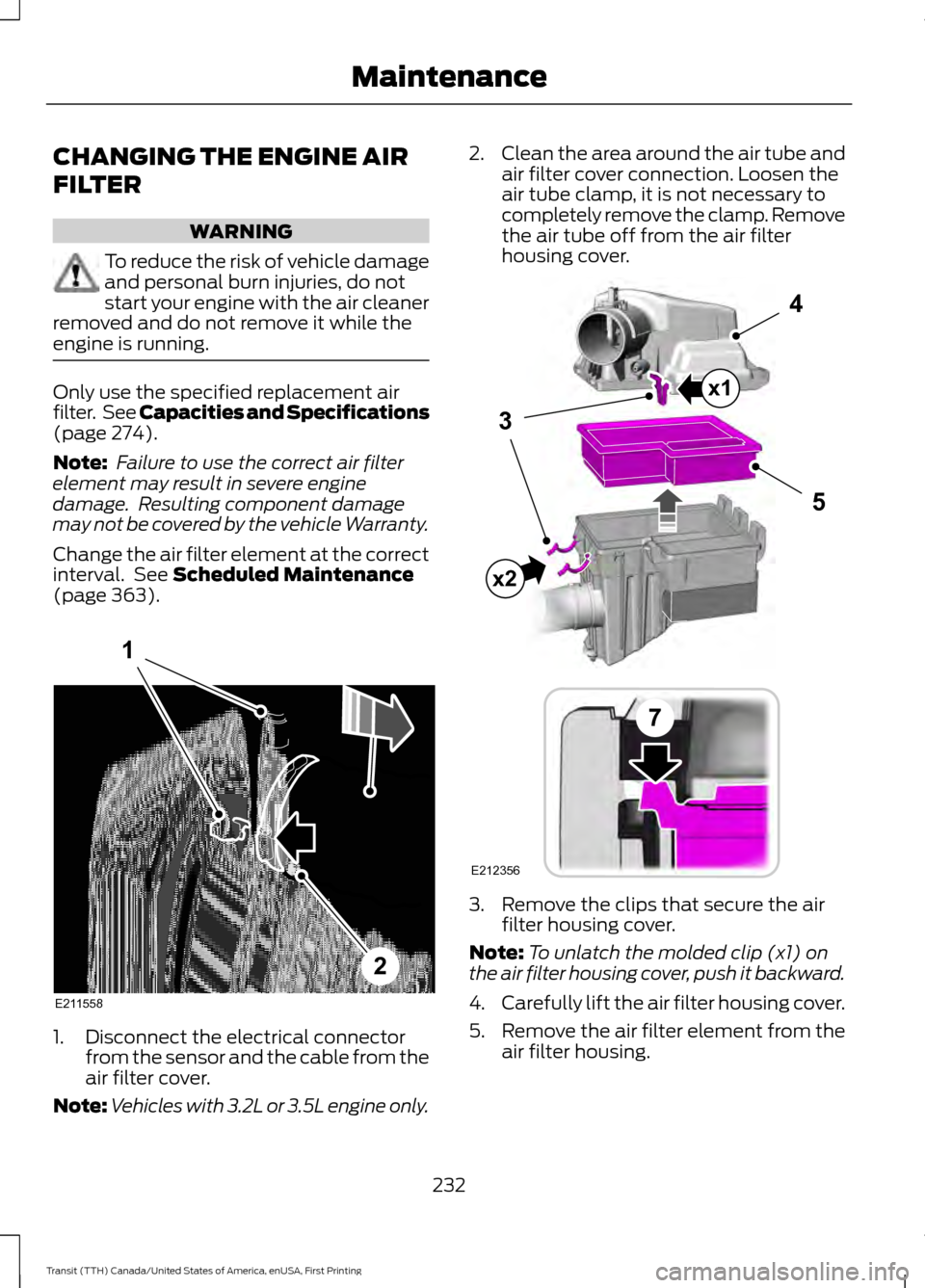
(page 363). 1. Disconnect the electrical connector
from the sensor and the cable from the
air filter cover.
Note: Vehicles with 3.2L or 3.5L engine only. 2.
Clean the area around the air tube and
air filter cover connection. Loosen the
air tube clamp, it is not necessary to
completely remove the clamp. Remove
the air tube off from the air filter
housing cover. 3. Remove the clips that secure the air
filter housing cover.
Note: To unlatch the molded clip (x1) on
the air filter housing cover, push it backward.
4. Carefully lift the air filter housing cover.
5. Remove the air filter element from the
air filter housing.
232
Transit (TTH) Canada/United States of America, enUSA, First Printing MaintenanceE211558
1
2 E212356
5
4
7
3
x1
x2
Page 236 of 411
6.
Wipe any dirt or debris from the air filter
housing and cover to make sure no dirt
gets in the engine and that you have a
good seal.
7. Install a new air filter element. Be careful not to crimp the filter element
edges between the air filter housing
and cover.
8. Install the air filter housing cover.
Note: Make sure the front clips are fully
engaged and the molded clip on the air filter
housing cover is fully pushed down and
securely clicks into place.
9. Install the air tube onto the air filter cover. Tighten the air tube clamp until
you feel a strong resistance.
10. Reconnect the electrical connector to the sensor and the cable to the air
filter cover.
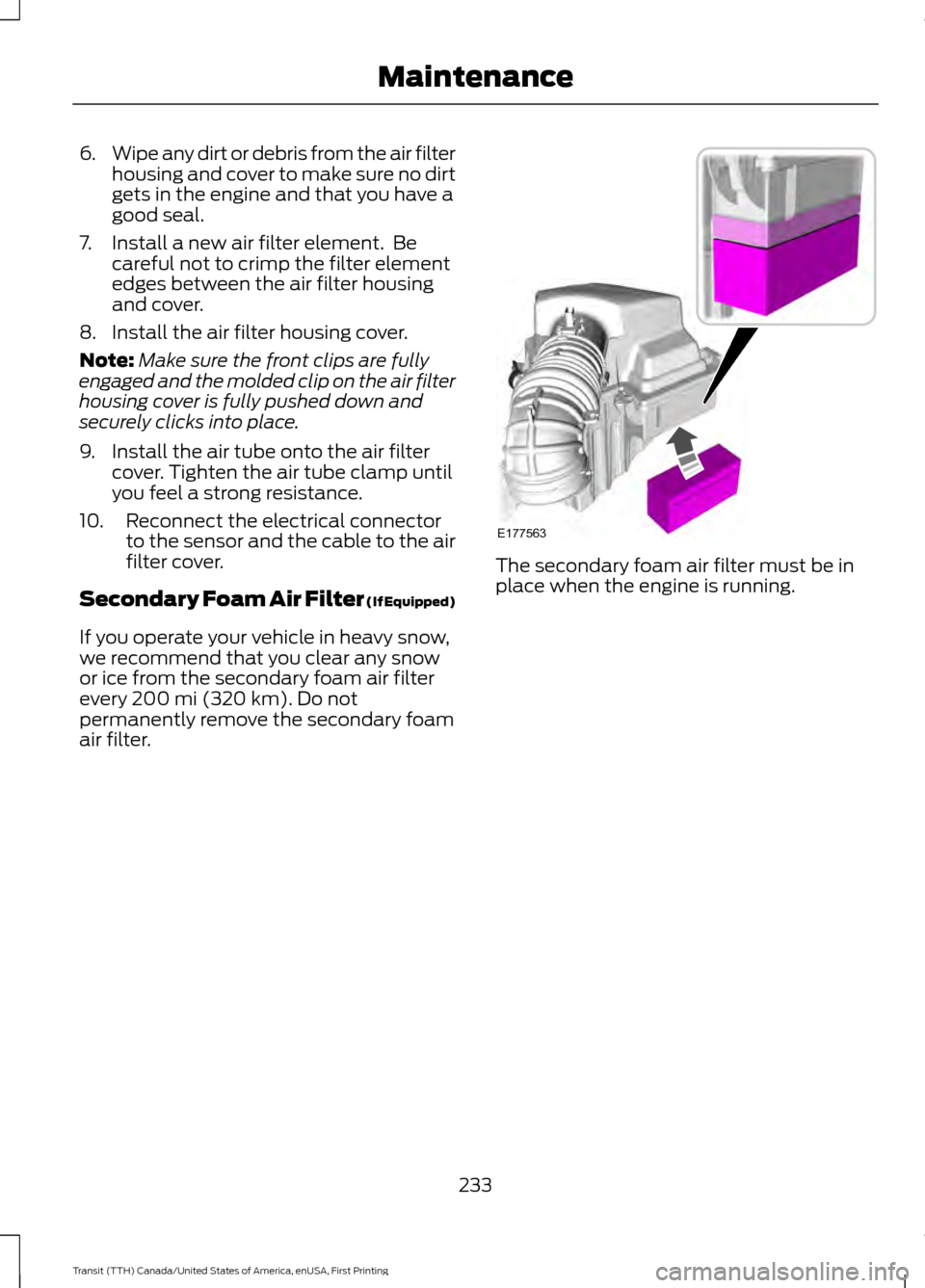
Secondary Foam Air Filter (If Equipped)
If you operate your vehicle in heavy snow,
we recommend that you clear any snow
or ice from the secondary foam air filter
every
200 mi (320 km). Do not
permanently remove the secondary foam
air filter. The secondary foam air filter must be in
place when the engine is running.
233
Transit (TTH) Canada/United States of America, enUSA, First Printing MaintenanceE177563
Page 237 of 411
CLEANING PRODUCTS
For best results, use the following products
or products of equivalent quality:
•
Motorcraft Bug and Tar Remover
(ZC-42)
• Motorcraft Custom Bright Metal
Cleaner (ZC-15)
• Motorcraft Detail Wash (ZC-3-A)
• Motorcraft Dusting Cloth (ZC-24)
• Motorcraft Engine Shampoo and
Degreaser (U.S. only) (ZC-20)
• Motorcraft Engine Shampoo (Canada
only) (CXC-66-A)
• Motorcraft Multi-Purpose Cleaner
(Canada only) (CXC-101)
• Motorcraft Premium Glass Cleaner
(Canada only) (CXC-100)
• Motorcraft Premium Quality
Windshield Washer Fluid (Canada
only) [CXC-37-(A, B, D or F)]
• Motorcraft Premium Windshield Wash
Concentrate with Bitterant (U.S. only)
(ZC-32-B2)
• Motorcraft Professional Strength
Carpet & Upholstery Cleaner (ZC-54)
• Motorcraft Premium Leather and Vinyl
Cleaner (ZC-56)
• Motorcraft Spot and Stain Remover
(U.S. only) (ZC-14)
• Motorcraft Ultra-Clear Spray Glass
Cleaner (ZC-23)
• Motorcraft Wheel and Tire Cleaner
(ZC-37-A)
CLEANING THE EXTERIOR
Note: If you use a car wash with a waxing
cycle, make sure that you remove the wax
from the windshield and the wiper blades.
Note: Prior to using a car wash facility
check the suitability of it for your vehicle. Note:
Some car washes use water at high
pressure. Due to this, water droplets may
enter inside your vehicle and could also
damage certain parts of your vehicle.
Note: Remove the aerial before using an
automatic car wash.
Note: Switch the heater blower off to
prevent contamination of the fresh air filter.
We recommend that you wash your vehicle
with a sponge and lukewarm water
containing a car shampoo.
Cleaning the Headlamps
Note: Do not scrape the headlamp lenses
or use abrasives, alcoholic solvents or
chemical solvents to clean them.
Note: Do not wipe the headlamps when
they are dry.
Cleaning the Rear Window
Note: Do not scrape the inside of the rear
window or use abrasives or chemical
solvents to clean it.
Use a clean, lint free cloth or a damp
chamois leather to clean the inside of the
rear window.
Cleaning the Chrome Trim
Note: Do not use abrasives or chemical
solvents. Use soapy water.
Note: Do not apply cleaning product to hot
surfaces and do not leave cleaning product
on chrome surfaces for a period of time
exceeding that which is recommended.
Note: Industrial-strength (heavy-duty)
cleaners, or cleaning chemicals, may cause
damage over a period of time.
Body Paintwork Preservation WARNINGS
Do not polish your vehicle in strong
sunshine.
234
Transit (TTH) Canada/United States of America, enUSA, First Printing Vehicle Care