fuel cap FORD TRANSIT 2016 5.G User Guide
[x] Cancel search | Manufacturer: FORD, Model Year: 2016, Model line: TRANSIT, Model: FORD TRANSIT 2016 5.GPages: 411, PDF Size: 5.65 MB
Page 126 of 411
WARNINGS
Do not overfill the fuel tank. The
pressure in an overfilled tank may
cause leakage and lead to fuel spray
and fire. Do not attempt to start the engine if you
have refueled the fuel tank with the
incorrect fuel. This can cause damage not
covered by the vehicle warranty. Have your
vehicle checked by an authorized dealer
immediately.
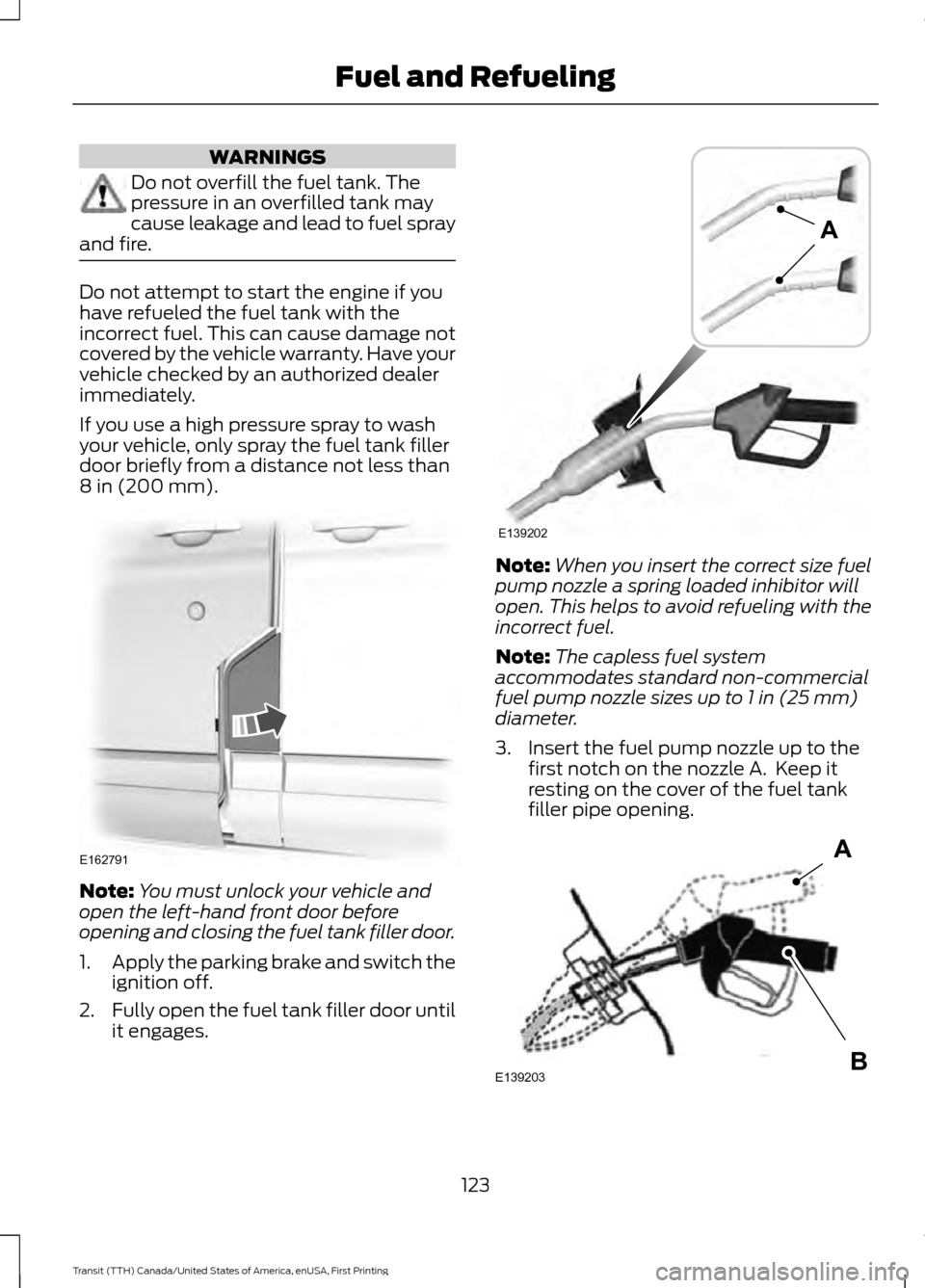
If you use a high pressure spray to wash
your vehicle, only spray the fuel tank filler
door briefly from a distance not less than
8 in (200 mm).
Note:
You must unlock your vehicle and
open the left-hand front door before
opening and closing the fuel tank filler door.
1. Apply the parking brake and switch the
ignition off.
2. Fully open the fuel tank filler door until
it engages. Note:
When you insert the correct size fuel
pump nozzle a spring loaded inhibitor will
open. This helps to avoid refueling with the
incorrect fuel.
Note: The capless fuel system
accommodates standard non-commercial
fuel pump nozzle sizes up to
1 in (25 mm)
diameter.
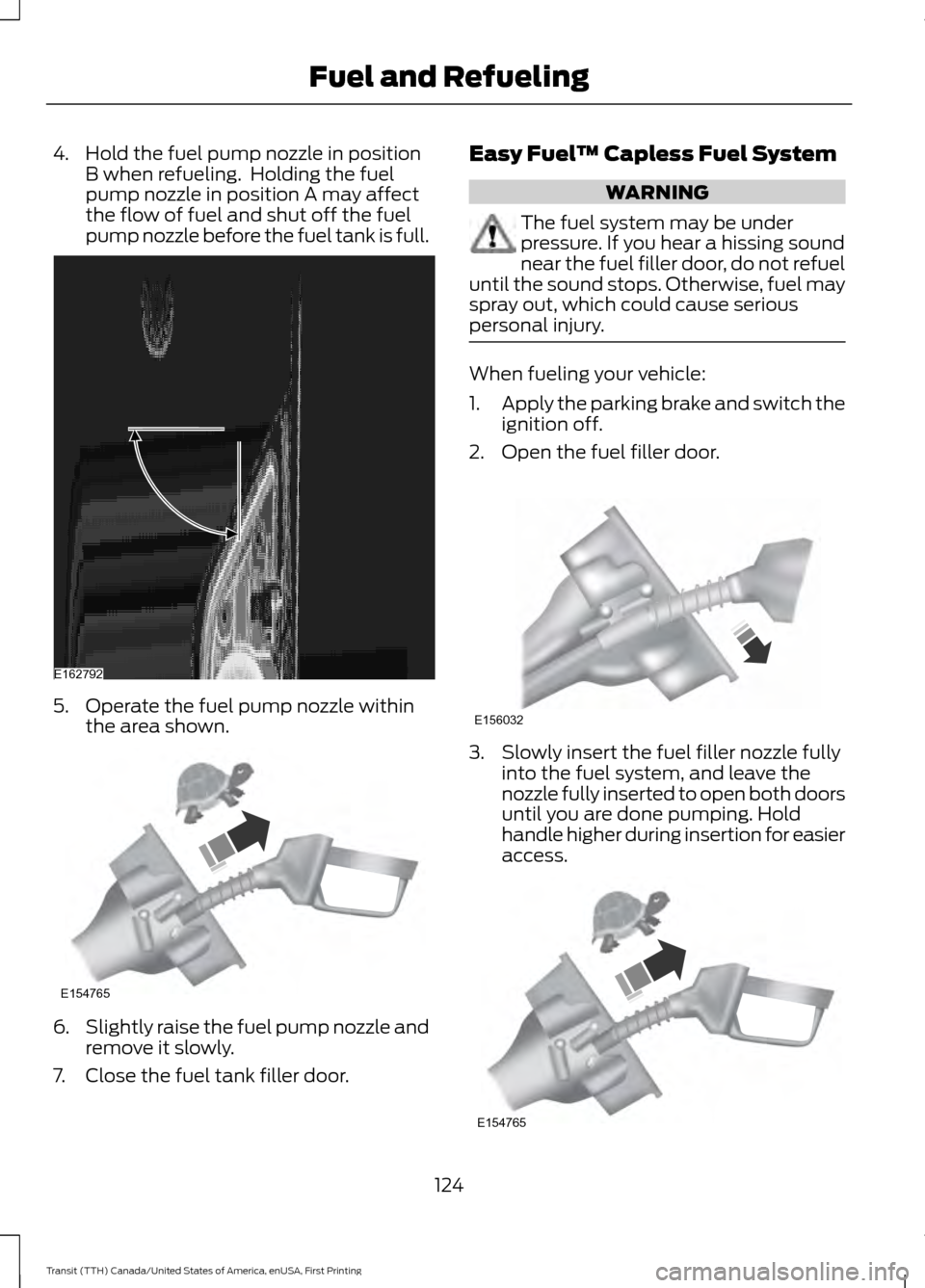
3. Insert the fuel pump nozzle up to the first notch on the nozzle A. Keep it
resting on the cover of the fuel tank
filler pipe opening. 123
Transit (TTH) Canada/United States of America, enUSA, First Printing Fuel and RefuelingE162791 E139202
A E139203
A
B
Page 127 of 411
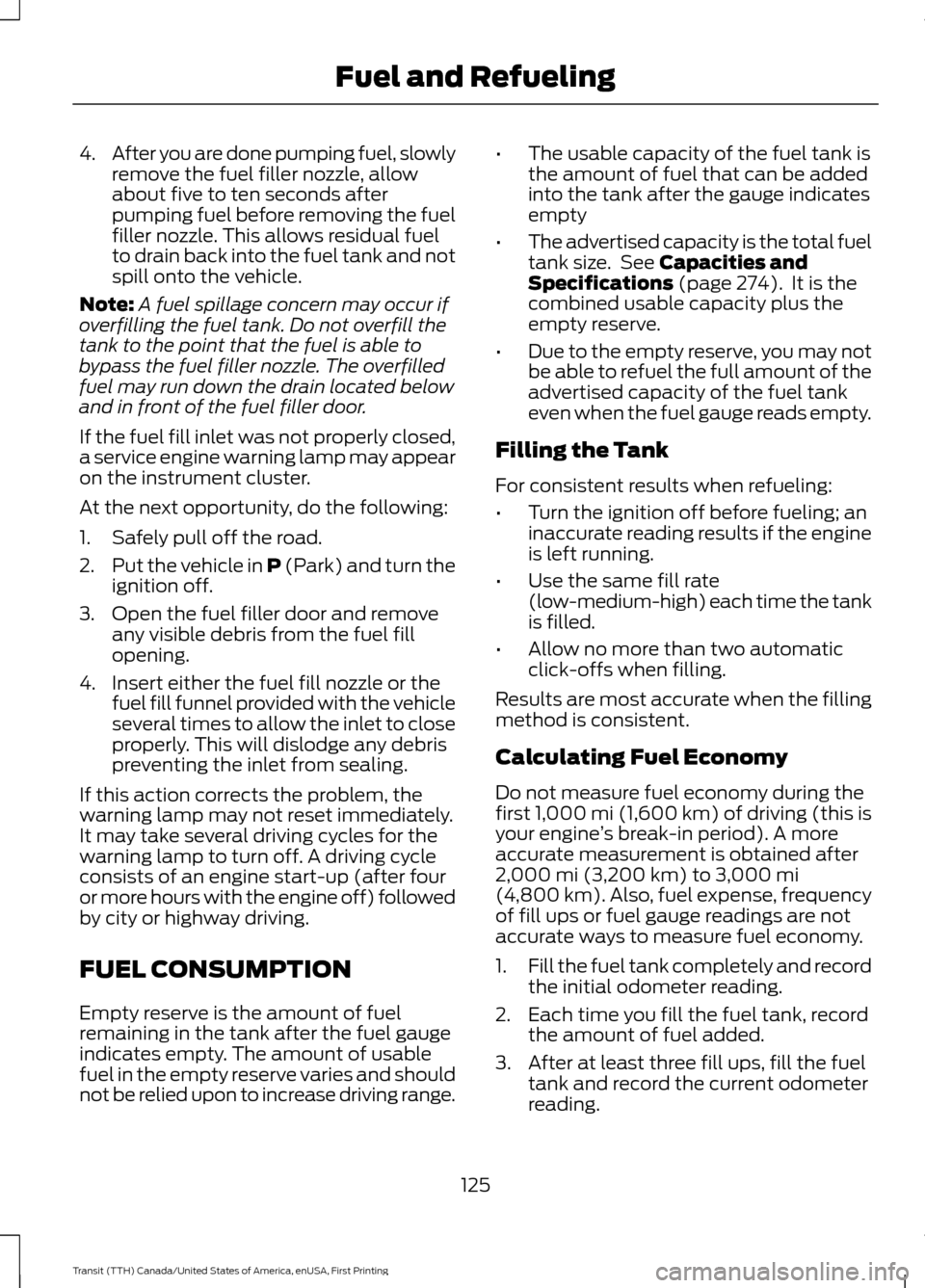
4. Hold the fuel pump nozzle in position
B when refueling. Holding the fuel
pump nozzle in position A may affect
the flow of fuel and shut off the fuel
pump nozzle before the fuel tank is full. 5. Operate the fuel pump nozzle within
the area shown. 6.
Slightly raise the fuel pump nozzle and
remove it slowly.
7. Close the fuel tank filler door. Easy Fuel
™ Capless Fuel System WARNING
The fuel system may be under
pressure. If you hear a hissing sound
near the fuel filler door, do not refuel
until the sound stops. Otherwise, fuel may
spray out, which could cause serious
personal injury. When fueling your vehicle:
1.
Apply the parking brake and switch the
ignition off.
2. Open the fuel filler door. 3. Slowly insert the fuel filler nozzle fully
into the fuel system, and leave the
nozzle fully inserted to open both doors
until you are done pumping. Hold
handle higher during insertion for easier
access. 124
Transit (TTH) Canada/United States of America, enUSA, First Printing Fuel and RefuelingE162792 E154765 E156032 E154765
Page 128 of 411
4.
After you are done pumping fuel, slowly
remove the fuel filler nozzle, allow
about five to ten seconds after
pumping fuel before removing the fuel
filler nozzle. This allows residual fuel
to drain back into the fuel tank and not
spill onto the vehicle.
Note: A fuel spillage concern may occur if
overfilling the fuel tank. Do not overfill the
tank to the point that the fuel is able to
bypass the fuel filler nozzle. The overfilled
fuel may run down the drain located below
and in front of the fuel filler door.
If the fuel fill inlet was not properly closed,
a service engine warning lamp may appear
on the instrument cluster.
At the next opportunity, do the following:
1. Safely pull off the road.
2. Put the vehicle in P (Park) and turn the
ignition off.
3. Open the fuel filler door and remove any visible debris from the fuel fill
opening.
4. Insert either the fuel fill nozzle or the fuel fill funnel provided with the vehicle
several times to allow the inlet to close
properly. This will dislodge any debris
preventing the inlet from sealing.
If this action corrects the problem, the
warning lamp may not reset immediately.
It may take several driving cycles for the
warning lamp to turn off. A driving cycle
consists of an engine start-up (after four
or more hours with the engine off) followed
by city or highway driving.
FUEL CONSUMPTION
Empty reserve is the amount of fuel
remaining in the tank after the fuel gauge
indicates empty. The amount of usable
fuel in the empty reserve varies and should
not be relied upon to increase driving range. •
The usable capacity of the fuel tank is
the amount of fuel that can be added
into the tank after the gauge indicates
empty
• The advertised capacity is the total fuel
tank size. See Capacities and
Specifications (page 274). It is the
combined usable capacity plus the
empty reserve.
• Due to the empty reserve, you may not
be able to refuel the full amount of the
advertised capacity of the fuel tank
even when the fuel gauge reads empty.
Filling the Tank
For consistent results when refueling:
• Turn the ignition off before fueling; an
inaccurate reading results if the engine
is left running.
• Use the same fill rate
(low-medium-high) each time the tank
is filled.
• Allow no more than two automatic
click-offs when filling.
Results are most accurate when the filling
method is consistent.
Calculating Fuel Economy
Do not measure fuel economy during the
first
1,000 mi (1,600 km) of driving (this is
your engine ’s break-in period). A more
accurate measurement is obtained after
2,000 mi (3,200 km)
to 3,000 mi
(4,800 km). Also, fuel expense, frequency
of fill ups or fuel gauge readings are not
accurate ways to measure fuel economy.
1. Fill the fuel tank completely and record
the initial odometer reading.
2. Each time you fill the fuel tank, record the amount of fuel added.
3. After at least three fill ups, fill the fuel tank and record the current odometer
reading.
125
Transit (TTH) Canada/United States of America, enUSA, First Printing Fuel and Refueling
Page 161 of 411
LOAD RETAINING FIXTURES
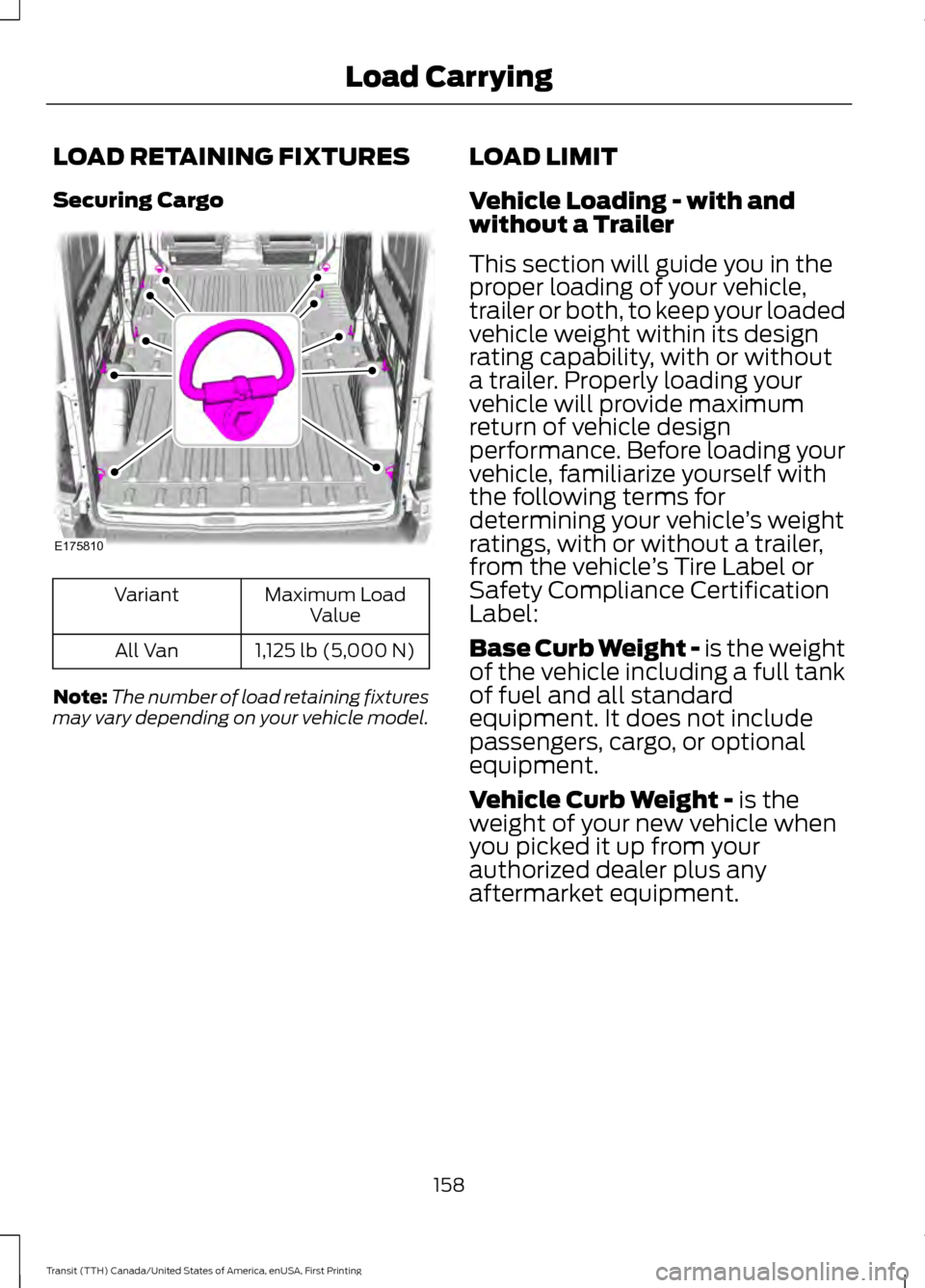
Securing Cargo
Maximum Load
Value
Variant
1,125 lb (5,000 N)
All Van
Note: The number of load retaining fixtures
may vary depending on your vehicle model. LOAD LIMIT
Vehicle Loading - with and
without a Trailer
This section will guide you in the
proper loading of your vehicle,
trailer or both, to keep your loaded
vehicle weight within its design
rating capability, with or without
a trailer. Properly loading your
vehicle will provide maximum
return of vehicle design
performance. Before loading your
vehicle, familiarize yourself with
the following terms for
determining your vehicle
’s weight
ratings, with or without a trailer,
from the vehicle ’s Tire Label or
Safety Compliance Certification
Label:
Base Curb Weight - is the weight
of the vehicle including a full tank
of fuel and all standard
equipment. It does not include
passengers, cargo, or optional
equipment.
Vehicle Curb Weight -
is the
weight of your new vehicle when
you picked it up from your
authorized dealer plus any
aftermarket equipment.
158
Transit (TTH) Canada/United States of America, enUSA, First Printing Load CarryingE175810
Page 186 of 411
WARNINGS
Use only an adequate-sized cable
with insulated clamps.
Preparing Your Vehicle
Note:
Do not attempt to push-start your
automatic transmission vehicle. Automatic
transmissions do not have push-start
capability. Attempting to push-start a
vehicle with an automatic transmission may
cause transmission damage.
Note: Use only a 12-volt supply to start your
vehicle.
Note: Do not disconnect the battery of the
disabled vehicle as this could damage the
vehicle's electrical system.
Park the booster vehicle close to the hood
of the disabled vehicle, making sure the
two vehicles do not touch, and switch off
all accessories.
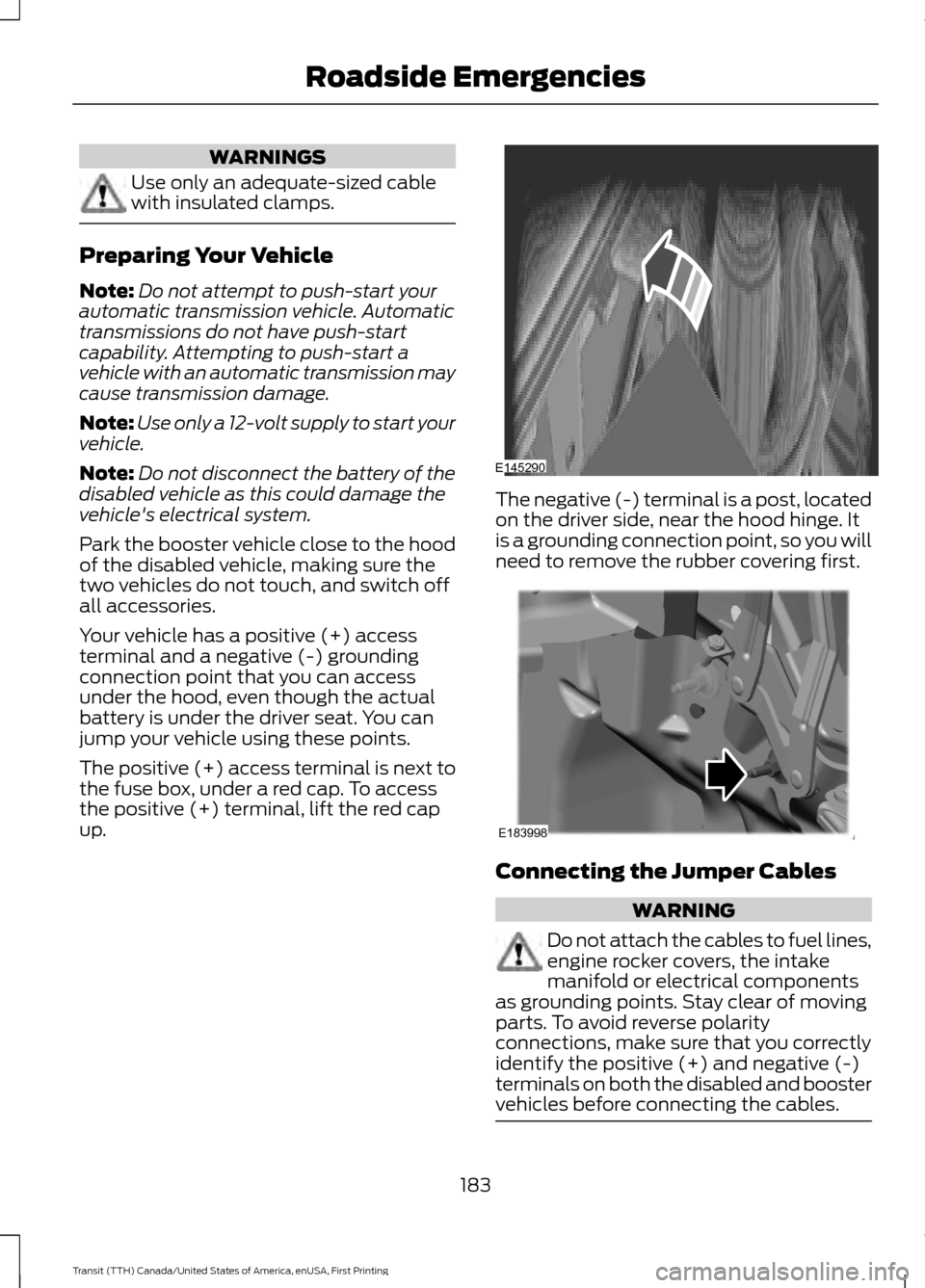
Your vehicle has a positive (+) access
terminal and a negative (-) grounding
connection point that you can access
under the hood, even though the actual
battery is under the driver seat. You can
jump your vehicle using these points.
The positive (+) access terminal is next to
the fuse box, under a red cap. To access
the positive (+) terminal, lift the red cap
up. The negative (-) terminal is a post, located
on the driver side, near the hood hinge. It
is a grounding connection point, so you will
need to remove the rubber covering first.
Connecting the Jumper Cables
WARNING
Do not attach the cables to fuel lines,
engine rocker covers, the intake
manifold or electrical components
as grounding points. Stay clear of moving
parts. To avoid reverse polarity
connections, make sure that you correctly
identify the positive (+) and negative (-)
terminals on both the disabled and booster
vehicles before connecting the cables. 183
Transit (TTH) Canada/United States of America, enUSA, First Printing Roadside EmergenciesE145290 E183998
Page 221 of 411
Have an authorized dealer check and
change the transmission fluid at the
correct service interval. See Scheduled
Maintenance (page 363). Your
transmission does not consume fluid.
However, if the transmission slips, shifts
slowly or if you notice a sign of leaking
fluid, contact an authorized dealer.
Do not use supplemental transmission
fluid additives, treatments or cleaning
agents. The use of these materials may
affect transmission operation and result
in damage to internal transmission
components.
BRAKE FLUID CHECK
Fluid levels between the MIN and MAX
lines are within the normal operating range;
there is no need to add fluid. If the fluid
levels are outside of the normal operating
range, the performance of the system
could be compromised; seek service from
your authorized dealer immediately.
POWER STEERING FLUID
CHECK WARNING
Do not allow the fluid to touch your
skin or eyes. This could cause serious
personal injury. Rinse the affected
areas immediately with plenty of water
and consult a physician. If the power steering fluid level is not
between the
MAX and MIN marks, add
power steering fluid that meets the correct
specification. See
Capacities and
Specifications (page 281).
Adding Power Steering Fluid
1. Remove the filler cap. 2. Add power steering fluid to the
MAX
mark. Do not overfill.
3. Replace the filler cap. Turn it until you feel a strong resistance.
WASHER FLUID CHECK
Note: The reservoir supplies the front and
rear washer systems.
When adding fluid, use a mixture of washer
fluid and water to help prevent freezing in
cold weather and improve the cleaning
capability. We recommend that you use
only high quality washer fluid.
For information on fluid dilution, refer to
the product instructions.
DRAINING THE FUEL FILTER
WATER TRAP WARNING
Do not dispose of fuel in the
household refuse or the public
sewage system. Use an authorized
waste disposal facility. Your vehicle is fitted with a diesel fuel
conditioner module located behind the fuel
tank.
A warning lamp will illuminate
and a message will be displayed
when approximately
3.38 fl oz
(100 ml) of water accumulates in the
module. If you allow the water level to
exceed this level, the water may pass
through to the engine and may cause fuel
injection equipment damage.
Note: To drain the fuel filter water trap,
access the underside of your vehicle.
218
Transit (TTH) Canada/United States of America, enUSA, First Printing Maintenance
Page 223 of 411
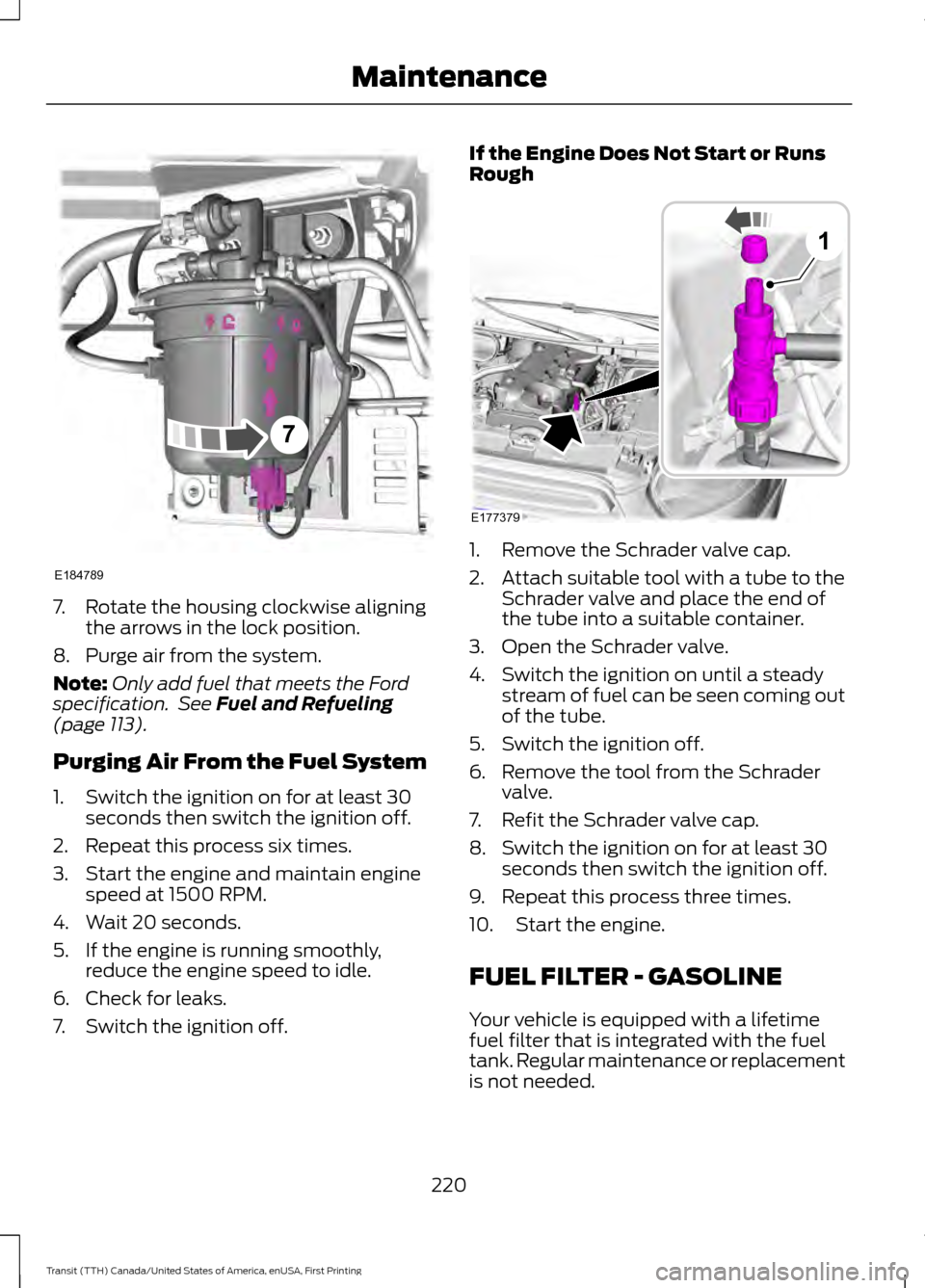
7. Rotate the housing clockwise aligning
the arrows in the lock position.
8. Purge air from the system.
Note: Only add fuel that meets the Ford
specification. See Fuel and Refueling
(page 113).
Purging Air From the Fuel System
1. Switch the ignition on for at least 30 seconds then switch the ignition off.
2. Repeat this process six times.
3. Start the engine and maintain engine speed at 1500 RPM.
4. Wait 20 seconds.
5. If the engine is running smoothly, reduce the engine speed to idle.
6. Check for leaks.
7. Switch the ignition off. If the Engine Does Not Start or Runs
Rough
1. Remove the Schrader valve cap.
2. Attach suitable tool with a tube to the
Schrader valve and place the end of
the tube into a suitable container.
3. Open the Schrader valve.
4. Switch the ignition on until a steady stream of fuel can be seen coming out
of the tube.
5. Switch the ignition off.
6. Remove the tool from the Schrader valve.
7. Refit the Schrader valve cap.
8. Switch the ignition on for at least 30 seconds then switch the ignition off.
9. Repeat this process three times.
10. Start the engine.
FUEL FILTER - GASOLINE
Your vehicle is equipped with a lifetime
fuel filter that is integrated with the fuel
tank. Regular maintenance or replacement
is not needed.
220
Transit (TTH) Canada/United States of America, enUSA, First Printing MaintenanceE184789
7 E177379
1
Page 277 of 411
ENGINE SPECIFICATIONS - 3.5L
3.5L V6 Ecoboost
Engine
214
Cubic inches
Minimum 87 octane
Required fuel
1-4-2-5-3-6
Firing order
Coil on plug
Ignition system
.030-.033 in. (.75-.85 mm)
Spark plug gap
10.0:1
Compression ratio
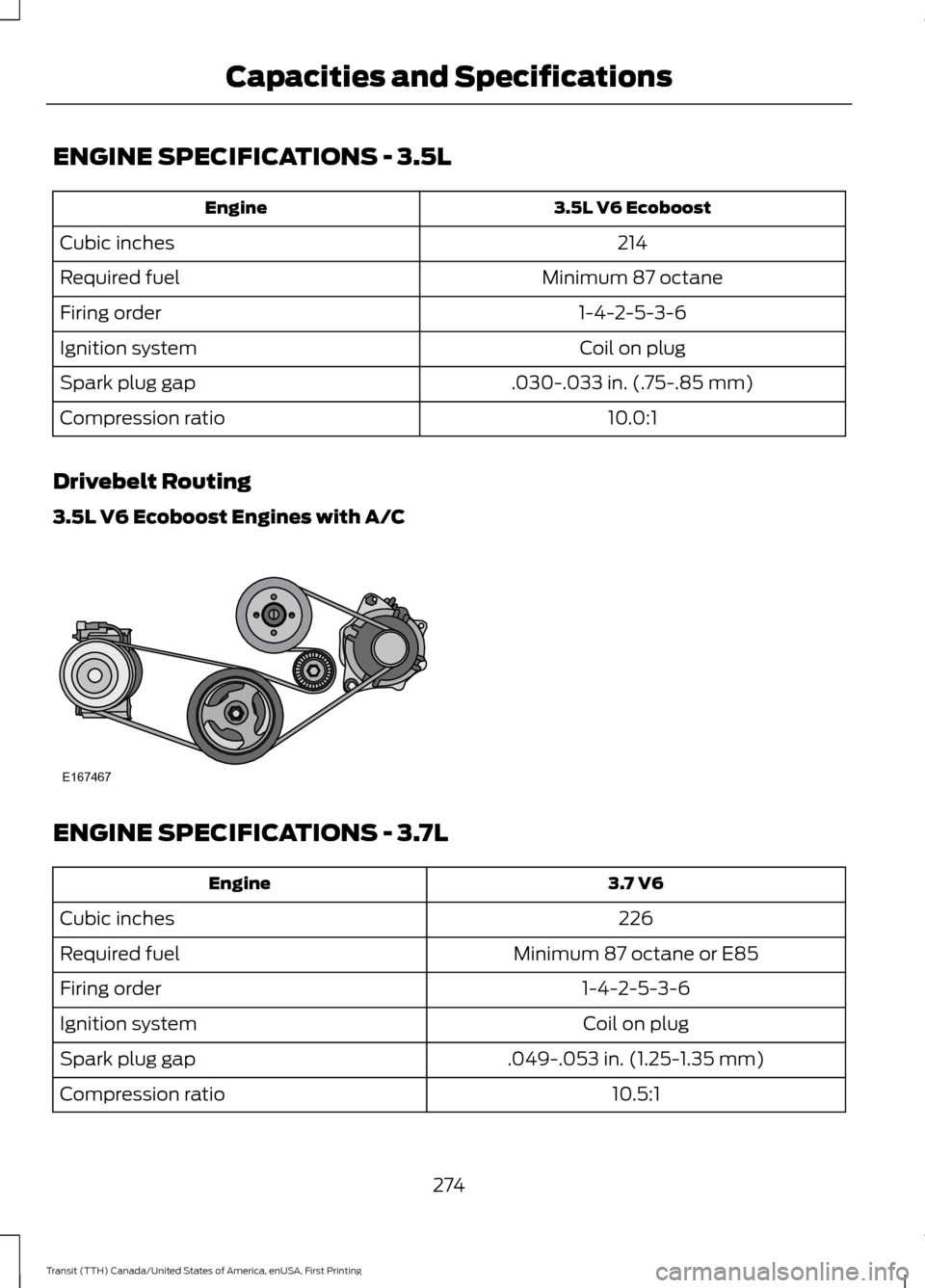
Drivebelt Routing
3.5L V6 Ecoboost Engines with A/C ENGINE SPECIFICATIONS - 3.7L
3.7 V6
Engine
226
Cubic inches
Minimum 87 octane or E85
Required fuel
1-4-2-5-3-6
Firing order
Coil on plug
Ignition system
.049-.053 in. (1.25-1.35 mm)
Spark plug gap
10.5:1
Compression ratio
274
Transit (TTH) Canada/United States of America, enUSA, First Printing Capacities and SpecificationsE167467
Page 278 of 411
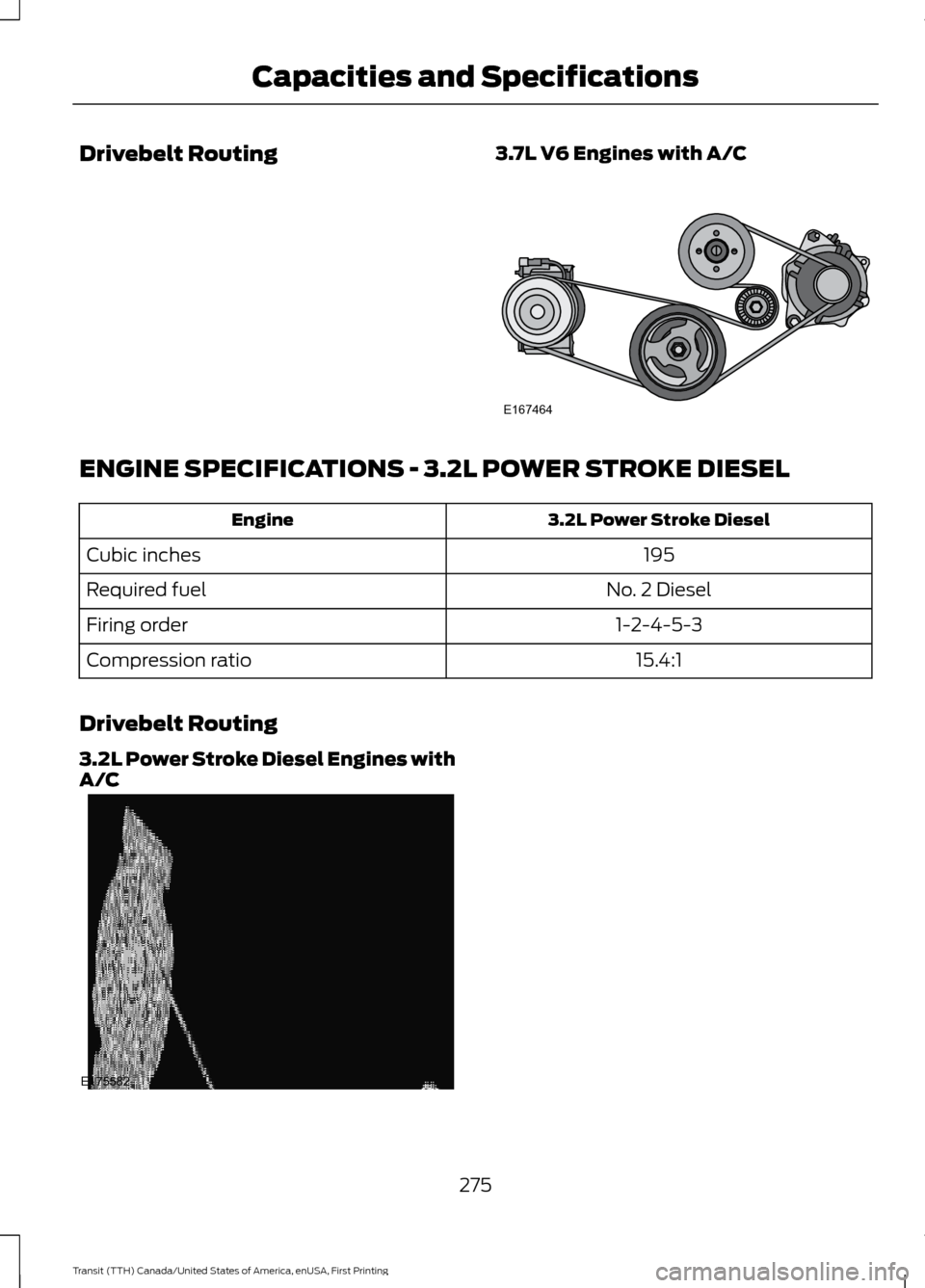
Drivebelt Routing
3.7L V6 Engines with A/CENGINE SPECIFICATIONS - 3.2L POWER STROKE DIESEL
3.2L Power Stroke Diesel
Engine
195
Cubic inches
No. 2 Diesel
Required fuel
1-2-4-5-3
Firing order
15.4:1
Compression ratio
Drivebelt Routing
3.2L Power Stroke Diesel Engines with
A/C 275
Transit (TTH) Canada/United States of America, enUSA, First Printing Capacities and SpecificationsE167464 E175582
Page 281 of 411
MOTORCRAFT PARTS - 3.2L POWER STROKE DIESEL
3.2L Power Stroke Diesel
Part number
Component
FA-1921
Diesel Foam Pre air filter
FA-1916
Air filter element
Service required
Automatic transmission fluid filter
BAGM-48H6-760 - dual batteries
Battery
FL-500S
Oil filter
FG-1140
Fuel filter
WW-2955 - driver side
Windshield wiper blades - vehicles with low
roof WW-2112 - passenger side
WW-2901 - driver side
Windshield wiper blades - vehicles with
medium or high roof WW-2049 - passenger side
Note: Motorcraft replacement parts are recommended for scheduled maintenance and
are available at an authorized dealer or at fordparts.com. These parts meet or exceed Ford
Motor Company ’s specifications, and are engineered for your vehicle. Use of other parts may
impact vehicle performance, emissions and durability. Your vehicle Warranty may be void
for any damage related to use of other parts.
Note: Should a Motorcraft oil filter not be available, use an oil filter that meets industry
performance specification SAE/USCAR-36.
278
Transit (TTH) Canada/United States of America, enUSA, First Printing Capacities and Specifications