fuel filter FORD TRANSIT CONNECT 2019 Owners Manual
[x] Cancel search | Manufacturer: FORD, Model Year: 2019, Model line: TRANSIT CONNECT, Model: FORD TRANSIT CONNECT 2019Pages: 493, PDF Size: 7.43 MB
Page 7 of 493

Rear Seats - Long Wheelbase, Vehicles
With: Second Row Dual Captain Chairs
........................................................................\
.124
Rear Seats - Long Wheelbase, Vehicles With: 60/40 Split Second Row
Seating .........................................................
127
Heated Seats ................................................
130
Auxiliary Power Points
Auxiliary Power Points ................................
131
Cigar Lighter ....................................................
131
Wireless Accessory Charging ..................
132
Storage Compartments
Cup Holders ...................................................
133
Overhead Console .......................................
133
Starting and Stopping the Engine
General Information ...................................
134
Ignition Switch ..............................................
134
Push Button Ignition Switch ....................
135
Starting a Gasoline Engine .......................
137
Starting a Flex Fuel Engine ......................
140
Starting a Diesel Engine ............................
142
Switching Off the Engine ..........................
144
Engine Block Heater ...................................
144
Unique Driving Characteristics
Auto-Start-Stop ..........................................
146
Fuel and Refueling
Safety Precautions .....................................
148
Fuel Quality - Diesel ...................................
148
Fuel Quality - Gasoline ...............................
151
Fuel Quality - E85 ........................................
152
Fuel Filler Funnel Location .......................
153
Running Out of Fuel ....................................
153
Refueling .........................................................
154Fuel Consumption
.......................................
157
Engine Emission Control
Emission Law ................................................
158
Catalytic Converter .....................................
159
Selective Catalytic Reductant System ........................................................................\
160
Diesel Particulate Filter .............................
163
Transmission
Automatic Transmission - 6-Speed Automatic Transmission ......................
169
Automatic Transmission - 8-Speed Automatic Transmission ........................
171
Brakes
General Information ....................................
173
Hints on Driving With Anti-Lock Brakes ........................................................................\
.
174
Parking Brake .................................................
174
Hill Start Assist .............................................
174
Traction Control
Principle of Operation ................................
176
Using Traction Control ...............................
176
Stability Control
Principle of Operation .................................
177
Using Stability Control ...............................
178
Parking Aids
Principle of Operation ................................
179
Rear Parking Aid ...........................................
179
Front Parking Aid ..........................................
181
Side Sensing System .................................
183
Active Park Assist ........................................
184
Rear View Camera .......................................
192
Cruise Control
Principle of Operation ................................
195
3
2019 Transit Connect (CHC) Canada/United States of America, CG3739en enUSA, Edition date: 201804, First-Printing Table of Contents
Page 9 of 493

Engine Coolant Check
..............................268
Automatic Transmission Fluid Check ........................................................................\
.
272
Brake Fluid Check ........................................
272
Washer Fluid Check ....................................
273
Changing the 12V Battery .........................
273
Checking the Wiper Blades .....................
275
Changing the Front Wiper Blades .........
275
Changing the Rear Wiper Blades - Vehicles With: Manual Liftgate ..........
275
Changing the Rear Wiper Blades - Vehicles With: Rear Cargo Doors ......
276
Adjusting the Headlamps ........................
276
Changing a Bulb ..........................................
278
Changing the Engine Air Filter - 2.0L Duratec-HE (MI4)/2.0L Flex Fuel, 1.5L
Duratorq-TDCi Diesel ............................
283
Changing the Engine Air Filter - 2.5L ....
283
Drive Belt Routing - 1.5L Duratorq-TDCi Diesel ..........................................................
284
Drive Belt Routing - 2.0L Duratec-HE (MI4)/2.0L Flex Fuel .............................
284
Drive Belt Routing - 2.5L ..........................
285
Vehicle Care
Cleaning Products ......................................
286
Cleaning the Exterior .................................
287
Waxing ............................................................
288
Cleaning the Windows and Wiper Blades ........................................................................\
289
Cleaning the Interior ..................................
289
Cleaning the Instrument Panel and Instrument Cluster Lens ......................
290
Cleaning Leather Seats .............................
291
Repairing Minor Paint Damage .............
292
Cleaning the Wheels .................................
292
Vehicle Storage ............................................
292
Wheels and Tires
General Information ..................................
295
Tire Sealant and Inflator Kit ...................
296Tire Care
..........................................................
301
Using Winter Tires .......................................
315
Using Snow Chains .....................................
315
Tire Pressure Monitoring System ...........
316
Changing a Road Wheel ..........................
320
Tire Pressures ...............................................
324
Lug Nuts .........................................................
325
Capacities and Specifications
Engine Specifications - 1.5L Duratorq-TDCi Diesel ............................
327
Engine Specifications - 2.0L Duratec-HE (MI4)/2.0L Flex Fuel .............................
328
Engine Specifications - 2.5L ...................
329
Motorcraft Parts - 1.5L Duratorq-TDCi Diesel ..........................................................
330
Motorcraft Parts - 2.0L Duratec-HE (MI4)/2.0L Flex Fuel ..............................
331
Motorcraft Parts - 2.5L ..............................
332
Vehicle Identification Number ...............
333
Vehicle Certification Label ......................
334
Transmission Code Designation - 6-Speed Automatic Transmission
........................................................................\
334
Transmission Code Designation - 8-Speed Automatic Transmission
........................................................................\
335
Capacities and Specifications - 1.5L Duratorq-TDCi Diesel ............................
335
Capacities and Specifications - 2.0L Duratec-HE (MI4)/2.0L Flex Fuel .....
340
Capacities and Specifications - 2.5L ........................................................................\
345
Bulb Specification Chart .........................
350
Audio System
General Information ..................................
352
Audio Unit - Vehicles Without: SYNC 3 ........................................................................\
353
Audio Unit - Vehicles With: SYNC 3 .....
356
AM/FM Radio - Vehicles Without: SYNC 3 ....................................................................
358
5
2019 Transit Connect (CHC) Canada/United States of America, CG3739en enUSA, Edition date: 201804, First-Printing Table of Contents
Page 12 of 493
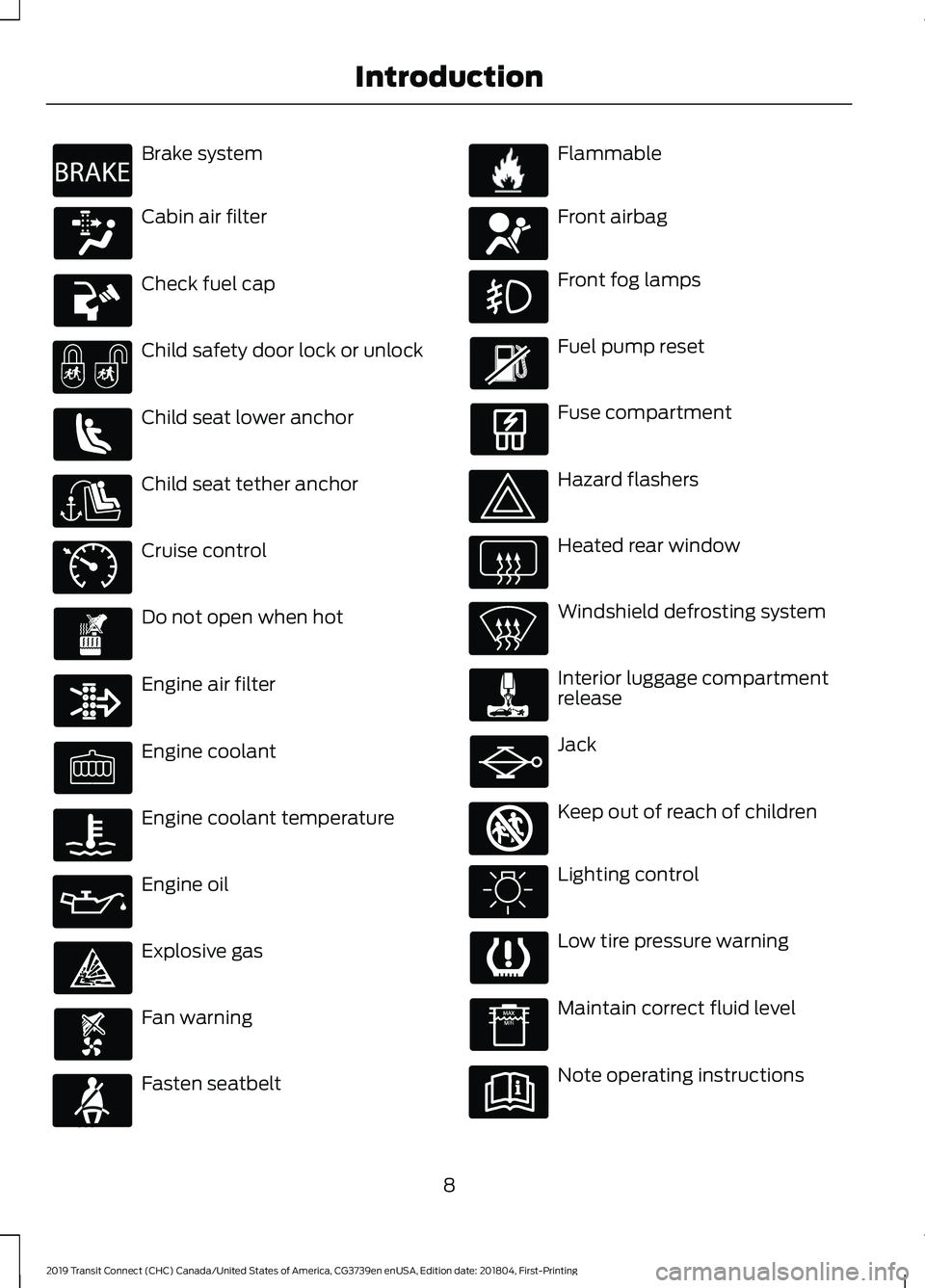
Brake system
Cabin air filter
Check fuel cap
Child safety door lock or unlock
Child seat lower anchor
Child seat tether anchor
Cruise control
Do not open when hot
Engine air filter
Engine coolant
Engine coolant temperature
Engine oil
Explosive gas
Fan warning
Fasten seatbelt Flammable
Front airbag
Front fog lamps
Fuel pump reset
Fuse compartment
Hazard flashers
Heated rear window
Windshield defrosting system
Interior luggage compartment
release
Jack
Keep out of reach of children
Lighting control
Low tire pressure warning
Maintain correct fluid level
Note operating instructions
8
2019 Transit Connect (CHC) Canada/United States of America, CG3739en enUSA, Edition date: 201804, First-Printing IntroductionE270480 E71340 E71880 E231160 E67017 E161353
Page 103 of 493
Fuel System
Description
Message
An early reminder of a low fuel condition.
Fuel Level Low
Fuel Level Low Distance
Metric:##0 Km To Empty
Fuel Level Low Distance
Imperial:#0 Miles To
Empty
The fuel fill inlet may not be properly closed.
Check Fuel Fill Inlet
The system has malfunctioned. Have your vehicle checked
as soon as possible.
Fuel Pressure Low
The system detects there is excess water in the fuel filter.
Have your vehicle checked as soon as possible.
Water in Fuel Drain Filter
Headlamps Description
Message
Displays if an electrical malfunction occurs with the headlamp
system. Have your vehicle checked as soon as possible.
Check Headlamp System
See manual
Hill Start Assist Description
Message
The system is not available. Have your vehicle checked as
soon as possible. See Hill Start Assist (page 174).
Hill Start Assist Not
Available
Lane Keeping System Description
Message
The system has malfunctioned. Have your vehicle checked
as soon as possible.
Lane Keeping Sys.
Malfunction Service
Required
99
2019 Transit Connect (CHC) Canada/United States of America, CG3739en enUSA, Edition date: 201804, First-Printing Information Displays
Page 117 of 493
Adjusting the Blower Motor Speed
Directing Air to the Overhead Air
Vents
When you direct air to the
overhead air vents, the system
distributes cold air.
Directing Air to the Footwell Air
Vents When you direct air to the
footwell air vents, the system
distributes hot air.
Directing Air to the Overhead Air
Vents and the Footwell Air Vents When you direct air to the
Overhead and footwell air vents,
the system distributes warm air.
HEATED WINDSHIELD Press the button to clear the
windshield of thin ice and fog.
The heated windshield turns off
after a short period of time.
Note: Make sure that the engine is running
before switching the heated windshield on.
Note: The system does not operate if the
battery charge level is low.
HEATED REAR WINDOW Press the button to clear the rear
window of thin ice and fog. The
heated rear window turns off
after a short period of time.
Note: Make sure the engine is on before
operating the heated windows. Note:
Do not use razor blades or other
sharp objects to clean or remove decals
from the inside of the heated rear window.
The vehicle Warranty may not cover
damage caused to the heated rear window
grid lines.
HEATED EXTERIOR MIRRORS
When you switch the heated rear window
on, the heated exterior mirrors turn on.
Note: Do not remove ice from the mirrors
with a scraper or adjust the mirror glass
when it is frozen in place.
Note: Do not clean the mirror housing or
glass with harsh abrasives, fuel or other
petroleum-based cleaning products.
CABIN AIR FILTER
Your vehicle is equipped with a cabin air
filter. It is located behind the center
console.
If your vehicle has rear climate control. The
cabin air filter is under the driver seat.
The particulate filtration system reduces
the concentration of airborne particles
such as dust, spores and pollen in the air
supplied to the interior of your vehicle.
Note: Make sure you have a cabin air filter
installed at all times. This prevents foreign
objects from entering the system. Running
the system without a filter in place could
result in degradation or damage to the
system.
113
2019 Transit Connect (CHC) Canada/United States of America, CG3739en enUSA, Edition date: 201804, First-Printing Climate Control
Page 153 of 493
Note:
Do not blend used engine oil with
diesel fuel under any circumstances.
Blending used oil with the fuel will
significantly increase your vehicle ’s exhaust
emissions and reduce engine life due to
increased internal wear.
You should use Ultra-Low Sulfur Diesel
fuel (also known as ULSD) designated as
number 1-D or 2-D with a maximum of
15-ppm sulfur in your diesel vehicle. You
may operate your vehicle on diesel fuels
containing up to 20% biodiesel, also
known as B20. These fuels should meet
the ASTM D975 diesel or the ASTM D7467
B6-B20 biodiesel industry specifications.
Outside of North America, use fuels
meeting EN590 or equivalent local market
standard. Using low sulfur diesel fuel
(16-500 ppm) or high sulfur
diesel fuel (greater than 500
ppm) in your diesel engine will cause
certain emission components to
malfunction which may also cause the
service engine soon light to illuminate
indicating an emissions-related concern.
Diesel fuel is adjusted seasonally for cold
temperature. For best results at
temperatures below 19°F (-7°C), it is
recommended to use a diesel fuel which
has been seasonally adjusted for the
ambient conditions.
Fuel Requirements - Choosing The
Right Fuel: Vehicles Operated
Where Ultra Low Sulfur Diesel Fuel
Is Not Required
For the engine to operate reliably on
low-sulfur or high-sulfur diesel fuel, the
engine must be a factory built high-sulfur
engine (available as a dealer order option
for select markets) or an ultra low sulfur
diesel fuel configured engine that has been
retrofitted for high-sulfur diesel fuel using
Ford Motor Company dealer service parts. Failure to use retrofit components other
than those available through your
authorized dealer will result in coolant
system damage, engine overheating,
selective catalyst reduction system or
diesel particulate filter damage and
possible base engine damage.
Use only a diesel engine configured for use
with high sulfur diesel fuel in markets with
diesel fuel that has sulfur content greater
than 15 ppm. Using low sulfur diesel fuel
(16–500 ppm) or high sulfur diesel fuel
(greater than 500 ppm) in a diesel engine
designed to use only Ultra Low Sulfur
Diesel fuel may result in damage to engine
emission control devices and the
aftertreatment system, potentially
rendering the vehicle inoperable.
Vehicles with engines configured for use
with high sulfur diesel fuel are only
available for sale in countries where ultra
low sulfur diesel fuel is generally not
available or mandated by the government.
Vehicles originally sold in a ultra low sulfur
diesel fuel market that are subsequently
exported to non- ultra low sulfur diesel fuel
markets will need to be retrofitted (at the
customer
’s expense using Ford authorized
dealer service parts) in order to be reliably
operated on non- ultra low sulfur diesel
fuel.
Biodiesel WARNING:
Do not mix diesel with
gasoline, gasohol or alcohol. This could
cause an explosion.
149
2019 Transit Connect (CHC) Canada/United States of America, CG3739en enUSA, Edition date: 201804, First-Printing Fuel and Refueling
Page 154 of 493
Note:
Do not use home heating oil,
agricultural fuel, raw fats and oils, waste
cooking greases, biodiesel greater than 20%
or any diesel not intended for highway use.
Damage to the fuel injection system, engine
and exhaust catalyst, and diesel particulate
filter can occur if you use an improper fuel.
Red dye is used to identify fuels intended
for agricultural and non-highway use.
You may operate your vehicle on diesel
fuels containing up to 20% biodiesel, also
known as B20.
Biodiesel fuel is a chemically converted
product from renewable fuel sources, such
as vegetable oils, animal fats and waste
cooking greases.
To help achieve acceptable engine
performance and durability when using
biodiesel in your vehicle:
• Confirm the biodiesel content of the
fuel to be B20 (20% biodiesel) or less
• Only use biodiesel fuel of good quality
that complies with industry standards
• Follow the recommended service
maintenance intervals. See General
Maintenance Information (page 416).
• Do not store biodiesel fuel in the fuel
tank for more than 1 month
• Consider changing brands or reducing
biodiesel content if you have cold
temperature fuel gelling issues or a
frequent LOW FUEL PRESSURE
message appearing
Use of biodiesel in concentrations greater
than 20% may cause damage to your
vehicle, including engine and/or exhaust
after-treatment hardware (exhaust
catalyst and particulate filter) failures.
Concentrations greater than 20% can also
cause fuel filter restrictions that may result
in a lack of power or damage to fuel
system components, including fuel pump
and fuel injector failures. SAE 5W-40 oil is recommended for fuels
with greater than 5% biodiesel (B5). For
more information about oil change
intervals and other maintenance when
operating on biodiesel
See Special
Operating Conditions Scheduled
Maintenance
(page 422).
Look for a label on the fuel pump to
confirm the amount of biodiesel contained
in a diesel fuel. Biodiesel content is often
indicated with the letter B followed by the
percent of biodiesel in the fuel. For
example, B20 indicates a fuel containing
20% biodiesel. Ask the service station
attendant to confirm the biodiesel content
of a diesel fuel if you do not see a label on
the fuel pump.
Biodiesel fuels degrade more easily than
diesel fuels not containing biodiesel and
should not be stored in the fuel tank for
more than 1 month. If you plan to park or
store your vehicle for more than 1 month,
then you should empty your vehicle fuel
tank of biodiesel fuel. You should fill the
tank with a pure petroleum-based diesel
fuel and run your vehicle for a minimum of
30 minutes.
Note: Degraded or oxidized biodiesel can
damage fuel system seals and plastics and
corrode steel parts.
During cold weather, if you have problems
operating on biodiesel, you may need to
use a diesel fuel with lower biodiesel
content, try another brand, or discontinue
the use of biodiesel.
Diesel Fuel Additives
It should not be necessary to add any
aftermarket additives to your fuel if you
use a high quality diesel fuel that conforms
to ASTM industry specifications.
Aftermarket additives can damage the fuel
injector system or engine.
150
2019 Transit Connect (CHC) Canada/United States of America, CG3739en enUSA, Edition date: 201804, First-Printing Fuel and Refueling
Page 162 of 493
EMISSION LAW
WARNING: Do not remove or alter
the original equipment floor covering or
insulation between it and the metal floor
of the vehicle. The floor covering and
insulation protect occupants of the vehicle
from the engine and exhaust system heat
and noise. On vehicles with no original
equipment floor covering insulation, do not
carry passengers in a manner that permits
prolonged skin contact with the metal
floor. Failure to follow these instructions
may result in fire or personal injury.
U.S. federal laws and certain state laws
prohibit removing or rendering inoperative
emission control system components.
Similar federal or provincial laws may
apply in Canada. We do not approve of any
vehicle modification without first
determining applicable laws. Tampering with emissions
control systems including
related sensors or the Diesel
Exhaust Fluid system can result in reduced
engine power and the illumination of the
service engine soon light. Tampering With a Noise Control
System
Federal laws prohibit the following acts:
•
Removal or rendering inoperative by
any person other than for purposes of
maintenance.
• Repair or replacement of any device or
element of the design incorporated into
a new vehicle for the purpose of noise
control prior to its sale or delivery to
the ultimate purchaser or while it is in
use.
• The use of the vehicle after any person
removes or renders inoperative any
device or element of the design.
The U.S. Environmental Protection Agency
may presume to constitute tampering as
follows:
• Removal of hood blanket, fender apron
absorbers, fender apron barriers,
underbody noise shields or acoustically
absorptive material.
• Tampering or rendering inoperative the
engine speed governor, to allow engine
speed to exceed manufacturer
specifications.
If the engine does not start, runs rough,
experiences a decrease in engine
performance, experiences excess fuel
consumption or produces excessive
exhaust smoke, check for the following:
• A plugged or disconnected air inlet
system hose.
• A plugged engine air filter element.
• Water in the fuel filter and water
separator.
• A clogged fuel filter.
• Contaminated fuel.
• Air in the fuel system, due to loose
connections.
• An open or pinched sensor hose.
• Incorrect engine oil level.
158
2019 Transit Connect (CHC) Canada/United States of America, CG3739en enUSA, Edition date: 201804, First-Printing Engine Emission Control
Page 163 of 493
•
Incorrect fuel for climatic conditions.
• Incorrect engine oil viscosity for
climactic conditions.
Note: Some vehicles have a lifetime fuel
filter that is integrated with the fuel tank.
Regular maintenance or replacement is not
needed.
Note: If these checks do not help you
correct the concern, have your vehicle
checked as soon as possible.
Noise Emissions Warranty,
Prohibited Tampering Acts and
Maintenance
On January 1, 1978, Federal regulation
became effective governing the noise
emission on trucks over 10,000 lb
(4,536 kg) Gross Vehicle Weight Rating
(GVWR). The preceding statements
concerning prohibited tampering acts and
maintenance, and the noise warranty
found in the Warranty Guide, are
applicable to complete chassis cabs over
10,000 lb (4,536 kg)
GVWR.
CATALYTIC CONVERTER WARNING: Do not park, idle or drive
your vehicle on dry grass or other dry
ground cover. The emission system heats
up the engine compartment and exhaust
system, creating the risk of fire. WARNING:
The normal operating
temperature of the exhaust system is very
high. Never work around or attempt to
repair any part of the exhaust system until
it has cooled. Use special care when
working around the catalytic converter.
The catalytic converter heats up to a very
high temperature after only a short period
of engine operation and stays hot after the
engine is switched off. Your vehicle has various emission control
components and a catalytic converter that
enables it to comply with applicable
exhaust emission standards.
To avoid damaging the catalytic converter:
•
Do not crank the engine for more than
10 seconds at a time.
• Do not run the engine with a spark plug
lead disconnected.
• Do not push-start or tow-start your
vehicle. Use booster cables. See Jump
Starting the Vehicle
(page 243).
• Do not switch the ignition off when your
vehicle is moving.
• Do not use leaded fuel.
Note: Resulting component damage may
not be covered by the vehicle Warranty.
On-Board Diagnostics System
Your vehicle has an on-board diagnostics
system that monitors the emission control
system. If any of the following warning
lamps illuminate, this may indicate that
the on-board diagnostics system has
detected an emission control system
malfunction. Engine coolant temperature
warning lamp.
Battery charging condition
warning lamp.
Malfunction indicator lamp.
Service engine soon warning
lamp.
Continuing to drive your vehicle may cause
reduced power or the engine to stop.
Failure to respond to a warning lamp may
cause component damage not covered by
the vehicle Warranty. Have your vehicle
checked as soon as possible.
159
2019 Transit Connect (CHC) Canada/United States of America, CG3739en enUSA, Edition date: 201804, First-Printing Engine Emission Control
Page 168 of 493
Malfunction indicator lamp.
Powertrain warning Lamp.
Water in fuel warning lamp.
If you continue to drive your vehicle when
the warning lamp is illuminated, the engine
could stop without warning. This could
result in damage not covered by the vehicle
Warranty. Have your vehicle checked as
soon as possible.
See Warning Lamps and Indicators
(page 88).
Diesel Particulate Filter Automatic
Regeneration WARNING:
Do not park or idle your
vehicle over dry leaves, dry grass or other
combustible materials. The regeneration
process creates very high exhaust gas
temperatures and the exhaust will radiate
a considerable amount of heat during and
after regeneration and after you have
switched the engine off. This is a potential
fire hazard. WARNING:
The normal operating
temperature of the exhaust system is very
high. Never work around or attempt to
repair any part of the exhaust system until
it has cooled. Use special care when
working around the diesel oxidation
catalytic converter or the diesel particulate
filter. The diesel oxidation catalytic
converter and the diesel particulate filter
heat up to very high temperatures after
only a short period of engine operation and
remain hot after you switch the engine off. The diesel particulate filter on your vehicle
requires periodic regeneration to maintain
correct operation. The emission control
system automatically carries out this
process. As soot gathers in the system it
begins to restrict the filter. The soot that
gathers inside the filter is cleaned in two
different ways, passive regeneration and
active regeneration. Both methods occur
automatically and require no actions from
the driver. During automatic regeneration,
the system cleans the diesel particulate
filter by oxidizing the soot. Cleaning
happens during normal engine operating
conditions at varying levels depending on
driving conditions.
Diesel particulate filter warning
lamp.
If the diesel particulate filter is near or at
saturation, a warning lamp or information
message appears in the information
display. Drive your vehicle in a manner to
allow effective diesel particulate filter
cleaning.
The warning lamp continues to illuminate
until the automatic regeneration process
completes. Continue to drive your vehicle
in a manner to allow effective diesel
particulate filter cleaning until the warning
lamp turns off.
Failure to carry out regeneration when
required could result in a clogged diesel
particulate filter. If the diesel particulate
filter fills beyond the regeneration
threshold, the system disables the ability
to carry out regeneration. This could result
in damage not covered by the vehicle
Warranty.
Where vehicle use meets any of the
following conditions:
• Driving short distances.
• Prolonged engine idling.
164
2019 Transit Connect (CHC) Canada/United States of America, CG3739en enUSA, Edition date: 201804, First-Printing Engine Emission Control E95449