GENESIS GV70 2023 Owners Manual
Manufacturer: GENESIS, Model Year: 2023, Model line: GV70, Model: GENESIS GV70 2023Pages: 637
Page 571 of 637
Maintenance
9-10
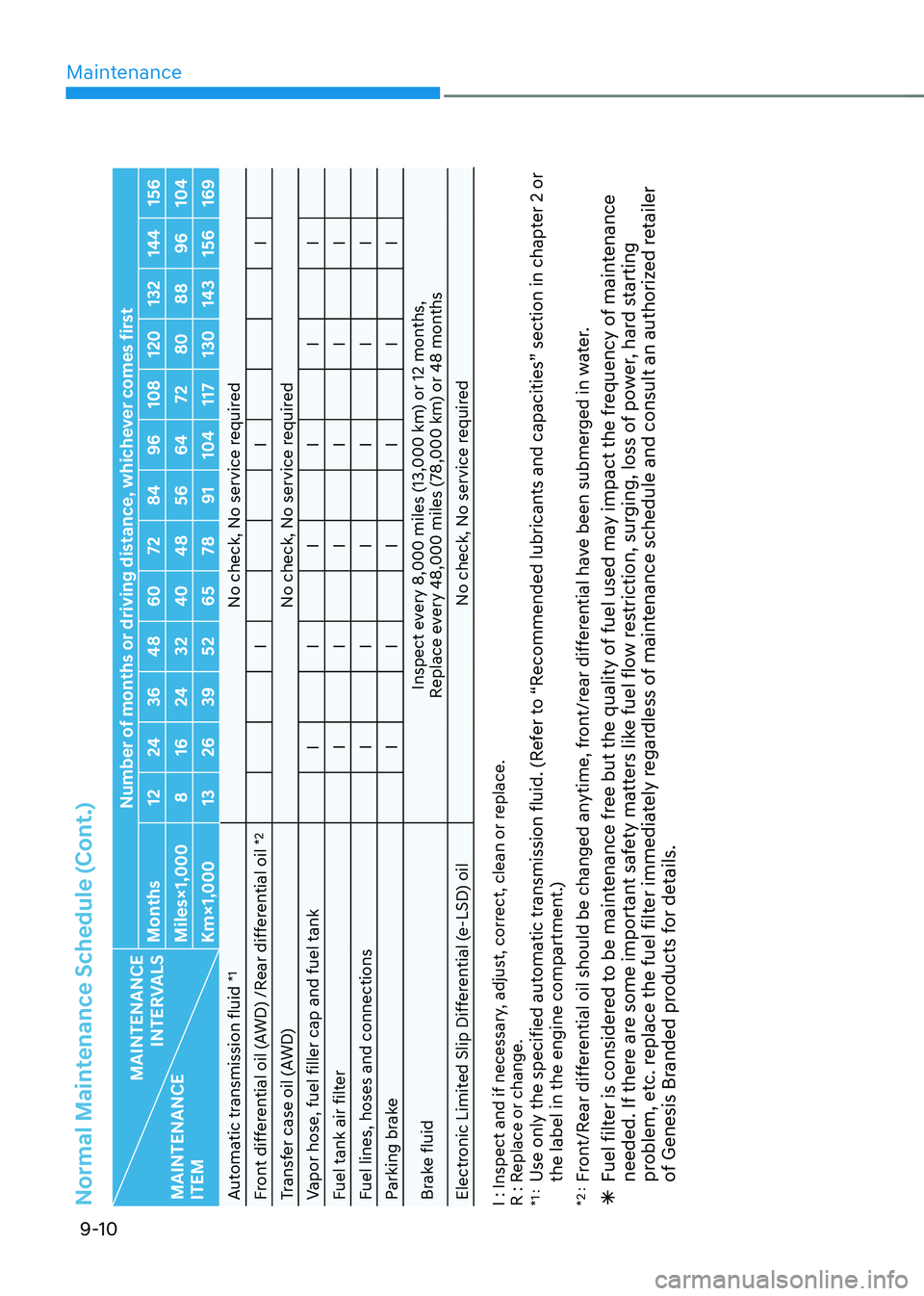
Normal Maintenance Schedule (Cont.)
MAINTENANCE
INTERVALS
MAINTENANCE
ITEM Number of months or driving distance, whichever comes first
Months 1224 3648 60 7284 96108 120 132144 156
Miles×1,000 816 24 3240 48 5664 7280 8896104
Km×1,000 1326 39 5265 78 91104 117130 143156169
Automatic transmission fluid
*1
No check, No service required
Front differential oil (AWD) /Rear differential oil
*2
I II
Transfer case oil (AWD) No check, No service required
Vapor hose, fuel filler cap and fuel tank IIIIII
Fuel tank air filter IIIIII
Fuel lines, hoses and connections IIIIII
Parking brake IIIIII
Brake fluid Inspect every 8,000 miles (13,000 km) or 12 months,
Replace every 48,000 miles (78,000 km) or 48 months
Electronic Limited Slip Differential (e-LSD) oil No check, No service required
I : Inspect and if necessary, adjust, correct, clean or replace.
R : Replace or change.
*1 : Use only the specified automatic transmission fluid. (Refer to “Recommended lubricants and capacities” section in chapter 2 or
the label in the engine compartment.)
*2 : Front/Rear differential oil should be changed anytime, front/rear differential have been submerged in water. Ã Fuel filter is considered to be maintenance free but the quality of fuel used may impact the frequency of maintenance
needed. If there are some important safety matters like fuel flow restriction, surging, loss of power, hard starting
problem, etc. replace the fuel filter immediately regardless of maintenance schedule and consult an authorized retailer
of Genesis Branded products for details.
Page 572 of 637
09
9-11
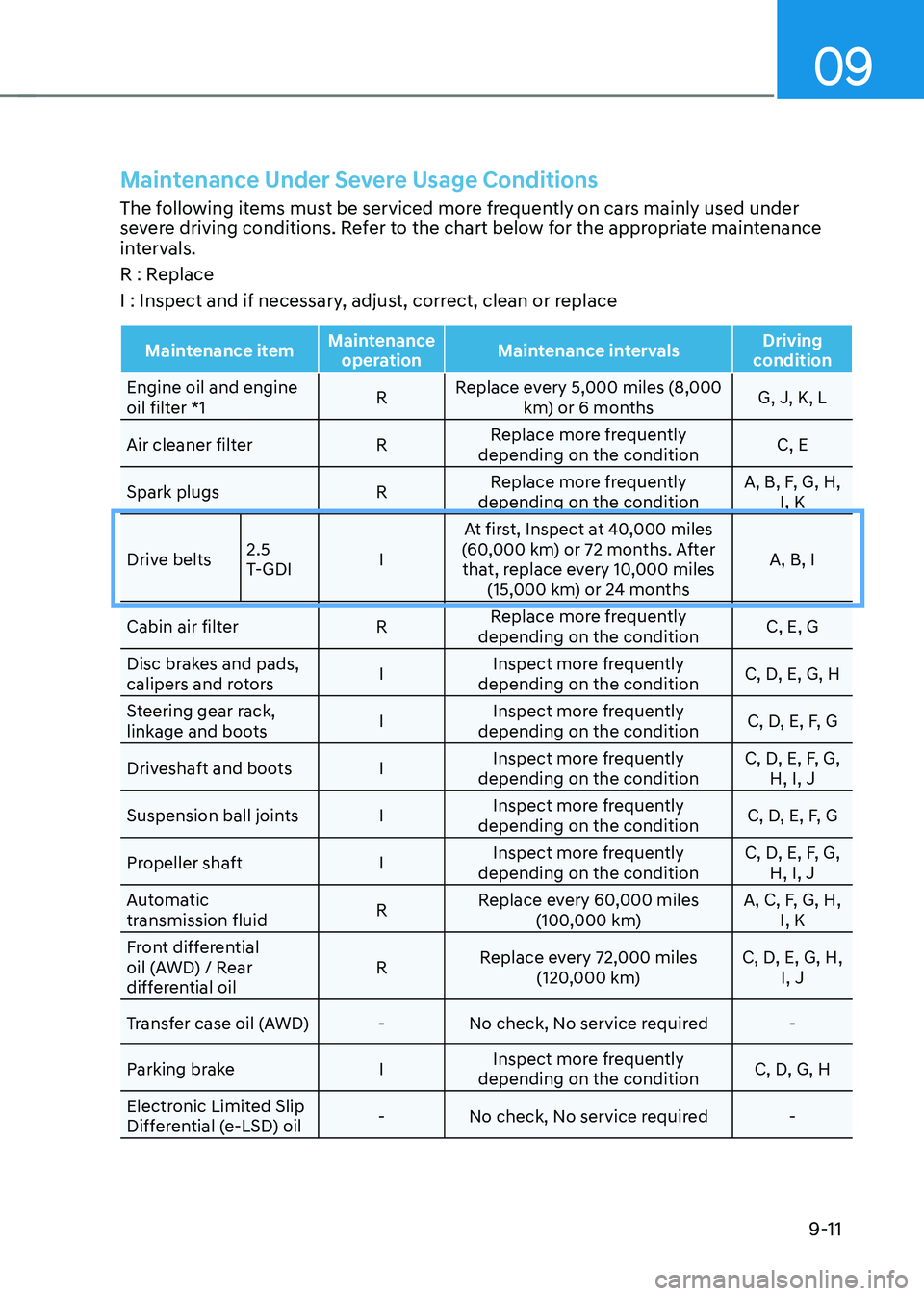
Maintenance Under Severe Usage Conditions
The following items must be serviced more frequently on cars mainly used under
severe driving conditions. Refer to the chart below for the appropriate maintenance
intervals.
R : Replace
I : Inspect and if necessary, adjust, correct, clean or replace
Maintenance itemMaintenance
operation Maintenance intervals Driving
condition
Engine oil and engine
oil filter *1 RReplace every 5,000 miles (8,000
km) or 6 months G, J, K, L
Air cleaner filter RReplace more frequently
depending on the condition C, E
Spark plugs RReplace more frequently
depending on the condition A, B, F, G, H,
I, K
Drive belts 2.5
T-GDI IAt first, Inspect at 40,000 miles
(60,000 km) or 72 months. After that, replace every 10,000 miles (15,000 km) or 24 months A, B, I
Cabin air filter RReplace more frequently
depending on the condition C, E, G
Disc brakes and pads,
calipers and rotors IInspect more frequently
depending on the condition C, D, E, G, H
Steering gear rack,
linkage and boots IInspect more frequently
depending on the condition C, D, E, F, G
Driveshaft and boots IInspect more frequently
depending on the condition C, D, E, F, G,
H, I, J
Suspension ball joints IInspect more frequently
depending on the condition C, D, E, F, G
Propeller shaft IInspect more frequently
depending on the condition C, D, E, F, G,
H, I, J
Automatic
transmission fluid RReplace every 60,000 miles
(100,000 km) A, C, F, G, H,
I, K
Front differential
oil (AWD) / Rear
differential oil R
Replace every 72,000 miles
(120,000 km) C, D, E, G, H,
I, J
Transfer case oil (AWD) -No check, No service required -
Parking brake IInspect more frequently
depending on the condition C, D, G, H
Electronic Limited Slip
Differential (e-LSD) oil -
No check, No service required -
Page 573 of 637
Maintenance
9-12
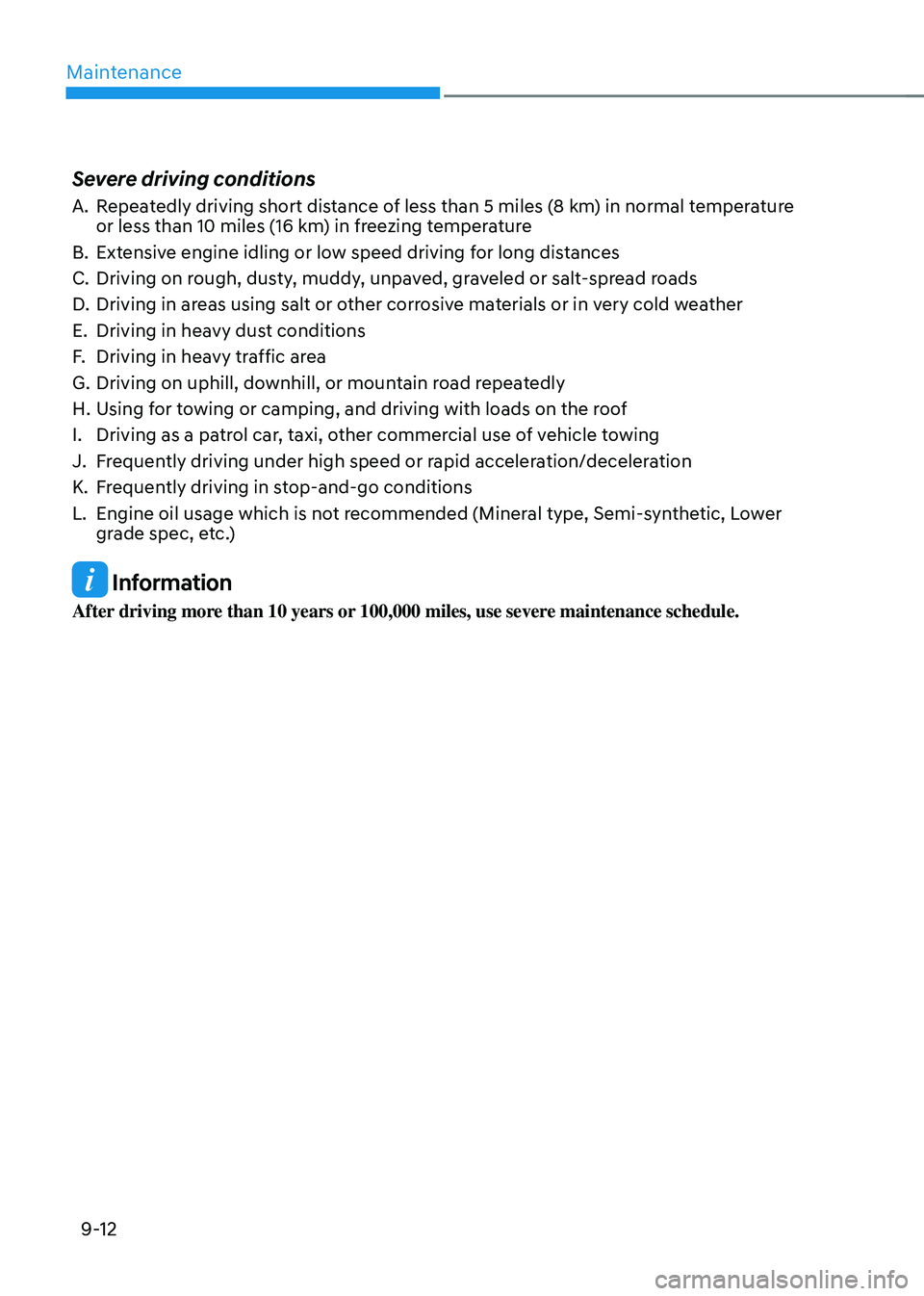
Severe driving conditions
A. Repeatedly driving short distance of less than 5 miles (8 km) in normal temperature
or less than 10 miles (16 km) in freezing temperature
B. Extensive engine idling or low speed driving for long distances
C. Driving on rough, dusty, muddy, unpaved, graveled or salt-spread roads
D. Driving in areas using salt or other corrosive materials or in very cold weather
E. Driving in heavy dust conditions
F. Driving in heavy traffic area
G. Driving on uphill, downhill, or mountain road repeatedly
H. Using for towing or camping, and driving with loads on the roof
I. Driving as a patrol car, taxi, other commercial use of vehicle towing
J. Frequently driving under high speed or rapid acceleration/deceleration
K. Frequently driving in stop-and-go conditions
L. Engine oil usage which is not recommended (Mineral type, Semi-synthetic, Lower
grade spec, etc.)
Information
After driving more than 10 years or 100,000 miles, use severe maintenance schedule.
Page 574 of 637
09
9-13
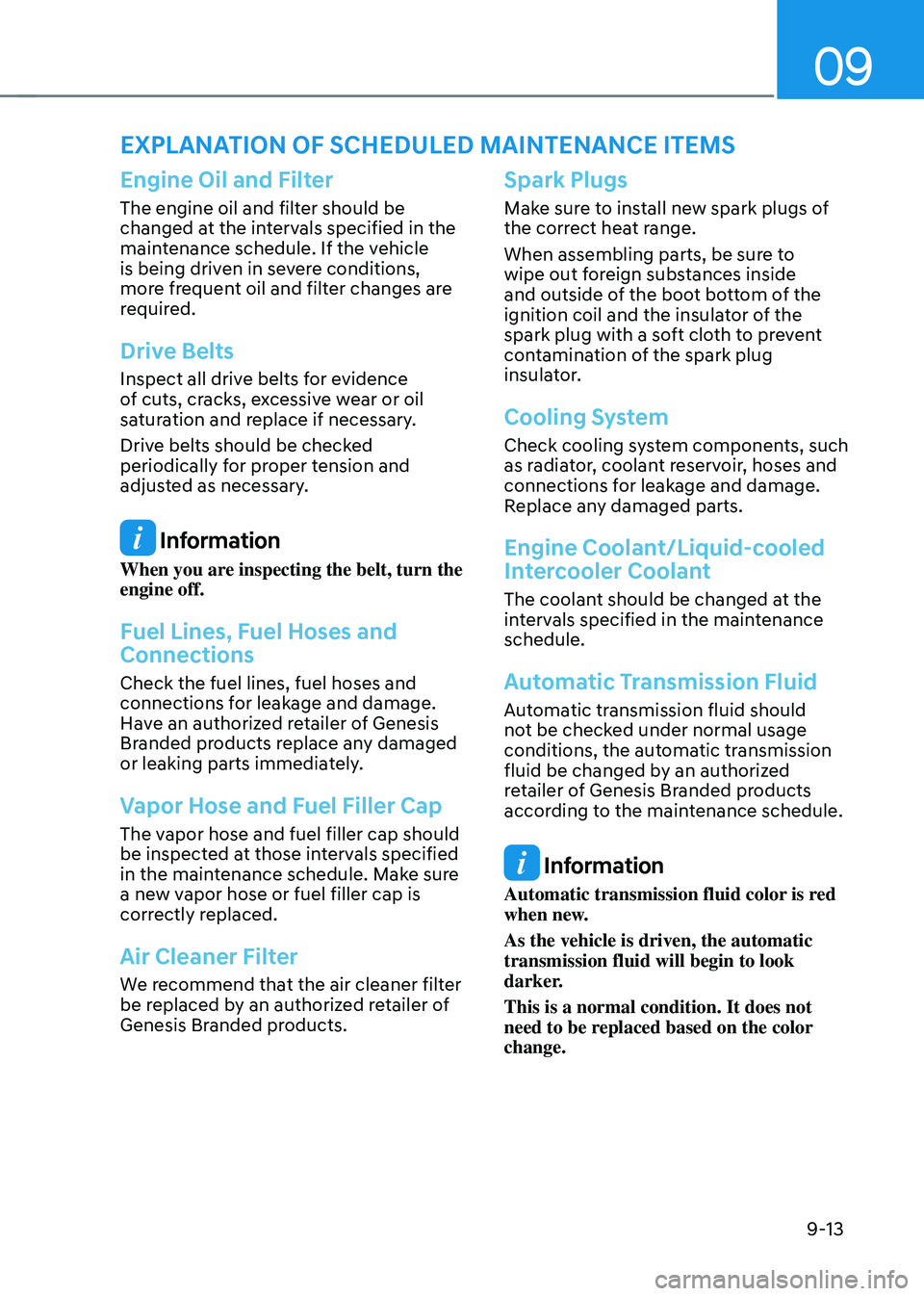
Engine Oil and Filter
The engine oil and filter should be
changed at the intervals specified in the
maintenance schedule. If the vehicle
is being driven in severe conditions,
more frequent oil and filter changes are
required.
Drive Belts
Inspect all drive belts for evidence
of cuts, cracks, excessive wear or oil
saturation and replace if necessary.
Drive belts should be checked
periodically for proper tension and
adjusted as necessary.
Information
When you are inspecting the belt, turn the
engine off.
Fuel Lines, Fuel Hoses and
Connections
Check the fuel lines, fuel hoses and
connections for leakage and damage.
Have an authorized retailer of Genesis
Branded products replace any damaged
or leaking parts immediately.
Vapor Hose and Fuel Filler Cap
The vapor hose and fuel filler cap should
be inspected at those intervals specified
in the maintenance schedule. Make sure
a new vapor hose or fuel filler cap is
correctly replaced.
Air Cleaner Filter
We recommend that the air cleaner filter
be replaced by an authorized retailer of
Genesis Branded products.
Spark Plugs
Make sure to install new spark plugs of
the correct heat range.
When assembling parts, be sure to
wipe out foreign substances inside
and outside of the boot bottom of the
ignition coil and the insulator of the
spark plug with a soft cloth to prevent
contamination of the spark plug
insulator.
Cooling System
Check cooling system components, such
as radiator, coolant reservoir, hoses and
connections for leakage and damage.
Replace any damaged parts.
Engine Coolant/Liquid-cooled
Intercooler Coolant
The coolant should be changed at the
intervals specified in the maintenance
schedule.
Automatic Transmission Fluid
Automatic transmission fluid should
not be checked under normal usage
conditions, the automatic transmission
fluid be changed by an authorized
retailer of Genesis Branded products
according to the maintenance schedule.
Information
Automatic transmission fluid color is red
when new.
As the vehicle is driven, the automatic
transmission fluid will begin to look
darker.
This is a normal condition. It does not
need to be replaced based on the color
change.
EXPLANATION OF SCHEDULED MAINTENANCE ITEMS
Page 575 of 637
Maintenance
9-14
NOTICE
The use of a non-specified fluid could
result in transmission malfunction and
failure.
Use only specified automatic
transmission fluid. (Refer to
“Recommended Lubricants and
Capacities” section in chapter 2.)
Brake Hoses and Lines
Visually check for proper installation,
chafing, cracks, deterioration and any
leakage. Replace any deteriorated or
damaged parts immediately.
Brake Fluid
Check the brake fluid level in the brake
fluid reservoir. The level should be
between the MIN and the MAX marks
on the side of the reservoir. Use only
hydraulic brake fluid conforming to DOT
4 specification.
Brake Discs, Pads, Calipers and
Rotors
Check the pads, the disc, and the rotor
for any excessive wear-out. Inspect
calipers for any fluid leakage.
Exhaust Pipe and Muffler
Visually inspect the exhaust pipes,
muffler and hangers for cracks,
deterioration, or damage. Start
the engine and listen carefully for
any exhaust gas leakage. Tighten
connections or replace parts as
necessary.
Propeller Shaft
Check the propeller shaft, boots, clamps,
rubber couplings and center-bearing
rubber for cracks, deterioration, or
damage. Replace any damaged parts
and if necessary, repack the grease.
Suspension Mounting Bolts
Check the suspension connections for
looseness or damage. Retighten to the
specified torque.
Steering Gear Box, Linkage &
Boots/Lower Arm Ball Joint
With the vehicle stopped and the engine
off, check for excessive free-play in the
steering wheel. Check the linkage for
bends or damage. Check the dust boots
and ball joints for deterioration, cracks,
or damage.
Replace any damaged parts.
Drive Shafts and Boots
Check the drive shafts, boots and clamps
for cracks, deterioration, or damage.
Replace any damaged parts and, if
necessary, repack the grease.
Air Conditioning Refrigerant
Check the air conditioning lines and
connections for leakage and damage.
Page 576 of 637
09
9-15
Checking the Engine Oil Level
Engine oil is used for lubricating,
cooling, and operating various hydraulic
components in the engine. Engine oil
consumption while driving is normal,
and it is necessary to check and refill the
engine oil regularly. Also, check and refill
the oil level within the recommended
maintenance schedule to prevent
deterioration of oil performance.
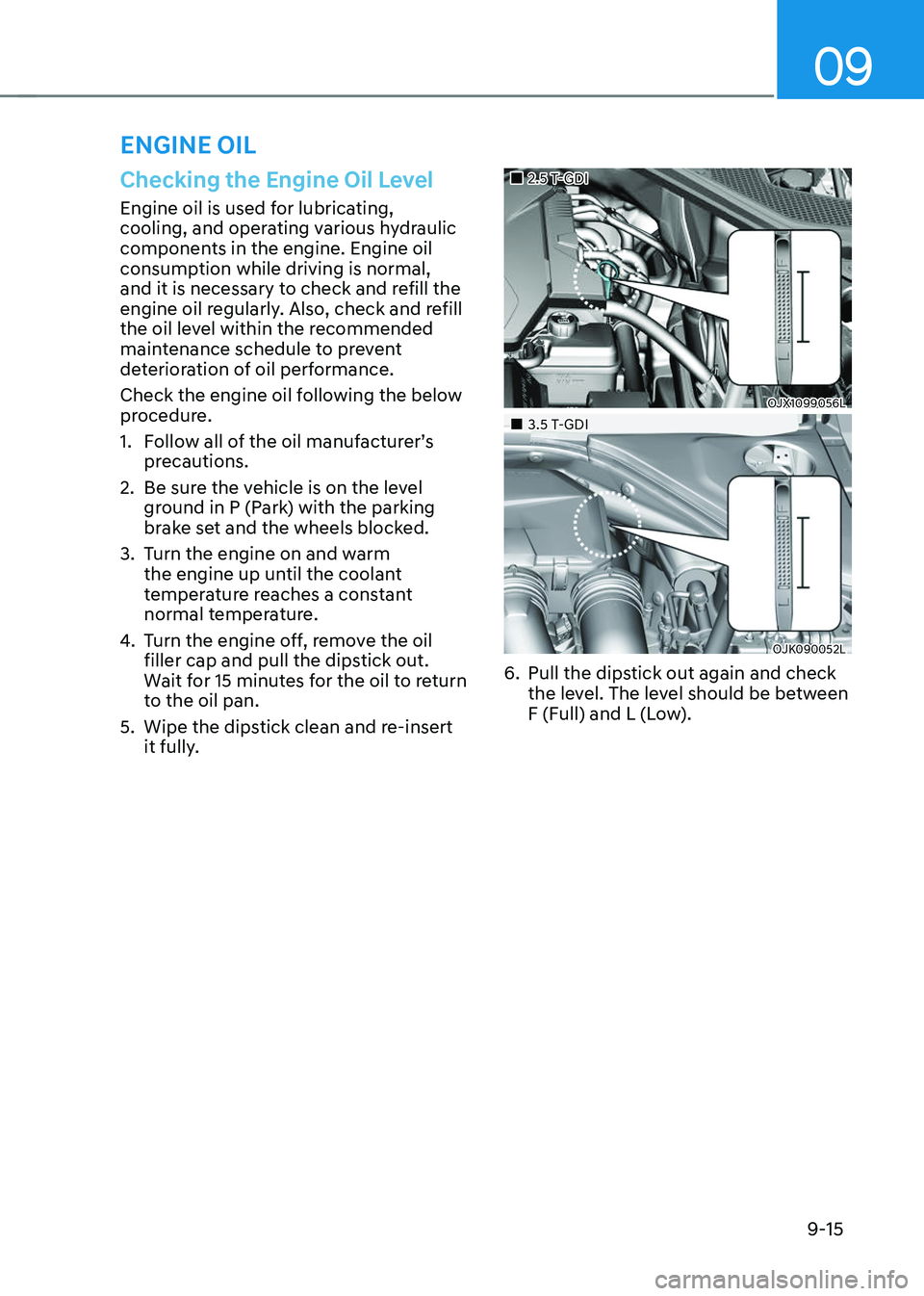
Check the engine oil following the below
procedure.
1. Follow all of the oil manufacturer’s
precautions.
2. Be sure the vehicle is on the level
ground in P (Park) with the parking
brake set and the wheels blocked.
3. Turn the engine on and warm
the engine up until the coolant
temperature reaches a constant
normal temperature.
4. Turn the engine off, remove the oil
filler cap and pull the dipstick out.
Wait for 15 minutes for the oil to return
to the oil pan.
5. Wipe the dipstick clean and re-insert
it fully.
Page 577 of 637
Maintenance
9-16
Page 578 of 637
09
9-17
Checking the Engine Oil and
Filter
OIK090122NOIK090122N
• The lubrication, rust prevention,
cooling, and cleaning effect of the
engine oil will gradually degrade
during its use. Have the engine oil
and filter changed by an authorized
retailer of Genesis Branded products
according to the Oil Life Management
System function or the Maintenance
Schedule at the beginning of this
chapter.
• If the maintenance schedule to
replace engine oil is exceeded,
the engine oil performance may
deteriorate and the engine condition
may be affected. Therefore, replace
the engine oil according to the
maintenance schedule.
• To keep the engine in optimal
condition, use the recommended
engine oil. If the recommended
engine oil and filter are not
used, replace it according to the
maintenance schedule under severe
usage conditions.
• The purpose of the maintenance
schedule for engine oil replacement
is to prevent oil deterioration and it is
irrelevant to oil consumption. Check
and refill engine oil regularly.
Information
When the oil pressure is low due to
insufficient engine oil, the Engine Oil
Pressure (
) warning light will illuminate.
In addition, the enhanced engine protection
system, which limits the engine’s power is
activated and the Malfunction Indicator
Lamp (
) will illuminate when the vehicle
is driven in this state continuously. When oil
pressure is restored, the Engine Oil Pressure
warning light will turn off and the engine
power will no longer be limited. However,
for gasoline 2.5 turbo engine, when the oil
pressure is restored, the warning light and
the enhanced engine protection system will
turn off after the engine is restarted.
CAUTION
The engine oil is very hot immediately
after the vehicle has been driven and
can cause burns during replacement.
Replace the engine oil after the engine
oil has cooled down.
WARNING
Used engine oil may cause irritation or
cancer of the skin if left in contact with
the skin for prolonged periods of time.
Used engine oil contains chemicals
that have caused cancer in laboratory
animals. Always protect your skin
by washing your hands thoroughly
with soap and warm water as soon as
possible after handling used oil.
WARNING
CALIFORNIA PROPOSITION 65
WARNING
Engine oil contains chemicals known to
the State of California to cause cancer,
birth defects and reproductive harm.
Used engine oil may cause irritation or
cancer of the skin if left in contact with
the skin for prolonged periods of time.
Always protect your skin by washing
your hands thoroughly with soap and
warm water as soon as possible after
handling used oil.
Page 579 of 637
Maintenance
9-18
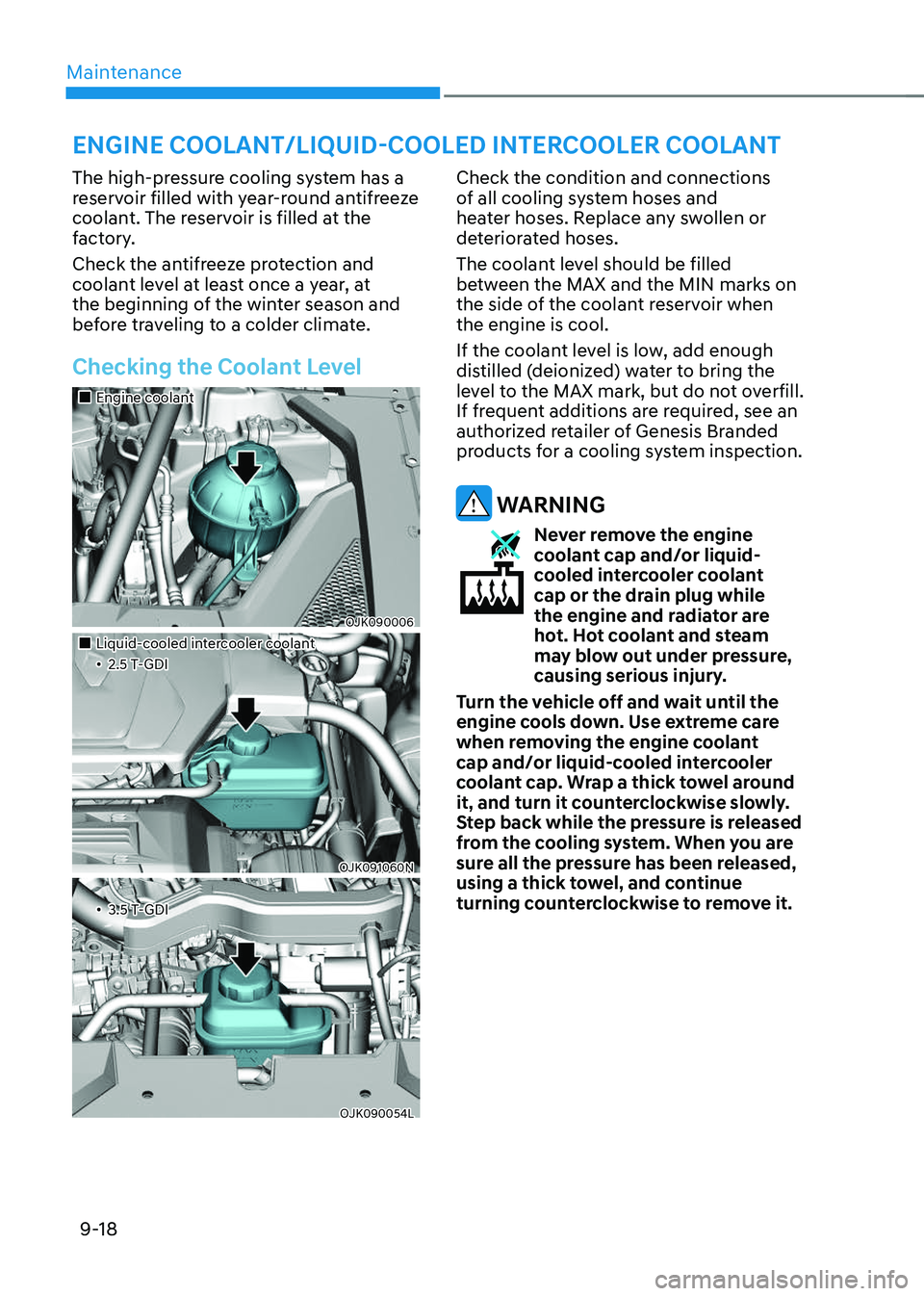
ENGINE COOLANT/LIQUID-COOLED INTERCOOLER COOLANT
The high-pressure cooling system has a
reservoir filled with year-round antifreeze
coolant. The reservoir is filled at the
factory.
Check the antifreeze protection and
coolant level at least once a year, at
the beginning of the winter season and
before traveling to a colder climate.
Checking the Coolant Level
Page 580 of 637
09
9-19
Information
The coolant level is influenced by the
engine temperature. Before checking or
refilling the coolant, turn the engine off.
WARNING
The electric motor for the cooling fan may continue to
operate or start up when the
engine is not running and can
cause serious injury. Keep
hands, clothing and tools away
from the rotating fan blades of
the cooling fan.
Always turn off the vehicle unless the
vehicle has to be inspected with the
engine on. Be cautious as the cooling
fan may operate if the negative (-)
battery terminal is not disconnected.
WARNING
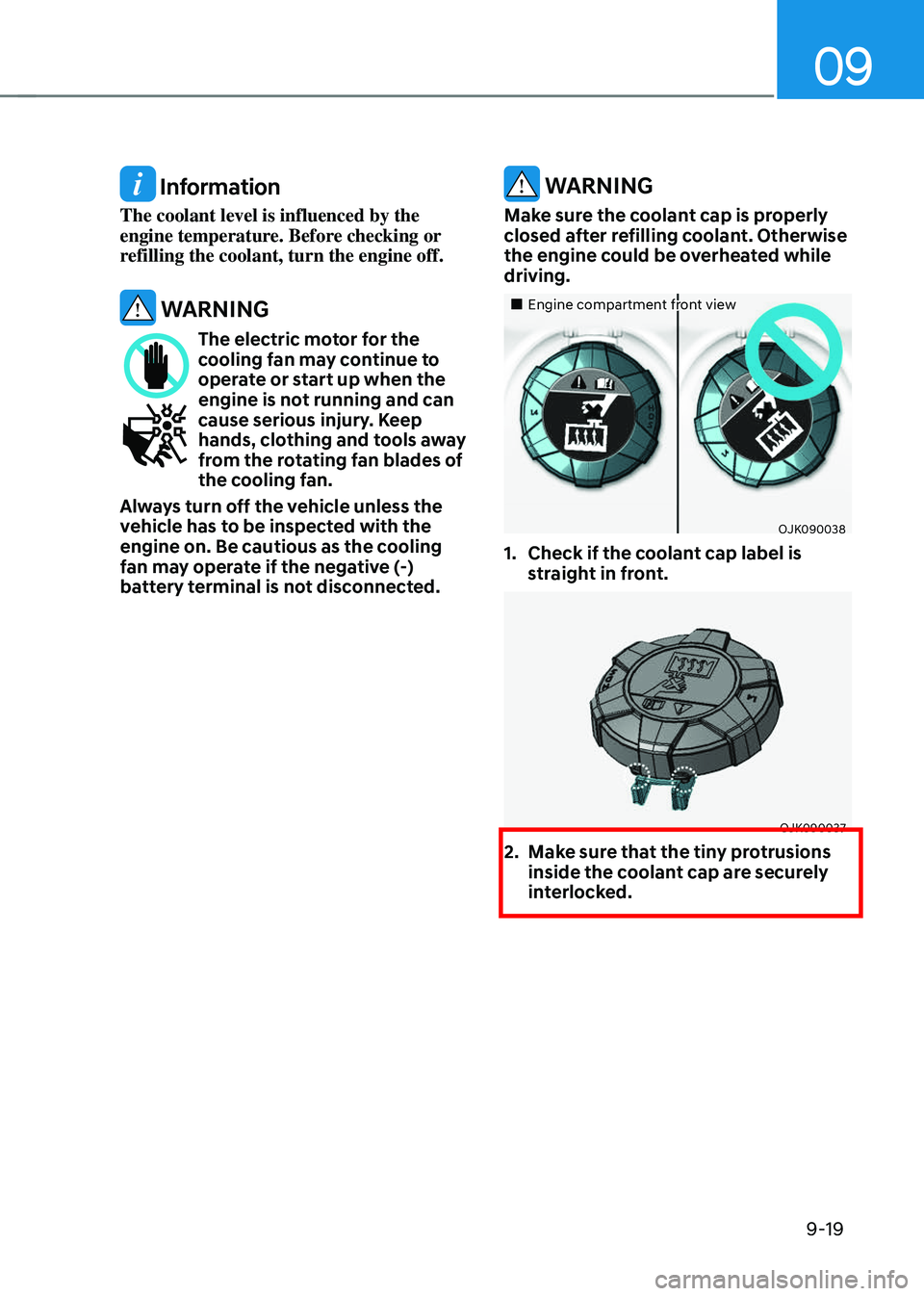
Make sure the coolant cap is properly
closed after refilling coolant. Otherwise
the engine could be overheated while
driving.