tire size GMC ACADIA 2009 User Guide
[x] Cancel search | Manufacturer: GMC, Model Year: 2009, Model line: ACADIA, Model: GMC ACADIA 2009Pages: 420, PDF Size: 2.23 MB
Page 314 of 420
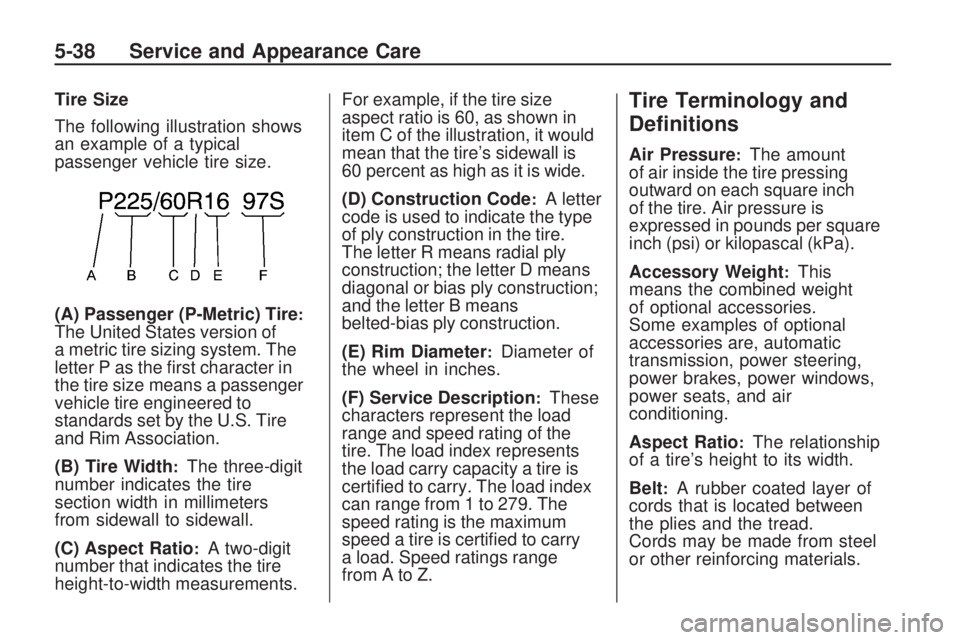
Tire Size
The following illustration shows
an example of a typical
passenger vehicle tire size.
(A) Passenger (P-Metric) Tire
:The United States version of
a metric tire sizing system. The
letter P as the rst character in
the tire size means a passenger
vehicle tire engineered to
standards set by the U.S. Tire
and Rim Association.
(B) Tire Width
:The three-digit
number indicates the tire
section width in millimeters
from sidewall to sidewall.
(C) Aspect Ratio
:A two-digit
number that indicates the tire
height-to-width measurements.For example, if the tire size
aspect ratio is 60, as shown in
item C of the illustration, it would
mean that the tire’s sidewall is
60 percent as high as it is wide.
(D) Construction Code
:A letter
code is used to indicate the type
of ply construction in the tire.
The letter R means radial ply
construction; the letter D means
diagonal or bias ply construction;
and the letter B means
belted-bias ply construction.
(E) Rim Diameter
:Diameter of
the wheel in inches.
(F) Service Description
:These
characters represent the load
range and speed rating of the
tire. The load index represents
the load carry capacity a tire is
certied to carry. The load index
can range from 1 to 279. The
speed rating is the maximum
speed a tire is certied to carry
a load. Speed ratings range
fromAtoZ.
Tire Terminology and
Denitions
Air Pressure:The amount
of air inside the tire pressing
outward on each square inch
of the tire. Air pressure is
expressed in pounds per square
inch (psi) or kilopascal (kPa).
Accessory Weight
:This
means the combined weight
of optional accessories.
Some examples of optional
accessories are, automatic
transmission, power steering,
power brakes, power windows,
power seats, and air
conditioning.
Aspect Ratio
:The relationship
of a tire’s height to its width.
Belt
:A rubber coated layer of
cords that is located between
the plies and the tread.
Cords may be made from steel
or other reinforcing materials.
5-38 Service and Appearance Care
Page 317 of 420
Vehicle Capacity Weight:The
number of designated seating
positions multiplied by 150 lbs
(68 kg) plus the rated cargo load.
SeeLoading the Vehicle on
page 4-16.
Vehicle Maximum Load on the
Tire
:Load on an individual tire
due to curb weight, accessory
weight, occupant weight, and
cargo weight.
Vehicle Placard
:A label
permanently attached to a
vehicle showing the vehicle’s
capacity weight and the original
equipment tire size and
recommended ination pressure.
See “Tire and Loading
Information Label” underLoading
the Vehicle on page 4-16.
Ination - Tire Pressure
Tires need the correct amount
of air pressure to operate
effectively.
Notice:Do not let anyone tell
you that under-ination or
over-ination is all right. It is
not. If your tires do not have
enough air (under-ination),
you can get the following:
Too much exing
Too much heat
Tire overloading
Premature or irregular wear
Poor handling
Reduced fuel economy
If your tires have too much air
(over-ination), you can get
the following:
Unusual wear
Poor handling
Rough ride
Needless damage from road
hazardsA vehicle specic Tire and
Loading Information label is
attached to your vehicle. This
label shows your vehicle’s
original equipment tires and the
correct ination pressures for
your tires when they are cold.
The recommended cold tire
ination pressure, shown on the
label, is the minimum amount of
air pressure needed to support
your vehicle’s maximum load
carrying capacity.
For additional information
regarding how much weight
your vehicle can carry, and an
example of the Tire and Loading
Information label, seeLoading
the Vehicle on page 4-16. How
you load your vehicle affects
vehicle handling and ride
comfort. Never load your vehicle
with more weight than it was
designed to carry.
Service and Appearance Care 5-41
Page 318 of 420
When to Check
Check your tires once a month
or more. Do not forget to check
the compact spare tire, if the
vehicle has one. It should be at
60 psi (420 kPa). For additional
information regarding the
compact spare tire, seeCompact
Spare Tire on page 5-81.
How to Check
Use a good quality pocket-type
gage to check tire pressure.
You cannot tell if your tires are
properly inated simply by
looking at them. Radial tires may
look properly inated even when
they are under-inated. Check
the tire’s ination pressure when
the tires are cold. Cold means
your vehicle has been sitting for
at least three hours or driven
no more than 1 mile (1.6 km).Remove the valve cap from the
tire valve stem. Press the tire
gage rmly onto the valve to get
a pressure measurement. If the
cold tire ination pressure
matches the recommended
pressure on the Tire and Loading
Information label, no further
adjustment is necessary. If the
ination pressure is low, add air
until you reach the recommended
amount.
If you overll the tire, release air
by pushing on the metal stem
in the center of the tire valve.
Re-check the tire pressure with
the tire gage.
Be sure to put the valve caps
back on the valve stems.
They help prevent leaks by
keeping out dirt and moisture.Tire Pressure Monitor
System
The Tire Pressure Monitor System
(TPMS) uses radio and sensor
technology to check tire pressure
levels. The TPMS sensors monitor
the air pressure in your vehicle’s tires
and transmit tire pressure readings to
a receiver located in the vehicle.
Each tire, including the spare
(if provided), should be checked
monthly when cold and inated to the
ination pressure recommended by
the vehicle manufacturer on the
vehicle placard or tire ination
pressure label. (If your vehicle has
tires of a different size than the size
indicated on the vehicle placard or
tire ination pressure label, you
should determine the proper tire
ination pressure for those tires.)
As an added safety feature, your
vehicle has been equipped with a tire
pressure monitoring system (TPMS)
that illuminates a low tire pressure
telltale when one or more of your
tires is signicantly under-inated.
5-42 Service and Appearance Care
Page 320 of 420
Changes or modications to
this system by other than an
authorized service facility could void
authorization to use this equipment.
Tire Pressure Monitor
Operation
This vehicle may have a Tire
Pressure Monitor System (TPMS).
The TPMS is designed to warn
the driver when a low tire pressure
condition exists. TPMS sensors
are mounted onto each tire
and wheel assembly, excluding the
spare tire and wheel assembly,
if the vehicle has one. The TPMS
sensors monitor the air pressure in
the vehicle’s tires and transmits
the tire pressure readings to
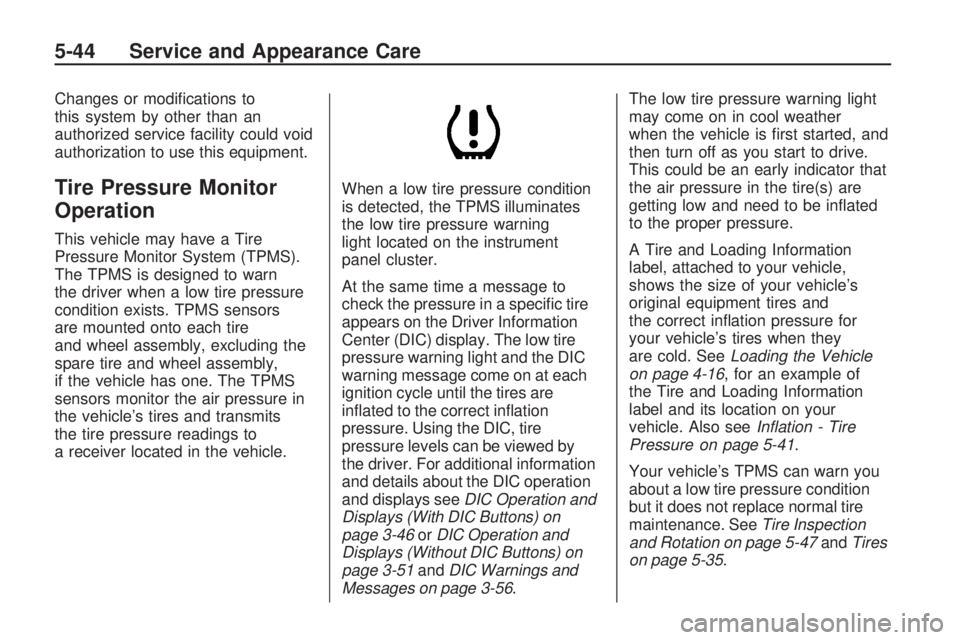
a receiver located in the vehicle.When a low tire pressure condition
is detected, the TPMS illuminates
the low tire pressure warning
light located on the instrument
panel cluster.
At the same time a message to
check the pressure in a specic tire
appears on the Driver Information
Center (DIC) display. The low tire
pressure warning light and the DIC
warning message come on at each
ignition cycle until the tires are
inated to the correct ination
pressure. Using the DIC, tire
pressure levels can be viewed by
the driver. For additional information
and details about the DIC operation
and displays seeDIC Operation and
Displays (With DIC Buttons) on
page 3-46orDIC Operation and
Displays (Without DIC Buttons) on
page 3-51andDIC Warnings and
Messages on page 3-56.The low tire pressure warning light
may come on in cool weather
when the vehicle is rst started, and
then turn off as you start to drive.
This could be an early indicator that
the air pressure in the tire(s) are
getting low and need to be inated
to the proper pressure.
A Tire and Loading Information
label, attached to your vehicle,
shows the size of your vehicle’s
original equipment tires and
the correct ination pressure for
your vehicle’s tires when they
are cold. SeeLoading the Vehicle
on page 4-16, for an example of
the Tire and Loading Information
label and its location on your
vehicle. Also seeInflation - Tire
Pressure on page 5-41.
Your vehicle’s TPMS can warn you
about a low tire pressure condition
but it does not replace normal tire
maintenance. SeeTire Inspection
and Rotation on page 5-47andTires
on page 5-35.
5-44 Service and Appearance Care
Page 325 of 420
You need new tires if any of the
following statements are true:
You can see the indicators at
three or more places around
the tire.
You can see cord or fabric
showing through the tire’s rubber.
The tread or sidewall is cracked,
cut, or snagged deep enough to
show cord or fabric.
The tire has a bump, bulge,
or split.
The tire has a puncture, cut, or
other damage that cannot be
repaired well because of the size
or location of the damage.
The rubber in tires degrades over
time, even if they are not being
used. This is also true for the spare
tire, if the vehicle has one. Multiple
conditions affect how fast this
aging takes place, including
temperatures, loading conditions,
and ination pressure maintenance.With proper care and maintenance
tires typically wear out before
they degrade due to age. If you are
unsure about the need to replace
the tires as they get older, consult
the tire manufacturer for more
information.
Buying New Tires
GM has developed and matched
specic tires for your vehicle. The
original equipment tires installed
on your vehicle, when it was new,
were designed to meet General
Motors Tire Performance Criteria
Specication (TPC Spec) system
rating. If you need replacement
tires, GM strongly recommends
that you get tires with the same
TPC Spec rating. This way, your
vehicle will continue to have tires
that are designed to give the
same performance and vehicle
safety, during normal use, as the
original tires.GM’s exclusive TPC Spec
system considers over a dozen
critical specications that impact
the overall performance of your
vehicle, including brake system
performance, ride and handling,
traction control, and tire pressure
monitoring performance. GM’s
TPC Spec number is molded
onto the tire’s sidewall near the
tire size. If the tires have an
all-season tread design, the TPC
Spec number will be followed
by an MS for mud and snow.
SeeTire Sidewall Labeling
on page 5-36for additional
information.
GM recommends replacing tires
in sets of four. This is because
uniform tread depth on all tires
will help keep your vehicle
performing most like it did
when the tires were new.
Service and Appearance Care 5-49
Page 326 of 420
Replacing less than a full set of
tires can affect the braking and
handling performance of your
vehicle. SeeTire Inspection
and Rotation on page 5-47for
information on proper tire
rotation.
{CAUTION
Mixing tires could cause you
to lose control while driving.
If you mix tires of different
sizes, brands, or types (radial
and bias-belted tires), the
vehicle may not handle
properly, and you could have a
crash. Using tires of different
sizes, brands, or types may
also cause damage to your
vehicle. Be sure to use the
correct size, brand, and type of
tires on all wheels. It is all right
to drive with your compact
spare temporarily, as it was
developed for use on your
vehicle. SeeCompact Spare
Tire on page 5-81.
{CAUTION
If you use bias-ply tires on the
vehicle, the wheel rim anges
could develop cracks after
many miles of driving. A tire
and/or wheel could fail
suddenly, causing a crash.
Use only radial-ply tires with
the wheels on the vehicle.
If you must replace your
vehicle’s tires with those that do
not have a TPC Spec number,
make sure they are the same
size, load range, speed rating,
and construction type (radial
and bias-belted tires) as your
vehicle’s original tires.
Vehicles that have a tire
pressure monitoring system
could give an inaccurate
low-pressure warning if non-TPC
Spec rated tires are installed
on your vehicle. Non-TPCSpec rated tires may give a
low-pressure warning that is
higher or lower than the proper
warning level you would get with
TPC Spec rated tires. SeeTire
Pressure Monitor System on
page 5-42.
Your vehicle’s original equipment
tires are listed on the Tire and
Loading Information Label.
SeeLoading the Vehicle on
page 4-16, for more information
about the Tire and Loading
Information Label and its location
on your vehicle.
Different Size Tires and
Wheels
If you add wheels or tires that are
a different size than your original
equipment wheels and tires, this
could affect the way your vehicle
performs, including its braking,
ride and handling characteristics,
stability, and resistance to rollover.
5-50 Service and Appearance Care
Page 327 of 420
Additionally, if your vehicle has
electronic systems such as anti-lock
brakes, rollover airbags, traction
control, and electronic stability
control, the performance of these
systems can be affected.
{CAUTION
If you add different sized wheels,
your vehicle may not provide an
acceptable level of performance
and safety if tires not
recommended for those wheels
are selected. You may increase
the chance that you will crash and
suffer serious injury. Only use GM
specic wheel and tire systems
developed for your vehicle, and
have them properly installed by
a GM certied technician.
SeeBuying New Tires on page 5-49
andAccessories and Modifications
on page 5-3for additional
information.
Uniform Tire Quality
Grading
Quality grades can be found
where applicable on the tire
sidewall between tread shoulder
and maximum section width.
For example:
Treadwear 200 Traction AA
Temperature A
The following information relates
to the system developed by the
United States National Highway
Traffic Safety Administration
(NHTSA), which grades tires
by treadwear, traction, and
temperature performance. This
applies only to vehicles sold in
the United States. The grades
are molded on the sidewalls of
most passenger car tires. The
Uniform Tire Quality Grading
(UTQG) system does not apply
to deep tread, winter-type snow
tires, space-saver, or temporary
use spare tires, tires with nominalrim diameters of 10 to 12 inches
(25 to 30 cm), or to some
limited-production tires.
While the tires available on
General Motors passenger cars
and light trucks may vary with
respect to these grades, they
must also conform to federal
safety requirements and
additional General Motors Tire
Performance Criteria (TPC)
standards.
Treadwear
The treadwear grade is a
comparative rating based on the
wear rate of the tire when tested
under controlled conditions on
a specied government test
course. For example, a tire
graded 150 would wear one
and a half (1.5) times as well
on the government course as a
tire graded 100. The relative
performance of tires depends
upon the actual conditions of
their use, however, and may
depart signicantly from the
Service and Appearance Care 5-51
Page 330 of 420
Used Replacement Wheels
{CAUTION
Putting a used wheel on the
vehicle is dangerous. You cannot
know how it has been used or
how far it has been driven. It
could fail suddenly and cause a
crash. If you have to replace a
wheel, use a new GM original
equipment wheel.
Tire Chains
{CAUTION
Do not use tire chains. There is
not enough clearance. Tire chains
used on a vehicle without the
proper amount of clearance can
cause damage to the brakes,
suspension or other vehicle parts.
The area damaged by the tire
chains could cause you to lose
control of the vehicle and you or
others may be injured in a crash.
(Continued)
CAUTION (Continued)
Use another type of traction
device only if its manufacturer
recommends it for use on the
vehicle and tire size combination
and road conditions. Follow that
manufacturer’s instructions. To
help avoid damage to the vehicle,
drive slowly, readjust or remove
the device if it is contacting the
vehicle, and do not spin the
vehicle’s wheels. If you do nd
traction devices that will t, install
them on the front tires.
5-54 Service and Appearance Care
Page 347 of 420
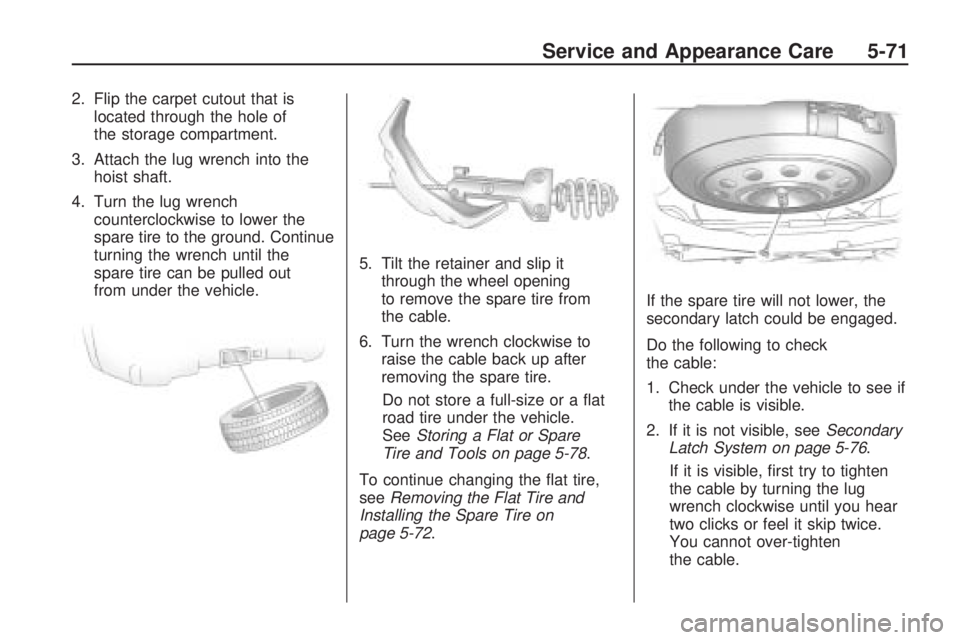
2. Flip the carpet cutout that is
located through the hole of
the storage compartment.
3. Attach the lug wrench into the
hoist shaft.
4. Turn the lug wrench
counterclockwise to lower the
spare tire to the ground. Continue
turning the wrench until the
spare tire can be pulled out
from under the vehicle.5. Tilt the retainer and slip it
through the wheel opening
to remove the spare tire from
the cable.
6. Turn the wrench clockwise to
raise the cable back up after
removing the spare tire.
Do not store a full-size or a at
road tire under the vehicle.
SeeStoring a Flat or Spare
Tire and Tools on page 5-78.
To continue changing the at tire,
seeRemoving the Flat Tire and
Installing the Spare Tire on
page 5-72.If the spare tire will not lower, the
secondary latch could be engaged.
Do the following to check
the cable:
1. Check under the vehicle to see if
the cable is visible.
2. If it is not visible, seeSecondary
Latch System on page 5-76.
If it is visible, rst try to tighten
the cable by turning the lug
wrench clockwise until you hear
two clicks or feel it skip twice.
You cannot over-tighten
the cable.
Service and Appearance Care 5-71
Page 356 of 420
8. Make sure the metal tube is
centered at the striker. Push
the tube toward the front of the
vehicle.
9. Close the liftgate and make sure
it is latched properly.
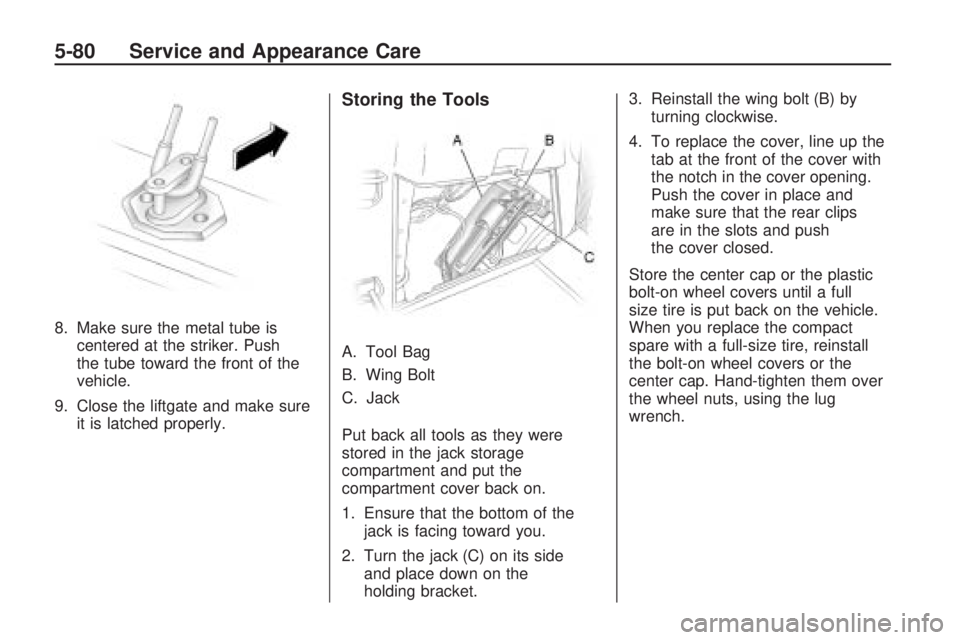
Storing the Tools
A. Tool Bag
B. Wing Bolt
C. Jack
Put back all tools as they were
stored in the jack storage
compartment and put the
compartment cover back on.
1. Ensure that the bottom of the
jack is facing toward you.
2. Turn the jack (C) on its side
and place down on the
holding bracket.3. Reinstall the wing bolt (B) by
turning clockwise.
4. To replace the cover, line up the
tab at the front of the cover with
the notch in the cover opening.
Push the cover in place and
make sure that the rear clips
are in the slots and push
the cover closed.
Store the center cap or the plastic
bolt-on wheel covers until a full
size tire is put back on the vehicle.
When you replace the compact
spare with a full-size tire, reinstall
the bolt-on wheel covers or the
center cap. Hand-tighten them over
the wheel nuts, using the lug
wrench.
5-80 Service and Appearance Care