steering wheel GMC ACADIA 2009 Owner's Guide
[x] Cancel search | Manufacturer: GMC, Model Year: 2009, Model line: ACADIA, Model: GMC ACADIA 2009Pages: 420, PDF Size: 2.23 MB
Page 243 of 420
Driving Your
Vehicle
Your Driving, the Road,
and the Vehicle
Driving for Better Fuel
Economy...........................4-1
Defensive Driving................4-2
Drunk Driving.....................4-2
Control of a Vehicle............4-3
Braking...............................4-3
Antilock Brake
System (ABS)...................4-4
Braking in Emergencies......4-5
StabiliTrak®System............4-5
All-Wheel Drive (AWD)
System.............................4-7
Steering..............................4-8
Off-Road Recovery.............4-9
Passing..............................4-9
Loss of Control...................4-9
Driving at Night.................4-10
Driving in Rain and on
Wet Roads......................4-11
Before Leaving on a
Long Trip........................4-12
Highway Hypnosis.............4-12
Hill and Mountain Roads. . .4-12
Winter Driving...................4-13
If Your Vehicle is Stuck
in Sand, Mud, Ice,
or Snow
..........................4-15
Rocking Your Vehicle to
Get It Out.......................4-15
Loading the Vehicle..........4-16
Towing
Towing Your Vehicle.........4-20
Recreational Vehicle
Towing............................4-21
Towing a Trailer................4-24
Your Driving, the
Road, and the Vehicle
Driving for Better Fuel
Economy
Driving habits can affect fuel
mileage. Here are some driving
tips to get the best fuel economy
possible.
Avoid fast starts and accelerate
smoothly.
Brake gradually and avoid
abrupt stops.
Avoid idling the engine for long
periods of time.
When road and weather
conditions are appropriate, use
cruise control, if equipped.
Always follow posted speed limits
or drive more slowly when
conditions require.
Driving Your Vehicle 4-1
Page 247 of 420
As the brakes are applied, the
computer keeps receiving updates
on wheel speed and controls braking
pressure accordingly.
Remember: ABS does not change
the time needed to get a foot
up to the brake pedal or always
decrease stopping distance. If you
get too close to the vehicle in
front of you, there will not be enough
time to apply the brakes if that
vehicle suddenly slows or stops.
Always leave enough room up
ahead to stop, even with ABS.
Using ABS
Do not pump the brakes. Just hold
the brake pedal down rmly and
let antilock work. The antilock pump
or motor operating might be
heard and the brake pedal might be
felt to pulsate, but this is normal.
Braking in Emergencies
ABS allows the driver to steer and
brake at the same time. In many
emergencies, steering can help more
than even the very best braking.
Brake Assist
This vehicle has a Brake Assist
feature designed to assist the driver
in stopping or decreasing vehicle
speed in emergency driving
conditions. This feature uses the
stability system hydraulic brake
control module to supplement the
power brake system under
conditions where the driver has
quickly and forcefully applied the
brake pedal in an attempt to quickly
stop or slow down the vehicle. The
stability system hydraulic brake
control module increases brake
pressure at each corner of the
vehicle until the ABS activates.
Minor brake pedal pulsations or
pedal movement during this time is
normal and the driver should
continue to apply the brake pedal
as the driving situation dictates.The Brake Assist feature will
automatically disengage when the
brake pedal is released or brake
pedal pressure is quickly decreased.
StabiliTrak®System
The vehicle has the StabiliTrak
system which combines antilock
brake, traction and stability control
systems and helps the driver
maintain directional control of the
vehicle in most driving conditions.
When you rst start the vehicle and
begin to drive away, the system
performs several diagnostic checks
to ensure there are no problems. The
system may be heard or felt while it
is working. This is normal and does
not mean there is a problem with the
vehicle. The system should initialize
before the vehicle reaches 20 mph
(32 km/h). In some cases, it may take
approximately two miles of driving
before the system initializes.
Driving Your Vehicle 4-5
Page 250 of 420
Steering
Power Steering
If power steering assist is lost
because the engine stops or the
system is not functioning, the vehicle
can be steered but it will take
more effort.
Variable Effort Steering
If the vehicle has this steering
system, the system continuously
adjusts the effort felt when steering
at all vehicle speeds. It provides
ease when parking, yet a rm, solid
feel at highway speeds.
Steering Tips
It is important to take curves at a
reasonable speed.
Traction in a curve depends on the
condition of the tires and the
road surface, the angle at which the
curve is banked, and vehicle
speed. While in a curve, speed is
the one factor that can be controlled.If there is a need to reduce speed,
do it before entering the curve,
while the front wheels are straight.
Try to adjust the speed so you
can drive through the curve.
Maintain a reasonable, steady
speed. Wait to accelerate until out
of the curve, and then accelerate
gently into the straightaway.
Steering in Emergencies
There are times when steering can
be more effective than braking.
For example, you come over a hill
and nd a truck stopped in your
lane, or a car suddenly pulls
out from nowhere, or a child darts
out from between parked cars
and stops right in front of you.
These problems can be avoided
by braking — if you can stop in time.
But sometimes you cannot stop in
time because there is no room.
That is the time for evasive
action — steering around the
problem.The vehicle can perform very well in
emergencies like these. First,
apply the brakes. SeeBraking on
page 4-3. It is better to remove
as much speed as possible from a
collision. Then steer around the
problem, to the left or right
depending on the space available.
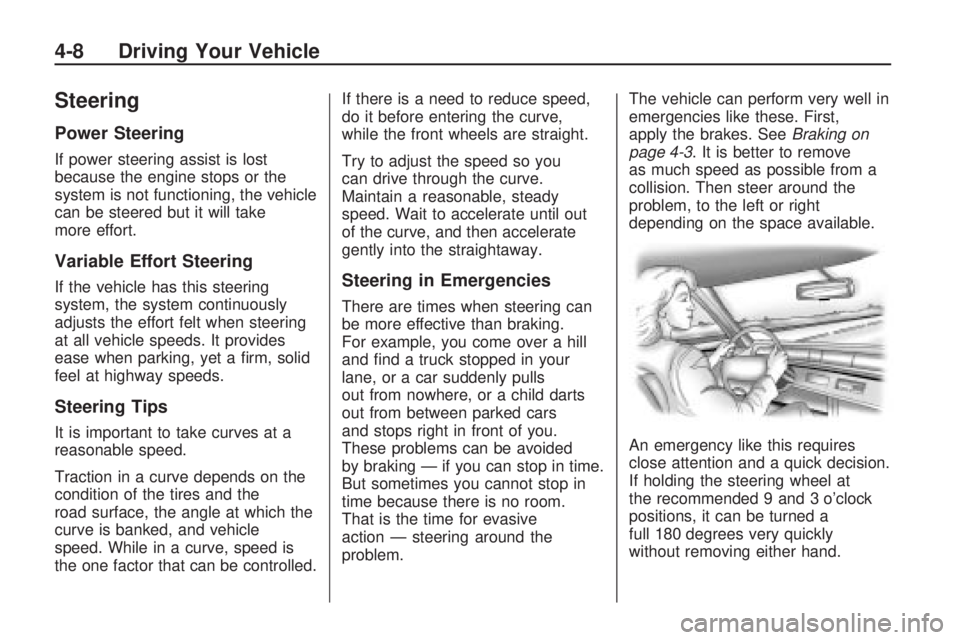
An emergency like this requires
close attention and a quick decision.
If holding the steering wheel at
the recommended 9 and 3 o’clock
positions, it can be turned a
full 180 degrees very quickly
without removing either hand.
4-8 Driving Your Vehicle
Page 251 of 420
But you have to act fast, steer
quickly, and just as quickly
straighten the wheel once you have
avoided the object.
The fact that such emergency
situations are always possible is a
good reason to practice defensive
driving at all times and wear
safety belts properly.
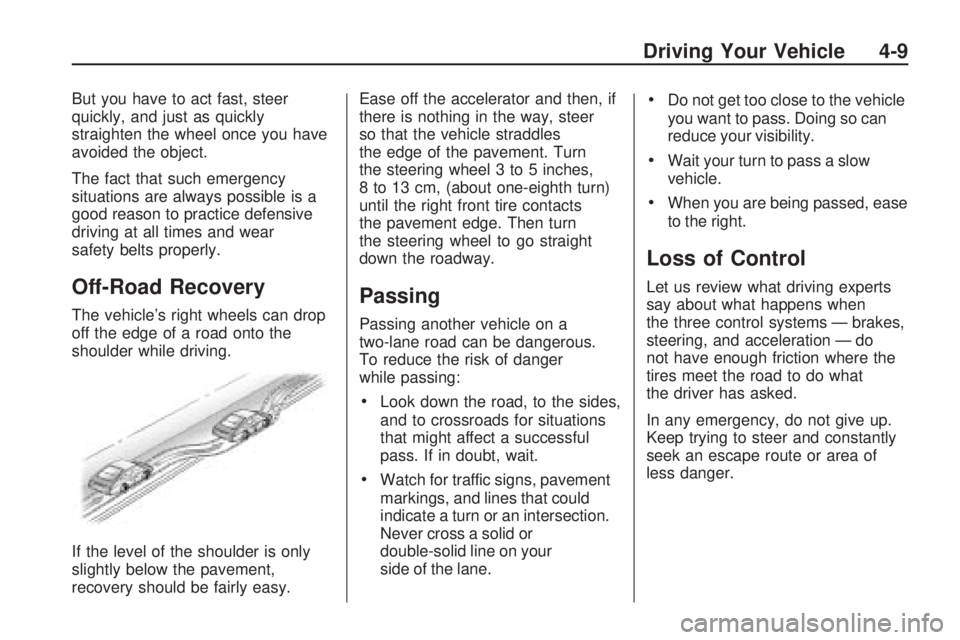
Off-Road Recovery
The vehicle’s right wheels can drop
off the edge of a road onto the
shoulder while driving.
If the level of the shoulder is only
slightly below the pavement,
recovery should be fairly easy.Ease off the accelerator and then, if
there is nothing in the way, steer
so that the vehicle straddles
the edge of the pavement. Turn
the steering wheel 3 to 5 inches,
8 to 13 cm, (about one-eighth turn)
until the right front tire contacts
the pavement edge. Then turn
the steering wheel to go straight
down the roadway.Passing
Passing another vehicle on a
two-lane road can be dangerous.
To reduce the risk of danger
while passing:
Look down the road, to the sides,
and to crossroads for situations
that might affect a successful
pass. If in doubt, wait.
Watch for traffic signs, pavement
markings, and lines that could
indicate a turn or an intersection.
Never cross a solid or
double-solid line on your
side of the lane.
Do not get too close to the vehicle
you want to pass. Doing so can
reduce your visibility.
Wait your turn to pass a slow
vehicle.
When you are being passed, ease
to the right.
Loss of Control
Let us review what driving experts
say about what happens when
the three control systems — brakes,
steering, and acceleration — do
not have enough friction where the
tires meet the road to do what
the driver has asked.
In any emergency, do not give up.
Keep trying to steer and constantly
seek an escape route or area of
less danger.
Driving Your Vehicle 4-9
Page 252 of 420
Skidding
In a skid, a driver can lose control
of the vehicle. Defensive drivers
avoid most skids by taking
reasonable care suited to existing
conditions, and by not overdriving
those conditions. But skids are
always possible.
The three types of skids correspond
to the vehicle’s three control
systems. In the braking skid, the
wheels are not rolling. In the steering
or cornering skid, too much speed
or steering in a curve causes tires
to slip and lose cornering force.
And in the acceleration skid, too
much throttle causes the driving
wheels to spin.
If the vehicle starts to slide, ease
your foot off the accelerator
pedal and quickly steer the way you
want the vehicle to go. If you
start steering quickly enough, the
vehicle may straighten out. Always
be ready for a second skid if it
occurs.Of course, traction is reduced when
water, snow, ice, gravel, or other
material is on the road. For safety,
slow down and adjust your
driving to these conditions. It is
important to slow down on slippery
surfaces because stopping
distance is longer and vehicle
control more limited.
While driving on a surface with
reduced traction, try your best to
avoid sudden steering, acceleration,
or braking, including reducing vehicle
speed by shifting to a lower gear.
Any sudden changes could cause
the tires to slide. You might not
realize the surface is slippery until
the vehicle is skidding. Learn to
recognize warning clues — such as
enough water, ice, or packed snow
on the road to make a mirrored
surface — and slow down when you
have any doubt.
Remember: Any Antilock Brake
System (ABS) helps avoid only the
braking skid.
Driving at Night
Night driving is more dangerous than
day driving because some drivers
are likely to be impaired — by alcohol
or drugs, with night vision problems,
or by fatigue.
Night driving tips include:
Drive defensively.
Do not drink and drive.
Reduce headlamp glare by
adjusting the inside rearview
mirror.
Slow down and keep more space
between you and other vehicles
because headlamps can only
light up so much road ahead.
Watch for animals.
When tired, pull off the road.
Do not wear sunglasses.
Avoid staring directly into
approaching headlamps.
4-10 Driving Your Vehicle
Page 257 of 420
To save fuel, run the engine for only
short periods as needed to warm the
vehicle and then shut the engine off
and close the window most of the
way to save heat. Repeat this until
help arrives but only when you feel
really uncomfortable from the cold.
Moving about to keep warm also
helps.
If it takes some time for help to
arrive, now and then when you run
the engine, push the accelerator
pedal slightly so the engine runs
faster than the idle speed. This
keeps the battery charged to restart
the vehicle and to signal for help with
the headlamps. Do this as little as
possible to save fuel.
If Your Vehicle is
Stuck in Sand, Mud, Ice,
or Snow
Slowly and cautiously spin the
wheels to free the vehicle when
stuck in sand, mud, ice, or snow.
SeeRocking Your Vehicle to Get It
Out on page 4-15.If the vehicle has a traction system,
it can often help to free a stuck
vehicle. Refer to the vehicle’s
traction system in the Index. If stuck
too severely for the traction
system to free the vehicle, turn the
traction system off and use the
rocking method.
{CAUTION
If you let your vehicle’s tires spin
at high speed, they can explode,
and you or others could be
injured. The vehicle can overheat,
causing an engine compartment
re or other damage. Spin the
wheels as little as possible and
avoid going above 35 mph
(55 km/h) as shown on the
speedometer.
For information about using tire
chains on the vehicle, seeTire
Chains on page 5-54.
Rocking Your Vehicle to
Get It Out
Turn the steering wheel left and
right to clear the area around
the front wheels. Turn off any
traction or stability system. Shift
back and forth between R (Reverse)
and a forward gear, spinning the
wheels as little as possible. To
prevent transmission wear, wait until
the wheels stop spinning before
shifting gears. Release the
accelerator pedal while shifting, and
press lightly on the accelerator
pedal when the transmission is in
gear. Slowly spinning the wheels in
the forward and reverse directions
causes a rocking motion that
could free the vehicle. If that does
not get the vehicle out after a
few tries, it might need to be towed
out. If the vehicle does need to
be towed out, seeTowing Your
Vehicle on page 4-20.
Driving Your Vehicle 4-15
Page 265 of 420
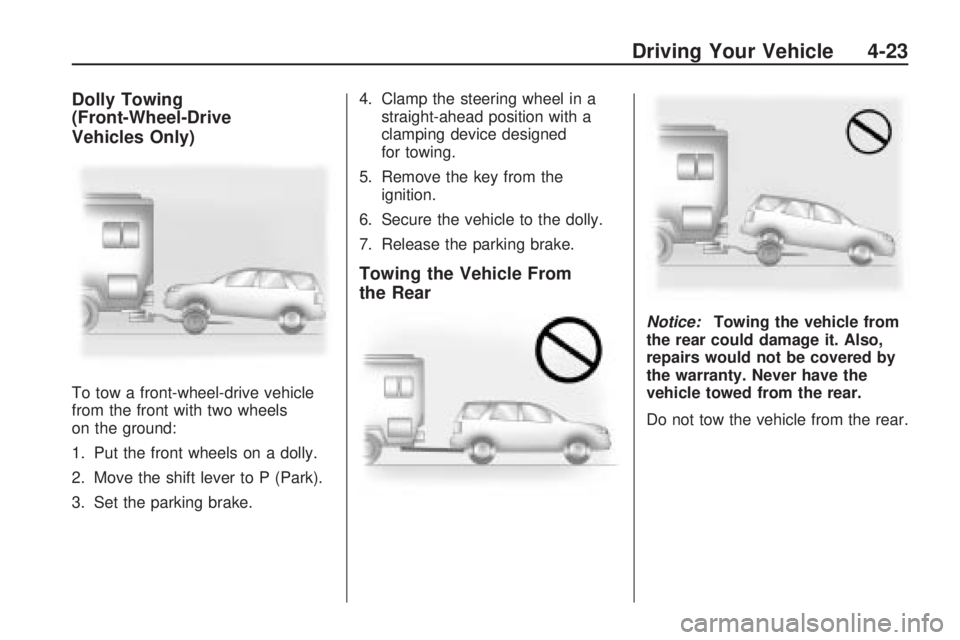
Dolly Towing
(Front-Wheel-Drive
Vehicles Only)
To tow a front-wheel-drive vehicle
from the front with two wheels
on the ground:
1. Put the front wheels on a dolly.
2. Move the shift lever to P (Park).
3. Set the parking brake.4. Clamp the steering wheel in a
straight-ahead position with a
clamping device designed
for towing.
5. Remove the key from the
ignition.
6. Secure the vehicle to the dolly.
7. Release the parking brake.
Towing the Vehicle From
the Rear
Notice:Towing the vehicle from
the rear could damage it. Also,
repairs would not be covered by
the warranty. Never have the
vehicle towed from the rear.
Do not tow the vehicle from the rear.
Driving Your Vehicle 4-23
Page 272 of 420
Backing Up
Hold the bottom of the steering
wheel with one hand. Then, to move
the trailer to the left, move that
hand to the left. To move the trailer
to the right, move your hand to
the right. Always back up slowly
and, if possible, have someone
guide you.
Making Turns
Notice:Making very sharp turns
while trailering could cause
the trailer to come in contact with
the vehicle. The vehicle could
be damaged. Avoid making very
sharp turns while trailering.
When turning with a trailer, make
wider turns than normal. Do this so
the trailer won’t strike soft shoulders,
curbs, road signs, trees or other
objects. Avoid jerky or sudden
maneuvers. Signal well in advance.
Turn Signals When Towing a
Trailer
The arrows on the instrument panel
ash whenever signaling a turn
or lane change. Properly hooked up,
the trailer lamps also ash, telling
other drivers the vehicle is turning,
changing lanes or stopping.
When towing a trailer, the arrows on
the instrument panel ash for turns
even if the bulbs on the trailer are
burned out. For this reason you may
think other drivers are seeing the
signal when they are not. It is
important to check occasionally to be
sure the trailer bulbs are still working.
Driving on Grades
Because of the added load of the
trailer, the vehicle’s engine may
overheat on hot days, when going
up a long or steep grade with a
trailer. If the engine coolant
temperature gage indicates
overheating, turn off the air
conditioning to reduce engine load,
pull off the road and stop in a
safe spot. Let the engine run while
parked, preferably on level
ground, with the transmission in
P (Park) for a few minutes before
turning the engine off.
Reduce speed and shift to a lower
gearbeforestarting down a long
or steep downgrade. If the
transmission is not shifted down, the
brakes might have to be used so
much that they would get hot and no
longer work well.
On a long uphill grade, shift down
and reduce the vehicle speed
to around 55 mph (88 km/h) to
reduce the possibility of the engine
and the transmission overheating.
4-30 Driving Your Vehicle
Page 277 of 420
Service and
Appearance Care
Service
Service...............................5-3
Accessories and
Modications.....................5-3
California Proposition 65
Warning............................5-3
California Perchlorate
Materials Requirements.....5-3
Doing Your Own
Service Work....................5-4
Adding Equipment to the
Outside of the Vehicle......5-4
Fuel
Fuel....................................5-5
Gasoline Octane.................5-5
Gasoline Specications.......5-5
California Fuel....................5-5
Additives.............................5-5
Fuels in Foreign
Countries..........................5-6
Filling the Tank...................5-7
Filling a Portable Fuel
Container..........................5-8
Checking Things
Under the Hood
Checking Things Under
the Hood..........................5-9
Hood Release.....................5-9
Engine Compartment
Overview.........................5-10
Engine Oil.........................5-11
Engine Oil Life System.....5-13
Engine Air Cleaner/Filter. . .5-15
Automatic Transmission
Fluid................................5-16
Cooling System.................5-16
Engine Coolant.................5-17
Engine Overheating...........5-21
Overheated Engine
Protection
Operating Mode
...............5-23
Power Steering Fluid.........5-23
Windshield Washer Fluid. . .5-24
Brakes..............................5-25
Battery..............................5-28
Jump Starting...................5-28
All-Wheel Drive
All-Wheel Drive.................5-33
Headlamp Aiming
Headlamp Aiming..............5-33
Bulb Replacement
Bulb Replacement.............5-33
Halogen Bulbs..................5-33
License Plate Lamp..........5-34
Replacement Bulbs...........5-34
Windshield Wiper
Blade Replacement
Windshield Wiper Blade
Replacement...................5-34
Tires
Tires.................................5-35
Tire Sidewall Labeling.......5-36
Tire Terminology and
Denitions.......................5-38
Ination - Tire Pressure. . . .5-41
Tire Pressure Monitor
System............................5-42
Tire Pressure Monitor
Operation........................5-44
Tire Inspection and
Rotation..........................5-47
Service and Appearance Care 5-1
Page 314 of 420
Tire Size
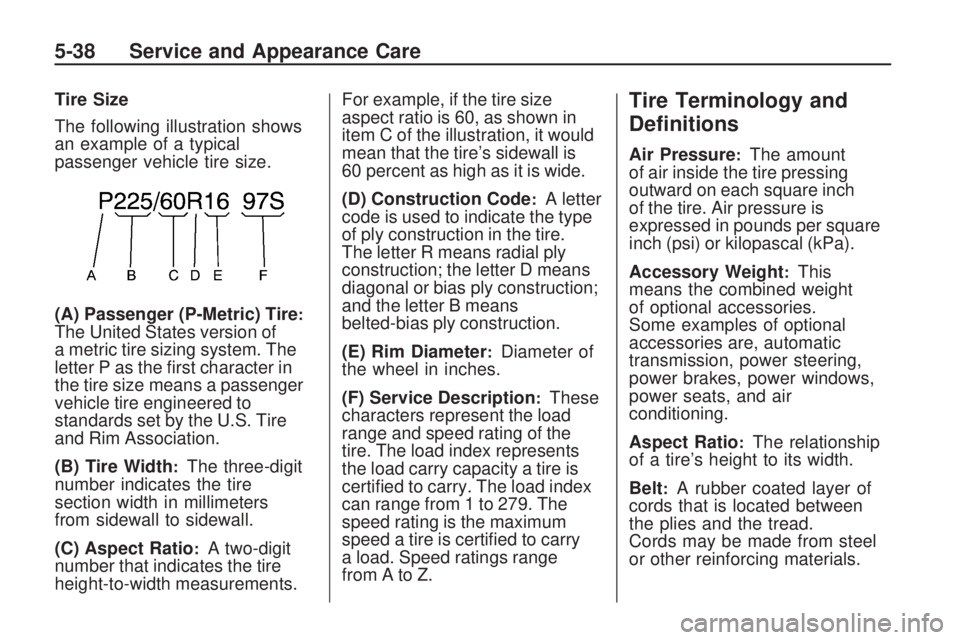
The following illustration shows
an example of a typical
passenger vehicle tire size.
(A) Passenger (P-Metric) Tire
:The United States version of
a metric tire sizing system. The
letter P as the rst character in
the tire size means a passenger
vehicle tire engineered to
standards set by the U.S. Tire
and Rim Association.
(B) Tire Width
:The three-digit
number indicates the tire
section width in millimeters
from sidewall to sidewall.
(C) Aspect Ratio
:A two-digit
number that indicates the tire
height-to-width measurements.For example, if the tire size
aspect ratio is 60, as shown in
item C of the illustration, it would
mean that the tire’s sidewall is
60 percent as high as it is wide.
(D) Construction Code
:A letter
code is used to indicate the type
of ply construction in the tire.
The letter R means radial ply
construction; the letter D means
diagonal or bias ply construction;
and the letter B means
belted-bias ply construction.
(E) Rim Diameter
:Diameter of
the wheel in inches.
(F) Service Description
:These
characters represent the load
range and speed rating of the
tire. The load index represents
the load carry capacity a tire is
certied to carry. The load index
can range from 1 to 279. The
speed rating is the maximum
speed a tire is certied to carry
a load. Speed ratings range
fromAtoZ.
Tire Terminology and
Denitions
Air Pressure:The amount
of air inside the tire pressing
outward on each square inch
of the tire. Air pressure is
expressed in pounds per square
inch (psi) or kilopascal (kPa).
Accessory Weight
:This
means the combined weight
of optional accessories.
Some examples of optional
accessories are, automatic
transmission, power steering,
power brakes, power windows,
power seats, and air
conditioning.
Aspect Ratio
:The relationship
of a tire’s height to its width.
Belt
:A rubber coated layer of
cords that is located between
the plies and the tread.
Cords may be made from steel
or other reinforcing materials.
5-38 Service and Appearance Care