ECU GMC CANYON 2008 Owner's Guide
[x] Cancel search | Manufacturer: GMC, Model Year: 2008, Model line: CANYON, Model: GMC CANYON 2008Pages: 428, PDF Size: 5.82 MB
Page 81 of 428
Keys...............................................................2-3
Remote Keyless Entry (RKE) System.................2-4
Remote Keyless Entry (RKE)
System Operation.......................................2-5
Doors and Locks.............................................2-7
Door Locks....................................................2-7
Power Door Locks..........................................2-8
Programmable Automatic Door Locks.................2-8
Rear Door Security Locks (Crew Cab)...............2-9
Lockout Protection..........................................2-9
Rear Doors (Extended Cab).............................2-9
Tailgate.......................................................2-10
Windows........................................................2-12
Manual Windows..........................................2-12
Power Windows............................................2-13
Sliding Rear Window.....................................2-14
Sun Visors...................................................2-14
Theft-Deterrent Systems..................................2-15
Content Theft-Deterrent.................................2-15
Passlock
®(U. S. Only)..................................2-16
PASS-Key®III+............................................2-17
PASS-Key®III+ Operation (Canada Only).........2-17Starting and Operating Your Vehicle................2-19
New Vehicle Break-In....................................2-19
Ignition Positions..........................................2-19
Retained Accessory Power (RAP)...................2-21
Starting the Engine.......................................2-21
Engine Coolant Heater..................................2-22
Automatic Transmission Operation...................2-23
Manual Transmission Operation......................2-26
Four-Wheel Drive..........................................2-28
Parking Brake..............................................2-32
Shifting Into PARK (P)
(Automatic Transmission)............................2-34
Shifting Out of PARK (P)
(Automatic Transmission)............................2-36
Parking Your Vehicle
(Manual Transmission)...............................2-37
Parking Over Things That Burn.......................2-37
Engine Exhaust............................................2-37
Running the Engine While Parked...................2-38
Section 2 Features and Controls
2-1
Page 89 of 428
Rear Door Security Locks
(Crew Cab)
If your vehicle is a crew cab model, it may have rear
door security locks. With this feature, you can lock the
rear doors so they cannot be opened from the inside.
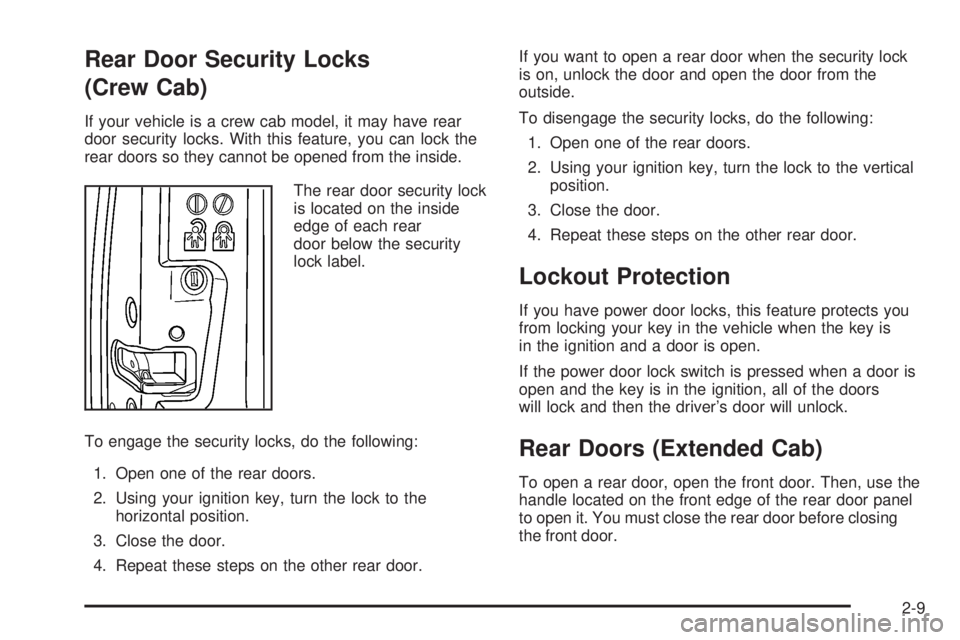
The rear door security lock
is located on the inside
edge of each rear
door below the security
lock label.
To engage the security locks, do the following:
1. Open one of the rear doors.
2. Using your ignition key, turn the lock to the
horizontal position.
3. Close the door.
4. Repeat these steps on the other rear door.If you want to open a rear door when the security lock
is on, unlock the door and open the door from the
outside.
To disengage the security locks, do the following:
1. Open one of the rear doors.
2. Using your ignition key, turn the lock to the vertical
position.
3. Close the door.
4. Repeat these steps on the other rear door.
Lockout Protection
If you have power door locks, this feature protects you
from locking your key in the vehicle when the key is
in the ignition and a door is open.
If the power door lock switch is pressed when a door is
open and the key is in the ignition, all of the doors
will lock and then the driver’s door will unlock.
Rear Doors (Extended Cab)
To open a rear door, open the front door. Then, use the
handle located on the front edge of the rear door panel
to open it. You must close the rear door before closing
the front door.
2-9
Page 90 of 428
Tailgate
{CAUTION:
It is extremely dangerous to ride on the
tailgate, even when the vehicle is operated at
low speeds. People riding on the tailgate can
easily lose their balance and fall in response to
vehicle maneuvers. Falling from a moving
vehicle may result in serious injuries or death.
Do not allow people to ride on the tailgate. Be
sure everyone in your vehicle is in a seat and
using a safety belt properly.
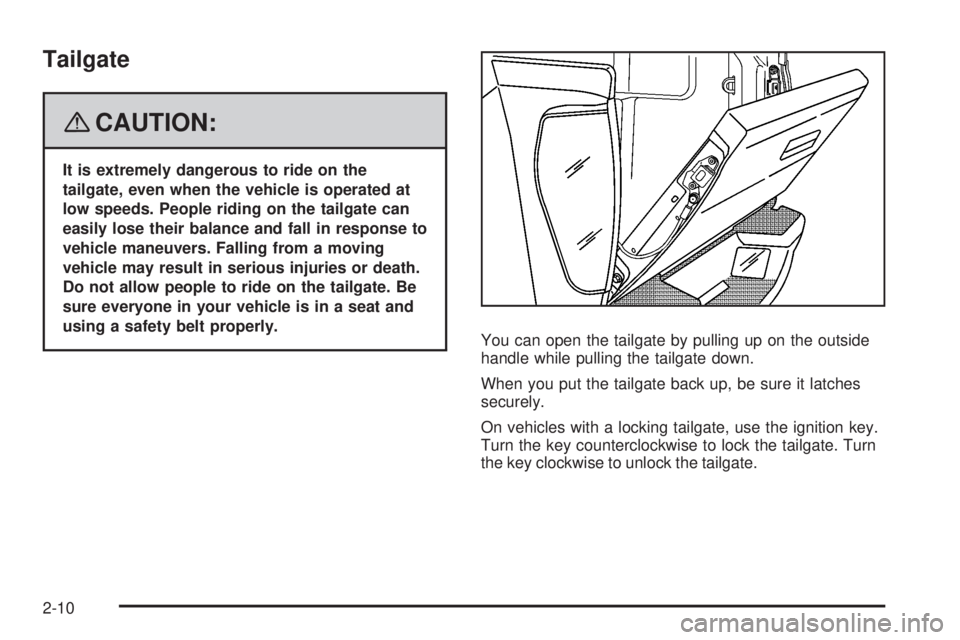
You can open the tailgate by pulling up on the outside
handle while pulling the tailgate down.
When you put the tailgate back up, be sure it latches
securely.
On vehicles with a locking tailgate, use the ignition key.
Turn the key counterclockwise to lock the tailgate. Turn
the key clockwise to unlock the tailgate.
2-10
Page 91 of 428
Removing the Tailgate
Follow these steps if you want to remove the tailgate:
1. With the tailgate fully open, lift up slightly on the
entire tailgate assembly.
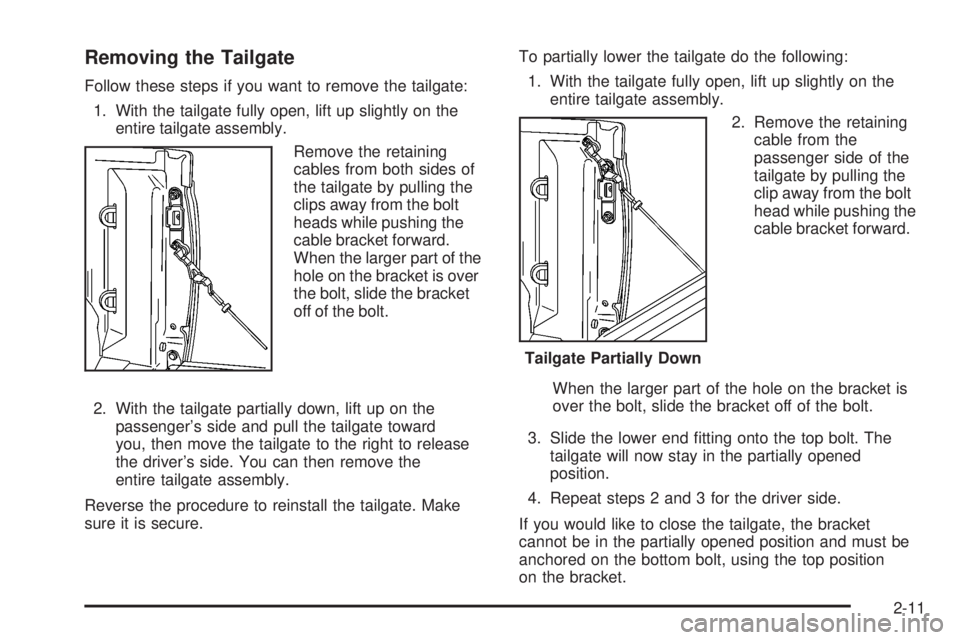
Remove the retaining
cables from both sides of
the tailgate by pulling the
clips away from the bolt
heads while pushing the
cable bracket forward.
When the larger part of the
hole on the bracket is over
the bolt, slide the bracket
off of the bolt.
2. With the tailgate partially down, lift up on the
passenger’s side and pull the tailgate toward
you, then move the tailgate to the right to release
the driver’s side. You can then remove the
entire tailgate assembly.
Reverse the procedure to reinstall the tailgate. Make
sure it is secure.To partially lower the tailgate do the following:
1. With the tailgate fully open, lift up slightly on the
entire tailgate assembly.
2. Remove the retaining
cable from the
passenger side of the
tailgate by pulling the
clip away from the bolt
head while pushing the
cable bracket forward.
When the larger part of the hole on the bracket is
over the bolt, slide the bracket off of the bolt.
3. Slide the lower end tting onto the top bolt. The
tailgate will now stay in the partially opened
position.
4. Repeat steps 2 and 3 for the driver side.
If you would like to close the tailgate, the bracket
cannot be in the partially opened position and must be
anchored on the bottom bolt, using the top position
on the bracket.
Tailgate Partially Down
2-11
Page 95 of 428
Visor Vanity Mirror
The passenger’s side sun visor may have a mirror. Pull
down the visor to access the mirror.
Theft-Deterrent Systems
Vehicle theft is big business, especially in some cities.
Although your vehicle has a number of theft-deterrent
features, we know that nothing we put on it can make it
impossible to steal.
Content Theft-Deterrent
If your vehicle has
the Remote Keyless
Entry (RKE) system, the
vehicle has a content
theft-deterrent alarm
system.To activate the content theft-deterrent system:
1. Close all the doors.
2. Lock the doors with the RKE transmitter. The
security light, located on the instrument panel
cluster, will ash.
If the lock button on the RKE transmitter is pressed, but
a door is open, the horn will chirp six times. Press
the lock button again, within three seconds, and the
doors will lock. Close the open door and the system will
be activated.
If a locked door is not opened using the RKE transmitter,
or by OnStar
®, the pre-alarm will go off. If the engine
is not started or unlock not pressed within 10 seconds,
the front turn signal lamps will ash for two minutes, and
the horn will sound for two minutes, then will turn off to
save the battery power.
Remember, the theft-deterrent system will not activate if
you lock the doors with a key, the manual door lock,
or power door lock switch. The system can only
be activated using the RKE transmitter, or by OnStar
®.
SeeOnStar®System on page 2-47for additional
information. You should also remember that you can
start your vehicle with the correct ignition key if the alarm
has been set off.
2-15
Page 96 of 428
Here is how to avoid setting off the alarm by accident:
If you do not want to activate the theft-deterrent
system, the vehicle should be locked with the
door key after the doors are closed.
Always unlock a door with the RKE transmitter.
Unlocking a door any other way will set off the
alarm.
If you set off the alarm by accident, you can turn off the
alarm by pressing unlock on the RKE transmitter.
The alarm will not stop if you try to unlock a door any
other way.
Testing the Alarm
To test the alarm:
1. From inside the vehicle, activate the system by
locking the doors with the RKE transmitter.
2. Unlock the door with the manual door lock and
open the door. This should set off the alarm.
3. To turn the alarm off, press the unlock button on
the RKE transmitter or start the engine.
If the alarm does not sound when it should but the lights
ash, check to see if the horn works. The horn fuse
may be blown. To replace the fuse, seeFuses
and Circuit Breakers on page 5-110.
If the alarm does not sound or the front turn signal
lamps do not ash, see your dealer/retailer for service.
Passlock®(U. S. Only)
Your vehicle has the Passlock®theft-deterrent system.
Passlock
®is a passive theft-deterrent system.
Passlock®enables fuel if the ignition lock cylinder is
turned with a valid key. If an incorrect key is used or the
ignition lock cylinder is tampered with, the fuel system is
disabled and the vehicle will not start.
During normal operation, the security light will turn off
approximately ve seconds after the engine is started.
SeeSecurity Light on page 3-37.
If the engine stalls and the security light ashes, wait
about 10 minutes until the light stops ashing before
trying to restart the engine. Remember to release the
key from START as soon as the engine starts.
If the engine does not start after three tries, the vehicle
needs service.
If the engine is running and the security light comes on,
you will be able to restart the engine if you turn the
engine off. However, your Passlock
®system is not
working properly and must be serviced by your dealer/
retailer. Your vehicle is not protected by Passlock
®at this
time. See your dealer/retailer for service.
In an emergency, call the Roadside Assistance Center.
SeeRoadside Assistance Program on page 7-7.
Do not leave the key or device that disarms or
deactivates the theft deterrent system in the vehicle.
2-16
Page 97 of 428
PASS-Key®III+
The PASS-Key®III+ system operates on a radio
frequency subject to Federal Communications
Commission (FCC) Rules and with Industry Canada.
This device complies with Part 15 of the FCC Rules.
Operation is subject to the following two conditions:
1. This device may not cause harmful interference.
2. This device must accept any interference received,
including interference that may cause undesired
operation.
This device complies with RSS-210 of Industry Canada.
Operation is subject to the following two conditions:
1. This device may not cause interference.
2. This device must accept any interference received,
including interference that may cause undesired
operation of the device.
Changes or modications to this system by other than
an authorized service facility could void authorization to
use this equipment.
PASS-Key
®III+ uses a radio frequency transponder in
the key that matches a decoder in your vehicle.
PASS-Key®III+ Operation
(Canada Only)
Your vehicle has a passive theft-deterrent system.
The system is automatically armed when the key
is removed from the ignition.
The system is automatically disarmed when the key is
turned to ON/RUN.
You do not have to manually arm or disarm the system.
The security light will come on if there is a problem with
arming or disarming the theft-deterrent system.
The key uses a transponder that matches an immobilizer
control unit in your vehicle. Only the correct key will
start the vehicle. If the key is ever damaged, you may
not be able to start your vehicle.
When trying to start the vehicle, if the engine does not
start and the security light comes on, there may be
a problem with your theft-deterrent system. Turn the
ignition off and try again.
If the engine still does not start, and the key appears to
be undamaged, try another ignition key. At this time,
you may also want to check the fuse. SeeFuses and
Circuit Breakers on page 5-110. If the engine still does
not start with the other key, your vehicle needs service.
2-17
Page 98 of 428
If your vehicle does start, the rst key may be faulty. See
your dealer/retailer who can service the theft-deterrent
system and have a new key made.
It is possible for the theft-deterrent system decoder to
learn the transponder value of a new or replacement
key. Up to 10 keys can be programmed for the vehicle.
The following procedure is for programming additional
keys only.
Canadian Owners:If you lose or damage your keys,
only a dealer/retailer can service the theft-deterrent
system to have new keys made. To program additional
keys you will require two current driver’s keys.
To program a new key do the following:
1. Verify that the new key has PK3+ stamped on it.
2. Insert the current driver’s key in the ignition
and start the engine. If the engine will not start see
your dealer/retailer for service.
3. After the engine has started, turn the key to
LOCK/OFF, and remove the key.4. Insert the second current driver’s key in the ignition
and start the engine within ten seconds of removing
the previous key. If the engine will not start see
your dealer/retailer for service.
5. After the engine has started, turn the key to
LOCK/OFF, and remove the key. Insert the key to
be programmed and turn it to ON/RUN within
ten seconds of removing the previous key.
The security light will turn off once the key has
been programmed.
6. Repeat the Steps 1 through 5 if additional keys are
to be programmed.
If the security light comes on and stays on while driving,
you will be able to restart the engine if you turn it off.
The theft-deterrent system, however, is not working
properly and must be serviced by your dealer/retailer.
Your vehicle is not protected by the theft-deterrent
system at this time.
In an emergency, contact Roadside Assistance.
SeeRoadside Assistance Program on page 7-7.
Do not leave the key or device that disarms or
deactivates the theft deterrent system in the vehicle.
2-18
Page 127 of 428
OnStar®System
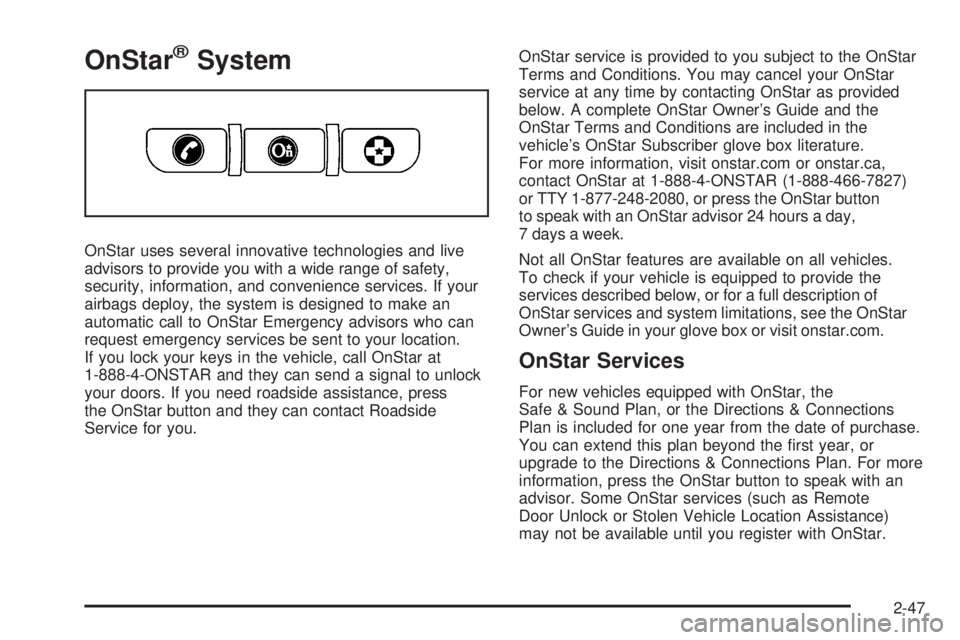
OnStar uses several innovative technologies and live
advisors to provide you with a wide range of safety,
security, information, and convenience services. If your
airbags deploy, the system is designed to make an
automatic call to OnStar Emergency advisors who can
request emergency services be sent to your location.
If you lock your keys in the vehicle, call OnStar at
1-888-4-ONSTAR and they can send a signal to unlock
your doors. If you need roadside assistance, press
the OnStar button and they can contact Roadside
Service for you.OnStar service is provided to you subject to the OnStar
Terms and Conditions. You may cancel your OnStar
service at any time by contacting OnStar as provided
below. A complete OnStar Owner’s Guide and the
OnStar Terms and Conditions are included in the
vehicle’s OnStar Subscriber glove box literature.
For more information, visit onstar.com or onstar.ca,
contact OnStar at 1-888-4-ONSTAR (1-888-466-7827)
or TTY 1-877-248-2080, or press the OnStar button
to speak with an OnStar advisor 24 hours a day,
7 days a week.
Not all OnStar features are available on all vehicles.
To check if your vehicle is equipped to provide the
services described below, or for a full description of
OnStar services and system limitations, see the OnStar
Owner’s Guide in your glove box or visit onstar.com.
OnStar Services
For new vehicles equipped with OnStar, the
Safe & Sound Plan, or the Directions & Connections
Plan is included for one year from the date of purchase.
You can extend this plan beyond the rst year, or
upgrade to the Directions & Connections Plan. For more
information, press the OnStar button to speak with an
advisor. Some OnStar services (such as Remote
Door Unlock or Stolen Vehicle Location Assistance)
may not be available until you register with OnStar.
2-47
Page 134 of 428
Up-Shift Light...............................................3-30
Brake System Warning Light..........................3-31
Antilock Brake System Warning Light...............3-32
Traction Control System (TCS)
Warning Light...........................................3-32
Engine Coolant Temperature Gage..................3-33
Tire Pressure Light.......................................3-33
Malfunction Indicator Lamp.............................3-34
Oil Pressure Light.........................................3-36
Security Light...............................................3-37
Cruise Control Light......................................3-37
Highbeam On Light.......................................3-37
Fuel Gage...................................................3-38Driver Information Center (DIC).......................3-38
DIC Operation and Displays...........................3-38
DIC Warnings and Messages.........................3-42
Audio System(s).............................................3-46
Setting the Time...........................................3-47
Radio(s)......................................................3-48
Using an MP3..............................................3-64
XM Radio Messages.....................................3-68
Theft-Deterrent Feature..................................3-69
Radio Reception...........................................3-69
Fixed Mast Antenna......................................3-70
XM™ Satellite Radio Antenna System..............3-70
Chime Level Adjustment................................3-70
Section 3 Instrument Panel
3-2