lock GMC ENVOY 1998 Service Manual
[x] Cancel search | Manufacturer: GMC, Model Year: 1998, Model line: ENVOY, Model: GMC ENVOY 1998Pages: 386, PDF Size: 20.33 MB
Page 134 of 386
Section 3 Comfort Controls and Audio Systems
In this section, you’ll find out how to operate the comfort control and audio systems offered with your vehicle. Be
sure to read about the particular systems supplied with your vehicle.
3-2
3-2
3
-5
3-5
3-5
3-6
3-7
3-8
3-8
3-8
Comfort Controls Electronic Climate Control System
Air Conditioning
Heating
Ventilation System
Defogging and Defrosting
Rear Window Defogger
Audio Systems Setting the Clock
AM-FM Stereo with Cassette
Tape Player 3- 12
3- 16
3-18
3-2 1
3-23
3-23
3-24
3-26
3-26
3-26
AM-FM Stereo with Compact Disc Player
(If Equipped)
Rear Seat Audio (RSA)
Console-Mounted CD Changer
Theft-Deterrent Feature
Understanding Radio Reception
Tips About Your Audio System
Care of Your Cassette Tape Player
Care
of Your Compact Discs
Care of Your Compact Disc Player
Fixed Mast Antenna
3-1
ProCarManuals.com
Page 141 of 386

Audio Systems
Your Delco Electronics audio system has been designed
to operate easily and give years
of listening pleasure.
You will get the most enjoyment out of it if you acquaint
yourself with
it first. Find out what your Delco
Electronics system can do and how to operate all its
controls, to be sure you’re getting the most
out of the
advanced engineering that went into it.
Setting the Clock
Press and hold HR until the correct hour appears on the
display. Press and hold
MN until the correct minute
appears
on the display. To display the clock with the
ignition
off, press RECALL or HR/MN and the time
will be displayed for
a few seconds. There is an initial
two-second delay before the clock goes into the
time-set mode.
AM-FM Stereo with Cassette Tape Player
Included with the AM-FM Stereo with Cassette Tape
Player are six
Base@ high performance speakers and a six
channel Bose amplifier. Please see your dealer for details.
Playing the Radio
PWR-VOL: Press this knob to turn the system on and
off.
To increase volume, turn the knob to the right. Turn
it to the left to decrease volume. The knob is capable of
being rotated continuously.
REAR DSPL: When the primary radio is turned on,
press
this button to turn the rear seat audio display on.
Press
it again to turn the rear seat audio display off.
3-8
ProCarManuals.com
Page 154 of 386

Compact Disc Changer Errors
If ERR appears on the display, it could be that:
0
0
0
0
0
0
0
You are driving on a very rough road. (The disc
should play when the road gets smoother.)
A disc is upside down.
It is dirty, scratched or wet.
It is very humid.
(If so, wait about an hour and
try again.)
The disc player
is very hot.
The CD changer door
is open. Completely close the
changer door
to restore normal operation.
An empty magazine is inserted in the CD changer.
Try the magazine again with a disc loaded on one of
the trays.
Press
RECALL to make ERR go off the display.
If any error occurs repeatedly or if an error cannot be
corrected, please contact your dealer.
Theft-Deterrent Feature
THEFTLOCK@ is designed to discourage theft of your
radio.
It works by using a secret code to disable all radio
functions whenever battery power is removed.
The THEFTLOCK feature for the radio may be used or
ignored.
If ignored, the system plays normally and the
radio is not protected by the feature. If THEFTLOCK is
activated, your radio will
not operate if stolen.
When THEFTLOCK is activated, the radio will display
LOC to indicate a locked condition anytime battery
power has been interrupted. If your battery loses power
for any reason, you must unlock the radio with
the secret
code before
it will operate.
Activating the Theft-Deterrent Feature
The instructions which follow explain how to enter your
secret code to activate
the THEFTLOCK system. It is
recommended that you read through all nine steps
before starting
the procedure.
NOTE:
If you allow more than 15 seconds to elapse
between any steps, the radio automatically reverts to
time and you must start the procedure over at Step 4.
3-21
I
ProCarManuals.com
Page 155 of 386

1. Write down any three or four-digit number from
000 to 1999 and keep it in a safe place separate from
the vehicle.
2. Turn the ignition to ACCESSORY or RUN.
3. Turn the radio off.
4. Press the 1 and 4 buttons together. Hold them down
until
--- shows on the display. Next you will use the
secret code number which you have written down.
5. Press MN and 000 will appear on the display.
6. Press MN again to make the last two digits agree
7. Press HR to make the first one or two digits agree
with your code.
with your
code.
8. Press AM-FM after you have confirmed that the
code matches the secret code
you have written down.
The display will show REP to let you know that you
need to repeat Steps
5 through 7 to confirm your
secret code.
9. Press AM-FM and this time the display will show
SEC to let you know that your radio is secure. The
indicator by the volume control will begin flashing
when the ignition is turned
off.
Unlocking the Theft-Deterrent Feature After a
Power Loss
Enter your secret code as follows; pause no more than
15 seconds between steps:
1. LOC appears when the ignition is on.
2. Press MN and 000 will appear on the display.
3. Press MN again to make the last two digits agree
with your code.
4. Press HR to make the first one or two digits agree
5. Press AM-FM after you have confirmed that the
with your code.
code matches the secret code
you have written down.
The display will show SEC, indicating the radio is
now operable and secure.
If you enter the wrong code eight times, INOP will
appear on the display.
You will have to wait an hour
with the ignition
on before you can try again. When you
try again,
you will only have three chances to enter the
correct code before INOP appears.
If you lose or forget your code, contact your dealer.
3-22
ProCarManuals.com
Page 156 of 386

Disabling the Theft-Deterrent Feature
Enter your secret code as follows; pause no more than
15 seconds between steps:
1. Turn the ignition to ACCESSORY or RUN.
2. Turn the radio off.
3. Press the 1 and 4 buttons together. Hold them down
until SEC shows on the display.
4. Press MN and 000 will appear on the display.
5. Press MN again to make the last two digits agree
with your code.
6. Press HR to make the first one or two digits agree
with your code.
7. Press AM-FM after you have confirmed that the
code matches the secret code
you have written down.
The display will show
---, indicating that the radio is
no longer secured.
If the code entered is incorrect, SEC will appear
on the
display. The radio will remain secured
until the correct
code
is entered.
When battery power is removed and later applied to
a
secured radio, the radio won’t turn on and LOC will
appear on the display.
To unlock a secured radio, see “Unlocking the
Theft-Deterrent Feature After a Power
Loss” earlier in
this section.
Understanding Radio Reception
AM
The range for most AM stations is greater than for FM,
especially at night. The longer range, however, can
cause stations to interfere with each other. AM can pick
up noise from things like storms and power lines. Try
reducing the treble to reduce this noise
if you ever get it.
FM Stereo
FM stereo will give you the best sound, but FM signals
will reach
only about 10 to 40 miles (1 6 to 65 km). Tall
buildings or hills can interfere with
FM signals, causing
the sound to come and go.
Tips About Your Audio System
Hearing damage from loud noise is almost undetectable
until it is too late. Your hearing can adapt to higher
volumes
of sound. Sound that seems normal can be loud
and harmful to your hearing. Take precautions by
adjusting the volume control on your radio to a safe
sound level before your hearing adapts to
it.
3-23
I
ProCarManuals.com
Page 166 of 386

And, of course, actual stopping distances vary greatly
with the surface of the road (whether it‘s pavement or
gravel);
the condition of the road (wet, dry, icy); tire
tread; the condition of your brakes; the weight of the
vehicle and the amount of brake force applied.
Avoid needless heavy braking. Some people drive
in
spurts -- heavy acceleration followed by heavy
braking
-- rather than keeping pace with traffic. This is a
mistake. Your brakes may not have time to cool between
hard stops. Your brakes will wear out rnucit faster
if you
do a lot of heavy braking.
If you keep pace with the
traffic and allow realistic following distances, you
will
eliminate a lot of unnecessary braking. Th, ti t means
better braking and longer brake life.
If your engine ever stops while you’re driving, brake
normally but don’t pump your brakes.
If you do, the
pedal may get harder
to push down. If your engine
stops,
you will still have some power brake assist. But
you will use it when you brake. Once the power assist is
used
up, it may take longer to stop and the brake pedal
will be harder
to push.
Anti-Lock Brakes (ABS)
Your vehicle has anti-lock brakes (ABS). ABS is an
advanced electronic braking system that will help
prevent
;1 braking skid.
When you start your engine and begin to drive away,
your anti-lock brake system
will check itself. You may
hear
a momentary motor or clicking noise while this test
is going on. This is normal.
If there’s a problem with the
anti-lock brake system, this
warning light
will stay on.
See “Anti-Lock Brake
System Warning Light”
in
the Index.
4-7
1
ProCarManuals.com
Page 167 of 386
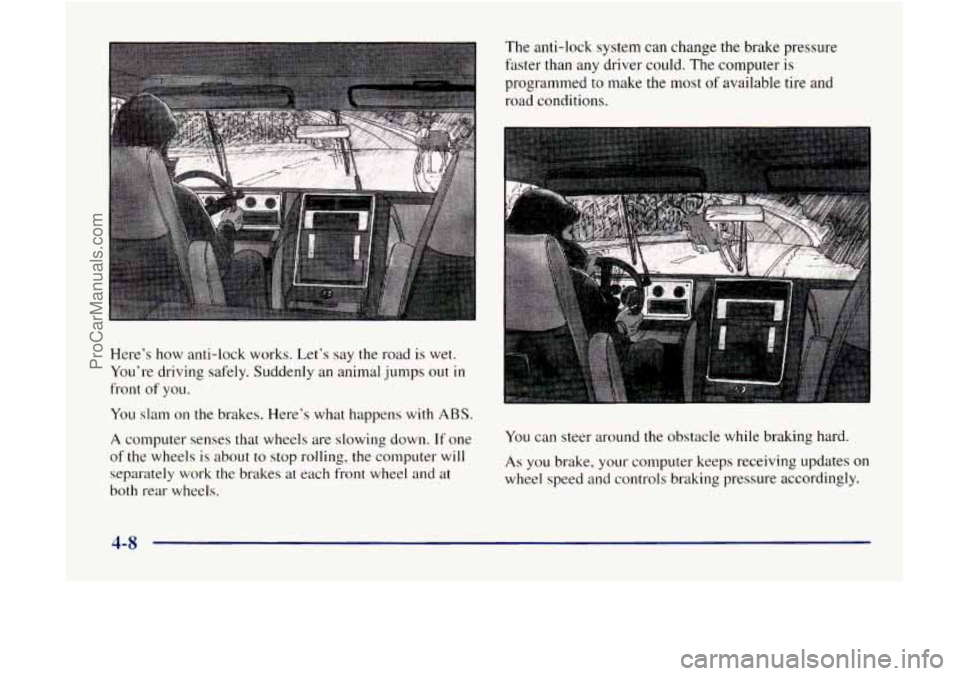
Here’s how anti-lock works. Let’s say the road is wet.
You’re driving safely. Suddenly an animal jumps out
in
front of you.
You slam on
the brakes. Here’s what happens with ABS.
A computer senses that wheels are slowing down. If one
of the wheels is about to stop rolling, the computer will
separately work the brakes at each front wheel and at
both rear wheels. The anti-lock system can
change the brake pressure
faster than any driver could. The computer
is
programmed to make the most of available tire and
road conditions.
You can steer around the obstacle while braking hard.
As you brake, your computer keeps receiving updates on
wheel speed and controls braking pressure accordingly.
4-8
ProCarManuals.com
Page 168 of 386
Re,member: Anti-lock doesn’t change the time you need
to get your foot up to the brake pedal or always decrease
stopping distance.
If you get too close to the vehicle in
front of you, you won’t have time to apply your brakes
if that vehicle suddenly slows or stops. Always leave
enough room up ahead
to stop, even though you have
anti-lock brakes.
Steering
Power Steering
If you lose power steering assist because the engine
stops or the system is not functioning, you can steer but
it will take much more effort.
Using Anti-Lock
Don‘t pump the brakes. Just hold the brake pedal down
firmly and let anti-lock work for you. You may feel the
brakes vibrate,
or YOLI may notice some noise, but
this is normal. Your anti-lock brakes work at all
times
-- whether you are in two-wheel or
four-wheel drive.
Braking in Emergencies
With anti-lock, you can steer and brake at the same
time.
In many emergencies, steering can help you more
than even the very best braking.
Steering Tips
Driving on Curves
It’s important to take curves at a reasonable speed.
A lot of the “driver lost control“ accidents mentioned on
the news happen on curves. Here’s
why:
Experienced driver or beginner, each of us is subject to
the same laws of physics when driving on curves. The
traction of the tires against the road surface makes
it
possible for the vehicle to change its path when you turn
the front wheels. If there’s no traction, inertia will keep
the vehicle going
in the same direction. If you’ve ever
tried to steer a vehicle on wet ice, you’ll understand this.
4-9
1
ProCarManuals.com
Page 170 of 386
Load Recovery
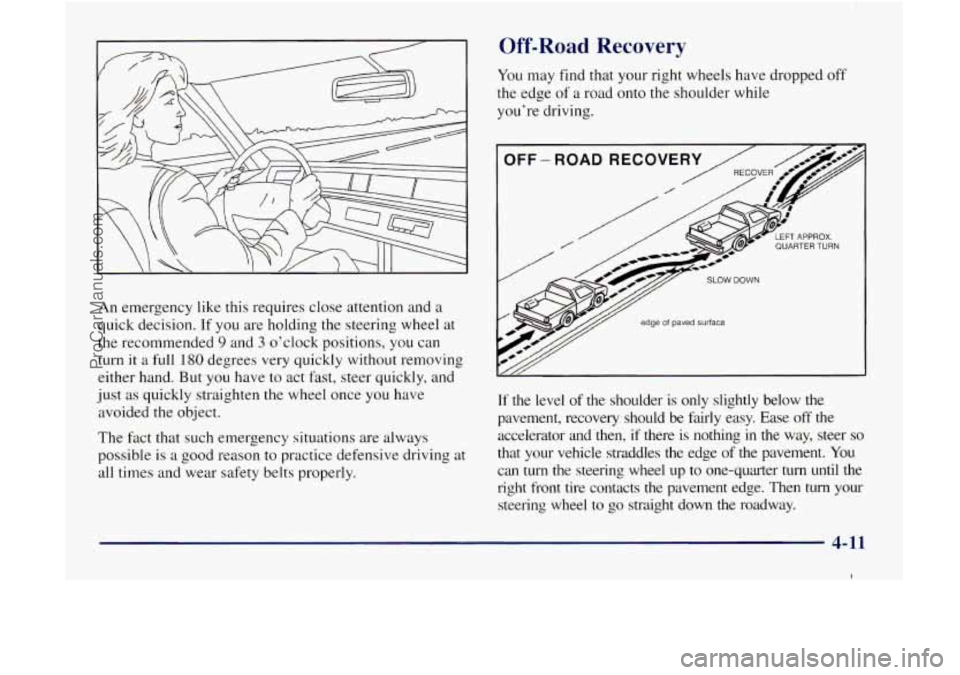
You may find that your right wheels have dropped off
the edge of a road onto the shoulder while
you're driving.
An emergency like this requires close attention and a
quick decision. If you are holding the steering wheel at
the recommended
9 and 3 o'clock positions, you can
turn it a
full 180 degrees very quickly without removing
either hand.
But you have to act fast, steer quickly, and
just as quickly straighten the wheel once you have
avoided the object.
The fac.t that such emergency situations are always
possible is
a good reason to practice defensive driving at
all times
and wear safety belts properly.
OFF - ROAD RECOVE
edge of paved surface
If the level of the shoulder is only slightly below the
pavement, recovery should be fairly easy. Ease
off the
accelerator and then, if there is nothing in the way, steer so
that your vehicle straddles the edge of the pavement. You
can turn the steering wheel up to one-quarter turn until the right front tire contacts the pavement edge. Then turn your
steering wheel to go straight down the roadway.
ProCarManuals.com
Page 173 of 386
If your vehicle starts to slide, ease your foot off the
accelerator pedal and quickly steer the way you want the
vehicle to go.
If you start steering quickly enough, your
vehicle may straighten out. Always be ready for
a
second skid if it occurs.
Of course, traction is reduced when water, snow, ice,
gravel or other material is
on the road. For safety, you‘ll
want to slow down and adjust your driving to these
conditions.
It is important to slow down on slippery
surfxes because stopping distance will be longer and
vehicle control more limited.
While driving on a surfxe
with reduced traction, try
your best to avoid sudden steering, acceleration
or
braking (including engine braking by shifting to a lower
gear). Any sudden changes could cause the tires to slide.
You may not realize the surfdce is slippery
until your
vehicle is skidding. Learn to recognize warning
clues
-- such as enough water, ice or packed snow on
the road to make a “mirrored surface”
-- and slow
down when
you have any doubt.
Remember: Any anti-lock brake system (ABS) helps
avoid only
the braking skid.
Driving Gu idelines
This multipurpose passenger vehicle is defined as a
utility vehicle in Consumer Information Regulations
issued by the National Highway Traffic Safety
Administration (NHTSA) of
the United States
Department of Transportation. Utility vehicles have
higher ground clearance and a narrower track to make
them capable of performing in a wide variety of off-road
applications. Specific design characteristics give them a
higher center of gravity than ordinary cars. An
advantage of the higher ground clearance is a better
view of the road allowing you
to anticipate problems.
They are not designed for cornering at
the same speeds
as conventional two-wheel-drive vehicles any more than
low-slung sports cars are designed to perform
satisfxtorily under off-road conditions.
If at all
possible, avoid sharp turns
or abrupt maneuvers. As with
other vehicles of this type, failure to operate this vehicle
correctly
may result in loss of control or
vehicle rollover.
4-14
ProCarManuals.com