lock GMC SAVANA 2021 Manual PDF
[x] Cancel search | Manufacturer: GMC, Model Year: 2021, Model line: SAVANA, Model: GMC SAVANA 2021Pages: 292, PDF Size: 6.38 MB
Page 179 of 292
GMC Savana Owner Manual (GMNA-Localizing-U.S./Canada-14583543) -
2021 - crc - 7/10/20
178 Vehicle Care
General Information
For service and parts needs, visit your
dealer. You will receive genuine GM parts
and GM-trained and supported service
people.
Genuine GM parts have one of these marks:
California Proposition 65 Warning
{Warning
Most motor vehicles, including this one,
as well as many of its service parts and
fluids, contain and/or emit chemicals
known to the State of California to cause(Continued)
Warning (Continued)
cancer and birth defects or other
reproductive harm. Engine exhaust, many
parts and systems, many fluids, and
some component wear by-products
contain and/or emit these chemicals. For
more information go to
www.P65Warnings.ca.gov/
passenger-vehicle.
See Battery - North America 0198 and
Jump Starting - North America 0236 and
the back cover.
California Perchlorate Materials
Requirements
Certain types of automotive applications,
such as airbag initiators, seat belt
pretensioners, and lithium batteries
contained in electronic keys, may contain
perchlorate materials. Perchlorate Material –
special handling may apply. See
www.dtsc.ca.gov/hazardouswaste/
perchlorate.
Accessories and Modifications
Adding non-dealer accessories or making
modifications to the vehicle can affect
vehicle performance and safety, including
such things as airbags, braking, stability,
ride and handling, emissions systems,
aerodynamics, durability, and electronic
systems like antilock brakes, traction control,
and stability control. These accessories or
modifications could even cause malfunction
or damage not covered by the vehicle
warranty.
Damage to suspension components caused
by modifying vehicle height outside of
factory settings will not be covered by the
vehicle warranty.
Damage to vehicle components resulting
from modifications or the installation or use
of non-GM certified parts, including control
module or software modifications, is not
covered under the terms of the vehicle
warranty and may affect remaining
warranty coverage for affected parts.
GM Accessories are designed to complement
and function with other systems on the
vehicle. See your dealer to accessorize the
vehicle using genuine GM Accessories
installed by a dealer technician.
Page 181 of 292
GMC Savana Owner Manual (GMNA-Localizing-U.S./Canada-14583543) -
2021 - crc - 7/10/20
180 Vehicle Care
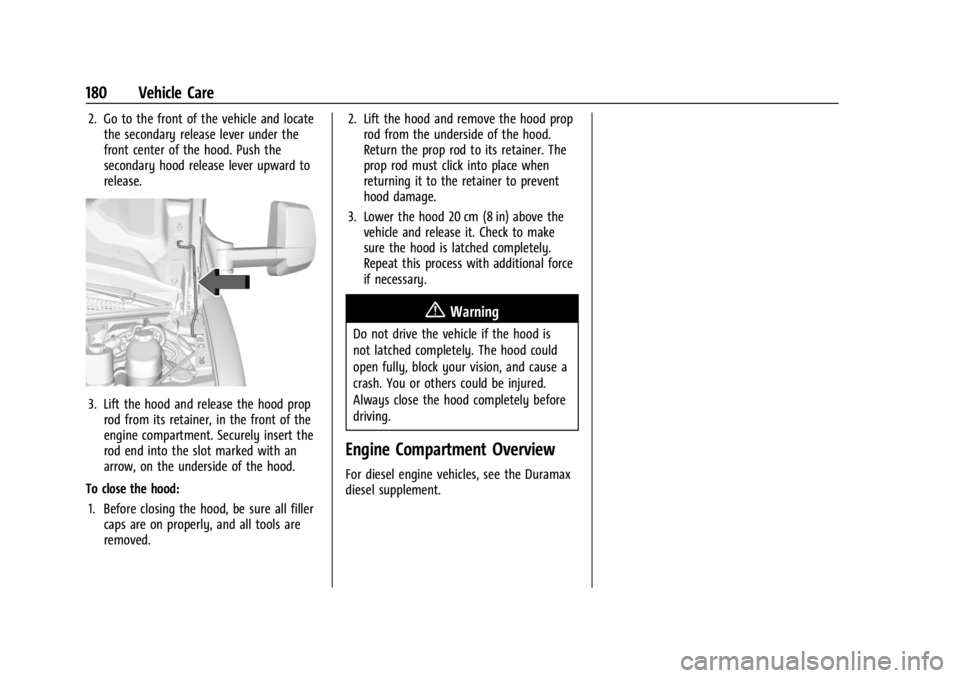
2. Go to the front of the vehicle and locatethe secondary release lever under the
front center of the hood. Push the
secondary hood release lever upward to
release.
3. Lift the hood and release the hood proprod from its retainer, in the front of the
engine compartment. Securely insert the
rod end into the slot marked with an
arrow, on the underside of the hood.
To close the hood: 1. Before closing the hood, be sure all filler caps are on properly, and all tools are
removed. 2. Lift the hood and remove the hood prop
rod from the underside of the hood.
Return the prop rod to its retainer. The
prop rod must click into place when
returning it to the retainer to prevent
hood damage.
3. Lower the hood 20 cm (8 in) above the vehicle and release it. Check to make
sure the hood is latched completely.
Repeat this process with additional force
if necessary.
{Warning
Do not drive the vehicle if the hood is
not latched completely. The hood could
open fully, block your vision, and cause a
crash. You or others could be injured.
Always close the hood completely before
driving.
Engine Compartment Overview
For diesel engine vehicles, see the Duramax
diesel supplement.
Page 183 of 292

GMC Savana Owner Manual (GMNA-Localizing-U.S./Canada-14583543) -
2021 - crc - 7/10/20
182 Vehicle Care
1.Battery - North America 0198.
2. Radiator Pressure Cap. See Cooling
System 0191.
3. Coolant Recovery Tank. See Cooling
System 0191.
4. Engine Oil Dipstick. See “Checking Engine
Oil” under Engine Oil 0184. 5. Engine Cooling Fan (Out of View). See
Cooling System 0191.
6. Engine Air Cleaner/Filter 0189.
7. Engine Oil Fill Cap. See “When to Add
Engine Oil” underEngine Oil 0184.
8. Power Steering Fluid Reservoir. See Power Steering Fluid 0196.
9. Engine Compartment Fuse Block 0206. 10. Brake Master Cylinder Reservoir. See
Brake Fluid 0197.
11. Windshield Washer Fluid Reservoir. See “Adding Washer Fluid” underWasher
Fluid 0196.
Page 184 of 292
GMC Savana Owner Manual (GMNA-Localizing-U.S./Canada-14583543) -
2021 - crc - 7/10/20
Vehicle Care 183
6.6L V8 Engine
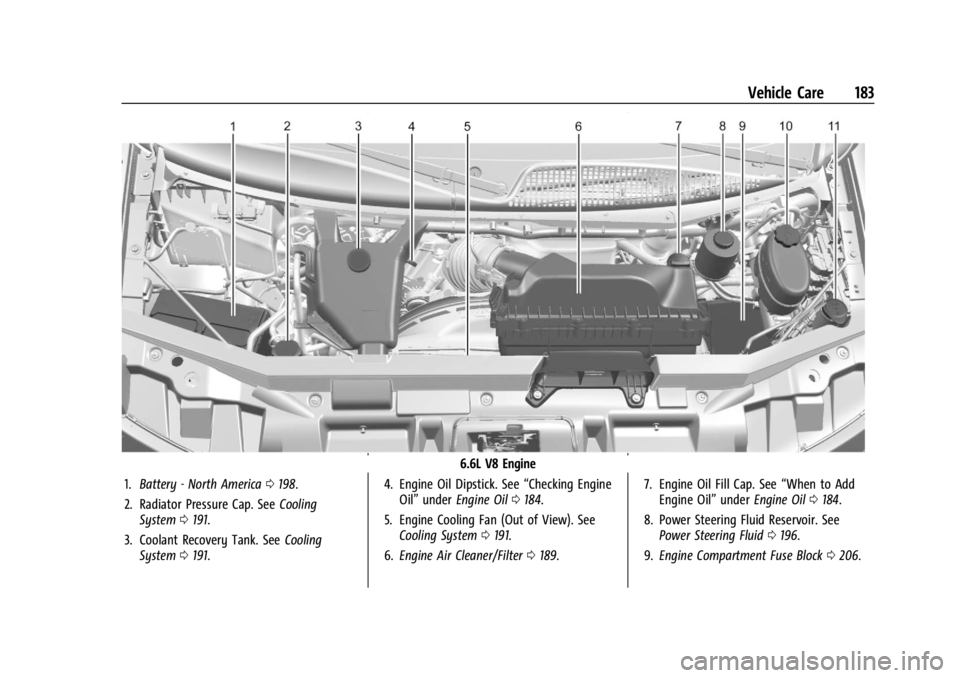
1. Battery - North America 0198.
2. Radiator Pressure Cap. See Cooling
System 0191.
3. Coolant Recovery Tank. See Cooling
System 0191. 4. Engine Oil Dipstick. See
“Checking Engine
Oil” under Engine Oil 0184.
5. Engine Cooling Fan (Out of View). See Cooling System 0191.
6. Engine Air Cleaner/Filter 0189. 7. Engine Oil Fill Cap. See
“When to Add
Engine Oil” underEngine Oil 0184.
8. Power Steering Fluid Reservoir. See Power Steering Fluid 0196.
9. Engine Compartment Fuse Block 0206.
Page 189 of 292
GMC Savana Owner Manual (GMNA-Localizing-U.S./Canada-14583543) -
2021 - crc - 7/10/20
188 Vehicle Care
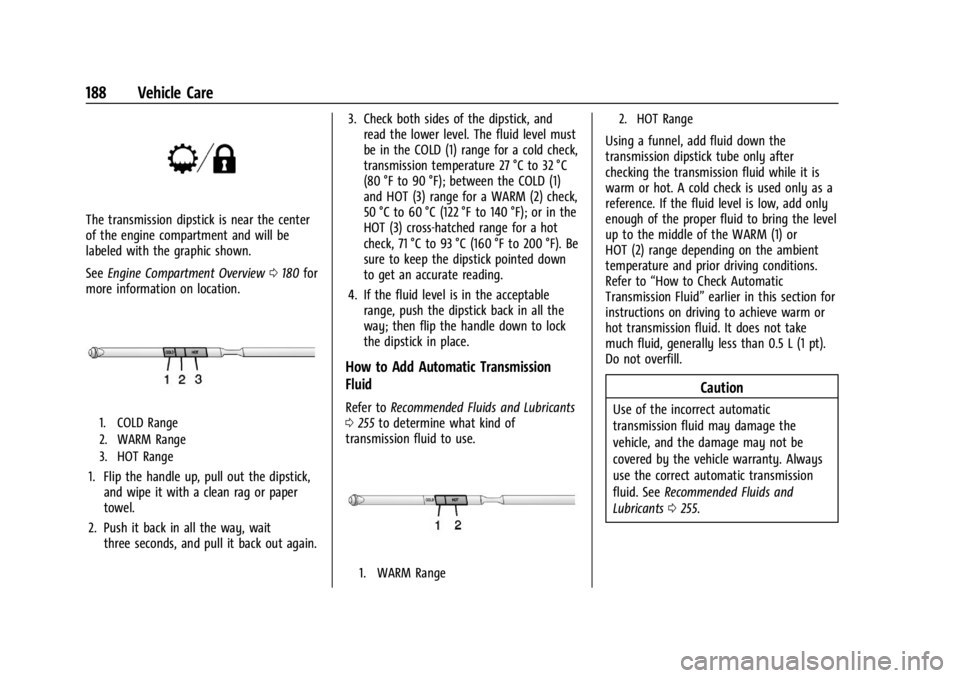
The transmission dipstick is near the center
of the engine compartment and will be
labeled with the graphic shown.
SeeEngine Compartment Overview 0180 for
more information on location.
1. COLD Range
2. WARM Range
3. HOT Range
1. Flip the handle up, pull out the dipstick, and wipe it with a clean rag or paper
towel.
2. Push it back in all the way, wait three seconds, and pull it back out again. 3. Check both sides of the dipstick, and
read the lower level. The fluid level must
be in the COLD (1) range for a cold check,
transmission temperature 27 °C to 32 °C
(80 °F to 90 °F); between the COLD (1)
and HOT (3) range for a WARM (2) check,
50 °C to 60 °C (122 °F to 140 °F); or in the
HOT (3) cross-hatched range for a hot
check, 71 °C to 93 °C (160 °F to 200 °F). Be
sure to keep the dipstick pointed down
to get an accurate reading.
4. If the fluid level is in the acceptable range, push the dipstick back in all the
way; then flip the handle down to lock
the dipstick in place.
How to Add Automatic Transmission
Fluid
Refer to Recommended Fluids and Lubricants
0 255 to determine what kind of
transmission fluid to use.
1. WARM Range 2. HOT Range
Using a funnel, add fluid down the
transmission dipstick tube only after
checking the transmission fluid while it is
warm or hot. A cold check is used only as a
reference. If the fluid level is low, add only
enough of the proper fluid to bring the level
up to the middle of the WARM (1) or
HOT (2) range depending on the ambient
temperature and prior driving conditions.
Refer to
“How to Check Automatic
Transmission Fluid” earlier in this section for
instructions on driving to achieve warm or
hot transmission fluid. It does not take
much fluid, generally less than 0.5 L (1 pt).
Do not overfill.
Caution
Use of the incorrect automatic
transmission fluid may damage the
vehicle, and the damage may not be
covered by the vehicle warranty. Always
use the correct automatic transmission
fluid. See Recommended Fluids and
Lubricants 0255.
Page 190 of 292
GMC Savana Owner Manual (GMNA-Localizing-U.S./Canada-14583543) -
2021 - crc - 7/10/20
Vehicle Care 189
.After adding fluid, recheck the fluid level
as described under“How to Check
Automatic Transmission Fluid,” earlier in
this section.
.When the correct fluid level is obtained,
push the dipstick back in all the way;
then flip the handle down to lock the
dipstick in place.
Automatic Transmission Fluid
(8-Speed Transmission)
When to Check and Change Automatic
Transmission Fluid
It is usually not necessary to check the
transmission fluid level. The only reason for
fluid loss is a transmission leak or
overheated transmission. This vehicle is not
equipped with a transmission fluid level
dipstick. There is a special procedure for
checking and changing the transmission fluid
in these vehicles. Because this procedure is
difficult, this should be done at the dealer.
Contact the dealer for additional information
or the procedure can be found in the service
manual. See Publication Ordering
Information 0269.
Caution
Use of the incorrect automatic
transmission fluid may damage the
vehicle, and the damage may not be
covered by the vehicle warranty. Always
use the correct automatic transmission
fluid. See Recommended Fluids and
Lubricants 0255.
Change the fluid and filter at the scheduled
maintenance intervals listed in Maintenance
Schedule 0249. Be sure to use the
transmission fluid listed in Recommended
Fluids and Lubricants 0255.
Engine Air Cleaner/Filter
The air cleaner/filter assembly is on the
front of the engine compartment on the
driver side of the vehicle. See Engine
Compartment Overview 0180.
When to Inspect the Engine Air Cleaner/Filter
For intervals on changing and inspecting the
engine air filter, see Maintenance Schedule
0 249. How to Inspect/Replace the Engine Air
Cleaner/Filter
Do not start the engine or have the engine
running with the engine air filter housing
open. Before removing the engine air filter,
make sure that the engine air filter housing
and nearby components are free of dirt and
debris. Do not clean the engine air filter or
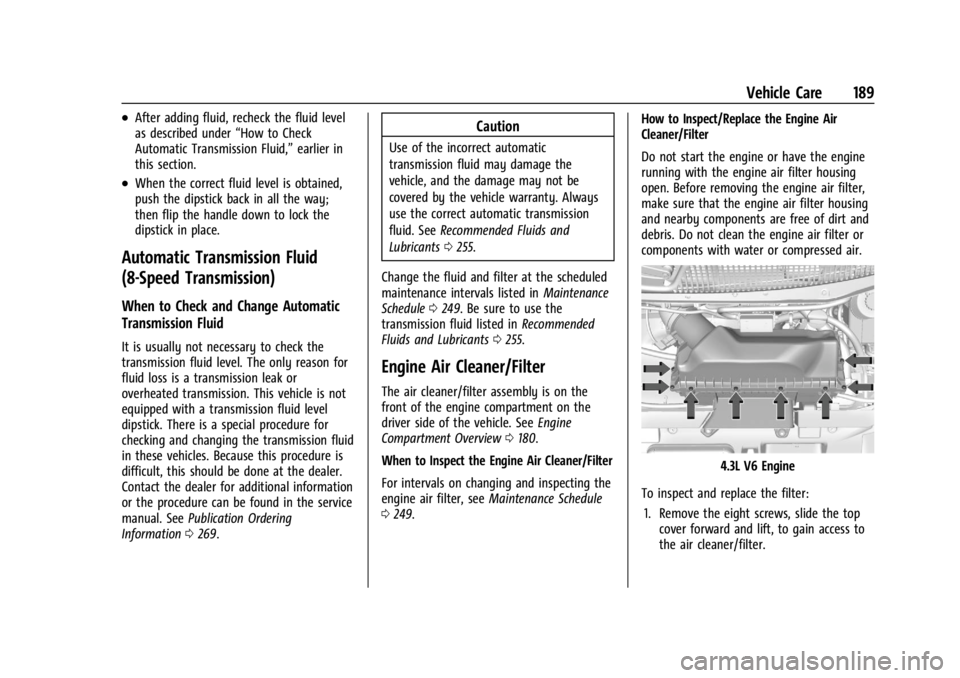
components with water or compressed air.
4.3L V6 Engine
To inspect and replace the filter: 1. Remove the eight screws, slide the top cover forward and lift, to gain access to
the air cleaner/filter.
Page 194 of 292
GMC Savana Owner Manual (GMNA-Localizing-U.S./Canada-14583543) -
2021 - crc - 7/10/20
Vehicle Care 193
How to Add Coolant to the Recovery
Tank for Gasoline Engines
{Warning
Spilling coolant on hot engine parts can
burn you. Coolant contains ethylene
glycol and it will burn if the engine parts
are hot enough.
{Warning
Plain water, or other liquids such as
alcohol, can boil before the proper
coolant mixture will. With plain water or
the wrong mixture, the engine could get
too hot but there would not be an
overheat warning. The engine could catch
fire and you or others could be burned.
{Warning
Steam and scalding liquids from a hot
cooling system are under pressure.
Turning the pressure cap, even a little,
can cause them to come out at high
speed and you could be burned. Never
turn the cap when the cooling system,(Continued)
Warning (Continued)
including the pressure cap, is hot. Wait
for the cooling system and pressure cap
to cool.
Caution
Failure to follow the specific coolant fill
procedure could cause the engine to
overheat and could cause system
damage. If coolant is not visible in the
surge tank, contact your dealer.
If coolant is needed, add the proper
DEX-COOL coolant mixture at the coolant
recovery tank.
How to Add Coolant to the Radiator
{Warning
Steam and scalding liquids from a hot
cooling system are under pressure.
Turning the pressure cap, even a little,
can cause them to come out at high
speed and you could be burned. Never
turn the cap when the cooling system, (Continued)
Warning (Continued)
including the pressure cap, is hot. Wait
for the cooling system and pressure cap
to cool.
If coolant is needed, add the proper mixture
directly to the radiator, but be sure the
cooling system is cool before this is done.
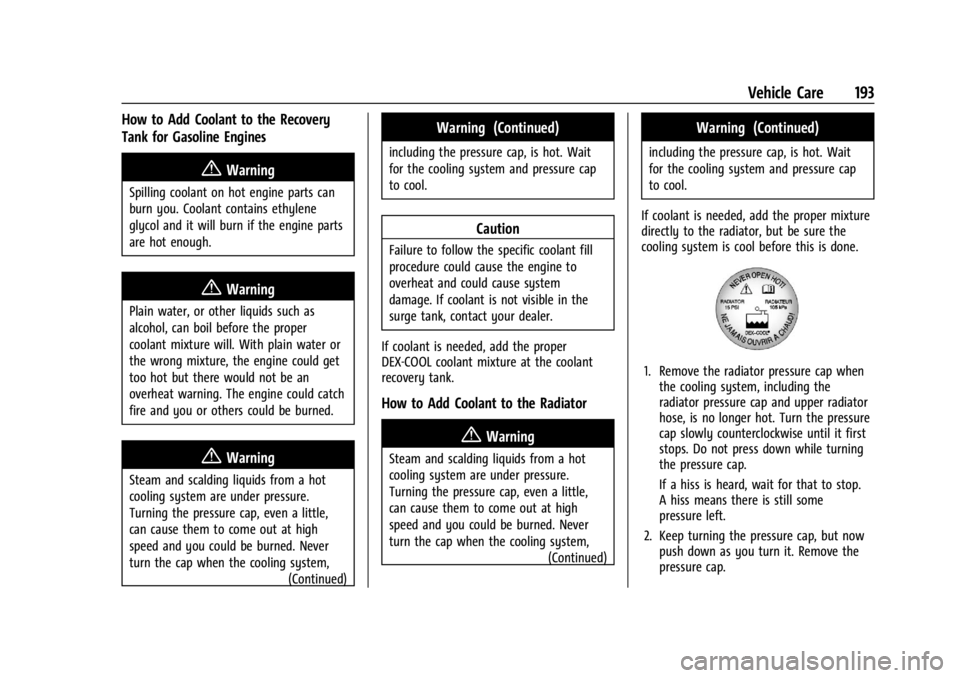
1. Remove the radiator pressure cap when the cooling system, including the
radiator pressure cap and upper radiator
hose, is no longer hot. Turn the pressure
cap slowly counterclockwise until it first
stops. Do not press down while turning
the pressure cap.
If a hiss is heard, wait for that to stop.
A hiss means there is still some
pressure left.
2. Keep turning the pressure cap, but now push down as you turn it. Remove the
pressure cap.
Page 202 of 292
GMC Savana Owner Manual (GMNA-Localizing-U.S./Canada-14583543) -
2021 - crc - 7/10/20
Vehicle Care 201
Automatic Transmission Shift Lock
Control Function Check
{Warning
When you are doing this inspection, the
vehicle could move suddenly. If the
vehicle moves, you or others could be
injured.
1. Before starting this check, be sure there is enough room around the vehicle.
It should be parked on a level surface.
2. Apply the parking brake. Be ready to apply the regular brake immediately if
the vehicle begins to move.
3. With the engine off, turn the ignition on, but do not start the engine. Without
applying the regular brake, try to move
the shift lever out of P (Park) with
normal effort. If the shift lever moves
out of P (Park), contact your dealer for
service.
Ignition Transmission Lock Check
While parked, and with the parking brake
set, try to turn the ignition off in each shift
lever position.
.The ignition should turn to off only when
the shift lever is in P (Park).
.The ignition key should come out only
when the ignition is off.
Contact your dealer if service is required.
Park Brake and P (Park)
Mechanism Check
{Warning
When you are doing this check, the
vehicle could begin to move. You or
others could be injured and property
could be damaged. Make sure there is
room in front of the vehicle in case it
begins to roll. Be ready to apply the
regular brake at once should the vehicle
begin to move.
Park on a fairly steep hill, with the vehicle
facing downhill. Keeping your foot on the
regular brake, set the parking brake.
.To check the parking brake's holding
ability: With the engine running and the
transmission in N (Neutral), slowly remove
foot pressure from the regular brake
pedal. Do this until the vehicle is held by
the parking brake only.
.To check the P (Park) mechanism's holding
ability: With the engine running, shift to
P (Park). Then release the parking brake
followed by the regular brake.
Contact your dealer if service is required.
Wiper Blade Replacement
Windshield wiper blades should be inspected
for wear and cracking. See Maintenance
Schedule 0249.
Replacement blades come in different types
and are removed in different ways. For
proper type and length, see Maintenance
Replacement Parts 0256.
Caution
Allowing the wiper arm to touch the
windshield when no wiper blade is
installed could damage the windshield.
Any damage that occurs would not be
covered by the vehicle warranty. Do not
allow the wiper arm to touch the
windshield.
1. Lift the wiper arm away from the windshield.
Page 204 of 292
GMC Savana Owner Manual (GMNA-Localizing-U.S./Canada-14583543) -
2021 - crc - 7/10/20
Vehicle Care 203
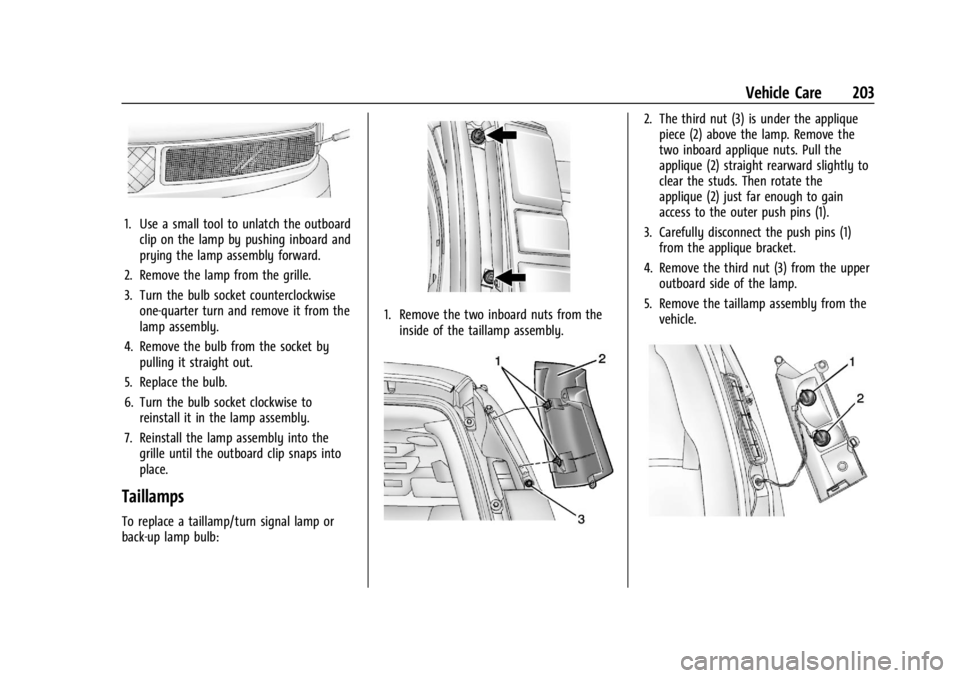
1. Use a small tool to unlatch the outboardclip on the lamp by pushing inboard and
prying the lamp assembly forward.
2. Remove the lamp from the grille.
3. Turn the bulb socket counterclockwise one-quarter turn and remove it from the
lamp assembly.
4. Remove the bulb from the socket by pulling it straight out.
5. Replace the bulb.
6. Turn the bulb socket clockwise to reinstall it in the lamp assembly.
7. Reinstall the lamp assembly into the grille until the outboard clip snaps into
place.
Taillamps
To replace a taillamp/turn signal lamp or
back-up lamp bulb:
1. Remove the two inboard nuts from theinside of the taillamp assembly.
2. The third nut (3) is under the appliquepiece (2) above the lamp. Remove the
two inboard applique nuts. Pull the
applique (2) straight rearward slightly to
clear the studs. Then rotate the
applique (2) just far enough to gain
access to the outer push pins (1).
3. Carefully disconnect the push pins (1) from the applique bracket.
4. Remove the third nut (3) from the upper outboard side of the lamp.
5. Remove the taillamp assembly from the vehicle.
Page 205 of 292
GMC Savana Owner Manual (GMNA-Localizing-U.S./Canada-14583543) -
2021 - crc - 7/10/20
204 Vehicle Care
6. Remove the taillamp/turn signal lamp (1)or back-up lamp (2) bulb socket by
turning it counterclockwise one-quarter
turn and pulling it out of the lamp
assembly.
7. Remove the bulb by pulling it straight out.
8. Push the new bulb into the socket.
9. Reinstall the bulb socket by turning it clockwise into the lamp assembly.
10. Reverse Steps 1–5 to reinstall the taillamp assembly and applique.
Center High-Mounted Stoplamp
(CHMSL)
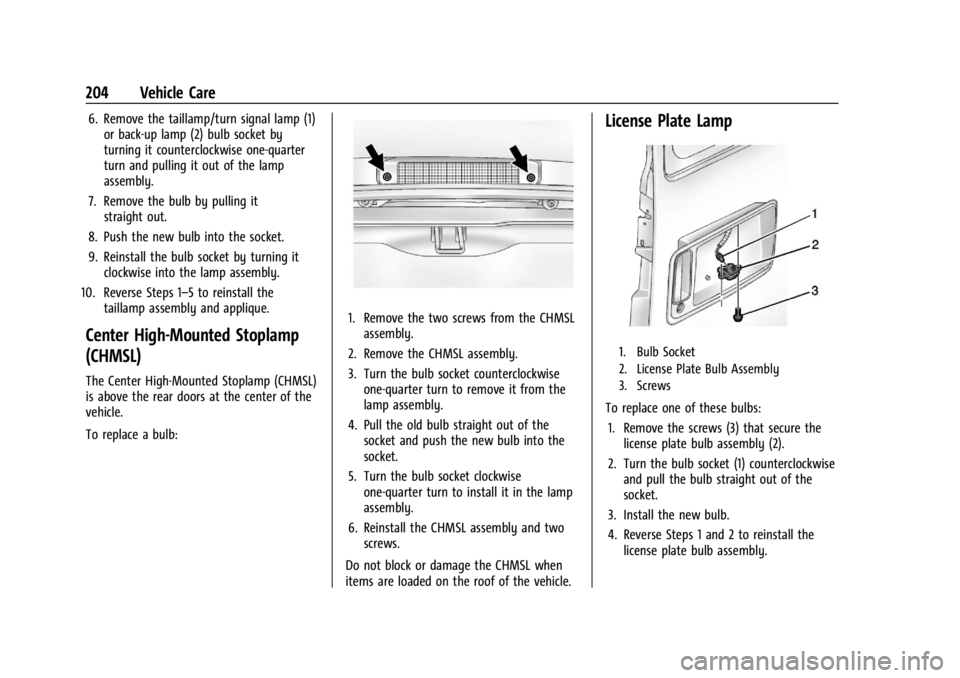
The Center High-Mounted Stoplamp (CHMSL)
is above the rear doors at the center of the
vehicle.
To replace a bulb:
1. Remove the two screws from the CHMSLassembly.
2. Remove the CHMSL assembly.
3. Turn the bulb socket counterclockwise one-quarter turn to remove it from the
lamp assembly.
4. Pull the old bulb straight out of the socket and push the new bulb into the
socket.
5. Turn the bulb socket clockwise one-quarter turn to install it in the lamp
assembly.
6. Reinstall the CHMSL assembly and two screws.
Do not block or damage the CHMSL when
items are loaded on the roof of the vehicle.
License Plate Lamp
1. Bulb Socket
2. License Plate Bulb Assembly
3. Screws
To replace one of these bulbs: 1. Remove the screws (3) that secure the license plate bulb assembly (2).
2. Turn the bulb socket (1) counterclockwise and pull the bulb straight out of the
socket.
3. Install the new bulb.
4. Reverse Steps 1 and 2 to reinstall the license plate bulb assembly.