change time GMC SIERRA 1993 User Guide
[x] Cancel search | Manufacturer: GMC, Model Year: 1993, Model line: SIERRA, Model: GMC SIERRA 1993Pages: 436, PDF Size: 23.88 MB
Page 224 of 436
‘
Your Driving and the Road
Weather Forecasts: What’s the weather outlook along your route?
Should -you delay your trip a short time to avoid a major storm system?
Maps: Do you have up-to-date maps? . .. .. . -1 .. On fhe Road
Unless you are the only driver, ‘it is good .to share the driving task’with
others. Limit turns behind the wheel to about
100 miles (160 km) or two
hours at a sitting. Then, either change drivers or stop for s\
ome- refreshment
like coffee, tea or soft drinks and some limbering up. But do\
stop and move
around. Eat lightly along the way. Heavier meals tend
to make some people
sleepy.
.. . .- , - .~
On two-lane highways or undivided multilane highways that do no\
t have
controlled access, you’ll want to watch for some situations \
not usually found
on freeways. Examples are: stop signs and signals, shopping cen\
ters with
direct access to the highway, no passing zones and school zone\
s, vehicles
turning’ left and right
off the road, pedestrians, cyclists, parked vehicles, and
even animals.
Highway Hypnosis
Is there actually such a condition as “highway hypnosis?” Or \
is it just plain ,
falling asleep at the wheel? Call it highway hypnosis, lack of awareness, or
whatever.
’ There is something about an easy stretch of road with the sam\
e scenery,
along with the hum
of the tires on the road, the drone of the engine, and the
, rush of the wind against the vehicle that can make you sleepy\
. Don’t let it ’.
happen to you! If it does, your vehicle can leave the road in less than a
second,
and you could crash and be injured.
What can you do about highway hypnosis? First, be aware that it
can
happen.
Then here are some tips:
Make sure your vehicle is well - ventilated, with a comfortably cool interior.
Keep your eyes moving. Scan the road ahead and to the sides. \
Check
your rearview mirrors frequently and your instruments from time \
to time.
This can help you avoid a fixed stare.
-
,x ! - : ,-.:.&---z-.- ..* .-7
0 d
Wear good sunglasses in bright light. Glare can cause drowsiness. But
don’t wear sunglasses at night. They will drastically reduce \
your overall
-%
vision at the very time you need all the s.eeing power you h\
ave.
If you get sleepy, pull off the road into a rest, service, or parking area
and take a nap, get some exercise, or both. For safety, treat\
drowsiness
on the highway as an emergency.
4-46
ProCarManuals.com
Page 237 of 436
Driving with a Trailer
Towing a trailer requires a certain amount of experience. Before setting out
for the open road, you’ll want to get to know your rig. Acquaint yourself with
the feel of handling and braking with the added weight of the trailer. And
always keep in mind that the vehicle you are driving is now a good deal
longer and not nearly
so responsive as your vehicle is by itself.
Before you start, check the trailer hitch and platform, safety \
chains, electrical
connector, lights, tires and mirror adjustment.
If the trailer has electric brakes,
start your vehicle and trailer moving and then apply the trailer brake controller
by hand to be sure the brakes are working. This lets you check your
electrical connection at the same time.
During your trip, check occasionally to be sure that the load is secure, and
that the lights and any trailer brakes are still working.
Following Distance
Stay at least twice as far behind the vehicle ahead as you w\
ould when
driving your vehicle without a trailer. This can help you avoid situations \
that
require heavy braking and sudden turns.
Passing
You’ll need more passing distance up ahead when you’re towing a trailer.
And, because you’re a good deal longer, you’ll need to g\
o much farther beyond the passed vehicle before you can return to your lane.
Backing Up
Hold the bottom of the steering wheel with one hand. Then, to move the
trailer left, just move your hand to the left.
To move the trailer to the right,
move your hand to the right. Always back up slowly and,
if possible, have
someone guide you.
Making Turns
When you’re turning with a trailer, make wider turns than normal. Do this so
your trailer wheels won’t strike soft shoulders, curbs, road signs\
, trees, or
other objects. Avoid jerky or sudden maneuvers. Signal well in advance.
Turn Signals When Towing a Trailer
When you tow a trailer, your vehicle has to have a different turn signal
flasher and extra wiring. The green arrows on your instrument \
panel will flash
whenever you signal a turn or lane change. Properly hooked up, the trailer
lights will also flash, telling other drivers you’re about t\
o turn, change lanes,
or stop.
When towing a trailer, the green arrows on your instrument pan\
el will flash for
turns even
if the bulbs on the trailer are burned out. Thus, you may think
4-59
ProCarManuals.com
Page 271 of 436
I CAUTION
Sust or dirt on the wheel, or on the parts to which it is fastened,
could come
off and cause an accident. When you change a wheel,
remove any rust or dirt from the places where the wheel attac\
hes to
the vehicle. In an emergency, you can use a cloth or a paper towel
to
do this; but be sure to use a scraper or wire brush later- if vou
need to, to get all the rust or dirt
off.
A :an make the wheel nuts become loose after a time. The wheel
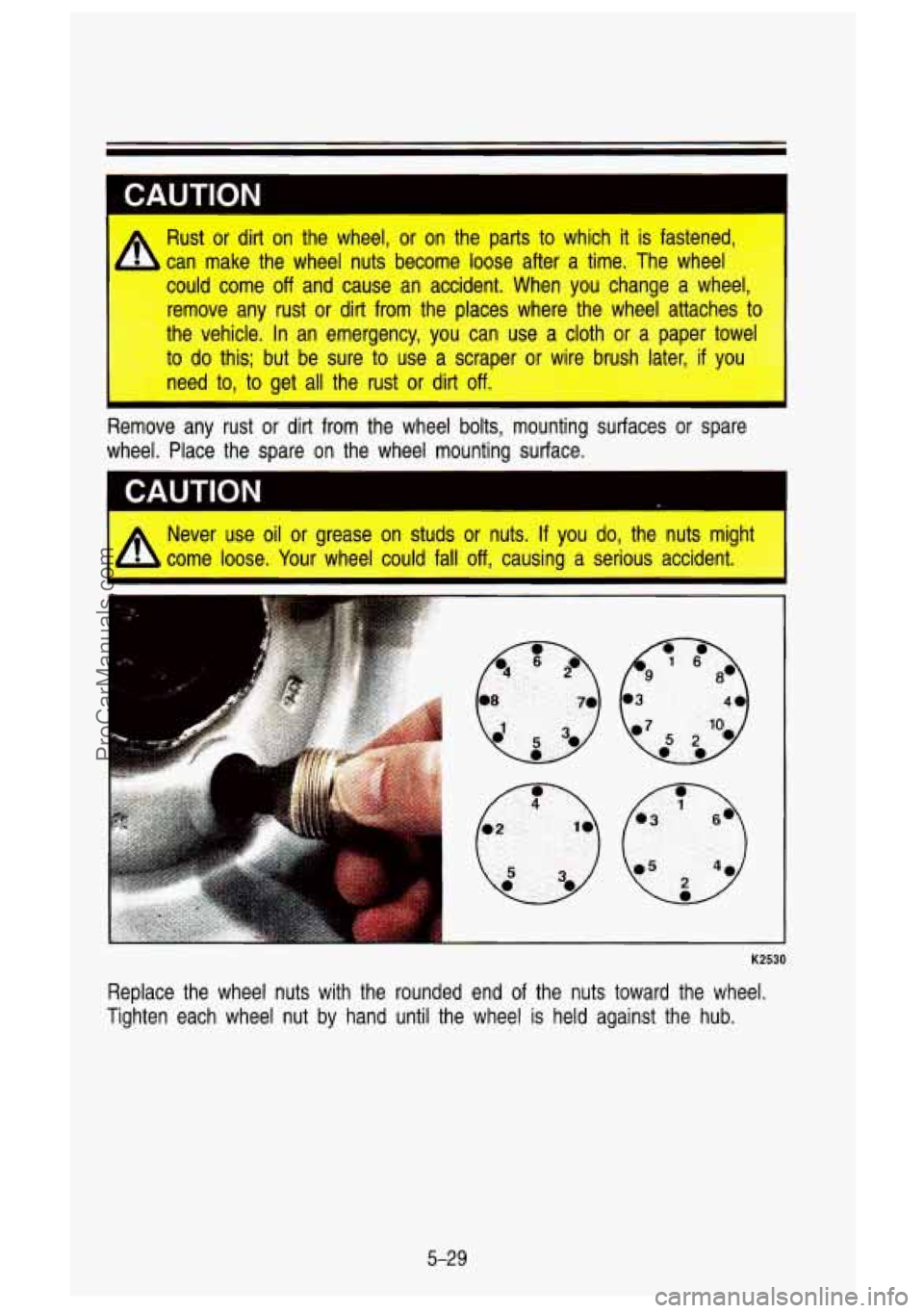
Remove any rust
or dirt from the wheel bolts, mounting surfaces or spare
wheel. Place the spare on the wheel mounting surface.
1 CAUTION I
Never use oil or grease on studs or nuts. If you do, the nuts migh
come loose. Your wheel could fall
off, causing a serious accident.
K2530
Replace the wheel nuts with the rounded end of the nuts toward the wheel.
Tighten each wheel nut by hand until the wheel is held against the hub.
5-29
ProCarManuals.com
Page 286 of 436

Service & Appearance Care
This light also should come on when you start your engine, as\
a check. If it
doesn’t, have it fixed
so it will be there to let you know if you ever do get
water in your fuel.
If the light comes on at any other time, use this chart.
“WATER IN FUE
PROBLEM
Light comes on intermittently.
1) Temperatures above freezing.
Light stays on
2) Temperatures below freezing.
3) Immediately after refueling -
Large amounts of water
probably pumped into the
tank.
.” LIGHT CHART
RECOMMENDED ACTION
Drain water from fuel filter.
Drain fuel filter immediately.
If nc
water is drained and light stays on
-
replace fuel filter.
Drain fuel filter immediately.
If no
water can be drained
- water may be
frozen. Open air bleed
to check for
fuel pressure.
If no fuel pressure
replace filter.
Fuel tank purging required. See your
dealer for assistance.
1
iesitation or “flat” performance at high speed or hard acceleration may be an
ndication of premature fuel filter plugging due to dirty
or contaminated fuel.
The filter element may need
to be changed if this happens. See your dealer
or assistance.
f you drive when this warning light is on, you can damage your fuel I
njection system and your engine. If the light comes on right after you
efuel,
it means water was pumped into your fuel tank. Turn off your
mgine immediately. Then, have the water drained at once.
I
To drain water:
1. Remove the fuel tank cap.
2. Connect a hose going from the water drain valve to a fuel-resistant
container.
6-8
ProCarManuals.com
Page 289 of 436
2. Unplug the Shut-Off solenoid wire from the fuel pump to prevent the
engine from starting.
3. With the air bleed valve open, turn your ignition key to Start for 10 to
15 seconds to crank (but not start) your engine. Keep doing this until
you can just see some clear fuel at the air bleed valve.
I A Diesel fuel is flammable. It could start a fire if it gets on hot engine
b parts. You could be burned. Don’t let too much fuel flow from the air
bleed valve or screw, and wipe up any spilled fuel with a cloth.
4. Close the air bleed valve, or replace the screw and reconnect \
the
Shut-Off solenoid wire.
5. Turn the ignition key to Start for 10 to 15 seconds at a time until your
engine starts.
Fuel Filter Replacement (6.5L Diesel Engines)
If you want to change the fuel filter yourself, here’s how \
to do it:
1 CAUTION
A Diesel fuel is flammable. It could start a fire if something ignites it,
-L and you could be burned. Don’t let it get on hot .engine parts, and
I keep matches or other ignition sources away.
1. Turn off your engine and set your parking brake.
2. Take off the fuel tank cap. This releases pressure in the tank.
6-1 1
ProCarManuals.com
Page 303 of 436
These numbers on an oil container show its viscosity, or thickness.
Do not use other viscosity oils such as
SAE IOW-40 or SAE 2OW-50.
Energy Conserving II
Oils with these words on the container will help you save fuel.
This doughnut-shaped logo (symbol) is used on most oil containers to help
you select the correct oil.
You should look for this on the oil container, and use
only those oils that
display the logo.
GM Goodwrench@ oil (in Canada, GM Engine Oil) meets all the requirements
for your vehicle.
Engine Oil Additives:
Don’t add anything to your oil. Your GM dealer is ready to advise if you think
something should be added.
When to Change Engine Oil:
See if any one of these is true for you:
Most trips are less than 4 miles (6 km).
It’s below freezing outside and most trips are less than 10 miles
(16 km).
The engine is at low speed most of the time (as in door to door
delivery, or in stop-and-go traffic).
You tow a trailer often.
Most trips are through dusty places.
The vehicle is frequently operated off-road.
If any one of these is true for your vehicle, then you need to change your
oil and filter every 3,000 miles (5000 km) or 3 months-whichever comes
first.
Vehicles with Light Duty Emissions (8500 GVWR or less).
If none of them is true, change the oil every 7,500 miles (12 500 km) or 12
months-whichever comes first. Change the filter at the first oil change and at
every other oil change after that.
Vehicles with Heavy Duty Emissions (8501 GVWR or more).
If none of them is true, change the oil every 6,000 miles (10 000 km) or 12
months-whichever comes first. Change the filter at the first oil change and at
every other oil change after that
‘if mileage determines when you change your
oil.
If time determines when you change your oil, change the filter ea\
ch time
you change your oil.
6-25
ProCarManuals.com
Page 304 of 436
Service & Appearance Care
Engine Block Heater:
An engine block heater can be a big help if you have to park outside in very
cold weather,
0°F (-18°C) or colder. If your vehicle has this option, see
“Engine Block Heater” in the Index.
What to Do with Used Oil:
I CAUTION I
Used engine oil contains things that have caused skin cancer
laboratory animals. Don’t let used oil stay on your skin fo\
r very
I
Clean your skin and nails with soap and water, or a good han\
d
cleaner. Wash or properly throw away clothing or rags containin\
g
used engine oil.
Used-oil can be a real threat
to the environment. If you change your own oil,
be sure to drain all free-flowing oil from the filter before disp\
osal. Don’t ever
dispose of oil by putting it in the trash, pouring it on the ground, into sewers,
or into streams or bodies of water. Instead, recycle it by taking it to a place
that collects used
oil. If you have a problem properly disposing of your used
oil, ask your dealer, a service station or a local recycling \
center for help.
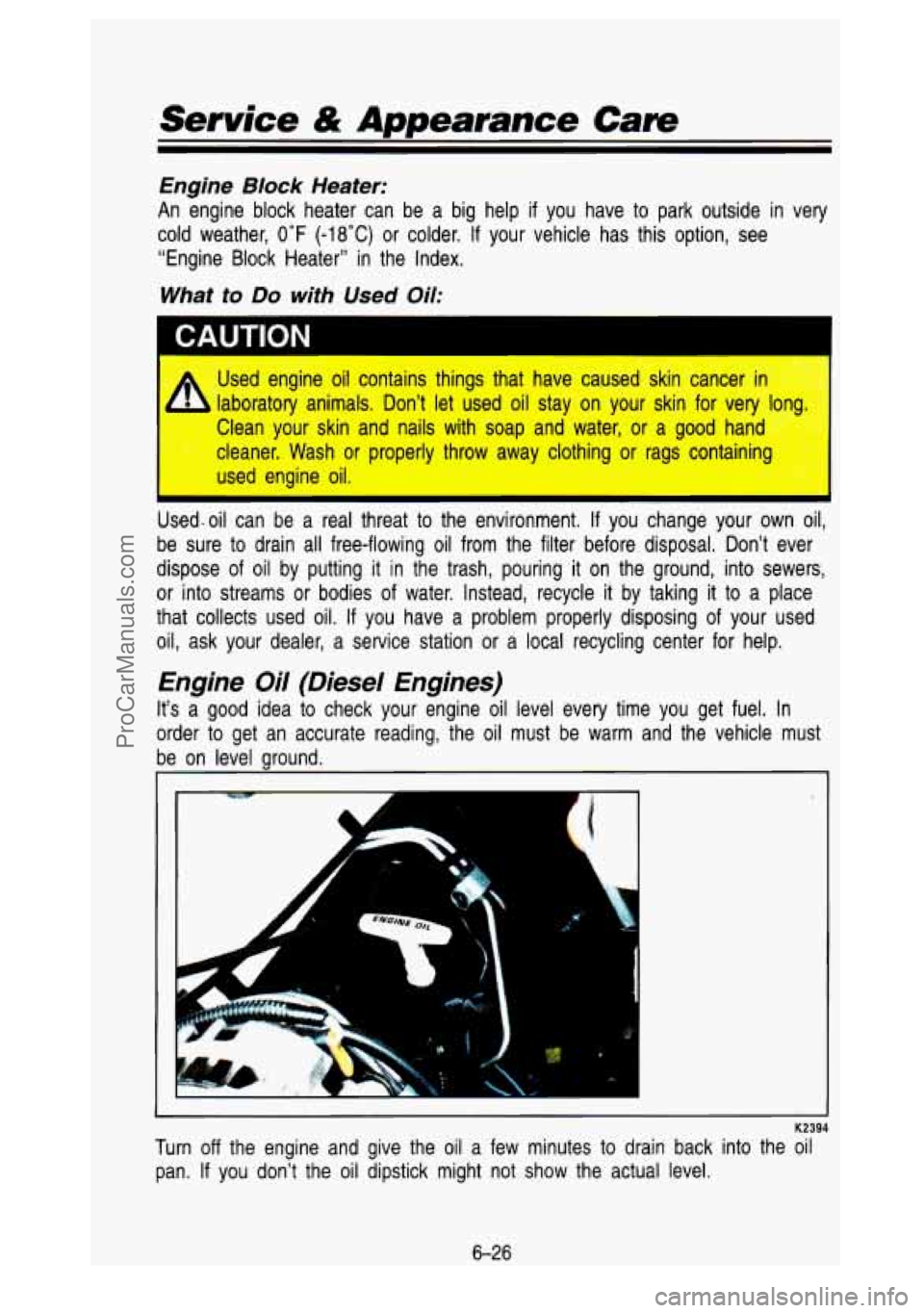
Engine Oil (Diesel Engines)
It’s a good idea to check your engine oil level every time you get fuel. In
order
to get an accurate reading, the oil must be warm and the vehicle\
must
be on level ground.
c
-
K2394
Turn off the engine and give the oil a few minutes to drain back into the oil
pan. If you don’t the
oil dipstick might not show the actual level.
6-26
ProCarManuals.com
Page 308 of 436
Service & Appearance Cam
heavy-duty applications at temperatures above freezing, 32°F (O’C), SAE
30 grade oil is recommended.
These numbers on an oil container show its viscosity, or thickness.
Do not use other viscosity oils such as
SAE IOW-40 or SAE 2OW-50.
This doughnut-shaped logo (symbol) is used on most oil contai\
ners to help
you select the correct oil.
You should
look for this on the oil container, and use only those oils that
display the logo.
GM Goodwrench@ oil (in Canada, GM Engine Oil) meets all the \
requirements
for your vehicle.
Engine Oil Additives:
Don’t add anything to your oil. Your GM dealer is ready to advise if you think
something should be added.
When to Change Engine Oil:
See if any one of these is true for you:
Most trips are less than 4 miles (6 km).
It’s below freezing outside and most trips are less than 10 miles (16
The engine is at low speed most of the time (as in door to door
You tow a trailer often.
Most trips are through dusty places. km).
delivery, or in stop-and-go traffic).
The vehicle is frequently operated off-road .
If any one of these is true for your vehicle, then you need to change your
oil and filter every 2,500 miles (4000 km) or 3 months-whichever comes
first.
If none of these is true, change the oil and filter every 5,000 miles (8000
km) or 12 months-whichever comes first.
6-30
ProCarManuals.com
Page 311 of 436
Automatic Transmission Fluid
When to Check and Change:
A good time to check your automatic transmission fluid level is when the
engine oil is changed. Refer
to the Maintenance Schedule to determine when
to change your fluid. See "Scheduled Maintenance Services" in the \
Index.
How to Check:
Because this operation can be a little difficult, you may choose to have this
done at a General Motors dealership Service Department.
If you
do it yourself, be sure to follow all the instructions here, or you could
get a false reading on the dipstick.
I Too much or too little fluid can damage your transmission. Too much can
nean that some of the fluid could come out and fall on hot engine parts,
itarting
a fire. Be sure to get an accurate reading if you check your
ransmission ftuid.
Wait at least
30 minutes before checking the transmission fluid level if you
have been driving:
When outside temperatures are above 90°F (32°C).
At high speed for quite a while.
In heavy traffic-especially in hot weather.
While pulling a trailer.
To get the right reading, the fluid must be at normal operating temperature,
which is 180°F
to 200°F (82°C to 93°C).
To check the transmission fluid hot: Get the vehicle warmed up by driving
about
15 miles (24 km) when outside temperatures are above 50°F (1 0°C). If
it's colder than
50°F (lO°C), drive the vehicle in D (3rd gear) until the engine
temperature gage moves and then remains steady for ten minutes. Then
follow the hot check procedures.
To check transmission fluid cold: A cold check is made after the vehicle
has been sitting for eight hours or more with the engine
off and is used only
as a reference. Let the engine run at idle for five minutes
if outside
temperatures are 50°F (10°C) or more.
If it's colder than 50°F (lO"C), you
may have
to idle the engine longer. A hot check must follow when fluid is
added during a cold check.
6-33
ProCarManuals.com
Page 314 of 436
*
Senrice & Appearance Care
Manual Transmission Huld
When to Check:
the fluid in your manual transmission doesn't require changing.
How to 'Check:
Because this operation can be a :little difficult, you may cho\
ose to have this
done at your dealership Service Department.
t A good time to have it checked is when .the engine oil is changed. However,
If you do it yourself, be sure to follow' all the instructions here, or you could
get a false reading..
. . .. . . ... -
Too much or too little fluid can damage your transmission. Too much can
mean that some of the fluid could come out and fall on hot engine parts,
starting a fire. Be sure
to get an accurate reading if you check your
transmission fluid.
Check the fluid level only when your engine is
off, the vehicle is parked on a
level place and the transmission is cool enough for you to re\
st your fingers
on the transmission case.
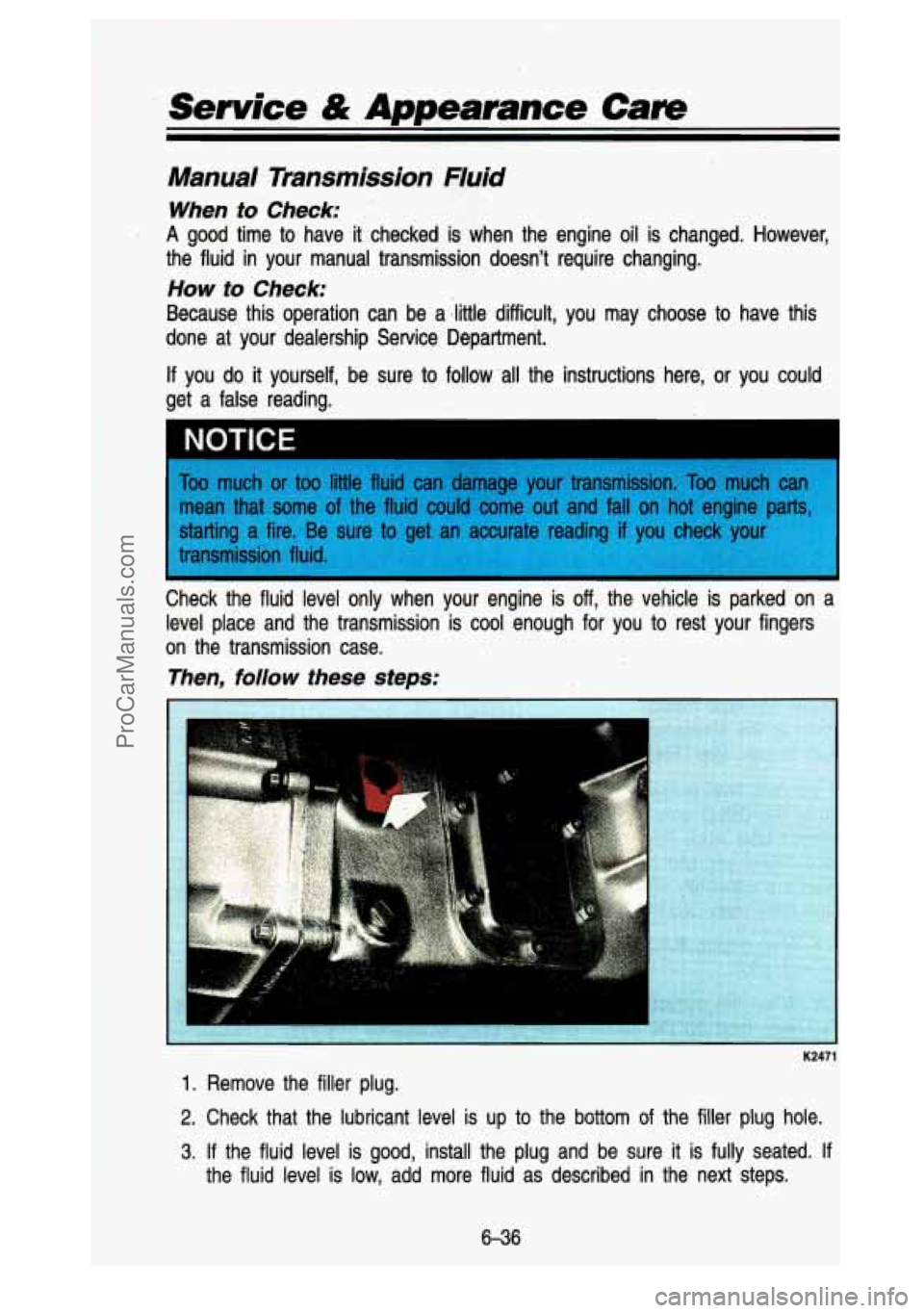
Then, follow these steps:.
~ ~~ ~
1. Remove the filler plug.
K2471
2. Check that the lubricant level is up to the bottom of the filler- plug hole.
3. If the fluid level is good, install the plug and be sure it is fully seated. If
the fluid level is low, add more fluid as described in the next steps.
6-36
ProCarManuals.com