lock GMC SIERRA 1993 Workshop Manual
[x] Cancel search | Manufacturer: GMC, Model Year: 1993, Model line: SIERRA, Model: GMC SIERRA 1993Pages: 436, PDF Size: 23.88 MB
Page 175 of 436
TUNE
To tune in radio stations, push the (t) to increase frequency and (-) to
decrease frequency.
A MIFM
Push to get AM or FM.
SEEK
Press the SEEK button to make the receiver seek, and stop at, the next
higher available station.
SCAN
Press the SCAN button to make the receiver scan, and momentarily pause
at, all available stations.
SCAN will appear in the VF display while the
receiver is in the scan mode. Press
SCAN again to cancel the scan mode
and hold the current station.
Pushbuttons
The six pushbuttons let you return to favorite stations. You can set the
pushbuttons for up to twelve favorite stations
(6 AM and 6 FM). To set the
pushbuttons, just:
Tune in the station you want.
Press the SET button. (SET appears in the VF display for a few
seconds.)
Within 5 seconds, push one of the six pushbuttons to store the station.
After that, whenever you press that button, the preset station will return.
Clock
To set the clock, just:
Press the SET button. The word SET will light up in the VF display.
Within 5 seconds, press and hold the SEEK button until the correct hour
Then, press and hold the SCAN button until the correct minute appears
appears on the display.
on the display.
After you set the time, the word SET will remain
in the VF display for a
few seconds.
Tone
To adjust the tone of this radio combination, see the instructions for the
graphic equalizer tape deck.
3-1 5
ProCarManuals.com
Page 194 of 436
If you keep pace with the traffic and alllow realieti~ following dbtances, ‘you
will eliminate a lot .of unnecessary braking.. That means - better brakin’g . and
longer brake life;
,* If your engine ever stops while- you’re driving, brake normally but don’t
pump your brakes. If you do, tht$ pedal may get harder to. .push down. If
your- engine stops, you will still have some power $rake, assist But you
will use it when you brake. Once the power assist =is used ‘up, it may
take longer to stop and the brake pedal will be harder to push.
Anti-lock Brakes (ABS)
Your vehicl’e has an ‘advanced electronic braking system that can help keep it
under Control.
When you turn your key on you m.ay .hear a momentary clicking ngise. , ,.
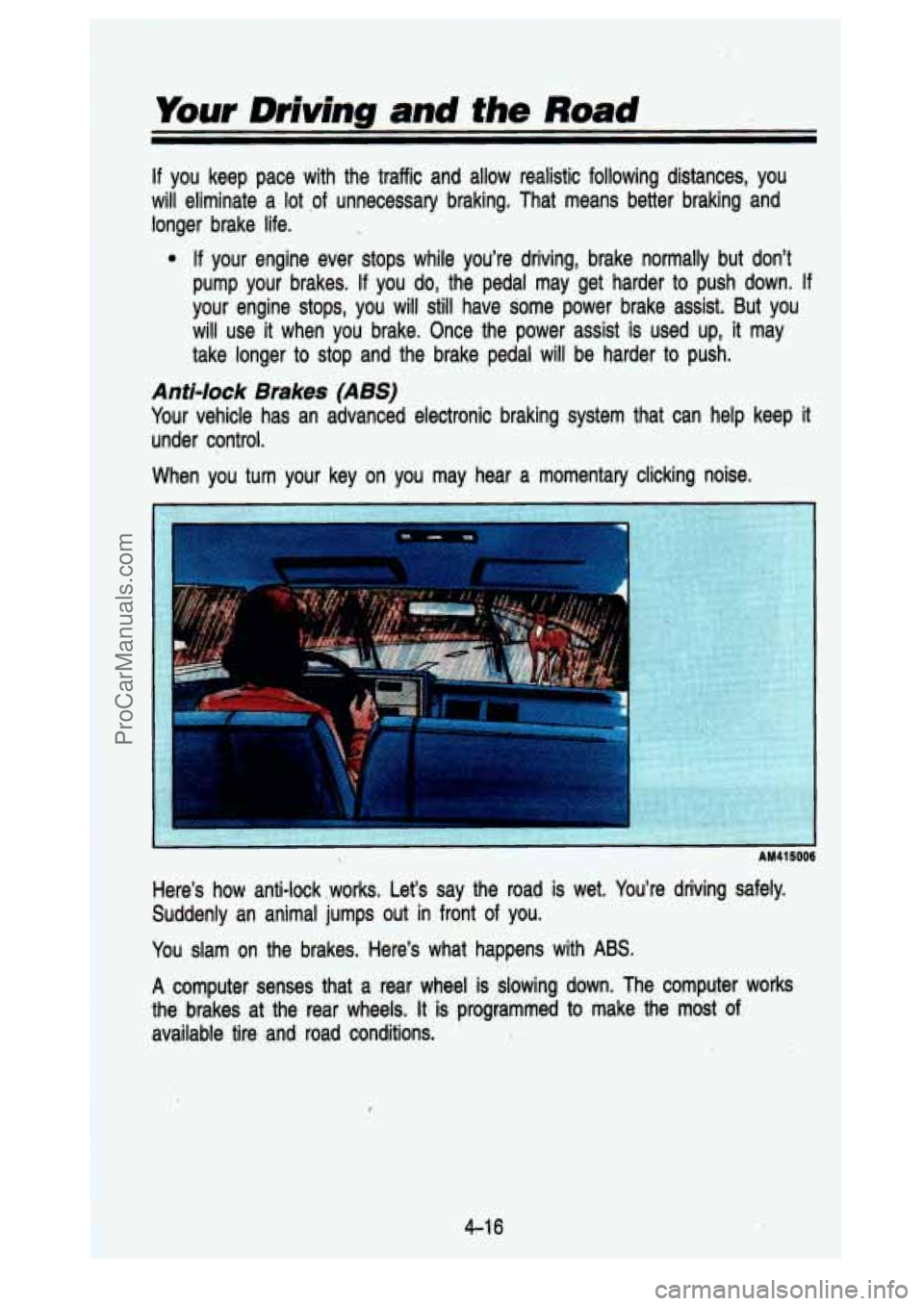
Here’s I how anti-lock .works. Let’s say the road is wet. You’re d.rivilng. sifely.
Suddenly an animal jumps out In frqnt of you.
ProCarManuals.com
Page 195 of 436

c
AM41 501 6
As you brake, your computer keeps receiving updates on rear wheel spee\
d
and controls braking pressure accordingly.
CAUTION I
A
Anti-lock doesn’t change the time you need to get your foot up to I
the brake pedal. If you get too close to the vehicle in front of you,
you won’t have time
to apply your brakes if that vehicle suddenly
slows or stops. Always leave enough room up ahead to stop, even
though you have anti-lock brakes.
To Use Anti-Lock:
Use rear wheel anti-lock like regular brakes. You may feel the brakes vibrate,
or you may notice some noise outside your vehicle, but this is normal. Let
anti-lock work for you, but remember: Your front wheels can still stop rolling.
If that happens, release enough pressure on the brakes to get the wheels
rolling again
so that you can steer.
With the four-wheel drive option you won’t have anti-lock braking when you
shift into four-wheel drive. But you will have regular braking. When you shift
back into two-wheel drive, you will have anti-lock again.
4-1 7
ProCarManuals.com
Page 197 of 436

Rear Drum Brakes
If you have rear drum brakes, they don’t have the wear indicators, \
but if you
ever hear a rear brake rubbing noise, have the rear brake lining inspected.
Also, the rear brake drums should be removed and inspected each time\
the
tires are removed for rotation or changing. When you have the \
front brakes replaced, have the rear brakes inspected, too.
Brake linings should always be replaced as complete axle sets.
Brake Pedal Travel
See your dealer if the brake pedal does not return to normal height, or if
there is a rapid increase in pedal travel. This could be a sign of brake
trouble.
Brake Adjusiment
Every time you make a brake stop, your disc brakes adjust for\
wear. If your
brake pedal goes down farther than normal, your rear drum brak\
es may need
adjustment. Adjust them by backing up and firmly applying the brakes a few
times.
Braking In Emergencies
At some time, nearly every driver gets into a situation that requires hard
braking. You have the rear wheel anti-lock braking system. Your front wheels
can stop rolling when you brake very hard. Once they
do, the vehicle can’t
respond to your steering. Momentum will carry it in whatever direction it was
headed when the wheels stopped rolling. That could be off the \
road, into the
very thing you were trying to avoid, or into traffic.
So, use a “squeeze” braking technique. This will give you max\
imum braking
while maintaining steering control. You
do this by pushing on the brake pedal
with steadily increasing pressure. When you
do, it will help maintain steering
control. In many emergencies, steering can help you more than even the very
best braking.
Steering
Power Sieerhg
If you lose power steering assist because the engine stops or \
the system
fails to function, you can steer but it will take much more effort.
4-1 9
ProCarManuals.com
Page 199 of 436

Steering in Emergencies
There are times when steering can be more effective than braki\
ng. For example, you come over a hill and find a truck stopped in yo\
ur lane, or a
car suddenly pulls out from nowhere, or a child darts out fro\
m between parked cars and stops right in front of you. You can avoid these problems by
braking-if you can stop in time. But sometimes you can't; ther\
e isn't room.
That's the time for evasive action-steering around the problem. \
Your vehicle can perform very well in emergencies like these. First \
apply your
brakes, but not enough to lock your front wheels. It is better to remove as
much speed as you can from a possible collision. Then steer around the
problem, to the left or right depending on the space available\
.
An emergency like this requires close attention and a quick decision. If yo\
u
are holding the steering wheel at the recommended
9 and 3 o'clock positions,
you can turn
it a full 180 degrees very quickly without removing either hand.
But you have to act fast, steer quickly, and just as quickly \
straighten the
wheel once you have avoided the object. You must then be prep\
ared to steer
back to your original lane and then brake to a controlled stop.
Depending on your speed, this can be rather violent for an un\
prepared driver.
This is one of the reasons driving experts recommend that you use your
safety belts and keep both hands on the steering wheel.
K2218
The fact that such emergency situations are always possible is \
a good reason
to practice defensive driving at
all times.
4-2 1
ProCarManuals.com
Page 203 of 436
may not realize the surface is slippery until your vehicle is skidding. Learn to
recognize warning clues-such as enough water, ice
or packed snow on the
road to make a “mirrored surface’’-and slow down when you have \
any
doubt.
Remember: the rear wheel anti-lock braking system (RWAL) helps\
avoid only
a rear braking skid. In a braking skid (where the front wheels are no longer
rolling), release enough pressure on the brakes to get the front wheels rolling
again. This restores steering control. Push the brake pedal dow\
n steadily
when you have to stop suddenly.
As long as the front wheels are rolling, you
will have steering control. Steer the way you want to go.
Off-Road Driving with Your FourcWheel
Drive Vehicle
This off-road guide is for vehicles that have four-wheel drive. Also, see
“Anti-lock Brakes” in the Index.
If your vehicle doesn’t have four-wheel drive,
you shouldn’t drive off-road unless you’re on a level, so\
lid surface.
Off-road driving can be great fun. But it does have some defi\
nite hazards.
The greatest
of these is the terrain itself.
“Off-roading” means you’ve left the great North American\
road system behind.
Traffic lanes aren’t marked. Curves aren’t banked. There a\
re no road signs.
Surfaces can be slippery, rough, uphill
or downhill. In short, you’ve gone right
back
to nature.
Off-road driving involves some new skills. And that’s why it’s very important
that you read this guide. You’ll find many driving tips and suggestions. These
will help make your off-road driving safer and more enjoyable. \
Before You Go Off-Roading
There are some things to do before you go out. For example, be sure to
have all necessary maintenance and service work done. Be sure \
you read all
the information about your four-wheel drive vehicle in this manual.
Is there
enough fuel?
Is the spare tire fully inflated? Are the fluid levels up where
they should be? What are the local laws that apply to off-roa\
ding where you’ll be driving?
If you don’t know, you should check with law enforcement people\
in the area. Will you be on someone’s private land?
If so, be sure to get the
necessary permission.
4-25
ProCarManuals.com
Page 204 of 436
Your Driving and the Road
Loading Your Vehicle for Off-Road Driving
There are some important things to remember about how to load your
vehicle.
The heaviest things should be on the load floor and forward of your rear
Be sure the load is secured properly, so driving on the off-road terrain
axle. Put heavier items as far forward as you can.
doesn’t toss things around.
CAUTION
Cargo on the load floor piled higher than the seatbacks can be
3 thrown forward during a sudden stop. You or your passengers
could be injured. Keep cargo below the top
01 le seatbacks.
- Unsecured cargo on the load floor ca- >e tossecl about when
3-7 driving over rough terrain. You or your passengers can be strum
& by flying objects. Secure the cargo properly*
Heavy loads on the roof raise the vehicle’s center of gravi\
ty.
making it more likely
to roll over. You can be seriously injured
the vehicle rolls over. Put heavy loads inside the cargo area, not
on the roof. Keep in the cargo area as far forward and
low as Dossible.
I
You’ll find other important information in this manual. See “Vehicle Loading,’’
and “Tires” in the Index.
Traveling to Remote Areas
It makes sense to plan your trip, especially when going to a remote area.
Know the terrain and plan your route. You are much less likely to get bad
surprises. Get accurate maps of trails and terrain.
Try to learn of any blocked
or closed roads.
It’s also a good idea to travel with at least one other v\
ehicle. If something
happens to one of them, the other can help quickly.
Does your vehicle have a winch?
If so, be sure to read the winch
instructions. In a remote area,
a winch can be handy if you get stuck. But
you’ll want to know how to use
it properly.
Getting Familiar with Off-Road Driving
It’s a good idea to practice in an area that’s safe and close to home before
you
go into the wilderness. Off-road driving does require some new and\
different driving skills. Here’s what we mean.
4-26
ProCarManuals.com
Page 207 of 436
Approaching a Hill
When you approach a hill, you need to decide if it’s one of those hills that’s
just too steep to climb, descend,
or cross. Steepness can be hard to judge.
On a very small hill, for example, there may be a smooth, constant incline
with only a small change in elevation where you can easily see all the way
to the top. On a large hill, the incline may get steeper as you near the top, \
but you may not see this because the crest of the hill is hidden by bushes,
grass,
or shrubs.
Here are some other things to consider as you approach a hill.
Is there a constant incline, or does the hill get sharply steeper in
Is there good traction on the hillside, or will the surface cause tire
Is there a straight path up or down the hill so you won’t have to make
0 Are there obstructions on the hill than can block your path (boulders,
What’s beyond the hill? Is there a cliff, an embankment, a drop-off, a
places?
slipping?
turning maneuvers?
trees, logs
or ruts)?
fence? Get out and walk the hill
if you don’t know. It’s the smart way to
find out.
Is the hill simply too rough? Steep hills often have ruts, gullies, troughs
and exposed rocks because they are more susceptible to the eff\
ects
of
erosion.
Driving Uphill
Once you decide you can safely drive up the hill, you need to take some
special steps.
Use a lower gear and get a firm grip on the steering wheel.
Get a smooth start up the hill and try to maintain your speed. Don’t use
more power than you need, because you don’t want your wheel\
s to start
spinning
or sliding.
turns, you might want
to find another route.
Try to drive straight up the hill if at all possible. If the path twists and
4-29
ProCarManuals.com
Page 208 of 436
Your Driving and the Road
A Turning or driving across steep hills can be dangerous. You could
lose traction, slide sideways, and possibly roll over. You could be
seriously injured or
I 'I' ?d. When driving up hills, always try to go
I straight up.
Ease up on your speed as you approach the top of the hill.
Attach a flag to the vehicle to make you more visible to approaching
traffic on trails or hills.
Sound the horn as you approach the top of hill to let opposing traffic
know you're there.
Use your headlights even during the day. They make you more visible to
oncoming traffic.
I A Driving to the top (crest) of a hill at full speed can muse an
accident.
There could be a drop-off, embankment, cliff, or even
another vehicle. You buld be seriously injured or killed. .As you near
the
top of a hill, slow down and stay alert. I
Q: What should I do if my vehicle stalls, or is about to stall, and I can't
make it
up the hill?
A: If this happens, there are some things you should do, and there are some
things
you must not do. First, here's what you should do:
0
0
0
0
Push the brake pedal to stop the vehicle and keep it from rolling
backwards.
Also, apply the parking brake.
If your engine is still running, shift the transmission into reverse, release
the parking brake, and slowly back down the hill in reverse.
If your engine has stopped running, you'll need to restart it. With the
brake pedal depressed and the parking brake still applied, shift the
transmission to
P (Park) (or, shift to N (Neutral) if your vehicle has a
manual transmission) and restart the engine. Then, shift to Reverse,
release the parking brake, and slowly back down the hill in reverse.
As you are backing down the hill, put your left hand on the ste\
ering
wheel at the
12 o'clock position. This way, you'll be able to tell if your
wheels are straight or turned to the left or right as you back down.
4-30
ProCarManuals.com
Page 210 of 436

Your Driving and the Road
If you decide you can go down a hill safely, then try to keep your vehicle
headed straight down, and use a low gear. This way, engine dr\
ag can help
your brakes and they won’t have to do
all the work. Descend slowly, keeping
your vehicle under control at all times.
CAUTION
A Heavy braking when going down a hill can cause your brakes to
overheat and fade. This could cause
loss of control and a serious ‘
accident. Apply the brakes lightly when descending a hill and use a
low gear to keep vehicle speed under
control.
Q: Are there some things I should not do when driving down a hili?
A: Yes! These are important because if you ignore them you could lose
control and have a serious accident.
When driving downhill, avoid turns that take you across the in\
cline of the
hill.
A hill that’s not too steep to drive down may be too steep to drive
across. You could
roll over if you don’t drive straight down.
Never go downhill with the transmission in N (Neutral), or with the clutch
pedal depressed in a manual shift. This is called “free-whee\
ling,” Your
brakes will have
to do all the work and could overheat and fade.
Avoid braking so hard that you lock the wheels when going downhill. If
your front wheels are locked, you can’t steer your vehicle. \
If your wheels
lock up during downhill braking, you may feel the vehicle star\
ting to slide
sideways.
To regain your direction, just ease off the brakes and steer to
keep the front of the vehicle pointing straight downhill.
Q: Am I likely to stall when going downhill?
A: It’s much more likely to happen going uphill. But if it happens going
downhill, here’s what to do.
Stop your vehicle by applying the regular brakes. Apply the pa\
rking
brake.
Shift to P (Park) (or to Neutral with the manual transmission) and, while
still braking, restart the engine.
Shift back to a low gear, release the parking brake, and drive straight
down.
If the engine won’t start, get out and get help.
4-32
ProCarManuals.com