lock GMC SIERRA 1993 Owner's Guide
[x] Cancel search | Manufacturer: GMC, Model Year: 1993, Model line: SIERRA, Model: GMC SIERRA 1993Pages: 436, PDF Size: 23.88 MB
Page 87 of 436
. If the light. doesn’t go off, wait a few seconds, then try staiting your engine
again. And, see your dealer
as soon as you- can for a starting system check.
If the light comes on and then goes out and you know your batte\
ries are
charged, but your engine still won’t start, your vehicle nee\
ds service.
If your batteries don’t have enough .charge to start ,your engine, see “Battery”
in the Index.
Be sure you have the right oil for your engine, and that you’ve changed the
oil
at the proper times. If you use the wrong oil, your engine may be harder
to start.
If the engine starts, runs a short time, then stops, your vehicle needs service.
NOTICE
Don’t use starting “aids” such as ether or gasoline, in the m~v intakc They
could damage your engine.
..- - .- * K2214
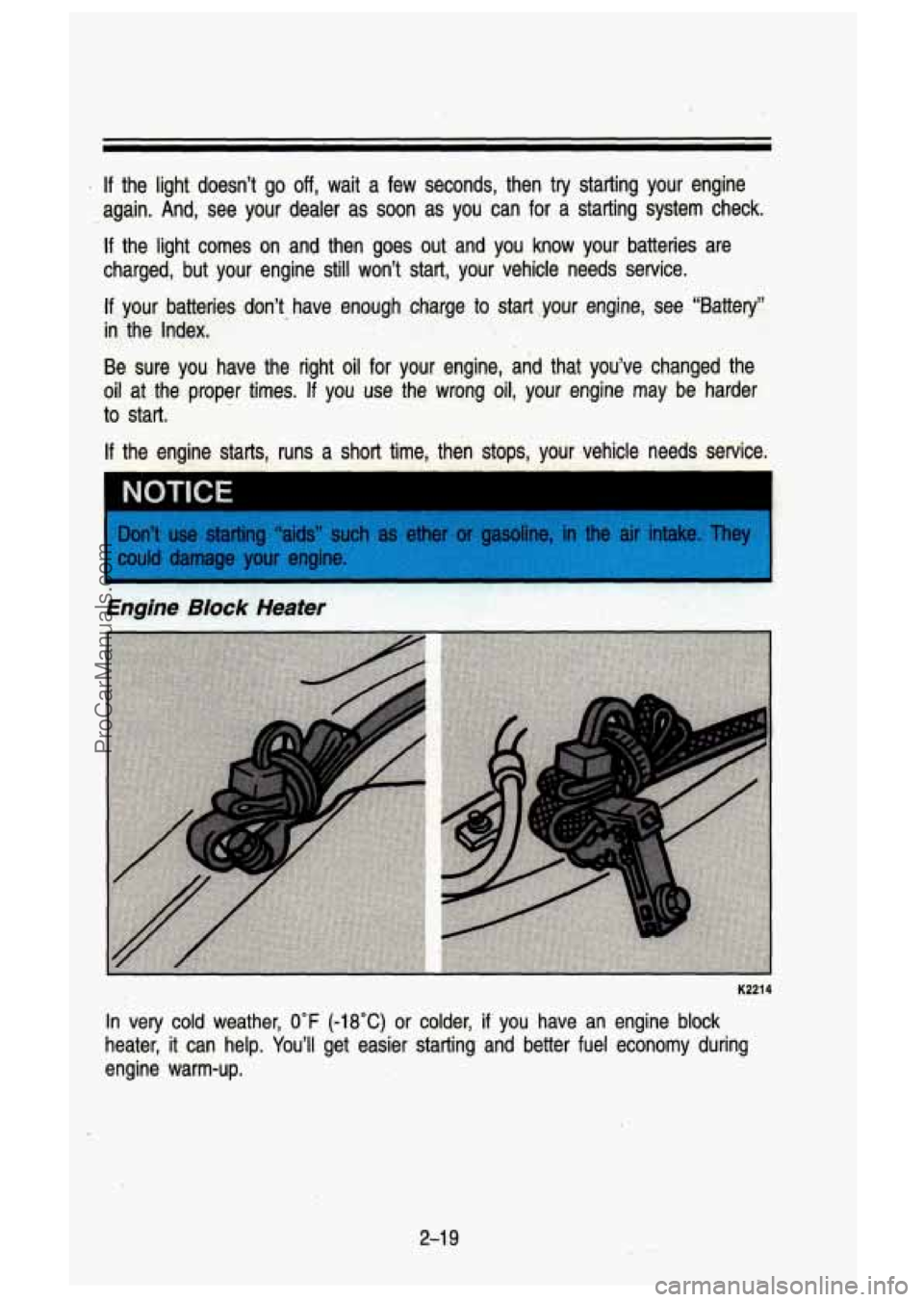
In very cold weather, 0°F (-18°C) or colder, if you have an engine block
heater, it can help. You’ll get easier starting and better fuel economy during
engine warm-up.
2-1 9
ProCarManuals.com
Page 88 of 436
Features & Controls
To use the block heater:
1.
Turn off the engine.
2. Open the hood and unwrap the electrical cord.
3. Plug it into a normal, grounded 110-volt outlet.
Plugging the cord into an ungrounded outlet could cause an electrical
- shock. Also, the wrong extension cord could overheat and cause a
fire. You could be seriously injured. Plug the cord into a properly
grounded three-prong 110-volt outlet.
If the cord won’t reach, use a
! heavy-duty three-prong extension cord rated for at least 15 amps.
After you’ve used the block heater, be sure
to store the cord in the
manner it was, to help keep it away from moving engine parts. If
you
don’t, it could be torn and damaged.
How long should you keep the block heater plugged in? The ans\
wer depends
on the weather, the kind of oil you have, and some other thi\
ngs. Instead of
trying to list everything here, we ask that you contact a Gen\
eral Motors
dealer in the area where you’ll be parking your vehicle. Th\
e dealer can give
you the best advice for that particular area.
2-20
ProCarManuals.com
Page 89 of 436
Automatic lLansmission
K2362
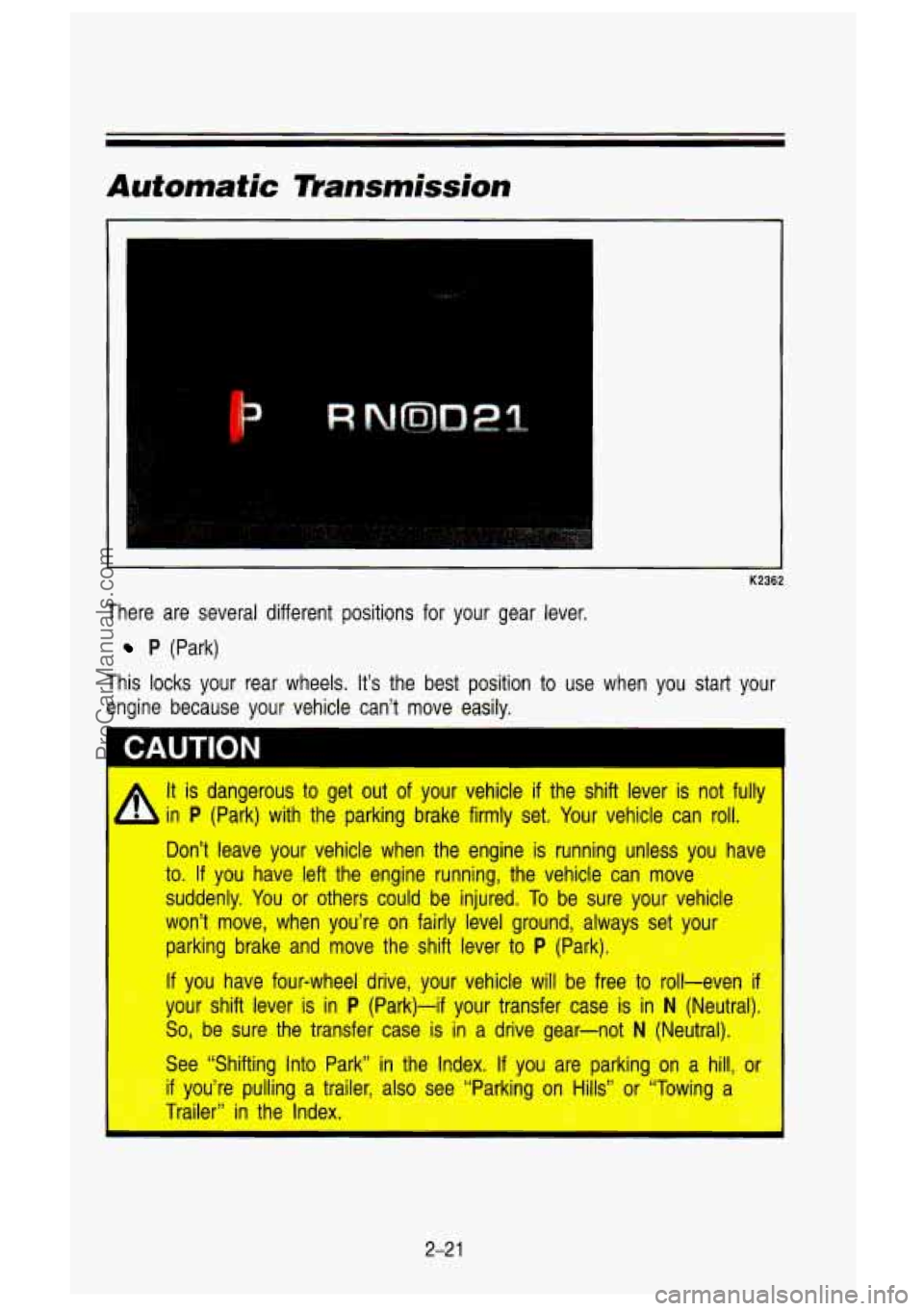
There are several different positions for your gear lever.
P (Park)
This locks your rear wheels. It’s the best position to use when you start your
engine because your vehicle can’t move easily.
* It is dangerous to get out of your vehicle if the shift lever is not fully
in
P (Park) with the parking brake firmly set. Your vehicle can roll.
Don’t leave your vehicle when the engine is running unless \
you have
to. If you have left the engine running, the vehicle can move
suddenly. You or others could be injured.
To be sure your vehicle
won’t move, when you’re on fairly level ground, always se\
t your parking brake and move the shift lever to
P (Park).
If you have four-wheel drive, your vehicle will be free to roll-even
if
your shift lever is in P (ParkLif your transfer case is in N (Neutral).
So, be sure the transfer cas s in a drive gear-not N {“eutral).
See “Shifting Into
P- I;’’ in tne 3ex. If you are parking on a hill, or
if you’re pulling a traller, also see “Parking on Hills” \
or “Towing a
Trailer’’ in the Index.
2-2 1
ProCarManuals.com
Page 96 of 436

Features & Controls
Four-Wheel-Drive Vehicles Only: If your vehicle has four-wheel drive and is
equipped with a manual transmission, disregard the shift light \
when the
transfer case is in
4 LOW.
Shift Speeds-Manual Transmission
This chart shows when to shift to the next higher gear for best fuel economy.
MANUAL TRANSMISSION RECOMMENDED SHIFT SPEED
IN MPH (KMIH)
Engine
and
VIN
45-50 25-40 50 40 15
4,3L
V6
3 to 4 2 to 3 1 to 2 3 to 4 2 to 3 1 to 2 Code
Trans. Cruise Shift Speed
Acceleration Shift Speed
(4
- (64) (40) (24) (K)
(72-80)
(40-64) - (80) (64)
(24)
5-Speed*
40 25 15 5.7L V8
- -
* Transmission with L (low) gear only. L (low) is intended for heavy loads and
is not recommended for normal driving.
I TO1 61 I
If your speed drops below 20 mph (32 km/h), or if the engine is not running
smoothly, you should downshift to the next lower gear. You may have to
downshift two or more gears
to keep the engine running smoothly or for good
performance.
I A If you skip more than one gear when you downshift, you could lose
I & control of your vehicle: And you could injure yourself or others. I
I Ju skip more than one gear when you downshift, or if you race the
;,,,ine when you downshift, you can damage the clutch or transmission. \
I
Locking Rear Axle
If you have this feature, your rear axle can give you additional \
traction on
snow, mud, ice, sand or gravel.
It works like a standard axle most of the
time,
but when one of the rear wheels has no traction and the other does,
the locking feature
will allow the wheel with traction to move the vehicle.
2-28
ProCarManuals.com
Page 98 of 436
Features & Controls
Propshaft Brake Burnish Procedure
If you have a 3500 HD Model, it is recommended that the propshaft mounted
parking brake be burnished as part of the new vehicle break in. The parking
brake
will work best after it has been burnished following these instructions.
Make
10 stops, using the parking brake foot pedal, from 20 mph (32 k\
m/h)
about 2
112 miles (4 km) apart. In between stops, drive the vehicle at 20
mph (32 kmlh).
Torque Lock
The parking brake should be set first whenever leaving the dri\
ver’s seat. If
you are parked on a hill and the transmission is placed in P (Park) before
the parking brake is set, the weight of the vehicle may put too much force
on the parking pawl in the transmission.
It may be difficult to pull the selector
lever out of
P (Park). This is called “torque lock.” To prevent this, the parking
brake should be set
BEFORE moving the selector lever to P (Park).
When preparing
to move the vehicle, the selector lever should be moved out
of
P (Park) BEFORE releasing the parking brake. Set the parking brake first,
then release the transmission from
P (Park), even on level surfaces.
If “torque lock” does occur, you may have to have another vehicle nudge
your vehicle uphill a little
to take some of the pressure off the transmission
while you pull the selector lever out of
P (Park).
Shifting Into P (Park) (Automatic Transmission Models Only)
1 CAUTION
It can be dangerous to get out of your vehicle if the shift lever is not
fully in
P (Park) with the parking brake firmly set. Your vehicle can
roll.
If you have left the engine running, the vehicle can move suddenly.
You
or others could be injured. TO be sure your vehicle won’t move,
when you’re
on fairly level ground, use the steps that follow.
If you have four-wheel drive and your transfer case is in N (Neutral),
your vehicle will be free to roll-even if your shift lever is in P
{Park). So, be sure the transfer case is in a drive gear-not N
(Neutral).
If you are parking on a hill, or if you’re pulling a trailer, also see
“Parking on Hills9’ or “Towing a Trailer” in the Index. I
2-30
ProCarManuals.com
Page 99 of 436
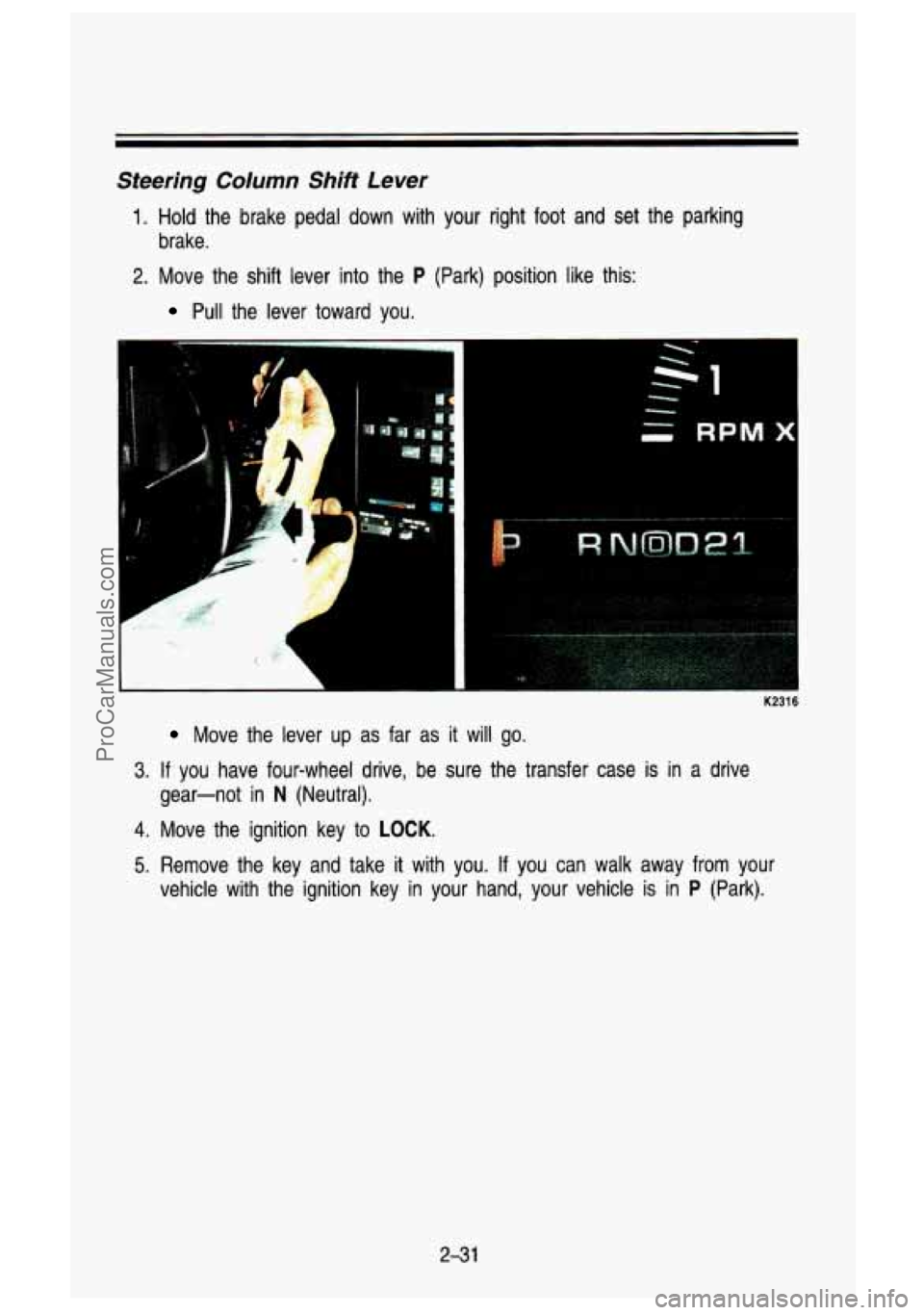
Steering Column Shift Lever
1. Hold the brake pedal down with your right foot and set the parking
brake.
2. Move the shift lever into the P (Park) position like this:
Pull the lever toward you.
~- - --
w KL" I"
Move the lever up as far as it will go.
3. If you have four-wheel drive, be sure the transfer case is in a drive
4. Move the ignition key to LOCK.
5. Remove the key and take it with you. If you can walk away from your
vehicle with the ignition key
in your hand, your vehicle is in P (Park).
gear-not
in N (Neutral).
2-31
ProCarManuals.com
Page 100 of 436
Leaving Your Vehicle With the Engine Running (Automatic
Transmission Models Only)
I CAUTION
A It can be dangerous to leave your vehicle with the engine running. 1
1 Your vehicle could move suddenly if the shift lever is not fully in P
(Park) with the parking brake firmly set.
If you have a four-wheel drive with a manual transfer case sh\
ift lever
and your transfer case
is in N (Neutral), your vehicle will be free to
roll, even
if your shift lever is in P (Park). So be sure the transfer
case is in a drive gear-not in
N (Neutral).
And,
if you leave the vehicle with the engine running, it could
overheat and even catch fire. You or others could be injured. Don’t
leave your vehicle with the engine running unless you have to.\
If you have to leave your vehicle with the engine running, be su\
re your
vehicle
is in P (Park) and your parking brake is firmly set, before you leav\
e
it. If you have a four-wheel drive, be sure that the transfer case i\
s in a drive
gear-not in
N (Neutral).
After you’ve moved the shift lever into the
P (Park) position, hold the regular
brake pedal down. Then, see
if you can move the shift lever away from P
(Park) without first pulling it toward you.
If you can, it means that the shift lever wasn’t fully locked into
P (Park).
Parking Your Vehicle (Manual Transmission Models Only)
Before you get out of your vehicle, put your manual transmission in R
(Reverse) and firmly apply the parking brake.
If you have four-wheel drive, be sure your transfer case is in a\
drive gear.
Your vehicle could roll
if it isn’t.
If you are parking on a hill, or if your vehicle is equipped to tow a trailer,
see “Parking on Hills” or “Towing a Trailer” in the\
Index.
2-32
ProCarManuals.com
Page 104 of 436
Features & Contmls
Four- Wheel Drive
CAUTION I
It can be dangerous to get out of your vehicle if the shift lever -is not
fully in
P (Park) with the parking brake firmly set. Your vehicle can
roll. Don’t leave your vehicle when the engine is running unless you
have
to. If you’ve left the engine running, the vehicle can ‘move
suddenly. You or -others could be injured.
To be sure your vehicle
won’t move, even when you’re on fairly level ground, always
set your
parking brake and move the shift lever
to P (Park).
If you have four-wheel drive and your transfer case is in N (Neutral),
your vehicle
will be free to roll, even if your shift lever is in P’(Park).
So, be sure the transfer case is in a drive gear-not in N (Neutral).
Follow the proper steps
to be suce your vehicle won’t move. See
“Shifting Into
P (Park)” in the Index.
If you are parking on a hill, or if you’re pulling a trailer, also see
“Parking ‘on Hills’’ or “Towing a Trailer” in this section.
I
If your vehicle has four-wheel drive, you can send your engine’\
s driving power
to all four wheels for extra traction. To get the most satisfaction out of
four-wheel drive, you must be familiar with it’s operation. \
Read the part that
follows before using four-wheel drive. You should use
2H for most normal
driving conditions.
Rear-wheel antilock brakes
do not work when you shift into four-wheel drive.
Your regular brakes will still work. When you shift back into two-w\
heel drive,
your rear-wheel antilock brakes will take over again.
I NOTICE
Driving in the 4H or 4L positions for a long time on dry or wet pavement
could shorten the life
of your vehicle’s drivetrain.
2-36
ProCarManuals.com
Page 106 of 436
Featwes & Contmk
The front axle portion of the indicator diagram will light up when you shift into
four-wheel drive.
A slight delay between shifting and the indicator’s lighting is
normal.
If the indicator does not light up, or if the front axle light does not go
out after you shift out of four-wheel drive, have your dealer check your
system.
When your headlights or parking lights are on, rotate the dial\
to the right of
your headlight switch up
to brighten, or down to dim, your transfer case
indicator light.
Transfer Case Shift Positions
2H (High): This setting is for driving in most street and highway situations.
Your front axle is not engaged in two-wheel drive.
4H (High): This setting engages your front axle to help drive your vehicle.
Use
4H when you need extra traction, such as on wet or icy roads, or in
most
off -road situations.
N (Neutral): Shift to this setting only when your vehicle needs to be towed or
when using a power take
off.
4L (Low): This setting also engages your front axle to give you extra traction,
but should be used only for off-road or on extremely slippery surfaces.
You can shift from
2H to 4H or from 4H to 2H while the vehicle is moving.
Your front axle will engage faster
if you take your foot off of the accelerator
for a few seconds after you shift. In extremely cold weather it may be
necessary to stop or slow the vehicle to shift out of
2H.
To shift into or out of 4L or N (Neutral):
1. Slow the vehicle to a roll, about 3 mph (5 kmlh) and shift your
2. Shift the transfer case shift lever in one continuous motion.
transmission into neutral.
Don’t pause in
N (Neutral) as you shift the transfer case into 4L, or your
aears could clash.
Kernember that driving
in 4H or 4L may reduce fuel economy. Also, driving in
four-wheel drive on dry pavement could cause your tires to wea\
r faster and
make your transfer case harder
to shift.
Front Axle Locking Feature
The front axle locks and unlocks automatically when you shift the transfer
case.
A slight delay for the axle to lock or unlock is normal. If the outside
temperature is very hot, or the vehicle has been used under hard driving
conditions, there may be a slight delay for the axle to unlock.
2-38
ProCarManuals.com
Page 107 of 436

Whenever you are in four wheel-drive, the rear wheel anti-lock brake system
does not operate. The regular brake system operates normally. W\
hen you shift back into two-wheel drive, the anti-lock brake system will operate.
Windows
To open your manual windows, turn the hand crank on each door to raise or
lower your side door windows.
If you have the optional power windows, the controls are on each
of the side
doors.
The driver's door has a switch for the passenger windows as well. Your
power windows will work when the ignition has been turned to
ACC or Run.
Push the switch with the down pointing arrow to lower the window.
Push the switch with the up pointing arrow to raise the window.
2-39
ProCarManuals.com