wheel GMC SIERRA 1994 Manual PDF
[x] Cancel search | Manufacturer: GMC, Model Year: 1994, Model line: SIERRA, Model: GMC SIERRA 1994Pages: 404, PDF Size: 20.91 MB
Page 326 of 404
Dual lire Operation
If your vehicle has dual rear wheels, the outer tire will usually wear faster
than the inner tire. Your tires will wear more evenly and last longer
if you
rotate the tires periodically. If you’re going to be doing a lot of driving on
high-crown roads,
you can reduce tire wear by adding 5 psi (35 kPa) to the
tire pressure in the outer tires. Be sure to return to the recommended
pressures when
no longer driving under those conditions.
Buying New Tires
To find out what kind and size of tires you need, look at the
CertificationRire label.
The tires installed on your vehicle when it was new had
a Tire Performance
Criteria Specification
(TPC Spec) number on each tire’s sidewall. When you
get new tires, get ones with that same TPC Spec number. That way, your
vehicle will continue
to have tires that are designed to give proper
endurance, handling, speed rating, traction, ride and other things during
normal service on your vehicle. If your tires have an all-season tread
design, the TPC number will be followed by a
“MS” (for mud and snow).
If you ever replace your tires with those not having
a TPC Spec number,
make sure they are
the same size, load range, speed rating and construction
type (bias, bias-belted or radial) as your original tires.
6-76
ProCarManuals.com
Page 327 of 404

Uniform Tire Quality Grading
The following information relates to the system developed by the Un\
ited
States National Highway Traffic Safety Administration which grade\
s tires
by treadwear, traction and temperature performance. (This applie\
s only to vehicles sold in the United States.)
Treadwear
The treadwear grade is a comparative rating based on the wear rate of the
tire when tested under controlled conditions on a specified gov\
ernment test
course. For example, a tire graded
150 would wear one and a half (1 1/2)
times as well on the government course as a tire graded 100. The relative
performance of tires depends upon the actual conditions of their use,
however, and may depart significantly from the norm due to variations in
driving habits, service practices and differences in road charac\
teristics and
climate.
Traction -A, B, C
The traction grades, from highest to lowest are: A, B, and C. They represent
the tire’s ability to stop on wet pavement as measured under controlled
conditions on specified government test surfaces of asphalt and concrete. A
tire marked
C may have poor traction performance.
Warning: The traction grade assigned to this tire is based on braking
(straight-ahead) traction tests and does not include cornering \
(turning)
traction.
Temperature - A, B, C
The temperature grades are A (the highest), B, and C, representing the tire’s
resistance to the generation of heat and its ability to dissipate heat when
tested under controlled conditions on a specified indoor laborat\
ory test
wheel. Sustained high temperature can cause the material of the tire to
degenerate and reduce tire life, and excessive temperature can \
lead to
sudden.tire failure. The grade
C corresponds to a level of performance
which all passenger car tires must meet under the Federal Motor Vehicle
Safety Standard
No. 109. Grades B and A represent higher levels of
performance on the laboratory test wheel than the minimum required by
law.
Warning: The temperature grade for
this tire is established for a tire that is
properly inflated ad not overloaded. Excessive speed, underinflation, or
excessive loading, either separately or in combination, can cause heat
buildup and possible tire failure.
These grades are molded on the sidewalls
of passenger car tires.
6-77
ProCarManuals.com
Page 328 of 404
While the tires available as standard or optional equipment on General
Motors vehicles may vary with respect
to these grades, all such tires meet
General Motors performance standards and have been approved for use on
General Motors vehicles. All passenger type
(P Metric) tires must conform
to Federal safety requirements in addition to these grades.
Wheel Alignment and Tire Balance
The wheels on your vehicle were aligned and balanced carefully at the
factory
to give you the longest tire life and best overall performance.
In most cases,
you will not need to have your wheels aligned again.
However,
if you notice unusual tire wear or your vehicle pulling one way or
the other, the alignment may need to be reset. If
you notice your vehicle
vibrating when driving on
a smooth road, your wheels may need to be
rebalanced.
Wheel Replacement
Repla@ Zm wheel that is bent, cracked or badly rusted. If wheel nuts keep
coming loose, the wheel, wheel bolts, and wheel nuts should be replaced. If
the wheel leaks air, replace it (except some aluminum wheels, which can
sometimes be repaired). See your GM dealer if any of these conditions exist.
Your dealer will know
the kind of wheel you need.
Each new wheel should have the same load carrying capacity, diameter,
width, offset, and be mounted the same way as the one it replaces.
If you need to replace any of your wheels, wheel bolts, or wheel nuts,
replace them only with new GM original equipment parts. This way,
you
will be sure to have the right wheel, wheel bolts, and wheel nuts for your
GM model.
6-78
ProCarManuals.com
Page 329 of 404
NOTICE:
The wrong wheel can also cause problems with bearing life,
brake cooling, speedometer/odometer calibration, headlight aim,
bumper height, vehicle ground clearance, and tire or tire chain
clearance to the body and chassis.
Used Replacement Wheels
Tire Chains
NOTICE:
If your vehicle has dual wheels or LT26Y75R16 size tires, don’t
use tire chains; they can damage your vehicle.
If you don’t have
dual wheels or
if you have a tire size other than LT265/75R16,
use tire chains only where legal and only when you must. Use
only SAE Class “S” type chains that are the proper size for your
tires. Install them on the tires of the rear axle. Tighten them as
tightly
as possible with the ends securely fastened. Drive slowly
and follow the chain manufacturer’s instructions.
If you can
hear the chains contacting your vehicle, stop and retighten them.
If the contact continues, slow down until it stops. Driving too
fast with chains on will damage your vehicle.
6-79
ProCarManuals.com
Page 336 of 404
Aluminum Wheels (If So Equipped)
Your aluminum wheels have a protective coating similar to the painted
surface
of your vehicle. Don’t use strong soaps, chemicals, chrome polish,
abrasive cleaners or abrasive cleaning brushes on them because you could
damage this coating. After rinsing thoroughly, a wax may be applied.
NOTICE:
If you have aluminum wheels, don’t use an automatic vehicle
wash that has hard silicon carbide cleaning brushes. These
brushes can take
off the protective coating.
White Side wall Tires
Your GM dealer has a GM White Sidewall Tire Cleaner. You can use a stiff
brush with the cleaner.
Weatherstrips
Silicone grease on weatherstrips will make them last longer, seal better, and
not stick or squeak. Apply silicone grease with
a clean cloth at least every
six months. During very cold, damp weather more frequent application may
be required. (See “Recommended Fluids
& Lubricants” in the Index.)
Sheet Metal Damage
If your vehicle is damaged and requires sheet metal repair or replacement,
make sure
the body repair shop applies anti-corrosion material to the parts
repaired or replaced
to restore corrosion protection.
Foreign Material
Calcium chloride and other salts, ice melting agents, road oil and tar, tree sap,
bird droppings, chemicals from industrial chimneys, and other foreign matter
can damage your vehicle’s finish
if they remain on painted surfaces. Use
cleaners that are marked safe for painted surfaces to remove foreign matter.
Finish Damage
Any stone chips, fractures or deep scratches in the finish should be repaired
right away. Bare metal will corrode quickly and may develop into a major
repair expense.
Minor chips and scratches can be repaired with touch-up materials available
from your dealer or other service outlets. Larger areas of finish damage can
be corrected
in your dealer’s body and paint shop.
6-86
ProCarManuals.com
Page 340 of 404
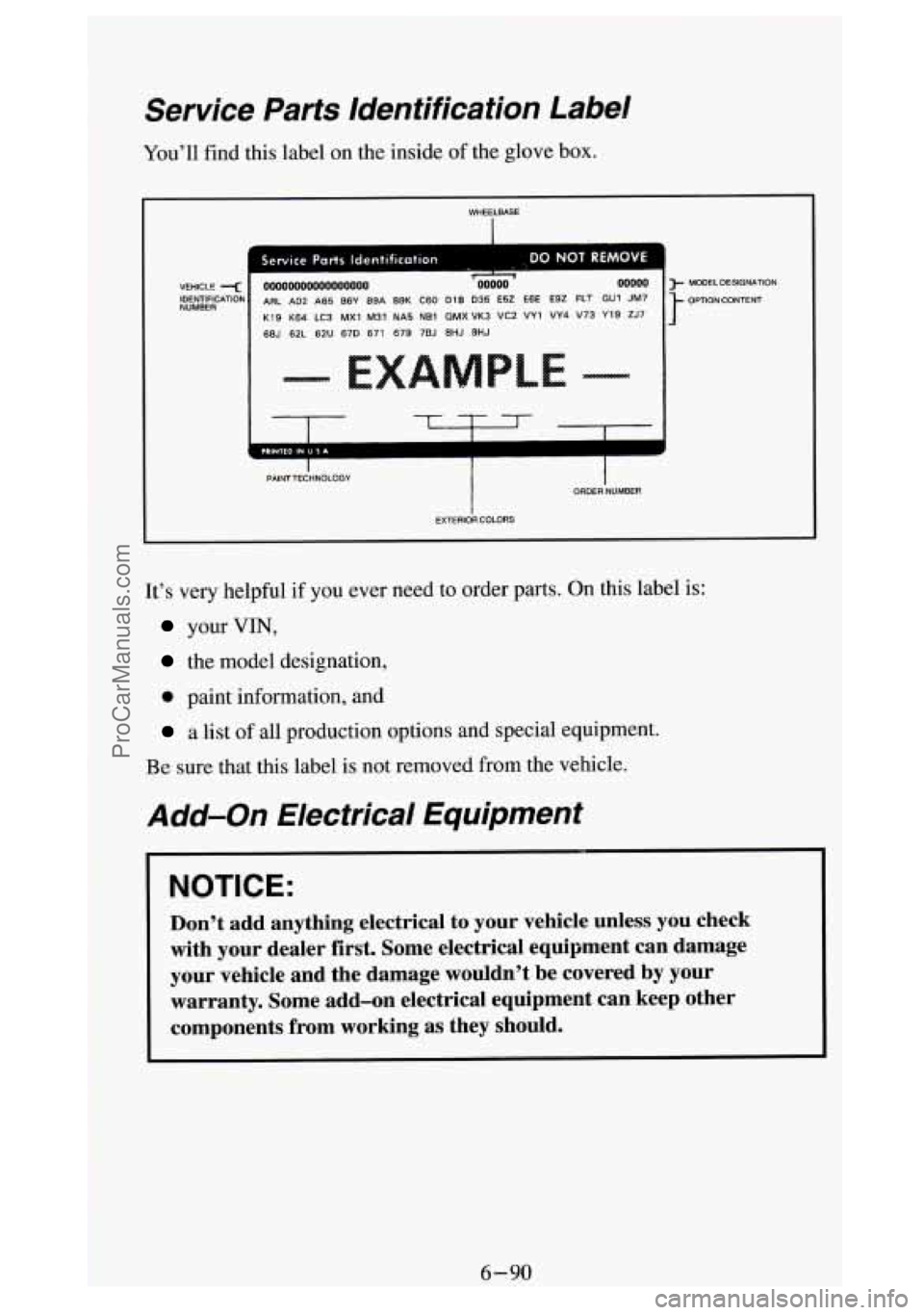
Service Parts 1dent;fkation Label
You’ll find this label on the inside of the glove box.
-
WHEELBASE
Service Ports identification . DO NOT REMOVE
VEHICLE < M)ooooMN)~ooooo %oooo OW00 J- MODELDESIGNATION
IDENTIFICATION
ARL ~02 ~65 ~6y B~A B9K C60 018 D35 E52 E6E E92 FLT GU1 JM7 NUMBER OPTIONCONTENT K19 K64 LC3 MX1 M31 NA5 NE1
QMXVK3 Vc2 VY1 VY4 V73 ‘f19
6BJ 62L 62U 67D 671 679 7BJ BHJ 9HJ
c PAINTTECHNOLOGY EXTERIOR COLORS ORDER NUMBER
It’s very helpful if you ever need to order parts. On this label is:
your VIN,
the model designation,
0 paint information, and
a list of all production options and special equipment.
Be sure that this label is not removed from the vehicle.
Add-on Electrical Equipment
NOTICE:
Don’t add anything electrical to your vehicle unless you che\
ck
with your dealer first. Some electrical equipment can damage
your vehicle and the damage wouldn’t be covered by your warranty. Some add-on electrical equipment can keep other
components from working as they should.
6-90
ProCarManuals.com
Page 342 of 404
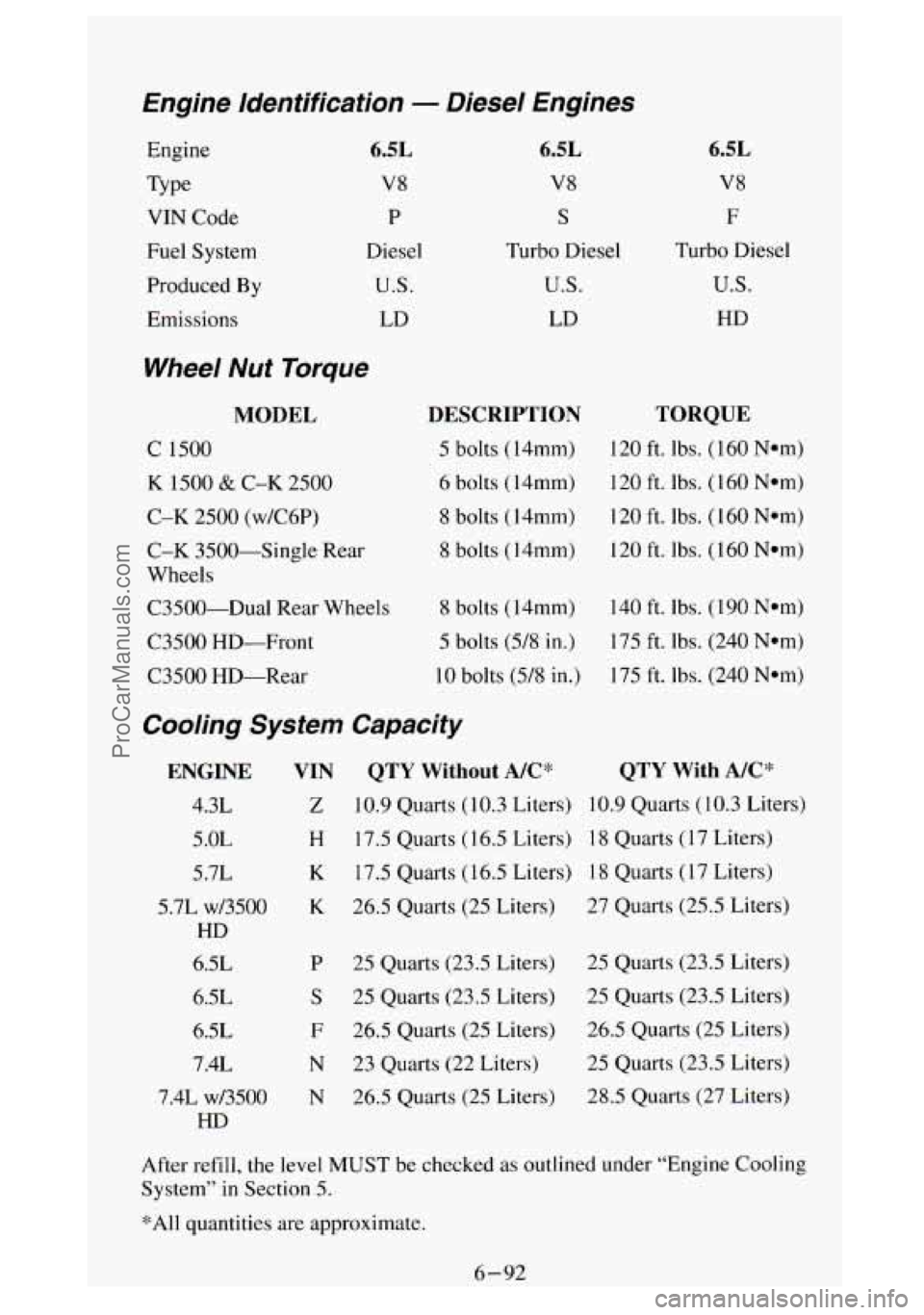
Engine ldenfificafion - Diesel Engines
Engine
Type VIN Code
Fuel System
Produced
By
Emissions
6.5L
V8
P
Diesel
U.S.
LD
Wheel Nut Torque
MODEL
C 1500
K 1500 & C-K 2500
C-K 2500 (w/C6P)
C-K 3500-Single Rear
Wheels
C3500-Dual Rear Wheels
C3500 HD-Front
C3500 HD-Rear
6.5L
V8
S
Turbo Diesel
us.
LD
DESCRIPTION
5 bolts (I41nm)
6 bolts (14mm)
8 bolts ( I4mm)
8 bolts (14mm)
8 bolts (14mm)
5 bolts (5/8 in.)
10 bolts (5/8 in.)
6.5L
V8
F
Turbo Diesel
U.S.
HD
TORQUE
120 ft. Ibs. (160 Nom)
120 ft. lbs. ( 160 Nom)
120 ft. lbs. (160 Nom)
120 ft. lbs.
(1 60 Nom)
140 ft. Ibs. (190 Nom)
175
ft. lbs. (240 Nom)
175
ft. Ibs. (240 Nom)
Cooling System Capacity
ENGINE
4.3L
VIN QTY Without A/C* QTY With AlC*
2 10.9 Quarts (10.3 Liters) 10.9 Quarts (10.3 Liters)
5 .OL H 17.5 Quarts (16.5 Liters) 18 Quarts (17 Liters)
5.7L
K 17.5 Quarts (16.5 Liters) 18 Quarts (17 Liters)
5.7L w/3500
K 26.5 Quarts (25 Liters) 27 Quarts (25.5 Liters)
HD
6.5L P 25 Quarts (23.5 Liters)
6.5L
S 25 Quarts (23.5 Liters)
6.5L
F 26.5 Quarts (25 Liters)
7.4L
N 23 Quarts (22 Liters)
7.4L
w/3500 N 26.5 Quarts (25 Liters)
HD
25 Quarts (23.5 Liters)
25 Quarts (23.5 Liters)
26.5 Quarts (25 Liters)
25 Quarts (23.5 Liters)
28.5 Quarts (27 Liters)
After refill, the level MUST be checked as outlined under “Engine Cooling
System”
in Section 5.
*All quantities are approximate.
6-92
ProCarManuals.com
Page 344 of 404
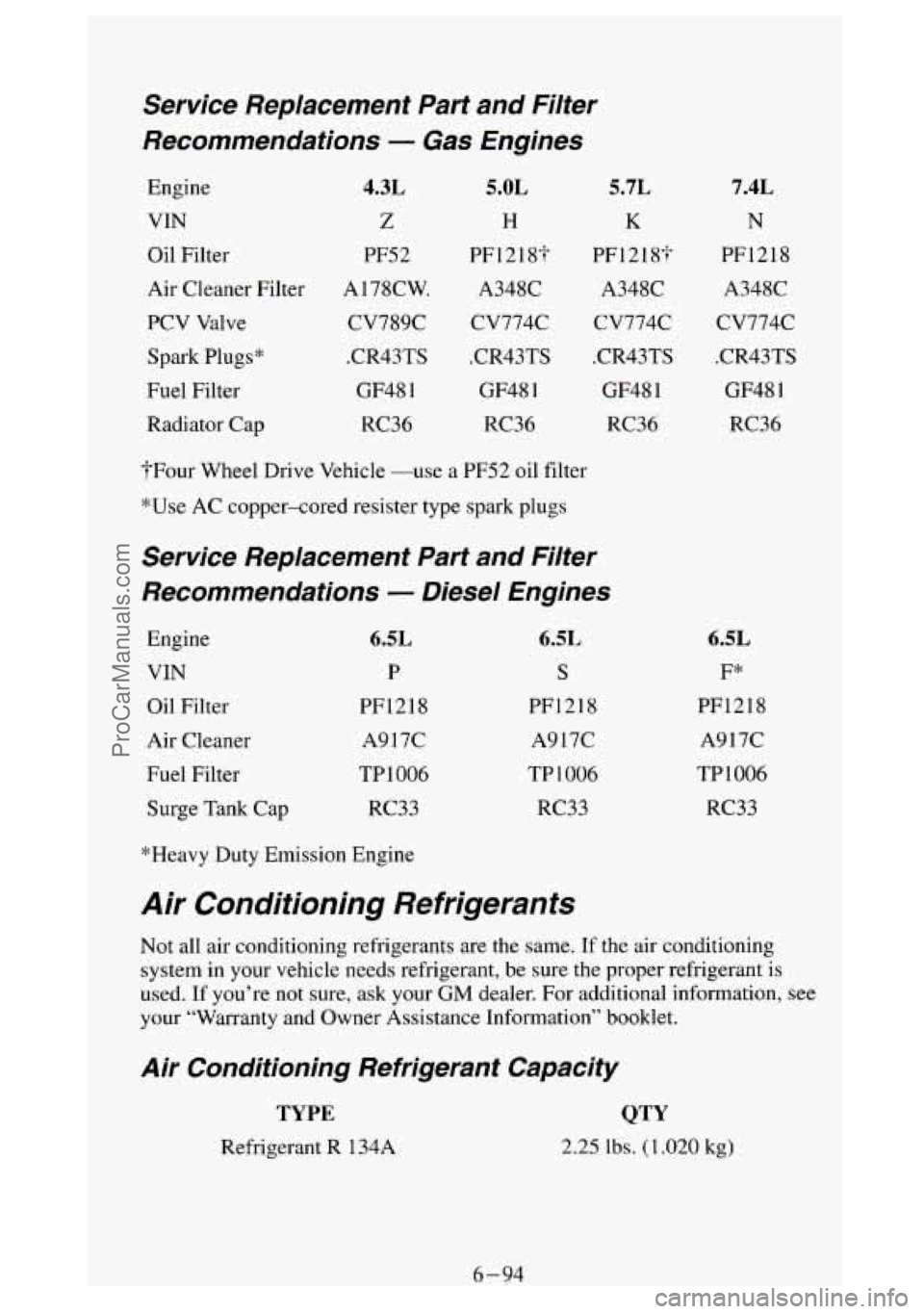
Service Replacement Part and Filter
Recommendations
- Gas Engines
Engine
VIN
Oil Filter
Air Cleaner Filter
PCV Valve
Spark Plugs*
Fuel Filter Radiator Cap
4.3L
z
PF52
A178CW. CV789C
.CR43TS
GF48
1
RC36
5.OL
H
PF1218T A348C
cv774c
.CR43TS GF48
1
RC36
5.7L
K
PF1218t A348C
cv774c
.CR43TS GF48 1
RC36
“four Wheel Drive Vehicle -use a PF52 oil filter
*Use AC copper-cored resister type spark plugs
Service Replacement Part and Filter
Recommendations
- Diesel Engines
Engine
VIN
Oil Filter
Air Cleaner
Fuel Filter Surge Tank Cap 6.5L
P
PF1218
A9 17C
TP 1006
RC33
6.5L
S
PF1218 A917C
TP 1006
RC33
7.4L
N
PF1218 A348C
cv774c
.CR43TS GF48
1
RC36
6.5L
F*
PF1218 A917C
TP 1006
RC33
“Heavy Duty Emission Engine
Air Conditioning Refrigerants
Not all air conditioning refrigerants are the same. If the air conditioning
system in your vehicle needs refrigerant, be sure the proper refrigerant is
used.
If you’re not sure, ask your GM dealer. For additional information, see
your “Warranty and Owner Assistance Information” booklet.
Air Conditioning Refrigerant Capacity
TYPE
Refrigerant R 134A
QTY
2.25 lbs. (1.020 kg)
6-94
ProCarManuals.com
Page 346 of 404
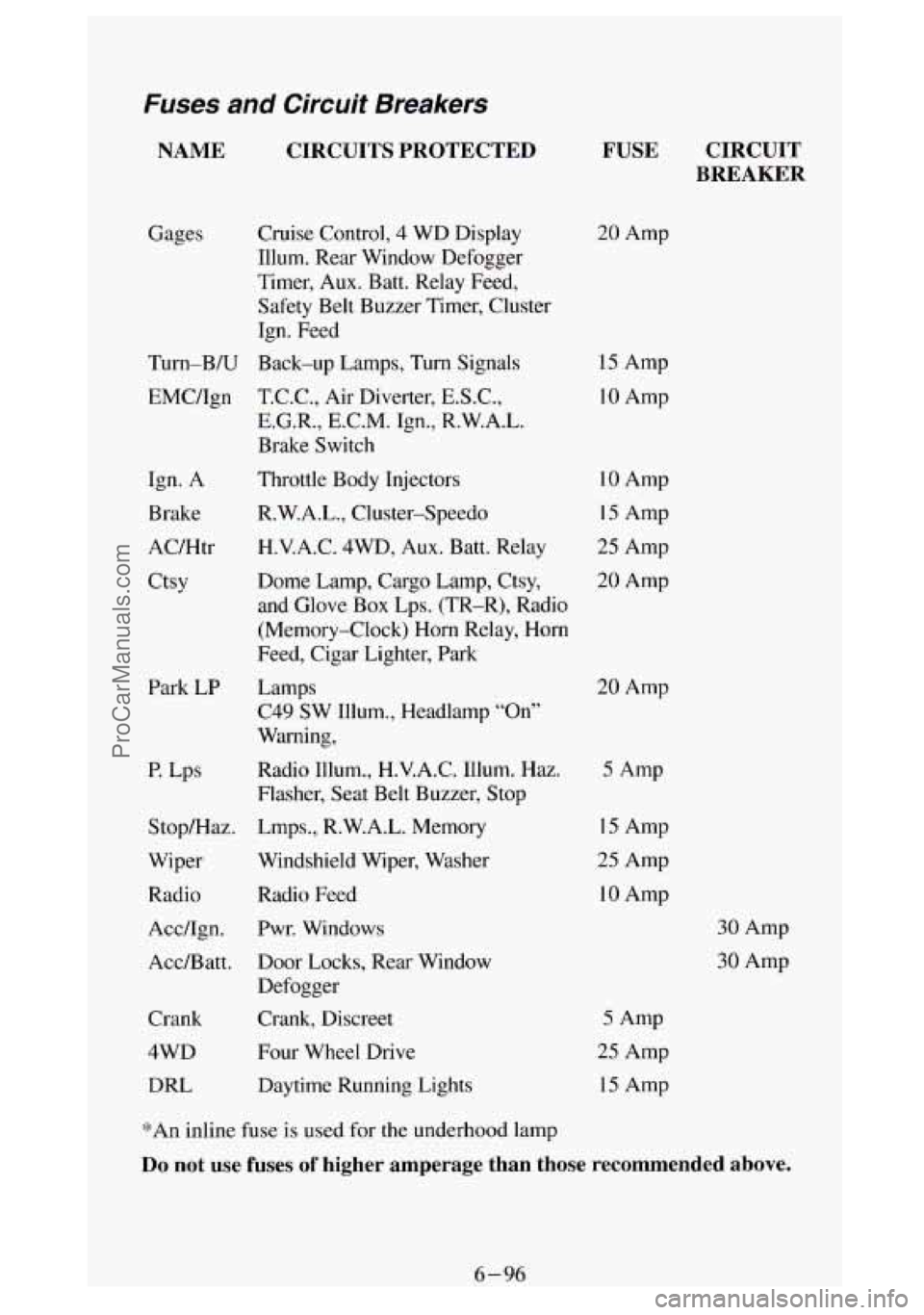
Fuses and Circuit Breakers
NAME CIRCUITS PROTECTED
Gages
Turn-B/U EMC/Ign
Ign. A
Brake
AC/Htr
Ctsy
Park LP
P. Lps
Stop/Haz.
Wiper
Radio
Acc/Ign.
Acc/Batt.
Crank
4WD
DRL
Cruise Control, 4 WD Display
Illum. Rear Window Defogger
Timer, Aux. Batt. Relay Feed,
Safety Belt Buzzer Timer, Cluster
Ign. Feed
Back-up Lamps,
Turn Signals
T.C.C., Air Diverter,
E.S.C.,
E.G.R., E.C.M. Ign., R.W.A.L.
Brake Switch
Throttle Body Injectors
R.W.A.L., Cluster-Speedo
H.V.A.C.
4WD, Aux. Batt. Relay
Dome Lamp, Cargo Lamp, Ctsy,
and Glove Box Lps. (TR-R), Radio
(Memory-Clock) Horn Relay, Horn
Feed, Cigar Lighter, Park
Lamps C49 SW Illum., Headlamp “On”
Warning,
Radio Illum., H.V.A.C. Illum. Haz.
Flasher, Seat Belt Buzzer, Stop
Lmps., R.W.A.L. Memory
Windshield Wiper, Washer
Radio Feed
Pwr. Windows
Door Locks, Rear Window
Defogger
Crank, Discreet
Four Wheel Drive
Daytime Running Lights
FUSE CIRCUIT
BREAKER
20 Amp
15 Amp
10 Amp
10 Amp
15 Amp
25 Amp
20 Amp
20 Amp
5 Amp
15 Amp
25 Amp
10 Amp
30 Amp
30 Amp
5 Amp
25 Amp
15 Amp
*An inline fuse is used
for the underhood lamp
Do not use fuses of higher amperage than those recommended above.
6-96
ProCarManuals.com
Page 348 of 404
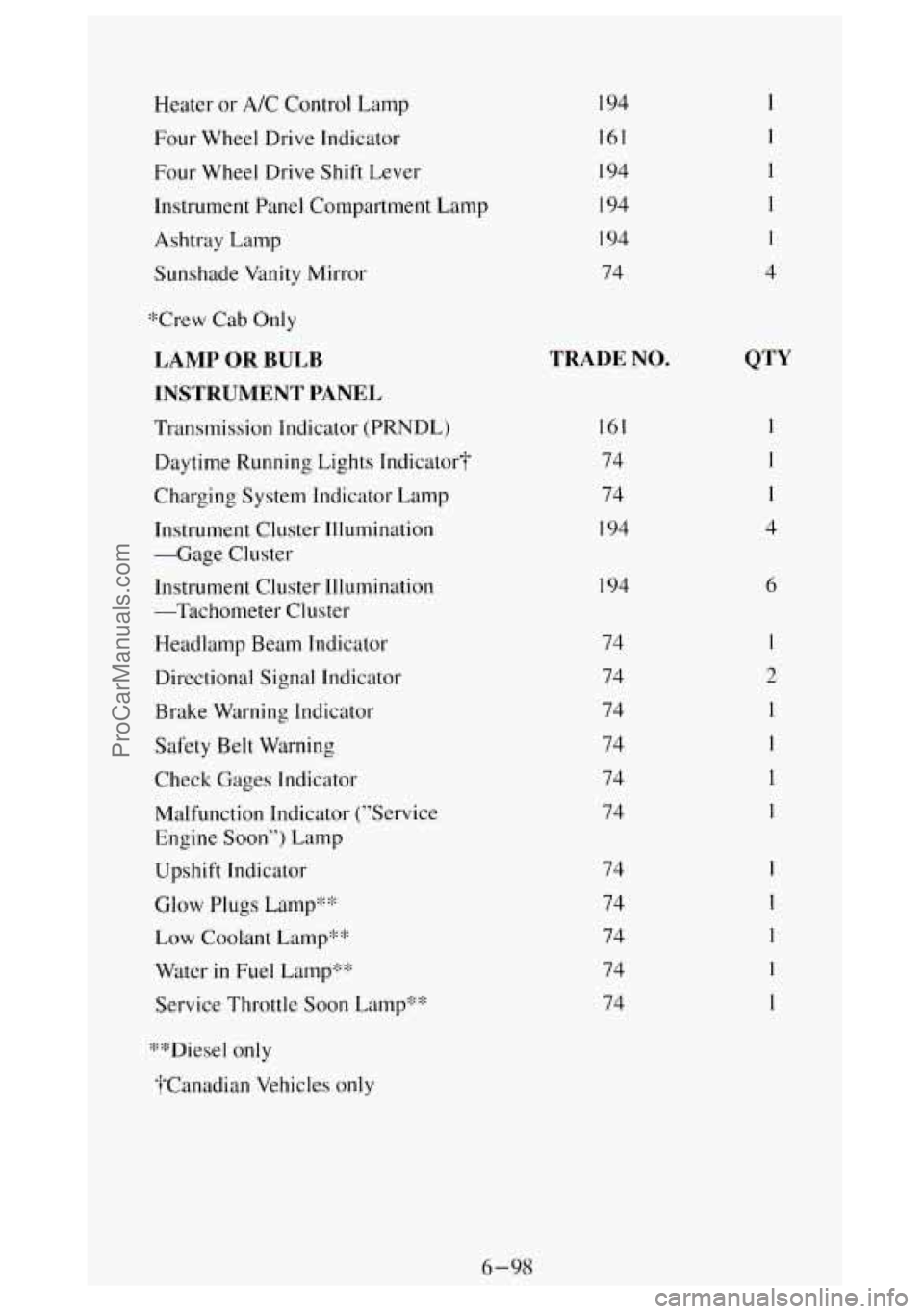
Heater or A/C Control Lamp
Four Wheel Drive Indicator
rour Wheel Drive Shift Lever
Instrument Panel Compartment Lamp
Ashtray Lamp
Sunshade Vanity Mirror
"Crew Cab Only
LAMP OR BULB
INSTRUMENT PANEL
Transmission Indicator (PRNDL)
Daytime Running Lights Indicatory
Charging System Indicator Lamp
Instrument Cluster Illumination
--Gage Cluster
Instrument Cluster Illumination
-Tachometer Cluster
Headlamp Beam Indicator
Directional Signal Indicator
Brake Warning Indicator
Safety Belt Warning
Check Gages Indicator
Malfunction Indicator ("Service
Engine Soon") Lamp
Upshift Indicator
Glow Plugs Lamp*:$:
Low Coolant
Water
in Fuel Lamp*'$
Service Throttle Soon Lamp*"
194
161
194
194
I94 74
TRADE NO.
161
74
74
I94
I94 74 74
74
74 74
74
74
74
74
74
74
6
6-98
ProCarManuals.com