wheel GMC SIERRA 1994 Repair Manual
[x] Cancel search | Manufacturer: GMC, Model Year: 1994, Model line: SIERRA, Model: GMC SIERRA 1994Pages: 404, PDF Size: 20.91 MB
Page 249 of 404

NOTICE:
~ ~ ~~ ~~
Spinning your wheels can destroy parts of your vehicle as well\
as
the tires. If you spin the wheels too fast while shifting your back
and forth, you can destroy your
.
Rocking your vehicle to get it out:
First, turn your steering wheel left and right. That will clear the area around
your front wheels. Then shift back and forth between
“R’ (Reverse) and a
forward gear (or with a manual
, between First or Second gear and Reverse),
spinning the wheels as little as possible. Release the accelerator pedal while
you shift, and press lightly on the accelerator pedal when the\
is in gear. If
that doesn’t get you out after a few tries, you may need to be towed out. Or,
you can use your recovery hooks,
if your vehicle has them. If you do need
to be towed out, see “Towing Your Vehicle” in the Index.
Using the Recovery Hooks
If you ever get stuck in sand, mud, ice or snow, your vehicle may be
equipped with recovery hooks. The recovery hooks are provided at the front
of your vehicle. You may need to use them
if you’re stuck off-road and
need to be pulled to some place where you can continue drivin\
g.
5-41
ProCarManuals.com
Page 252 of 404
Checking Things Under the Hood (continued)
Windshield Washer Fluid
................................. 6-45
Brake Master Cylinder
................................... 6-46
Replacing Brake System Parts
................................ 6-49
Other Maintenance Items
.................................... 6-49
Windshield Wiper Blade Inserts
.............................. 6-50
FluidLeakCheck
.......................................... 6-51
Lubrication
............................................... 6-51
Battery .................................................. 6-52
Vehiclestorage
......................................... 6-52
Bulb Replacement
......................................... 6-53
Fuses and Circuit Breakers
.................................. 6-62
Exhaustsystem
........................................... 6-64
Loading Your Vehicle
...................................... 6-64
Tires .................................................... 6-71
Inflation-Tire Pressure
.................................. 6-71
Tire Inspection and Rotation
............................... 6-73
When it’s Time for New Tires
............................. 6-74
Buying New Tires
....................................... 6-76
Uniform Tire Quality Grading
............................. 6-77
Wheel Alignment and Tire Balance
......................... 6-78
Wheel Replacement
..................................... 6-78
Tire Chains
............................................ 6-79
Appearancecare
.......................................... 6-80
Cleaning the Inside of Your Vehicle
......................... 6-81
Cleaning the Outside
of Your Vehicle ....................... 6-84
Appearance Care Materials
.................................. 6-87
Vehicle Identification Number
................................ 6-88
Service Parts Identification
Label ............................. 6-90
Specifications Charts
..................................... 6-91
6-2
ProCarManuals.com
Page 286 of 404
How to Check Lubricant
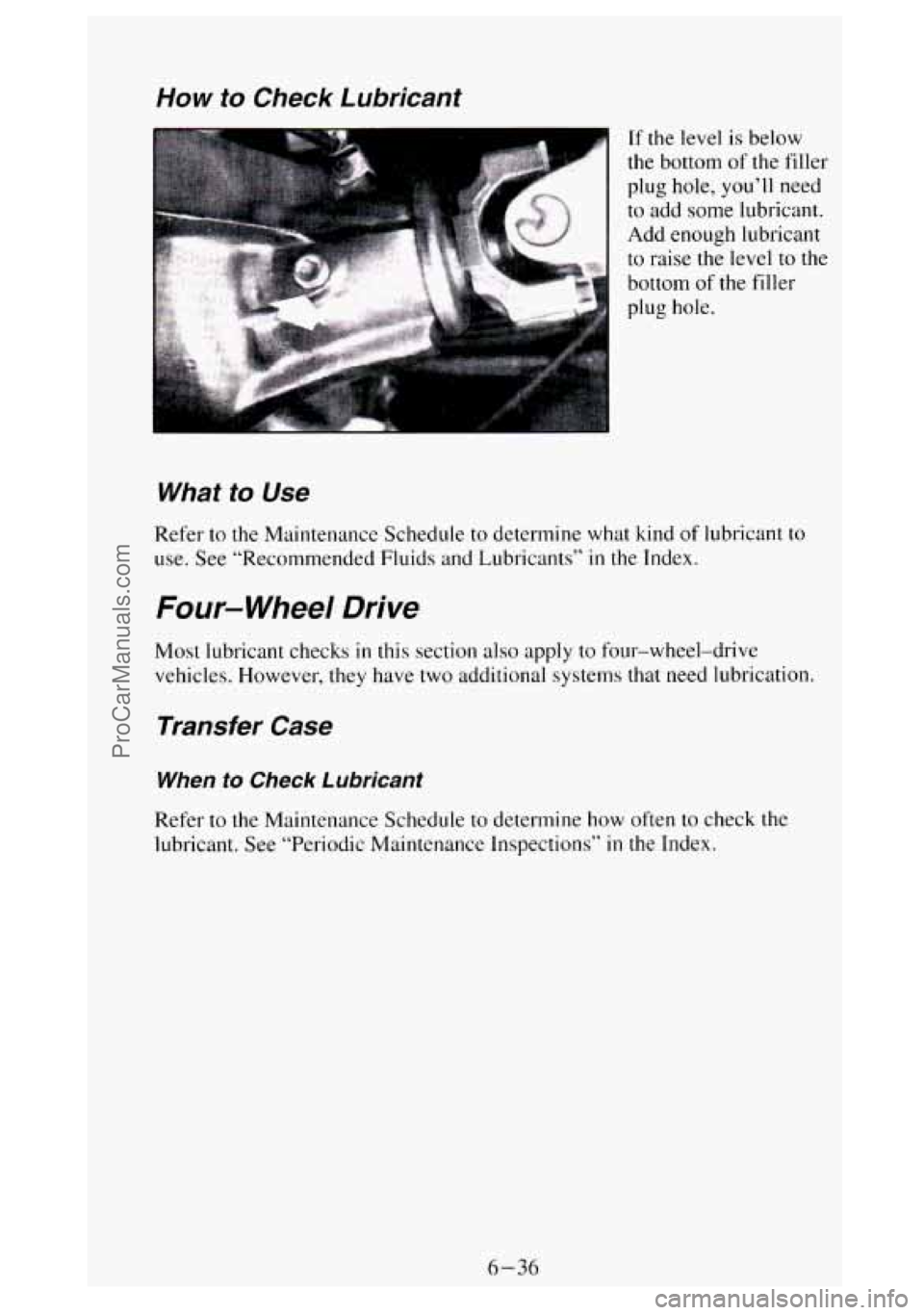
If the level is below
the bottom
of the filler
plug hole, you’ll need
to add some lubricant.
Add enough lubricant
to raise the level
to the
bottom of the filler
plug hole.
What to Use
Refer to the Maintenance Schedule to determine what kind of lubricant to
use. See “Recommended Fluids and Lubricants” in the Index.
Four- Wheel Drive
Most lubricant checks in this section also apply to four-wheel-drive
vehicles. However, they have two additional systems that need lubrication.
Transfer Case
When to Check Lubricant
Refer to the Maintenance Schedule to determine how often to check the
lubricant. See “Periodic Maintenance Inspections”
in the Index.
6-36
ProCarManuals.com
Page 298 of 404
Brake Wear
Your vehicle has front disc brakes and rear drum brakes. If you have a
C 3500 HD model, it has four-wheel disc brakes.
Disc brake pads have built-in wear indicators that make
a high-pitched
warning sound when the brake pads are worn and new pads are needed. The
sound may come and go or be heard
all the time your vehicle is moving
(except when you are pushing on the brake pedal firmly).
The brake wear warning sound means that sooner or later your
brakes won’t work well. That could lead to an accident.
When
you hear the brake wear warning sound, have your vehicle
serviced.
NOTICE:
Continuing to drive with worn-out brake pads could result in
costly brake repair.
Some driving conditions or climates may cause a brake squeal when the
brakes are first applied or lightly applied. This does not mean something is
wrong with your brakes.
If
you have rear drum brakes, they don’t have wear indicators, but if you
ever hear a rear brake rubbing noise, have
the rear brake linings inspected.
Also, the rear brake drums should be removed and inspected each time the
tires are removed for rotation or changing. When you have
the front brakes
replaced, have the rear brakes inspected, too.
Brake linings should always be replaced
as complete axle sets.
Brake Pedal Travel
See your dealer if the brake pedal does not return to normal height, or if
there is a rapid increase in pedal travel. This could be a sign of brake
trouble.
6-48
ProCarManuals.com
Page 299 of 404
Brake Adjustment
Every time you make a brake stop, your disc brakes adjust for wear.
If your brake pedal goes down farther than normal, your rear drum brakes
may need adjustment. Adjust them by backing up and firmly applying
the
brakes a few times.
Replacing Brake System Parts
The braking system on a modern vehicle is complex. Its many parts have to
be of top quality and work well together if the vehicle is to have really good
braking. Vehicles we design and test have top-quality
GM brake parts in
them, as your vehicle does when it is new. When you replace parts of your
braking system
- for example, when your brake linings wear down and
you have to have new ones put
in - be sure you get new genuine GM
replacement parts. If you don’t, your brakes may no longer work properly.
For example,
if someone puts in brake linings that are wrong for your
vehicle, the balance between your front and rear brakes can change, for
the
worse. The braking performance you’ve come to expect can change in many
other ways if someone puts in the wrong replacement brake parts.
Other Maintenance Hems
Front Suspension and Steering Linkage
Your maintenance schedule will tell you how often to lubricate the fittings.
See “Recommended Fluids and Lubricants”
in the Index for the proper
lubricant to use.
Front Wheel Bearings
Your vehicle has front wheel bearings that must be cleaned and repacked.
Your maintenance schedule
will tell you how often this must be done.
Front Shock Absorbers
The front shock absorbers of your vehicle do many things. They help the
vehicle ride smoothly and also control
the travel of the suspension system.
When the shock absorbers are serviced, any replacement shock absorbers
must be
the same as the original equipment shock absorbers in both
extended length and strength.
NOTICE:
If you use shock absorbers that are not the same as the original
shock absorbers, the shock absorbers
or suspension system
could be damaged.
6-49
ProCarManuals.com
Page 300 of 404
Wheel Nut Torque
For vehicle with dual wheels, wnen the vehicle, wheel or Tasteners are new,
have the torque set at
the first 100, 1,000 and 6,000 miles (1 60, 1600 and
9600 km). Use the torque specified
in the appropriate Specification Chart
later
in this section.
Single Belt Accessory Drive
If your new vehicle uses a serpentine belt, it is lighter and more durable than
systems with several belts.
The belt runs over or around the pulleys on the engine.
A tensioner may be
used
to keep the belt tight at all times. The tensioner also makes replacing
the belt easier.
If you need to replace the belt, be sure to get the correct
replacement belt. Your dealership or parts supplier can help you with this.
The Accessory Drive belt Routing label on your vehicle will show
you how
to route
the belt your vehicle uses.
Windshield Wiper Blade Inserts
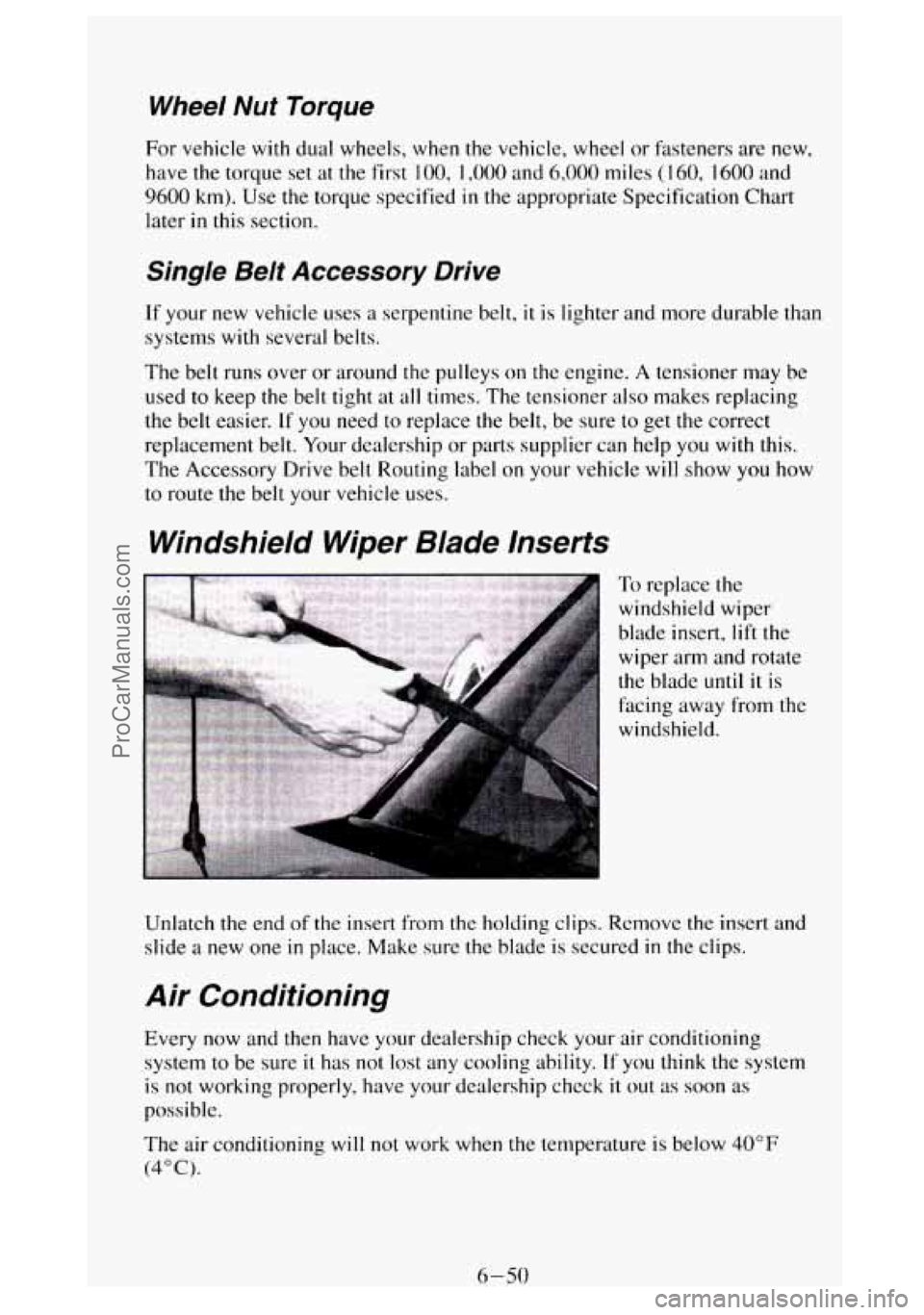
To replace the
windshield wiper
blade insert, lift the
wiper arm and rotate
the blade until
it is
facing away from the
windshield.
Unlatch
the end of the insert from the holding clips. Remove the insert and
slide a new
one in place. Make sure the blade is secured in the clips.
Air Conditioning
Every now and then have your dealership check your air conditioning
system
to be sure it has not lost any cooling ability. If you think the system
is not working properly, have your dealership check it out as soon as
possible.
The air conditioning
will not work when the temperature is below 40°F
(4°C).
6-50
ProCarManuals.com
Page 308 of 404
Fender Marker Lights-
Dual Rear Wheel Pickup Models
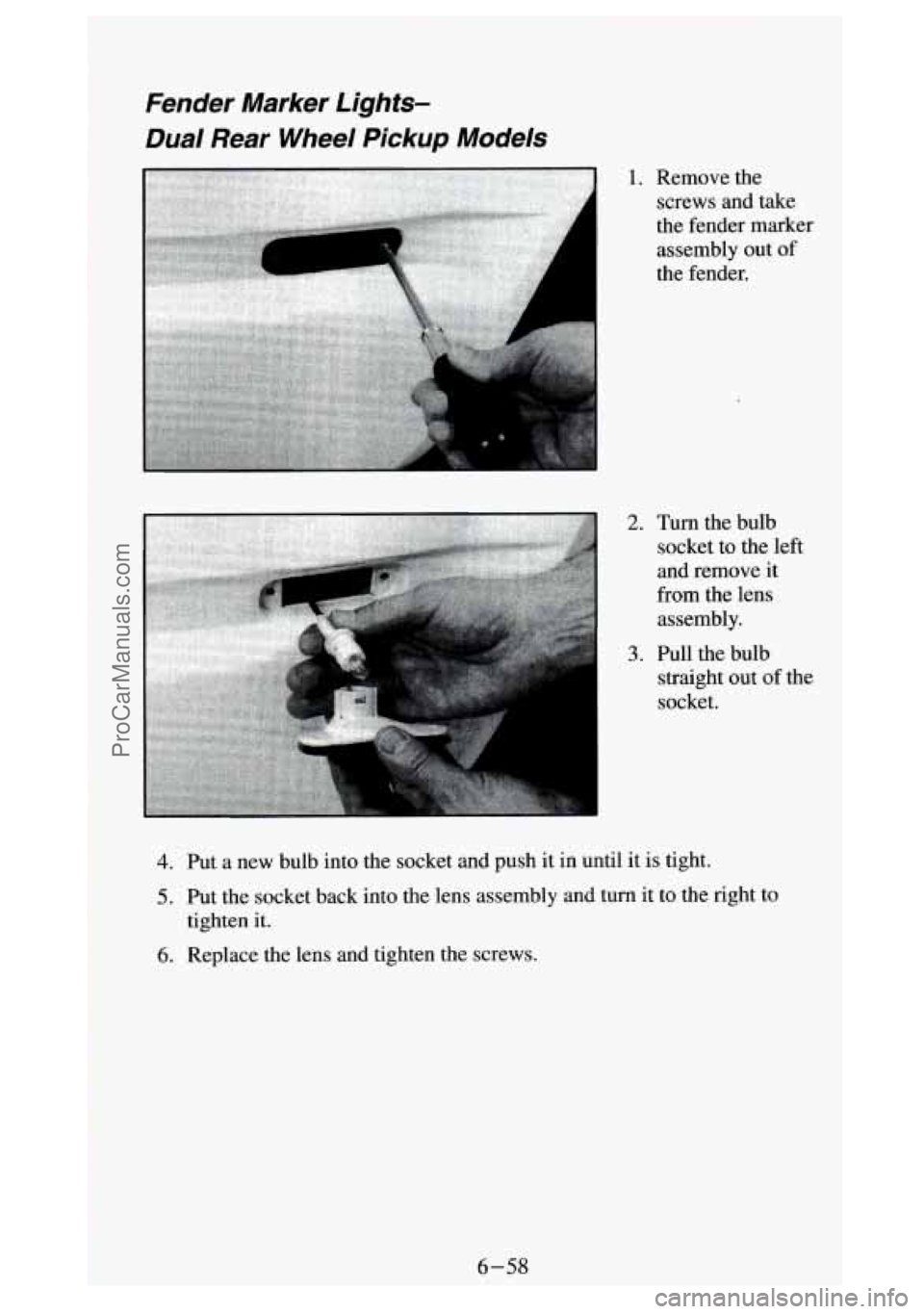
1.
2.
3.
Remove the screws and take
the fender marker
assembly out
of
the fender.
Turn the bulb
socket to the left
and remove it
from the lens assembly.
Pull the bulb straight out of the
socket.
4. Put a new bulb into the socket and push it in until it is tight.
5. Put the socket back into the lens assembly and turn it to th\
e right to
tighten it.
6. Replace the lens and tighten the screws.
ProCarManuals.com
Page 320 of 404
After you’ve loaded your vehicle and camper, drive to a weigh station and
weigh
on the front and rear wheels separately. This will tell you the loads on
your axles. The loads
on the front and rear axles shouldn’t be more than
either of the GAWRs. The total
of the axle loads should not be more than
the GVWR.
Open your driver’s door and look at
the CertificatiodTire label to find out
your CWAR and GVWR.
If
you’ve gone over your weight ratings, move or take out some things until
all the weights fall below the ratings. Of course, you should always tie down
any loose items when you load your vehicle or camper.
When you install and load your slide-in camper, check the manufacturer’s
instructions.
If
you want more information on curb weights, cargo weights, cargo weight
rating and the correct center of gravity zone for your vehicle, your dealer
can help
you. Just ask for a copy of “Consumer Information, Truck-Camper
Loading.”
Trailer Recommendations
You must subtract your hitch loads from the CWR for your vehicle. Weigh
your vehicle with
the trailer hitch attached, so that you won’t go over the
GVWR or the GAWR.
You’ll get the best performance if you spread out the weight of your load
the right way, and if‘ you choose the correct hitch and trailer brakes.
For more information, see “Trailer Towing’’
in the Index.
Pickup Conversion To Chassis Cab
General Motors is aware that some vehicle owners may consider having the
pickup box removed and
a commercial or recreational body installed.
Before
you do so, first contact the GM Zone Office for your area for
information on such conversions. (See the “Warranty and Owner
Assistance” booklet for Zone Office.) Owners should be aware that, as
manufactured, there are differences between a chassis cab and a pickup with
the box removed which may affect vehicle safety. The components
necessary to adapt
the pickup to permit its safe use with a specialized body
should be installed by a body builder
in accordance with the information
available from
the Zone Office.
6-70
ProCarManuals.com
Page 324 of 404
If your vehicle has front tires with different load ratings or tread designs
(such
as all season vs. on/off road) than the rear tires, don’t rotate your tires
front
to rear.
After the tires have been rotated, adjust the front and rear inflation pressure
as shown on the CertificatiodTire label. Make certain that all wheel nuts are
properly tightened. See “Wheel
Nut Torque” in the Index.
A CAUTION:
Rust or dirt on a wheel, or on the parts to which it is fastened,
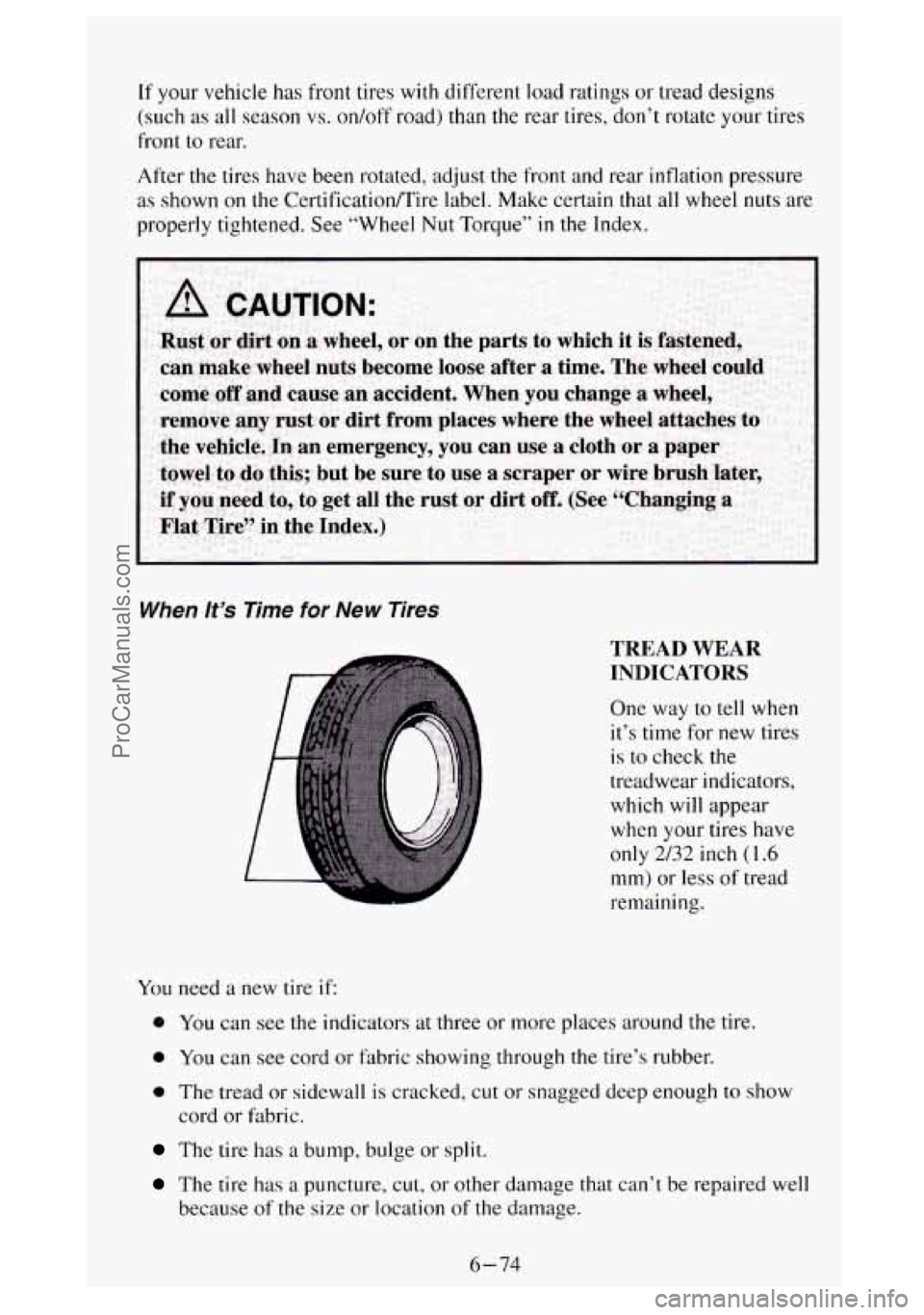
When It’s Time for New Tires
TREAD WEAR
INDICATORS
One way to tell when
it’s time for
new tires
is to check the
treadwear indicators,
which
will appear
when your tires have
only
2/32 inch (1.6
mm) or less of tread
remaining.
You need a
new tire if:
0 You can see the indicators at three or more places around the tire.
0 You can see cord or Fabric showing through the tire’s rubber.
0 The tread or sidewall is cracked, cut or snagged deep enough to show
cord or fabric.
The tire has a bump, bulge or split.
The tire has a puncture, cut, or other damage that can’t be repaired well
because
of the size or location of the damage.
6-74
ProCarManuals.com
Page 325 of 404
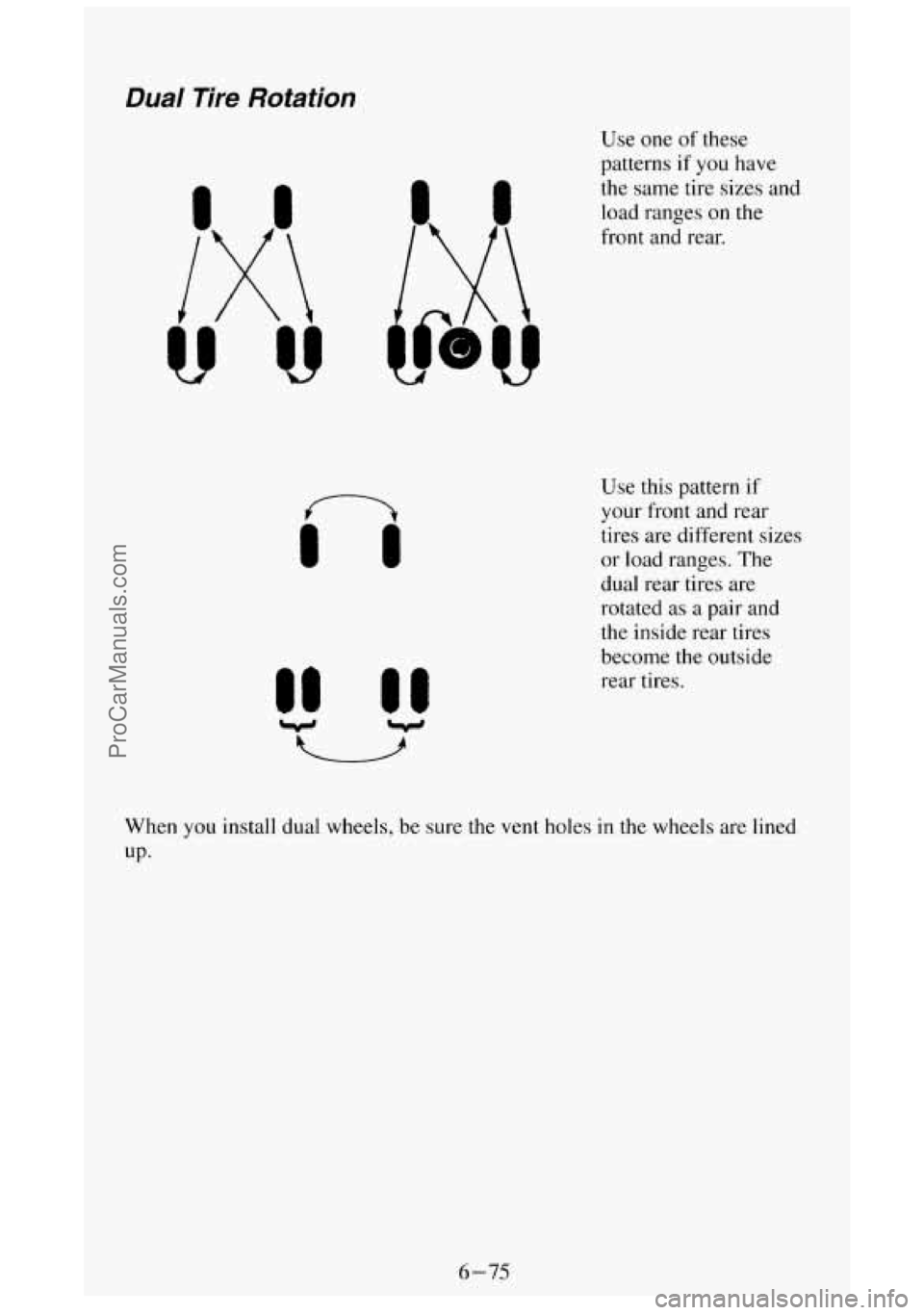
Dual Tire Rotation
n
Use one of these
patterns if you have
the same tire sizes and
load ranges on
the
front and rear.
Use
this pattern if
your front and rear
tires are different sizes
or load ranges. The
dual rear tires are
rotated
as a pair and
the inside rear tires
become the outside
rear tires.
When you install dual wheels, be sure
the vent holes in the wheels are lined
UP.
6-75
ProCarManuals.com